Our readers keep the lights on and my smoothie glass nicely filled. As an Amazon Associate, I earn from qualifying purchases.
A single scratch in your clear coat after a two-hour hand wash is a special kind of frustration—it makes you wonder if the towel you used was the real culprit. Detailing towels aren’t just cloths; they are the final contact point between your polish, wax, or drying mitt and the paint, and a poor weave can undo all your careful work in a instant.
I’m Mohammad Maruf — the founder and writer behind WellFizz. I’ve spent countless hours cross-referencing fabric weights, split-fiber ratios, and real-world wash tests from detailing forums to separate genuinely safe towels from marketing fluff.
This guide cuts through the confusion to help you identify the best detailing microfiber towels for every step of your regimen, from paint-safe buffing to streak-free glass finishing.
How To Choose The Best Detailing Microfiber Towels
Selecting a detailing towel is not about grabbing the cheapest bulk pack. The weave density, fiber blend, and edge type determine whether your paint stays flawless or gets swirled. Here are the three specifications that matter most.
GSM Weight Determines the Job
Grams per square meter (GSM) tells you how plush and absorbent a towel is. Lightweight towels (200–300 GSM) are ideal for glass and interior dusting where you want zero lint. Mid-weight towels (350–450 GSM) work for drying, wax removal, and final buffing because they hold more liquid without dripping. Heavy towels (500–700 GSM) are for high-volume water absorption during drying, but they can be too thick for applying thin layers of sealant.
Fiber Blend: 70/30 vs. 80/20
A 70/30 blend (70% polyester, 30% polyamide) is the gold standard for paint-safe detailing. The higher polyamide content creates finer split fibers that trap dirt particles deep within the weave rather than dragging them across the clear coat. An 80/20 blend is adequate for household cleaning or glass work but feels less plush and can be less effective at encapsulating fine dust.
Edge Construction Prevents Swirls
Stitched edges create a hard ridge that can mar soft paint if you accidentally wipe with the corner. Edgeless towels—where the fabric is laser-cut or woven with a seamless loop—eliminate this risk entirely. For final buffing and wax removal, edgeless construction is strongly preferred. For glass or wheels, a satin-bound edge is acceptable as long as it is cut flush to the fabric.
Quick Comparison
On smaller screens, swipe sideways to see the full table.
| Model | Category | Best For | Key Spec | Amazon |
|---|---|---|---|---|
| The Rag Company Eagle Edgeless 450 | Premium | Paint-safe buffing and wax removal | 450 GSM, 70/30 Korean blend | Amazon |
| The Rag Company Premium Glass Towel | Premium | Streak-free glass, mirror, and chrome | 350 GSM, dual-texture corduroy | Amazon |
| SINLAND 380 GSM Drying Towels | Mid-Range | High-absorption drying without water spots | 380 GSM, 24×16 inch, 6-pack | Amazon |
| POLYTE Professional 350 GSM | Mid-Range | General detailing and multi-surface use | 350 GSM, tagless rounded corners | Amazon |
| Amazon Basics 48-Pack | Budget | Bulk household cleaning and interior wipe-downs | 16×12 inch, 60/19/21 blend, 48-pack | Amazon |
In‑Depth Reviews
1. The Rag Company Eagle Edgeless 450 (6-Pack)

With over 600,000 fibers per square inch, the Eagle Edgeless 450 sets the benchmark for paint-safe microfiber. The 70/30 Korean split-fiber blend uses finer polyamide filaments that trap dirt deeper in the weave, preventing those tiny particles from dragging across your clear coat during final buffing. The edgeless laser-cut construction means there is no stitched ridge to catch on trim or leave a micro-mar.
This towel is optimized for wax and sealant removal, waterless washing, and light polishing. The 450 GSM weight delivers substantial plushness that soaks up excess compound without dripping, yet it is not so thick that you lose tactile feedback when applying thin layers of product. Users consistently report zero lint even on fresh black paint.
Owners note that the towel is too plush for glass work—dedicate a separate glass towel for windows. After several washes with a dedicated microfiber detergent, the fibers actually soften further without losing absorbency. The six-pack provides enough rotation for a full detail session without needing to re-use a soiled towel on paint.
Why it’s great
- Edgeless construction eliminates swirl risk from rough edges
- 450 GSM 70/30 Korean blend provides superior dirt encapsulation
- Gets softer with each wash while maintaining absorbency
Good to know
- Not recommended for glass—the plush nap leaves streaks
- Premium price point reflects the Korean-sourced fiber quality
2. The Rag Company Premium Window & Glass Detailing Towel (5-Pack)

The dual-texture design sets this towel apart from any other glass cloth on the market. One side features a corduroy-like ribbed surface that mechanically grabs dried-on bug residue and stubborn water spots, while the opposite side is a silky smooth finish that buffs away the last microfilm for a truly streak-free pane. This is a specialized tool, not a general-purpose rag.
At 350 GSM with a 70/30 Korean blend, the fabric weight is intentionally kept moderate. A heavier towel would retain too much cleaner and leave smears; this density strikes the exact balance for applying a mist of glass cleaner, wiping once, and flipping to dry before the solution evaporates into a haze. The precise weave ensures zero lint shedding even on sensitive automotive glass.
Professional detailers and home users alike confirm that these towels outperform paper towels dramatically. The key is washing them separately with a dedicated microfiber detergent—never fabric softener—to keep the split fibers open. Use the corduroy side for initial cleaning and the smooth side for the final wipe, and you will not see a single streak.
Why it’s great
- Dual-texture design tackles spots then buffs streak-free in one pass
- Korean AA-grade Hyosung split fiber ensures zero lint on glass
- Thoughtful 350 GSM weight avoids cleaner oversaturation
Good to know
- Not suited for paint work—the corduroy texture could induce micro-marring
- Five-pack is adequate for detailing but not for whole-house windows
3. SINLAND Microfiber Car Drying Towels 380 GSM (6-Pack)
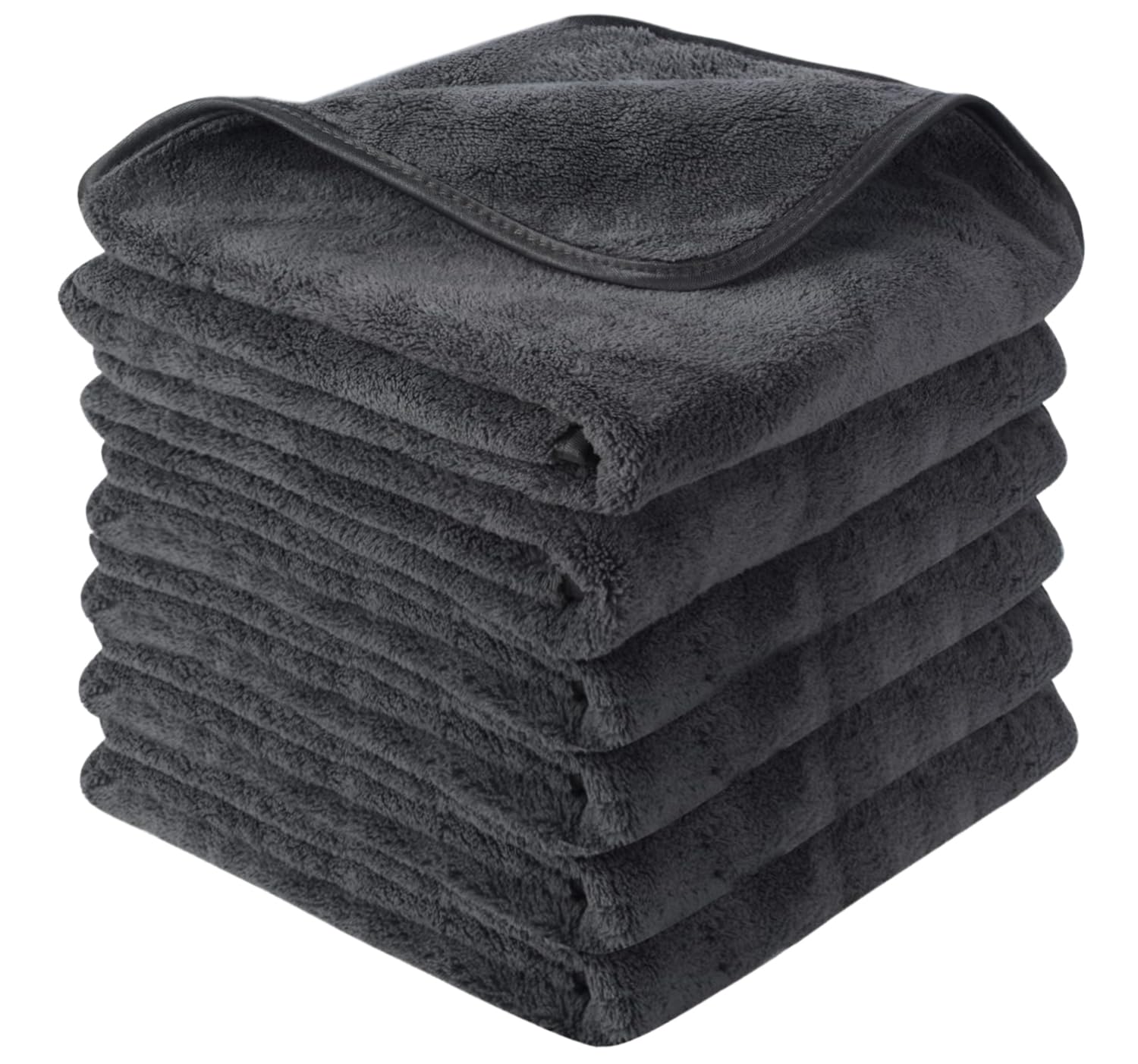
The SINLAND 380 GSM towels solve the single biggest drying frustration: water spots. Because they are large at 24 by 16 inches and plush with a 380 GSM density, two towels are enough to dry a full-size Jeep Cherokee without wringing out. The 80/20 polyester-nylon blend uses a plush weave that wicks moisture into the fabric core rather than pushing it across the paint.
Reinforced edging with good stitching prevents fraying after repeated machine washes, and the towels dry quickly themselves—critical when you are working through multiple vehicles or a single large SUV. Users testing these on soft paint report no scratching or smearing, and the towel leaves behind a spotless finish that does not require a secondary drying aid.
The six-pack quantity is generous for the price category. Dedicate two towels for the initial drying pass, two for a secondary touch-dry, and keep two in reserve for door jambs and trunk edges. Owners note that the synthetic blend loses a small amount of plushness over many washes, but the absorbency remains consistent for dozens of cycles.
Why it’s great
- Large 24×16 inch size allows fast coverage on trucks and SUVs
- 380 GSM plush weave absorbs water without streaking
- Reinforced edges hold up well to repeated machine washing
Good to know
- 80/20 blend is less plush than 70/30 Korean towels
- May leave light lint on fresh ceramic coatings if not washed first
4. POLYTE Microfiber Cleaning Towel 350 GSM (12-Pack)

The POLYTE professional towels strike an intentional balance: 350 GSM is dense enough for interior wipe-downs and light drying but not so thick that it interferes with detail spray application. The tagless construction with rounded corners prevents fraying from the start, and the lack of a sewn label means there is nothing abrasive to scratch delicate dashboard plastics.
Two sides of equal weave consistency make these towels reversible for maximum usage per wash. Users switching from cheaper supermarket packs immediately notice the difference in thickness—these do not collapse into a limp rag the moment they get damp. They hold eight times their weight in water but dry roughly twice as fast as standard cotton blends, reducing the risk of mildew odor between uses.
The twelve-pack in three colors enables a color-coded system: one color for paint, one for wheels and tires, and one for interior glass. This separation prevents cross-contamination of brake dust or silicone dressings onto your clear coat. Owners with light-colored vehicles appreciate the lack of dye bleed after the initial wash.
Why it’s great
- Tagless rounded corners prevent fraying and scratching on interior trim
- Twelve towels in three colors support task-separation workflows
- Dries fast to resist mildew and odor buildup
Good to know
- 350 GSM is suitable for general detailing but not heavy water absorption
- Some users report the towels are slightly thinner than expected at this GSM rating
5. Amazon Basics Microfiber Cleaning Cloths (48-Pack)

This is not a paint-safe detailing towel—but that is not its job. The Amazon Basics 48-pack uses a tri-blend of 60% bicomponent fiber and 40% polyester with a relatively low GSM that makes it excellent for engine bays, door jambs, wheels, and interior dusting where you want a disposable-feel cloth that you can toss after heavy grime. At this quantity, you can afford to dedicate a fresh towel to each dirty task.
The fabric feels noticeably thinner than a 350 GSM towel, and the weave is less tight. For wiping down glass or applying a quick detailer, you may see lint on the first few uses—washing them once before first use eliminates this shedding. The 16 by 12 inch size is narrower than purpose-built detailing towels, but the compact dimensions make them easy to wring out and manipulate in tight crevices.
Owners consistently validate the durability claim of “hundreds of reuses” provided you avoid fabric softener and high heat in the dryer. The color coding (blue, white, yellow) works well for separating zones: blue for wheels, white for interior, yellow for exterior glass. For beginners on a tight budget, this pack offers a low-risk entry point to learn proper towel care before investing in premium dedicated towels.
Why it’s great
- Exceptional value at 48 towels for high-volume or grime-heavy tasks
- Soft enough for interior wipe-downs and glass when pre-washed
- Color-coded options help beginners avoid cross-contamination
Good to know
- Low GSM and looser weave mean lint potential on first use
- Not recommended for paint correction, wax removal, or final buffing
FAQ
Can I use the same microfiber towel for paint and wheels?
Why does my microfiber towel leave lint even after washing?
Final Thoughts: The Verdict
For most users, the best detailing microfiber towels winner is the The Rag Company Eagle Edgeless 450 because the edgeless 70/30 Korean blend delivers paint-safe buffing with zero lint and a plushness that protects even soft black clear coats. If you want a dedicated glass towel that eliminates streaks, grab the Rag Company Premium Glass Towel. And for high-volume drying on a mid-range budget, nothing beats the SINLAND 380 GSM 6-Pack.

Mo Maruf
I created WellFizz to bridge the gap between vague wellness advice and actionable solutions. My mission is simple: to decode the research and give you practical tools you can actually use.
Beyond the data, I am a passionate traveler. I believe that stepping away from the screen to explore new environments is essential for mental clarity and physical vitality.