Our readers keep the lights on and my smoothie glass nicely filled. As an Amazon Associate, I earn from qualifying purchases.
Dragging a manual solder sucker across a tired circuit board is a recipe for lifted pads, frustrated fingers, and a pile of ruined components. A proper desoldering gun changes the game by combining heat and vacuum into a single handpiece that clears through-hole joints in one smooth pull — no second hand needed for a separate iron.
I’m Mohammad Maruf — the founder and writer behind WellFizz. I’ve spent countless hours cross-referencing thermal specs, suction mechanisms, and real-world user experiences to separate the guns that actually work from the ones that choke on the first capacitor.
Whether you’re swapping thumbsticks on a controller or recapping vintage audio gear, choosing the right desoldering gun saves hours of frustration and protects expensive boards from heat damage.
How To Choose The Best Desoldering Gun
Not every desoldering gun delivers the same combination of heat delivery and vacuum draw. The wrong choice can leave you battling clogged nozzles and cold joints. Focus on these three factors to land a tool that matches the type and volume of work you actually do.
Heating Performance and Temperature Control
Listen for the heating element type — nichrome wire elements are cheaper but recover slowly, while ceramic heaters reach temperature faster and maintain stability under load. Look for adjustable temperature ranges, ideally with PID stabilization, to handle both delicate leaded solder and stubborn lead-free joints without overshooting.
Suction Mechanism and Clog Prevention
The pump design determines whether you clear solder in one pass or spend half the job clearing blockages. Models with a dedicated vacuum pump provide stronger and more consistent suction than solenoid-based designs. Replaceable filter tubes and included cleaning needles are non-negotiable for preventing nozzle clogging after every few joints.
Nozzle Selection and Ergonomics
Nozzle diameter directly affects how cleanly a joint clears. A 1.0mm nozzle handles most standard through-hole components, while 1.2mm or larger nozzles work better for ground planes and thick pads. Pay attention to handle balance and weight — a gun that feels front-heavy will fatigue your wrist during extended recapping sessions.
Quick Comparison
On smaller screens, swipe sideways to see the full table.
| Model | Category | Best For | Key Spec | Amazon |
|---|---|---|---|---|
| YIHUA 948 | Dedicated Station | Continuous through-hole desoldering | 80W / Vacuum pump / 716-896°F | Amazon |
| Hakko FR-301 | Portable Gun | Field repairs and bench work | 98W / Ceramic heater / 500°C max | Amazon |
| WEP 8786D-I SE | 2-in-1 Station | Mixed soldering and desoldering | Iron + hot air / PID / 392-896°F | Amazon |
| MYPOUOS 8588D | 2-in-1 Station | Phone and SMD rework | 750W / Dual LED / 100-480°C | Amazon |
| HighTop Automatic | Entry Gun | Hobbyist and occasional use | 30W / Nichrome / 400°C max | Amazon |
| Preciva 929D-V | Entry Gun | One-handed vacuum desoldering | 30W / Ceramic / 400°C max | Amazon |
| TXINLEI 858D | Hot Air Station | SMD rework with included pump | 700W / Hot air / 100-450°C | Amazon |
In-depth Reviews
1. YIHUA 948 Desoldering Station

The YIHUA 948 is a dedicated desoldering station built around an 80W heating element and a proper vacuum pump, not a solenoid. This combination delivers continuous suction that clears joints in a single pull — users report removing entire rows of capacitors from a receiver board without stopping to clear the nozzle. The temperature range spans 716°F to 896°F with a °C/°F toggle, and the station includes an auto shutoff and sleep function to protect the heating element during downtime.
The kit comes loaded with four additional nozzles, two ceramic filters, a set of cleaning pins, and ten filtration adsorbers — everything you need to keep the pump path clean. Users who have recapped six or more receivers without issues attribute the reliability to consistent filter maintenance rather than luck. The replaceable filter tube design lets you swap out the spring and ceramic filter in seconds when suction drops.
The heat-up time is slower than premium units, taking a few minutes before the pump activates, but once at temperature the gun stays stable. Some hobbyists note that the pump gradually weakens over extended sessions if the filter isn’t cleaned after every use, but the disposable filter components make this a minor habit rather than a design flaw. For anyone doing regular through-hole desoldering, this station delivers professional-grade results at a mid-range investment.
Why it’s great
- Continuous vacuum pump clears multiple joints without resetting
- Includes full accessory kit with spare filters and nozzles
- Sleep function and auto shutoff extend element life
Good to know
- Slow warm-up before pump becomes active
- Requires filter cleaning after each use to maintain suction
2. Hakko FR-301 Portable Desoldering Tool

The Hakko FR-301 is a self-contained portable desoldering gun that packs 98 watts of ceramic heating into a pencil-style handpiece. It reaches temperatures up to 500°C, making it capable of melting lead-free solder quickly without needing a separate station. The integrated pump provides strong and consistent suction, and users consistently report that it speeds up desoldering dramatically — one reviewer described previously frustrating through-hole tasks becoming almost enjoyable.
A critical note for buyers: many listings on Amazon ship the Japanese 100V version. Running this unit on a standard 120V outlet without a Variac or step-down transformer can cause the pump to overspeed and potentially fail. Experienced users confirm the heating element is safe at 120V, but the pump requires voltage modification or an external inverter. The unit weighs roughly 2 pounds, which some users find fatiguing for extended bench sessions, though the portable format is excellent for field repairs.
The included 1.0mm nozzle works for most joints, but many users recommend stepping down to a 0.8mm nozzle for finer work. Nozzle cleaning is required frequently to maintain suction — the gun’s performance depends entirely on keeping the solder path clear. Replacement parts are affordable and widely available. Despite the voltage caveat, the FR-301 is the benchmark that other portable guns are measured against, delivering heat transfer and suction that cheaper units cannot match.
Why it’s great
- 98W ceramic heater handles lead-free solder with ease
- Self-contained portable design for field work
- Strong continuous suction clears pads cleanly
Good to know
- Japanese 100V version requires voltage modification for US outlets
- Weighs ~2 pounds — can fatigue hand during long sessions
- Frequent nozzle cleaning needed to maintain performance
3. WEP 8786D-I SE Hot Air Soldering Iron Station
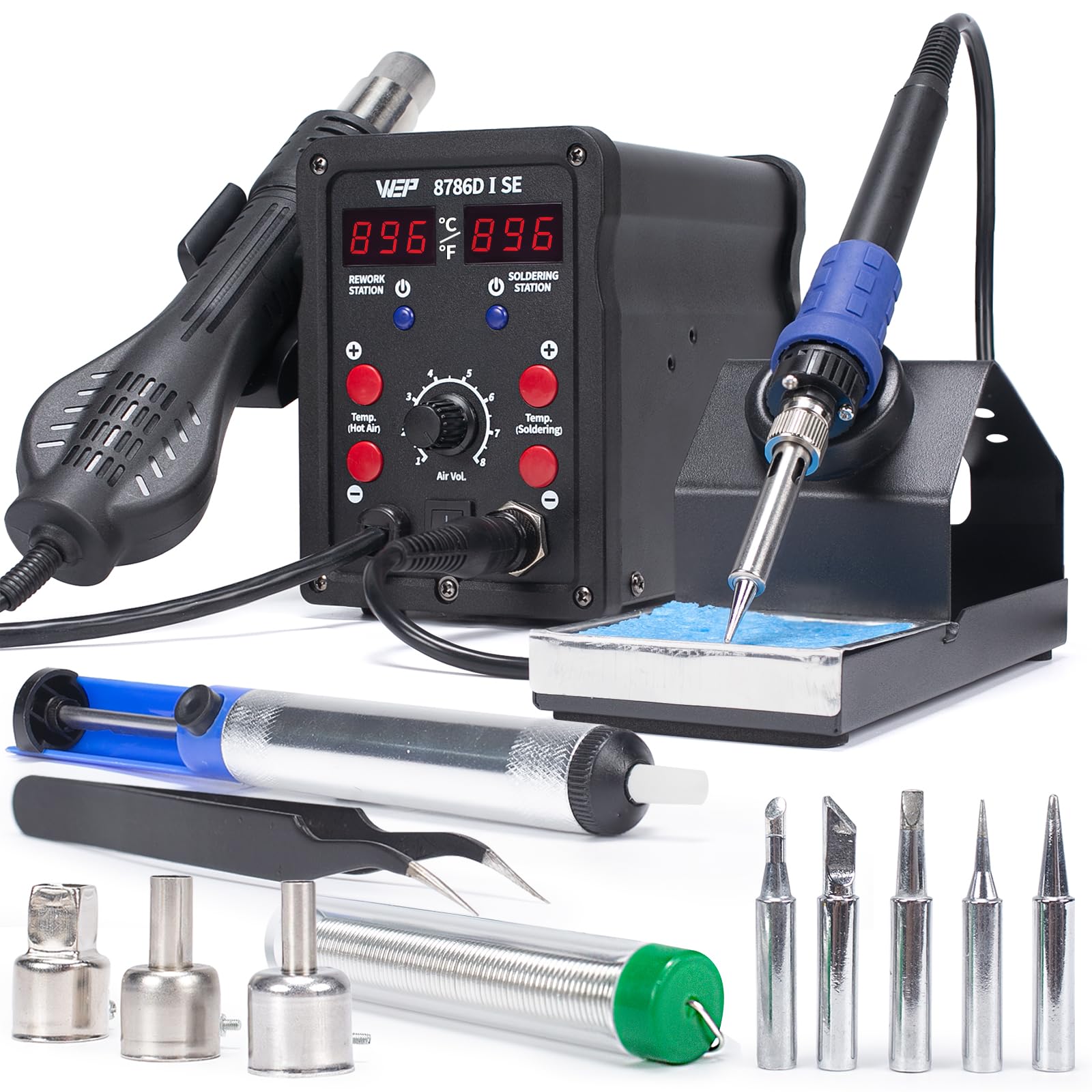
The WEP 8786D-I SE combines a soldering iron and a hot air rework station into one unit, with a dedicated desoldering pump included in the kit. Both the iron and the hot air gun feature PID temperature stabilization, with adjustable ranges from 392°F to 896°F. The hot air side includes an automatic cool-down mode that drops the gun to 212°F when placed in the holder — a safety feature that also extends the heating element’s service life.
The kit ships with five soldering tips, three hot air nozzles, tweezers, and a roll of lead-free solder wire, plus the desoldering pump. Users praise the build quality — the grip stays cool during extended use, and the digital control module is compact enough to sit comfortably on a crowded bench. The 10-minute sleep mode on the iron side prevents accidental overheating when the tool is idle, which is a welcome detail for forgetful users.
A few users noted that the soldering iron feels underpowered for large ground-plane joints, requiring temperatures above 400°C to get good flow. Some units arrived with cross-threaded heat gun nuts or tips that didn’t fit the rack properly, which points to occasional quality control gaps. However, the overall package is hard to beat for someone who needs both a soldering station and a desoldering pump without buying two separate tools.
Why it’s great
- PID stabilization on both iron and hot air for consistent temps
- Auto cool-down and sleep modes protect components
- Comprehensive kit with tips, nozzles, and solder wire
Good to know
- Soldering iron lacks power for large thermal-mass joints
- Occasional fit and finish issues reported
4. MYPOUOS 8588D 2-in-1 Station

The MYPOUOS 8588D is a dual-channel station delivering 750 watts to the hot air gun and a separate soldering iron, both with independent temperature controls from 100°C to 480°C. The dual blue LED displays show set and actual temperatures with a stated tolerance of ±2°C. The hot air gun includes a handle induction sensor that triggers automatic cooling when placed on the holder — the gun drops to 212°F before stopping heating entirely, which prevents heating element burnout.
The entire station features anti-static construction, which is important when working with sensitive SMD components on phone boards or laptop logic boards. Users who have owned the unit for over four years report it still performs reliably, with one comparing the soldering iron performance favorably to a Weller. The hot air function is widely praised for making desoldering multi-pin ICs easy — heat the joint and lift the component without damaging the board.
Some units have arrived with a defective soldering iron out of the box, requiring a replacement, and the display blinks a bright blue “–:–” pattern when plugged in but idle, which some find distracting. The hot air nozzle selection is basic, and users needing fine pitch work may need to buy additional nozzles separately. Overall, this station offers strong value for hobbyists who need both hot air and iron functionality without stepping up to premium pricing.
Why it’s great
- Anti-static design protects sensitive SMD components
- Handle induction auto-cooling extends heater life
- Reliable long-term performance with consistent temperature control
Good to know
- Occasional defective soldering iron out of box
- Display idle pattern can be distracting on bench
5. HighTop Automatic Desoldering Pump

The HighTop Automatic Desoldering Pump is a corded 30W electric gun that combines a nichrome heating element with a solenoid-based suction mechanism. It plugs directly into a 110V outlet, warms up in about five minutes, and clears solder from through-hole pads with a single button press. Users have successfully used it to remove ICs from Commodore 64 boards, USB ports, and thumbstick potentiometers without damaging pads — impressive for an entry-level unit.
The package includes three nozzle sizes and a carry bag, making it portable for home DIY work. The operation is straightforward: heat the joint, press the side button to suck the solder into the chamber, then release the button to purge the solder into a receptacle. The suction is surprisingly strong — some users describe it as “violent,” requiring a steady hand to avoid moving the board. The hollow tip design makes targeting individual pins easy, and the price point makes it accessible for hobbyists who only desolder occasionally.
The major downside is reliability. Multiple users report the microswitch burning out after as few as 30 component desolderings, and the solenoid can develop a chatter that spits solder rather than pulling it cleanly. The unit also lacks temperature control, running at a fixed 400°C, which is fine for leaded solder but may struggle with lead-free joints. For the price, it works well for light use, but it is not built for sustained or professional work.
Why it’s great
- Strong suction clears joints in one pull
- Three nozzle sizes included for different pad diameters
- Very accessible price for entry-level users
Good to know
- Microswitch and solenoid prone to early failure
- No temperature adjustment — runs fixed at 400°C
6. Preciva 929D-V Electric Desoldering Iron

The Preciva 929D-V uses a ceramic heating element — a meaningful upgrade over the nichrome found in comparably priced guns — paired with a vacuum button for one-handed operation. It preheats in roughly three minutes and comes with 1.0mm and 1.2mm nozzles plus a cleaning needle. The ABS handle has an anti-slip texture, and the included gaskets can be replaced if suction starts to drop over time.
Users report that the gun removes most solder from through-holes on the first try, with the smaller 1.0mm nozzle being the preferred choice for standard components. One user removed 31 capacitors from a Sega Genesis board in about 30 minutes without any pad damage. The one-handed operation is genuinely easier than coordinating a separate iron and manual pump — you heat and suck in a single motion.
Reliability is a concern, with reports of the unit failing to heat after two to three months of use. The included instructions are multi-language and unclear, so first-time users should reference the Amazon listing images or video guides rather than the paper booklet. Despite the longevity risk, the ceramic heater and thoughtful gasket replacement design make it a reasonable entry-level choice for hobbyists on a tight budget.
Why it’s great
- Ceramic heater provides faster heat-up and stable temps
- One-handed vacuum operation simplifies workflow
- Replaceable gaskets restore suction when aging
Good to know
- Several reports of heater failure after a few months
- Paper instructions are confusing; use online resources
7. TXINLEI 858D Solder Station

The TXINLEI 858D is a 700W hot air rework station that includes a soldering iron, a desoldering pump, and a full set of accessories in one box. The hot air gun has digital temperature control from 100°C to 450°C with adjustable airflow, and the handle includes an inductance sensor that automatically stops heating when the gun is placed back on the holder. The station comes with three nozzle sizes, an IC puller, tweezers, and a 6-in-1 BGA tool.
Users find the station effective for SMD rework — it handles resistors, LEDs, and small IC removal with practice. The auto-shutoff feature is a highlight, preventing the gun from overheating when left idle. The soldering iron is basic but functional for light through-hole work, and the included desoldering pump is a standard manual plunger rather than an integrated vacuum, which limits its throughput compared to dedicated desoldering guns.
Build quality is mixed. Some units have the power cable wired incorrectly, bypassing the fuse, and the soldering inside needs inspection before use. The temperature reads hot out of the box and requires calibration with a thermocouple for accuracy. The 858D is best suited for users who need hot air for SMD work and want a basic desoldering option included, rather than those requiring high-volume through-hole desoldering.
Why it’s great
- Hot air and iron combined in a compact station
- Automatic handle stop function improves safety
- Complete accessory kit for SMD rework
Good to know
- Manual desoldering pump included, not integrated vacuum
- Power cable may be incorrectly wired — inspect before use
- Temperature calibration required for accuracy
FAQ
What nozzle diameter should I use for standard through-hole components?
Why does my desoldering gun lose suction after a few uses?
Can I use a desoldering gun for lead-free solder?
Final Thoughts: The Verdict
For most users, the desoldering gun winner is the YIHUA 948 because its dedicated vacuum pump and 80W heater provide the continuous, reliable suction needed for full board recaps and component salvaging without breaking the bank. If you need a portable tool for field repairs and can manage the voltage caveat, grab the Hakko FR-301. And for a budget-friendly entry that still offers one-handed vacuum operation, the Preciva 929D-V is a solid choice for hobbyists desoldering a few components at a time.

Mo Maruf
I created WellFizz to bridge the gap between vague wellness advice and actionable solutions. My mission is simple: to decode the research and give you practical tools you can actually use.
Beyond the data, I am a passionate traveler. I believe that stepping away from the screen to explore new environments is essential for mental clarity and physical vitality.