Our readers keep the lights on and my smoothie glass nicely filled. As an Amazon Associate, I earn from qualifying purchases.
Choosing a pair of desk speakers means deciding between warmth and clinical accuracy, between a compact footprint and a room-filling soundstage. The right set transforms late-night work sessions, gaming, and music listening into moments of genuine immersion, while the wrong one leaves your mix muddy or your bass hollow.
I’m Mohammad Maruf — the founder and writer behind WellFizz. I’ve spent hundreds of hours analyzing frequency response curves, driver materials, amplifier topologies, and connectivity standards across the powered speaker landscape to identify the models that deliver measurable performance on a desktop.
Each model reviewed below was selected for its ability to balance clarity, connectivity, and build quality in a nearfield listening environment. This guide cuts through the noise to help you find the best desk speakers for your specific setup and budget.
How To Choose The Best Desk Speakers
Desk speakers are a nearfield investment — you sit close, so small design compromises become audible fast. Focus on driver size, amplifier architecture, and connectivity before aesthetics.
Driver Material and Size
A 3-inch full-range driver struggles with bass extension below 80 Hz, while a 5-inch Kevlar or aluminum cone can deliver tight low-end without a subwoofer. Tweeter materials — silk dome for smooth highs, carbon fiber for extended air — affect how long you can listen without fatigue.
Amplifier Topology and Power
Class D amplifiers run cool and efficient, perfect for compact cabinets, but class A/B often produces warmer mids. Look at RMS wattage, not peak — 60 watts RMS per channel is more meaningful than a 150-watt peak number. A separate subwoofer output lets you add a .1 channel later without replacing the speakers.
Connectivity and Input Versatility
Bluetooth 5.3 with LDAC or aptX HD supports high-resolution wireless streaming, but wired connections — USB-C, optical, RCA, XLR, HDMI eARC — ensure zero latency for gaming and video editing. If your turntable lacks a built-in preamp, make sure the speakers accept a standard RCA phono input.
Quick Comparison
On smaller screens, swipe sideways to see the full table.
| Model | Category | Best For | Key Spec | Amazon |
|---|---|---|---|---|
| Yamaha HS5 W Pair | Studio Monitor | Flat-response mixing | 5″ cone woofer, 70W total | Amazon |
| Edifier M90 | Multimedia | Versatile hub use | 4″ aluminum driver, 100W | Amazon |
| Audioengine A5+ Wireless | Hi-Fi Bookshelf | Warm vinyl listening | 5″ aramid fiber woofer, 150W | Amazon |
| KRK RP5G5 ROKIT 5 | Studio Monitor | Production with room tuning | 5″ Kevlar driver, DSP EQ | Amazon |
| OHAYO 60W | Multimedia | Budget desktop upgrade | 3″ driver, 60W total | Amazon |
In‑Depth Reviews
1. Yamaha HS5 W 5-Inch Powered Studio Monitor Pair

The Yamaha HS5 is the nearfield reference monitor that serious producers and mixing engineers have trusted for years. Its flat frequency response — no artificial bass boost, no hyped treble — means you hear the mix exactly as it is, revealing compression artifacts, sibilance, and phase issues that colored speakers hide.
The 5-inch cone woofer and 1-inch dome tweeter deliver a balanced 70 watts of total power. The low end is tight rather than booming, which is ideal for a desk where rear ports can be positioned away from walls. The white cabinet finish also reduces visual glare in studio lighting.
Setup requires XLR or ¼-inch TRS cables, so you need an audio interface or mixer. That extra step is worth it for the accuracy: these monitors expose the truth in every track, making them the best choice if your work depends on translation.
Why it’s great
- Exceptionally flat frequency response for critical mixing
- Tight, non-muddy low end from the 5-inch cone
- Rock-solid build quality with premium cabinet materials
Good to know
- Requires XLR or TRS inputs — no built-in Bluetooth or USB
- Bass roll-off may leave some listeners wanting a subwoofer
2. Edifier M90 Compact Speakers with HDMI eARC
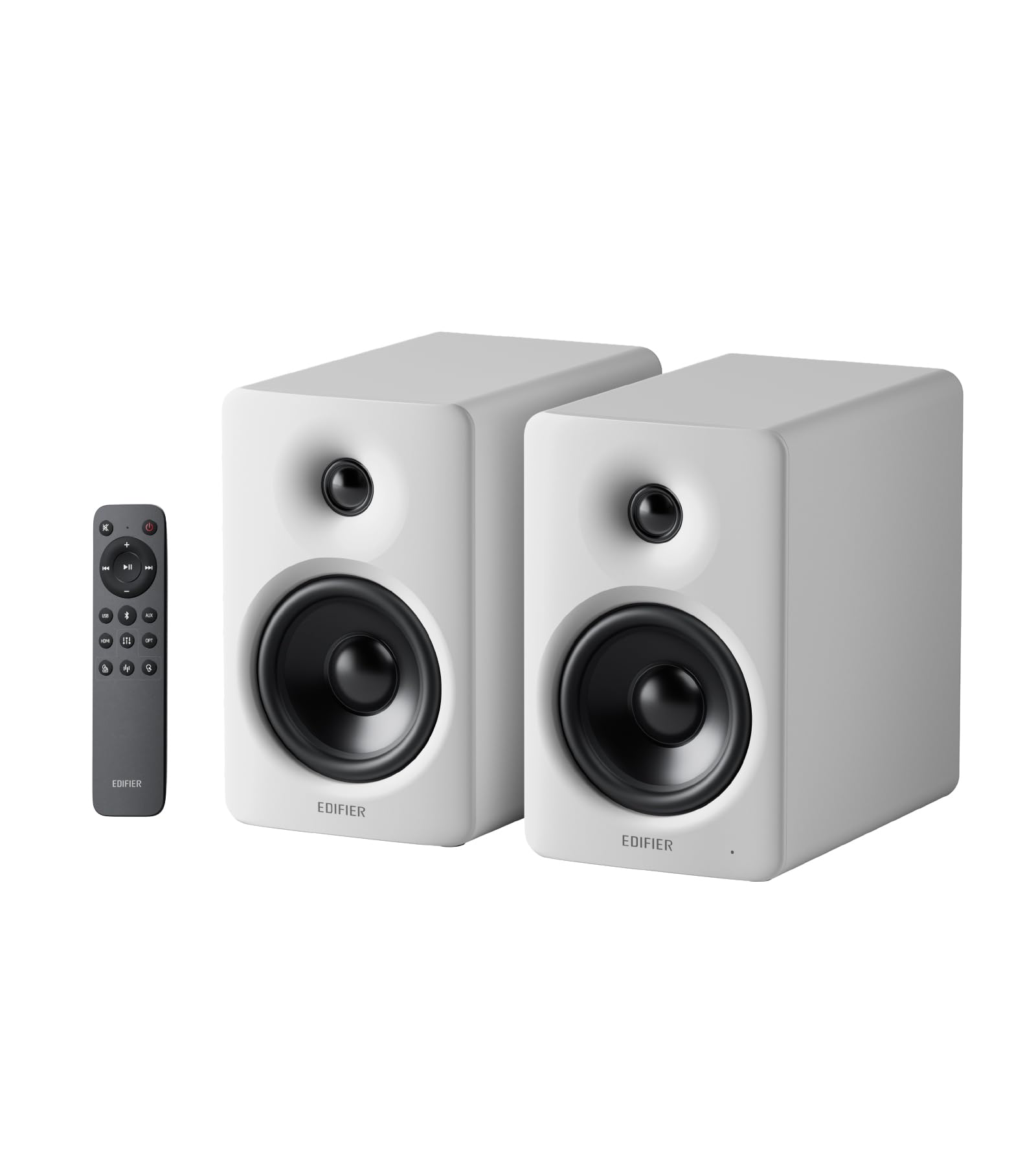
The Edifier M90 packs 100 watts RMS into a compact package, using a 4-inch aluminum driver and a 1-inch silk dome tweeter. The real draw is connectivity: HDMI eARC for TV integration, optical for consoles, USB-C for modern laptops, and LDAC Bluetooth 6.0 for high-resolution wireless streaming from Android devices.
The dedicated subwoofer output lets you build a 2.1 system later. The included 2.4 GHz remote and Edifier ConneX app provide EQ customization, though presets are saved globally for all inputs once tuned via the app over Bluetooth. The white finish and small footprint make it easy to integrate into a living room or office desk.
Reviewers note that the sound out of the box can feel flat, but after using the app to dial in a custom EQ curve, these speakers open up with rich mids and crisp highs. The bass is surprisingly deep for a 4-inch driver, enough for movie explosions without distortion.
Why it’s great
- Massive connectivity suite including HDMI eARC and USB-C
- Powerful 100W RMS output with deep bass for size
- App-controlled EQ and subwoofer output for future expansion
Good to know
- Initial out-of-box sound requires app tuning for best results
- Bluetooth EQ customization only works when using Bluetooth input
3. Audioengine A5+ Wireless Bookshelf Speakers

The Audioengine A5+ Wireless is a powered bookshelf speaker tuned for warmth and musicality. The 5-inch aramid fiber woofer produces punchy, controlled bass without overwhelming the midrange, while the silk dome tweeter delivers smooth highs that avoid listener fatigue even after long listening sessions.
Connectivity is simple: RCA and 3.5 mm AUX inputs for turntables, TVs, and computers, plus Bluetooth with a 50-foot range. The handcrafted wood cabinet — available in gloss white or natural bamboo — reduces cabinet resonance and adds furniture-grade aesthetics to your desk.
A break-in period of a few hours is often noted: the sound opens up significantly after the first day, gaining richer texture and deeper bass extension. The included remote and solid aluminum build quality reinforce the premium feel, though the Bluetooth model still requires a wired connection between the left and right speakers.
Why it’s great
- Warm, non-fatiguing sound profile ideal for long listening
- Furniture-grade cabinets with excellent resonance control
- Simple setup with RCA and Bluetooth, no receiver needed
Good to know
- Requires a break-in period before sound reaches full potential
- Bluetooth model still needs speaker wire between left and right units
4. KRK RP5G5 ROKIT 5 Generation Five Pair

The KRK ROKIT 5 G5 builds on the legendary Rokit lineage with a Kevlar driver that provides stiffness and low weight for fast transient response. The custom Class D amplifiers run cool while delivering clean power, and the new 1-inch silk dome tweeter improves high-mid and phase coherence over previous generations.
The DSP-driven room tuning is the standout feature: you can adjust EQ curves to compensate for desk reflections, corner bass buildup, or proximity to walls. The included Iso-Foam isolation pads decouple the speakers from the desk surface, reducing low-frequency smearing. Inputs are professional-grade XLR and ¼-inch TRS combos.
Reviewers report these are slightly cleaner and more detailed than the G4s, with better power supply reliability. For nearfield production work, they offer excellent stereo imaging and reveal mix details that consumer speakers gloss over, making them a strong alternative to the Yamaha HS series.
Why it’s great
- DSP room tuning compensates for imperfect desk placements
- Kevlar drivers deliver fast, accurate transient response
- Iso-Foam pads and XLR/TRS inputs suit pro environments
Good to know
- No Bluetooth or consumer inputs for casual listening
- Best paired with a KRK subwoofer for full-range production
5. OHAYO 60W Computer Speakers

The OHAYO 60W speakers use a 0.75-inch carbon fiber silk dome tweeter and a 3-inch carbon fiber full-range driver inside an MDF wooden enclosure to reduce resonance. The rear bass port extends low-end depth, while the integrated independent sound card keeps noise floor low for clean playback.
Connectivity covers Bluetooth 5.3, RCA, AUX, USB, and even TRS — five input options that rival speakers costing three times more. The front-panel volume knob and separate tone controls let you adjust treble and bass without software. Reviewers note the USB input delivers clearer sound than the 3.5 mm aux, with better separation and less hollow midrange.
At under 1 watt of power draw at full volume, these are energy efficient while still filling a small to medium room. The low end lacks the extension of larger drivers, but for a compact desktop upgrade from built-in laptop speakers, the OHAYO set delivers impressive clarity and feature density for the price.
Why it’s great
- Five input options including Bluetooth 5.3 and USB
- Energy efficient with clear sound at low volumes
- Wooden cabinet reduces resonance better than plastic
Good to know
- 3-inch drivers limit deep bass extension
- USB input sounds noticeably better than the AUX connection
FAQ
Do I need a subwoofer with 5-inch desk speakers?
What is the difference between studio monitors and multimedia speakers?
Can I use studio monitors for gaming?
Final Thoughts: The Verdict
For most users, the best desk speakers winner is the Edifier M90 because it combines versatile connectivity, 100W of clean power, and enough bass from a 4-inch driver to satisfy without a subwoofer. If you want flat-response accuracy for music production, grab the Yamaha HS5 W Pair. And for warm, fatigue-free listening with turntables or vinyl, nothing beats the Audioengine A5+ Wireless.

Mo Maruf
I created WellFizz to bridge the gap between vague wellness advice and actionable solutions. My mission is simple: to decode the research and give you practical tools you can actually use.
Beyond the data, I am a passionate traveler. I believe that stepping away from the screen to explore new environments is essential for mental clarity and physical vitality.