Our readers keep the lights on and my smoothie glass nicely filled. As an Amazon Associate, I earn from qualifying purchases.
A 3D printer shakes, shifts, and vibrates during long prints. Put it on an unsteady surface, and you get layer shifts, failed overhangs, and wasted filament. That is the real cost of a desk that cannot hold a machine weighing 30 pounds while it oscillates at high speed. This guide isolates the one furniture variable that directly determines print quality: structural rigidity under dynamic load.
I’m Mohammad Maruf — the founder and writer behind WellFizz. I’ve spent hundreds of hours cross-referencing frame materials, vibration-dampening mechanisms, weight capacities, and storage configurations to find the best desks and stands that keep prints accurate and workspaces organized.
Whether you run a single Bambu A1 or a farm of Prusa machines, choosing the right desk for 3d printer is a direct investment in first-layer success and tool-free filament access.
How To Choose The Best Desk For 3D Printer
The wrong desk amplifies printer vibration, wastes precious floor space, and turns filament spool swaps into a scavenger hunt. Three criteria cut through the noise: frame rigidity under load, integrated storage geometry, and surface-level adjustability.
Frame Rigidity and Print Accuracy
Every rapid acceleration of the print head generates a lateral force. A desk with thin particle-board panels and unbraced legs bows under that force, turning a 0.1 mm layer line into a visible shift. Look for desks with a welded steel or heavy-gauge metal frame and diagonal cross-bracing or full rear panels. Weight capacity above 200 pounds on the top shelf is a reliable indicator that the frame will not flex during high-speed printing. Anti-vibration pads or leveling feet are a bonus — they decouple the machine from floor-borne movement.
Filament Storage and Workflow
A dedicated desk for 3D printing should keep filament spools off the floor and away from dust. Adjustable metal arms or rods that hold 1 kg spools reduce friction drag on the extruder. Desks with enclosed lower cabinets or mesh side shelves protect hygroscopic filaments like nylon and PETG from humidity swings while keeping tools within arm’s reach. The best designs give you at least two rows of spool storage without overlapping with the printer’s footprint.
Adjustability and Leveling
Unstable floors are the silent cause of inconsistent first layers. Leveling feet let you tweak each corner independently to cancel out warped floorboards or carpet dips. Taller stands benefit from locking casters — they provide mobility for cleaning and cable management but must lock firmly to prevent creep during a 12-hour print. Retractable feet or a combination of casters and fixed pads offers the best of both worlds.
Quick Comparison
On smaller screens, swipe sideways to see the full table.
| Model | Category | Best For | Key Spec | Amazon |
|---|---|---|---|---|
| HavenlyYouth 3D Printer Stand | All-in-One | Large printer + filament hub | 41″ x 23.6″ top; 800 lbs capacity | Amazon |
| Kerty Upgraded 3D Printer Stand | Dual-Printer | Two printers side by side | 40.55″ x 23.6″ top; 300 lbs | Amazon |
| Poweruck PRT22 Heavy Duty Stand | Pro-Grade | Vibration-sensitive, tall printers | 78″ H; 75% vibration damping | Amazon |
| AHOWPD 3D Printer Table (Black) | Compact | Small footprint with drawer storage | 28.4″ H; fabric drawer included | Amazon |
| AHOWPD 3D Printer Table (Brown) | Compact | Same layout, brown finish | 28.4″ H; fabric drawer included | Amazon |
| AHOWPD Stand with Filament Storage | Tower Stand | 60 spools + printer on top | 59″ H; 300 lbs capacity | Amazon |
| ARTINRACK TR22 | Mobile | Moving printer between spaces | 24″ x 24″ top; locking casters | Amazon |
| SANODESK L-Shaped Standing Desk | Adjustable | Dual-monitor + printer workspace | Electric height; 4 drawers | Amazon |
| LITTLE TREE Executive Desk | Large Office | Massive surface for equipment | 86.6″ W x 29.5″ D | Amazon |
In‑Depth Reviews
1. HavenlyYouth 3D Printer Stand
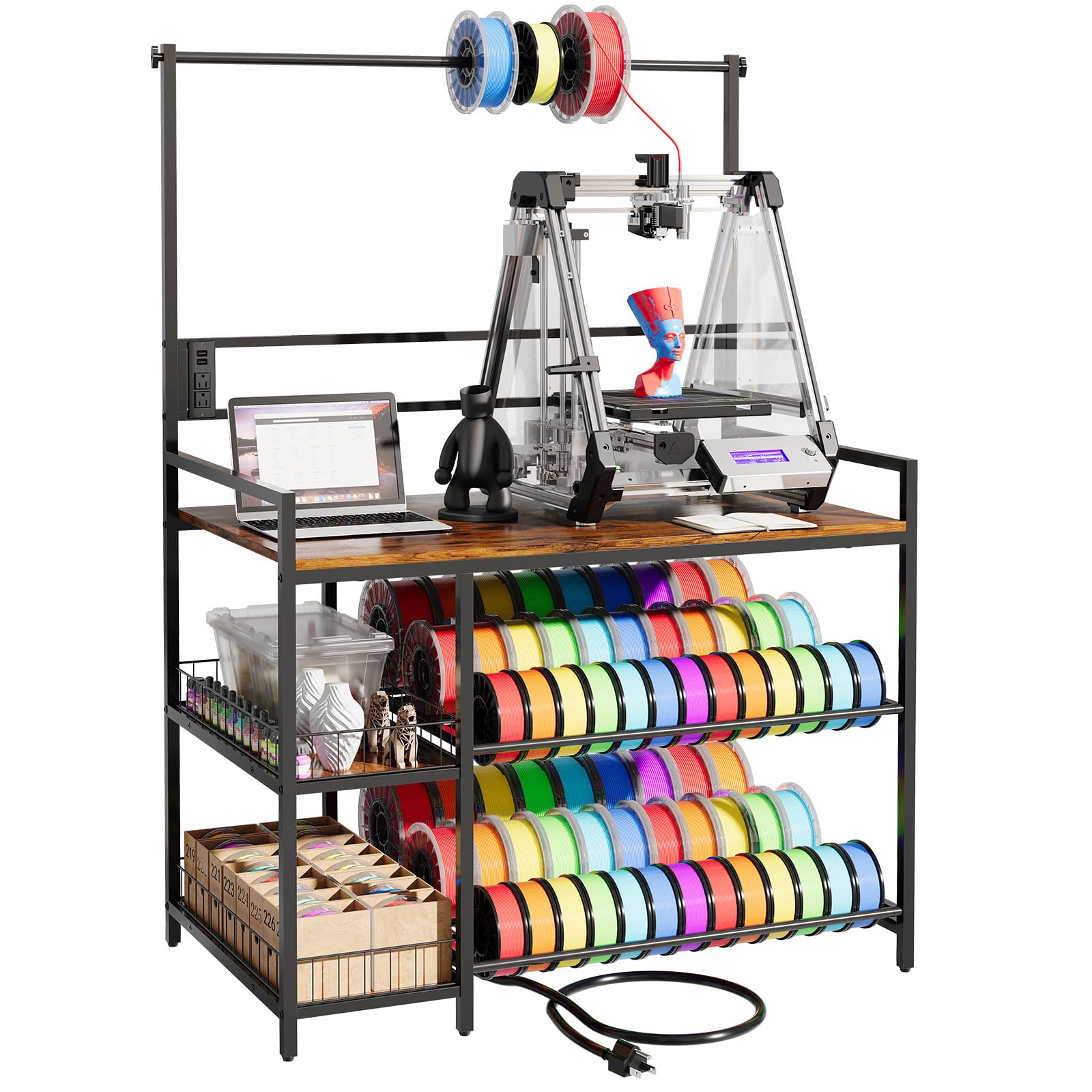
The HavenlyYouth stand solves the biggest pain point for larger printers like the Bambu P1S or Creality K1 Max — having enough surface area without sacrificing filament storage. Its 41 x 23.6-inch top supports up to 800 pounds, and the mid-shelf holds another 500 pounds, meaning you can stack a second printer or heavy resin wash station below. The 57.4-inch height puts the top spool bar at eye level, making filament swaps smooth and fast.
It integrates a charging station with two AC outlets and two USB ports directly into the frame. That eliminates the need for a separate power strip dangling under the desk. The vintage panel and black steel frame look more like furniture than a utility rack, which matters if the stand lives in a living room or office rather than a garage.
Assembly runs about 30 minutes with a power screwdriver. Some users noted the power strip cord protrudes from the back, requiring the stand to sit 4 to 5 inches from the wall. The top filament bar can tilt slightly when you unscrew the retaining knob, but this is minor. For the price, this is the most complete all-in-one desk for a 3D printer.
Why it’s great
- 150-pound capacity on the top shelf handles even heavy enclosed printers
- Integrated power strip with USB reduces cable clutter
- Built-in spool rack and two storage baskets for tools
Good to know
- Power strip cord placement pushes the unit away from the wall
- Top filament bar can shift when unscrewing retention knob
2. Kerty Upgraded 3D Printer Stand
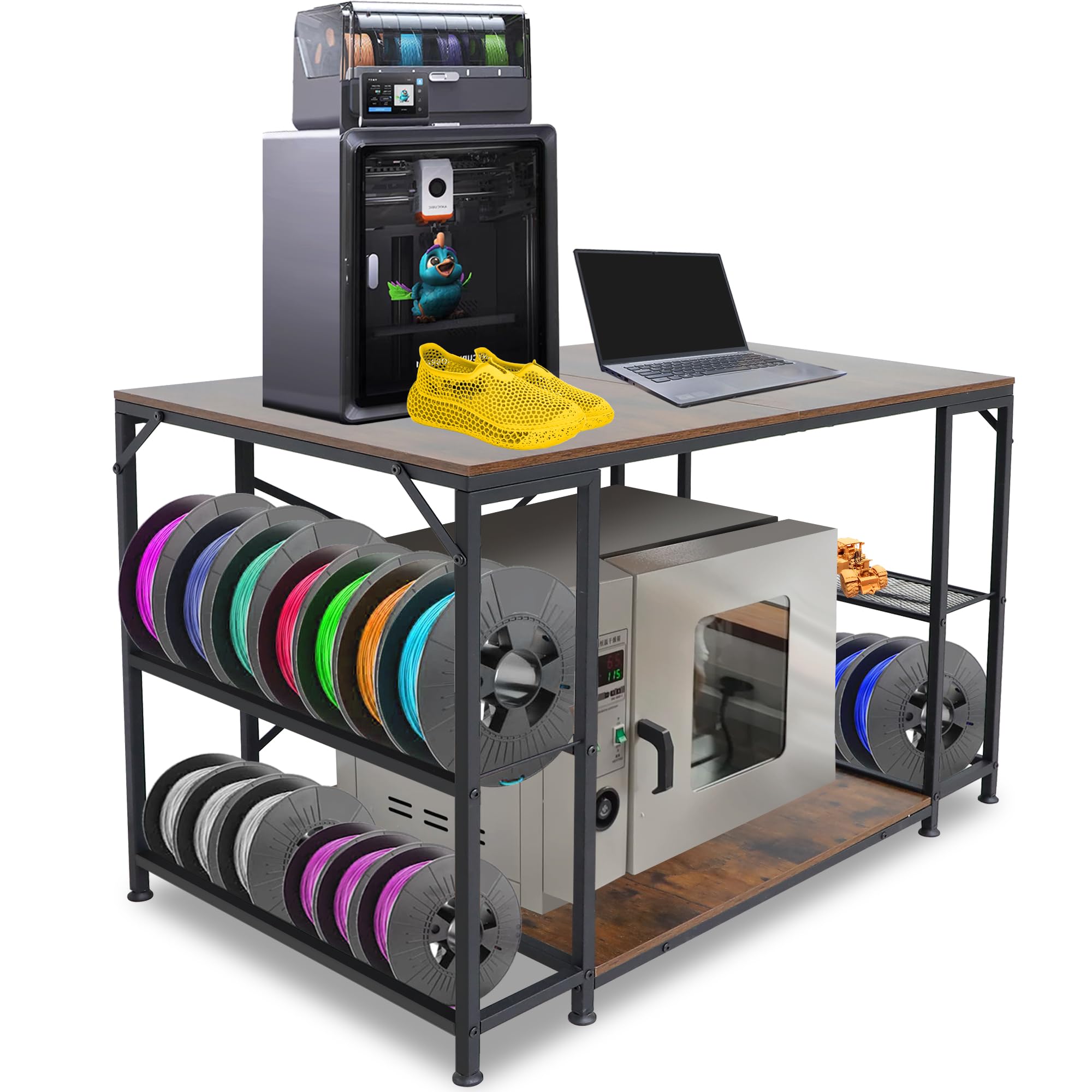
The Kerty stand is built around a reinforced metal frame with full diagonal cross-bracing, making it one of the most stable desks for 3D printers under 30 inches tall. The top shelf measures 40.55 by 23.6 inches — just wide enough to park an X1C with AMS beside an H2S without overhang. Multiple users confirmed zero layer shifts during high-speed prints on two machines simultaneously.
Side storage is the star here. Each side has metal racks rated for up to 8 spools of 1 kg filament, and one side includes a mesh grid shelf that holds gloves, nozzles, and scrapers. The top shelf supports 300 pounds, the bottom 150 pounds. Anti-vibration foot pads come installed, so you don’t need to buy separate dampeners. Assembly instructions are basic but adequate; expect about 30 minutes if you lay out the parts first.
The only real gap is a lack of enclosed storage — everything is open to dust. If your workshop is prone to floating particles, a separate cover for filament may be needed. But for anyone running two printers and wanting quick access to spools, this desk delivers the most rigid platform in its price bracket.
Why it’s great
- Full steel cross-bracing eliminates vibration-induced layer shifts
- Side racks hold 16 spools total across both sides
- Anti-vibration foot pads reduce noise transfer
Good to know
- Open shelving exposes spools to dust
- Assembly instructions are minimal
3. Poweruck PRT22 Heavy Duty Stand
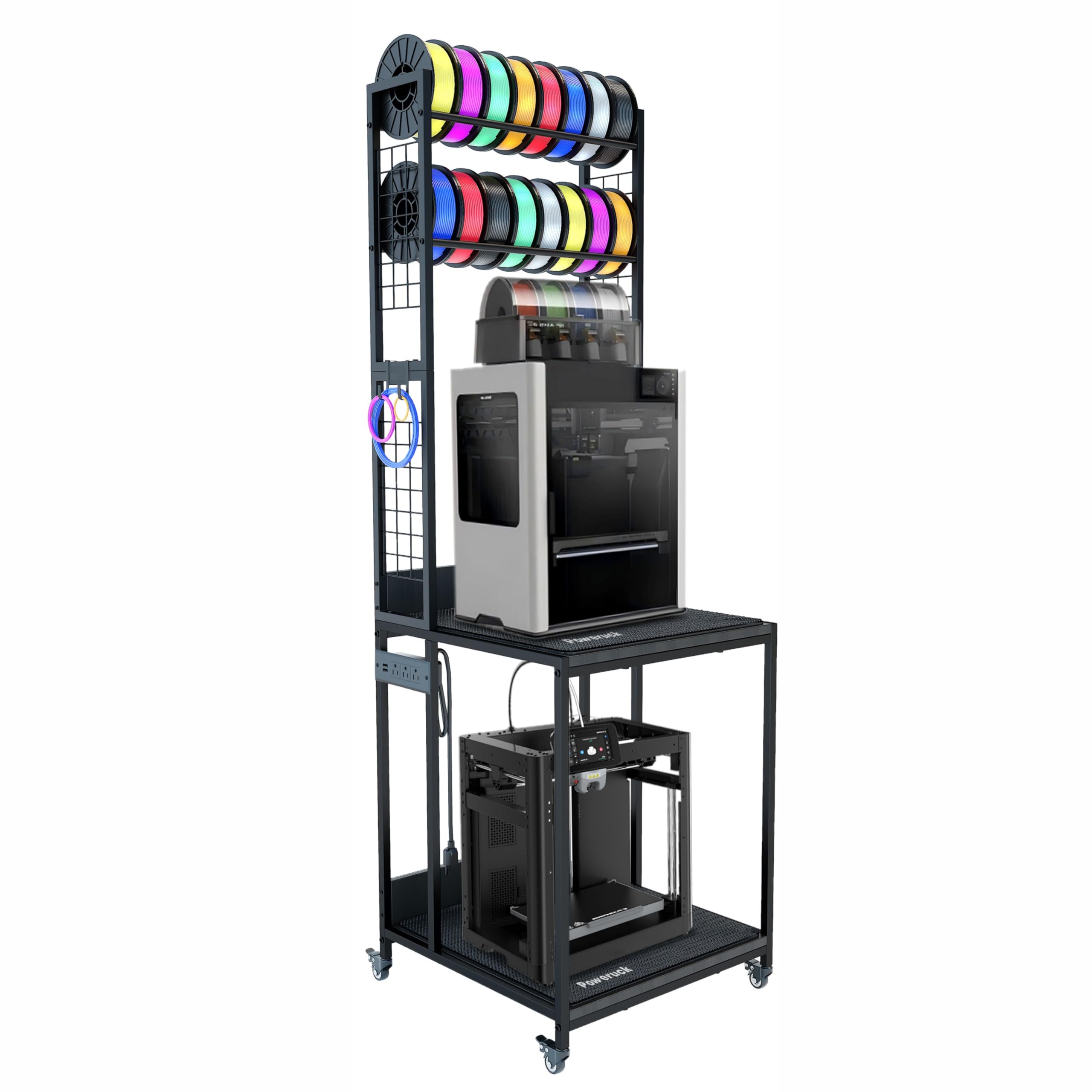
The PRT22 addresses the most neglected spec in 3D printer furniture: vibration damping. It ships with high-density polymer pads that absorb 75 percent of operational vibration, which translates directly to cleaner layers on tall prints. The frame itself is reinforced steel with a powder-coated finish, supporting up to 140 pounds across two shelves. The 24 x 24-inch top fits large printers like the Bambu H2D or Creality K2 Plus without overhang.
Stand height is 34 inches on the top shelf, which is taller than most desks. This is intentional — it accommodates next-gen printers with enclosed upper gantries. Four locking casters make it easy to roll away for servicing, and the locking mechanism holds firm enough that the stand does not creep during a 24-hour print. The built-in power hub has three AC outlets and two USB ports, routing all cables neatly under the top shelf.
The main tradeoff is a smaller footprint than wider stands. Filament storage sits on the top shelf rather than dedicated side racks, which cuts into usable printer space. Users with multiple spools may need extra floor shelving. But for a single high-end printer where vibration is the primary concern, the PRT22 is the most targeted solution on the market.
Why it’s great
- Specialized vibration-damping mats reduce ringing and ghosting
- Tall 34-inch high shelf fits enclosed printers easily
- Locking casters allow mobility without sacrificing stability
Good to know
- Limited dedicated filament storage on the frame itself
- Weight capacity is lower on a per-shelf basis than wider stands
4. AHOWPD 3D Printer Table (Black)
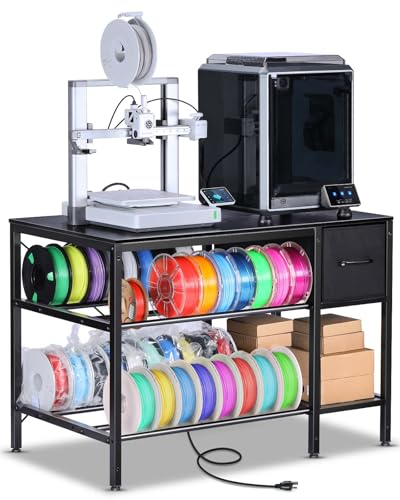
The AHOWPD black table proves you do not need a massive budget to get a stable, organized desk for 3D printer. The 39.4 x 23.7-inch top holds a Prusa CORE One with room to spare, and the full-length metal tube racks on the middle and bottom shelves store up to 12 standard 1 kg spools without tangling. The metal frame uses 0.78-inch thick steel, which resists the flex that causes layer shifting on budget tables.
It includes a built-in power strip with two AC outlets and two USB ports, plus a fabric drawer that slides left or right for tool storage. The drawer is not heavy-duty MDF — it is cloth on a metal slide — but it works well for small nozzles, Allen keys, and spare PTFE tubes. Assembly takes about 20 minutes, and all hardware is labeled clearly.
At 28.4 inches tall, this table sits lower than most standing desks. That is fine for seated use but may feel low if you prefer to stand while monitoring prints. Some users reported slight wobble if screws are not fully tightened, but that goes away with a final pass on every bolt. For a compact footprint with integrated power and filament storage, this is the best value entry-level option.
Why it’s great
- Thick steel frame resists flex under high-speed printing
- Built-in power strip and fabric drawer improve workspace setup
- Four rows of filament storage keep spools dust-free
Good to know
- Fabric drawer may wear faster than solid-wood drawers
- Table height is low for standing users
5. AHOWPD 3D Printer Table (Brown)
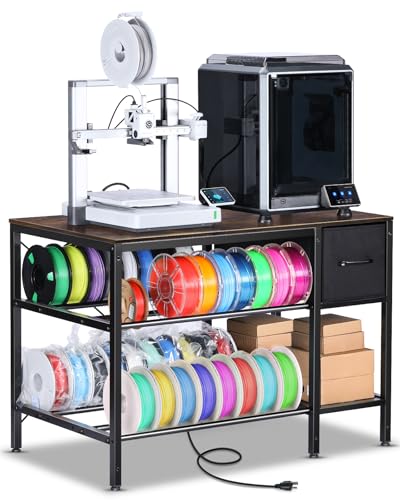
This is the same desk frame as the black AHOWPD table above but finished in brown wood-grain laminate for users who prefer a warmer aesthetic. The dimensions, weight capacity, power strip, and fabric drawer are identical. The brown panel does a good job of hiding minor scuff marks compared to glossy black finishes.
Like the black version, it fits a Bambu Lab A1 with AMS comfortably, and the 30-minute assembly process is straightforward. The full-length drawer is still cloth, but it slides smoothly and holds tools without sagging. The power strip placement at the rear of the tabletop is convenient for plugging in a filament dryer and an air purifier simultaneously.
Because the frame geometry is identical, the same stability caveat applies — final tightening of all screws is necessary to eliminate wobble. The brown version costs the same as the black, so the choice comes down to finish preference. If your workshop or office has lighter wood tones, this is the better match visually.
Why it’s great
- Same sturdy frame and storage as the black version
- Brown laminate hides scuffs better than glossy finishes
- Built-in power strip simplifies cable routing
Good to know
- Fabric drawer may not hold heavy tools long-term
- Requires thorough screw tightening for maximum stability
6. AHOWPD Stand with Filament Storage
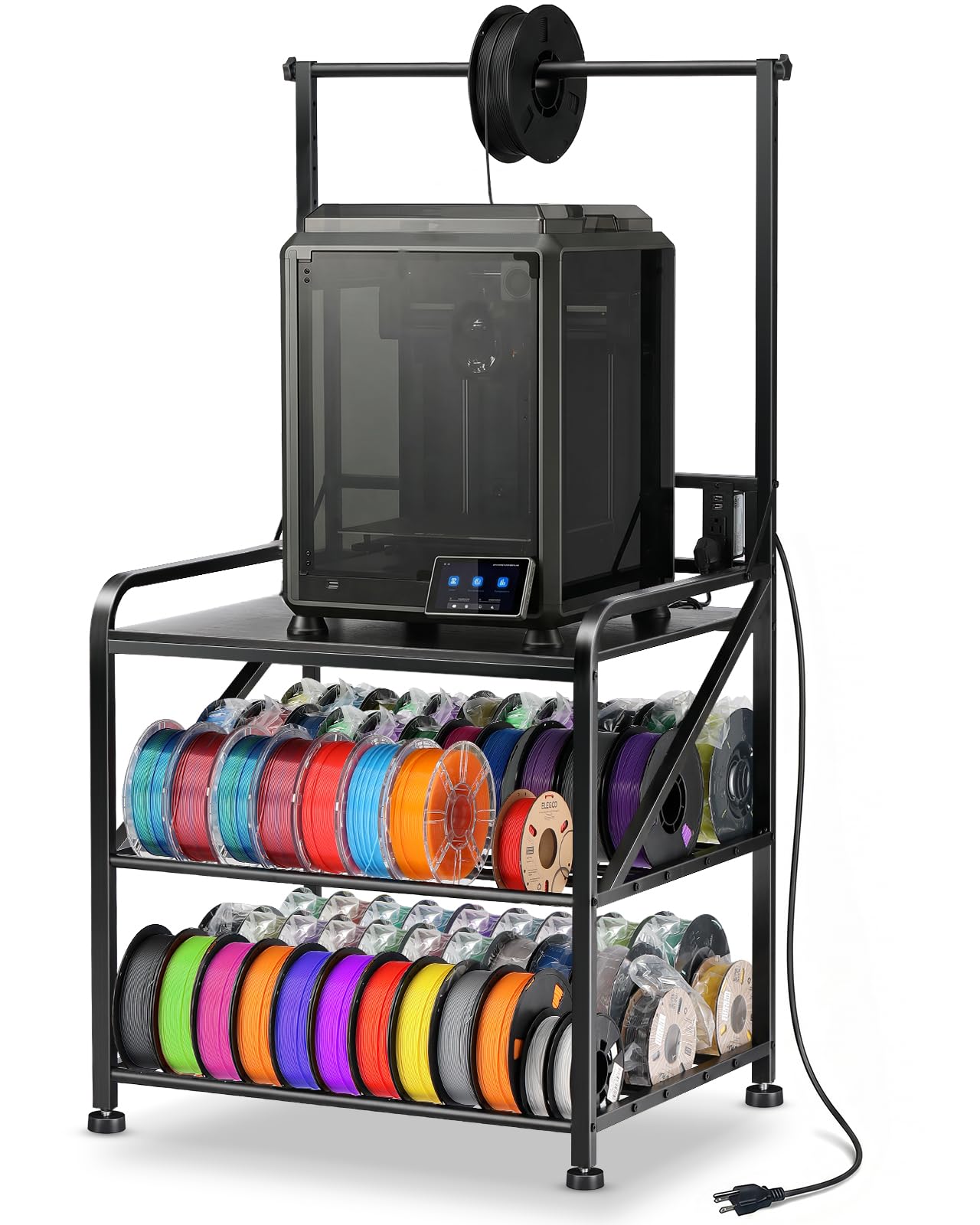
If filament storage is your primary bottleneck, this AHOWPD tower stand is the high-density solution. It holds up to 60 spools on its middle and lower shelves, with the top surface dedicated to the printer. The solid wood top measures 27.5 x 23 inches — tight for large enclosed printers but perfect for compact machines like the Bambu A1 Mini or Anycubic Kobra 2 Pro.
The frame uses 0.78-inch thick metal with leveling feet instead of casters, which eliminates rolling wobble entirely. The weight capacity is 300 pounds, so the combined load of a heavy printer and 30 kg of filament is well within spec. Assembly is under 15 minutes, and the included video guide is genuinely helpful.
The biggest caveat is the 59-inch height. With a printer on top, the platform sits near eye level, which is convenient for checking prints but makes the unit top-heavy if you have kids or pets bumping into it. The leveling feet must be adjusted carefully to prevent rocking on uneven floors. Still, for sheer filament density per square foot of floor space, no stand in this guide comes close.
Why it’s great
- Massive 60-spool capacity keeps bulk spools organized
- Solid wood top with leveling feet reduces vibration
- Fast assembly under 15 minutes
Good to know
- Tall footprint feels top-heavy, especially on carpet
- Top surface is smaller than full-width desks
7. ARTINRACK TR22

The ARTINRACK TR22 is a mobile 2-tier stand built for shops where printers need to shift between workbenches. The 24 x 24-inch top fits most mid-size printers — users have mounted the Bambu H2D on it, albeit with tight side clearance. The lower shelf adds another 24 inches of height clearance, enough for a wash-and-cure station or a second printer.
Four 360-degree swivel casters include lock mechanisms that hold the stand in place without creep. The frame is a mix of thick wood boards and metal bracing, rated to 140 pounds. A spare set of fixed feet is included if you prefer a stationary setup. The top shelf includes a filament bar, though reviewers found the side-mounted spool holder was difficult to use and preferred to print their own shelf attachment.
The main weakness reported by multiple users is inconsistent threading on the wheel mounts. Some arrived with poorly cut threads that would not accept the bolts, rendering the casters unusable. This is a manufacturing quality control issue. If you get a clean set, the stand is stable and spacious. If not, you may need to use the included fixed feet permanently.
Why it’s great
- Locking casters allow easy repositioning
- Spacious 24×24-inch top fits large printers
- Includes both casters and fixed feet for flexibility
Good to know
- Threading defects reported on some wheel mounts
- Side spool holder is nearly unusable without 3D-printed adapter
8. SANODESK L-Shaped Standing Desk
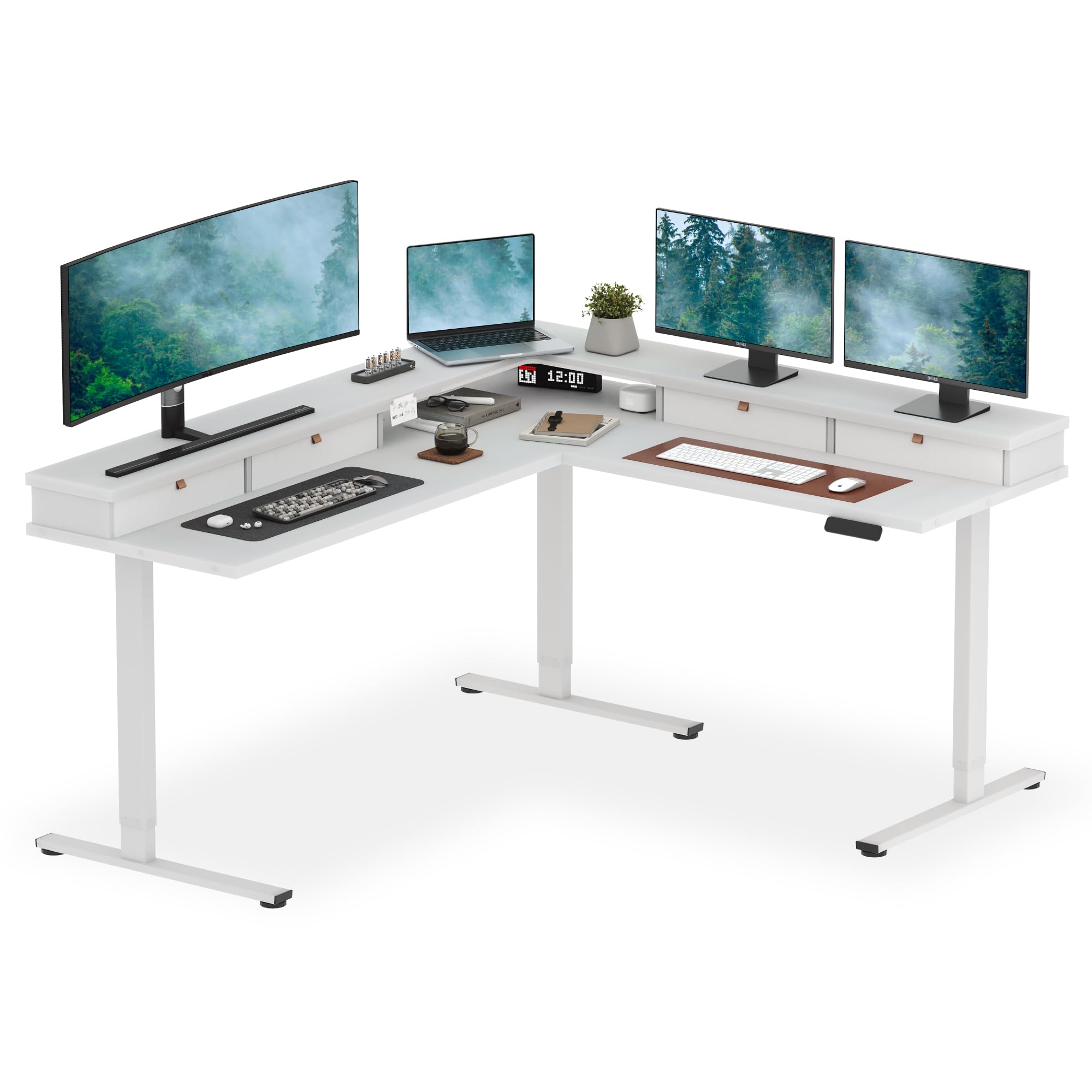
The SANODESK is a full electric standing desk with an L-shaped footprint, making it a practical choice for users who need a dedicated 3D printer station alongside their computer setup. The carbon steel frame lifts the entire desk surface quietly and smoothly, and it includes three customizable height memory buttons and a child lock for safety. The white laminate top is scratch-resistant and easy to wipe clean of filament dust.
Four deep box drawers provide storage for tools, nozzles, and unfinished projects, with metal slides that feel significantly more durable than the fabric drawers on budget stands. The built-in USB charging port is handy for powering a tablet running a print-monitoring app. The L-shape gives you a generous 71-inch total span — enough room for a dual-monitor rig on one wing and a 3D printer on the other.
This desk is not designed specifically for 3D printing, so there is no integrated spool rack or filament storage. You will need to add a separate filament dryer and wall-mounted spool holder. Assembly is the most complex of any desk in this guide — budgeting at least an hour is realistic. The overall build quality is high, but the lack of printer-specific features makes it better for hybrid office-maker spaces than dedicated print farms.
Why it’s great
- Electric height adjustment works for sit-stand printing
- Four metal-slide drawers offer serious tool storage
- L-shape fits both computer and printer on one surface
Good to know
- No integrated filament storage or spool holder
- Assembly is time-consuming and may require a second person
9. LITTLE TREE Executive Desk
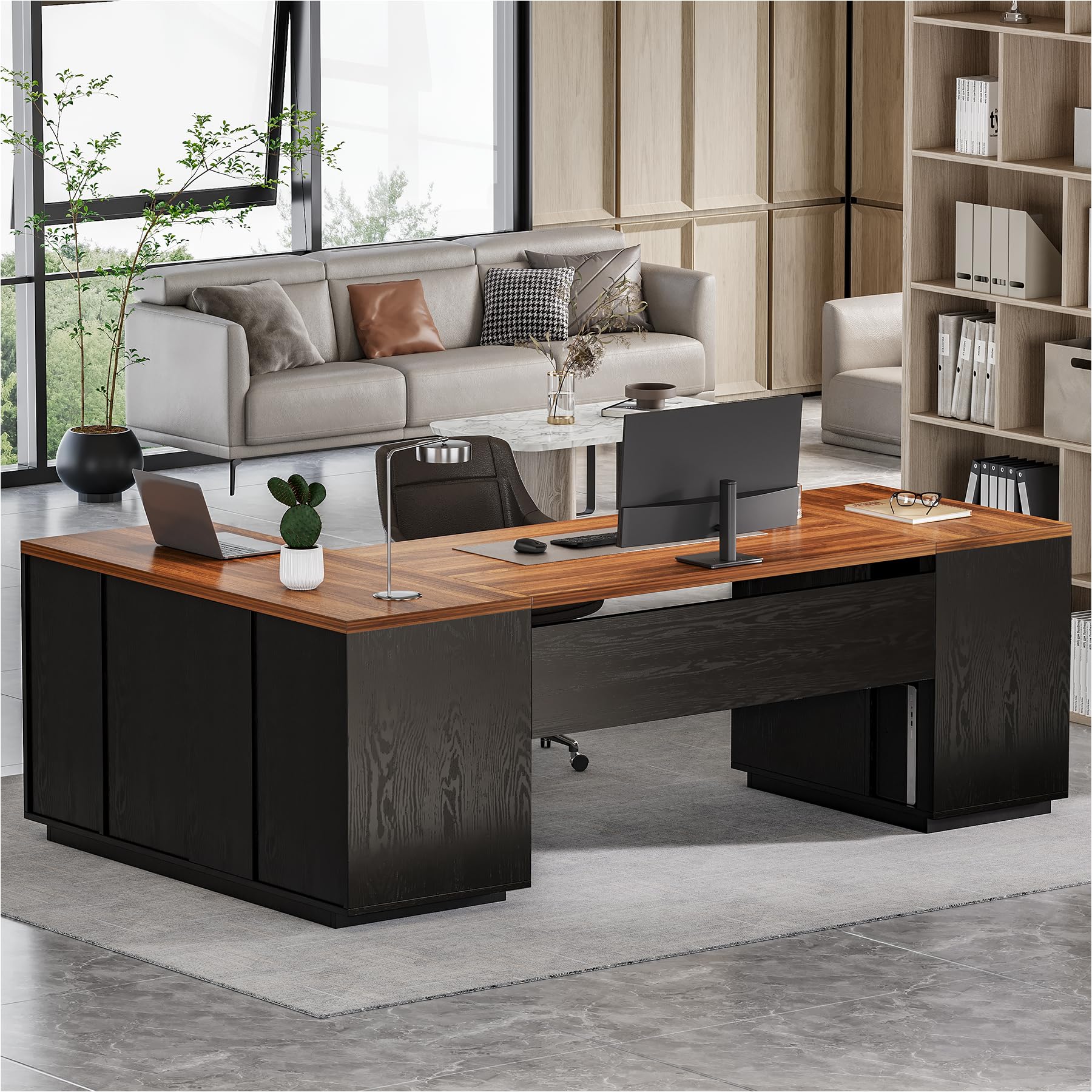
The LITTLE TREE executive desk is the largest surface in this guide at 86.6 inches wide and 29.5 inches deep. That depth is critical — it can comfortably fit a large enclosed printer like a Creality K2 Plus with a filament dryer beside it, plus a monitor arm for slicing software. The included three-drawer file cabinet rolls under the desk and keeps filament desiccant packs and spare parts organized behind a drawer front.
The desk is made from lacquered MDF with a brown and black finish that looks professional in a home office. The 30-inch depth handles deep equipment better than the standard 24-inch desks. The cam-lock assembly system, while common in this price tier, received mixed feedback — some buyers found the fasteners flimsy and the drawer slides rough. A power drill and patience are recommended for assembly; expect 90 minutes to 2 hours.
There is no integrated spool rack, power strip, or vibration damping. This is a pure office desk that happens to be wide and deep enough for 3D printing equipment. If your priority is a clean aesthetic with enclosed file storage and you are willing to source separate spool shelving and a vibration-dampening mat, this desk delivers a massive, stable platform. But it is not optimized for filament workflow in the way that dedicated stands are.
Why it’s great
- Very wide and deep surface fits large printers alongside monitors
- Included three-drawer file cabinet provides enclosed storage
- Professional look suits home office environments
Good to know
- No built-in spool racks or power management
- Cam-lock assembly can be finicky and time-consuming
FAQ
Why does my print fail on a lightweight desk?
Should I use locking casters or leveling feet?
How many filament spools should a desk store?
Final Thoughts: The Verdict
For most users, the desk for 3d printer winner is the HavenlyYouth 3D Printer Stand because it combines an 800-pound capacity top with integrated filament storage, a built-in power station, and a footprint that fits both desktop and floor-standing printers. If you need a dual-printer setup with maximum rigidity, grab the Kerty Upgraded Stand. And for vibration-sensitive single-printer farms, nothing beats the Poweruck PRT22 and its dedicated damping pads.

Mo Maruf
I created WellFizz to bridge the gap between vague wellness advice and actionable solutions. My mission is simple: to decode the research and give you practical tools you can actually use.
Beyond the data, I am a passionate traveler. I believe that stepping away from the screen to explore new environments is essential for mental clarity and physical vitality.