Our readers keep the lights on and my smoothie glass nicely filled. As an Amazon Associate, I earn from qualifying purchases.
Finding a desk chair that doesn’t aggravate your scoliosis is a challenge of spinal geometry. Standard seats with flat backs and fixed lumbar bumps can push against an uneven curve, causing more pain than they prevent, while the wrong tilt mechanism forces your pelvis into a posterior tilt that flattens the lower back’s natural lordosis.
I’m Mohammad Maruf — the founder and writer behind WellFizz. This guide came from analyzing the specific support features, adjustability ranges, and pressure-distribution technologies that matter most for managing scoliosis during long seated hours.
After evaluating nine models for their lumbar systems, seat-depth control, and dynamic movement capabilities, these picks represent the best options for anyone searching for the best desk chair for scoliosis.
How To Choose The Best Desk Chair For Scoliosis
Standard office chairs are built for symmetrical bodies with uniform curves. Scoliosis introduces asymmetry in both the frontal plane (lateral curve) and the sagittal plane (ribcage rotation), so your chair needs to accommodate a spine that doesn’t sit straight. Here are the specific features to evaluate.
Lumbar Support Must Be More Than a Bump
A fixed lumbar pad that protrudes equally on both sides will push into an elevated ribcage on one side of your back. The most effective lumbar systems for scoliosis are adjustable in height and depth, or they use a flexible membrane that conforms to your spine’s specific lateral curve. Chairs with adaptive or auto-following lumbar support can track your spine’s movement as you shift, maintaining contact with the curve rather than fighting it.
Seat Depth Control Is Non-Negotiable
A seat pan that is too long forces your pelvis into a posterior tilt, flattening the lower back and increasing pressure on the sacrum. For scoliosis, a seat that can slide forward reduces the distance from your lower back to the backrest, allowing the lumbar system to engage your actual curve. Look for chairs with at least three inches of seat-depth adjustment or a waterfall front edge that relieves pressure on the back of your thighs.
Movement Encourages Spinal Fluid Exchange
Scoliotic discs need movement to hydrate. A chair that locks you in one position starves the spinal discs of fluid exchange. Active-sitting mechanisms, tilting seats, and synchro-tilt systems that allow your hips to rock naturally reduce static loading on the curved segments of your spine. Chairs designed for dynamic sitting force periodic weight shifts that keep nutrients flowing to the intervertebral discs.
Quick Comparison
On smaller screens, swipe sideways to see the full table.
| Model | Category | Best For | Key Spec | Amazon |
|---|---|---|---|---|
| Steelcase Leap | Premium | Spine Conformity | 3D LiveBack technology mimics natural spine | Amazon |
| Secretlab Titan Evo | Premium | Built-In Lumbar Control | 4-way built-in adjustable lumbar support | Amazon |
| Branch Verve | Premium | Contoured Spine Support | V-shaped suspended back with integrated spine support | Amazon |
| Vari CoreChair | Premium | Active Sitting Stability | Patented tilting mechanism for core engagement | Amazon |
| FLEXISPOT ErgoX-PRO | Mid-Range | Full Body Adjustability | 5D lumbar support, 7D armrests, 4D headrest | Amazon |
| Newtral Ergonomic Chair | Mid-Range | Auto-Following Lumbar | Automatic lumbar tracking technology | Amazon |
| ELABEST T96 | Mid-Range | Budget-Friendly Spine Curve | Bionic-curve backrest with adjustable lumbar | Amazon |
| HOMRELEXA Teddy Fleece | Entry-Level | Cross-Legged Sitting | 22.8″ seat width, 400 lb capacity | Amazon |
| MOLENTS Desk Chair | Entry-Level | Entry-Level Adjustability | Adjustable lumbar support up/down and forward/back | Amazon |
In‑Depth Reviews
1. Steelcase Leap Office Chair

The Steelcase Leap remains the gold standard for scoliosis because its 3D LiveBack technology uses a tensioned exoskeleton that flexes with your spine’s natural movement rather than locking you against a rigid frame. The chair’s back curves to follow the lateral and rotational deviations of a scoliotic spine, providing support exactly where your curve needs it—not where a generic mold assumes your spine sits.
The seat glides forward as you recline via the Natural Glide System, which keeps your pelvis stable during recline and prevents the posterior pelvic tilt that aggravates lower back asymmetry. Combined with the lower back firmness dial, you can dial in precise lumbar pressure to match the convex and concave sides of your curve.
Reviews consistently highlight its ability to reduce pain after months of use, though some users with specific hip rotations find the seat padding firm. At this tier, the adjustability range covers most scoliosis patterns, and the chair arrives fully assembled.
Why it’s great
- 3D LiveBack conforms to lateral spine curves for personalized support
- Seat glides forward during recline to protect pelvic alignment
- Lower back firmness dial adjusts pressure independently for each side
Good to know
- Premium tier investment requires careful budget planning
- Seat padding may feel firm for users with coccyx sensitivity
2. Secretlab Titan Evo Classic Gaming Chair

The Titan Evo’s 4-way built-in adjustable lumbar support is a standout feature for scoliosis because it can be positioned independently on each side to accommodate a lateral curve. The tensioned membrane allows for micro-adjustments in both height and depth, meaning you can push more support into the concave side of your curve while softening the convex side.
The cold-cure foam seat provides consistent resistance that doesn’t sag unevenly over time, which is critical because a slumped seat deepens pelvic rotation. The full-metal 4D armrests track your arm position through different sitting positions without adding shoulder tension—a common trigger point for scoliosis patients.
User feedback notes the magnetic memory foam head pillow offers adjustable neck support that reduces upper cervical strain, but the leatherette material can trap heat during extended sessions. The chair’s 165-degree recline range allows decompression breaks without leaving the chair.
Why it’s great
- Independent lumbar adjustment on each side matches curve asymmetry
- Cold-cure foam prevents uneven sagging that worsens pelvic tilt
- Full-metal armrests track movement without adding shoulder tension
Good to know
- Leatherette surface may feel warm for extended sitting
- Firm foam requires a gradual break-in period for comfort
3. Branch Verve Chair

The Branch Verve uses a V-shaped suspended back with integrated spine support that distributes contact pressure along the entire vertical axis rather than concentrating it at a single lumbar point. For scoliosis, this continuous vertical support reduces the discomfort of a bump pressing directly into a rotated ribcage.
The chair offers six adjustment points including seat depth and lumbar height, which allow you to precisely set the back shape to match your curve’s apex. The high-density foam seat provides consistent support without bottoming out, and the 3D knit back promotes airflow to prevent overheating.
User reviews note the armrests are narrower than typical, which can be beneficial for scoliosis users who need to keep shoulders from rounding forward. The design emphasizes simplicity over extreme adjustability, making it a good choice for those who want effective support without complex tuning.
Why it’s great
- Continuous spine support avoids concentrated pressure on rotated ribs
- Seat depth and lumbar height adjustments allow precise curve matching
- Narrow armrests help prevent forward shoulder rounding
Good to know
- Armrest design limits adjustment range for broad-shouldered users
- Back support is basic rather than adaptive to curve changes
4. Vari CoreChair
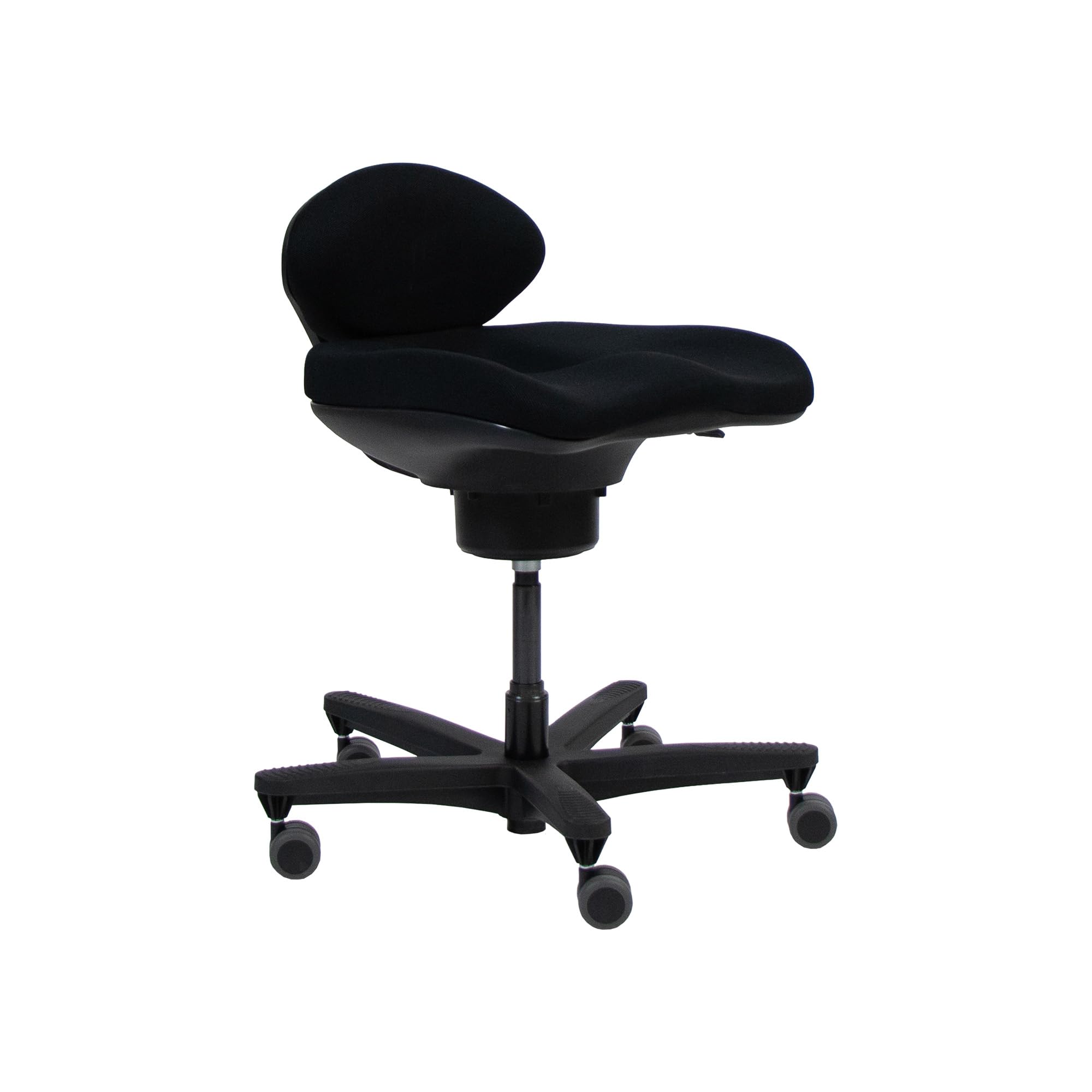
The Vari CoreChair fundamentally reimagines seating for scoliosis by eliminating the fixed backrest and replacing it with a patent-pending tilting mechanism that forces your core muscles to engage continuously. This active sitting approach keeps your spine in a dynamic state rather than allowing it to stagnate in a curved position, which is critical for scoliosis because static loading deepens the curve.
The sculpted seat stabilizes your pelvis at the contact point, while the armless design reduces upper body rotation restrictions. Seat height adjusts from 17 to 21.5 inches and depth from 16.75 to 18.33 inches, ensuring the pelvis remains stable during movement. The 3D knit upholstery allows airflow and distributes pressure.
User feedback describes this as “a chair you hate at first but love after a month” because it actively discourages slouching. It’s best suited for fit users who can tolerate the constant core engagement, and the compact design makes it excellent for standing desk users who alternate between standing and active sitting.
Why it’s great
- Active sitting mechanism prevents static loading of curved spine segments
- Pelvis stabilization reduces rotation transmission to the spine
- Armless design allows unrestricted upper body movement
Good to know
- Requires core strength adaptation period of several weeks
- Not suitable for users who prefer a stable backrest for leaning
5. FLEXISPOT ErgoX-PRO
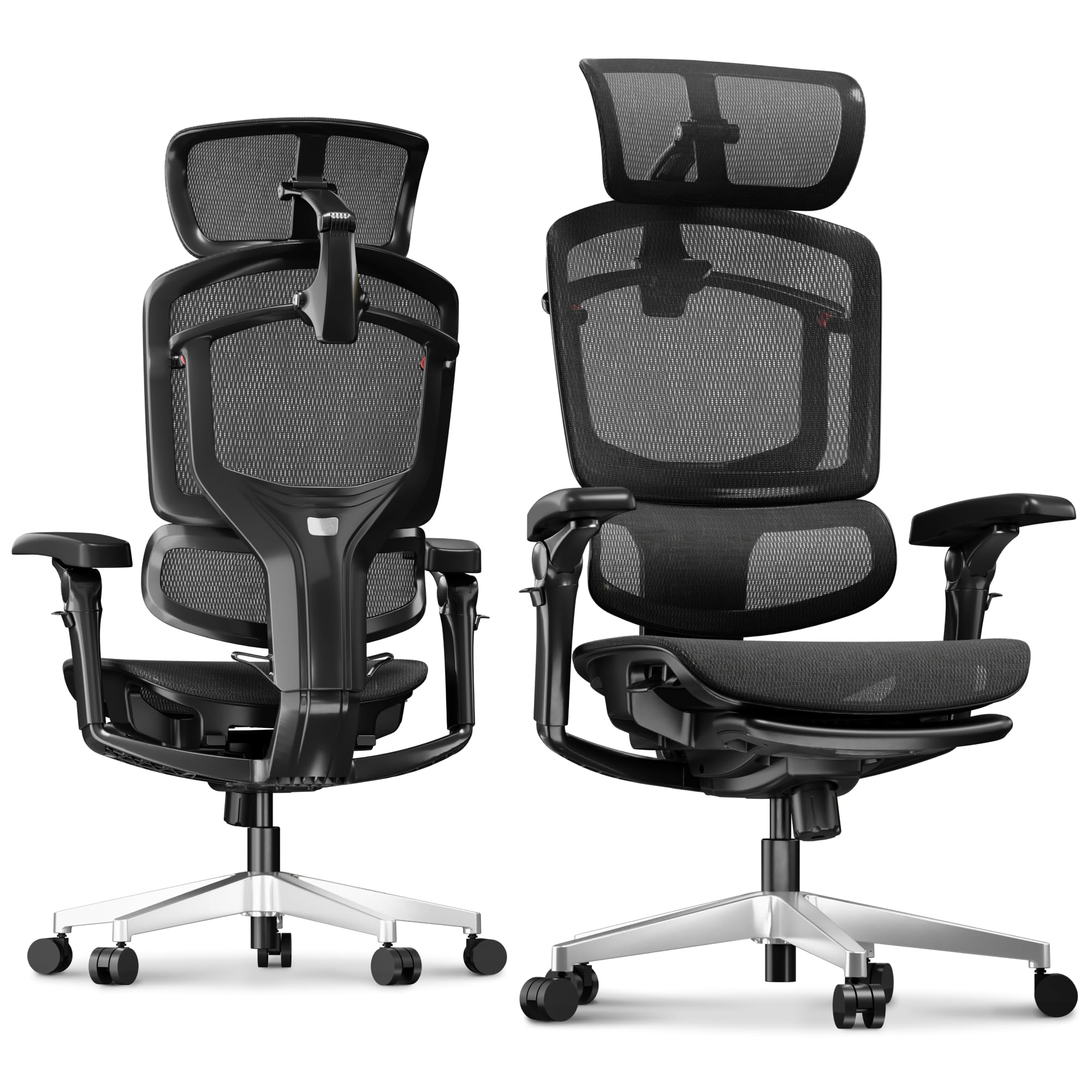
The FLEXISPOT ErgoX-PRO’s 5D lumbar support system is among the most configurable for scoliosis because it allows adjustment in five dimensions including forward projection, height, and rotation. This means you can create a support pocket that cradles the convex side of your curve while providing firm resistance on the concave side.
The AeroWeave 5.0 mesh seat provides breathability and distributes weight across a large surface area, reducing pressure points that can trigger sciatic irritation—a common comorbidity with scoliosis. The 4D headrest can be repositioned to support the neck without forcing the head into a forward tilt that worsens upper cervical curves.
The 7D linkage armrests move with your arms during typing, reducing shoulder tension that often radiates into the thoracic curve. The reinforced nylon frame supports up to 551 pounds, ensuring stability for users who need to shift weight frequently to find comfort.
Why it’s great
- 5D lumbar allows rotational and projection adjustments for curve asymmetry
- Mesh seat reduces pressure points that trigger sciatic flare
- Linkage armrests move with arms to reduce thoracic curve strain
Good to know
- Mesh seat may lack cushioning for users with existing coccyx pain
- Multiple adjustment points can be overwhelming to dial in
6. Newtral Ergonomic Home Office Chair

The Newtral chair’s automatic lumbar tracking technology uses a spring-loaded mechanism that follows your spine’s movement in real time. For scoliosis, this means the lumbar support stays in contact with the curve even as you shift forward or back, preventing the gap that forms between a static lumbar pad and a curved spine when you lean.
The seat depth adjustment allows you to slide the pan forward so the back engages your lower curve rather than your mid-back. The 7-centimeter high-density sponge cushion provides consistent support without collapsing, and the Korea Filo mesh back promotes airflow to prevent sweat buildup during extended sessions.
User reviews note the lumbar mechanism is effective but can make a slight spring noise and may pull on shirts. The 3D armrests are highly adjustable but some users find them easy to bump out of position. The chair’s 96-126 degree tilt lock range allows periodic spine decompression.
Why it’s great
- Auto-following lumbar maintains contact with curve during dynamic movement
- Seat depth adjustment ensures back support engages lower curve
- Back can tilt to allow periodic spine decompression without leaving seat
Good to know
- Spring-loaded lumbar can make noise and pull fabric
- Armrest adjustment locks can be accidentally engaged during use
7. ELABEST Ergonomic Mesh Office Chair

The ELABEST T96 uses a bionic-curve backrest designed to mimic the spine’s natural S-shape. While this is a fixed curve, its design provides better support than flat backs for users with mild to moderate scoliosis because it cradles the spinal column rather than pressing against a single point.
The adjustable lumbar support can be positioned to target the apex of your curve, and the synchro-tilt mechanism with three lockable positions allows you to change the angle of the back relative to the seat. The mesh seat prevents heat buildup, which is beneficial for users who experience temperature sensitivity due to nerve compression.
The 3D adjustable armrests allow width and angle customization that reduces shoulder tension. At this tier, the build quality is solid with BIFMA 5.1 certification, though the lumbar adjustment range is less extensive than premium options. It’s a solid choice for users who need good curve support without the premium price.
Why it’s great
- Bionic-curve backrest cradles the spine’s natural shape
- Adjustable lumbar targets curve apex with height positioning
- Mesh seat prevents overheating for nerve-compression sensitivity
Good to know
- Fixed back curve limits customization for severe curve patterns
- Armrests may feel wide for users with narrow shoulders
8. MOLENTS Ergonomic Office Chair

The MOLENTS chair offers a unique lumbar adjustment system for its price range, allowing both vertical positioning and forward/back projection. This dual-axis adjustment means you can push the lumbar pad deeper into the concave side of your curve while softening it on the convex side—a rare feature at this tier.
The full-mesh construction promotes airflow across the entire back and seat, reducing moisture buildup during extended work sessions. The backrest reclines between 90 and 120 degrees with three lockable positions, allowing you to change spinal loading angles throughout the day.
User reviews consistently praise the customer service responsiveness, with proactive follow-up from the manufacturer. The chair fits users between 5’4″ and 6 feet well, though taller users may find the backrest height limited. The assembly process is straightforward with clear instructions.
Why it’s great
- Dual-axis lumbar adjustment targets both height and projection
- Full-mesh construction prevents heat buildup on back and seat
- Responsive customer support with proactive follow-up
Good to know
- Backrest height may be limited for taller users
- Armrest adjustment range is basic compared to premium models
9. HOMRELEXA Teddy Fleece Chair
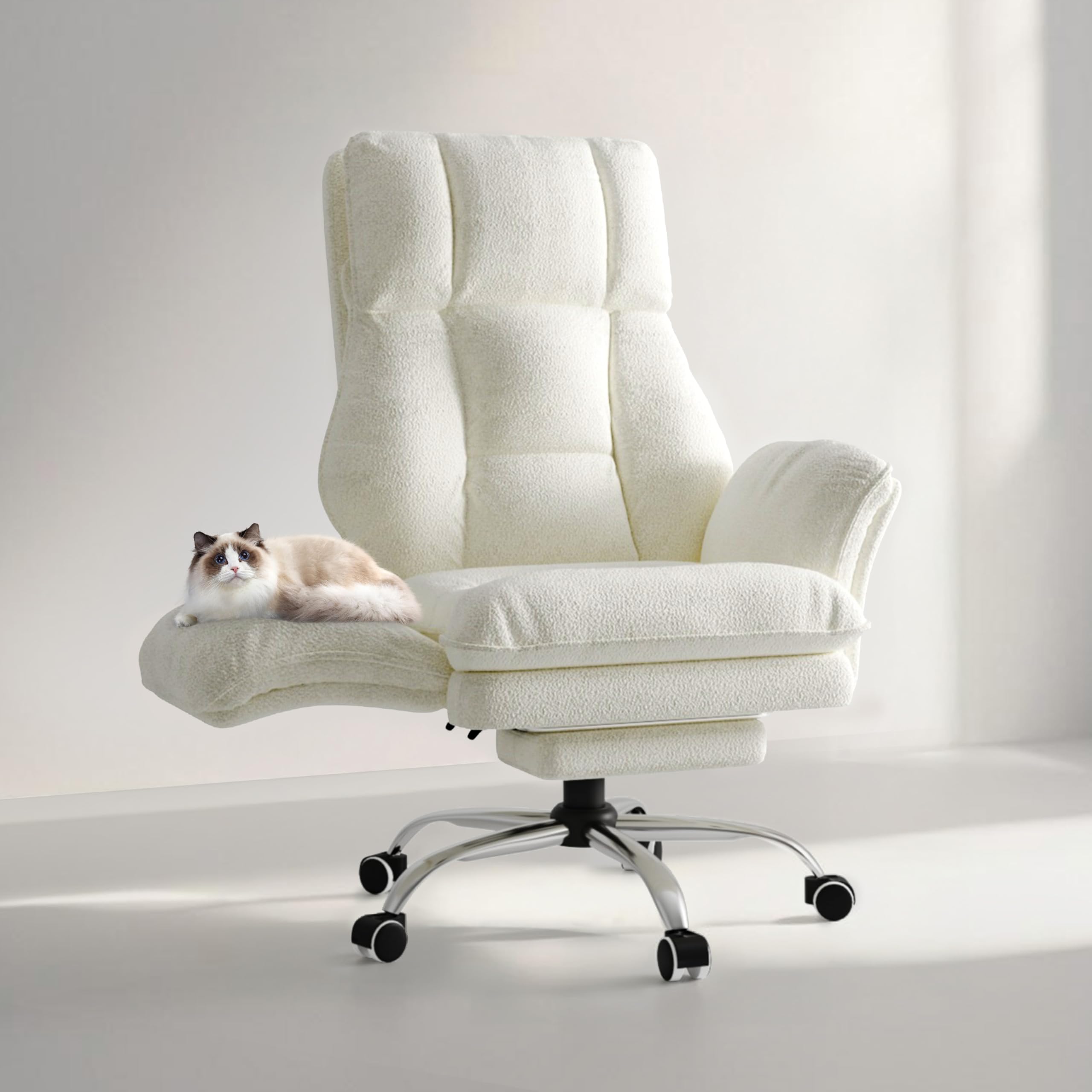
The HOMRELEXA chair’s primary advantage for scoliosis is its wide seat and flip armrests that allow cross-legged sitting positions. Changing sitting positions periodically is crucial for scoliosis because it shifts the gravitational load across different spinal segments, preventing the disc dehydration that occurs from static loading.
The extra-thick coil comfort layer distributes weight evenly across the seat, reducing pressure on the sciatic and sacral areas that are often affected by scoliosis-related nerve compression. The flip armrests expand the seat width from 22.8 to 38.6 inches, creating space for position changes.
The teddy fleece material is soft but may contour to body shape over time, potentially creating uneven support. The chair supports up to 400 pounds with BIFMA-approved base and SGS-certified gas cylinder. It’s best suited for users who value position variety over precision lumbar adjustment.
Why it’s great
- Wide seat and flip armrests allow position changes for load redistribution
- Thick foam layer reduces pressure on sciatic and sacral areas
- Sturdy build supports frequent position changes
Good to know
- Soft material may contour unevenly over extended use
- Limited lumbar adjustability for active curve support
FAQ
Should I choose a chair with a backrest or an active sitting stool for scoliosis?
How often should I adjust my chair settings for scoliosis during the day?
Is a mesh seat or foam cushion better for scoliosis with nerve pain?
Final Thoughts: The Verdict
For most users, the best desk chair for scoliosis winner is the Steelcase Leap because its 3D LiveBack technology conforms to lateral and rotational spine deviations while the Natural Glide System preserves pelvic alignment during recline. If you want active core engagement that dynamically shifts spinal loading, grab the Vari CoreChair. And for a mid-range option with auto-following lumbar that adapts to your movement, nothing beats the Newtral Ergonomic Chair.

Mo Maruf
I created WellFizz to bridge the gap between vague wellness advice and actionable solutions. My mission is simple: to decode the research and give you practical tools you can actually use.
Beyond the data, I am a passionate traveler. I believe that stepping away from the screen to explore new environments is essential for mental clarity and physical vitality.