Our readers keep the lights on and my smoothie glass nicely filled. As an Amazon Associate, I earn from qualifying purchases.
The difference between a chair that hurts your posture and one that fixes it comes down to a single metric: how well its lumbar support tracks the natural S-curve of your spine. Most chairs force your lower back into a flat C-shape, collapsing your pelvis and torquing your cervical spine forward. A well-engineered desk chair actively holds the lumbar curve, keeping your shoulders back, your hips aligned, and your head balanced above your spine—even during the eighth hour of a workday.
I’m Mohammad Maruf — the founder and writer behind WellFizz. I’ve spent hundreds of hours analyzing ergonomic seat mechanics, lumbar adjustability ranges, foam density, and certification standards to understand exactly what separates a posture-supporting chair from a back-pain generator.
Every chair on this list has been evaluated for its ability to maintain natural spinal alignment through adjustable lumbar support, seat depth, armrest positioning, and recline mechanics. This guide will help you find the best desk chair for good posture for your height, weight, and daily sitting habits.
How To Choose The Best Desk Chair For Good Posture
Posture support is not about a thick cushion or a high backrest. It is about how many independent adjustments the chair offers and whether those adjustments actually align your spine under load. Before you click buy, you need to understand three specific mechanisms that determine whether a chair will help or hurt your back.
Lumbar Support Range and Adaptability
The most critical feature for posture is a lumbar support that adjusts both vertically (up and down along your spine) and in depth (inward and outward toward the curve of your lower back). Static lumbar bumps push on the wrong vertebra. Look for at least 2 inches of vertical travel and 0.5 inches of depth adjustment. Adaptive lumbar supports that change position as you recline are a premium feature that prevents the classic “lumbar gap” when you lean back.
Seat Depth and Cushion Geometry
A seat that is too long forces your knees to lock and your pelvis to tilt backward, collapsing the lumbar curve. Adjustable seat depth—usually 2 to 3 inches of travel—lets you set the distance from your back to the front edge so your thighs are fully supported without pressure behind the knees. Waterfall front edges also reduce circulation blocking. Foam density matters: 55D high-density foam resists sagging far better than soft low-density foam that bottoms out after three months.
Recline Mechanics and Synchronized Movement
Good postural chairs allow you to recline without losing lumbar contact. A synchro-tilt mechanism moves the seat and backrest together at a ratio (often 3:1 or 2:1) so your hips stay supported as you lean back. Chairs with a tilt tension knob let you dial resistance to your body weight, preventing the chair from snapping back to upright. Multi-position locks (90°, 105°, 120°, 130°) help you switch between typing, reading, and relaxing without compromising alignment.
Quick Comparison
On smaller screens, swipe sideways to see the full table.
| Model | Category | Best For | Key Spec | Amazon |
|---|---|---|---|---|
| Steelcase Leap | Premium | Full-day ergonomic support | 3D LiveBack + 4D arms | Amazon |
| Ergohuman Eurotech ME7ERG | Premium | Tall users, long durability | 8 adjustments + synchro tilt | Amazon |
| Hbada X7 Smart | Premium | Automated lumbar tracking | 3D auto-lumbar + 8D massage | Amazon |
| FLEXISPOT ErgoX Max | Premium | Heavy-duty build | 661 lb cap + 4D adaptive lumbar | Amazon |
| ProtoArc EC200 | Mid-Range | Adjustable seat depth value | 2.36″ vert / 0.8″ depth lumbar | Amazon |
| GABRYLLY Ergonomic | Mid-Range | Recline with footrest | 135° recline + steel base | Amazon |
| COLAMY Executive | Mid-Range | Plush leather cushioning | 6.7″ thick foam + pop-out lumbar | Amazon |
| ELABEST Mesh Office | Mid-Range | Bionic back contour | 4D armrests + waterfall foam seat | Amazon |
| MOLENTS Ergonomic | Value | Entry-level posture fix | 3D armrests + 90-120° recline | Amazon |
In‑Depth Reviews
1. Steelcase Leap Office Chair

The Steelcase Leap uses its proprietary 3D LiveBack technology, which segments the backrest into flex zones that mimic the natural movement of your spine as you recline. The backrest does not just pivot at one hinge—it actually changes shape along the thoracic and lumbar regions, keeping your vertebrae stacked regardless of whether you lean forward over a keyboard or recline for deep thought. The lower back firmness dial lets you increase or decrease lumbar tension by turning a knob, which is rare even among premium chairs.
The Natural Glide System means the seat pan slides forward as the backrest reclines, preventing your shirt from pulling and your hips from sliding away from the lumbar support. Seven points of adjustment cover seat height, seat depth, back upright tension, armrest height, armrest width, armrest depth, and armrest pivot angle. Reviewers consistently report 10+ years of daily use without structural failure, and many note that the chair actually became more comfortable as the foam broke in over two months.
One common caveat: users under 5-foot-6 report the Leap’s lowest seat height (about 16 inches from the floor) is still too high for their feet to be flat. The chair also arrives fully assembled, which is a major convenience for large-box shipping. If you sit 8+ hours daily and need precise spinal contouring, this is the chair that outlasts all others in both build and alignment.
Why it’s great
- 3D LiveBack mimics natural spine curvature dynamically
- Lower back firmness dial provides on-demand lumbar tension
- Natural Glide System keeps posture consistent during recline
- Fully assembled out of the box
Good to know
- Premium price point, not budget accessible
- Seat height may be tall for users under 5-foot-6
- Fabric can feel scratchy to some; foam is moderately firm
2. Ergohuman Eurotech ME7ERG GEN2 High Back Mesh

The Ergohuman ME7ERG delivers eight independent ergonomic adjustments: seat height, seat depth, angle, back height, back angle, tilt tension, tilt lock, and arm height. The synchro-tilt mechanism uses a 3:1 ratio, meaning the backrest reclines three degrees for every one degree the seat tilts upward. This prevents you from sliding into a slouched pelvis position when you lean back—a common failure in chairs with lazy single-pivot recline.
The mesh back is made from US-manufactured polyester that does not sag or lose tension over years of use. Multiple reviewers report owning this chair for 10 to 15 years, with some exceeding 5,400 hours of sitting time. The lumbar support is dynamic, meaning it flexes with your spine rather than pushing against a fixed point. Users up to 6-foot-5 and 270 pounds report solid, creak-free performance with no back soreness after full-day sessions.
The seat cushion uses high-density foam beneath a mesh outer layer, combining breathability with support. One notable downside: the armrest foam can feel under-supported at the front tip, and the 5mm hex wrench assembly is easier with a power drill attachment. The limited lifetime warranty backs the frame and mechanism, and reviewers who needed replacements received free parts even years after purchase.
Why it’s great
- 8-point adjustability covers back height and seat angle
- Synchro-tilt 3:1 ratio preserves lumbar contact
- Proven 10–15 year lifespan in real user reports
- Excellent for tall and heavier users
Good to know
- Armrest foam can feel soft at the front tip
- Plastic casters are standard, not premium
- No seat tilt up/down independent of recline
3. Hbada X7 Smart Ergonomic Chair
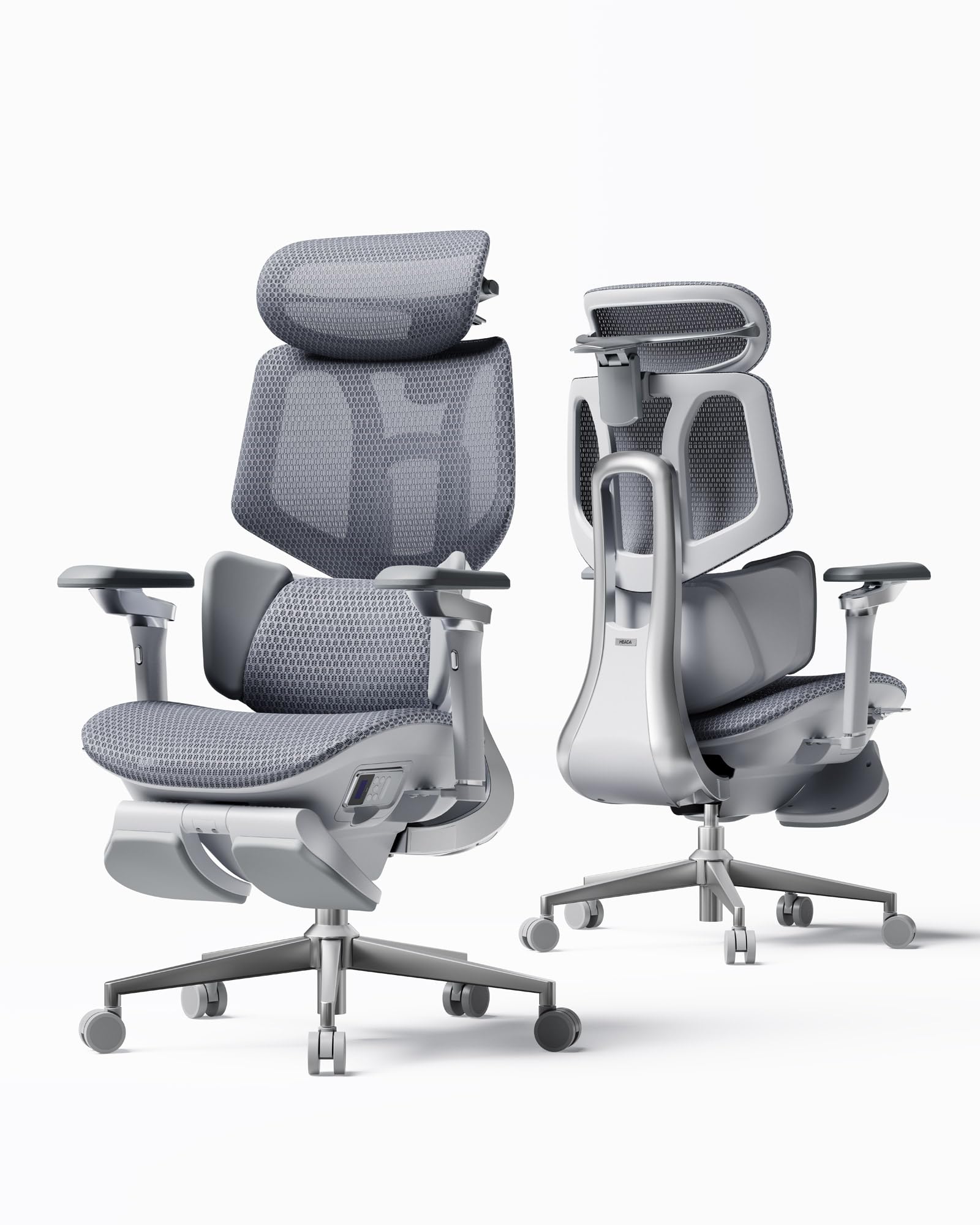
The Hbada X7 is the only chair on this list with a gravity-sensing base that automatically adjusts lumbar support intensity as you shift weight. The 3D auto-adjusting lumbar system uses a 6D adjustable waist pillow combined with 8D massage rollers that offer three levels of heating (104°F to 122°F) . For users who experience lower back tension after four hours of sitting, the massage function provides active relief that no static lumbar pad can match.
The seat integrates a dual-fan cooling system with three speed settings—Silent, Balanced, and Turbo—that draws heat away from the thighs and lower back. The 3D high-resilience mesh seat is rated for 65% better breathability compared to standard mesh chairs. The 720° omnidirectional armrests rotate on a dual axis, extend 110mm horizontally, and lift 50mm vertically. The 140° recline pairs with a footrest for full nap-mode comfort.
Assembly is pre-assembled out of the box—just attach the gas lift and casters. The aluminum alloy frame and 5-star nylon base support up to 330 pounds. A key limitation: users 6 feet tall and above report that the stock gas cylinder prevents them from achieving optimal seat height for proper 90-degree knee angle. Replacing the cylinder solves this, but it is an extra step. The automated lumbar tracking and heating make this chair unique for posture-focused buyers who work in cooler environments.
Why it’s great
- Gravity-sensing auto lumbar adjusts as you move
- 8D massage rollers with 3-level heating
- Dual-fan ventilated seat prevents heat buildup
- 720° armrests for full ergonomic freedom
Good to know
- Stock cylinder may be too tall for users 6 feet+
- Lumbar massage is an added feature, not a replacement for proper adjustability
4. FLEXISPOT ErgoX Max
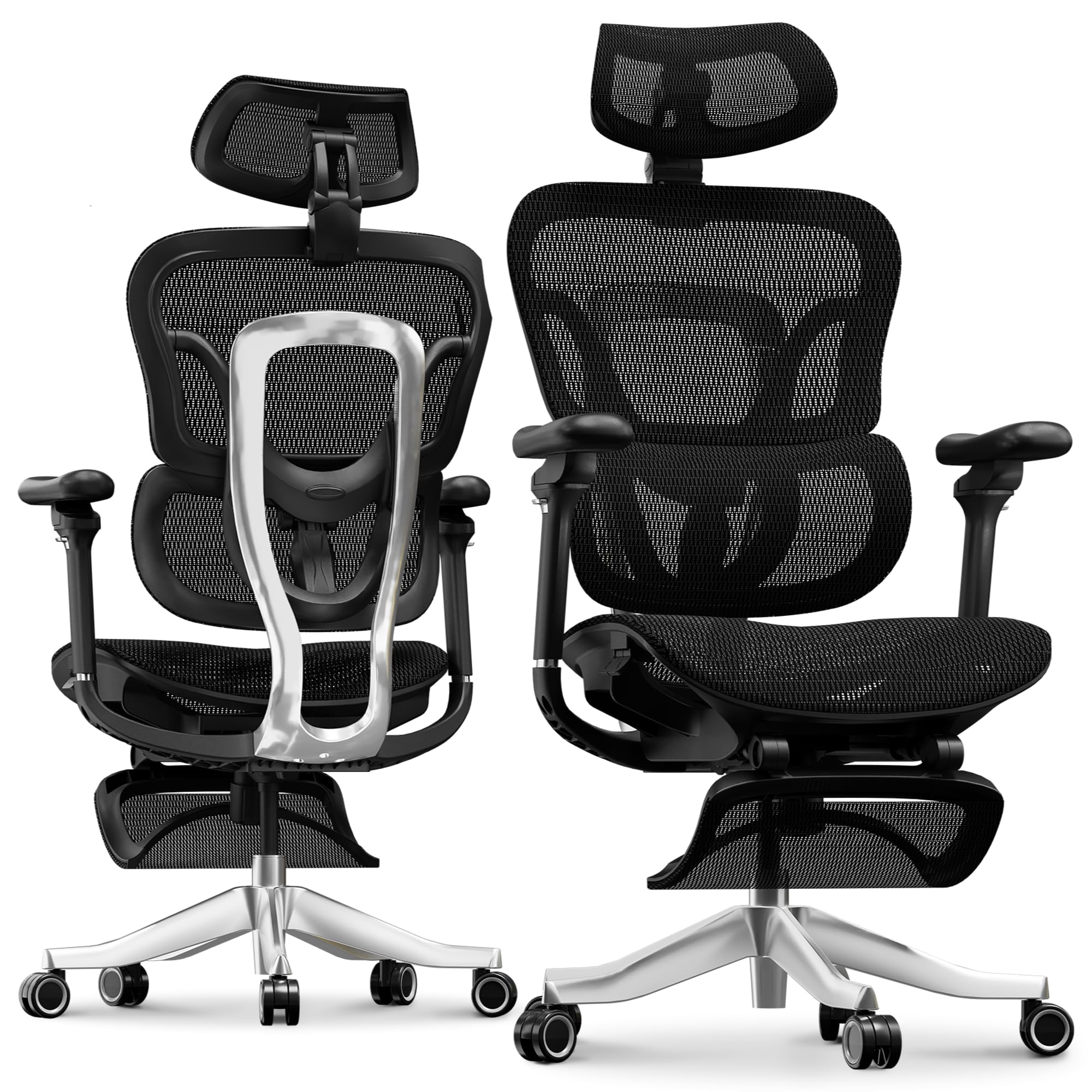
The FLEXISPOT ErgoX Max is built around a full aluminum alloy back frame and aluminum base—a material choice that allows it to support up to 661 pounds without flex or creak. The 4D adaptive lumbar support auto-adjusts to your posture as you move, providing dynamic lower-back alignment without needing to fiddle with knobs every hour. The 5D adjustable armrests offer height, width, depth, angle, and pivot adjustment, matching the adjustability of chairs costing twice as much.
The 5-level back height adjustment means you can raise the entire backrest to match your torso length, which is critical for users over 6 feet whose shoulder blades often land above static backrests. Three recline angles (90°, 110°, 135°) lock into place, and the electroplated chrome casters roll silently on hardwood and carpet alike. The retractable footrest extends 18.1 inches and folds away under the seat, making it one of the few heavy-duty chairs with integrated leg support.
Reviewers praise the chair’s ability to handle severe spine issues, with one user reporting that the backrest helped them maintain work hours despite a herniated disc. The footrest is well-padded but shorter users (5-foot-2) find it a perfect length. The seat cushion feels firm but has a slight squishy top layer—50D high-density foam with a 2-inch memory foam topper. Assembly takes 20 minutes with labeled hardware.
Why it’s great
- 661 lb weight capacity with aluminum alloy frame
- 4D adaptive lumbar auto-conforms to your posture
- 5-level back height adjustment fits long torsos
- Integrated retractable footrest for napping
Good to know
- Headrest requires re-adjustment when chair is reclined
- Footrest cannot be used when leaning back without tilting forward
5. ProtoArc EC200 Ergonomic Office Chair
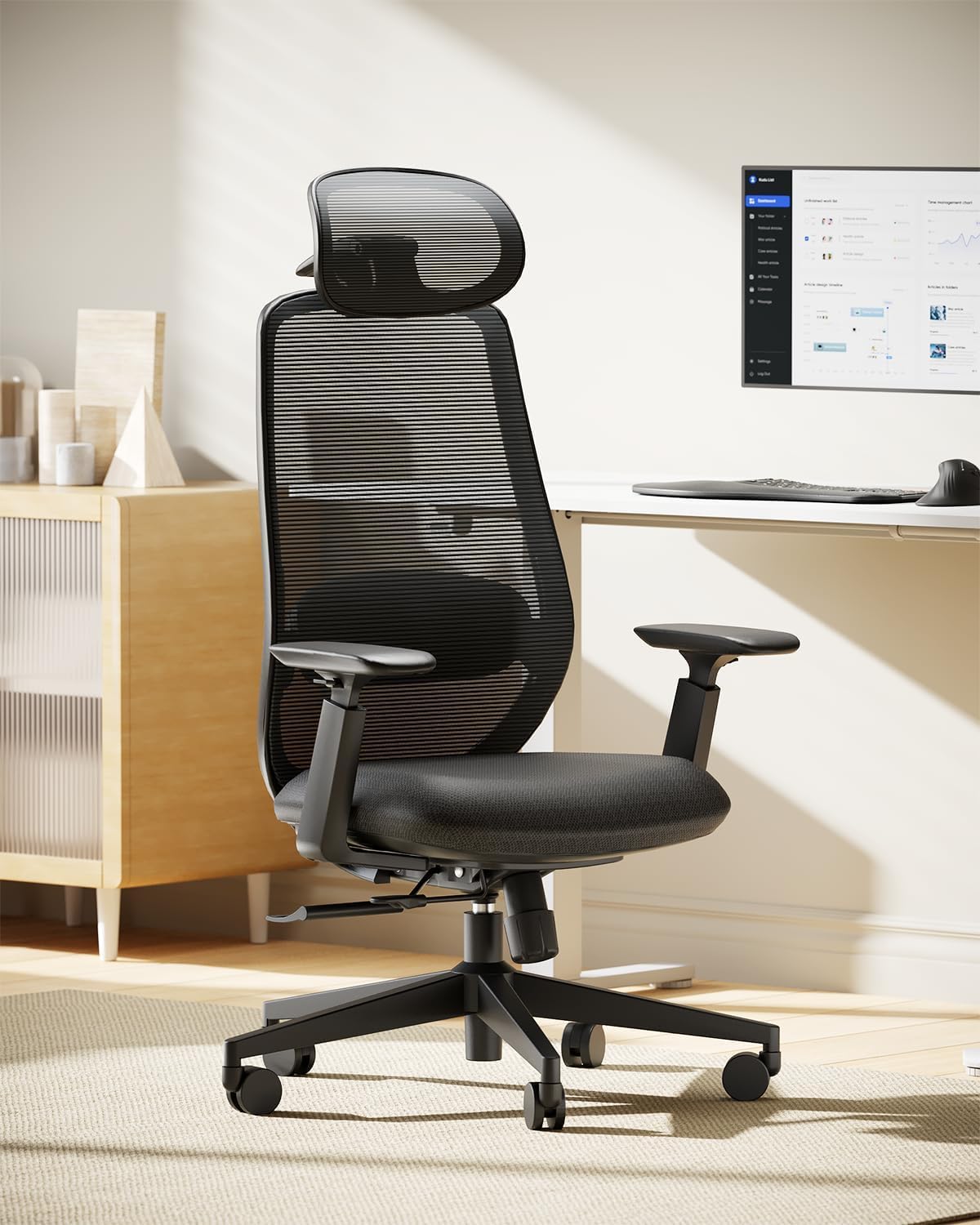
The ProtoArc EC200 brings a feature rarely found at its price tier—adjustable seat depth. The 5-position sliding seat provides 1.97 inches of travel with instant lock, allowing users between 5-foot-4 and 6-foot-0 to properly support their thighs without pressure behind the knees. The 55D high-density foam seat cushion is deliberately firm, resisting the sagging that occurs within months on softer budget chairs.
The 3-point ergonomic support system aligns head, back, and lumbar. The lumbar support adjusts 2.36 inches vertically and 0.8 inches in depth, filling the gap between your lower back and the mesh. The 3D wider headrest offers 3.94 inches of height adjustment, 2.76 inches of depth, 75° pivot, and 35° rotation, cradling the cervical spine without pushing your head forward. The breathable mesh back keeps the entire back cool during long coding sessions.
The 4-stage recline locks at 90° (typing mode), 105° (reading mode), 120° (call mode), and 130° (relax mode). The tilt tension knob lets you dial resistance to your weight. Assembly is designed to take 20 minutes with color-coded hardware and an ergonomic tool. Reviewers note that users slightly below 5-foot-4 may find the seat depth still too long, and bare feet sometimes hit the wheel arms when sitting cross-legged.
Why it’s great
- Adjustable seat depth with 1.97 inch travel in this price range is rare
- 55D high-density foam prevents premature sagging
- 4-stage recline locks for typing, reading, calls, and relaxation
- Breathable mesh back keeps you cool 8+ hours
Good to know
- Minimum recommended height is 5-foot-4; shorter users may struggle
- Lumbar extends 0.8 inch depth; users with deep lumbar curve may need more
6. GABRYLLY Ergonomic Office Chair with Footrest
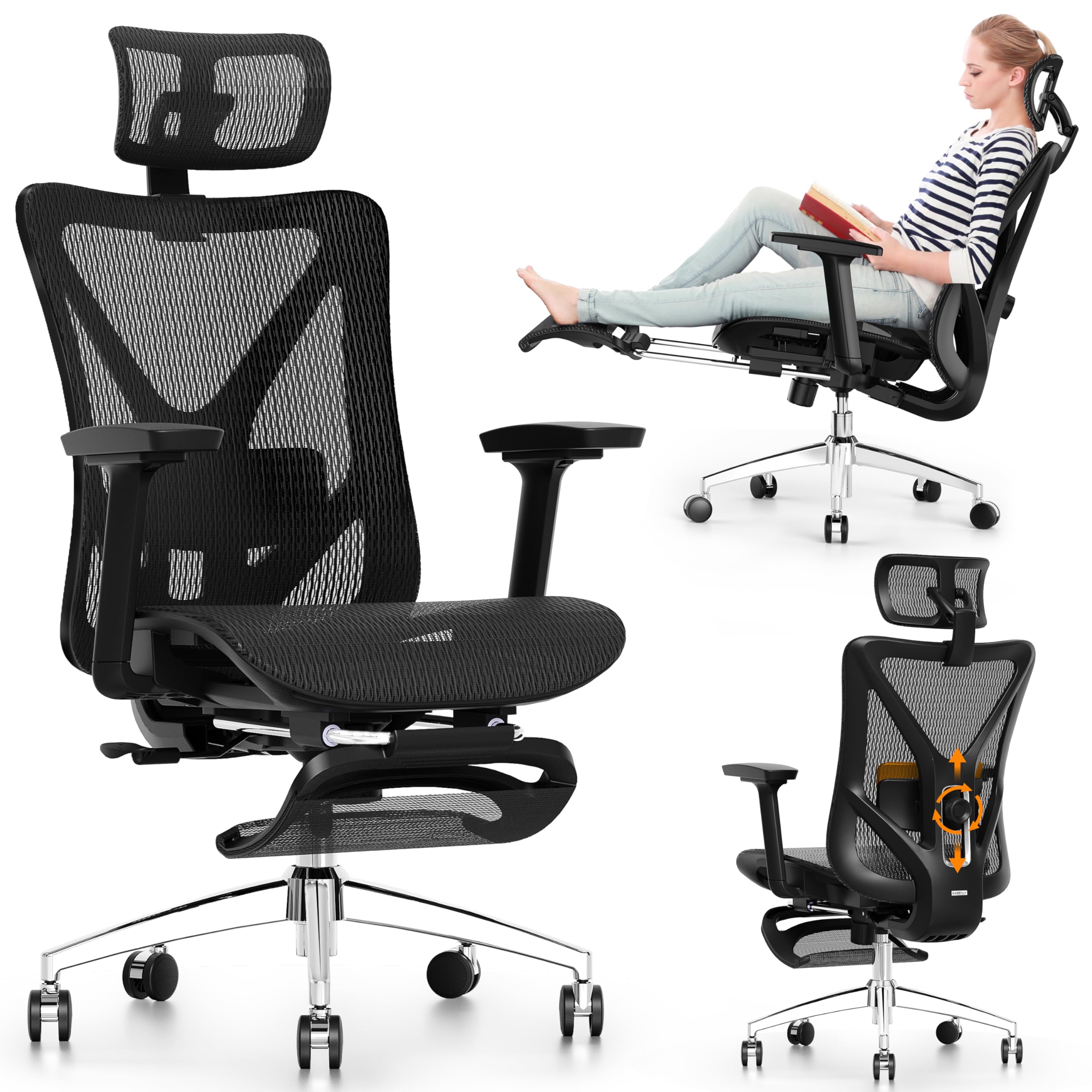
The GABRYLLY Ergonomic Office Chair offers a 135-degree recline with three lockable positions (90°, 110°, 135°) and an integrated steel footrest that extends 18.1 inches. The footrest is sturdy enough to support your full leg weight without sagging, making this chair one of the few mid-range options that genuinely function as a napping station without sacrificing daily task posture.
The 2-way adjustable lumbar support moves 3 inches vertically and 1.6 inches horizontally, providing a larger adjustment range than many chairs in its class. The large mesh headrest adjusts in three dimensions (height, angle, bracket) for personalized neck support. The 3D adjustable armrests move up-down, front-back, and in-out, though some users report that the armrests shift position unintentionally when leaned on heavily—a minor irritation for an otherwise well-built chair at this price.
The all-mesh back and seat provide superior airflow for hot climates. The 27.5-inch diameter steel base with smooth silent casters offers excellent stability even during full recline. Assembly takes 15 to 25 minutes. The 300-pound weight capacity and SGS/BIFMA testing provide confidence for larger users. One downside: the mesh tension is high, meaning thinner users may find the seat surface taut compared to cushioned alternatives.
Why it’s great
- 135° recline with stable steel footrest for napping
- Lumbar adjustment range (3 in. vert / 1.6 in. horiz) is generous
- Large steel base provides excellent stability during recline
- All-mesh design keeps you cool in warmer environments
Good to know
- Armrests can shift position unintentionally under heavy leaning
- Mesh tension is firm; may feel taut for lighter users
- Armrests do not flip up or fold back for storage
7. COLAMY Office Ergonomic High Back Executive Chair

The COLAMY Executive Chair prioritizes cushion depth above all else. The 6.7-inch thick seat cushion uses high-density foam that delivers a plush yet resilient feel—significantly thicker than the average 3-4 inch foam found in most chairs. The waterfall front edge reduces thigh pressure and improves blood circulation during extended sitting. The pop-out lumbar support engages with a button push, protruding forward to fill the lumbar gap, and retracts flush with the back when not needed.
The flip-up arms allow the chair to be pushed fully under a desk, freeing floor space—a practical feature for compact home offices. The adjustable headrest moves in height and angle, and the upholstered leather surface wipes clean easily. The heavy-duty metal base supports up to 300 pounds, and the upgraded casters roll silently without scratching floors. Reviewers consistently praise the seat comfort for long hours (8+), noting the lumbar support is effective but not aggressive—better for mild lower back fatigue than severe lumbar issues.
One significant concern: a minority of users report a defective headrest button that causes the headrest to drop to its lowest position, hitting the upper spine at the T4 vertebra. The lumbar pad is wide and padded rather than contoured, which may not provide enough targeted pressure for users with deep lumbar curves. Assembly takes 20 to 30 minutes with clear instructions.
Why it’s great
- 6.7 inch thick cushion delivers luxury-level plush comfort
- Pop-out lumbar support engages on demand, retracts when not needed
- Flip-up arms save desk space when chair is pushed under
- Waterfall front edge reduces thigh pressure and improves circulation
Good to know
- Headrest button defect reported in some units
- Lumbar pad is wide and flat, not contoured for deep lumbar curves
- Armrest height may be too low for desks taller than 30 inches
8. ELABEST Mesh Office Chair
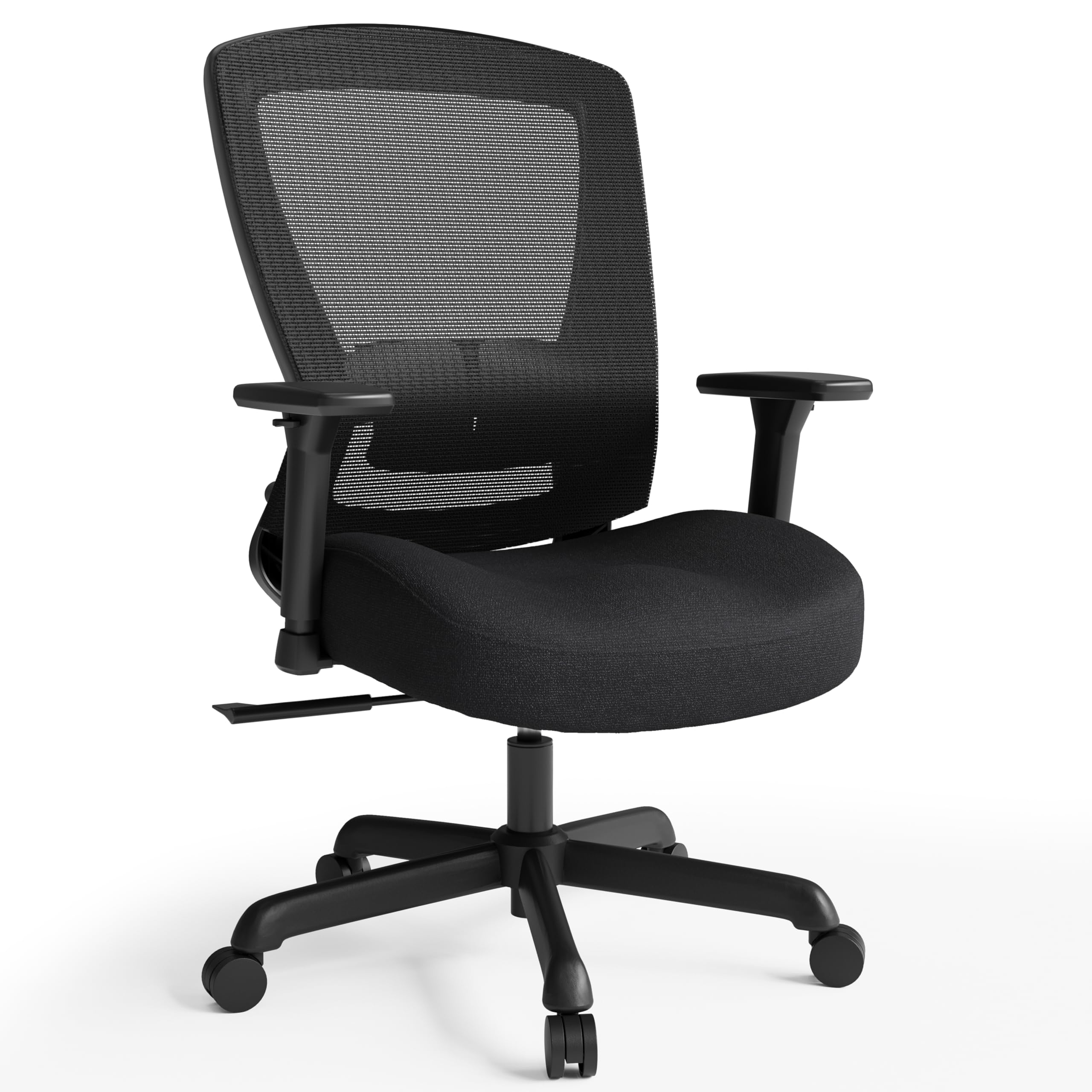
The ELABEST features a bionic backrest that mimics the natural segmentation of the human spine. The backrest is divided into vertical flex sections that move independently, allowing the chair to contour to your upper and lower back differently as you lean side to side or shift weight. The built-in adjustable lumbar pad targets the exact curve of the lumbar region, relieving the “chair fatigue” that builds during long coding or meeting sessions.
The high-density molded foam seat uses a pressure-zone design with contoured thigh recesses and a raised front-center ridge—a shape that promotes blood flow and reduces numbness during 8+ hour workdays. The 4D armrests move in height, width, angle, and lateral slide (side to side), letting you align your forearms perfectly with your keyboard to reduce shoulder strain. The “Golden Triangle” upper back structure provides stable shoulder support for typing-intensive days.
BIFMA 5.1 certification confirms the chair meets commercial-grade durability standards. The seat height range (19 to 22.8 inches) fits desks from standard to slightly taller. Reviewers note that the armrests are too wide for users with narrow shoulders out of the box, but the manufacturer provides rotating armrest replacements upon request. The foam seat is firmer than many mesh-perch chairs, which is a plus for posture but may require a break-in period of about two weeks.
Why it’s great
- Bionic segmented backrest contours independently to upper and lower back
- 4D armrests slide laterally for perfect keyboard alignment
- Pressure-zone foam seat reduces numbness during long sits
- BIFMA 5.1 certified for commercial-grade durability
Good to know
- Armrests are wide by default; rotating replacements available on request
- Foam seat requires a break-in period for optimal comfort
- Best for users between 5-foot-5 and 5-foot-10
9. MOLENTS Ergonomic Office Chair

The MOLENTS Ergonomic Office Chair is the most accessible entry point on this list, offering essential posture features without the price escalation of premium models. The adjustable lumbar support moves up-down and forward-backward, providing a tailored lower back fit that many budget chairs skip entirely. The 3D adjustable armrests move in height, width, and angle, giving you enough freedom to keep elbows at 90 degrees while typing.
The premium breathable mesh back uses high-elastic polyester that does not trap body heat, keeping you dry during warmer months. The seat cushion uses shaped sponge foam that is firm enough to prevent bottoming out but softer than high-density foam options. The backrest reclines from 90 to 120 degrees with three lockable positions, letting you toggle between upright typing and relaxed reading without losing lumbar contact.
Assembly takes under 15 minutes with clearly labeled parts. The manufacturer (MOLENTS) is known for proactive customer service—multiple reviewers mention receiving follow-up emails from a representative named Alice who confirmed warranty details and offered a free foam seat cover. One limitation: the armrest panels slide forward and backward, which some users prefer to lock; MOLENTS offers a fixed panel replacement on request. The wheels roll smoothly on hardwood but can be sticky on thick carpet.
Why it’s great
- Adjustable lumbar support with vertical and depth movement at low cost
- Breathable mesh back prevents heat buildup in warm climates
- Exceptional customer service with proactive follow-up and free parts
- 3D armrests adjust in height, width, and angle
Good to know
- Armrest panels slide forward/backward; fixed replacements available on request
- Wheels may be sticky on thick carpet
- Seat cushion is softer than high-density foam; may compress over long periods
FAQ
Does a mesh back provide better posture support than a padded back?
How do I know if the seat depth is right for my leg length?
Is a higher recline angle better for posture?
Can a chair correct bad posture if I have existing back pain?
Final Thoughts: The Verdict
For most users, the desk chair for good posture winner is the Steelcase Leap because its 3D LiveBack technology actively conforms to the spine’s natural shape while the lower back firmness dial lets you dial in precise lumbar tension, all backed by a 15-year track record of real-world durability. If you want automated lumbar adjustment without manual fiddling, grab the Hbada X7 Smart for its gravity-sensing lumbar tracking and built-in massage. And for a mid-range option that delivers adjustable seat depth and 55D high-density foam, nothing beats the ProtoArc EC200.

Mo Maruf
I created WellFizz to bridge the gap between vague wellness advice and actionable solutions. My mission is simple: to decode the research and give you practical tools you can actually use.
Beyond the data, I am a passionate traveler. I believe that stepping away from the screen to explore new environments is essential for mental clarity and physical vitality.