Our readers keep the lights on and my smoothie glass nicely filled. As an Amazon Associate, I earn from qualifying purchases.
Eight hours in a chair that doesn’t fit your spine means each minute adds tension to your lower back and neck. The gap between your lumbar curve and the backrest forces your shoulders forward, and a headrest that only touches the top of your skull does nothing for the cervical strain that builds by midday. That cycle of pressure and compensation is what makes a standard office chair the wrong tool for anyone dealing with back and neck pain.
I’m Mohammad Maruf — the founder and writer behind WellFizz. I’ve spent hundreds of hours dissecting the ergonomic specifications, foam density ratings, adjustment axes, and recline mechanisms that separate a supportive chair from one that simply looks the part.
This guide breaks down nine models engineered with targeted lumbar curves, multi-axis headrests, and adjustable seat depths that let your legs rest flat instead of dangling. Your search for the best desk chair for back and neck pain ends with a clear comparison of the specs that actually reduce spinal and cervical load.
How To Choose The Best Desk Chair For Back And Neck Pain
Buying a chair purely on padding thickness or brand name is the fastest route to another year of backaches. For genuine spinal and cervical relief, you need to evaluate the mechanical adjustments that let the chair conform to your unique dimensions, not the other way around.
Lumbar Support That Actually Moves
A fixed lumbar bump works for exactly one body type — and that type is rarely you. Look for a chair that offers both vertical and horizontal lumbar adjustment. Vertical movement (at least two inches) lets the support pad align with the natural inward curve of your lower spine, while horizontal depth (at least half an inch) lets you increase or decrease how much it pushes into your back. Without both axes, the lumbar support either misses your curve entirely or presses too aggressively.
Headrest Adjustability Beyond Height
Many chairs advertise a headrest but only let you move it up and down, which does nothing for the forward-head posture that causes upper neck pain. A true neck-relief headrest must offer depth (forward/backward) and tilt angle adjustment in addition to height. This multi-axis control lets the pad cradle the cervical curve right at the base of your skull, not just brush the crown of your head.
Seat Depth and Thigh Support
When the seat pan is too long, the front edge presses into the back of your knees, forcing you to scoot forward and lose contact with the lumbar support. A sliding seat with at least two inches of range fixes this. Combined with a waterfall front edge (a curved drop-off that reduces pressure behind the knees), proper seat depth keeps your pelvis neutral and your lower back engaged with the lumbar pad for the entire workday.
Quick Comparison
On smaller screens, swipe sideways to see the full table.
| Model | Category | Best For | Key Spec | Amazon |
|---|---|---|---|---|
| ProtoArc EC300 | Mid-Range | Sacrum & Lumbar Coverage | 55 High-Density Foam + 5-Position Seat Depth | Amazon |
| Branch Ergonomic Chair Pro | Premium | Ultimate Adjustability | 14 Adjustment Points + 5D Armrests | Amazon |
| GABRYLLY Ergonomic Chair | Mid-Range | Napping / Leg Support | 135° Recline + Retractable Footrest | Amazon |
| ProtoArc EC200 | Mid-Range | Custom Lumbar & Seat Depth | 4-Position Seat Depth + 2-Way Lumbar | Amazon |
| ELABEST T96 | Mid-Range | Shoulder & Upper Back | Golden Triangle Shoulder Frame + BIFMA 5.1 | Amazon |
| MOLENTS Ergonomic Chair | Mid-Range | Breathable Full Mesh | Full Mesh Seat + 3D Armrests | Amazon |
| SIHOO M18 | Mid-Range | Budget-Friendly Reliability | 330lbs Capacity + BIFMA Certified | Amazon |
| CASASIO Ergonomic Chair | Value | Virgin Foam Cushioning | 3.5-Inch Virgin Foam + 300lbs Capacity | Amazon |
| Branch Ergonomic Chair | Premium | Executive Aesthetics | Aluminum Frame + 8-Point Adjustment | Amazon |
In‑Depth Reviews
1. ProtoArc EC300 Ergonomic Office Chair
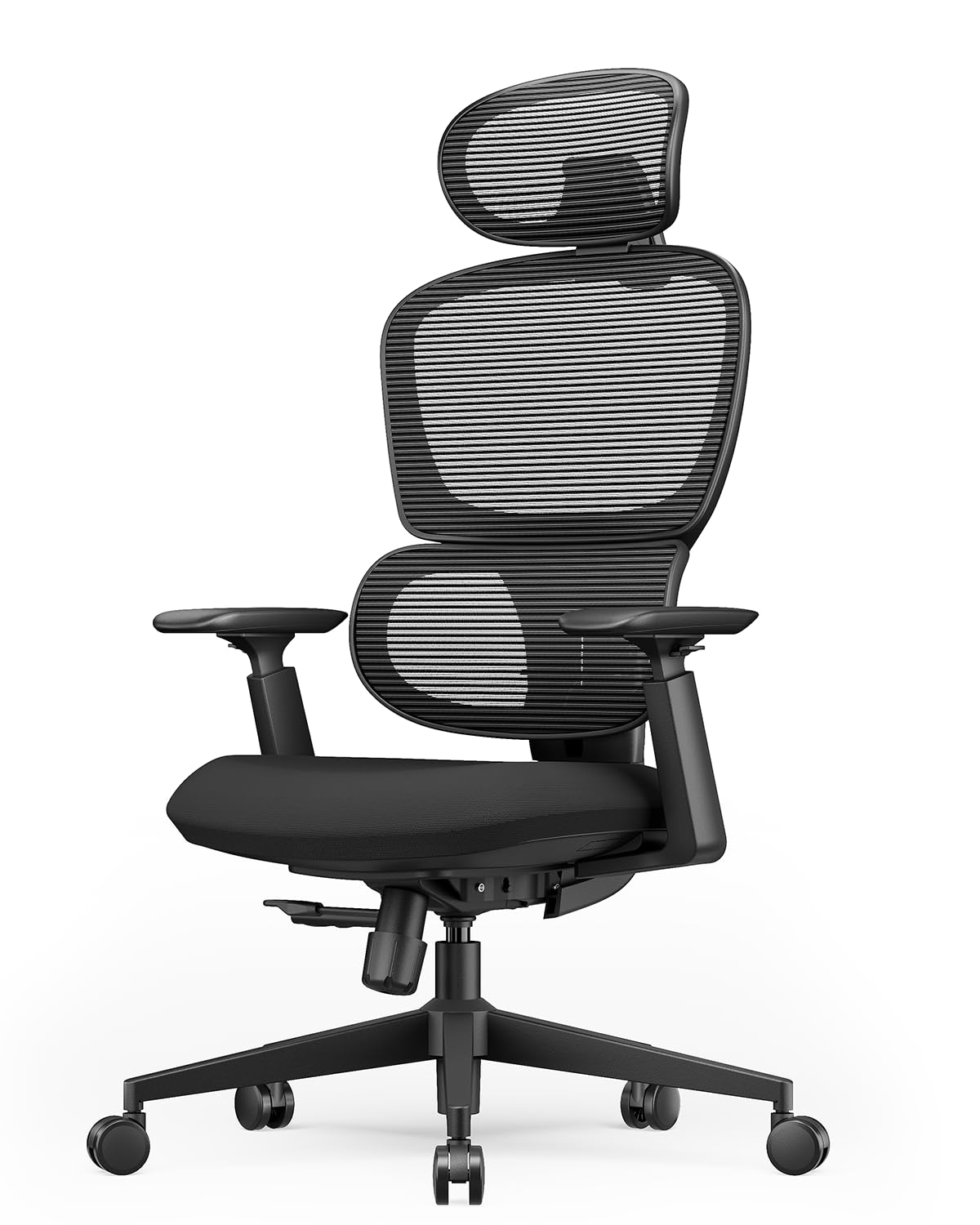
The EC300 distinguishes itself with two design choices that directly target the root causes of back and neck strain. First, the lumbar support is engineered to cradle both the lumbar spine and the sacrum with a wider contact surface, providing lower-back coverage that narrow or floating lumbar pads miss. Second, the backrest itself adjusts through five height settings, allowing the support zones to align perfectly with your torso length rather than forcing your spine to conform to a fixed backrest.
The 55 high-density foam seat resists sagging noticeably better than standard polyurethane. With a five-position slide that offers roughly two inches of adjustment range, you can dial in thigh support so the front edge never presses behind your knees — a critical detail for maintaining a neutral pelvis that keeps your lumbar curve engaged. The 3D headrest adds independent pillow rotation beyond simple height and depth, letting you tilt the pad to meet your cervical curve rather than craning your neck forward to meet the headrest.
Four locked recline positions (90°, 105°, 120°, 130°) with adjustable tilt tension cover everything from upright typing to afternoon lounging. The alloy base and SGS Class-4 gas lift deliver stability comparable to chairs costing twice as much. Assembly takes about 30 minutes with clearly labeled parts.
Why it’s great
- Height-adjustable backrest tailors lumbar and thoracic support to torso length
- Sacrum-wide lumbar pad reduces lower-back pressure points
- Premium 55 high-density foam resists compression and maintains thigh support
Good to know
- Rated for users up to 220 lbs, which may limit larger frames
- Armrests adjust in height only — no width or angle movement
2. Branch Ergonomic Chair Pro
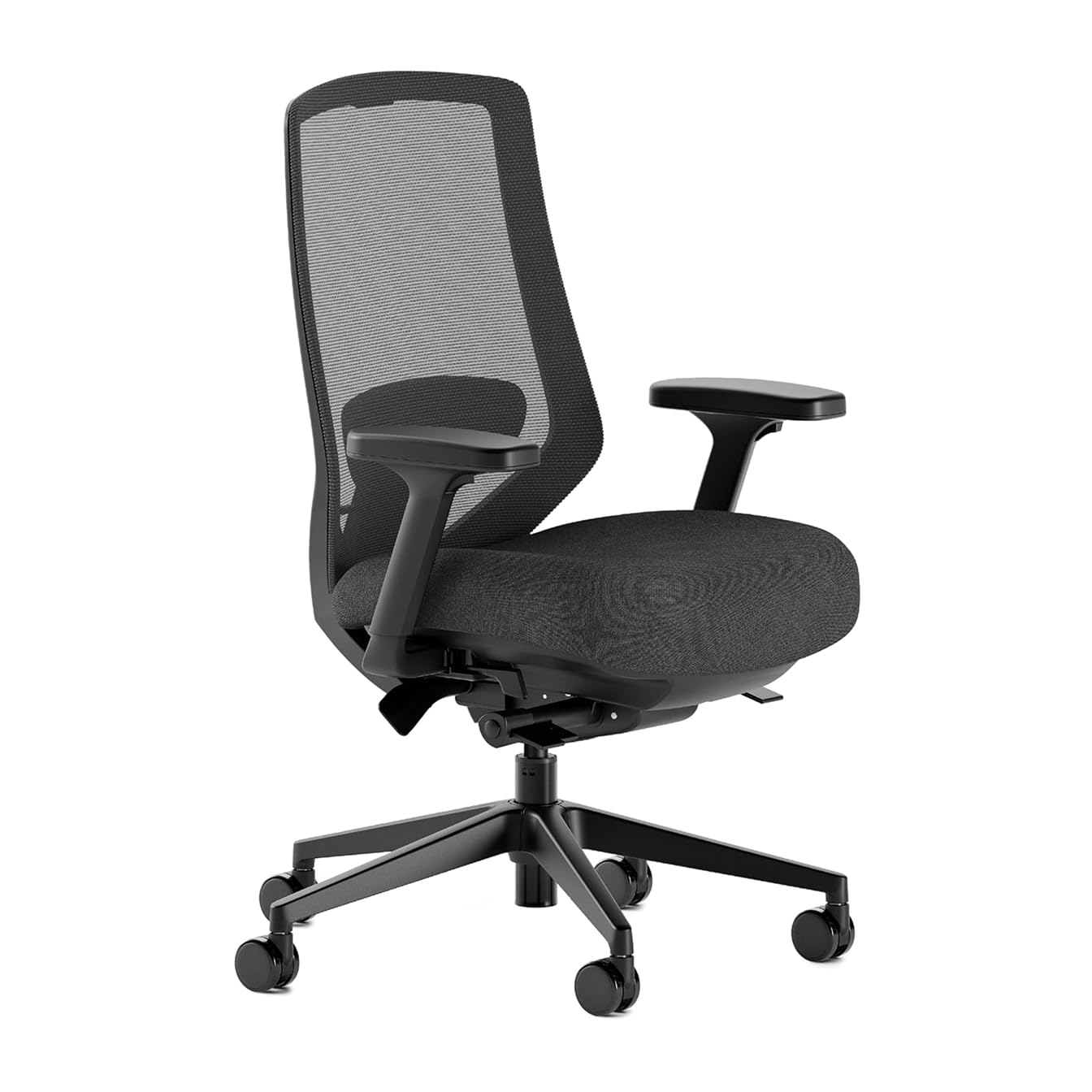
With 14 distinct points of adjustment, the Branch Ergonomic Chair Pro offers the highest degree of personalization in this roundup. The 5D armrests go beyond typical 3D designs by adding pivot and pad-position movement, allowing you to rest your forearms in a neutral, shoulders-back posture that directly reduces tension in the upper trapezius and neck. That level of arm support is rare in sub-premium chairs and makes a measurable difference for users who type for extended hours.
The two-way lumbar cushion adjusts vertically to match your spine’s natural curve and uses a padded surface rather than a hard plastic bracket, avoiding the uncomfortable pressure that some aggressive lumbar supports create. The forward-tilt feature is another standout — it tilts the entire seat pan forward, encouraging an open hip angle that reduces lower-back compression during focused work. The molded high-density foam cushion distributes weight evenly and maintains its shape through all-day use without the bottoming-out sensation that plagues cheaper foam.
Users under 5’6” report that the chair accommodates their frame exceptionally well, thanks to the adjustable seat depth that fully supports the thighs without knee pressure. The headrest is sold separately, which is worth noting if neck support is a non-negotiable requirement from day one.
Why it’s great
- 14 adjustment points allow fine-tuning for nearly any body dimension
- 5D armrests reduce shoulder and neck strain through full foreman support
- Forward-tilt mechanism promotes active sitting and open hip angle
Good to know
- Headrest is an optional add-on, not included
- Some users report the seat cushion feels firm for the first week
3. GABRYLLY Ergonomic Office Chair with Footrest
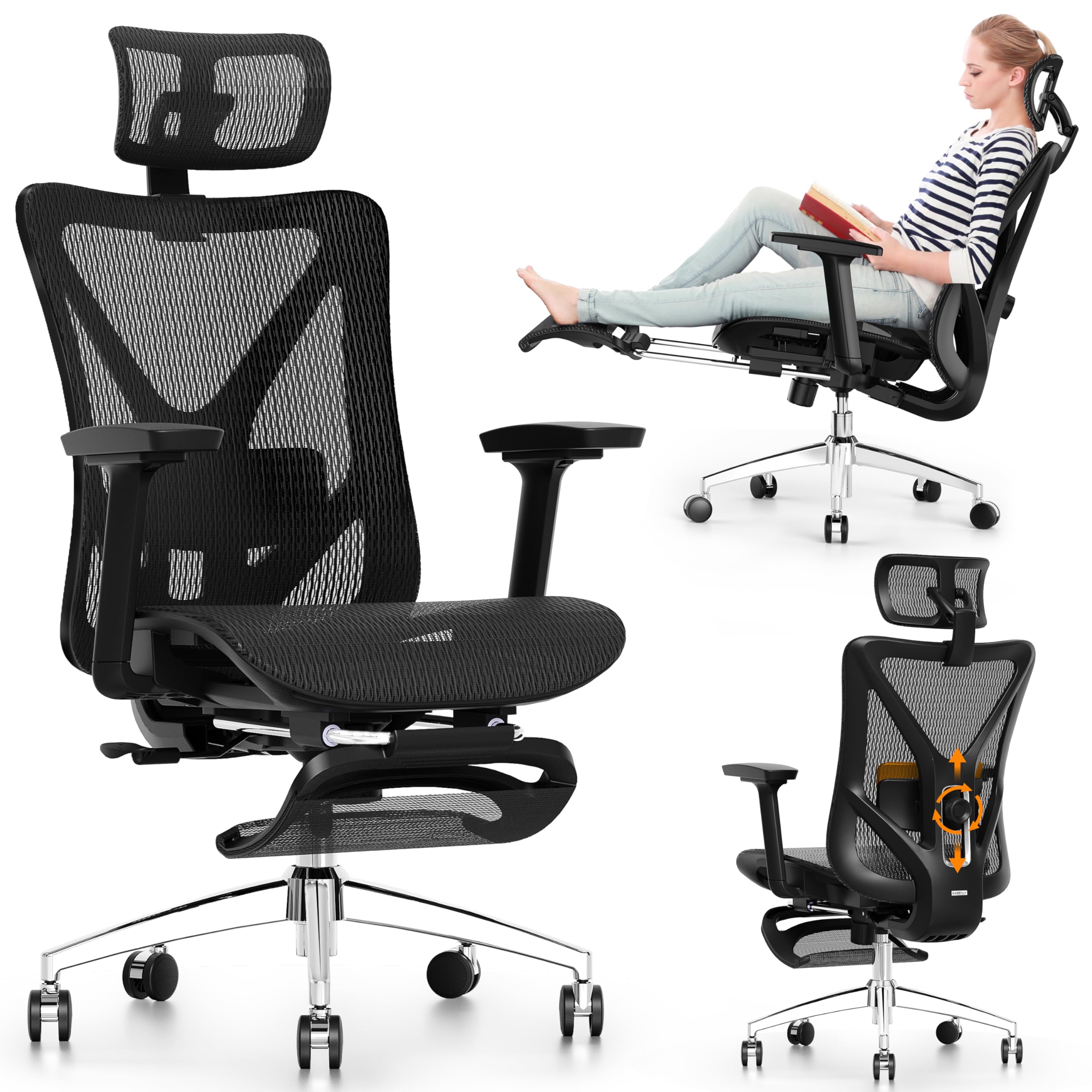
What sets the GABRYLLY apart is the retractable steel footrest that extends 18.1 inches for stable leg elevation, combined with a 135° recline. For users whose back and neck pain worsens because they cannot properly decompress their spine during breaks, this chair converts from a work station to a nearly-flat lounger without leaving your desk. The three-position lock (90°, 110°, 135°) lets you choose a micro-break angle without losing seat depth or lumbar contact.
The 2-way lumbar support adjusts 3 inches vertically and 1.6 inches horizontally, providing enough range to hit the lordotic curve for users between 5’3” and 6’ tall. The 3D armrests (up/down, forward/back, in/out) reduce shoulder hunching during tasks that require sustained arm engagement. The large mesh headrest offers three axes of adjustment — height, angle, and bracket rotation — which is the kind of cervical support needed to prevent forward-head posture during reclined breaks.
The steel base with a 27.5-inch diameter provides exceptional stability when the chair is fully reclined, and the quiet casters roll smoothly on hard floors. Assembly takes 15–25 minutes, and the 3-year parts warranty adds long-term confidence. The mesh is taut, which some users find firm for extended sitting without a cushion.
Why it’s great
- Retractable steel footrest enables genuine spinal decompression during breaks
- 3D headrest with bracket rotation cradles the cervical curve
- Steel base and 300 lb capacity provide stable recline support
Good to know
- Armrests shift under pressure and lack a locking mechanism
- Taut mesh may feel firm for users who prefer plush cushioning
4. ProtoArc EC200 Ergonomic Office Chair
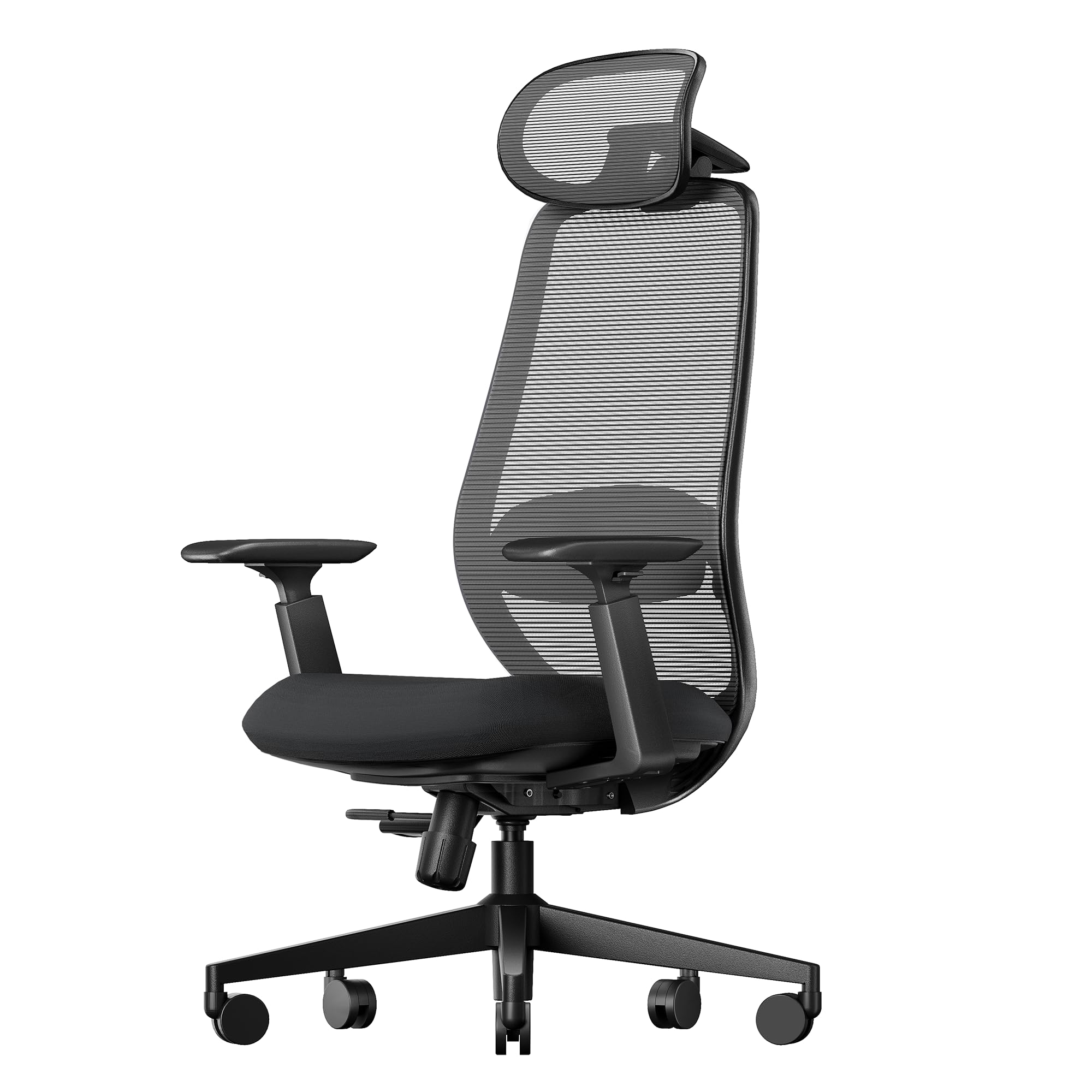
The EC200 focuses its engineering budget on the adjustments that matter most for back and neck relief: a 4-direction lumbar support (2.36-inch height and 0.8-inch depth) and a 5-position sliding seat with instant lock. The lumbar support is designed to reduce lower-back strain by up to 50% through high-strength mesh that contours to the spine rather than pushing against it with a rigid pad. That distinction matters for users who find traditional lumbar pads too aggressive.
The seat cushion uses 55-density high-resiliency foam that is intentionally firm — soft cushions collapse under sustained weight, forcing the hips to tilt backward and flatten the lumbar curve. The slightly firm surface keeps your pelvis in a neutral position, and the breathable top layer prevents the heat buildup that often accompanies dense foam. The 3D dual-axis headrest adds height, depth, and rotation adjustments that let you tuck the pad under the occipital ridge for genuine cervical support.
The chair meets BS EN 1335 and BIFMA X5.1 standards, and the TÜV Rheinland-tested Class 4 gas lift ensures smooth, reliable height adjustment over years of use. Assembly takes roughly 20 minutes with a visual guide. Some users note the seat cushion remains firm even after a break-in period, and the armrests adjust in height only.
Why it’s great
- 4-direction lumbar support contours to the spine rather than pushing against it
- 55-density foam resists sagging and maintains pelvic neutrality
- BIFMA X5.1 and TÜV Rheinland certification ensure long-term reliability
Good to know
- Armrests adjust in height only, not width or angle
- Cushion remains firm and may feel too hard for lightweight users
5. ELABEST Ergonomic Mesh Office Chair T96

The ELABEST T96 addresses an often-neglected source of neck pain: shoulder and upper-back fatigue from sustained typing and coding. Its “Golden Triangle” back structure provides targeted reinforcement for the upper back and shoulder blades, preventing the rounded-shoulder posture that pulls the cervical spine forward. This makes the T96 particularly effective for users whose neck pain originates from trapezius tension rather than a poorly positioned headrest.
The synchro-tilt mechanism offers three lockable recline positions with adjustable tension, tested for 8+ hour use. The full-mesh seat is a deliberate departure from foam — it eliminates heat buildup entirely and uses the mesh’s tension to support the thighs without creating pressure points. The waterfall front edge promotes circulation behind the knees, which is critical for maintaining blood flow during long static sessions. The 3D adjustable armrests (height, width, angle) let you dial in forearm support that keeps your shoulders relaxed rather than elevated.
BIFMA 5.1 commercial-grade certification means the base, gas lift, and casters are built for multi-shift durability. Assembly takes roughly 20 minutes with clearly labeled bolts and spare parts included. The mesh seat is firm by design, and users over 200 lbs or taller than 5’10” may find the seat depth insufficient for full thigh support.
Why it’s great
- Golden Triangle frame stabilizes shoulders and reduces upper-back tension
- Full-mesh seat eliminates heat buildup and prevents thigh pressure points
- BIFMA 5.1 certification ensures commercial-grade durability
Good to know
- Mesh seat is firm and lacks foam cushioning for plush comfort
- Best suited for users between 5’5” and 5’10” under 200 lbs
6. MOLENTS Ergonomic Office Chair

The MOLENTS distinguishes itself with a full-mesh seat that combines high elasticity with breathability, making it a strong option for users in warm climates or those who tend to overheat in foam-based chairs. The lumbar support adjusts in both vertical and horizontal axes, allowing precise placement against the lordotic curve. The mesh backrest uses a solid back design that provides uniform tension across the entire spine without hot spots.
Three recline positions (90° to 120°) offer enough range for work and light relaxation without the complexity of a multi-angle lock system. The 3D armrests slide forward/backward and rotate left/right in addition to height adjustment, giving you enough range to support your forearms during typing without elevating your shoulders. The wide seat (19.8 inches across) accommodates larger frames comfortably, and the shaped sponge fill in the cushion provides initial softness with enough density to resist compression over time.
Customer support from this manufacturer is notably proactive — several users report receiving follow-up emails confirming fit and offering free accessories like foam seat covers. Assembly takes roughly 15 minutes with labeled parts. Some users note that the wheels roll poorly on thick carpet and recommend a chair mat.
Why it’s great
- Full-mesh seat provides superior airflow for all-day coolness
- 3D armrests with forward/backward and rotation adjustment reduce shoulder strain
- Proactive customer support offers fit checks and free accessories
Good to know
- Casters struggle on thick carpet without a chair mat
- Armrest panels may slide forward unintentionally during use
7. SIHOO M18 Ergonomic Office Chair
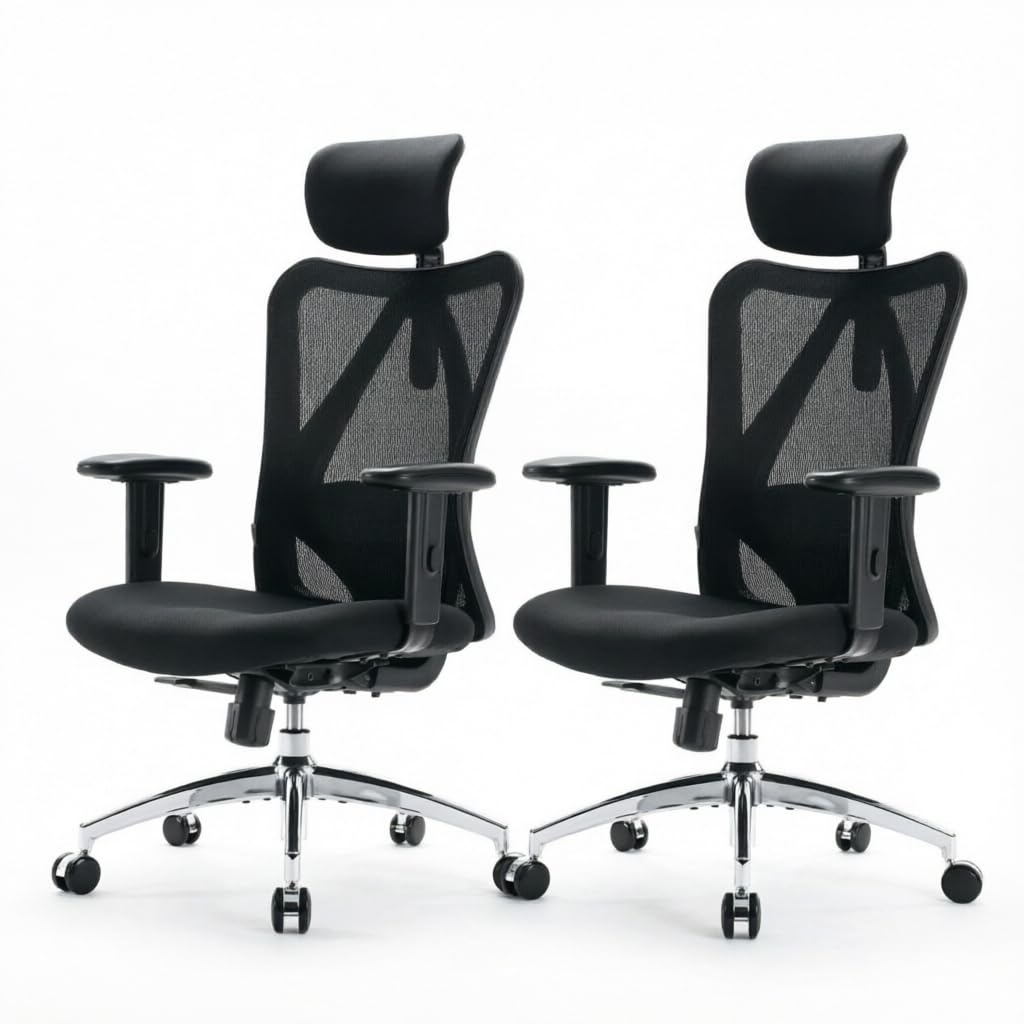
The SIHOO M18 is a well-established entry-level ergonomic chair that has maintained a strong reputation for reliability over years of production. It passed the 1,136 kg static pressure test and BIFMA certification, meaning the aluminum-alloy base and gas lift can support up to 330 lbs without structural compromise. For users with back and neck pain who need a durable chair at a budget-friendly entry point, the M18 offers a solid foundation without exotic adjustment mechanisms.
The lumbar support is a cushioned pad that adjusts vertically, providing adequate lower-back support for users between 5’6” and 6’2”. The headrest adjusts in height and tilt angle, giving enough cervical support to reduce forward-head posture during upright sitting. The 2D armrests adjust up and down only, which limits shoulder support for users who need width or angle movement, but the wide seat cushion (21 inches) provides ample hip space for larger frames.
The mesh backrest is breathable and the seat cushion is firm enough to prevent bottoming out during full-day use. Recline tension is adjustable, and the chair locks in multiple positions. Assembly is straightforward with eight steps. The armrests are rubber-topped and provide minimal padding, and the lumbar support uses a plastic bracket that some users find uncomfortable against their lower back.
Why it’s great
- 330 lbs capacity and BIFMA certification ensure long-term structural integrity
- Wide seat cushion accommodates larger frames without compression
- Proven track record of reliability across multiple production years
Good to know
- Armrests adjust up and down only — no width or angle movement
- Lumbar support uses a plastic bracket that may feel hard against the back
8. CASASIO Ergonomic Office Chair
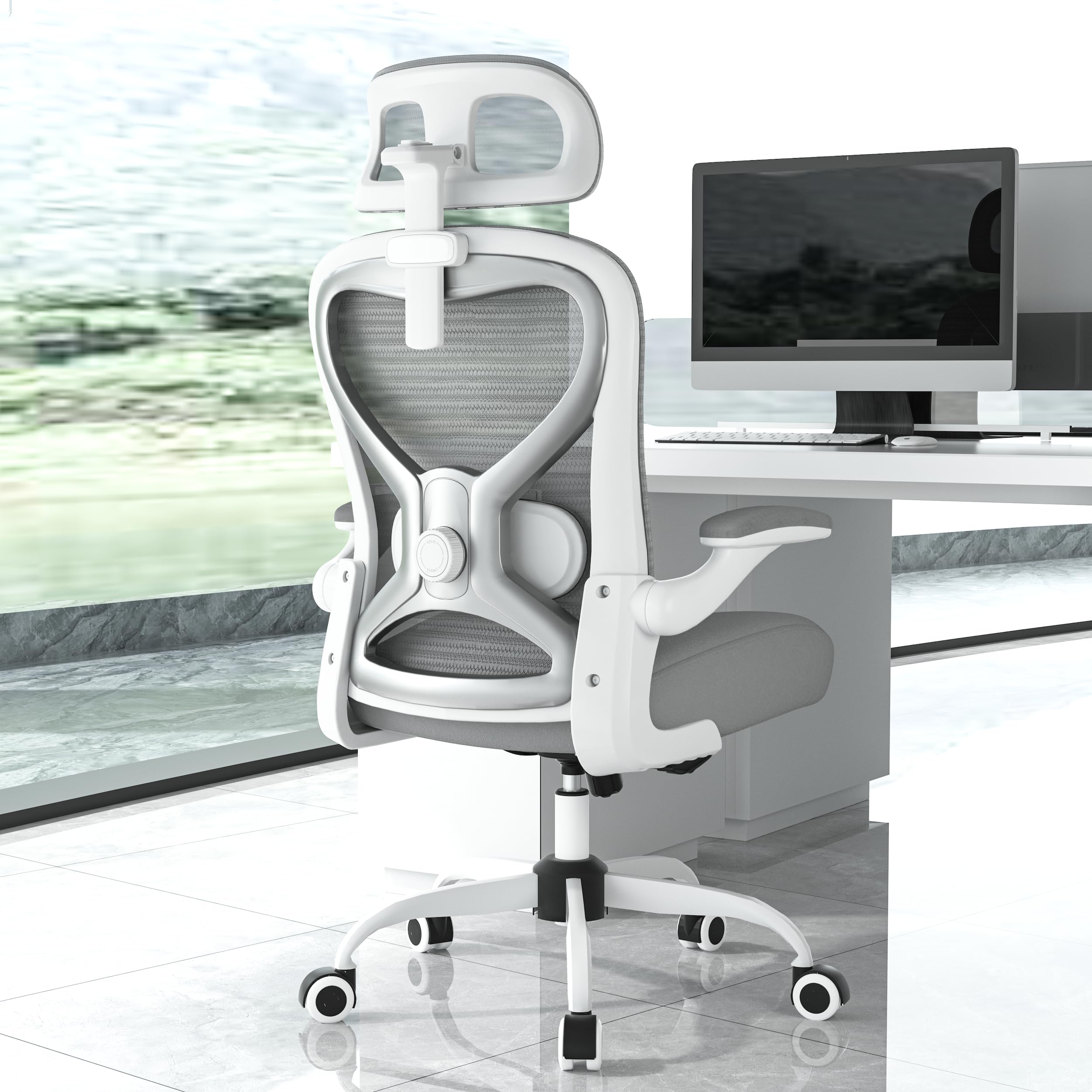
This CASASIO chair prioritizes seat cushioning above all else, using a 3.5-inch virgin foam seat that distributes weight evenly and resists the permanent sagging that plagues recycled-foam cushions. For users whose back pain is directly linked to hip and thigh soreness after prolonged sitting, this depth of foam provides a noticeable improvement over thinner or lower-density alternatives. The virgin foam retains its resilience longer, making this chair a strong candidate for 8+ hour shifts.
The contoured mesh back aligns with the spine’s natural curve, and the dual-direction adjustable lumbar cushion offers both vertical and depth placement for targeted lower-back relief. The 3D adjustable headrest (height, depth, angle) cradles the neck and head during both focused work and reclined relaxation. The flip-up armrests are a practical space-saving feature for smaller desks or shared workspaces, though they lack the width or angle adjustment of more premium arms.
The reinforced metal base supports up to 300 lbs, and the tilt-and-rock mechanism adds a gentle rocking motion that can relieve tension and improve blood flow during static sitting. Assembly takes roughly 15–20 minutes with clear instructions. The armrests only adjust in height, and the foam cushion, while supportive, may retain heat during extended use in warm rooms.
Why it’s great
- 3.5-inch virgin foam cushion provides superior pressure distribution and sag resistance
- Flip-up armrests save desk space in small or shared offices
- Tilt-and-rock mechanism promotes micro-movement to reduce static tension
Good to know
- Armrests adjust in height only — no width or angle movement
- Thick foam cushion may retain heat during prolonged use
9. Branch Ergonomic Chair
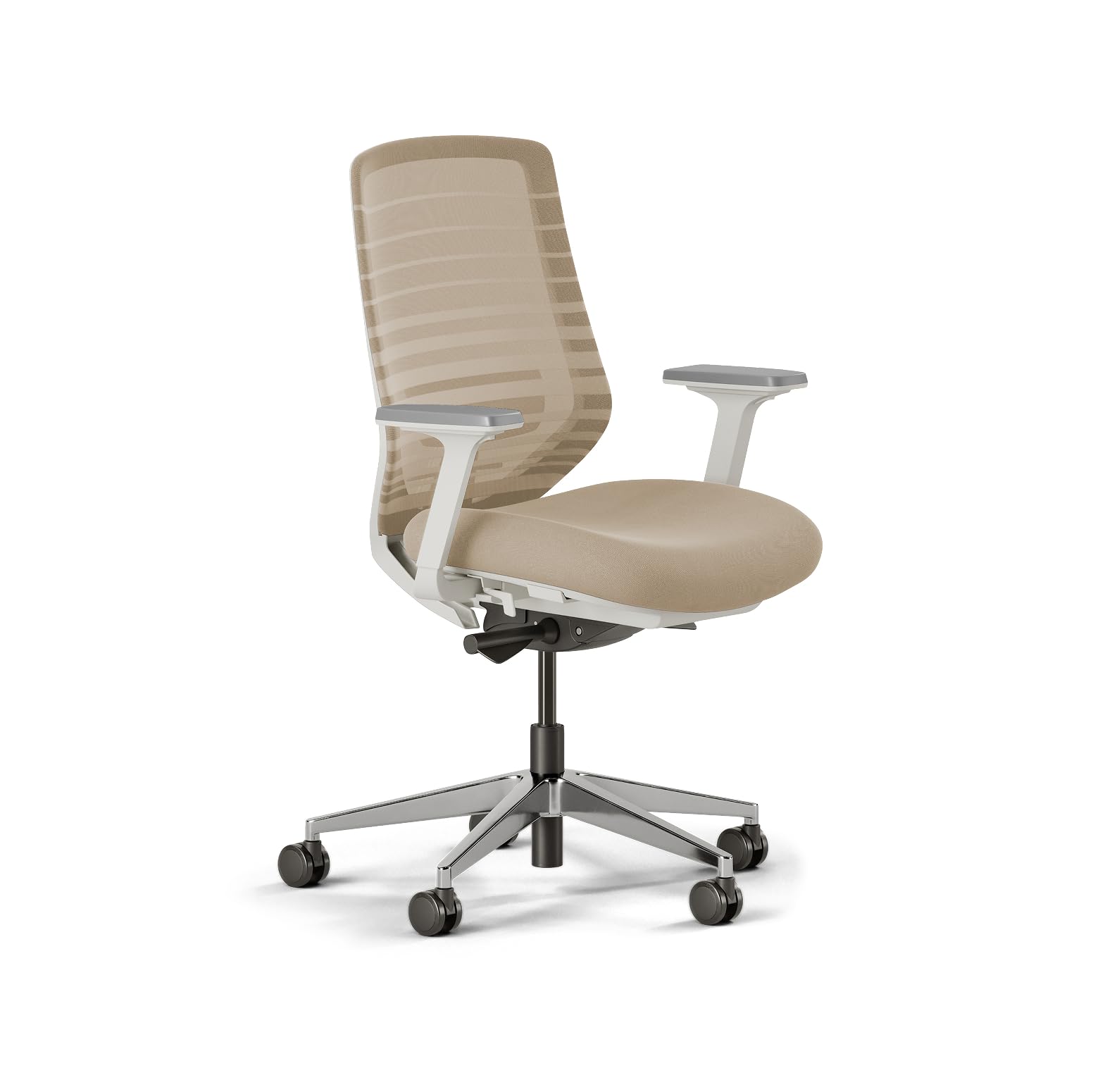
The standard Branch Ergonomic Chair offers a sleek, minimalist design with 8 points of adjustment, making it a refined option for users who value aesthetics alongside ergonomic function. The aluminum frame keeps the chair lightweight at roughly 42 lbs while providing the structural rigidity needed for daily use. The adjustable seat height and depth allow users from 5’0” to 6’2” to find a position that keeps their feet flat and thighs fully supported.
The breathable mesh backrest provides consistent airflow and mild lumbar support through its contoured shape, though the lumbar is not independently adjustable — a trade-off that makes this chair more suitable for users whose back pain is mild rather than acute. The armrests adjust in height and pivot width, offering enough range to keep elbows at 90 degrees during typing. The smooth-rolling casters are designed for hard floors and move silently across wood or laminate surfaces.
Assembly takes roughly 30 minutes, with the seatback attachment being the most involved step. Petite users (around 5’0”) report that the low seat height and adjustable depth make this one of the few ergonomic chairs that fits without modification. The lack of a forward-tilt mechanism and the non-adjustable lumbar limit its appeal for users with severe lower-back conditions.
Why it’s great
- Aluminum frame provides lightweight rigidity with modern aesthetics
- Adjustable seat depth accommodates both petite and tall users
- Smooth casters designed for silent movement on hard floors
Good to know
- Lumbar support is not independently adjustable
- No forward-tilt mechanism for active sitting support
FAQ
Is a headrest necessary for neck pain relief in a desk chair?
Can a chair cure my existing back pain or just prevent worsening?
How does adjustable seat depth affect lower-back pain?
Final Thoughts: The Verdict
For most users, the desk chair for back and neck pain winner is the ProtoArc EC300 because its height-adjustable backrest, sacrum-spanning lumbar pad, and 55-density foam seat combine to address both spinal alignment and pressure distribution at a mid-range price. If you want the highest degree of adjustability, grab the Branch Ergonomic Chair Pro with its 14 adjustment points and 5D armrests. And for users who need regular spinal decompression through reclined breaks, nothing beats the GABRYLLY with its built-in footrest and 135-degree recline.

Mo Maruf
I created WellFizz to bridge the gap between vague wellness advice and actionable solutions. My mission is simple: to decode the research and give you practical tools you can actually use.
Beyond the data, I am a passionate traveler. I believe that stepping away from the screen to explore new environments is essential for mental clarity and physical vitality.