Our readers keep the lights on and my smoothie glass nicely filled. As an Amazon Associate, I earn from qualifying purchases.
A spool of 3D filament that snaps mid-print or surfaces with a rough, bubbly texture is almost always a victim of absorbed moisture. The mechanical link between ambient humidity and print quality is direct — hygroscopic materials like PLA, PETG, and Nylon swell from within, creating voids, stringing, and layer adhesion failures that no slicer setting can fully correct. The right desiccant, deployed correctly inside an airtight enclosure, is the single most effective countermeasure.
I’m Mohammad Maruf — the founder and writer behind WellFizz. Hundreds of hours spent cross-referencing absorption rates, recharge cycle durability, and real-world humidity drop data from 3D printing communities have shaped the recommendations in this guide.
After comparing five top-selling options on bead consistency, indicating accuracy, and recharge reliability across multiple enclosure types, the best choice for consistent print quality is the desiccant for filament that combines high absorption mass with a clear visual saturation cue.
How To Choose The Best Desiccant For Filament
Choosing a desiccant for filament storage goes beyond grabbing the cheapest bag. The wrong choice can lead to poor moisture uptake, inaccurate saturation readings, or difficult recharge cycles that discourage proper maintenance.
Bead Size and Uniformity
Industry standard 3–5 mm beads offer the best balance of surface area for absorption and air gap for effective heat transfer during reactivation. Beads that are too fine can clump and slow moisture diffusion, while oversized beads reduce total surface area per pound.
Color Indicating vs. Non-Indicating
Orange-indicating silica gel shifts to green or dark green as moisture is absorbed, giving you a clear visual reminder to recharge before the desiccant becomes fully saturated. Non-indicating (white) silica requires a separate humidity meter to gauge effectiveness, adding an extra step that many users skip.
Recharge Method Compatibility
Most bulk beads can be reactivated in an oven at 200–250°F or a microwave at 700W. Microwave cycles are shorter (7–10 minutes) but require a microwave-safe dish and careful monitoring to avoid overheating. Oven drying takes longer but distributes heat more evenly for large batches.
Quantity and Packaging
Enclosures vary widely in volume — a Bambu Lab AMS or AMS Lite may need as little as 100–200 grams, while a large airtight storage box for multiple spools can benefit from 2–5 pounds. Bulk packs with included organza bags offer flexibility to distribute the desiccant exactly where it’s needed.
Quick Comparison
On smaller screens, swipe sideways to see the full table.
| Model | Category | Best For | Key Spec | Amazon |
|---|---|---|---|---|
| TUXIYA 5 LBS | Premium | Multi-spool enclosures | 5 lbs total, 15 organza bags | Amazon |
| Viktairy 5.5 LBS | Premium | High-volume storage | 5.5 lbs total, 10 organza bags | Amazon |
| Viktairy 2.2 LBS | Mid-Range | Single AMS or small dry box | 2.2 lbs total, 5 organza bags | Amazon |
| VOISEN 2 LBS | Mid-Range | Value-conscious AMS users | 2 lbs total, sealed plastic container | Amazon |
| wisedry 100g x 5 | Budget | Travel and small storage | 100g per pack, pre-sealed | Amazon |
In‑Depth Reviews
1. TUXIYA 5 LBS Orange Indicating Silica Gel Desiccant Beads
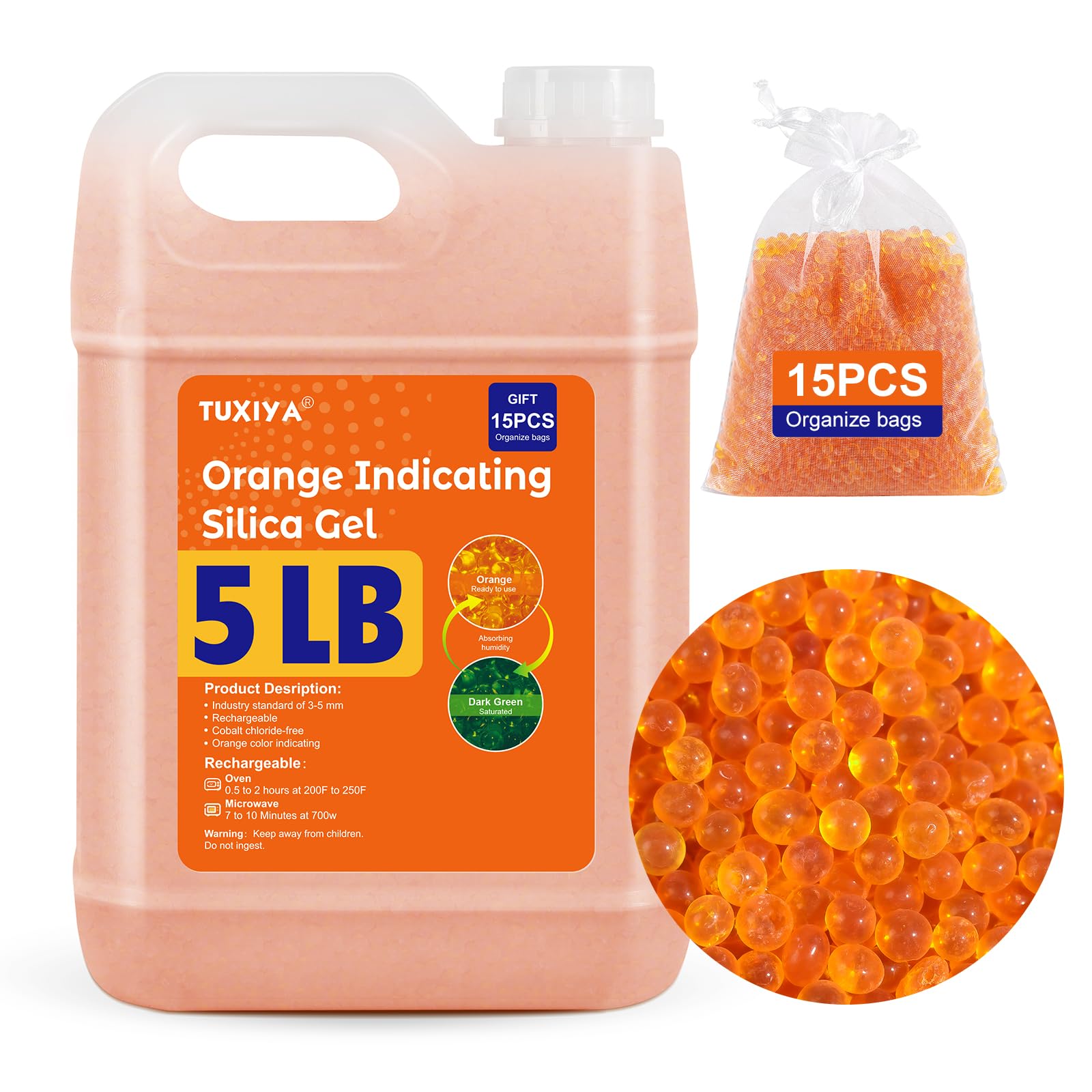
This 5-pound bulk set delivers the highest mass-to-cost ratio among mid-range options, making it ideal for users maintaining multiple spools in large airtight bins. Real-world testing shows that roughly one cup of these 3–5 mm beads can drop relative humidity from 45% to 19% within 24 hours in a typical CFS or AMS enclosure. The orange-to-dark-green color shift is clearly visible through the included organza bags, eliminating guesswork about when to recharge.
The beads are consistent in diameter and free of dust, which helps maintain even airflow across the bed. The indicator transition begins at 50–60% saturation, meaning you still have reserve capacity even after the color change first appears — a useful buffer for busy print schedules. Baking these at 200°F for 1 to 2 hours restores the bright orange hue reliably.
With 15 organza bags, you can distribute the desiccant across several enclosures or safes without buying additional containers. The double-sealed airtight barrel keeps beads fresh until you’re ready to deploy them, a detail that matters for long-term storage in humid climates.
Why it’s great
- Large 5-pound quantity with 15 bags for multi-zone placement
- Clear orange-to-dark-green indicator visible through fabric bags
- Drops RH from mid-40s to below 20% within 24 hours in AMS enclosures
Good to know
- Beads are not suitable for drying flowers due to 3–5 mm size
- Recharge time varies; check color periodically rather than relying on fixed oven time
2. Viktairy 5.5 LBS Premium Color Indicating Reusable Silica Gel
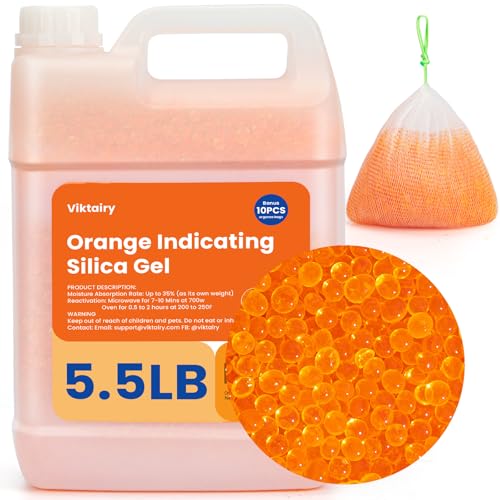
At 5.5 pounds, this Viktairy offering nudges ahead of the TUXIYA in total mass, making it the heaviest bulk option reviewed here. The orange-indicating beads absorb up to 35% of their own weight, and field reports from Bambu Lab P1S and X1C users confirm that a single jar can maintain a humidity floor of 15–20% in a 20-quart gasket box for weeks between recharges.
The beads arrive clean and uniformly sized, with no noticeable fines that could clog small desiccant containers. Users have noted that the color shift tends toward a darker orange rather than a bright green, so it is wise to establish your own reference point after the first recharge cycle. Microwave reactivation at 700W for 7–10 minutes works well, but oven drying at 250°F on a cookie sheet provides more even results for the full batch.
The included organza bags are functional but thin — handling them with care during refills prevents tearing. If you fill multiple AMS units or a large gun safe, the 5.5-pound volume means you will not need to reorder for many recharge cycles.
Why it’s great
- Highest total bead weight in this guide at 5.5 pounds
- Consistent 3–5 mm bead size with minimal dust
- Reliable humidity drop from 42% to 15% in a sealed 20-quart container
Good to know
- Indicator shifts to dark orange rather than green — adjust your visual cue accordingly
- Included bags are fragile; handle gently during bead transfer
3. Viktairy 2.2 LBS Orange Indicating Reusable Silica Gel Beads
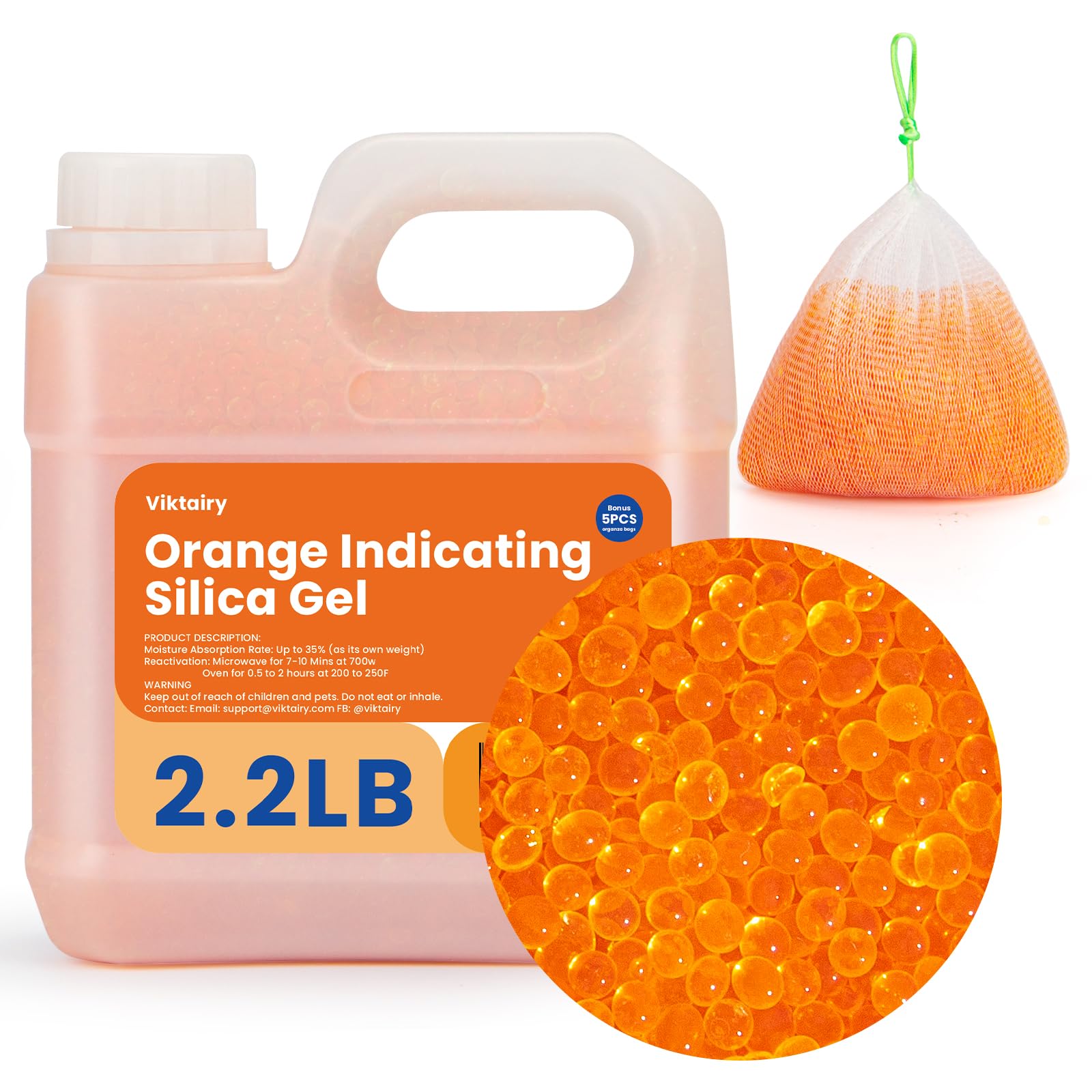
This 2.2-pound jar is the sweet spot for users with a single AMS unit or a small dry box. Despite the lower overall mass, the absorption performance is identical to its larger sibling — the same 35% weight capacity and 3–5 mm bead geometry. In a Bambu Lab AMS, users report dropping internal humidity from high levels to 15% within three hours of placement, which is fast enough to rescue filament that has been exposed to ambient air.
The orange-to-green indicator is more consistent on this batch compared to some larger packs, with the shift to dark green occurring at roughly 50–60% saturation. The five included organza bags are sufficient for an AMS, a small safe, and a camera case simultaneously. The airtight barrel packaging keeps unused beads fresh for months — important if you only need a fraction of the jar at a time.
One practical note: beads scatter easily during pour-out, so use a funnel or a scoop to avoid losing material. The 2.2-pound weight is also a good trial size if you are new to bulk desiccant and want to confirm that your enclosure benefits before committing to a 5-pound package.
Why it’s great
- Perfect quantity for single AMS or small dry box without excess waste
- Fast humidity drop — from 42% to 15% in about 3 hours in a 20-quart bin
- Reliable orange-to-green indicator makes recharge timing intuitive
Good to know
- Beads scatter easily — use a funnel when filling bags
- Organza bags are thin and may tear with rough handling
4. VOISEN 2 LBS Orange Indicating Silica Gel Desiccant Beads
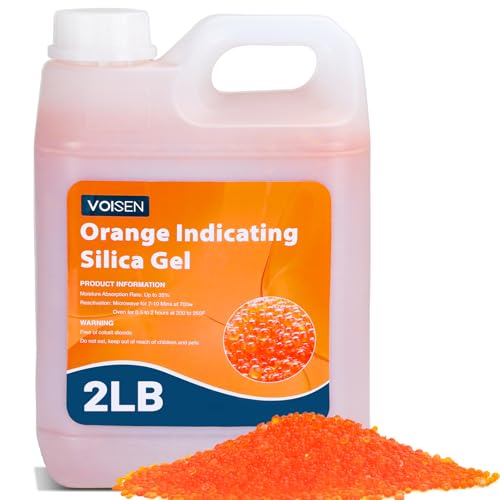
VOISEN’s 2-pound offering is a direct competitor to the Viktairy 2.2-pound jar, with a slight edge in container design — the sealed plastic tub feels more robust than the thin-walled barrels used by some brands. The 3–5 mm beads are consistent in size, and the orange-to-dark-green indicator is clear enough to read through the included bags when the desiccant is deployed in an AMS or electronics cabinet.
Users running Bambu AMS 2 units report stable humidity levels in the 10–13% range for months between recharges. The microwave reactivation method is straightforward: place the beads in a Pyrex dish and run the defrost cycle for about 10 minutes. The oven method at 200°F for 1.5–2 hours also works well, and users note that the beads return to their original bright orange reliably after each cycle.
The main trade-off is the slightly lower total weight (2 lbs vs. 2.2 lbs) and the absence of included organza bags — you will need to supply your own breathable containers. If you already have reusable bags from a previous purchase, this is a minor inconvenience, but it adds cost for first-time buyers.
Why it’s great
- Sturdy sealed plastic container keeps beads fresh during long-term storage
- Maintains 10–13% RH in AMS 2 enclosures for months between recharges
- Microwave and oven reactivation both work reliably with clear color return
Good to know
- No organza bags included — you must supply your own breathable containers
- Slightly lower net weight compared to the Viktairy 2.2 lb option
5. wisedry 100g [5 Packs] Reusable Desiccant Packs

This set takes a different approach: five pre-sealed pouches of 100 grams each, using a blue indicating dot that turns pink when saturated. The sealed packaging prevents premature absorption, so each pack arrives fresh and ready to deploy. For users who dislike handling loose beads, this is a tidy alternative — just open a pouch and drop it into your filament box, camera case, or luggage.
The 100-gram size is well matched to small enclosures: a single pack inside a Bambu AMS Lite or a Pelican-style dry box keeps humidity low without taking up much space. Microwave reactivation takes about 6 minutes, and the indicator dot provides an unambiguous yes/no on saturation — no need to scrutinize bead color across a whole batch. Users in coastal environments report that these packs protect garage openers and reloading dies from corrosion over months of continuous use.
The trade-off is the lower total mass (500g across five packs) compared to bulk bead options. For multi-spool setups or large bins, you would need multiple sets to match the capacity of a single 2-pound jar. The per-gram cost is also higher, making this a premium choice for convenience rather than scale.
Why it’s great
- Pre-sealed packs eliminate bead handling and spill risk
- Blue-to-pink indicator dot gives a clear, binary saturation signal
- Fast 6-minute microwave reactivation for quick turnaround
Good to know
- Higher per-gram cost compared to bulk bead options
- 500g total may be insufficient for large multi-spool storage bins
FAQ
How much desiccant do I need for a Bambu Lab AMS?
Can I microwave silica gel desiccant beads directly?
What does the orange-to-green color change actually mean?
Why do some users report a dark orange color instead of green?
Final Thoughts: The Verdict
For most users, the desiccant for filament winner is the TUXIYA 5 LBS Orange Indicating Silica Gel because it offers the best blend of total capacity, included bags, and reliable color indication at a compelling value. If you want a lower entry point for a single AMS, grab the Viktairy 2.2 LBS — it delivers the same absorption quality in a more modest quantity. And for users who prioritize convenience and zero mess, nothing beats the wisedry 100g pre-sealed packs with their simple blue-to-pink indicator.

Mo Maruf
I created WellFizz to bridge the gap between vague wellness advice and actionable solutions. My mission is simple: to decode the research and give you practical tools you can actually use.
Beyond the data, I am a passionate traveler. I believe that stepping away from the screen to explore new environments is essential for mental clarity and physical vitality.