Our readers keep the lights on and my smoothie glass nicely filled. As an Amazon Associate, I earn from qualifying purchases.
Fishing blind means wasting time drifting over empty water. A reliable depth finder transforms your day on the water by revealing the underwater world — the structure, the thermoclines, and the fish holding tight to cover. Without one, you are guessing; with the right unit, you are hunting with intel.
I’m Mohammad Maruf — the founder and writer behind WellFizz. I study marine electronics, sonar technology, and angler feedback to find which units deliver real returns at every price level.
Whether you fish from a kayak, a bass boat, or the shore, choosing the best depth finder means balancing screen size, sonar frequency, and GPS mapping to match how and where you fish.
How To Choose The Best Depth Finder
A depth finder is an investment in catching more fish and avoiding costly navigation mistakes. Three factors separate a good unit from a great one: sonar technology, display quality, and transducer coverage.
Sonar Type: CHIRP vs. Traditional
CHIRP (Compressed High-Intensity Radar Pulse) sends a sweep of frequencies, delivering sharper target separation and better readings at speed. Traditional 200/83 kHz dual-beam sonar works fine in shallow water but struggles to distinguish fish from structure in deeper or weedy environments. If you fish water deeper than 30 feet, CHIRP is worth the upgrade.
Screen Size and Readability
A 4-inch display shows basic depth and fish icons, but a 5-inch or larger screen reveals bottom contours, thermoclines, and individual fish arches. For bright sunlight, look for a SolarMAX or LED-backlit display with anti-glare coating. Resolution matters more than raw inches — a 480×320 pixel screen on a 4.3-inch unit shows soft details, while a 800×480 screen on a 7-inch unit makes structure crisp.
Transducer Beam Angle and Frequency
Wide beams (60 degrees) cover more area in shallow water, while narrow beams (20 degrees) give better detail in deep water. Dual-beam transducers let you switch between the two. Mid-range and premium units often include DownScan or SideScan imaging, which produce photo-like views of structure. If you fish rivers or rocky lakes, DownScan is invaluable for identifying drop-offs and brush piles.
Quick Comparison
On smaller screens, swipe sideways to see the full table.
| Model | Category | Best For | Key Spec | Amazon |
|---|---|---|---|---|
| Lowrance Elite FS 10 | Premium | Advanced anglers needing SideScan | 10-inch touchscreen, Active Imaging 3-in-1 | Amazon |
| Garmin LiveScope Plus LVS34 | Premium | Forward-facing live sonar on bass boats | Real-time sonar, LVS34 transducer | Amazon |
| Garmin Striker Vivid 7cv | Premium | Large-screen CHIRP with GPS mapping | 7-inch display, GT20-TM transducer | Amazon |
| Lowrance HOOK Reveal 5 SplitShot | Mid-Range | All-around freshwater fishing | 5-inch SolarMAX, FishReveal + DownScan | Amazon |
| Humminbird Helix 5 Sonar G2 | Mid-Range | Dual-beam sonar without GPS | 5-inch widescreen, SwitchFire Sonar | Amazon |
| Garmin Striker Plus 4 | Mid-Range | Ice fishing and kayak use | 4.3-inch display, CHIRP dual-beam | Amazon |
| Humminbird PiranhaMAX 4 | Budget-Friendly | Entry-level Down Imaging on a budget | 4.3-inch color, Down Imaging sonar | Amazon |
| Deeper PRO+ 2 | Mid-Range | Castable fishing from shore or dock | Wireless sonar, 330ft depth / GPS | Amazon |
| Yoocylii XF-08 Handheld | Budget-Friendly | Quick depth checks and shallow ponds | 3.5-inch LCD, 125 kHz wireless sonar | Amazon |
In‑Depth Reviews
1. Lowrance Elite FS 10
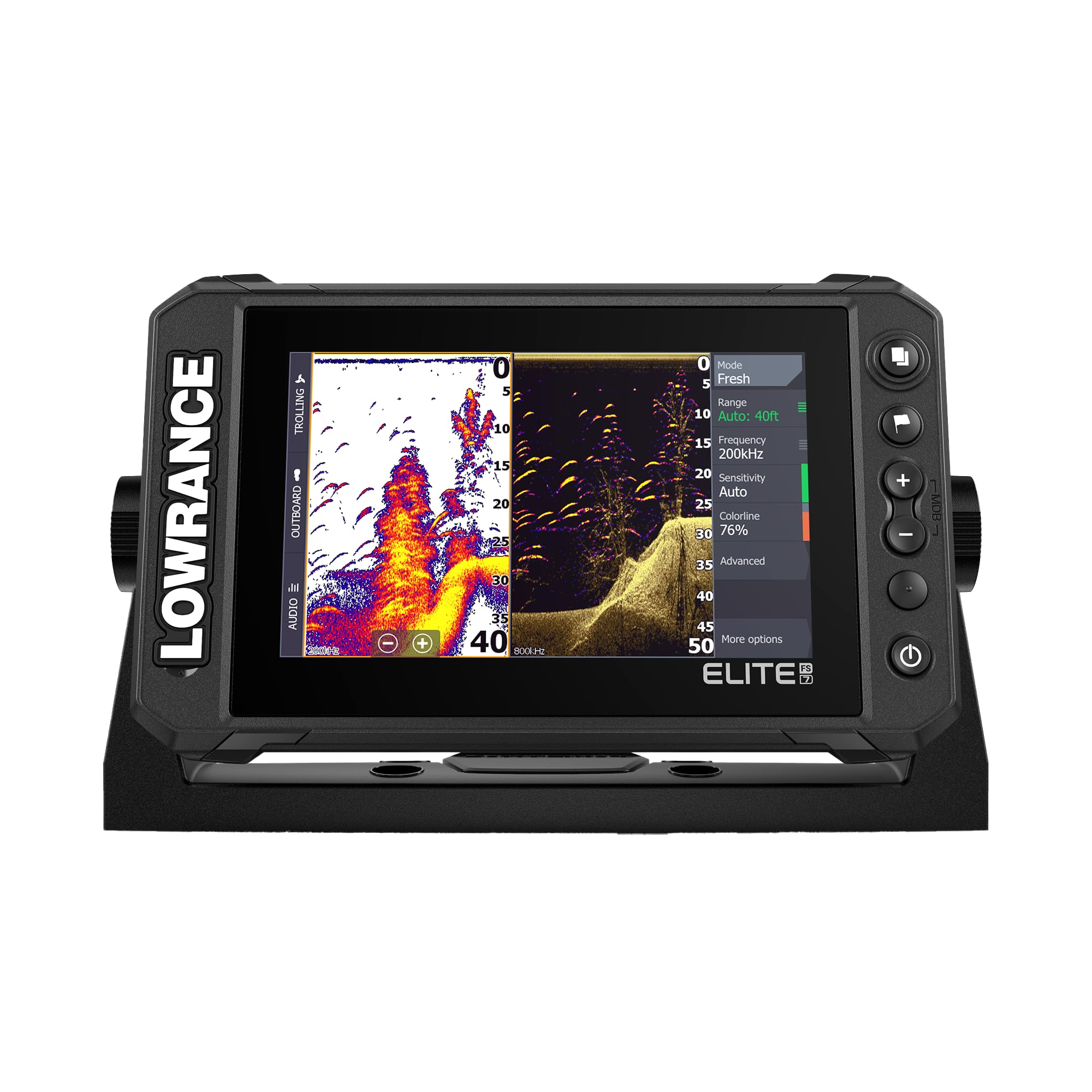
The Elite FS 10 is a full chartplotter and fish finder in one package. Its Active Imaging 3-in-1 transducer delivers CHIRP, SideScan, and DownScan with FishReveal technology, which overlays fish arches on DownScan imagery. On the water, this means you see individual fish suspended near brush piles with photographic clarity — not just blobs.
The 10-inch touchscreen responds quickly to inputs, and the preloaded C-MAP contour maps highlight ledges, drop-offs, and humps. Genesis Live lets you create custom 1-foot contours on any body of water in real time. The unit integrates with trolling motors and ActiveTarget 2 live sonar, making it a true command center for serious anglers.
Setup takes an afternoon, and the learning curve is steeper than a basic unit. But once dialed in, this system eliminates guesswork. The screen is readable in direct sun, and the processing speed keeps up with fast boat maneuvers. If you fish tournaments or spend serious time on large lakes, this is the level of performance that pays off.
Why it’s great
- SideScan and DownScan reveal structure in photo-like detail
- 10-inch touchscreen with split-screen sonar and mapping
- Live sonar ready for ActiveTarget 2 XL upgrade
Good to know
- Requires time to learn all menu options and features
- Uses more power than smaller units; needs adequate 12V supply
2. Garmin LiveScope Plus LVS34

The LiveScope Plus system changes how you fish by showing real-time movement of fish and your lure. The LVS34 transducer produces crisp imagery with reduced noise compared to previous generations, and it supports Forward, Down, and Perspective modes. Anglers report seeing individual crappie suspended at 25 feet and watching their jig drift into the strike zone.
This system requires a compatible Garmin ECHOMAP or GPSMAP display (sold separately), and the GLS 10 black box processes the sonar data. The included trolling motor barrel mount and shaft mount make installation straightforward on a bow-mount trolling motor. The vivid color palettes help distinguish bottom composition from fish targets.
Battery drain is noticeable — running live sonar all day demands a deep-cycle marine battery. The price reflects top-tier performance, and the unit is heavy at over 10 pounds. But for anglers who want to see exactly what is happening under the boat in real time, this system delivers the clearest picture available.
Why it’s great
- Real-time forward sonar shows lure and fish movement
- Reduced noise and artifacts versus earlier LiveScope models
- All mounting hardware included for trolling motor installation
Good to know
- Requires compatible Garmin display unit (not included)
- Heavy system; requires sturdy trolling motor setup and deep-cycle battery
3. Garmin Striker Vivid 7cv

The Striker Vivid 7cv brings a large, sunlight-readable 7-inch display and CHIRP ClearVü scanning sonar into a package that stays well below the premium tier. The GT20-TM transducer covers both traditional CHIRP and ClearVü frequencies, giving you detailed down-looking images of structure and fish. The vivid color palettes — seven options — help separate fish arches from the bottom even in stained water.
Built-in Quickdraw Contours mapping lets you create custom 1-foot contour maps on any lake you fish. The high-sensitivity GPS marks waypoints, records routes, and shows boat speed. Wi-Fi connectivity pairs with the ActiveCaptain app for transferring waypoints and receiving software updates. For a 7-inch unit with CHIRP and GPS, the feature set is hard to beat.
The interface is intuitive enough for a first-time user but offers enough depth for experienced anglers. Some buyers note that the unit does not come with preloaded maps — you create your own contour maps on the water. The tilt/swivel bailmount bracket makes positioning easy on console or dash.
Why it’s great
- Large 7-inch display with high-contrast color palettes
- CHIRP ClearVü shows structure in sharp detail
- Quickdraw Contours creates custom 1-foot maps
Good to know
- No preloaded inland maps; mapping is user-created on the water
- Learning all features requires reading the manual or watching tutorials
4. Lowrance HOOK Reveal 5 SplitShot

The HOOK Reveal 5 combines CHIRP sonar with DownScan Imaging in one transducer, and the FishReveal feature overlays fish arches on DownScan imagery — making it easy to tell a fish from a rock. The SplitShot transducer includes a wide-angle high-CHIRP element and a DownScan element, so you get good bottom detail and fish detection without switching transducers.
The 5-inch SolarMAX display is readable in direct sunlight, and the autotuning sonar adjusts settings as conditions change. Preloaded C-MAP US inland maps cover nearly 4,000 lakes, and Genesis Live creates custom contour maps on the fly. For a mid-range unit, the mapping capability is excellent.
Setup is straightforward, and the interface is menu-driven without a touchscreen. The unit draws power from a 12V DC source. Some users find the DownScan image lacks the extreme clarity of a 7-inch unit, but for the price, the detail is impressive. It is a solid choice for bass boats and aluminum fishing rigs.
Why it’s great
- FishReveal blends CHIRP and DownScan for clear fish identification
- Preloaded C-MAP inland lakes with Genesis Live custom mapping
- Autotuning sonar adjusts sensitivity automatically
Good to know
- No touchscreen; menu navigation uses buttons
- DownScan detail at 5 inches is good but not as sharp as larger screens
5. Humminbird Helix 5 Sonar G2

The Helix 5 Sonar G2 focuses purely on sonar performance without GPS, speed, or mapping. This makes it a strong choice for anglers who already have a chartplotter or who want a dedicated depth viewer on the front deck. The Dual Beam PLUS sonar combines a 28-degree narrow beam and a 60-degree wide beam, and you can view them separately or blended.
SwitchFire Sonar lets you toggle between two display modes — Max Mode shows every return including debris, while Clear Mode filters noise for a cleaner image. On the water, this is useful for distinguishing soft bottom from hard bottom and for watching lure presentations. The 5-inch widescreen display is bright and easy to read, though it lacks down imaging or side imaging.
The unit comes with the XNT 9 20 T transom-mount transducer and mounts easily on any boat. Since there is no GPS, you won’t get waypoint marking or contour mapping. But for anglers who just need a clear, fast sonar reading of depth and fish location, this unit delivers without extra complexity.
Why it’s great
- SwitchFire Sonar adjusts display to add or remove detail
- Dual Beam PLUS coverage for wide search and precise returns
- Clean, simple interface with fast sonar processing
Good to know
- No GPS, no mapping, and no down imaging
- Small screen can be hard to see from a distance on larger consoles
6. Garmin Striker Plus 4
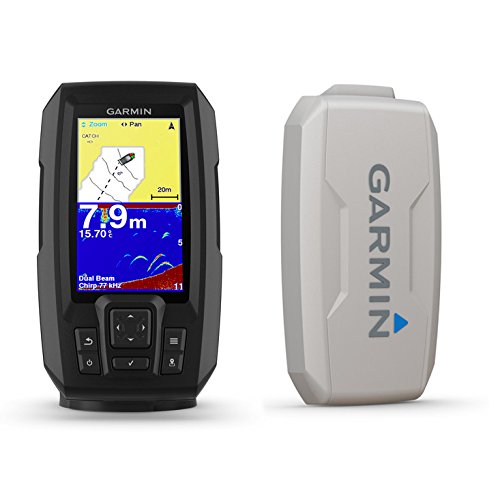
The Striker Plus 4 packs Garmin CHIRP sonar and a built-in GPS into a compact 4.3-inch package weighing just over a pound. It is popular for ice fishing, kayak use, and as a backup unit on small boats. The dual-beam transducer provides good target separation, and the Quickdraw Contours software lets you create 1-foot contour maps on up to 2 million acres of water.
The display is sunlight-readable, and the interface is one of the easiest to navigate among budget-conscious units. The built-in GPS marks waypoints and tracks boat speed. Users report running 7-plus hours on a 5Ah battery in cold weather. The unit also includes a protective cover in the box.
In deeper water beyond 400 feet, the standard transducer struggles to maintain a clear bottom lock, and the navigation response is slightly slow. The fish alarm is faint. But for shallow to moderate depths — typical for most freshwater fishing — the Striker Plus 4 is a reliable performer that floats if knocked off a kayak.
Why it’s great
- Garmin CHIRP sonar for sharp target separation
- Quickdraw Contours creates 1-foot maps without preloaded charts
- Lightweight and floats if dropped in water
Good to know
- Standard transducer loses bottom detail past 400 feet
- Fish alarm is quiet; menu buttons not backlit
7. Humminbird PiranhaMAX 4

The PiranhaMAX 4 brings Down Imaging to the entry-level price point. This is a rare find: a sub-200-dollar unit that shows timber, brush, rocks, and bridge pilings with photo-like clarity. The 4.3-inch color display is easy to read in bright sun, and the redesigned interface is simple enough for a first-time buyer.
Dual Beam sonar lets you choose between a 20-degree narrow beam for detail and a 60-degree wide beam for coverage. Fish ID+ technology shows fish as icons with depth markings, and the depth and fish alarms add safety. The included XNT 9 DI T transom-mount transducer is easy to install on small boats and kayaks.
The transducer cable is short — about 15 feet — which means larger boats may need an extension cable. The display is not as crisp as a 5-inch screen, and the unit lacks GPS and mapping. But for the price, the Down Imaging capability alone makes it a strong starter unit.
Why it’s great
- Down Imaging at a budget-friendly price — rare in this tier
- Easy-to-use interface with Fish ID+ icons
- Dual Beam sonar gives both detail and coverage options
Good to know
- Transducer cable may be too short for larger consoles
- No GPS, no mapping, and screen is only 4.3 inches
8. Deeper PRO+ 2
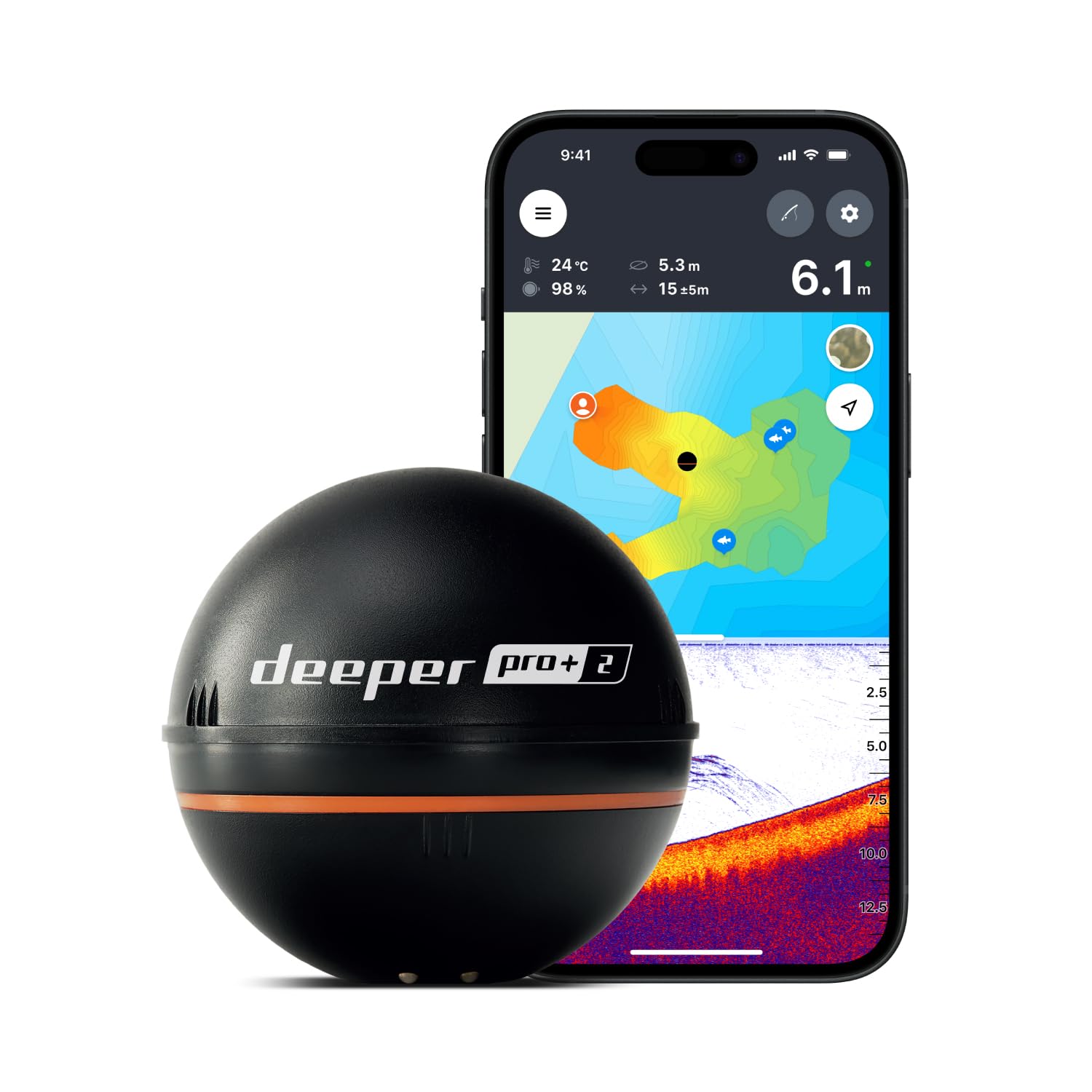
The Deeper PRO+ 2 is a castable sonar that works from shore, dock, kayak, or boat. It connects to your smartphone via Wi-Fi and displays depth, water temperature, bottom contours, and fish activity on the free Fish Deeper app. The built-in GPS lets you create bathymetric maps as you fish, saving them for future trips.
Three beam frequencies — wide, mid, and narrow — cover different depths and scenarios. The narrow beam achieves target separation as fine as 0.4 inches, which is remarkable for a castable unit. The wireless range is reliable up to 200 feet, and the battery life lasts through long sessions.
The unit weighs over 3 ounces, so you need a stout rod with 20-pound or heavier braided line to cast it. It is not practical for small creeks where casting range is limited. Some users report occasional app disconnections and glitchy cloud uploads. But for shore anglers and kayak fishermen who want mapping and sonar without a permanent mount, this is the best option.
Why it’s great
- Castable and portable — no mounting required
- GPS bathymetric mapping from shore or dock
- Excellent target separation on narrow beam
Good to know
- Requires heavy rod and 20lb+ braided line to cast
- App has optional subscription upsells for advanced features
9. Yoocylii XF-08 Handheld
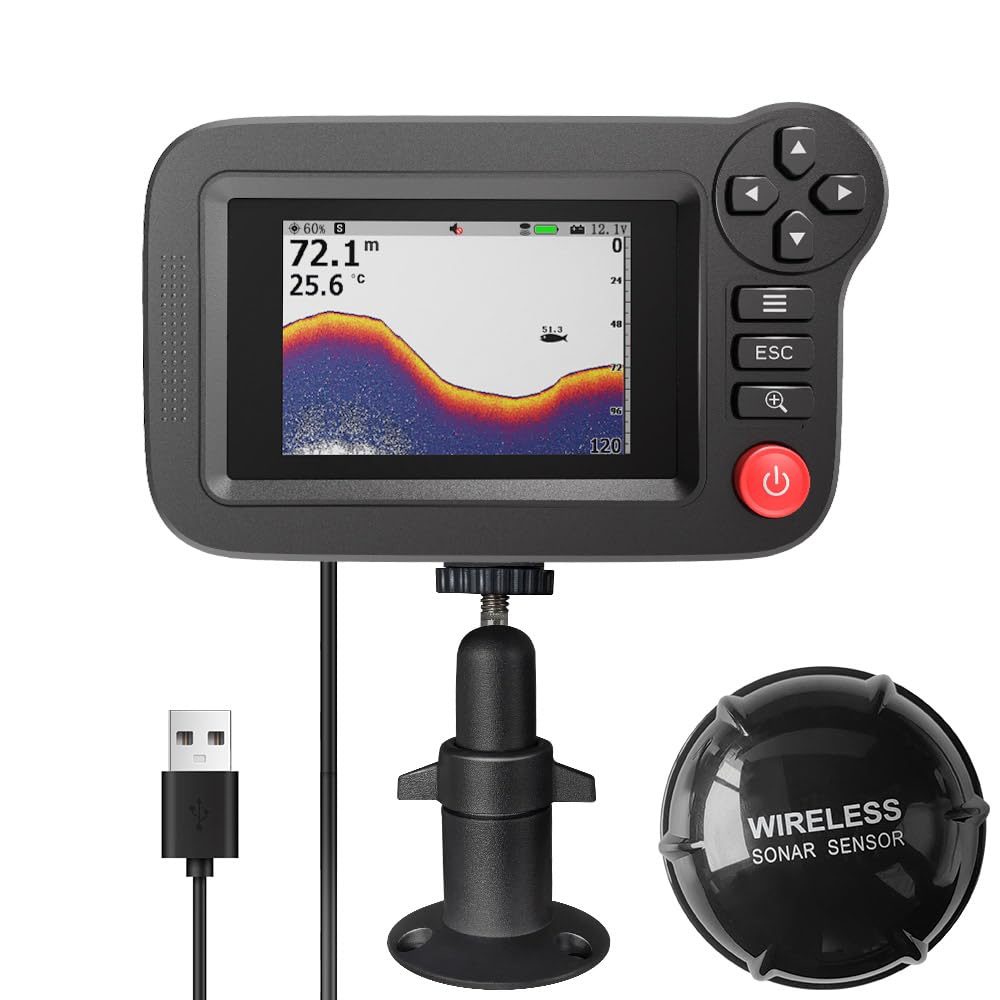
The Yoocylii XF-08 is a fully portable handheld depth finder with a wireless sonar probe. It reads depth up to 164 feet, shows fish as small/medium/large icons, and includes alarms for shallow and deep zones. The 3.5-inch color LCD is readable outdoors, and the unit runs on batteries or USB power. It is a grab-and-go tool for quick depth checks.
The wireless probe is water-activated and rated IP67, and the host unit communicates up to 600 feet. Setup is simple — hang the probe over the side or attach to a kayak. The fish alert works reliably, and the display shows water temperature and bottom contour in basic form. For the price, the value is high for casual fishing.
Build quality is where corners are cut. The locking nut on the bottom can strip, and the antenna hinge feels fragile. It chews through batteries if left on. But for pond checking, ice fishing, or as a backup emergency depth tool, the XF-08 performs its core job adequately. It is not for serious anglers who need detailed structure imaging.
Why it’s great
- Fully portable with wireless probe — no installation needed
- Simple fish icons and depth alarms for basic use
- Very low entry price for a color display depth finder
Good to know
- Build quality concerns: plastic nut and antenna joint
- Battery life is limited; probe requires regular battery changes
FAQ
What depth of water do I need to read before buying a depth finder?
Can I use a depth finder without a boat for shore fishing?
What does CHIRP mean and do I need it?
Is a bigger screen always better for a depth finder?
Final Thoughts: The Verdict
For most users, the best depth finder winner is the Lowrance HOOK Reveal 5 SplitShot because it balances CHIRP sonar, DownScan imaging, and GPS mapping at a mid-range price without sacrificing clarity. If you want a large 7-inch screen with CHIRP and custom mapping on a budget, grab the Garmin Striker Vivid 7cv. And for serious anglers who need SideScan and live sonar capability, nothing beats the Lowrance Elite FS 10.

Mo Maruf
I created WellFizz to bridge the gap between vague wellness advice and actionable solutions. My mission is simple: to decode the research and give you practical tools you can actually use.
Beyond the data, I am a passionate traveler. I believe that stepping away from the screen to explore new environments is essential for mental clarity and physical vitality.