Our readers keep the lights on and my smoothie glass nicely filled. As an Amazon Associate, I earn from qualifying purchases.
Sorting through the noise of transom mounts, cone angles, and CHIRP frequencies to find a reliable depth finder that actually fits your budget can feel like fishing in murky water. The difference between a unit that shows you a clear bottom contour and one that just blinks a number often comes down to transducer quality and display technology, not the sticker price.
I’m Mohammad Maruf — the founder and writer behind WellFizz. I’ve spent hundreds of hours analyzing sonar specifications, reading through thousands of angler reviews, and comparing the real-world performance of depth finders across every price tier to give you an honest, spec-driven breakdown.
Whether you fish from a kayak, a bass boat, or the bank, this guide cuts through the marketing to help you choose the best unit for your water. Here are the top picks for the best depth finder under 500 in 2025.
How To Choose The Best Depth Finder Under 500
Not all depth finders are created equal. Even within the same budget, you’ll face trade-offs between sonar technology, screen real estate, and mapping features. The key is matching the unit’s strengths to where and how you fish.
Sonar Type: CHIRP vs. Traditional 2D
CHIRP (Compressed High-Intensity Radiated Pulse) sends a sweep of frequencies, providing much sharper target separation and clearer bottom detail than traditional 2D sonar. Most modern units in this range use some form of CHIRP, making it the baseline to look for. If you fish around heavy structure like timber or brush, the improved clarity is a game-changer.
Transducer and Cone Angle
The transducer is the eyes of your depth finder. A 90-degree cone covers a wide area but sacrifices detail, while a 20-degree cone provides high-accuracy returns over a smaller footprint. Many transducers now offer dual or triple beams so you can switch coverage based on conditions. For kayak and bank fishing, a castable or portable transducer is often more practical than a fixed transom mount.
Display Quality and Sunlight Readability
A 5-inch display is the sweet spot for most boat consoles, but a 7-inch screen like the Garmin Striker Vivid series makes a real difference in reading fish arches and bottom contours. Look for a color TFT or SolarMAX display if you fish in direct sunlight — grayscale units wash out fast under glare. Resolution above 400×320 pixels is recommended for crisp imaging.
GPS and Mapping Capabilities
Built-in GPS lets you mark waypoints, track your path, and create custom contour maps. Features like Quickdraw Contours or Genesis Live allow you to generate high-detail bathymetric maps of your favorite lake, even without preloaded charts. This is especially valuable for anglers who fish unfamiliar water or want to find hidden structure.
Quick Comparison
On smaller screens, swipe sideways to see the full table.
| Model | Category | Best For | Key Spec | Amazon |
|---|---|---|---|---|
| Garmin Striker 7SV | Premium | Side Imaging & Full GPS | 7″ display, CHIRP ClearVü + SideVü | Amazon |
| Garmin Striker Vivid 7cv | Premium | ClearVü & Large Screen | 7″ display, CHIRP ClearVü sonar | Amazon |
| Lowrance HOOK Reveal 5 | Mid-Range | FishReveal & DownScan | 5″ SolarMAX display, FishReveal | Amazon |
| Humminbird Helix 5 Sonar G2 | Mid-Range | SwitchFire Sonar & Versatility | 5″ widescreen, Dual Beam PLUS | Amazon |
| Humminbird PiranhaMAX 4 DI | Mid-Range | Down Imaging on a Budget | 4.3″ display, Down Imaging sonar | Amazon |
| Deeper PRO+ 2 | Mid-Range | Castable & GPS Mapping | WiFi, 330ft depth, GPS bathymetry | Amazon |
| LUCKY Y2020-CWLA | Budget | Portable & Castable Use | 147ft depth, 125kHz, 90° beam | Amazon |
| Yoocylii Xf-08 | Budget | Big Screen on a Budget | 3.5″ LCD, 164ft depth, IP67 probe | Amazon |
| LUCKY FF-1108-1CWLA | Budget | Entry-Level Portable Unit | 2.4″ LCD, 147ft depth, fish lamp | Amazon |
In‑Depth Reviews
1. Garmin Striker 7SV

The Garmin Striker 7SV sits at the very top of the budget range thanks to its full suite of sonar technologies: CHIRP traditional, ClearVü, and SideVü scanning sonar. The 7-inch sunlight-readable display is a massive advantage over smaller units, giving you a clear picture of fish arches, submerged timber, and bottom contour changes without squinting. The included CV52HW-TM transducer delivers sharp down and side imaging, and the Quickdraw Contours mapping software lets you create 1-foot contour maps of your favorite lake — all stored onboard.
Built-in Wi-Fi connects through the ActiveCaptain app, enabling waypoint transfers and software updates directly from your smartphone. The GPS is reliable for marking brush piles, drop-offs, and your own boat’s speed. For anglers who fish both deep reservoirs and shallow flats, the ability to switch between wide and narrow CHIRP frequencies makes this unit incredibly versatile.
On the water, the 7SV performs best when the transducer is mounted low enough to avoid hull interference. Some users report a learning curve with the interface, especially when setting up side imaging gains. There is no preloaded cartography — you’ll need to create your own maps or rely on GPS waypoints. For those who want the largest screen and best sonar diversity under the upper limit, this is the clear winner.
Why it’s great
- 7-inch screen with excellent sunlight readability
- CHIRP ClearVü and SideVü for superior structure imaging
- Quickdraw Contours for custom 1-foot bathymetric maps
- Built-in Wi-Fi for waypoint sharing and software updates
Good to know
- No preloaded charts — you create your own maps
- Side imaging requires careful transducer positioning
- Interface can be complex for first-time users
2. Garmin Striker Vivid 7cv

The Striker Vivid 7cv brings the same large 7-inch display as the 7SV but focuses on ClearVü down imaging instead of side scanning. The GT20-TM transducer pumps out crisp CHIRP traditional sonar and high-resolution ClearVü, which gives you a photo-like view of fish, structure, and the bottom directly below your boat. The Vivid scanning sonar color palettes — seven in total — help you distinguish between fish arches and vegetation with a quick glance.
Built-in GPS and Quickdraw Contours mapping are included, allowing you to mark productive spots and generate custom contour maps on the fly. The tilt/swivel bailmount bracket makes adjusting the viewing angle easy, even in cramped cockpits. Wi-Fi connectivity through the ActiveCaptain app lets you grab waypoints from the community and receive smart notifications.
Some users note that the unit does not come with preloaded maps, so you’ll rely on GPS waypoints and your own Quickdraw creations. The interface is intuitive but the sheer number of features can be overwhelming until you dial in the settings for your specific water depth. For boaters who prize a large, vivid down-imaging view and don’t need side scan, this is an exceptional pick.
Why it’s great
- Bright 7-inch display with vivid color palettes
- ClearVü down imaging for exceptional structure detail
- Quickdraw Contours for custom mapping without extra cost
- Built-in Wi-Fi and ActiveCaptain app support
Good to know
- No built-in maps — requires waypoint or Quickdraw mapping
- No SideVü imaging (only ClearVü down scan)
3. Lowrance HOOK Reveal 5 SplitShot

Lowrance’s HOOK Reveal 5 combines CHIRP sonar with DownScan Imaging through its SplitShot transducer, then layers the data with FishReveal technology. FishReveal essentially merges the target separation of CHIRP with the high-resolution structure view of DownScan, making fish appear as clearly defined arches on the screen rather than ambiguous blobs. The 5-inch SolarMAX display is designed to stay readable even under direct sunlight — a major plus for open-boat fishing.
Preloaded C-MAP US Inland maps cover nearly 4,000 lakes, and Genesis Live allows you to create custom contour maps with even more detail as you fish. Autotuning sonar automatically adjusts gain and sensitivity settings based on water conditions, so you spend less time fiddling with menus and more time fishing. The flush mount design is compatible with standard Lowrance mounting patterns.
Installation is straightforward, but the included documentation could be clearer on initial sonar setup — several users report needing to manually turn on the sonar in the settings menu before seeing returns. The 5-inch screen, while clear, is noticeably smaller than the Garmin 7-inch units, so if screen real estate is a priority, you’ll want to compare side by side. For anglers who want automatic sonar optimization and FishReveal in a proven package, this unit is hard to beat.
Why it’s great
- FishReveal combines CHIRP and DownScan for clear fish identification
- Autotuning sonar adjusts settings automatically
- Preloaded C-MAP maps for thousands of US inland lakes
- SolarMAX display stays visible in direct sunlight
Good to know
- Sonar may be turned off by default — must be enabled manually
- 5-inch screen is smaller than some competitors in this range
4. Humminbird Helix 5 Sonar G2

The Helix 5 G2 is a workhorse unit that brings Humminbird’s SwitchFire sonar technology to the mid-range. SwitchFire lets you toggle between Max Mode (showing every return, including thermoclines and debris) and Clear Mode (removing noise for a cleaner view of fish arcs). This is incredibly useful when fishing in heavy cover or stained water where standard sonar can get cluttered. The Dual Beam PLUS transducer provides a 20-degree narrow beam for high-accuracy returns and a 60-degree wide beam for broad coverage.
The 5-inch widescreen display delivers crisp, color-enhanced views of bottom structure and fish arches. While this unit does not include Down Imaging or GPS, it’s AIS and AutoPilot compatible, meaning it can integrate into a larger networked system if you upgrade later. For anglers focused purely on traditional 2D sonar quality and water temperature reading, the Helix 5 is extremely capable.
Some users report that the transducer cable is on the shorter side, occasionally requiring an extension for larger boats. The lack of GPS and mapping features means you’ll need a separate device for waypoint marking. If you’re a simplicity-minded angler who wants the best traditional sonar interface in a compact form factor, this is a strong choice.
Why it’s great
- SwitchFire sonar helps clean up returns in noisy water
- Dual Beam PLUS for narrow detail and wide coverage
- Compact 5-inch widescreen with easy interface
- AIS and AutoPilot compatible for future expansion
Good to know
- No GPS, Down Imaging, or Side Imaging
- Transducer cable may be short for larger consoles
5. Humminbird PiranhaMAX 4 DI

The PiranhaMAX 4 DI is a rare find at this price point: a dedicated Down Imaging unit that clearly shows submerged brush, timber, and rock piles below your boat. The 4.3-inch color LCD is surprisingly readable in bright conditions, and the interface is one of the simplest Humminbird has ever designed. The XNT 9 DI T transducer sends a crisp down imaging view alongside traditional 2D sonar, and the included Fish ID+ feature marks fish on screen with optional alarms.
Setup is quick — the tilt and swivel mount attaches easily to most transoms or kayak rails. Users consistently praise the value of getting Down Imaging functionality at a fraction of the cost of premium units. The depth alarms and zoom features work well, and you can toggle between narrow and wide beam frequencies to match water conditions.
The transducer cable length is a known limitation — it may not reach the console on larger boats without an extension cable. The screen is smaller than the 5-inch+ units, so reading fine bottom detail at speed can be challenging. For kayak anglers or small boat owners who want Down Imaging without going over budget, this is the best entry-level option.
Why it’s great
- Down Imaging at a budget-friendly price
- Simple, intuitive menu system
- Fish ID+ with audible alarms
- Compact size ideal for kayaks and small boats
Good to know
- Transducer cable may need extension for larger consoles
- 4.3-inch screen is smaller than most mid-range units
- No GPS or mapping capabilities
6. Deeper PRO+ 2
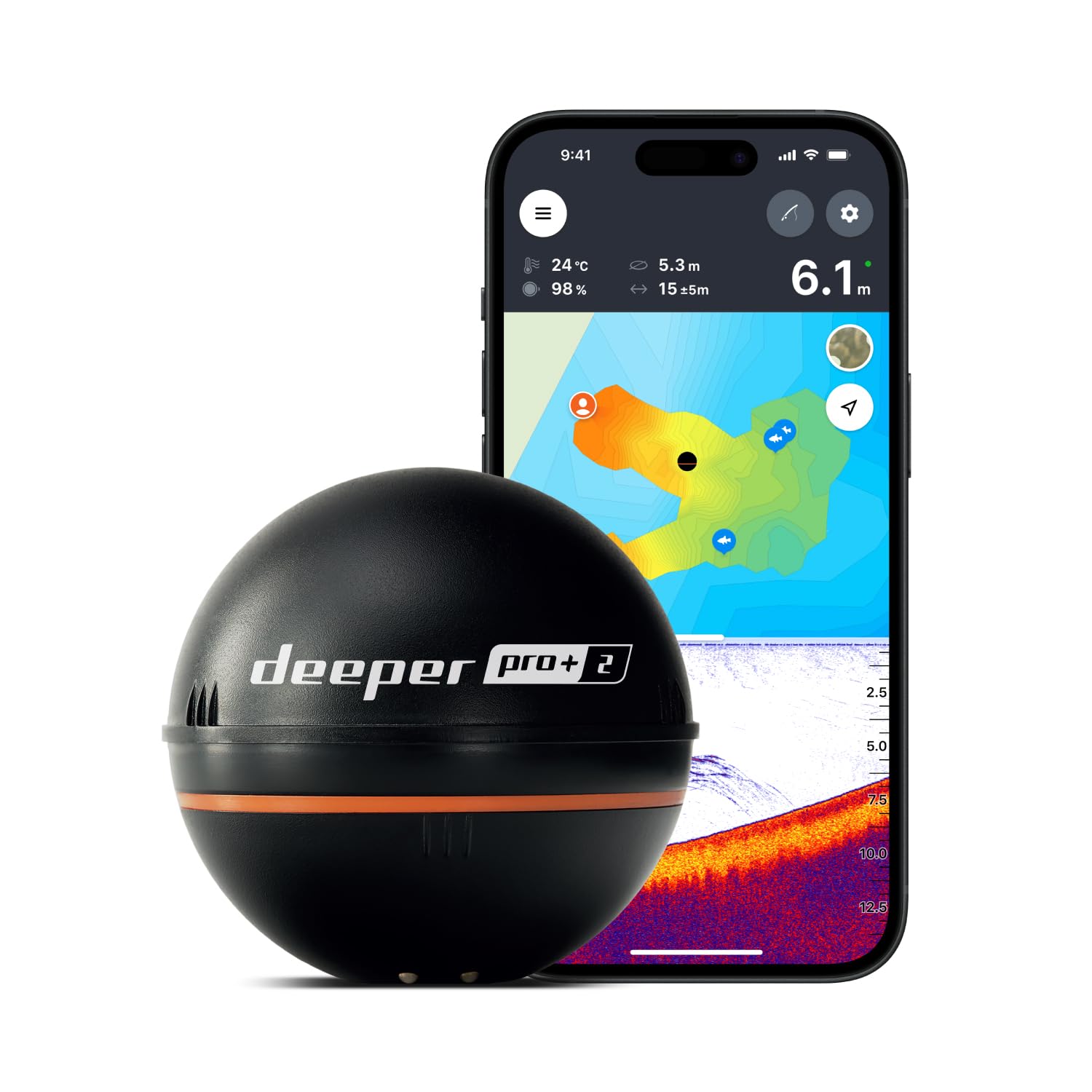
The Deeper PRO+ 2 is a completely different approach — a Wi-Fi-enabled castable sonar that works with your smartphone or tablet. The sonar unit itself is a small, waterproof ball that you cast from shore, a dock, or a kayak. It connects via Wi-Fi up to 200 feet away and sends real-time depth, temperature, and fish location data to the free Fish Deeper app. The built-in GPS creates bathymetric maps of the water you’re fishing, which you can save and revisit.
The triple-beam sonar offers wide, mid, and narrow cone angles, giving you flexibility between covering broad areas and pinpointing specific structure. Target separation is impressive for a castable unit — 0.4 inches on the narrow beam. The app shows fish size classifications (small, medium, large) and bottom hardness composition, helping you identify gravel versus mud bottoms.
Because the unit is designed to be cast, you need a sturdy rod rated for at least 20-pound braided line. Some users report battery issues after extended use in cold temperatures, and the PRO+ 2’s weight can feel heavy on ultralight tackle. If you primarily fish from shore or a kayak and already use your phone for navigation, the Deeper PRO+ 2 offers capabilities that traditional transom-mount units simply can’t match.
Why it’s great
- Castable design ideal for shore and kayak fishing
- Built-in GPS creates custom bathymetric maps
- Triple-beam sonar with excellent target separation
- Real-time data displayed on your smartphone
Good to know
- Requires a rod with 20lb+ braided line for casting
- Battery life may suffer in cold water conditions
- App has optional paid subscription for advanced features
7. LUCKY Y2020-CWLA

This LUCKY model is a wireless castable fish finder that communicates with a handheld display unit. The sonar transducer ball is castable via a fishing line through its tether hole, and the 125kHz transducer with a 90-degree beam angle provides a broad underwater view. The handheld receiver shows water depth, water temperature, fish size (small, medium, large icons), and bottom contour on a small LCD display.
The transducer has an attractive lamp that glows in low light, making it visible during night fishing sessions. Battery life is strong — the handheld lasts around 5 to 6 hours on a full charge, with a battery-saving mode that extends it to 10 hours or more. Users consistently report accurate depth readings within about 1 foot and good fish detection in shallow to moderate depths.
Build quality is decent for the price, but some units develop charging issues after a few months of heavy use. The screen resolution is basic, and the lack of mapping or GPS is noticeable if you’re used to modern units. For a simple, portable depth finder that works well for bank fishing, ice fishing, and kayak trips, the Y2020-CWLA is a reliable entry point.
Why it’s great
- Fully wireless castable transducer with tether hole
- Impressive battery life with power-saving mode
- Glowing transducer lamp for night fishing
- Accurate depth and fish size detection in shallow water
Good to know
- Some units may have battery or charging issues over time
- Basic LCD screen with no GPS or mapping
- Build quality is entry-level; not suited for heavy use
8. Yoocylii Xf-08
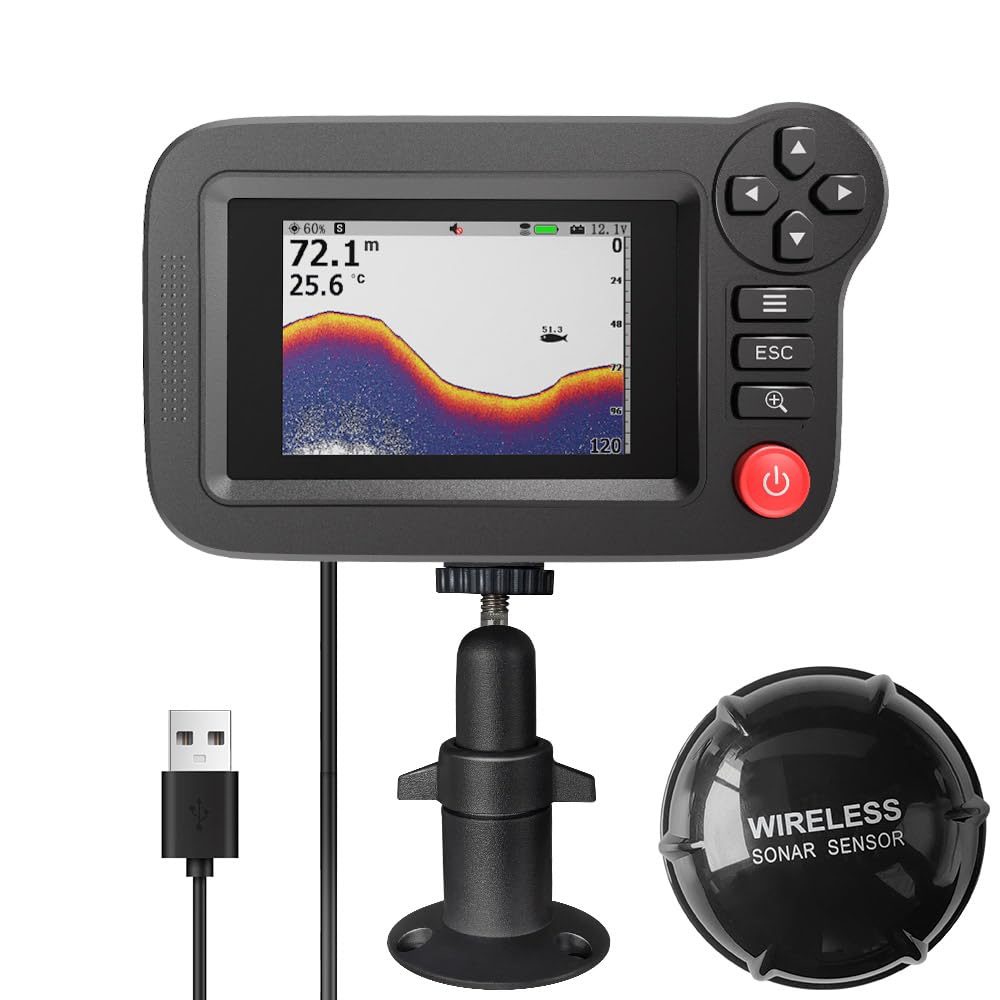
The Yoocylii Xf-08 offers one of the largest displays in the budget portable category at 3.5 inches, with a 480×320 resolution that is sunlight-readable. The wireless sonar transducer uses a 125kHz frequency and can detect depths up to 164 feet. The wireless range is rated at 328 to 656 feet, giving you plenty of flexibility whether you’re fishing from a dock, a kayak, or the shore.
The transducer is IP67 waterproof and water-activated, meaning it powers on automatically when placed in water and switches off when removed. The handheld unit accepts standard batteries, and the included 5V/12V charging cables offer flexibility for both household and boat charging. Smart fish alerts classify fish into small, medium, and large sizes, and you can set depth alarms for shallow and deep zones.
Some users note that the locking nut on the bracket stripped quickly and the antenna joint feels fragile. Battery consumption is also higher than average — expect to replace batteries frequently if you don’t use rechargeables. For an affordable unit with a big, clear screen and decent sonar performance in calm conditions, the Xf-08 delivers good value.
Why it’s great
- Large 3.5-inch color LCD with good resolution
- IP67 waterproof transducer, water-activated
- Smart fish alerts with size classification
- Versatile power options: USB and 12V
Good to know
- Bracket and antenna can feel flimsy
- Higher battery consumption than competitors
- Limited bottom contour detail vs. premium units
9. LUCKY FF-1108-1CWLA
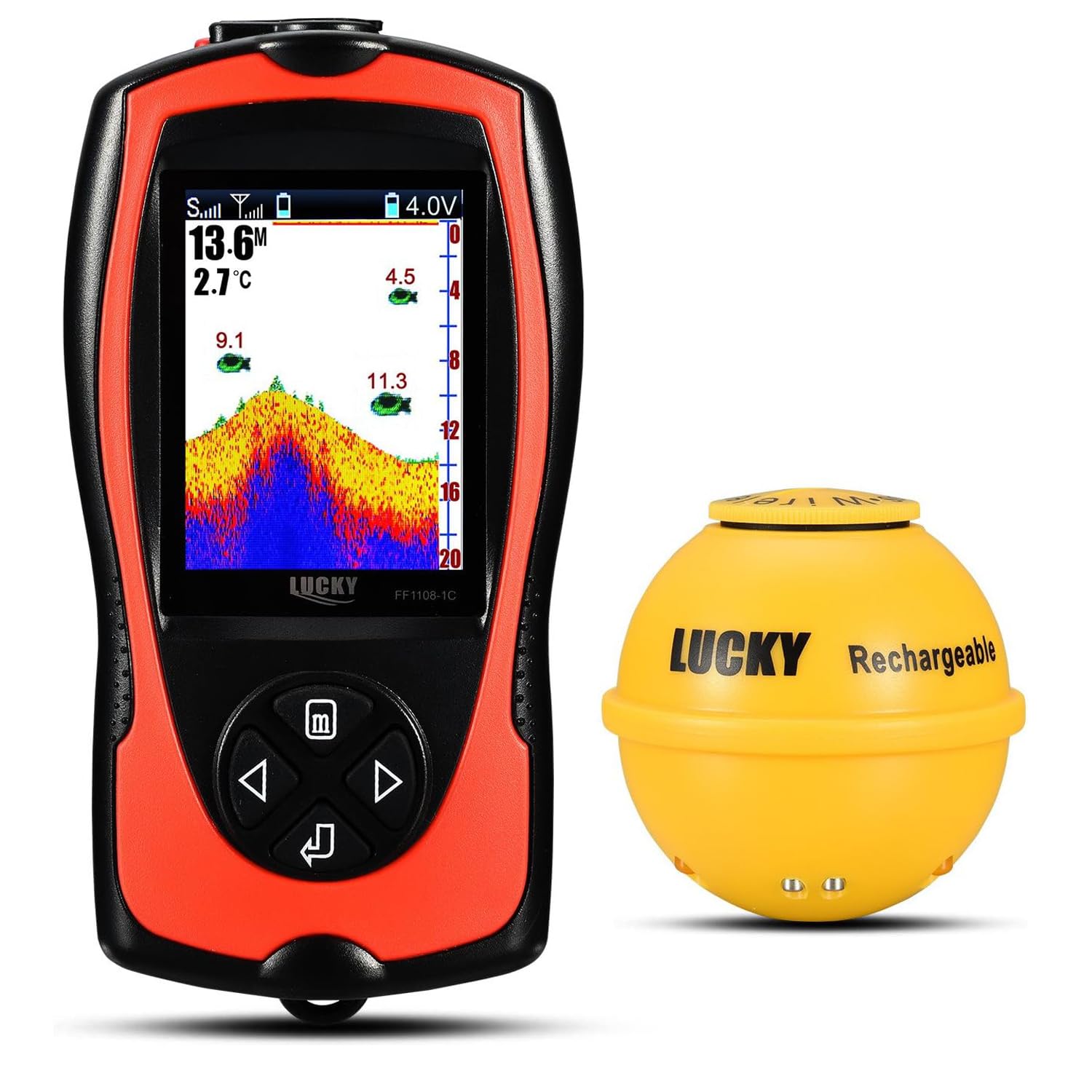
The LUCKY FF-1108-1CWLA is the most affordable entry point for anyone wanting a wireless handheld fish finder. The 2.4-inch TFT color LCD is small but functional, displaying water depth, fish icons, water temperature, and bottom contour. The transducer has a built-in fish attractive lamp that illuminates in low light, making it easier to see where the sensor is during night fishing.
Wireless range is listed at 492 feet, with a depth detection limit of 147 feet. The unit operates in both wireless and simulation modes, so you can practice using the interface before you hit the water. Both the handheld and the sonar transducer recharge via USB cable — the handheld lasts about 4 hours, while the sonar runs up to 10 hours on a charge.
Reviews are mixed on this unit. It performs well in shallow, calm water but struggles to distinguish between fish and debris, leading to false alarms. Build quality is average, and the small screen can be hard to read in bright sunlight. For absolute beginners who want a low-cost introduction to depth finders without any wiring, it serves its purpose, but most users will quickly outgrow it.
Why it’s great
- Lowest price point for a wireless handheld system
- Transducer has fish attractive lamp for night fishing
- Rechargeable with USB cables included
- Simulation mode for learning without being on the water
Good to know
- False fish detection from debris in murky water
- Small 2.4-inch screen is hard to read in direct sunlight
- Battery life on handheld is only 4 hours
FAQ
What is the most useful spec to look for in a depth finder under 500?
Can I use a budget depth finder for ice fishing?
Do I need GPS in my depth finder if I fish the same lake every time?
Final Thoughts: The Verdict
For most users, the best depth finder under 500 winner is the Garmin Striker 7SV because it combines a 7-inch display, SideVü and ClearVü imaging, GPS mapping, and CHIRP sonar — all within a very tight budget. If you want the same large screen but don’t need side scanning, grab the Garmin Striker Vivid 7cv. And for kayak or shore anglers who need a castable, app-based solution, the Deeper PRO+ 2 is a unique tool that nothing else in this range can match.

Mo Maruf
I created WellFizz to bridge the gap between vague wellness advice and actionable solutions. My mission is simple: to decode the research and give you practical tools you can actually use.
Beyond the data, I am a passionate traveler. I believe that stepping away from the screen to explore new environments is essential for mental clarity and physical vitality.