Our readers keep the lights on and my smoothie glass nicely filled. As an Amazon Associate, I earn from qualifying purchases.
Mold and mildew don’t take weekends off, and your boat’s enclosed cabin, bilge, or storage locker is the perfect breeding ground for musty odors and corrosion. A dehumidifier specifically built for marine environments must handle constant dampness, operate safely around fuel vapors, and never rely on moving parts that can spark — all while running silently for weeks on end.
I’m Mohammad Maruf — the founder and writer behind WellFizz. I’ve spent countless hours analyzing product specs, customer reliability data, and real-world performance reports to understand exactly what keeps a boat dry without draining your battery or wallet.
Whether you winterize a sailboat or fight summer humidity on a cruiser, the right dehumidifier for boat use must balance corrosion resistance, low power draw, and fail-safe operation for unattended periods.
How To Choose The Best Dehumidifier For Boat
Selecting a dehumidifier for boat use is fundamentally different from picking one for a basement or bedroom. You need a unit that can handle temperature swings, operates safely in a volatile environment, and requires minimal maintenance when you’re away from the dock. Focus on these three factors before making a decision.
Convection vs. Compressor vs. Desiccant
Compressor dehumidifiers rely on refrigerant and a fan, which can introduce spark risks and fail when cabin temperatures drop below 41°F. Convection-style air dryers (like the Davis Air-Dryr) use no moving parts — they gently warm the air, creating a natural circulation that prevents condensation without a fan or switch. Desiccant units use silica gel or zeolite to absorb moisture silently and can be electrically renewed. For a boat, convection or desiccant systems are almost always safer and more reliable than compressor models.
Coverage Volume and Power Draw
Boat interiors are measured in cubic feet, not square feet. A unit rated for 1000 cubic feet is suitable for a small cabin or storage locker, while larger vessels may need two units. Power draw is equally critical — many boats run on shore power or inverter systems, so look for units pulling 70–120 watts to avoid tripping breakers. The best dehumidifier for boat use balances enough thermal output to circulate air without overloading your electrical system.
Safety Certifications and Build Materials
Marine environments demand corrosion-proof construction and fail-safe thermal protection. Look for aluminum or polycarbonate housings (not steel), a thermal cutoff switch that prevents overheating if vents are blocked, and zero exposed spark-producing components. Units that are “safe to the touch” and designed for continuous 24/7 operation are essential for unattended use on a boat.
Quick Comparison
On smaller screens, swipe sideways to see the full table.
| Model | Category | Best For | Key Spec | Amazon |
|---|---|---|---|---|
| SEEKR Stor-Dry | Convection | Marine-grade silent circulation | Corrosion-proof aluminum, 70W | Amazon |
| Onsekin 2000 Sq.Ft | Rotary Desiccant | Large cabin / year-round use | 2.5L tank, 270W, digital hygrostat | Amazon |
| AEOCKY X1-Pro | Rotary Desiccant | Compact RV/bathroom, frost-free | 85oz tank, 340W, 25dB sleep mode | Amazon |
| Eva-Dry EDV-365 | Rechargeable Desiccant | Small spaces, no wiring | 400 cu ft per cylinder, 2hr renewal | Amazon |
| Ironwood Pacific Drywave 1000 | Convection | Covered storage, cool climates | 1000 cu ft, 120W, no moving parts | Amazon |
| Davis Air-Dryr 500 | Convection | Small cabins, entry-level price | 500 sq ft, 1 lb, thermal cutoff | Amazon |
| Pure Enrichment PureDry Mini | Peltier | Small closets, near power outlet | 27oz tank, 300ml/day, auto shutoff | Amazon |
In‑Depth Reviews
1. SEEKR by Caframo Stor-Dry

The SEEKR Stor-Dry is purpose-built for marine environments with a corrosion-proof aluminum housing that won’t rust or degrade in salt air. It draws only 70 watts — the lowest power consumption among convection units — making it ideal for boats running on shore power or limited inverter capacity. The unit gently warms the air to prevent condensation without any moving parts, eliminating the mechanical failure points common in fan-based systems.
Real-world owners report using it in shrink-wrapped boats through harsh Illinois winters and in airplane hangars with equal success. The compact 9-inch-square footprint fits easily under a cockpit seat or in a storage locker, and the silent operation means you’ll never hear it running. A thermal cutoff switch provides peace of mind for unattended use.
The only trade-off is the single-speed operation — there is no fan, thermostat, or humidity setting. It runs continuously while plugged in, which is exactly what you want for long-term moisture prevention. For a set-it-and-forget-it solution on a boat, this is the gold standard in reliability.
Why it’s great
- Marine-grade aluminum body resists corrosion
- Only 70W — lowest power draw in class
- Zero moving parts for maximum longevity
- Silent, continuous operation
Good to know
- No humidity control or adjustable output
- Coverage limited to smaller spaces (1000 cu ft)
- Some units reported fan failure after 12+ months
2. Onsekin 2000 Sq.Ft Small Dehumidifier
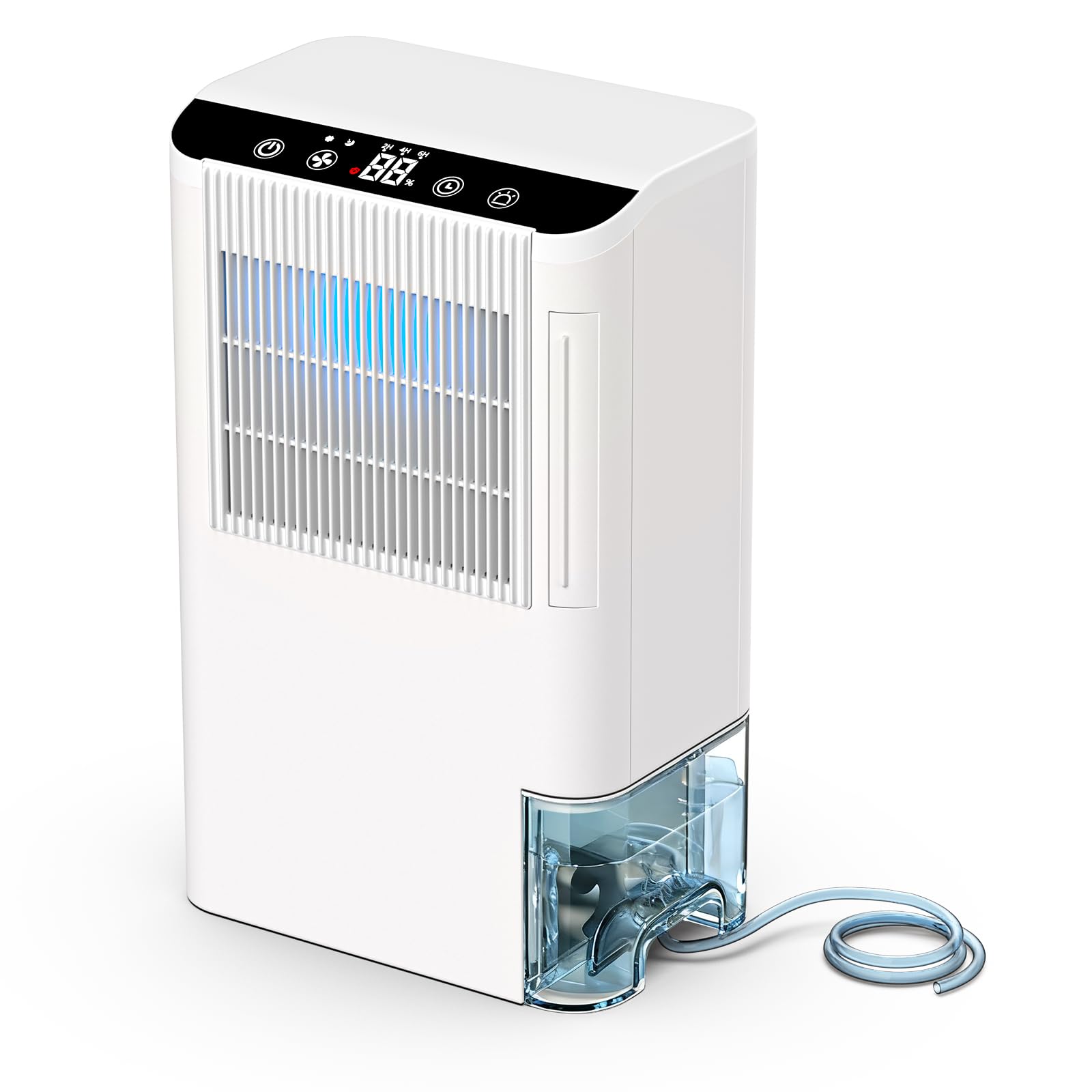
The Onsekin rotary desiccant dehumidifier solves the cold-weather failure problem that plagues compressor units. Its wheel-based desiccant technology performs 40–60% better than compressors below 41°F, making it the only mid-range option that works year-round in unheated boat cabins or shoulder-season weather. The 2.5-liter tank and included 3.3-foot drain hose offer flexibility for continuous drainage.
Owners consistently praise the whisper-quiet 46 dB sleep mode and the touch-panel controls that let you set run time, switch between day and sleep modes, and lock the seven-color ambient light. The digital hygrostat samples the air every 3 seconds and modulates the 270-watt heater to hold your exact target humidity within ±2%. For protecting guitars, vintage books, or sensitive electronics on board, this level of precision is invaluable.
The unit’s 9.8 x 6.4 x 15.7-inch footprint tucks under galley counters or inside camper benches, yet it services spaces up to 2000 square feet. A magnetic float valve, tilt sensor, and delayed cooling shutdown make it safe for 24/7 operation on carpet or wood flooring. The only real consideration is the warm exhaust air — typical of rotary desiccant units — which can slightly raise cabin temperature in very small spaces.
Why it’s great
- Exceptional cold-weather performance (below 41°F)
- Digital humidity control with ±2% accuracy
- Ultra-quiet sleep mode at 46 dB
- Includes continuous drain hose for zero maintenance
Good to know
- Outputs warm air — can raise small space temperature
- 270W draw is higher than convection dryers
- Touch controls may be less intuitive at a glance
3. AEOCKY X1-Pro Rotary Desiccant Dehumidifier
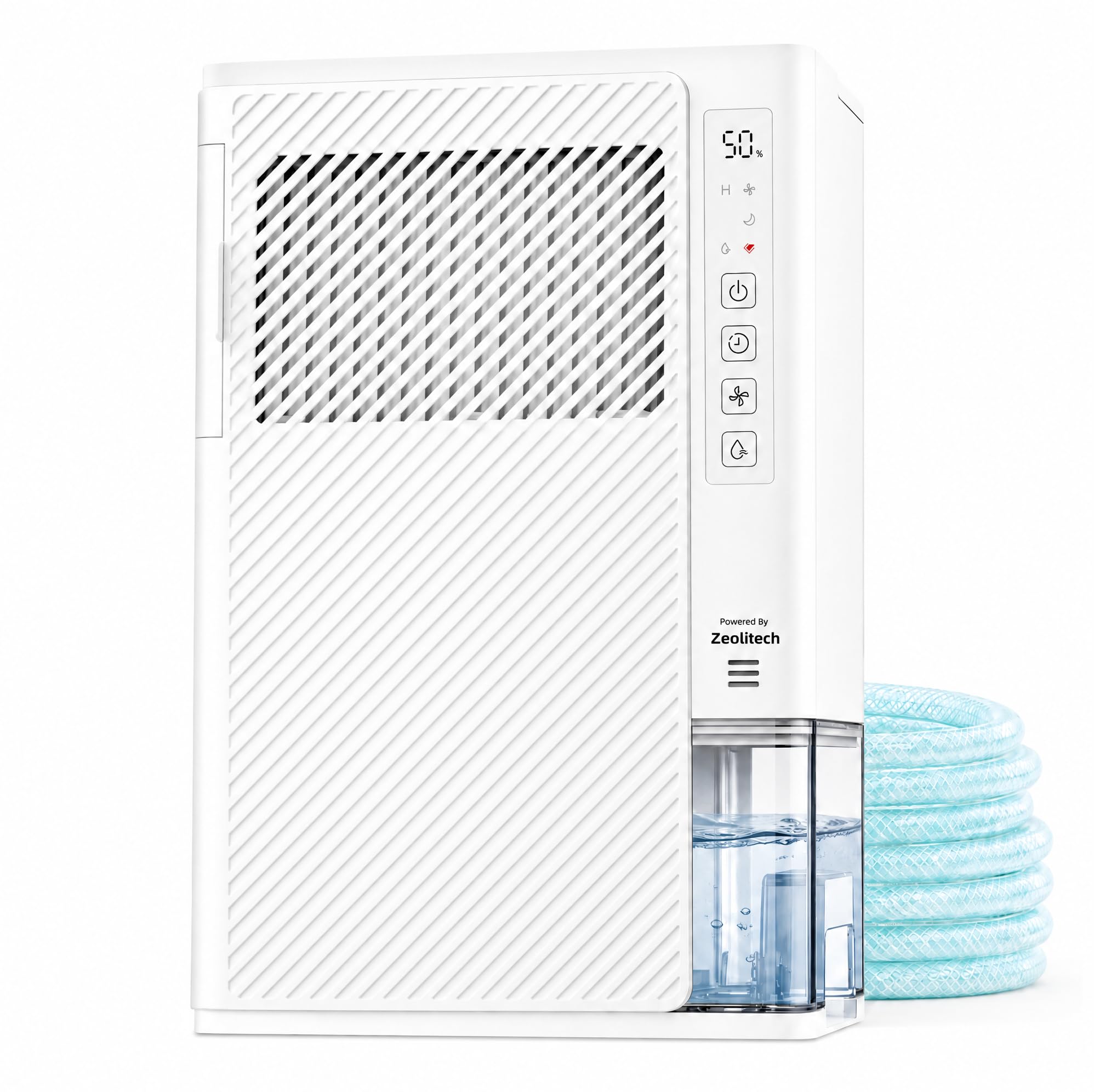
The AEOCKY X1-Pro delivers commercial-grade desiccant extraction in a chassis smaller than most Peltier units. Its zeolite-based rotary technology never frosts — a critical advantage for boats stored in winter climates where compressor units shut down. At 340 watts, it draws more power than convection dryers, but it extracts 80 ounces of water per day — roughly 10 times faster than semiconductor units of the same footprint.
Real-world reviews from RV and boat owners highlight its remarkable quietness: sleep mode drops to just 25 dB, which is barely audible over a refrigerator hum. The intelligent humidistat allows precise 40–80% humidity targets, and the 24-hour auto-off timer prevents over-drying in small spaces. The included 4.9-foot drain hose and massive 85-ounce tank mean you can run it for days without emptying.
One notable consideration is the warm scent during initial use — this is normal for molecular sieve cores and fades after a few cycles. Some owners found the unit undersized for rooms over 525 square feet with very high humidity, but for a boat cabin, closet, or RV, its combination of silence, speed, and frost-free operation is unmatched in this price tier.
Why it’s great
- Never frosts — works down to 34°F
- Extremely quiet at 25 dB in sleep mode
- Massive 85oz tank for long unattended runs
- 5 pints per day extraction in compact body
Good to know
- 340W power draw noticeably higher than convection units
- Initial warm scent from new desiccant core
- May struggle in spaces over 500 sq ft with extreme humidity
4. Eva-Dry EDV-365 Rechargeable Dehumidifier System

The Eva-Dry EDV-365 takes a completely different approach: two silica gel cylinders and a blower base that renews one cylinder while the other actively absorbs moisture in your space. This system requires no electricity during the absorption phase — the cylinder silently pulls moisture from the air using natural desiccant action. The color-changing indicator turns from orange (dry) to green (full), so you always know when to swap.
Boat owners love this system for gun safes, small cabin lockers, and electronics compartments where running a cord is impractical. Each cylinder covers up to 400 cubic feet (roughly 44 square feet), and the included blower base restores a full cylinder in just 2 hours — faster than competitors that require oven drying. The silica gel lasts up to 10 years with zero recurring cost.
The main limitation is capacity: in very humid environments, the cylinder may saturate every 3 days, requiring regular attention. One reviewer noted it failed to bring down humidity in a 6×6 room during summer, suggesting it works best in smaller, enclosed spaces. For a damp bilge, tackle locker, or electronics console, it’s a maintenance-free solution that won’t drain your battery.
Why it’s great
- No electricity needed during moisture absorption
- Renewable for 10 years — no refills needed
- Color-changing indicator eliminates guesswork
- Ultra-compact and safe for tight compartments
Good to know
- Limited coverage per cylinder (400 cu ft)
- Requires regular swap in high-humidity climates
- Blower base needed for renewal — must remember to rotate
5. Ironwood Pacific Drywave 1000 Air Dryer

The Ironwood Pacific Drywave 1000 operates on the same convection principle as the Davis Air-Dryr but covers a larger volume at 1000 cubic feet with a slightly higher 120-watt heat output. It has no fan, no motor, no moving parts — just natural convection that gently warms the air and prevents condensation from forming on cold surfaces. The thermal cutoff switch automatically shuts it down if vents become blocked.
Long-term owners report using these units for 15 years straight on covered boats in Oregon’s wet winters, preventing mold and mildew without any maintenance. The 2.5-pound build is slightly heavier than the Davis unit, but the increased thermal output makes it more effective in larger spaces like covered pickup trucks, storage containers, or small boat cabins. One reviewer uses it in a classic Bronco during rainy Pacific Northwest months with excellent results.
The only practical downside is the lack of an automotive-style adapter — it requires a standard 120V wall plug, which may mean running an extension cord to your boat. It also produces a very gentle warmth that, while safe to the touch, can be noticeable in extremely confined spaces. For a no-fuss, set-and-forget solution in a mid-size cabin, it’s a proven workhorse.
Why it’s great
- No moving parts — virtually indestructible
- Proven 15+ year reliability in marine use
- Covers 1000 cu ft with low 120W draw
- Thermal cutoff for safety
Good to know
- Only standard 120V plug (no 12V adapter)
- Warm air output can be felt in very small spaces
- No humidity setting — runs continuously
6. Davis Air-Dryr 500 Marine Air Dryer
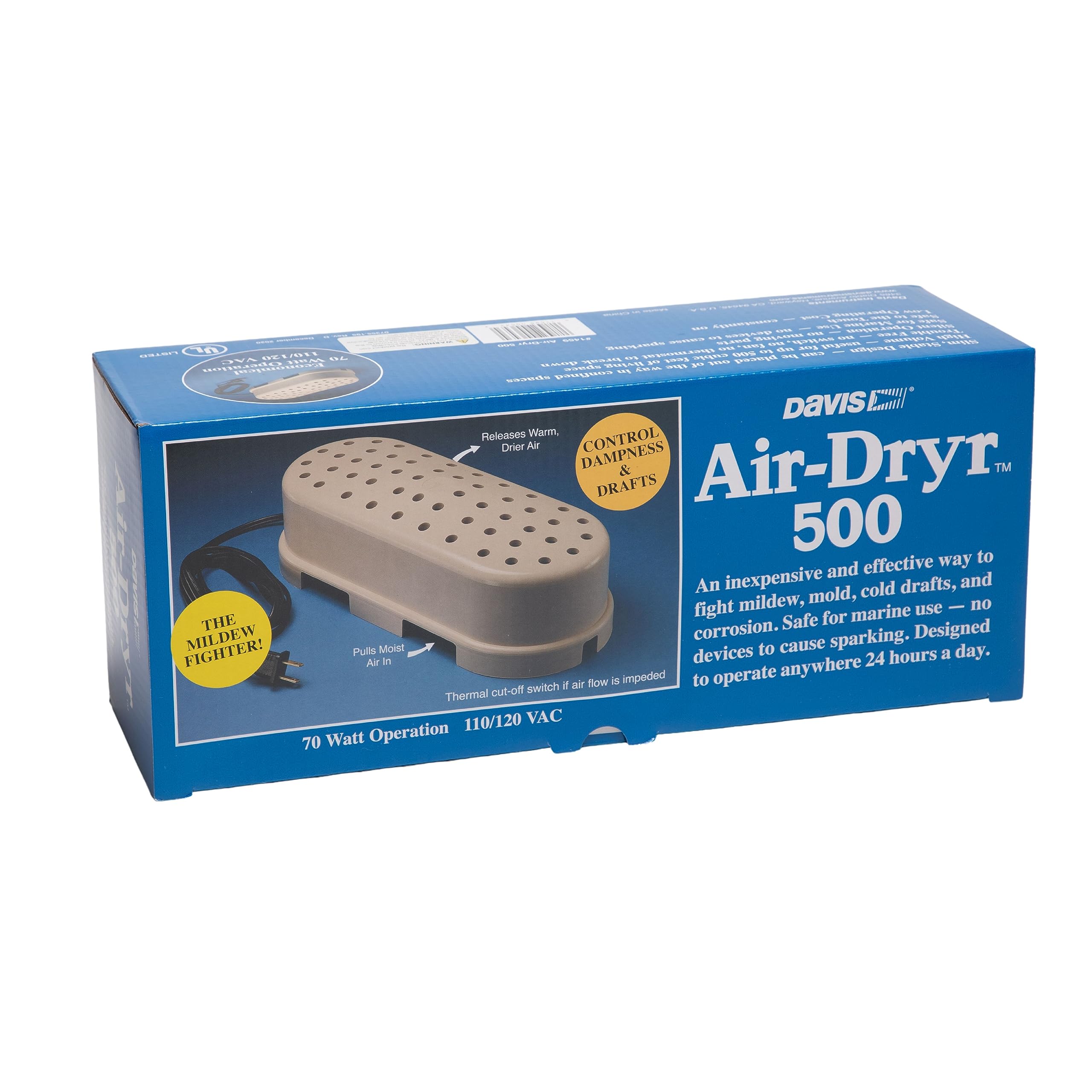
The Davis Air-Dryr 500 is the entry-level standard for marine dehumidification. Its polycarbonate housing is durable, neutral beige, and spark-free — critical for safe use in engine compartments or near fuel fumes. Weighing just 1 pound, you can mount it virtually anywhere with double-sided tape or a single screw. The thermal cutoff prevents overheating, and the lack of any switch, fan, or thermostat means there is literally nothing to break.
Boat and RV owners have used these continuously for over five years, replacing passive DampRid buckets that required constant refilling. The 500-square-foot rating is conservative for a small cabin or storage locker. One reviewer noted it was “barely adequate” for a very cold 150-cubic-foot RV storage space in freezing conditions, recommending the Air-Dryr 1000 for colder climates.
The biggest trade-off is capacity: it’s designed for small spaces and moderate humidity. In a large cabin or a boat with significant moisture ingress, you’ll need multiple units or a more powerful option. But for the price, it’s the most reliable spark-free method to keep a small compartment dry and mildew-free year after year.
Why it’s great
- Safe for marine use — no sparking components
- Extremely lightweight and easy to mount
- Cost-effective for small spaces
- Thermal cutoff for unattended safety
Good to know
- Limited coverage — best for small cabins
- No moving parts means slower moisture removal
- Some owners find it inadequate in freezing temps
7. Pure Enrichment PureDry Mini Dehumidifier

The Pure Enrichment PureDry Mini is a Peltier (thermoelectric) dehumidifier designed for very small spaces like a boat’s head compartment, hanging locker, or galley cabinet. It extracts up to 300ml of moisture per day into a transparent 27-ounce tank, and the automatic shutoff prevents overflow when the tank is full. At just 5.4 x 6.2 x 9.3 inches, it fits on a shelf or countertop without obstructing walkways.
Owner feedback is mixed for marine use: some report noticeable reductions in bathroom mugginess and foggy mirrors, while others found it collected almost nothing in high-humidity conditions. The key is matching expectations — this is not a replacement for a convection dryer in a winterized boat. It works best in a small, enclosed space with moderate humidity where you can empty the tank daily.
The 5-year warranty and quiet operation make it a reasonable choice for a weekend boat with shore power. But for long-term unattended storage or boats with persistent moisture problems, the convection or desiccant options above will deliver far superior results.
Why it’s great
- Compact footprint fits small nooks
- Auto shutoff prevents overflow
- Quiet operation for sleeping cabins
- Backed by 5-year manufacturer warranty
Good to know
- Low extraction rate (300ml/day)
- Not suitable for unattended long-term storage
- Some units arrived defective; requires immediate testing
FAQ
Can I use a compressor dehumidifier on my boat?
How do I calculate what size dehumidifier I need for my boat cabin?
Will a boat dehumidifier drain my battery while moored?
What safety features matter most for a marine dehumidifier?
Final Thoughts: The Verdict
For most users, the dehumidifier for boat winner is the SEEKR Stor-Dry because it offers the perfect balance of marine-grade corrosion resistance, ultra-low 70W power draw, and silent, spark-free convection with no moving parts. If you want precise digital humidity control and year-round performance in cold weather, grab the Onsekin 2000 Sq.Ft. And for small compartments where running a cord is impractical, nothing beats the Eva-Dry EDV-365 for zero-power moisture absorption.

Mo Maruf
I created WellFizz to bridge the gap between vague wellness advice and actionable solutions. My mission is simple: to decode the research and give you practical tools you can actually use.
Beyond the data, I am a passionate traveler. I believe that stepping away from the screen to explore new environments is essential for mental clarity and physical vitality.