Our readers keep the lights on and my smoothie glass nicely filled. As an Amazon Associate, I earn from qualifying purchases.
Specs are compiled from manufacturer listings and verified buyer reviews and can change over time — please confirm the key details on the product page before buying.
Choosing a defibrillator for your business is a big responsibility. You need a device that works under pressure, guides anyone through the steps, and stays ready for years without constant fuss. The best models let a complete stranger save a life with nothing but voice prompts and a clean chest.
I’m Mohammad Maruf — the founder and writer behind WellFizz. This guide is built by comparing the manufacturers’ published specifications and the patterns across verified customer reviews, so you get each pick’s real strengths and trade-offs instead of marketing spin.
After looking at dozens of models, seven AEDs stand out for small businesses because they balance clear emergency guidance, automatic self-testing, and the right mix of portability and preparedness. This guide walks you through the very best defibrillator for small business setups, from a compact carry-case option to a full wall-mount kit.
Our Picks at a Glance

How To Choose The Best Defibrillator for Small Business
If someone in your small business collapses from sudden cardiac arrest, you need a device that anyone can use without medical training. An AED (Automated External Defibrillator — a portable machine that checks the heart and delivers a shock to restart it) does exactly that, guided by voice prompts. For your business, the right choice depends on speed, portability, and support.
Voice Guidance and Shock Speed
The clearest, loudest voice prompts are critical in a panic. Philips models use SMART Analysis — a system that automatically assesses the heart’s rhythm — and a Quick Shock feature that delivers the shock within 8 seconds of the analysis. This speed is a life-or-death advantage in a workplace scenario where every second counts.
Self-Testing and Readiness
You will not be manually checking an AED every week. The best units perform daily, weekly, and monthly self-tests that verify the battery, electronics, and pad cartridge are all functional. This eliminates the need for manual calibration and means you can trust the device even if it sits unused for months.
Portability vs. Permanent Mounting
A slim carry case is light enough to move between floors or take on a company vehicle. A wall-mount cabinet with a rescue kit and sign turns the AED into a fixed emergency station that everyone knows where to find. The right choice depends on whether your business has one central floor or multiple areas to cover.
Quick Comparison
| Model | Best For | Weight | Quick Shock | What’s in the Box | Amazon |
|---|---|---|---|---|---|
| Philips HeartStart Home (M5068A-C01)★ Best Overall | Compact, go-anywhere AED | 5.5 lb | Within 8 seconds | Battery, pads, carry case | Amazon |
| Philips HeartStart OnSite (M5066A-C02)Office Ready | Public spaces & businesses | 5.34 lb | Within 8 seconds | Battery, pads, carry case | Amazon |
| SMFM AED (B0GCMTB69Q) | Budget-conscious first AED | 9.4 lb | — | Portable machine, carry case | Amazon |
In‑Depth Reviews
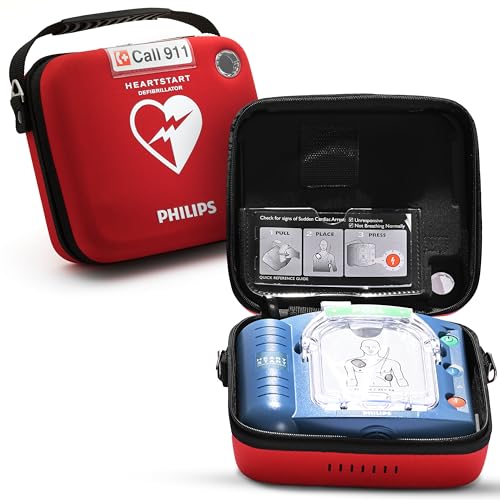
1. Philips HeartStart Home AED Defibrillator with Slim Carry Case, M5068A-C01
Our pick — over 4.5★ from 300+ verified ratings; the strongest balance of quality and price.
The compact AED that has already saved lives in real cardiac arrests.
This is the crowd-favorite Philips HeartStart Home AED — a portable defibrillator that comes from the start nearly ready to use. It performs a daily, weekly, and monthly self-test, so you never need to manually calibrate it. The voice prompts are step-by-step and include real-time CPR coaching, which means anyone in your office can operate it without training.
The defining feature here is Quick Shock: after SMART Analysis (the device’s automatic heart-rhythm check) assesses the rhythm, the AED can deliver a shock within 8 seconds. That speed helped Ken Esmark survive cardiac arrest at WebMD when a coworker grabbed this exact AED. Buyers report: “AED voice-guided steps, CPR for 45 seconds.” The unit weighs 5.5 pounds and measures 6 x 6 x 6 inches, so with the battery removed it slips into a carry-on bag — ideal if your business has multiple sites or road crews.
What wins people over is how simple the entire process is. The unit turns on automatically when you open the pad cartridge, and it will not deliver a shock unless the heart’s rhythm actually needs one. That removes the hesitation a bystander might feel. Around 44 owners highlight the ease of use as the top reason they bought it, with another 36 pointing to build quality.
Home AED with carry
- Self-testing runs daily, weekly, and monthly without any manual effort.
- Quick Shock delivers within 8 seconds of analysis — proven by real-life saves.
- Compact enough at 5.5 pounds to travel in a suitcase (battery removed).
- Includes an 8-year warranty on the AED itself.
Slim case limits extras
- Voice prompts are English-only, which may be a limitation for multilingual teams.
- Cost is a serious investment — about what you’d pay for a premium laptop.
First-time home buyers: you want a proven, portable, no-training-needed AED that fits in a carry-on and has a history of saving lives. The form factor suits small offices, traveling executives, or businesses with multiple locations.
Need pediatric pads: your workplace has a large multi-floor layout where a wall-mounted cabinet with a rescue kit would be more visible and quicker to grab in a panic.
2. Philips HeartStart OnSite AED Defibrillator, Slim Carry Case M5066A-C02
The lightest OnSite model, built for restaurants, offices, and airports.
At just 5.34 pounds, this is the most portable of the Philips OnSite lineup. It shares the same SMART Analysis and Quick Shock technology as the Home model but is officially labeled for public environments — making it a direct fit for any small business. The package dimensions measure 10.3 x 9.5 x 5.7 inches, which is noticeably smaller than the SMFM AED’s 19.6 x 15.1 x 11.7-inch box (a 1.9x size difference).
Owners mention that setup is straightforward and that the included YouTube training video makes it easy to familiarize your team. The same 8-year AED warranty and 4-year battery warranty apply, and the device runs a daily self-check so you never worry about readiness. Owners have placed these in churches and rural homes where hospital access is distant — the voice prompts bridge the gap between panic and action.
One limitation: the interface is English-only. For a multilingual office, post a quick-reference card in other languages near the unit. The slim carry case also lacks a wall mount and a spare pad cartridge, so if your business spans two floors, you will need to buy the Ready-Pack or mount the carry case in one central spot.
Compact portability: a small office, restaurant, or retail space where you need one lightweight AED that lives in an accessible spot. The 5.34-pound weight makes it easy to hand off to someone running toward an emergency.
Budget constrained: a large facility where a wall cabinet and a sign would make the AED more visible to everyone — the Value Package or Business Package would suit you better.
3. Philips HeartStart OnSite AED Defibrillator, OnSite Ready-Pack M5066A-R01
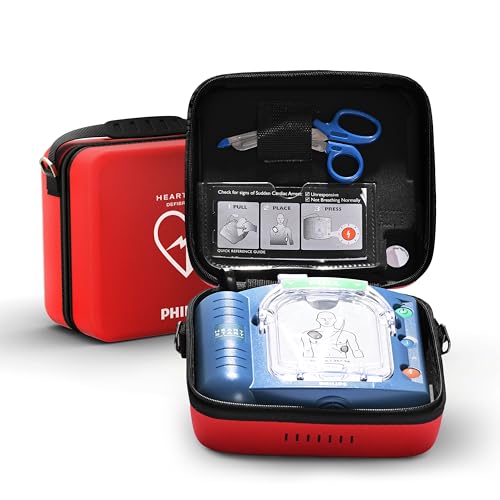
The full-cabinet kit for businesses that want everything in one order.
This Business Package is the most comprehensive offering in the Philips OnSite lineup. It bundles the AED with a basic cabinet (a lockable, alarmed storage box), a wall sign, and a Fast Response Kit. At 21 pounds and measuring 20.75 x 15.62 x 21.5 inches, the cabinet is substantial — it is designed to be mounted in a permanent location and deter theft or tampering. The alarm provides an audible alert when the cabinet is opened, which is useful in retail or public-facing spaces.
Owners describe it as an “AMAZING KIT” that includes a CPR pocket mask, organized manuals, and everything needed for a business setup. One buyer used this AED successfully during a heart attack — combined with CPR, it revived an unresponsive victim before paramedics arrived. The same 8-year AED warranty, 4-year battery warranty, and daily self-tests apply. Note that the cabinet requires a CR123A battery (included) to power the alarm.
Around 16 owners highlight build quality as the top positive, and 7 praise the value for money. A few mention issues with faulty pads — this is a known risk with any consumable medical component; always check the pad expiration date upon arrival. The Business Package does not include a spare pad cartridge, so if you want a backup, you would add the Ready-Pack or buy a spare separately.
Corporate compliance: a business with a single main entrance, lobby, or high-visibility area where a locked, alarmed AED cabinet is a regulatory or safety requirement.
Consider the lighter Value Package instead if: you do not need a lockable cabinet and your AED will be in a supervised office area — the Value Package saves weight and cost.
4. AED Automatic External Defibrillator, Portable Machine Emergency Suitable for Home, Gym, Office, School, and Public Access
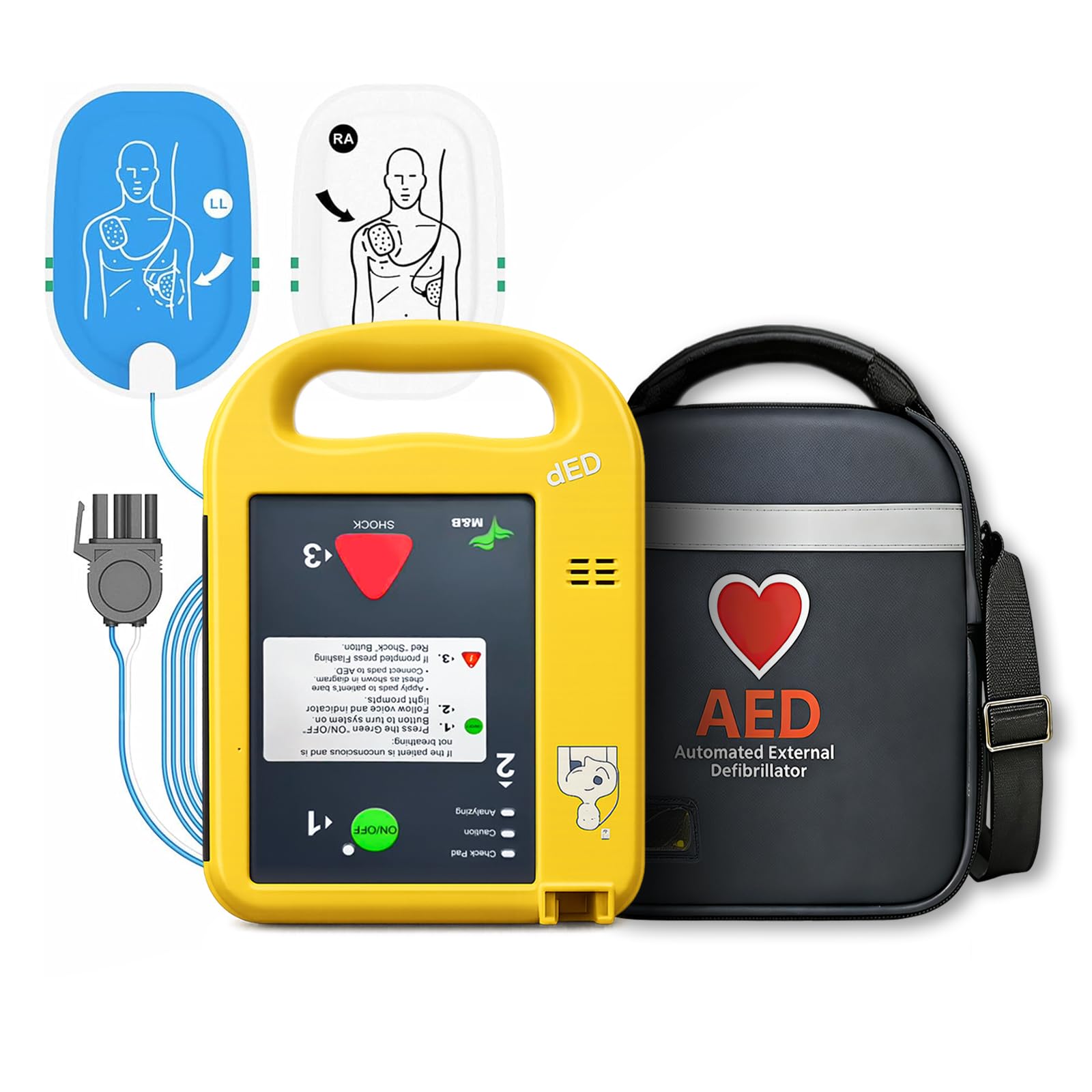
The most budget-friendly AED on the list — but with a tiny review base.
This SMFM-branded AED lands at a significantly lower price point than the Philips models, making it an entry-level option for a small business with a very tight budget. It weighs 9.4 pounds and comes in a package that measures 19.6 x 15.1 x 11.7 inches — that is about 76% heavier than the Philips OnSite at 5.34 pounds, as the comparison facts confirm. The larger box suggests a less compact design, so it takes up more wall or shelf space.
All five reviews are five-star, with owners calling it reliable and easy to use. One reviewer noted: “Even someone with minimal experience can quickly learn how to use it. The step-by-step guidance is clear.” Another compared it to big-brand units: “the build quality feels solid and reliable, and it performs just as well as some of the more expensive well-known brands.” Those are positive signals, but with only 5 total reviews, there is far less long-term data than the Philips models with hundreds of reviews each.
The key trade-off: this SMFM unit lacks a recognized medical-device track record. Philips has a market history and an 8-year AED warranty; this SMFM unit’s warranty and customer-support infrastructure are unknown. If you run a very small business (a single room, a micro-cafe, a home office) where budget is the single biggest factor, this could make sense — but for any workplace with employees or public foot traffic, the extra investment in a Philips unit buys a proven support network and established replacement-parts availability.
Travel companion: you are buying for a personal space or a tiny one-person business and cannot justify the premium cost of a Philips. The early reviews are encouraging.
Trusted brand needed: you have employees, customers, or any liability exposure — the 8-year warranty, available replacement pads, and thousands of owner experiences make it a lower risk over the long term.
Understanding the Specs
SMART Analysis & Quick Shock
SMART Analysis is the system inside Philips AEDs that automatically checks the person’s heart rhythm — a sensor called an ECG (electrocardiogram) reads the electrical signals. It only recommends a shock if it detects a rhythm called VF (ventricular fibrillation) or VT (ventricular tachycardia), which are the only conditions a shock can fix. Quick Shock then delivers that shock within 8 seconds of the analysis. In a real emergency, those seconds are what gives the person a chance to wake up.
Self-Testing: Daily, Weekly, Monthly
The best AEDs test themselves automatically. A daily self-check runs a quick battery and circuit test. A weekly self-check goes deeper and includes the pad cartridge. A monthly check is a full system verification. This means you never need to manually calibrate the device — you just check the green status light or “OK” indicator once a month to confirm it is ready. If a self-test fails, the unit alerts you audibly or visually so you can replace the battery or pads before an emergency.
FAQ
Do I need training to use an AED in my small business?
How often do the pads and battery need to be replaced?
Can an AED be used on a child?
Will the AED shock someone if they do not need it?
Where should I mount the AED in my office or retail space?
How long does the AED self-test take and how do I check the result?
Can I take a Philips HeartStart AED on a plane or in a car?
What is the difference between the Philips HeartStart Home and HeartStart OnSite models?
Does the Philips AED work with a smartphone or app?
What does the Fast Response Kit or rescue kit include?
Final Thoughts: The Verdict
For most small businesses, the best defibrillator for small business is the Philips HeartStart Home AED M5068A-C01 because it packs proven life-saving technology (Quick Shock within 8 seconds) into a 5.5-pound carry case that anyone can grab and use without training. If you want a permanent wall station with a rescue kit and a sign, grab the Philips OnSite Value Package. And for a very tight budget where every dollar matters, the SMFM AED is the entry-level option — but the Philips’ real-world track record and established support network make it the safer choice for any workplace with employees or customers.
How We Picked
We do not accept paid placement. Every pick is matched to a real buyer and a real use-case; we do not hands-on test units.
Sources & Methodology
Specifications: manufacturer listings and product documentation. Review insights: verified customer reviews, as of July 2026. Pricing: not shown on this page (it changes often); check the current price via the retailer link.
As an Amazon Associate, WellFizz earns from qualifying purchases. This does not affect which products we feature.
Related Guides

Mo Maruf
I created WellFizz to bridge the gap between vague wellness advice and actionable solutions. My mission is simple: to decode the research and give you practical tools you can actually use.
Beyond the data, I am a passionate traveler. I believe that stepping away from the screen to explore new environments is essential for mental clarity and physical vitality.