Our readers keep the lights on and my smoothie glass nicely filled. As an Amazon Associate, I earn from qualifying purchases.
A garden torn apart at dawn, fruit trees stripped overnight, and hoof prints where your plants used to be — deer damage is a quiet, costly frustration that standard fences often fail to stop. Deer repellent lights offer a different approach, using flashes of red and motion-activated strobes to trigger a prey animal’s natural flight response without chemicals or constant maintenance.
I’m Mohammad Maruf — the founder and writer behind WellFizz. I’ve spent countless hours analyzing motion-sensor specs, solar battery capacities, and real-world user feedback from rural farms to suburban backyards to separate effective deterrents from passive yard decorations.
This guide breaks down the top-performing units across multiple deployment strategies so you can confidently choose among the best deer repellent lights for your specific property size, pest pressure, and installation constraints.
How To Choose The Best Deer Repellent Lights
Deer are crepuscular foragers with excellent night vision and a hardwired fear of glowing predator eyes. Your repellent light needs to exploit that reflex consistently, every night, without gaps. Three aspects determine whether a unit actually holds the line.
Light Color and Flashing Pattern
Red LED flashes are the standard because they closely mimic the retinal reflection of a coyote or wolf. Steady white light does not trigger the same alarm. Some units strobe in rapid sequence, simulating agitated predators, while others blink at a slower cadence to conserve battery. Look for a pulsing red that creates an unpredictable flicker — deer habituate faster to a predictable beat.
Solar Panel Efficiency and Battery Runtime
Most units rely on a small monocrystalline or polycrystalline panel. Monocrystalline panels charge faster in partial shade, which matters if you mount the light under eaves or near tree lines. Battery capacity is expressed in mAh; aim for at least 1,000 mAh if you want the light to run past midnight during short winter days. Units that drop to standby before 2 AM leave a window of vulnerability during peak deer movement.
Sensor Sensitivity and Detection Range
Passive infrared (PIR) sensors detect body heat and movement. The detection angle (usually 110 to 120 degrees) and maximum range (20 to 33 feet) determine how much of your yard is covered. A narrow angle forces you to buy multiple units, while an overly sensitive sensor can trigger false alarms from swaying branches or passing cars, draining the battery and desensitizing the deer.
Quick Comparison
On smaller screens, swipe sideways to see the full table.
| Model | Category | Best For | Key Spec | Amazon |
|---|---|---|---|---|
| Upgraded Coyote Deterrent 4-Pack | Predator Eye Light | Full perimeter coverage with multiple mounts | 1,000 mAh, IP65, 1-8 ft height range | Amazon |
| Solar Control Light 4-Pack | Simulated Fire Light | Night-only passive deterrence on fence lines | 1,000 mAh, IP44, 5-7 day runtime | Amazon |
| Solar Outdoor Motion Sensor Alarm | Sound + Strobe Combo | High-pressure zones with stubborn animals | 130 dB alarm, 13 sounds, 500 ft range | Amazon |
| Solar Ultrasonic Repellent 2-Pack | Ultrasonic + Flash | Mixing daytime ultrasound and night strobe | 13.5–65.5 kHz, IP66, 110° sensor angle | Amazon |
| Solar Ultrasonic Repellent 2-Pack (Thoveneth) | Ultrasonic + Flash | Entry-level dual-mode coverage for small gardens | 25-33 ft detection, IPX4, 15-second burst | Amazon |
In‑Depth Reviews
1. Upgraded Coyote Deterrent Solar Predator Eyes 4-Pack
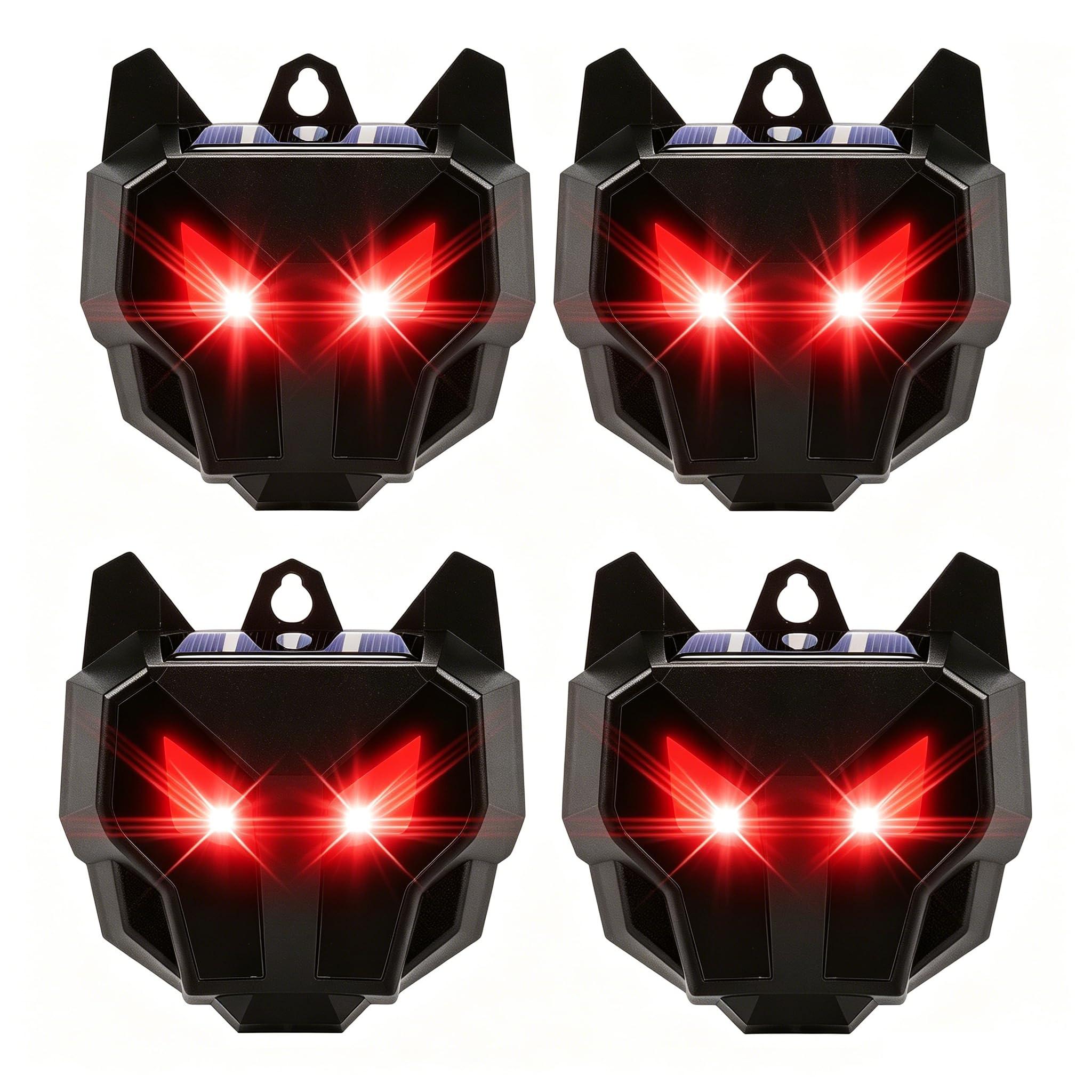
This four-pack delivers the most complete perimeter solution for the price. Each unit emits a pulsing red flash designed to mimic larger predator eyes — a wavelength that triggers deep-seated flight instincts in deer, raccoons, and skunks. The monocrystalline solar panel charges the 1,000 mAh battery efficiently even in overcast conditions, and the IP65 rating means heavy rain or freezing temps won’t short the electronics. Users consistently report a dramatic drop in nighttime animal activity within the first week of installation.
Mounting flexibility sets this pack apart. You can stake them at ground level for low-crawling skunks or hang them at the 8-foot mark to cover deer sightlines. The 360-degree coverage claim is functionally accurate when you cluster-mount three units around a chicken coop or orchard corner. One reviewer noted that after two weeks of deployment, raccoon and skunk visits stopped entirely, and no deer tracks appeared near the protected garden bed.
The trade-off is longevity. Several buyers reported that individual units stopped working after seven months, suggesting the internal battery or LED driver has a finite service life. For the per-unit cost, however, even a single-season run is competitive with chemical sprays or motion-sprinkler replacements. If you need a low-maintenance light-only solution that covers a large area out of the box, this four-pack is your strongest starting point.
Why it’s great
- Four units provide true 360° perimeter coverage for standard gardens and coops
- High-strength ABS and IP65 waterproofing withstand snow, frost, and heavy rain
- Adjustable mount height (1-8 ft) targets specific animal eye levels
Good to know
- Some units may fail after roughly 7 months of continuous night operation
- Requires 12-24 hours of direct sunlight before first use for optimal charge
2. Solar Control Light Nocturnal Animal Repeller 4-Pack
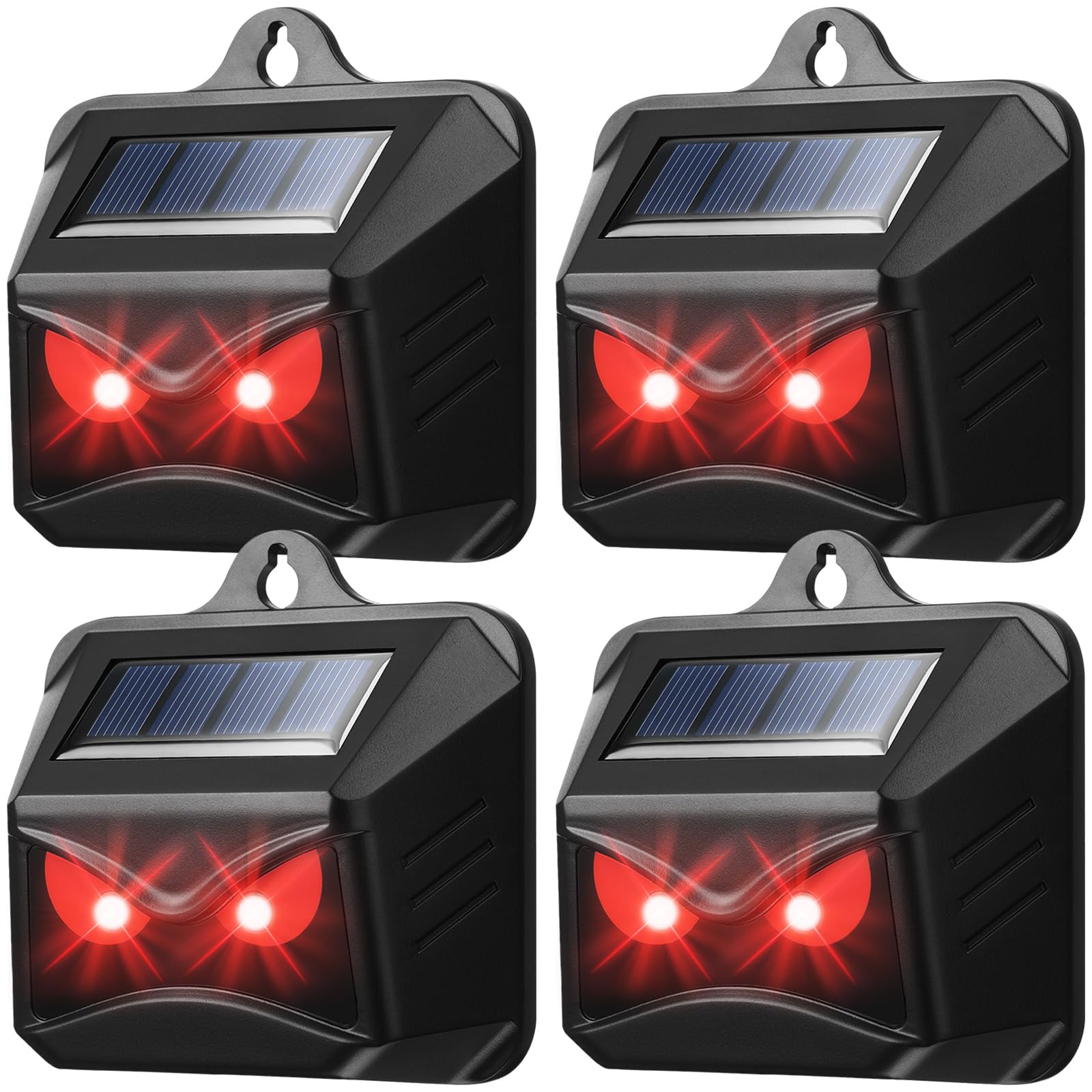
Rather than strobing like predator eyes, this unit uses two red LEDs that blink in a slower, fire-like pattern to create an illusion of campfire glow or a larger animal’s gaze. It is a passive dusk-to-dawn device — no motion sensor — which means it runs every night regardless of whether anything passes by. That simplicity eliminates false-trigger issues from wind or tree shadows, and the 1,000 mAh battery holds charge for five to seven days after a full solar top-up.
Farmers with livestock losses have reported immediate results. One user who lost 15 chickens and 12 ducks per month saw predator activity stop entirely after hanging these along the fence perimeter. Another reviewer with a serious coyote problem noted that units survived a full year of rain and snow on the original batteries. Deer, however, are a mixed bag — some users report that local herds habituated after several weeks, while others saw consistent deterrence throughout the season.
The install is genuinely tool-free. Each unit hangs on a post or fence in seconds using the built-in hook, and the light sensor handles automatic on/off switching. At this price point for a four-pack, the value is strong for those who want set-and-forget coverage without worrying about sensor calibration or battery drain from constant triggering.
Why it’s great
- No false alarms — runs continuously from dusk to dawn without motion triggering
- Five to seven days of runtime on a full charge, even in low-sun winter weeks
- Simple hook-and-hang installation works on fences, posts, and walls
Good to know
- Some deer and raccoons may eventually ignore the steady flicker pattern
- IP44 rating is splash-resistant but not fully immersion-proof in heavy storms
3. Solar Outdoor Motion Sensor Alarm with Strobe Light
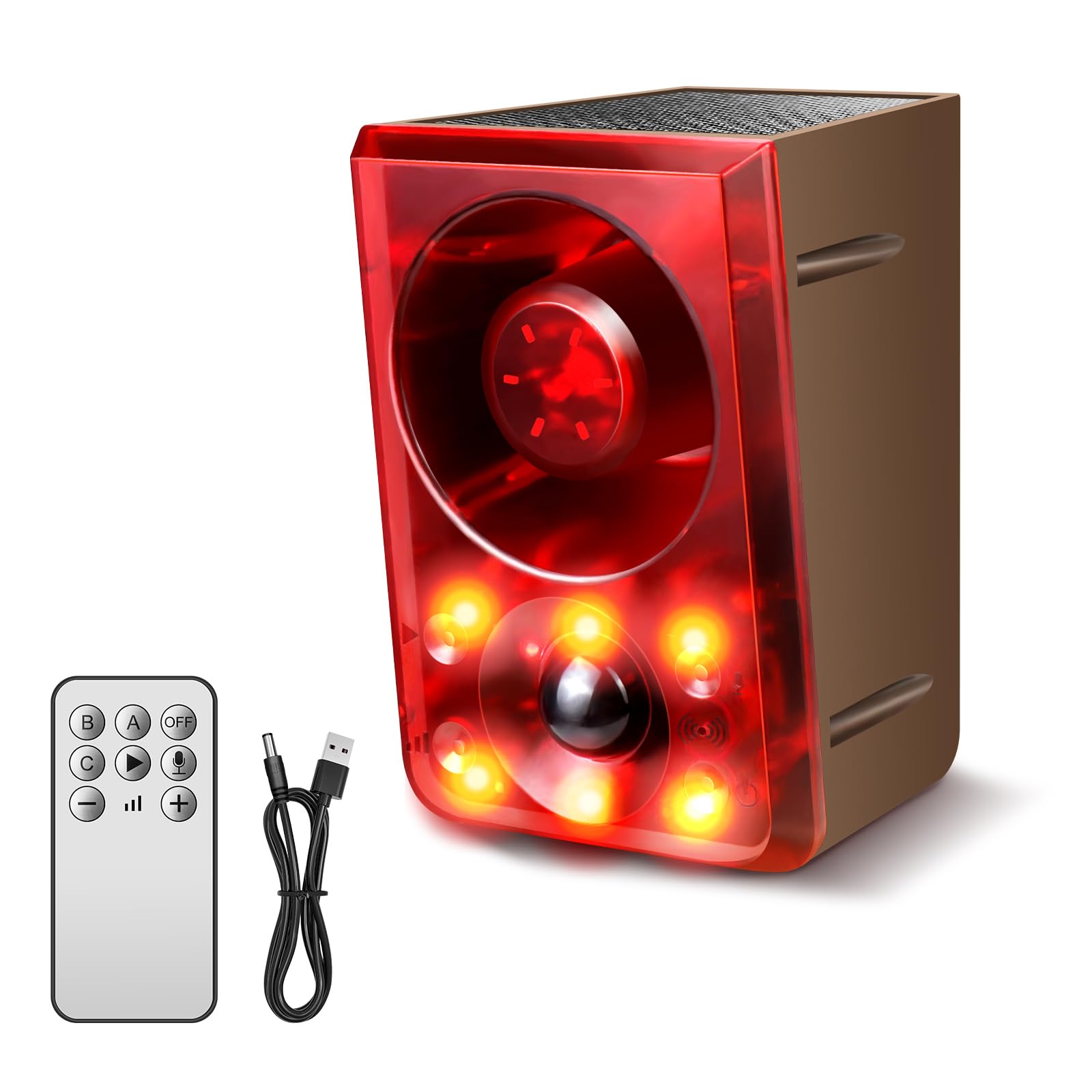
When light alone isn’t enough, this unit adds a 130-decibel alarm and strobe combination that hits multiple senses at once. Deer that have grown accustomed to a silent red flash may still bolt at the sound of a dog bark, gunshot, or wolf howl — all included among the 13 preloaded options. You can also record a custom vocal command, which is useful if neighbors tolerate a human voice better than a piercing siren.
Real-world results from buyers lean positive, especially for protecting chicken coops and small orchards. One user reported zero hen losses since installation, attributing the success to the unpredictable sound rotation and bright strobe. The PIR sensor has a stated 500-foot maximum range, though real-world detection is closer to 30 feet for small animals. The biggest complaint involves wind-triggered false alarms — tree branches moving within the detection zone will set it off repeatedly, which drains the battery and annoys nearby residents.
The remote control requires direct line-of-sight within three feet of the unit, which limits convenient adjustments unless you walk right up to the device. Consider this unit for high-pressure zones where deer have ignored passive lights, but plan your mounting location carefully to avoid false triggers from vegetation.
Why it’s great
- Customizable sound library plus voice recording prevents habituation
- Solar and USB dual-charging provides backup power for cloudy stretches
- Three operating modes (24-hour, night-only, timer) fit different property schedules
Good to know
- Wind-blown branches trigger frequent false alarms that drain battery and annoy neighbors
- Remote control only functions within three feet and requires direct line-of-sight
4. Solar Ultrasonic Animal Repellent with Flash Lights 2-Pack
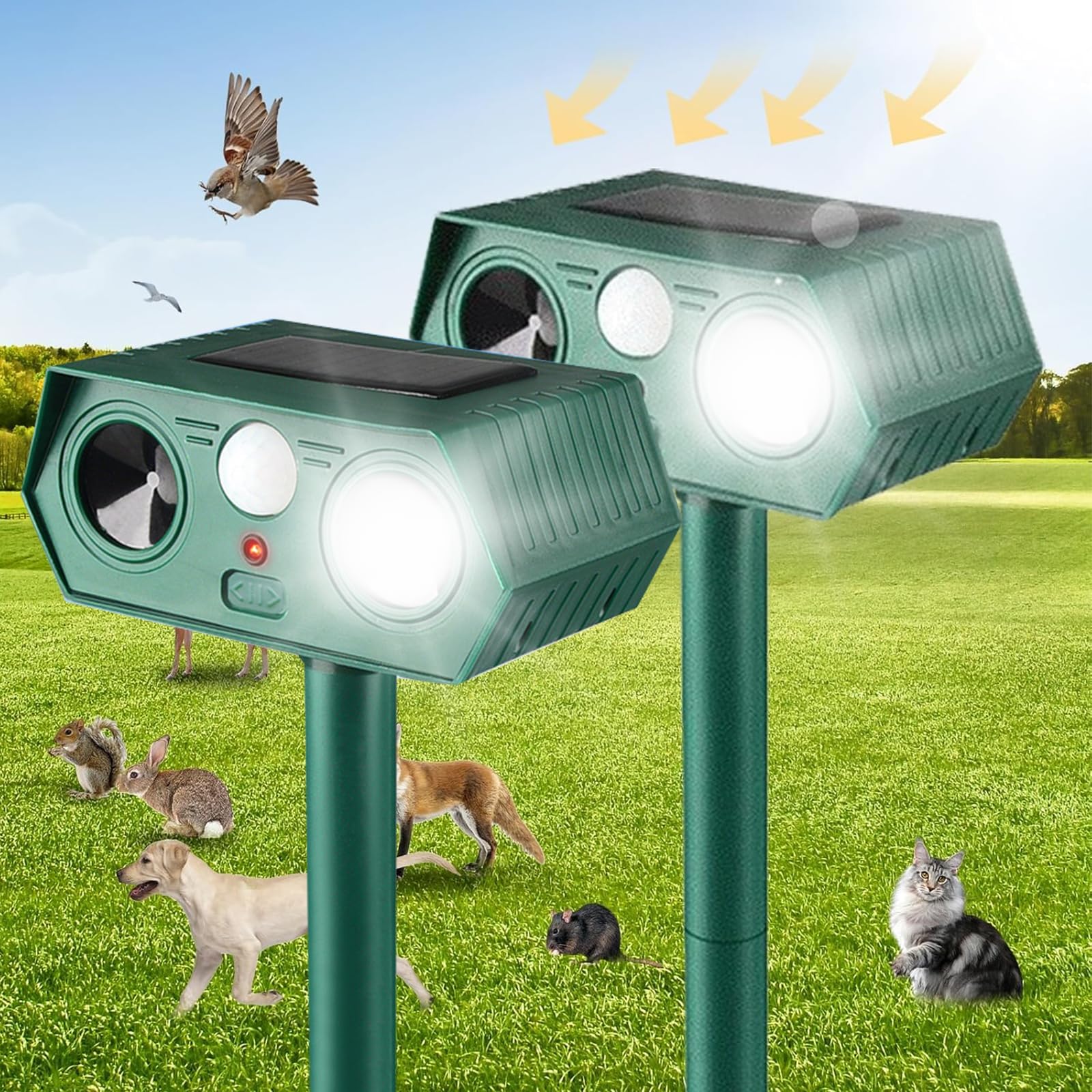
This unit differentiates itself by operating differently between day and night. During daylight hours, it emits sweeping ultrasonic frequencies from 13.5 kHz to 65.5 kHz that affect deer and smaller mammals without harming pets. After sunset, it adds bright LED flash lights to the ultrasonic burst, creating a two-pronged deterrent that challenges habituation better than a pure light or pure sound device alone.
Owner feedback highlights its effectiveness against rabbits, deer, and even neighborhood dogs. One buyer who dealt with heavy deer and rabbit feces on their property reported a complete absence of animal activity for several weeks after installation. The IP66 rating is notably higher than most competitors — it handles sustained heavy rain and temperature swings from freezing to over 100°F without performance loss. The 110-degree PIR sensor detects movement between 20 and 33 feet, and the adjustable mounting stake allows you to angle the sensor away from false triggers.
The main drawback is inconsistency. While many reviews praise its performance, one customer posted photographic evidence of a rabbit sitting directly in front of the unit while it was strobing and emitting ultrasound — the animal simply did not care. Effectiveness appears to vary based on local wildlife pressure and individual animal temperament. Buy this for its build quality and dual-mode approach, but set expectations realistically for stubborn individual animals.
Why it’s great
- Dual-mode operation uses ultrasound by day and adds LED flash at night
- IP66 rating provides genuine weather resistance against rain, frost, and UV
- Fewer false triggers than sound-only units due to moderate sensor angle
Good to know
- Some individual animals, especially rabbits, may ignore both ultrasound and flash
- Results can be inconsistent depending on regional wildlife habituation levels
5. Solar Ultrasonic Animal Repellent 2-Pack (Thoveneth)

This entry-level two-pack combines PIR motion detection with ultrasonic bursts and an accompanying red LED flash to cover both sound and light deterrence on a budget. The 110-degree sensor picks up movement from 25 to 33 feet, and the unit emits a 15-second burst of ultrasound when triggered before returning to standby mode — a design that conserves battery while still disrupting foraging patterns.
Garden owners with rabbit and cat problems have reported immediate results after placing these around raised beds. One customer who built a large garden bed saw zero animal intrusion after installation, and a user dealing with raccoons noted that the devices were easy to stake into the ground and required no wiring. The solar panel charges well in direct sun, and the IPX4 rating means light rain and snow won’t disable it, though sustained downpours may eventually seep in.
The biggest risk here is quality control. Several buyers reported that units stopped working after a short period, and one customer who ordered a second batch received a defective unit. Customer service response times appear inconsistent based on review reports. For a low-cost trial run to see if ultrasonic-plus-light deterrence works in your area, this pack is worth testing, but buy from a seller with a reliable return policy in case of early failure.
Why it’s great
- Low entry cost allows testing ultrasonic-plus-light deterrence without large investment
- 15-second burst mode saves battery and reduces animal habituation to constant noise
- Easy stake mounting and compact size fit small garden beds and patios
Good to know
- Quality control is inconsistent — some units arrive defective or fail within weeks
- IPX4 rating is splash-proof, not intended for prolonged heavy rain exposure
FAQ
Do deer eventually get used to red flashing lights?
How high should I mount deer repellent lights for best results?
Will solar repellent lights work in shaded or north-facing yards?
Can deer repellent lights bother my pets or livestock?
Final Thoughts: The Verdict
For most users, the best deer repellent lights winner is the Upgraded Coyote Deterrent 4-Pack because it combines true 360-degree coverage, IP65 durability, and a convincing predator-eye flash pattern at a per-unit cost that beats buying singles. If you want ultrasonic reinforcement to handle daytime ground pests and stubborn nighttime deer, grab the Solar Ultrasonic Repellent 2-Pack. And for the tightest budget paired with passive dusk-to-dawn coverage, nothing beats the value of the Solar Control Light 4-Pack.

Mo Maruf
I created WellFizz to bridge the gap between vague wellness advice and actionable solutions. My mission is simple: to decode the research and give you practical tools you can actually use.
Beyond the data, I am a passionate traveler. I believe that stepping away from the screen to explore new environments is essential for mental clarity and physical vitality.