Our readers keep the lights on and my smoothie glass nicely filled. As an Amazon Associate, I earn from qualifying purchases.
A long, white gouge across your door panel from a parking lot cart. A deep key mark trailing down the fender. These aren’t surface swirls that a quick wax can hide; they are fractures in your car’s clear coat that demand abrasion. The right compound must cut through the clear coat layer to level the scar, then refine the surface back to a high-gloss finish without leaving haze or micro-marring. This is the precise job of a heavy-cut compound designed for serious paint correction.
I’m Mohammad Maruf — the founder and writer behind WellFizz. I’ve spent hundreds of hours analyzing the abrasive technology, viscosity, and cut-level data of dozens of compounds to understand exactly what separates a professional-grade scratch remover from a filler-heavy liquid that washes away.
Each compound featured here has been evaluated on its ability to level sanding marks, its lubricity during extended buff cycles, and its capacity to finish down without requiring a secondary polish. This guide is your definitive resource for choosing the right best deep scratch remover for cars to restore your paint to its pre-damage clarity.
How To Choose The Best Deep Scratch Remover For Cars
A deep scratch remover is a high-speed abrasive rather than a paint filler. Selecting the wrong grit rating or abrasive chemistry can either fail to remove the scratch or cut too deeply, damaging the clear coat. Focus on these three variables to match the product to your scratch depth and your equipment.
Abrasive Grit Rating and Cut Level
The grit number tells you the particle size. A lower number means a larger, more aggressive particle. A P1000 compound (like the Menzerna Heavy Cut 1000) will remove deeper scratches but leave more haze. A P1200 compound (like the Meguiar’s M105) cuts slightly less but finishes clearer. For scratches that catch your fingernail, you need a compound at the P800 to P1000 range; for lighter clear coat scratches, a P1200 compound is sufficient.
Diminishing vs. Non-Diminishing Abrasives
Diminishing abrasive compounds (like Meguiar’s M105) start with large particles that break down into finer ones as you work, allowing the same product to cut and then polish in one step. Non-diminishing compounds (like the Griot’s Garage BOSS Correcting Cream) maintain a consistent particle size throughout the buff cycle, providing a more predictable cut but often requiring a separate finishing polish to remove micro-haze.
Lubricity and Work Time
A compound that dries out too fast creates dust, which can scatter abrasive particles across the panel and cause micro-scratches. The best heavy-cut compounds use a high-lubricity binder that keeps the abrasives suspended and lubricated for a 30–45 second work window. This is especially important when using a dual-action polisher, where the orbit motion generates heat faster than a rotary buffer.
Quick Comparison
On smaller screens, swipe sideways to see the full table.
| Model | Category | Best For | Key Spec | Amazon |
|---|---|---|---|---|
| Griot’s Garage BOSS Correcting Cream | Premium | Moderate defects with extended work time | P120 Grit, 16 oz | Amazon |
| Meguiar’s Mirror Glaze M105 | Mid-Range | Heavy swirls and P1200 sanding marks | P1200 Grit, 8 oz | Amazon |
| Menzerna Heavy Cut Compound 1000 | Mid-Range | Deep scratches and P1000 sanding marks | P1000 Grit, 8 oz | Amazon |
| Meguiar’s M0416 Heavy-Cut Cleaner | Budget | Heavy oxidation on older paint | P40 Grit, 16 oz | Amazon |
| Malco Super Duty Heavy Cut Compound | Premium | P1500 sand scratches on clear coat | P800 Grit, 32 oz | Amazon |
In‑Depth Reviews
1. Griot’s Garage BOSS Correcting Cream

The Griot’s Garage BOSS Correcting Cream is built around a high-lubricity formula that prevents the compound from drying out and dusting during extended buff cycles. Real-world reviews confirm that after 4–5 passes per panel on a 12-year-old Acura MDX with a dual-action polisher and orange foam pad, the paint returned to a mirror finish. The abrasive package is optimized for moderate defects—light scratches and swirl marks—rather than deep gouges that require wet sanding first.
The P120 grit aluminum oxide particles provide a consistent cut that does not break down over time, making this a non-diminishing compound. This means you get the same cutting power throughout the entire work session, but you will likely need a finishing polish to remove the micro-haze left behind. The extended buff cycle gives you more control, which is especially valuable for beginners who need time to work a panel without rushing.
One user noted that the cream removed water stains and cloudiness from a 40-year-old turntable acrylic dust cover, highlighting the compound’s versatility beyond automotive paint. However, deep scratches that catch a fingernail still require sandpaper before this product can level them. For the enthusiast who wants professional-grade results with minimal dusting and easy wipe-off, this is a premium pick that delivers.
Why it’s great
- Extended work time reduces dusting and allows thorough buffing
- Easy wipe-off with no stubborn residue
- Effective on moderate swirls and water stains across multiple surfaces
Good to know
- Non-diminishing formula requires a separate finishing polish
- Will not level deep scratches that need wet sanding
2. Meguiar’s Mirror Glaze M105 Ultra-Cut Compound
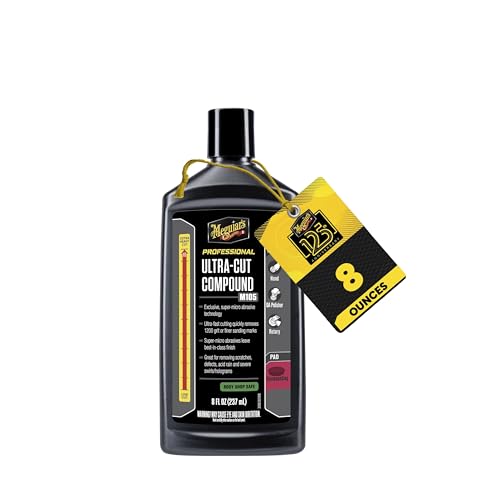
The Meguiar’s M105 is the most referenced heavy-cut compound in the enthusiast community, and for good reason. The super micro-abrasive technology uses particles that start at a P1200-equivalent size and break down into a fine polishing rouge as you work. This diminishing formula allows the product to both cut through moderate scratches and finish to a high-gloss shine in a single step—a significant convenience for users who do not want to buy a separate compound and polish.
Real-world testing shows the M105 can remove bird droppings, small scratches from black paint, and even 1200-grit wet sanding marks with multiple applications. One user restored a repainted fender to a factory-like shine that matched original 12-year-old paint, applying the compound by hand after sanding from 2000 to 7000 grit. The product works well with a dual-action polisher or rotary buffer, but multiple reviewers emphasize that a little goes a long way—over-application leads to wasted product and increased dust.
The main limitation is that the M105 is not designed for ultra-deep scratches that have penetrated through the clear coat. It is optimized for moderate to heavy paint defects, including heavy swirls and acid rain etching. For the price, the M105 offers the best balance of cutting power and finishing ability in a single bottle, making it the most versatile choice for the home detailer.
Why it’s great
- Diminishing abrasive cuts and finishes in one step
- Effective on P1200 sanding marks and heavy swirls
- Works by hand, DA polisher, or rotary buffer
Good to know
- Can dust if worked too long or at too high speed
- Not aggressive enough for scratches deeper than the clear coat
3. Menzerna Heavy Cut Compound 1000
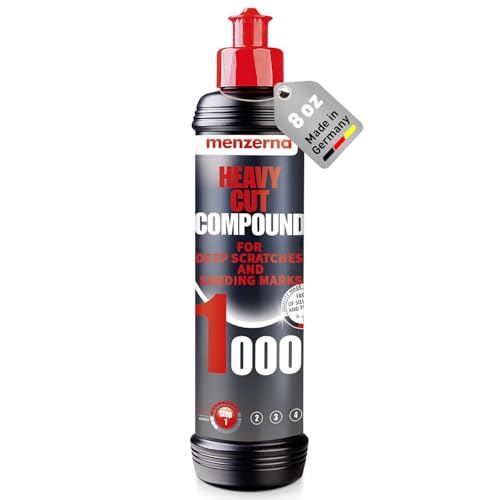
The Menzerna Heavy Cut Compound 1000 is engineered with a P1000 grit rating, making it slightly more aggressive than the Meguiar’s M105. This higher cut level allows it to tackle deeper scratches that a P1200 compound might only lighten. Users report that a deep scratch from a granite block—the kind that catches a fingernail—was reduced nearly completely after a single application by hand, with the remaining mark barely noticeable.
The formula is silicone-free, which prevents contamination of the paint surface and ensures that the compound does not interfere with wax or sealant adhesion. The compound can be applied by hand for small spot repairs or with an orbital or rotary buffer for panel-level correction. The manufacturer recommends a criss-cross pattern with a foam pad to ensure even coverage, then wipe-off when the milky film turns translucent.
A common note from reviewers is that the 8-ounce bottle is smaller than expected, but the compound is so effective that a little goes a long way. Several users mentioned that it removed scratches from a parking lot scrape in under 10 minutes by hand. The trade-off is that the P1000 grit leaves more haze than a finer compound, so a separate finishing polish is often needed for a mirror finish.
Why it’s great
- P1000 grit removes deeper scratches than typical P1200 compounds
- Silicone-free formula safe for refinishing
- Works well by hand for rapid spot repair
Good to know
- Leaves micro-haze that requires a finishing polish
- Small 8-ounce bottle covers fewer panels
4. Malco Super Duty Heavy Cut Compound
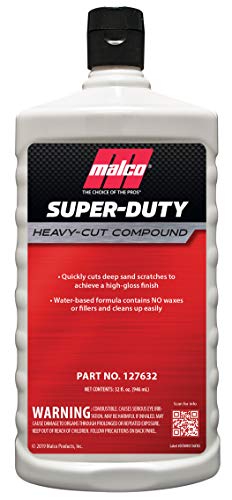
The Malco Super Duty Heavy Cut Compound is the most aggressive product in this lineup, featuring a P800 grit rating that can remove P1500 grit and finer sand scratches. This makes it the go-to choice for severe oxidation, deep clear coat scratches, and marine gel coat repair. Professional detailers and body shop technicians reach for this compound when they need to level sanding marks quickly without the compound clumping or drying out under the buffer.
The formula is designed for use with a 100% twisted white wool cutting pad. One professional detailer reported that this compound restored severely oxidized paint on a 2008 Honda Accord, far exceeding expectations compared to previous products. The compound works by breaking down the clear coat surface to remove the damaged layer, and it leaves a high-gloss finish that approaches show-car quality. However, because of its aggressive cut, it is not recommended for soft clear coats or single-stage paints that have minimal clear layer thickness.
The 32-ounce bottle provides a generous volume that covers multiple panels or several vehicles, making it a cost-effective choice for high-volume work. Several users noted that switching from a competitor brand to Malco resulted in faster work times and less physical effort, as the compound does not require repetitive passes to remove the same level of defect.
Why it’s great
- P800 grit removes P1500 sand scratches with ease
- Large 32-ounce bottle for extended projects
- Leaves a high-gloss finish after compounding
Good to know
- Too aggressive for soft clear coats
- Requires a wool cutting pad for best results
5. Meguiar’s M0416 Mirror Glaze Heavy-Cut Cleaner
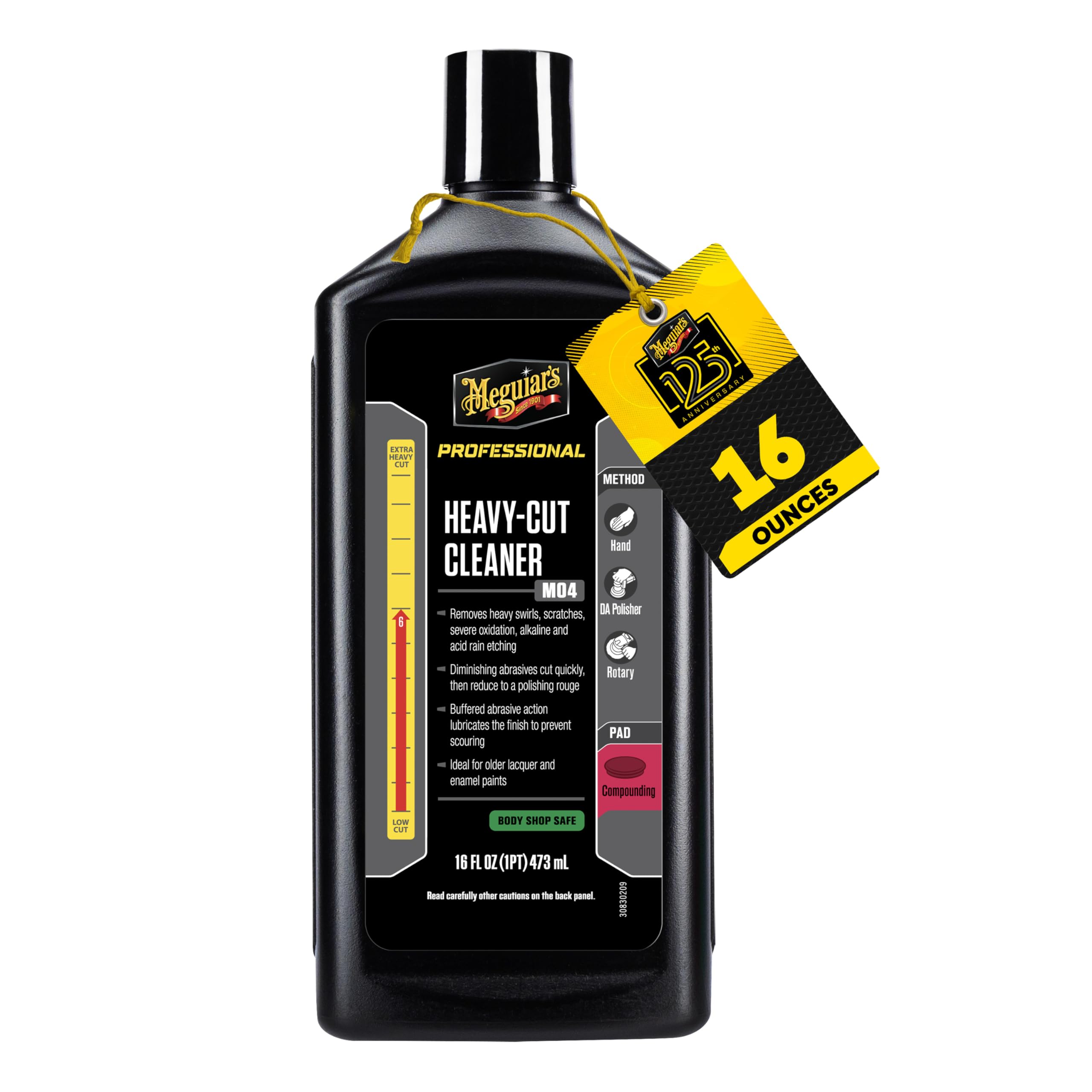
The Meguiar’s M0416 is an aggressive abrasive paint cleaner with a P40 grit rating. This is a coarse compound designed for serious defect removal, including heavy swirls, deep scratches, severe oxidation, and alkaline or acid rain etching. It is explicitly formulated for rotary buffer use and is body shop safe, making it a staple for professional paint correction where you need to remove a thick layer of damaged clear coat or single-stage enamel paint.
Unlike the M105, which uses diminishing micro-abrasives that break down into a polish, the M0416 uses a buffered abrasive action that reduces to a buffing rouge to minimize swirling. This means it cuts aggressively at first but transitions to a less aggressive phase as you work. Users report that it easily removes the orange peel effect from factory paint and restores faded, oxidized surfaces that have been neglected for years. It is especially effective on older lacquer and enamel paints where modern clear-coat compounds may struggle.
The main downside is that the P40 grit is very coarse, so it can leave a hazy finish that requires a finer polish to restore full gloss. Reviewers also caution that it is not a magic solution for deep scratches that have penetrated the clear coat—no liquid compound can fix a gouge that reaches the primer or metal. For a budget-friendly entry into heavy-cut compounding, the M0416 delivers unmatched cut per dollar, but only if you have a rotary buffer and the experience to use it safely.
Why it’s great
- Very aggressive cut for heavy swirls and severe oxidation
- Buffered abrasive reduces to a rouge to minimize micro-scratching
- Ideal for older lacquer and enamel paint
Good to know
- Requires a rotary buffer—not safe for hand application
- Requires a separate finishing polish for a mirror shine
FAQ
Can a deep scratch remover fix a scratch that reaches the metal?
Should I use a dual-action polisher or a rotary buffer for heavy-cut compounds?
Final Thoughts: The Verdict
For most users, the best deep scratch remover for cars winner is the Meguiar’s Mirror Glaze M105 because it combines a diminishing abrasive that cuts and finishes in one step with a P1200 grit ideal for moderate scratches and swirls. If you want the most aggressive cut for deep scratches, grab the Malco Super Duty Heavy Cut Compound. And for extended work time with minimal dusting on moderate defects, nothing beats the Griot’s Garage BOSS Correcting Cream.

Mo Maruf
I created WellFizz to bridge the gap between vague wellness advice and actionable solutions. My mission is simple: to decode the research and give you practical tools you can actually use.
Beyond the data, I am a passionate traveler. I believe that stepping away from the screen to explore new environments is essential for mental clarity and physical vitality.