Our readers keep the lights on and my smoothie glass nicely filled. As an Amazon Associate, I earn from qualifying purchases.
Choosing the wrong deep cycle marine battery means dead trolling motors mid-lake, sagging voltage that kills your fish finder, and hauling sixty-pound lead bricks in and out of your boat. The chemistry, capacity, and BMS configuration you pick determine whether you spend your day fishing or troubleshooting power. This guide breaks down the best options for every boat size, motor thrust, and budget.
I’m Mohammad Maruf — the founder and writer behind WellFizz. I’ve spent countless hours analyzing marine battery specifications, customer reliability data, and real-world performance metrics to separate marketing claims from genuinely durable power solutions.
Whether you troll a kayak with a 30-pound motor or run a 36-volt system on a bass boat, finding the best deep cycle marine battery means matching chemistry, amp-hour rating, and physical size to your exact use case — and this guide maps every option clearly.
How To Choose The Best Deep Cycle Marine Battery
Marine batteries face vibration, temperature swings, and deep discharge cycles that kill standard automotive batteries fast. The right choice depends on three factors: chemistry, capacity, and physical group size.
Chemistry: AGM vs LiFePO4 vs Flooded Lead-Acid
Flooded lead-acid is cheapest but requires venting and water checks. AGM is spill-proof and vibration-resistant, making it a solid mid-range choice for budget-focused boaters. LiFePO4 lithium delivers three times the usable capacity at half the weight, lasts thousands of cycles, and costs more upfront — the clear winner for frequent users or anyone tired of replacing batteries every two years.
Amp-Hours and Motor Draw
A 50Ah AGM battery running a 55-pound trolling motor at moderate speed (roughly 25A draw) will last about two hours before hitting 50% depth of discharge — the safe limit for lead-acid. Lithium batteries use 100% of their rated capacity, so a 50Ah lithium pack would run the same motor for the full two hours with no voltage sag. Calculate your daily runtime in hours multiplied by your motor’s amp draw, then add 20% buffer.
Group Size and Terminal Configuration
Measure your battery tray before buying. Group 24 is compact (roughly 10 x 6.8 x 9 inches), Group 27 adds length, and Group 31 is the largest standard marine size. Dual-purpose marine terminals (with both stud and wing-nut posts) allow easy connection to trolling motors and accessory panels without adapters.
Quick Comparison
On smaller screens, swipe sideways to see the full table.
| Model | Category | Best For | Key Spec | Amazon |
|---|---|---|---|---|
| Battle Born 100Ah | Premium | Full-time RV & boat house power | 3000-5000 cycles @ 100% DOD | Amazon |
| Litime 12V 100Ah TM | Premium | 36V trolling motor systems | TVS surge protection for motors | Amazon |
| Power Queen 12V 100Ah | Premium | Sailboats & off-grid cabins | 4S4P expandable to 20.48 kWh | Amazon |
| HumsiENK 12V 150Ah | Mid-Range | High-capacity solar & marine | Bluetooth 5.0 + 110A BMS | Amazon |
| DUMFUME 12V 150Ah | Mid-Range | Large solar arrays & long trips | 1920Wh energy capacity | Amazon |
| DC HOUSE 12V 100Ah Bluetooth | Mid-Range | Tech-savvy anglers & ice fishermen | Bluetooth cell-level monitoring | Amazon |
| HQST 12V 100Ah LiFePO4 | Mid-Range | Budget-conscious lithium adopters | LED display + low-temp cut-off | Amazon |
| WEIZE 12V 100Ah AGM | Value | Backup power & budget marine | 63 lbs, Group 31 AGM | Amazon |
| Newport 12V 50Ah AGM | Value | Light kayaks & small jon boats | 32 lbs, sealed AGM | Amazon |
In‑Depth Reviews
1. Battle Born 100Ah 12V LiFePO4
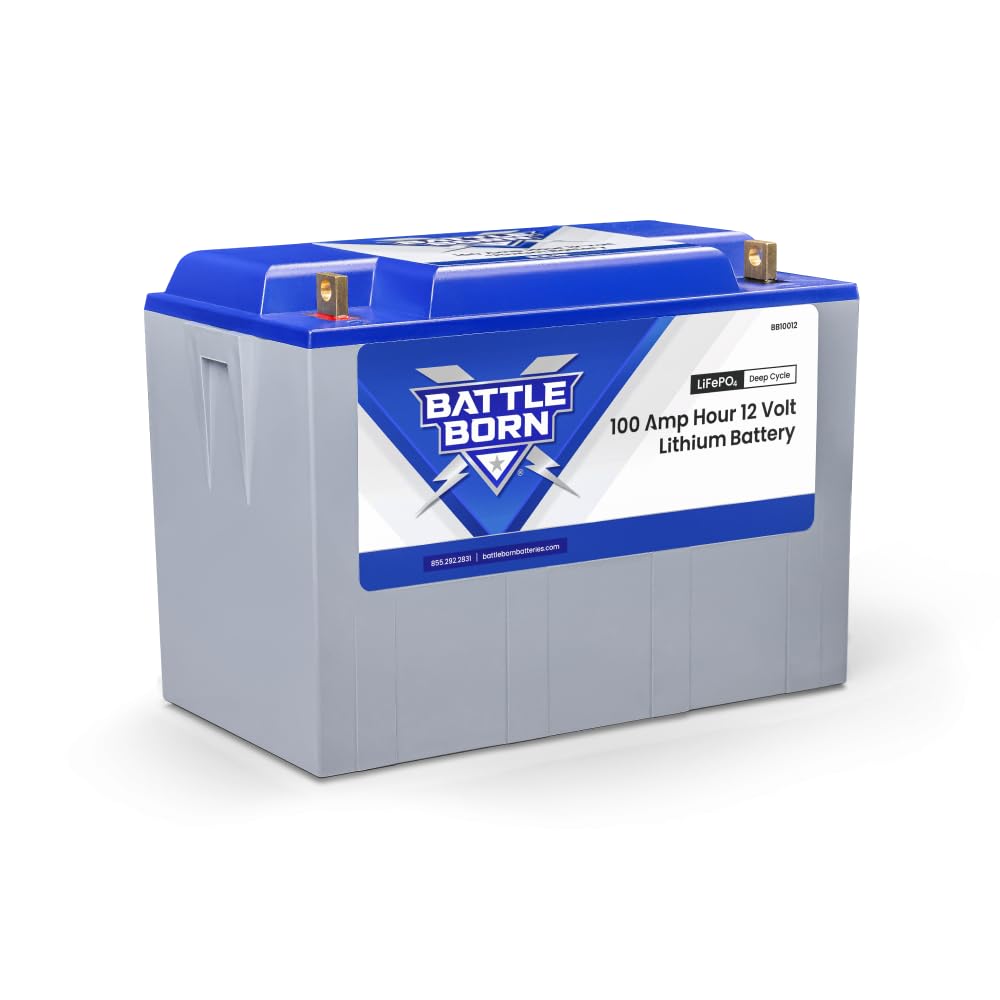
Battle Born is the benchmark for premium marine lithium batteries, and the 100Ah model lives up to its reputation with a rugged internal BMS that covers low-temp, over-voltage, short-circuit, and high-voltage protection. Its drop-in Group 27/31 form factor makes it a direct replacement for lead-acid without modifying trays or wiring — critical for boaters who want a clean upgrade.
Real-world testing shows this battery powers a 450W space heater for 1.5 hours in an RV and runs a DC fridge, lights, and water pump for a full week on a single charge. Owners consistently praise the 10-year warranty and responsive customer service, with one unit replaced free after a BMS anomaly at one year. At 31 pounds, it cuts over 60 pounds compared to an equivalent lead-acid bank.
The tradeoff is the highest upfront cost in this guide. If your boating season is short or your power needs are minimal, the premium may not pay back before the battery outlasts your boat. But for full-time cruisers, RV adventurers, or anyone tired of replacing batteries, the per-cycle cost is unbeatable.
Why it’s great
- 10-year warranty with documented replacement support
- Full 100% usable capacity with zero maintenance
- Lightweight at 31 lbs — easy single-person install
Good to know
- Requires lithium-compatible charger or solar controller
- Initial software setup may need a “jump start” if BMS enters sleep mode
2. Litime 12V 100Ah Trolling Motor LiFePO4

Litime engineered this battery specifically for marine trolling motor use, adding TVS (transient voltage suppression) circuitry that protects motor electronics from voltage spikes — a common cause of controller failure in rough water. The BMS also meets ABYC E-13 standards for salt-spray and moisture resistance, making it one of the few lithium batteries designed from the ground up for saltwater environments.
Anglers report running a 36V Minn Kota Ultrex for five hours on a bass boat and consuming only 10% of the battery’s capacity. The low-temp protection stops charging below 32°F and discharging below -4°F, which matters for early-season launches.
Some units arrive in sleep mode and require a wake-up procedure using a multibank charger’s force mode. Owners who didn’t get clear instructions initially found the process simple once described. For anglers running 12V to 36V motors, the spike protection alone justifies the mid-range price.
Why it’s great
- TVS surge protection extends trolling motor life
- ABYC E-13 compliant for marine salt-spray resistance
- Weighs only 22 lbs — 64% lighter than lead-acid
Good to know
- May ship in sleep mode with no clear wake-up instructions
- No built-in cell balancing across parallel batteries
3. Power Queen 12V 100Ah LiFePO4
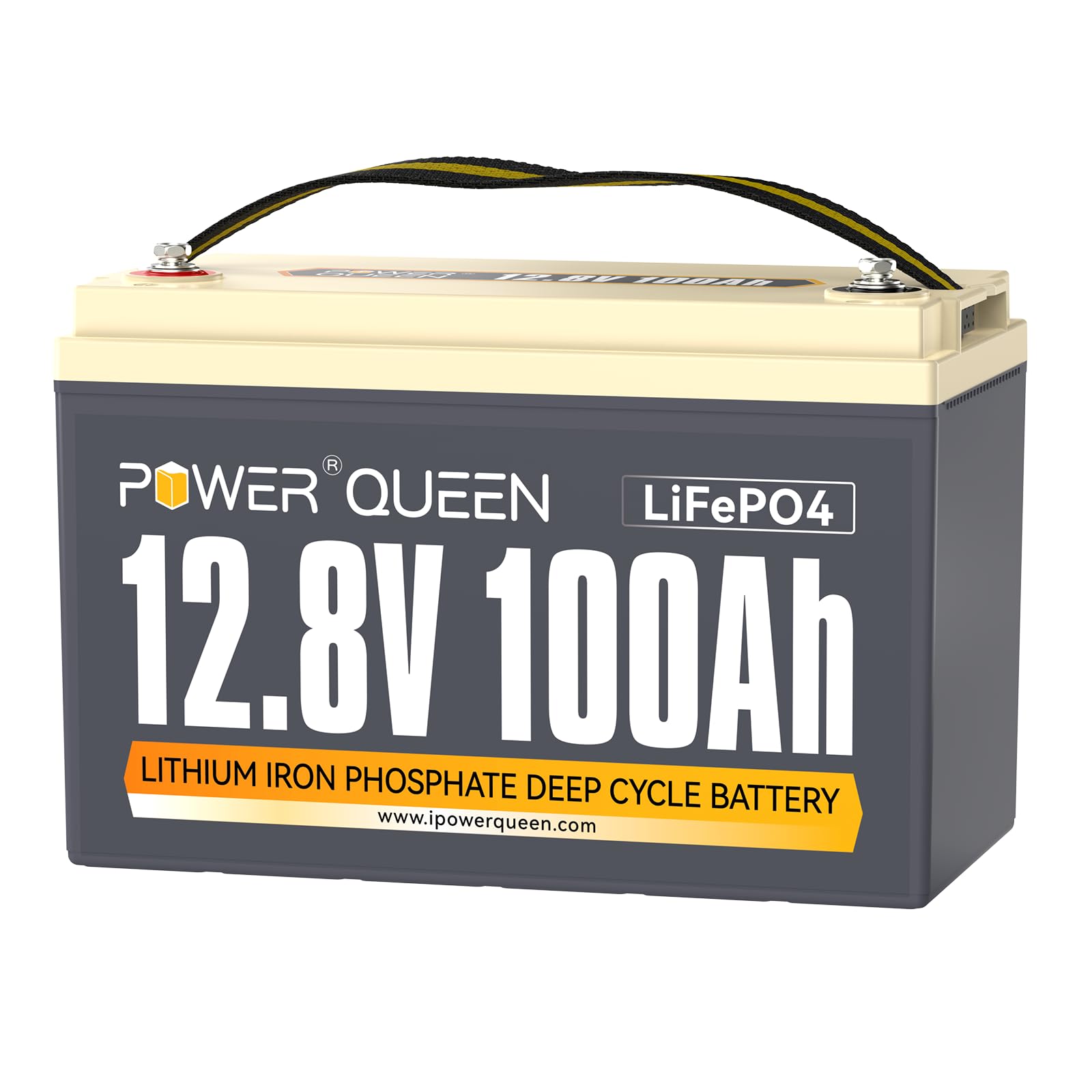
Power Queen uses Grade-A LiFePO4 cells and a 100A BMS that handles parallel and series configurations up to 4S4P — giving you the ability to build a 48V 400Ah bank (20.48 kWh) for larger marine or off-grid systems. The Group 31 footprint is standard for most boat battery trays, and the 24-pound weight makes repositioning inside tight bilge compartments manageable.
One owner runs three of these on a sailboat and measured 102 Ah from a full charge — slightly exceeding the rated capacity. Another uses a single unit for a 6-mile trolling motor run on a lake, noting the battery was still above 12.8V after hours of use. The 5-year warranty adds confidence, and the low self-discharge rate (3% per month) means it holds charge through winter storage.
The included 6mm bolts are easy to cross-thread if over-tightened. Swapping to M8 stainless hardware is a cheap upgrade. For boaters expanding their system over time, the parallel scalability makes this a long-term investment that grows with your power demands.
Why it’s great
- Grade-A LiFePO4 cells for consistent voltage output
- 4S4P expandable to 20.48 kWh total capacity
- 3% monthly self-discharge — winter-ready
Good to know
- 6mm terminal bolts easy to cross-thread
- No Bluetooth monitoring without separate accessory
4. HumsiENK 12V 150Ah LiFePO4
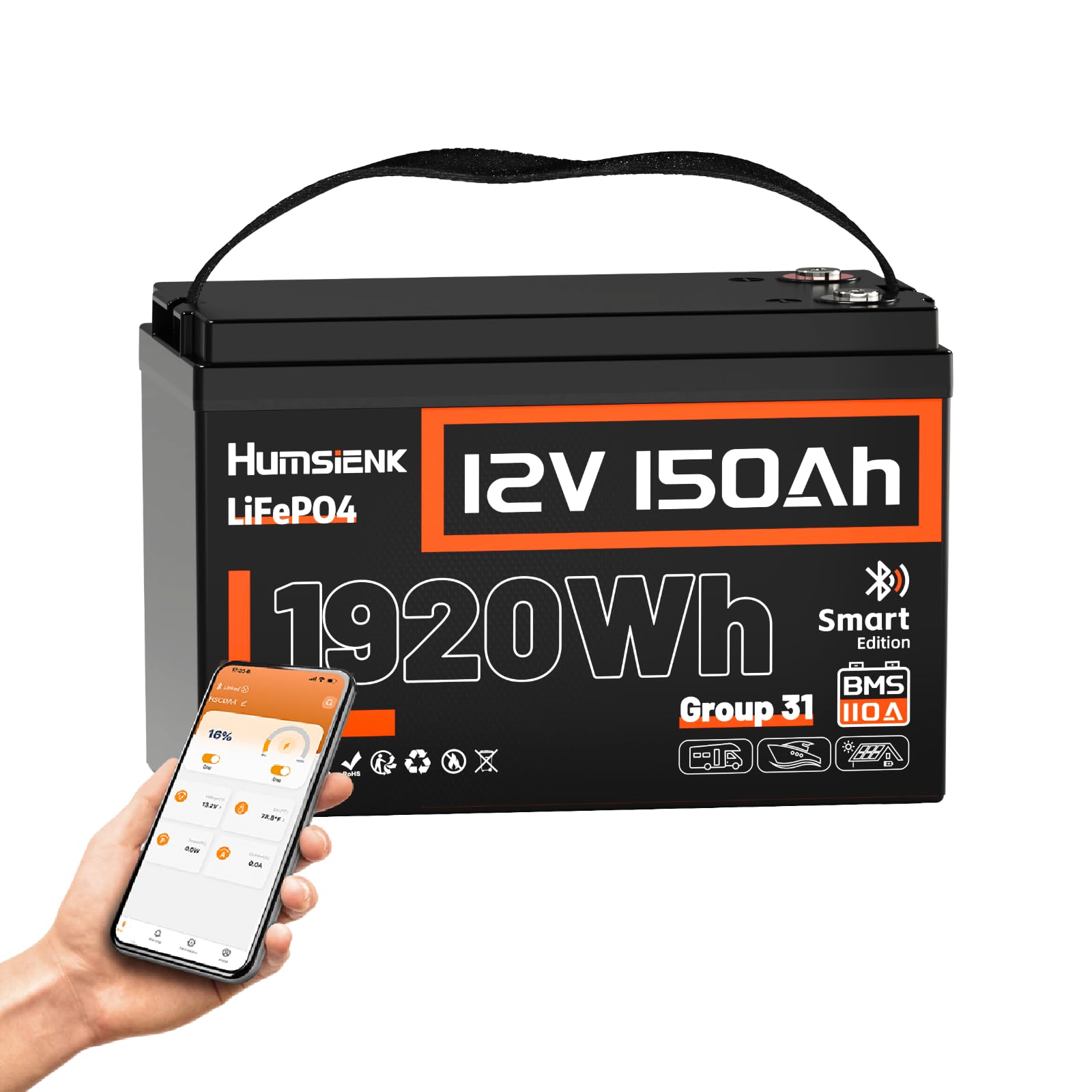
The HumsiENK 150Ah lithium battery packs 1920Wh of energy into a Group 31 case that weighs just 28.66 pounds — comparable to a 100Ah AGM but with 50% more usable capacity. The integrated Bluetooth 5.0 provides real-time voltage, current, SOC, and cycle count through the HumsiENK Smart App, which is especially useful for monitoring discharge rates while running a trolling motor or inverter.
The 110A BMS handles surges well, and owners report using four of these in a 48V solar bank with consistent performance after months of storage. The carrying strap is a thoughtful addition for maneuvering the battery into tight trays. The 5-year warranty and 15,000-cycle rating at 60% DOD mean this battery will outlast most boats.
The Bluetooth range is about 5 feet for reliable connection — enough to check status at the console but not from the cabin. The app also lacks a history log, so you can’t review discharge patterns later. For boaters who want the biggest capacity in a standard footprint with phone-based monitoring, this is a strong mid-range pick.
Why it’s great
- 150Ah capacity in standard Group 31 size
- Real-time Bluetooth monitoring via smartphone app
- Carrying strap and included bolts simplify installation
Good to know
- Bluetooth range limited to ~5 feet
- No historical data logging in the app
5. DUMFUME 12V 150Ah LiFePO4
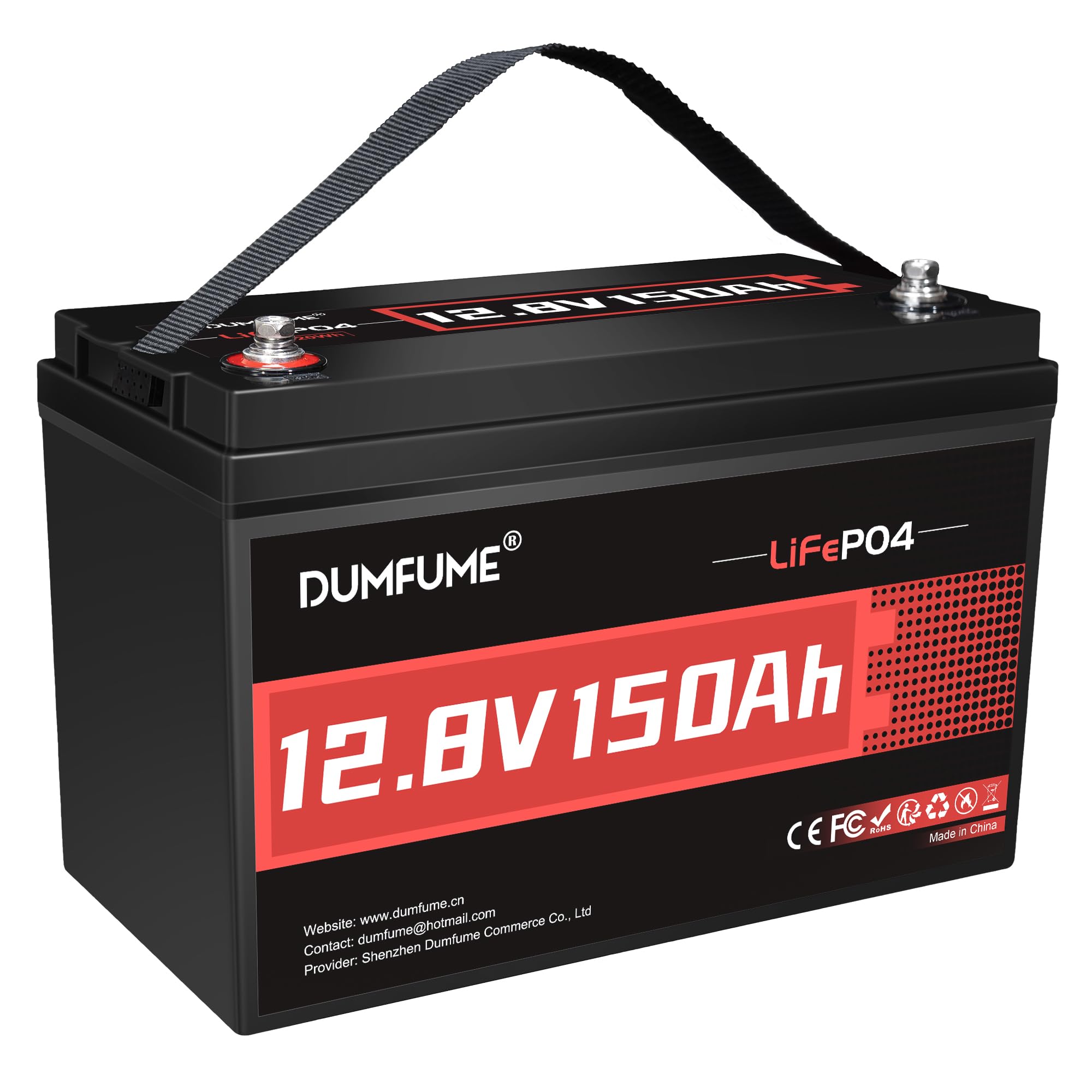
DUMFUME’s 150Ah battery delivers 1920Wh of usable energy at just 22.05 pounds — extraordinarily light for its capacity class. The 100A BMS covers overcharge, over-discharge, short circuit, and overheating, and the battery supports series/parallel stacking up to 4S4P for larger marine or solar banks. Owners report that four units in parallel exceeded their rated capacity by about 7 Ah each.
This battery is a “non-smart” design — no Bluetooth, no display — which reduces cost and eliminates potential electronics failure points. The compact 13.05 x 6.78 x 8.66-inch dimensions fit Group 31 trays, and the 5-year warranty provides a safety net. One owner noted that a damaged unit was replaced quickly by the company.
A notable caveat: the manual states the battery requires temperatures above 41°F (5°C) for charging, and return shipping for low-temperature damage isn’t covered. Some units arrived at 12.2-12.4V and needed a “jump” from another battery to wake the BMS. For off-grid solar and warm-weather marine use where you prioritize raw capacity over smartphone features, this is excellent value.
Why it’s great
- 1920Wh capacity at only 22 lbs
- Reported to exceed rated amp-hour capacity in some tests
- 5-year warranty with responsive replacement support
Good to know
- No Bluetooth or LED display
- Charging restricted above 41°F — not for winter use
6. DC HOUSE 12V 100Ah Bluetooth LiFePO4
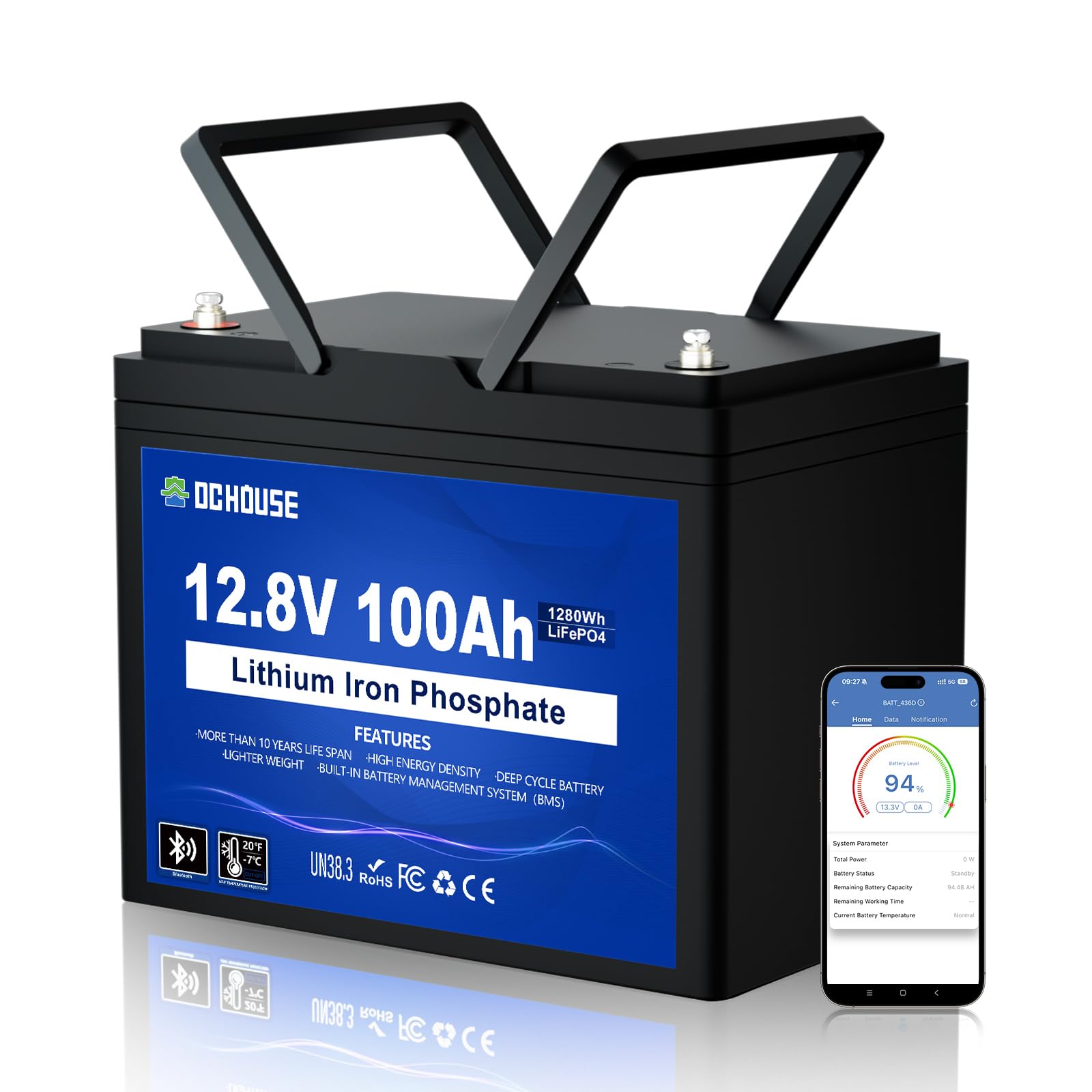
DC HOUSE packs Bluetooth cell-level monitoring into a compact size that’s just 0.32 inches taller than standard Group 24 specifications — a key advantage for boats with limited tray space. The app shows individual cell voltages, SOC, and current, with a dedicated fault display page that helps diagnose BMS issues without probing terminals. The low-temperature cut-off engages charging at 19.4°F and discharging at -4°F, with automatic recovery at 32°F.
Anglers report this battery uses about 25-30% of capacity per night running a CPAP machine off a 750W inverter while camping, and one owner noted it outperformed his old battery in a full season of use. The 15,000-cycle rating at 60% DOD and 3-year warranty offer reasonable confidence for the mid-range price bracket.
Bluetooth range is limited — you need to be within 5-10 meters for a stable connection. Some users found the app less polished than competitors, and customer service responsiveness has been inconsistent based on reports. For kayak fishermen and small-boat owners who want smartphone monitoring in a compact lithium format, the size-to-feature ratio is hard to beat.
Why it’s great
- Bluetooth cell-level monitoring in a compact Group 24+ size
- Low-temp cut-off protects winter charging
- Lightweight at 23.8 lbs for easy transport
Good to know
- Bluetooth range is limited to ~5 meters
- Customer service response can be slow
7. HQST 12V 100Ah LiFePO4

HQST’s entry-level lithium battery brings 100Ah capacity, an LED display showing real-time voltage and SOC, and low-temperature protection to a price point that competes with mid-range AGM. The built-in BMS has 20+ layers of protection including high/low-temperature cut-offs, and the battery supports series/parallel configurations up to 16 units for a 20.48 kWh system. At 22 pounds, it’s light enough to carry with one hand.
Users report using this battery for ice fishing — running a Humminbird Explore 12 with Mega Live 2 transducer for 12+ hours and losing less than 0.5V. The LED display is a practical touch for quickly checking remaining capacity without a multimeter. The 10-year product support and UL-tested cells add confidence at this price tier.
Reliability is a concern: one reviewer reported complete failure within a single summer of light use, with the BMS entering low-voltage cutoff and refusing to accept a charge. The LED screen is also vulnerable to moisture — owners in wet environments recommend sealing it with silicone or 5200 marine sealant. For fair-weather boaters on a budget who want lithium’s weight savings, this is a worthwhile entry point with measured expectations.
Why it’s great
- LED display shows voltage and remaining capacity at a glance
- 22 lbs — one-hand carry from truck to boat
- 10-year product support with UL-tested cells
Good to know
- LED screen not waterproof — needs sealing in wet environments
- Some units failed within one season of light use
8. WEIZE 12V 100Ah Deep Cycle AGM

WEIZE’s 100Ah AGM battery is the budget-friendly workhorse for marine backup and moderate trolling motor use. Sealed and spill-proof with a maintenance-free design, it fits standard Group 31 trays and delivers reliable power without the complexity of lithium charging profiles. The 3% self-discharge rate means it holds charge well through off-season storage.
Owners use these in parallel banks for emergency backup — four units feeding a 2,000W inverter provide 4.8 kWh for fans, garage door openers, and 120V outlets. One reviewer has run two of these with 150W solar panels in an off-grid RV for two years without issues. The 63-pound weight is a workout to carry, but the price per amp-hour is hard to beat for budget builds.
AGM chemistry limits usable capacity to about 50% to avoid damaging the battery. A 100Ah AGM battery effectively gives you 50Ah of safe runtime, which means shorter fishing days or the need for more batteries in parallel. For boaters with short trips and tight budgets who don’t want to upgrade chargers or wiring, this is a proven, low-hassle option.
Why it’s great
- Sealed AGM — no watering, no acid spills
- Proven reliability in solar and backup applications
- Low 3% monthly self-discharge rate
Good to know
- 63 lbs — heavy compared to lithium alternatives
- Only 50% usable capacity to prevent damage
9. Newport 12V 50Ah Deep Cycle AGM
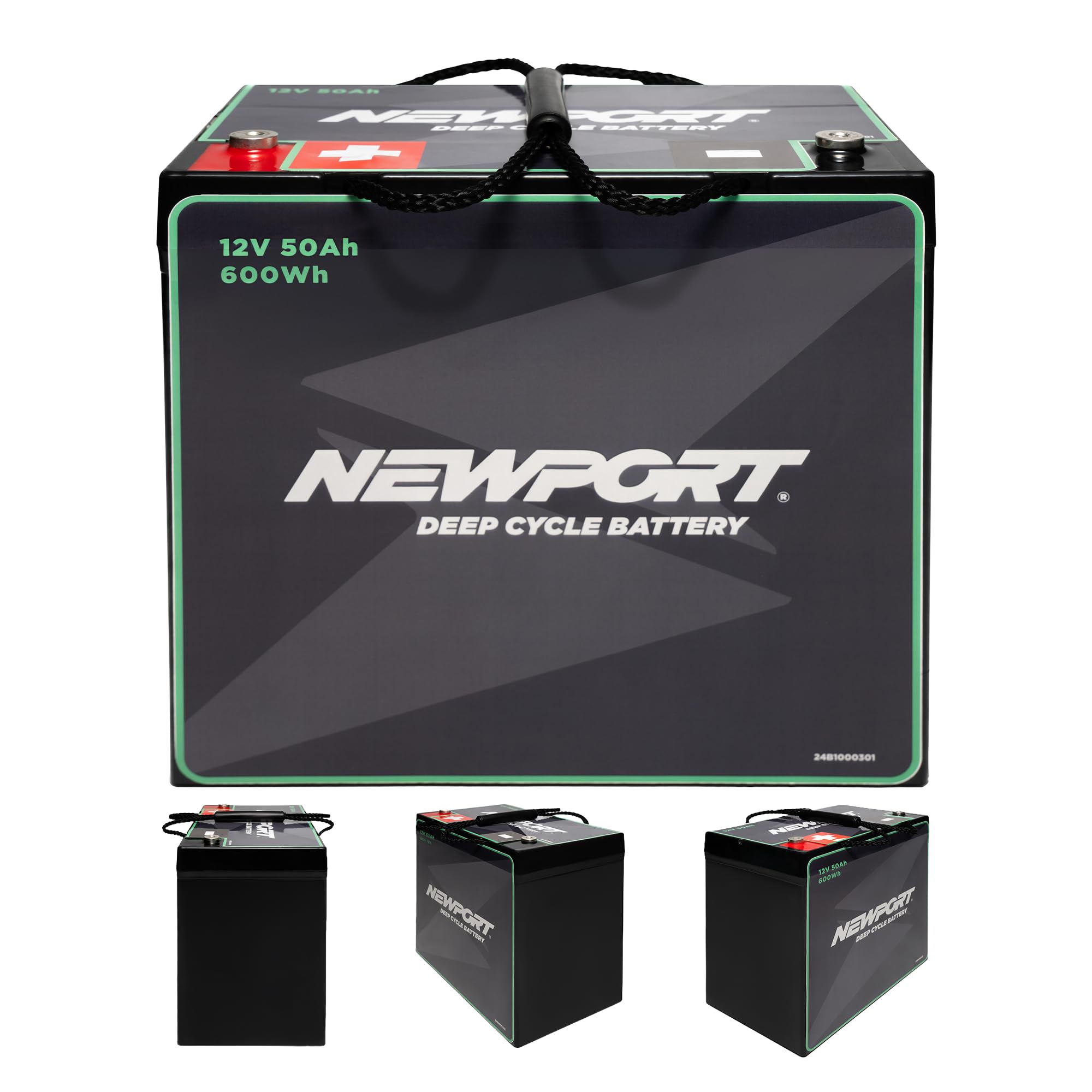
Newport’s 12V 50Ah AGM battery is purpose-built for lightweight marine applications where every pound matters. At 32 pounds with marine-style dual terminals, it fits kayaks, small jon boats, and portable fish finder setups where a full-size Group 31 battery would be overkill. The sealed AGM construction is leak-proof and can be mounted in any orientation.
One owner runs this battery in a two-person kayak trolling motor setup and gets a full day of fishing on a single charge. Another reports it survived a 20 MPH tumble from a truck bed onto asphalt with only cosmetic damage — no swelling, no performance loss. For a 50Ah lead-acid battery, the real-world runtime with a 55-pound trolling motor at moderate speeds is about 2 hours before hitting the 50% discharge limit.
There’s no built-in charge indicator, so you’ll need an external meter or a multimeter to avoid over-discharging. Some reviewers noted that battery life could be longer — a 25-pound trolling motor at full speed on a kayak drained it in about 7 hours. For ultralight setups, weekend fishing trips, or as a dedicated backup for electronics, this is a compact, durable entry-level choice.
Why it’s great
- 32 lbs — easy one-hand carry for kayak launches
- Survived a 20 MPH drop test with no damage
- Marine dual terminals fit trolling motors and accessories
Good to know
- No charge indicator — external meter recommended
- 50Ah capacity limits runtime with larger trolling motors
FAQ
Can I use a deep cycle marine battery to start my outboard motor?
How many amp-hours do I need for a trolling motor?
Will a lithium battery work with my existing charger?
Final Thoughts: The Verdict
For most users, the best deep cycle marine battery winner is the Litime 12V 100Ah Trolling Motor LiFePO4 because it combines TVS surge protection, ABYC marine compliance, and a price that undercuts premium brands while delivering reliable lithium performance. If you want maximum capacity and Bluetooth monitoring in a standard Group 31 footprint, grab the HumsiENK 12V 150Ah. And for budget boaters who don’t need lithium’s weight savings, the WEIZE 12V 100Ah AGM remains a proven, low-hassle workhorse for backup and moderate trolling use.

Mo Maruf
I created WellFizz to bridge the gap between vague wellness advice and actionable solutions. My mission is simple: to decode the research and give you practical tools you can actually use.
Beyond the data, I am a passionate traveler. I believe that stepping away from the screen to explore new environments is essential for mental clarity and physical vitality.