Our readers keep the lights on and my smoothie glass nicely filled. As an Amazon Associate, I earn from qualifying purchases.
A deep cycle AGM battery isn’t just a power source; it’s the difference between a trip ending early and a full day on the water or off the grid. Choosing the wrong one means voltage sag under load, frequent recharging, and a frustrating experience that kills the momentum of any adventure.
I’m Mohammad Maruf — the founder and writer behind WellFizz. I’ve cross-referenced dozens of datasheets, customer stress tests, and BMS logic diagrams to rank the real-world performance of today’s top deep cycle AGM batteries.
This guide breaks down the actual cycle life, discharge rates, and weight trade-offs of the market’s strongest contenders so you can confidently select the best deep cycle agm battery for your marine, solar, or backup power setup.
How To Choose The Best Deep Cycle AGM Battery
Selecting a deep cycle AGM battery requires matching your energy draw to the battery’s capacity, chemistry, and physical dimensions. Unlike starting batteries that deliver short high-current bursts, deep cycle units are engineered to discharge slowly and recover repeatedly without damage.
Amp-Hours and Your Load Profile
This is the single most important spec. A 50Ah battery might run a 55lb thrust trolling motor on moderate speed for 4-5 hours. A 100Ah unit can double that runtime or power a 700W inverter for several hours. Calculate your total daily watt-hours and divide by 12V to find the minimum Ah you need, then add 20% buffer to avoid over-discharging.
Group Size and Terminal Type
The battery must physically fit your tray or box. Group 24 (roughly 10 x 6.5 x 8.5 inches) is common for trolling motors and compact setups. Group 27 is taller and wider, offering more capacity. Group 31 maximizes Ah in a large footprint. Terminal type matters too — marine terminals (studs with wingnuts) are standard for boats, while automotive posts suit RVs and solar systems.
Weight as a Quality Indicator
AGM batteries use lead plates and absorbed glass mat separators. A 100Ah AGM typically weighs 60-68 pounds. Significantly lighter units may use thinner plates, reducing cycle life. Lithium LiFePO4 drop-ins can weigh as little as 22 pounds for the same capacity, but come at a higher entry price and require a compatible charger profile.
Quick Comparison
On smaller screens, swipe sideways to see the full table.
| Model | Category | Best For | Key Spec | Amazon |
|---|---|---|---|---|
| VMAX MR127 | Premium AGM | Heavy marine use, 80+ lb thrust motors | 100Ah, 68 lbs, Group 27 | Amazon |
| Litime 12V 100Ah TM | Premium LiFePO4 | Long-range trolling, Bluetooth monitoring | 100Ah, 22.2 lbs, Group 31 | Amazon |
| DC HOUSE 12V 100Ah | Premium LiFePO4 | Cold-weather marine, app-controlled SOC | 100Ah, 23.8 lbs, Group 24 | Amazon |
| HumsiENK 12V 100Ah BT | Mid-Range LiFePO4 | Solar backup, RV auxiliary power | 100Ah, 19.7 lbs, Group 24 | Amazon |
| SUPER EMPOWER 12V 100Ah | Mid-Range LiFePO4 | Compact kayak setups, 55lb motors | 100Ah, 21.6 lbs, Group 24 | Amazon |
| Mighty Max ML100-12 GEL | Premium GEL | Solar gate openers, extreme temp float | 100Ah, 60 lbs, Group 27 | Amazon |
| WEIZE 12V 100Ah | Mid-Range AGM | Off-grid solar banks, emergency backup | 100Ah, 63 lbs, Group 31 | Amazon |
| Mighty Max ML100-12 SLA | Value AGM | Solar/wind systems, budget-conscious builds | 100Ah, 28 lbs, Group 27 | Amazon |
| Newport 12V50Ah | Entry-Level AGM | Small kayaks, sump pump backup | 50Ah, 32 lbs, Marine terminal | Amazon |
In‑Depth Reviews
1. VMAX MR127 12 Volt 100Ah AGM Deep Cycle Battery

The VMAX MR127 is the benchmark for a true deep cycle AGM battery. Weighing 68 pounds, its heavy-duty lead-tin alloy grids and absorbed glass mat construction deliver consistent power delivery over repeated deep discharges. Users report running 40lb and 55lb thrust motors for over 5 hours while retaining 95% charge, a testament to its electrolyte suspension system that prevents stratification.
This Group 27 unit has marine terminals and integrated carrying handles, making it straightforward to install in a boat or RV battery box. The sealed, valve-regulated design means no maintenance and no risk of acid spills. VMAX claims a 10-year life expectancy in float service, and real-world anecdotal evidence from anglers using it daily supports that durability.
One caveat: if you drain it completely, some users found their charger refused to re-engage. The seller recommends a brief jump-start with a car battery to raise the voltage enough for the AGM charger to recognize it. This is a common trait among high-quality AGM batteries and not a defect, but it’s worth knowing before you buy.
Why it’s great
- Exceptional voltage stability under sustained load
- Built with heavy-duty lead-tin grids for extended cycle life
- Sealed, spill-proof with convenient carrying handles
Good to know
- Very heavy at 68 pounds — plan your mounting bracket accordingly
- May require a charger with AGM-specific reconditioning mode if deeply discharged
2. Litime 12V 100Ah Trolling Motors LiFePO4 Battery
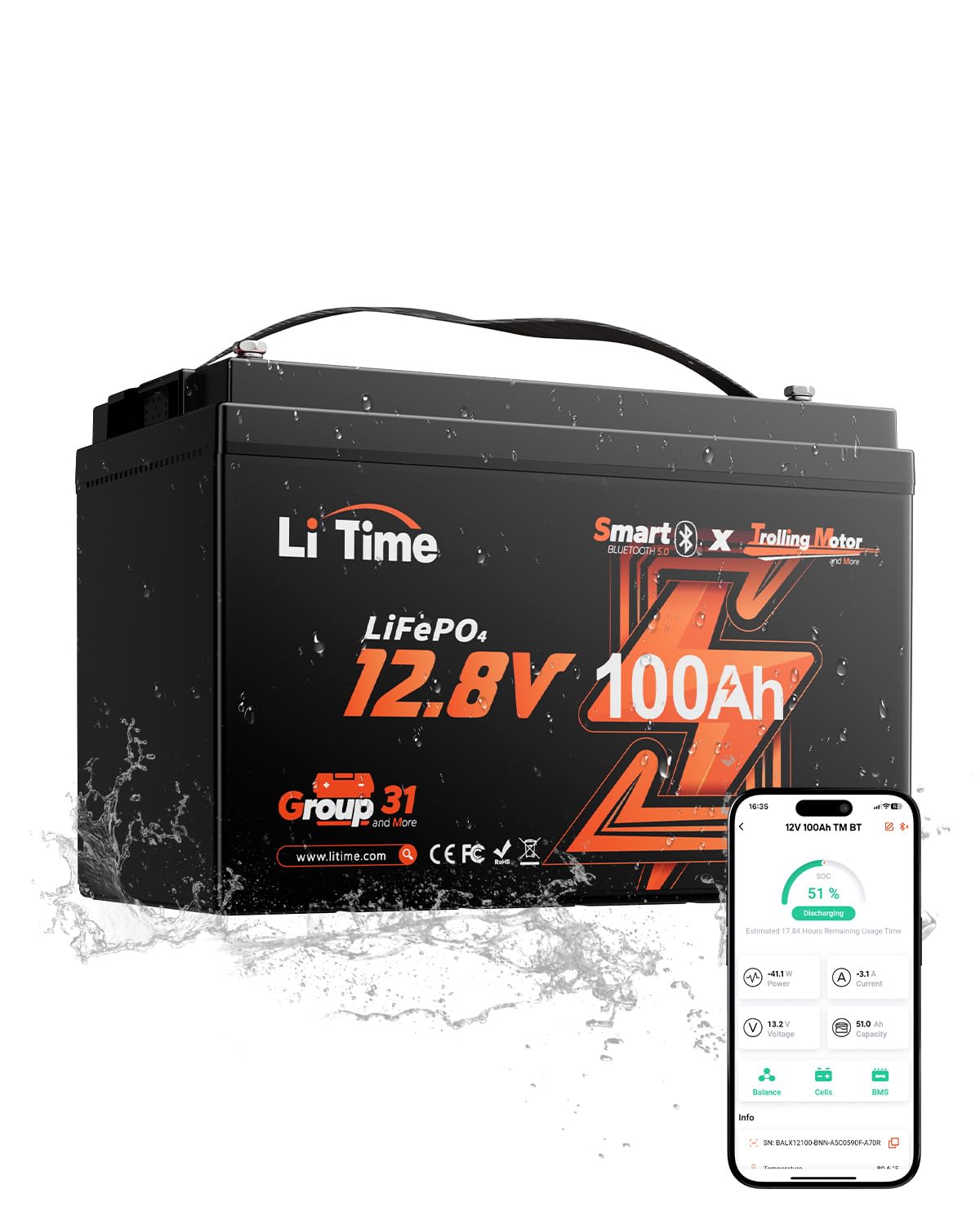
The Litime Group 31 LiFePO4 battery is a lithium drop-in replacement that weighs just 22.2 pounds while delivering 1280Wh of usable energy. Real-world reports from anglers using 80lb thrust motors show it retaining over 50% charge after two full days of fishing. The integrated Bluetooth app provides accurate state-of-charge monitoring, eliminating the guesswork of voltage-based indicators.
With a rated 4000 cycles at 100% depth of discharge and up to 15000 cycles at 60% DOD, this battery outlasts any AGM chemistry by a wide margin. The built-in 100A BMS includes low-temperature charging cutoff below 32°F, so you can leave it in a cold boat without damaging the cells. The IP65 rating adds further protection against salt spray and moisture.
It’s not designed for engine starting or golf cart use — strictly for deep cycle energy storage. The Bluetooth range is adequate for most boat consoles, and the battery expands up to 4P4S for a 48V 400Ah system. For anglers who want maximum runtime per pound and smartphone monitoring, this is the premium choice.
Why it’s great
- Dramatically lighter than AGM — saves over 45 pounds
- Bluetooth app tracks SOC, voltage, and temperature in real time
- 4000+ cycles at full discharge with 10-year service life
Good to know
- Requires a LiFePO4-specific charger or MPPT controller set to lithium profile
- Higher upfront investment compared to traditional AGM
3. DC HOUSE 12V 100Ah LiFePO4 Trolling Motor Battery
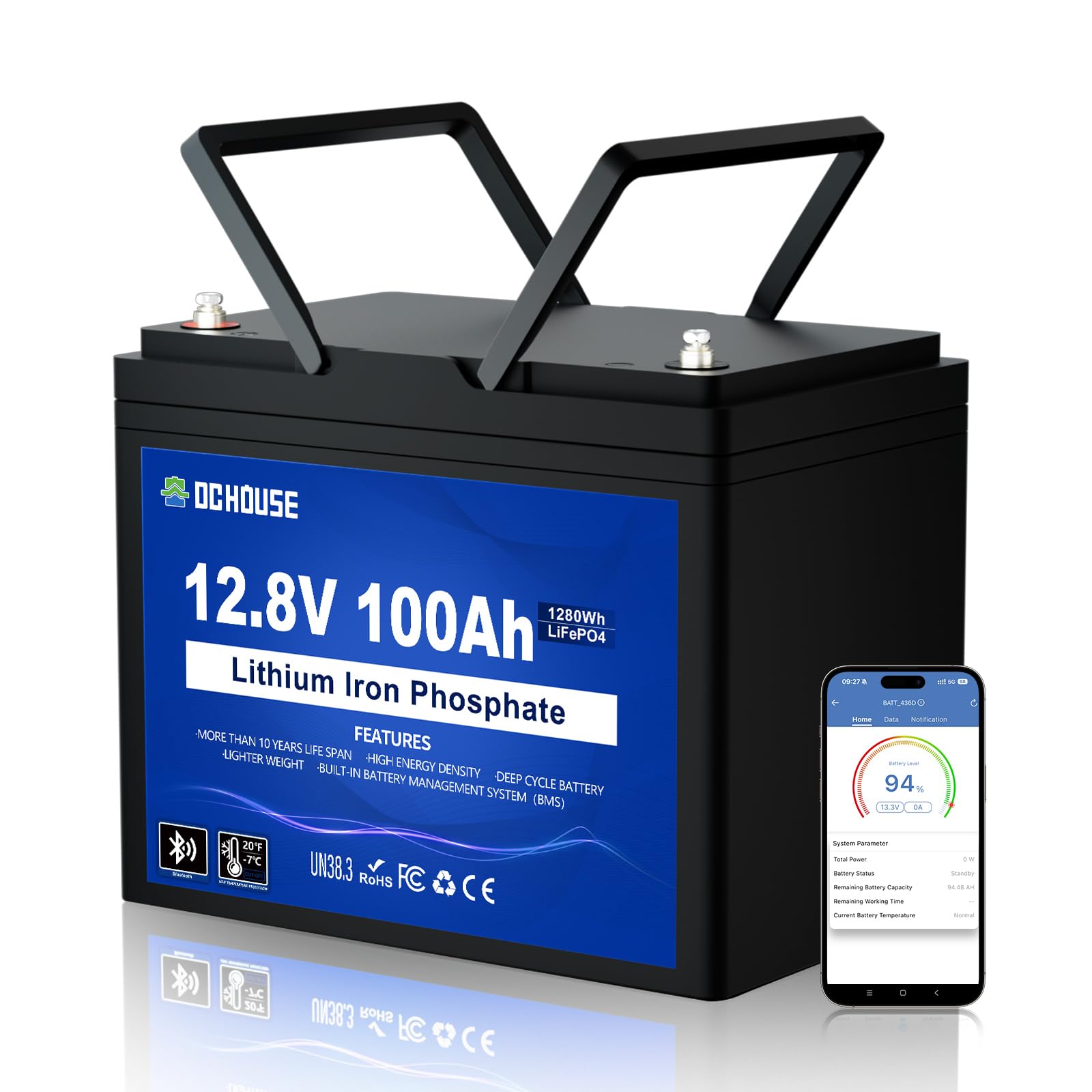
The DC HOUSE battery packs a 100A BMS with low-temperature cutoff into a Group 24 form factor weighing 23.8 pounds. Its Bluetooth app provides cell-level voltage data and a dedicated fault display for troubleshooting, which is rare at this price tier. Users running CPAP machines off a 750W inverter reported consuming only 25-30% capacity per night — enough for three nights of camping on a single charge.
This unit supports up to 4S or 4P configurations, though 4P4S is not allowed. With a 3-year warranty and A+ grade LiFePO4 cells, it offers a strong balance of features and cost. The low-temp cutoff engages at 19.4°F for charging and -4°F for discharge, automatically recovering at 32°F, making it suitable for ice fishing and cold-weather boating.
Some users note the Bluetooth range is limited to about 10 meters, which means you need to be near the battery compartment to connect. The overall build quality feels solid, and the M8 terminals accept standard ring terminals. It’s a smart mid-range pick if you want Bluetooth monitoring without jumping to the highest price tier.
Why it’s great
- Cell-level Bluetooth monitoring with fault diagnosis
- Low-temp cutoff protects cells in freezing conditions
- Compact Group 24 size fits most existing trays
Good to know
- Bluetooth signal range is limited to about 10 meters
- Customer service responsiveness has been inconsistent in some reports
4. HumsiENK 12V 100Ah LiFePO4 Battery with Bluetooth
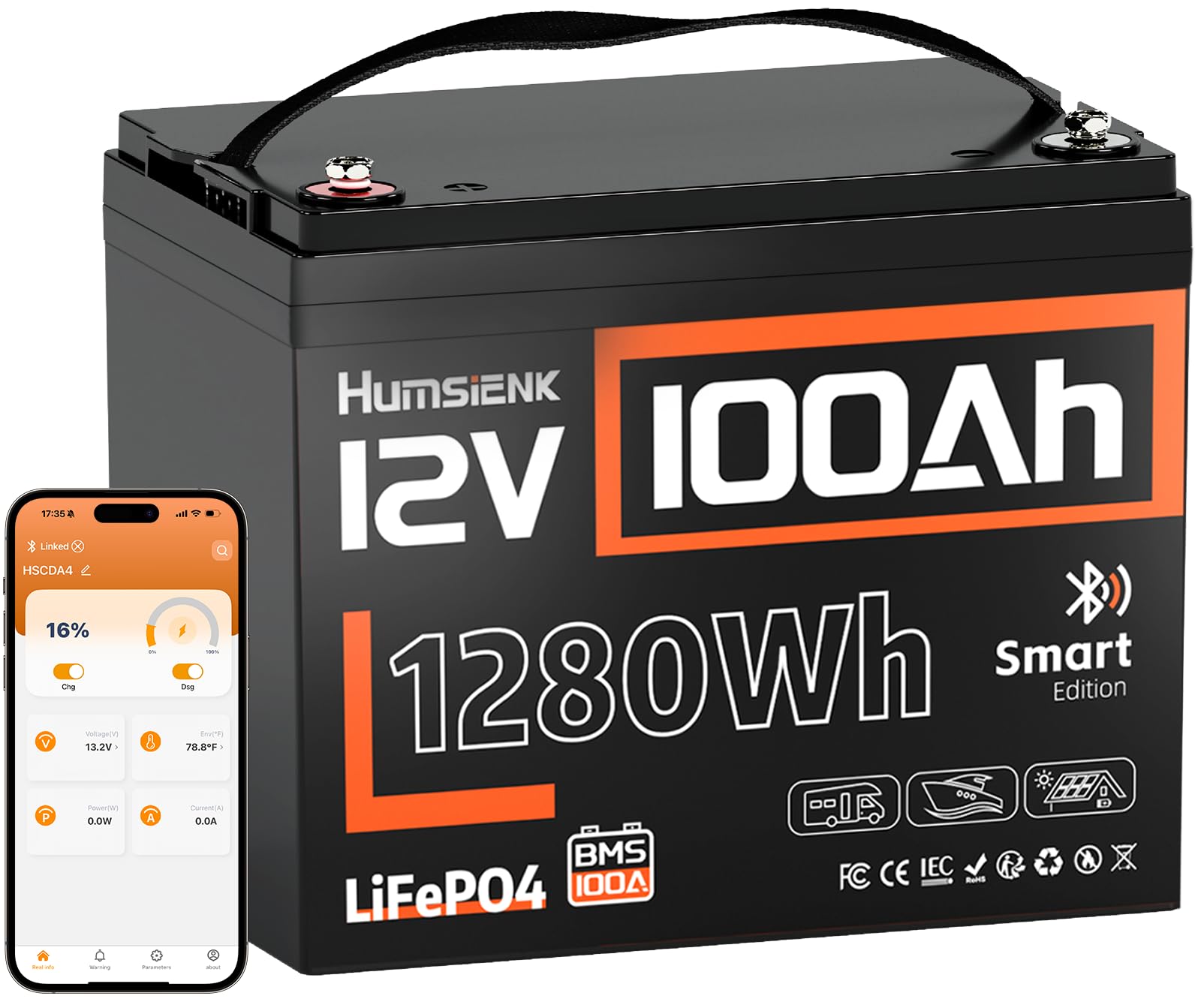
At 19.7 pounds, the HumsiENK is one of the lightest 100Ah lithium batteries available, offering a 60% weight reduction over an equivalent AGM. The dedicated app gives you real-time voltage, current, and temperature data with an adjustable discharge cutoff for extra safety. Users in mobile grooming trailers found the app useful for turning off the battery between stops to prevent parasitic drain.
The UL-tested, FCC- and CE-certified A+ cells support up to 15000 cycles at 60% DOD. The IP65 rating means it’s dust-tight and protected against low-pressure water jets, adding confidence for marine environments. It expands to 4S4P for up to 48V 400Ah, making it scalable for larger solar or RV systems.
One limitation: the Bluetooth range is only about 5 feet, according to some users, which can be inconvenient if the battery is mounted in a sealed compartment. Additionally, when four units are in series for a 48V bank, the reported state-of-charge can vary up to 10% between batteries, occasionally triggering pack-over-current warnings. It’s a solid unit for single-battery or parallel setups, but series configurations may require an external balancer.
Why it’s great
- Exceptional weight savings — under 20 pounds for 100Ah
- IP65 waterproof and dust-resistant for outdoor use
- Adjustable BMS discharge cutoff via the app
Good to know
- Bluetooth range is very short, around 5 feet
- Multiple units in series may show SOC imbalance without external balancer
5. SUPER EMPOWER 12V 100Ah LiFePO4 Lithium Battery
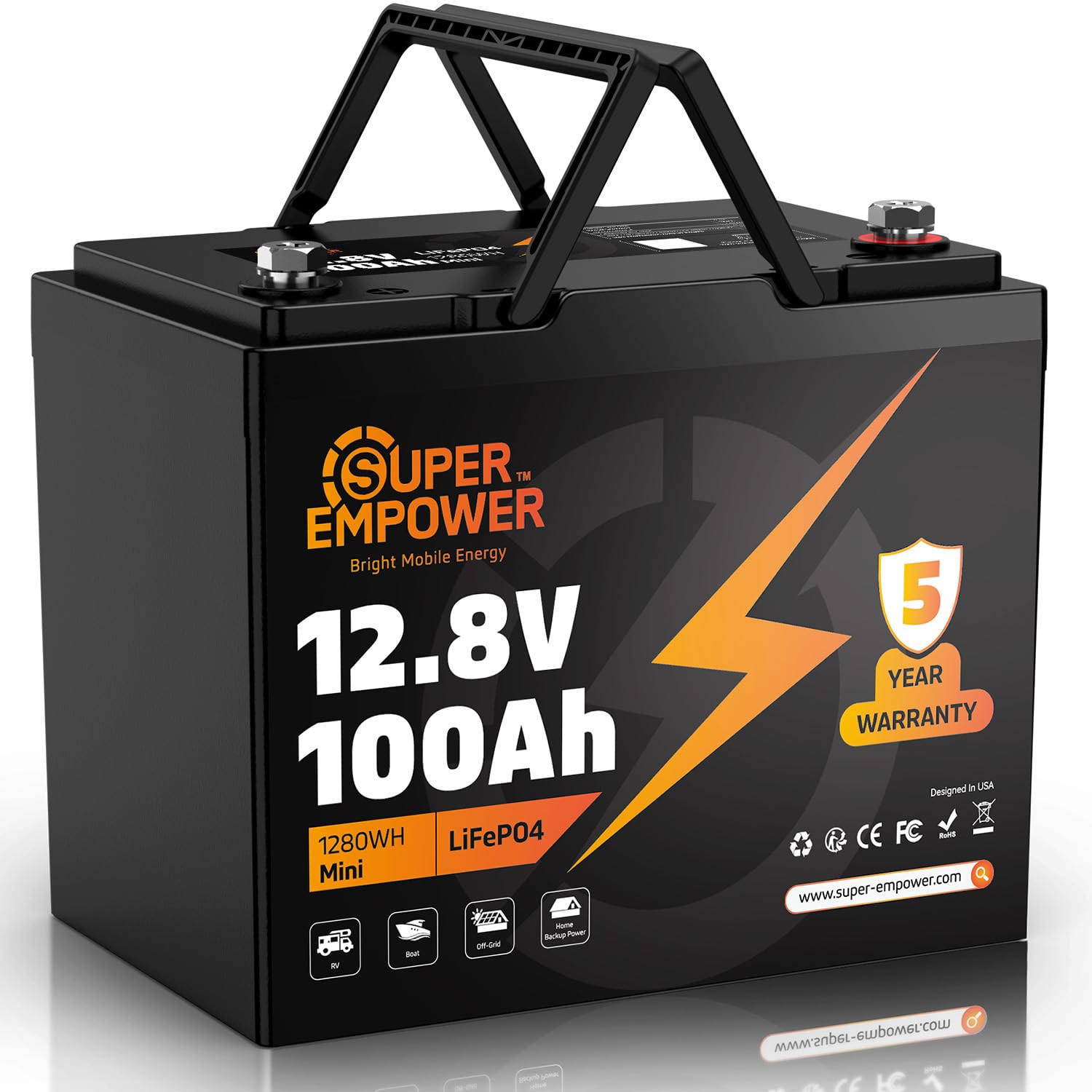
The SUPER EMPOWER battery is marketed as a drop-in replacement for lead-acid in a BCI Group 24 case, weighing just 21.6 pounds. It comes with M8 terminals and fits standard battery boxes without modification. Users running 55lb trolling motors on pontoon boats reported 4 hours of continuous use with no power loss, then recharging via solar to still have reserve for the next day.
Grade A+ LiFePO4 cells and a 100A BMS provide protection against overcharge, over-discharge, short circuit, and temperature extremes. The low-temperature charging cutoff engages below 32°F, preventing damage in cold conditions. This battery supports expansion up to 4S4P for a 51.2V 400Ah configuration with 20.48kWh capacity.
The initial charge from factory storage voltage can take overnight with a standard 10A charger, but subsequent recharges are much quicker. There is no battery percentage readout on the unit itself, so you’ll rely entirely on your external monitoring system or charger display. For a compact, lightweight lithium solution at a competitive price point, this works well for kayaks, small boats, and solar projects.
Why it’s great
- True drop-in Group 24 size with M8 terminals
- Lightweight at 21.6 pounds — easy to move
- Robust BMS with cold-temperature charge protection
Good to know
- No built-in display or indicator for remaining charge
- First charge from storage takes a long time
6. Mighty Max Battery ML100-12 GEL 12V 100Ah

The Mighty Max ML100-12 GEL is a 100Ah UL-certified gel battery that excels in applications where slow, steady charging is the norm, such as solar-powered gate openers and emergency lighting. Its proprietary thick gel paste resists vibration and shock better than standard AGM, and the slower self-discharge means it holds a charge longer when sitting idle. One user paired it with a 50W solar panel for a gate opener, running a Wyze camera 24/7 with no voltage drop.
This Group 27 battery uses internal thread (INT) terminals, which are different from the more common marine or automotive posts. The 60-pound weight is typical for a lead-acid battery of this capacity. The gel formulation also handles extreme temperature swings better than AGM, making it a strong choice for uninsulated sheds, remote cabins, or any climate with hot summers and cold winters.
The GEL chemistry requires a specific charging profile — ideally a charger with a gel setting, typically a lower absorption voltage (around 14.1V to 14.4V) than AGM or flooded. Using an AGM charger may overcharge and damage the gel over time. Also, the internal thread terminals may require adapters if your existing wiring uses standard ring terminals. It’s a niche but excellent choice for low-maintenance stationary applications.
Why it’s great
- Exceptional temperature tolerance for extreme climates
- Slow self-discharge rate ideal for seasonal or standby use
- Thick gel paste resists vibration and shock
Good to know
- Requires a charger with a GEL-specific voltage profile
- Internal thread terminals may need adapter cables for some setups
7. WEIZE 12V 100Ah Deep Cycle Battery Group 31

The WEIZE 12V 100Ah Group 31 battery delivers a robust 1150A max discharge current and a self-discharge rate of just 3%, making it a solid workhorse for off-grid solar banks and emergency backup systems. Users have successfully paralleled four of these batteries to create a 4.8 kWh bank powering a 2000W inverter, running fans, garage door openers, and 120V outlets without issue.
This AGM battery is maintenance-free and spill-proof, with dimensions of 12.99 x 6.73 x 8.34 inches, fitting standard Group 31 trays. At 63 pounds, it’s heavy but built with robust lead plates designed for deep discharge recovery. It works well as a replacement for UB121000 or Renogy 100 Amp Hour batteries in wheelchair, scrubber, lawn & garden, and trolling motor applications.
Some users note that it’s crucial to use an AGM-compatible charger with the correct absorption voltage (14.4V to 14.7V) to achieve full charge and avoid sulfation. The included screws for terminals are basic, and no wire harness or mounting hardware is included. For the capacity and price, it offers excellent value for medium-sized solar installations or as a dependable backup for furnace and fridge circuits.
Why it’s great
- High 1150A max discharge for inverter startup surges
- Very low self-discharge rate at 3%
- Proven in parallel setups for multi-kWh off-grid banks
Good to know
- No wiring or mounting hardware included
- Requires an AGM-profile charger for optimal performance
8. Mighty Max Battery ML100-12 SLA 12V 100Ah

The Mighty Max ML100-12 is a UL-certified 100Ah SLA/AGM battery that has been a consistent performer in budget-conscious solar and marine setups for years. Users report running 44lb trolling motors for 8+ hours while still retaining 35% charge, and a 32-inch TV on a 500W inverter for 4 hours with only a 1% voltage drop. Its Group 27 dimensions (12.09 x 6.65 x 8.48 inches) fit most standard boxes.
One strong point is its deep discharge recovery capability — the AGM construction allows it to be mounted in any position without leakage. The 28-pound weight is notably lighter than other 100Ah AGM batteries, which raises questions about plate thickness. Still, users in 400W+ solar arrays have reported 3+ years of reliable service with three units paralleled, running a 5000W inverter that powers a fridge, computers, LEDs, and a TV for up to 5 days without sun.
The primary downside is the warranty fulfillment process: Amazon handles returns for the first 30 days, but after that, the manufacturer requires the buyer to pay return shipping on a 60-pound hazmat battery. This can be expensive if a unit fails. Several users noted that initial defective units were replaced on warranty, but the logistics are cumbersome. For the price per Ah, it’s a solid entry point if you’re willing to accept that risk.
Why it’s great
- UL-certified with proven deep discharge recovery
- Lightweight for a 100Ah AGM at 28 pounds
- Decent cycle life in solar and trolling motor applications
Good to know
- Buyer pays return shipping for warranty claims after 30 days
- Lighter weight may indicate thinner plates vs premium competitors
9. Newport 12V50Ah Deep Cycle Marine Battery
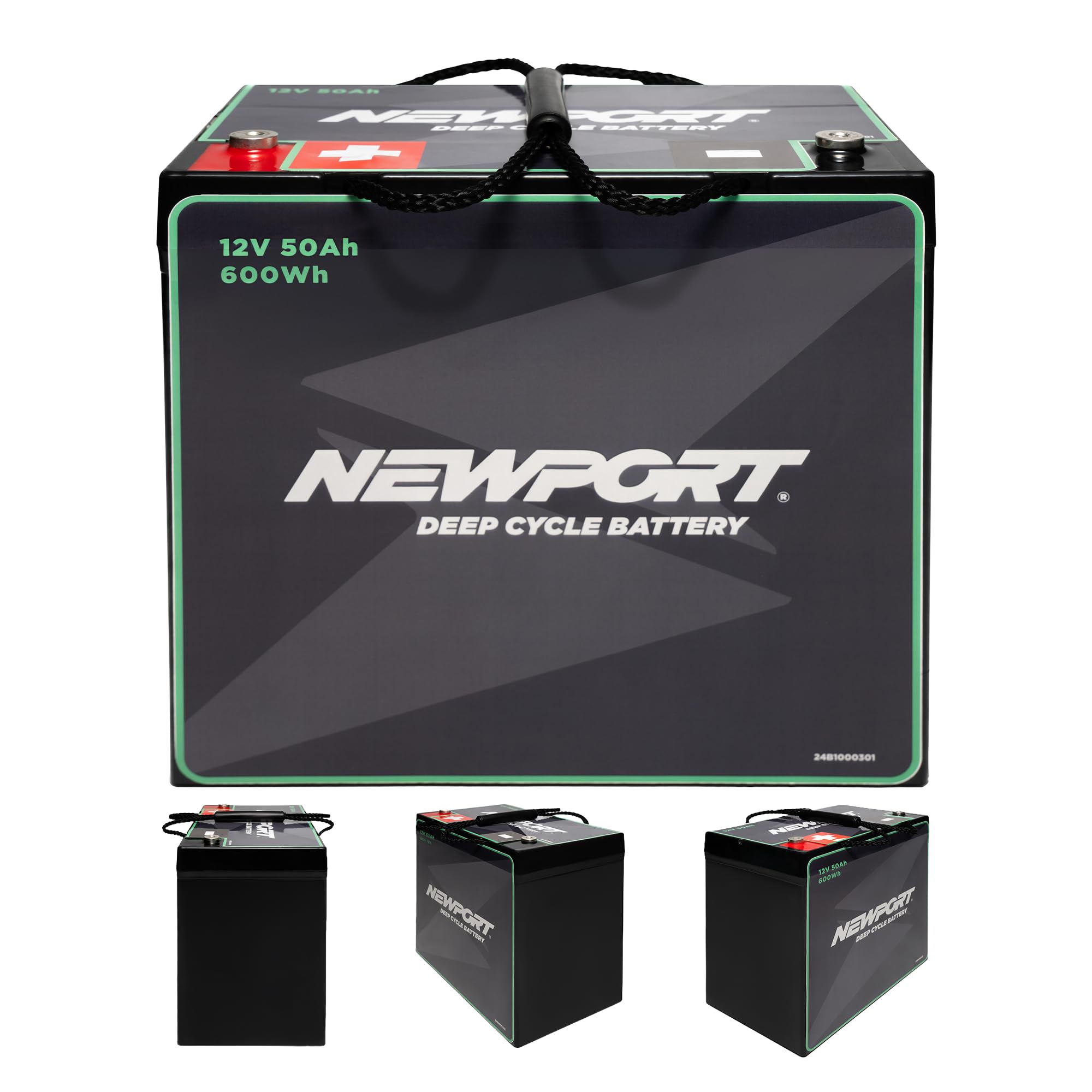
The Newport 12V50Ah is a compact, lightweight deep cycle AGM battery at 32 pounds, designed specifically for marine use with smaller trolling motors. It pairs well with a 2-person kayak using a 55lb thrust motor, delivering steady power for 4+ hours at moderate speeds without noticeable voltage sag. One user even reported it surviving a 20 MPH tumble from a truck bed with only cosmetic damage to the case — a testament to the sealed, rugged build.
The sealed AGM construction is leak-proof and maintenance-free, with marine terminals that accept standard wingnut connectors. At 50Ah, it’s not meant for large inverters or heavy loads, but it excels as a dedicated trolling motor battery or backup for a sump pump. Users have successfully run a 25lb trolling motor at full power for about 7 hours before depletion.
It has no built-in charge indicator, so you need an external meter or a smart charger with a display to monitor the state of charge. The 1-year limited warranty is standard but shorter than some competitors. For a lightweight, portable AGM solution that won’t break your back carting to the dock, the Newport is a solid entry-level choice.
Why it’s great
- Compact and lightweight at 32 pounds, easy one-hand carry
- Rugged case that can survive impacts and drops
- Steady voltage output with minimal sag under load
Good to know
- No built-in charge indicator or battery display
- 50Ah capacity limits runtime for larger motors or longer trips
FAQ
Can I use a standard car battery charger on an AGM deep cycle battery?
How many cycles can I expect from a 100Ah AGM marine battery?
What is the difference between AGM and GEL deep cycle batteries?
Can I mix a new AGM battery with an old one in parallel?
Final Thoughts: The Verdict
For most users, the best deep cycle agm battery winner is the VMAX MR127 because it combines proven AGM durability with the highest usable capacity for serious marine use. If you want to drop over 45 pounds of weight and get smartphone monitoring, grab the Litime 12V 100Ah TM. And for a budget-friendly entry point into trolling motors or solar backup, nothing beats the reliability of the Mighty Max ML100-12 SLA.

Mo Maruf
I created WellFizz to bridge the gap between vague wellness advice and actionable solutions. My mission is simple: to decode the research and give you practical tools you can actually use.
Beyond the data, I am a passionate traveler. I believe that stepping away from the screen to explore new environments is essential for mental clarity and physical vitality.