Our readers keep the lights on and my smoothie glass nicely filled. As an Amazon Associate, I earn from qualifying purchases.
That gouge from sliding a planter, the crack splitting a sun-warped board, the gnawed corner from the dog’s boredom — an untreated deck splinter isn’t just an eyesore, it’s a water magnet that accelerates rot. Patching it with the wrong filler guarantees a new, deeper crack within a season, trapping moisture under a rigid, brittle cap.
I’m Mohammad Maruf — the founder and writer behind WellFizz. I spent weeks cross-referencing tensile bond data, sanding feedback, and stain compatibility reports across the top deck-grade fillers to separate the formulas that move with seasonal wood expansion from those that snap and fail.
Whether you are patching a small nail hole or rebuilding a rotted post corner, this guide pinpoints the formula that actually holds. Read on for the definitive best deck wood filler selections built to survive freeze-thaw cycles and heavy foot traffic.
How To Choose The Best Deck Wood Filler
Deck wood filler faces a unique challenge: constant UV exposure, rain, snow, and the expansion and contraction of dimensional lumber. A formula that works beautifully on an interior door can crack and fall out of a deck board within weeks. Focus on three criteria before you buy.
Single-Part Paste vs. Two-Part Epoxy
Single-part wood fillers (usually water- or solvent-based pastes) are easy to apply and clean up, but they lack structural strength for deeper repairs. Two-part formulas like Bondo chemically cure into a hard plastic that bonds to compromised fibers. For rotted deck posts or large missing chunks, a two-part system is the only durable solution.
Cure Time and Sanding Window
A 15-minute cure time lets you sand, prime, and paint on the same day, which is critical if you have only a dry weekend window. Slower-curing formulas (12-24 hours) give you more working time for sculpting, but they delay the entire refinishing schedule and risk trapping moisture if rain arrives.
Water Resistance and Freeze-Thaw Stability
Look for the terms “water resistant” or “exterior grade” on the label. Cheaper fillers absorb moisture like a sponge, expand in freezing temperatures, and then crumble during a thaw. Premium deck fillers use ceramic microspheres or resin binders that block water migration while allowing the wood underneath to breathe.
Quick Comparison
On smaller screens, swipe sideways to see the full table.
| Model | Category | Best For | Key Spec | Amazon |
|---|---|---|---|---|
| Elmer’s ProBond | Single-Part Paste | Nail holes & small cracks | 32 oz tub, 24-hr dry time | Amazon |
| Bondo 12 oz Wood Filler | Two-Part Epoxy | Deep rot & structural gaps | 15-min cure to sand | Amazon |
| Timbermate 8 oz Jar | Water-Based Putty | Fine grain filling & trim | 8 oz jar, water mixable | Amazon |
| Deuvuo 32 oz Putty | Single-Part Putty | Large nail holes & knots | 32 oz, includes tools | Amazon |
| 3M Bondo 30 oz Large | Two-Part Epoxy | Large rotted areas | 30 oz, 15-min cure | Amazon |
In‑Depth Reviews
1. Elmer’s ProBond 32 oz All Purpose Wood Filler

The Elmer’s ProBond is the most versatile single-part filler for deck maintenance. Its patented ceramic microsphere formula delivers three times the strength of standard wood fillers, resisting shrinkage and cracking even when applied in layers up to three-quarters of an inch deep. The 32-ounce tub is generous enough to handle a full weekend of patching nail holes, dents, and woodpecker damage across a medium-sized deck.
Real-world users confirm it holds up to several winter freeze-thaw cycles on cedar trim without crumbling. The paste sands beautifully by hand or with a high-speed sander, and it takes both paint and stain without blotching. On warm days, a few drops of water stirred in prevent the surface film from forming, making application smoother.
The only drawback is the 24-hour dry time — you cannot sand and paint the same day. The resealable tub also sometimes arrives with a cracked lid, so inspect the seal immediately. Despite that, the balance of durability, ease of sanding, and large volume makes it the top pick for most deck owners.
Why it’s great
- Ceramic microspheres reduce cracking in deep fills
- Easy water cleanup, no harsh solvents required
- Generous 32 oz supply for multiple projects
Good to know
- Full 24-hour dry time before sanding or painting
- Tub lid can crack during shipping, risking dry-out
2. Bondo Wood Filler 12 oz with Hardener
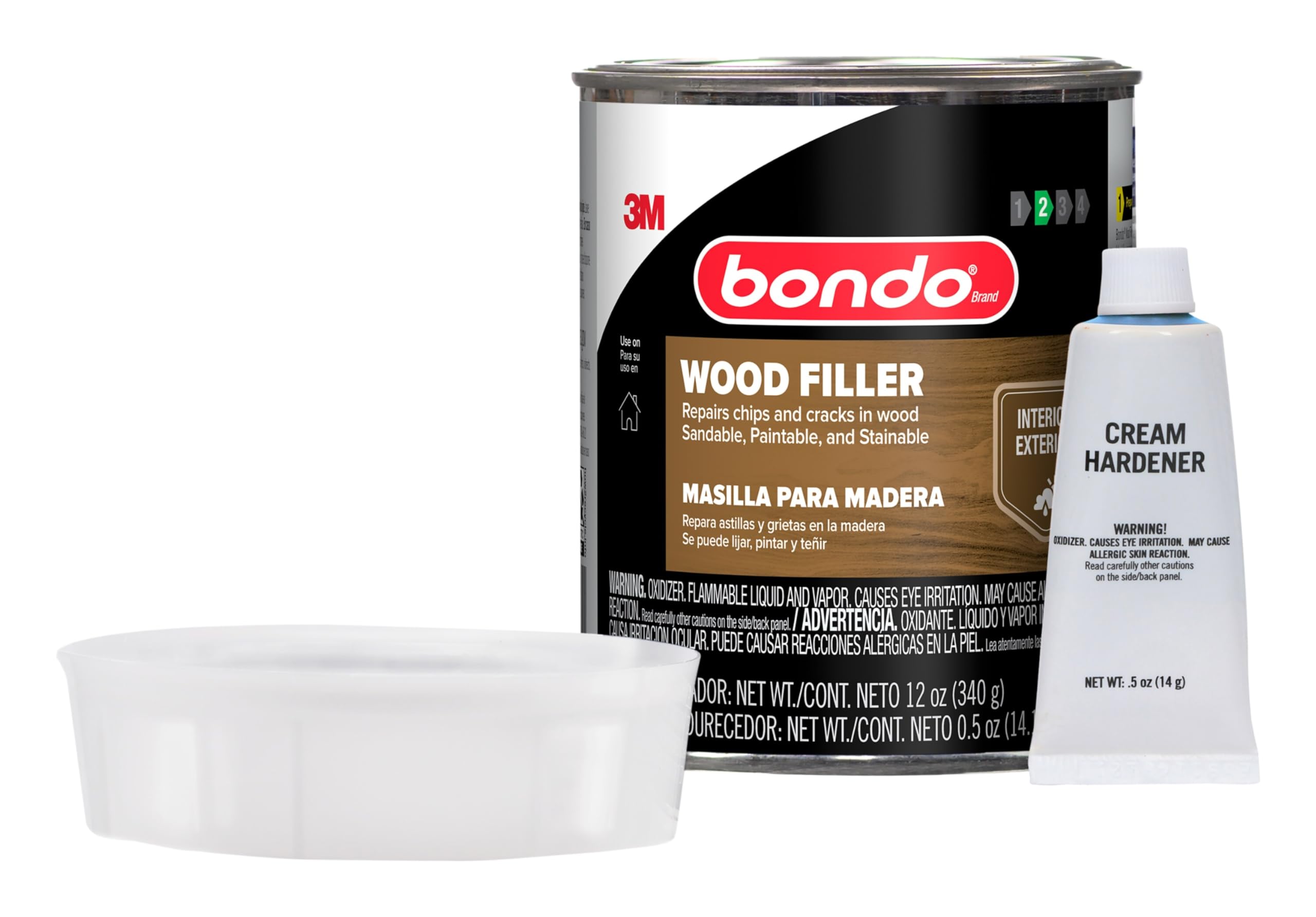
When you are patching a rotted door frame corner or a deep gouge in a deck stair tread, nothing beats the sheer bond strength of the Bondo two-part epoxy system. Mix the paste with the included blue cream hardener, and the chemical reaction produces a material that is harder and more water-resistant than the surrounding wood. The 12-ounce can is the right size for focused repairs on window sills, deck rails, and furniture legs.
The 15-minute cure to sandable state is a game-changer for same-day refinishing. Users report filling cavities up to half an inch deep without the filler sinking or pulling away from the edges. The cured material can be drilled, routed, and shaped like wood, making it ideal for rebuilding missing sections of trim. It also bonds well to rotted wood fibers when the loose debris is removed first.
Working time is extremely short — you have about three to five minutes to apply and shape the filler before it hardens. Mixing in a plastic baggie makes cleanup easier, and acetone is needed for tool cleaning. The odor is strong, so ventilation is mandatory. But for structural repairs where a paste would fail, this is the clear winner.
Why it’s great
- Chemically bonds to rotted wood for permanent repair
- Sandable and machinable in only 15 minutes
- Fills large gaps without shrinking or bubbling
Good to know
- Very short working time — prepare all tools first
- Strong chemical odor requires good airflow
3. 3M Bondo 30 oz Wood Filler

The 30-ounce version of the Bondo wood filler is the volume play for serious deck restoration projects. This is the same two-part chemistry that made the 12-ounce can famous, but sized for larger-scale repairs like a full rotted deck board splice or a post base rebuild. The brown tint blends naturally with most cedar, pine, and pressure-treated lumber, reducing the need for heavy staining to hide the patch.
Users who repaired exterior porch doors and rotted window frames report the material cures to a rock-hard state within 30 minutes, even in cooler weather. It sands smooth with 80-grit paper and accepts primer and paint without adhesion issues. The formula resists shrinking, so a single application is often enough for cavities up to three-eighths of an inch deep.
The red hardener can create a pinkish tint if too much is added, so use a digital scale or a careful eyeball for the correct ratio. The working time is again tight — mix only as much as you can apply in four minutes. For large-area repairs that demand structural integrity, this larger can delivers the same performance as the 12-ounce version at a better per-ounce value.
Why it’s great
- Large 30 oz container for extensive deck repairs
- Brown color blends with most exterior woods
- Rock-hard cure in under 30 minutes
Good to know
- Excess hardener can tint the filler pink
- Short working time requires batch mixing
4. Deuvuo White Wood Filler 32 oz Putty Kit

The Deuvuo white wood putty filler stands out for its all-in-one kit design. The 32-ounce tub includes sandpaper, scrapers, and mixing sticks, so you have everything needed for a small deck repair project without extra trips to the hardware store. The putty is a single-part water-based formula that applies smoothly and dries with minimal shrinkage on nail holes, knots, and hairline cracks.
Users in cabinet and furniture repair appreciate the bright white base, which works beautifully under paint. The putty sands effortlessly to a flat surface and accepts both latex and oil-based paints without peeling. The resealable container keeps the putty workable for months between projects, a feature that DIYers with ongoing repairs will value.
This filler is not designed for large structural gaps — users who attempted deep fills over a quarter-inch reported cracking as the putty cured. It performs best as a surface-level patching compound for cosmetic imperfections. If your deck has mostly shallow dings and screw holes, this kit is a tidy solution. For deeper rot, you need a two-part system.
Why it’s great
- Complete kit with tools and sandpaper included
- Bright white base takes paint exceptionally well
- Resealable tub keeps putty fresh for months
Good to know
- Not suitable for deep structural fills over 1/4 inch
- White color may require painting over for dark decks
5. Timbermate Maple/Beech/Pine Hardwood Wood Filler 8 oz

Timbermate is a water-based wood putty with a unique advantage: you can mix it with water to adjust consistency, making it suitable for everything from a thin skim coat over open grain to a thick paste for filling small cracks. The 8-ounce jar is small, but a little goes a long way because the putty does not dry out in the container even a year after opening.
DIY woodworkers rave about its sanding properties — it creates a glass-smooth surface that accepts stain without blotching. The original color formula is designed to match light hardwoods like maple and beech, and it can be tinted with water-based stains. For interior deck furniture or railings that see less direct moisture, Timbermate delivers a furniture-grade finish.
The main limitation is its exterior durability. Timbermate is labeled for interior use primarily, and while some users report success on covered porches, it will not survive direct rain and freeze-thaw cycles as well as the Bondo or Elmer’s ProBond formulas. It is best reserved for decorative deck elements, outdoor furniture repairs, and workshop projects where moisture exposure is minimal.
Why it’s great
- Adjustable consistency by adding water
- Sands to an exceptionally smooth, stain-ready finish
- Jar stays fresh for over a year without drying
Good to know
- Primarily an interior filler, limited weather resistance
- Small 8 oz jar goes fast on larger projects
FAQ
Can I use interior wood filler on a deck?
Why does my wood filler keep cracking after drying?
How do I stain over deck wood filler so it matches the surrounding wood?
Final Thoughts: The Verdict
For most users, the best deck wood filler winner is the Elmer’s ProBond 32 oz because it balances strength, sandability, and large value for routine nail holes and shallow cracks. If you need structural repair for rotted wood, grab the Bondo 12 oz Two-Part Filler for its unyielding bond and same-day cure. And for a complete cosmetic patching kit on painted surfaces, nothing beats the Deuvuo 32 oz Putty Kit with its included tools and smooth white finish.

Mo Maruf
I created WellFizz to bridge the gap between vague wellness advice and actionable solutions. My mission is simple: to decode the research and give you practical tools you can actually use.
Beyond the data, I am a passionate traveler. I believe that stepping away from the screen to explore new environments is essential for mental clarity and physical vitality.