Our readers keep the lights on and my smoothie glass nicely filled. As an Amazon Associate, I earn from qualifying purchases.
Deck flooring faces a constant enemy: trapped moisture. Leave standing water on traditional wood planks or cheap mats and the rot cycle begins—warping, splintering, and mold that ruins both the look and the structural feel. Interlocking deck tiles that prioritize drainage and material selection break this cycle by elevating the walking surface above the puddle.
I’m Mohammad Maruf — the founder and writer behind WellFizz. After hours of cross-referencing material densities, drainage channel depths, UV-stability reports, and fastener reliability across dozens of outdoor tile listings, I built this guide to separate durable resurfacing solutions from fast-disintegrating cheap tile sets.
Whether you are refreshing a balcony, covering cracked concrete, or building a custom layout around a pool, the right tiles transform the space without a contractor. This guide reveals the best deck flooring picks that combine snap-together simplicity with genuine weather toughness.
How To Choose The Best Deck Flooring
Choosing deck tiles is about matching the material science to your environment. A shaded balcony in the Pacific Northwest has different demands than a rooftop in Arizona. Ignoring the subfloor type, the local UV index, and your tolerance for maintenance leads to regret within one season.
Material: Hardwood vs. Solid PVC vs. Copolymer
Acacia hardwood offers natural warmth and a premium feel, but it requires a sealed finish and periodic oiling to prevent sun bleaching and splitting. Solid PVC tiles like the VEVOR are completely waterproof, flexible underfoot, and fume off a temporary chemical smell that dissipates. Copolymer plastic, used in premium garage-rated tiles, handles heavy rolling loads, chemical spills, and subzero temperatures without cracking.
Drainage Architecture
The spec that separates a dry tile from a mold magnet is the support pin height or channel depth. Tiles with pins shorter than 0.4 inches trap debris and reduce airflow. Look for tiles with at least 0.5-inch raised bases — the Big Floors DuraGrid uses a full grid elevation that dries fast even in humid basements and pool areas.
Connector Strength and Layout Flexibility
Peg-and-hook systems (common on acacia tiles) make installation tool-free, but the plastic pegs are the first failure point under shifting furniture or thermal expansion. Mallet-lock systems that require a rubber hammer create a tight, permanent fit that resists creeping gaps. For irregular layouts, PVC scissors or a jigsaw will cut any tile — confirm the material trims cleanly before buying.
Quick Comparison
On smaller screens, swipe sideways to see the full table.
| Model | Category | Best For | Key Spec | Amazon |
|---|---|---|---|---|
| Big Floors DuraGrid Deck Tiles | Plastic Grid | All-weather deck resurfacing | UV-stable polypropylene, 0.5″ raised grid | Amazon |
| Majestick Goods Slat Deck Tiles (Premium) | Acacia Wood | Warm natural wood aesthetic | 0.9″ thick acacia hardwood, PPC base | Amazon |
| Majestick Goods Slat Deck Tiles (Value) | Acacia Wood | Budget-friendly wood balcony floor | 0.9″ thick acacia, painted finish | Amazon |
| VEVOR Interlocking PVC Tiles | PVC Mat | Wet areas & heavy equipment | Soft PVC, 0.6″ drainage pins | Amazon |
| Big Floors GarageDeck | Copolymer Tile | Garage & heavy-duty floors | Coin pattern, 40,000+ lb load rating | Amazon |
In‑Depth Reviews
1. Big Floors DuraGrid Deck Tiles

The Big Floors DuraGrid is the most balanced mid-range deck tile for anyone who wants a permanent-feeling resurface without wood maintenance. Each 24-pack covers 24 square feet and arrives as 2×2-foot squares that snap together with a mallet-lock system — once engaged, the joints flex as a single sheet instead of separating.
The patented free-draining design elevates the tile half an inch above the subfloor, which is critical for basements, pool surrounds, and rainy-season decks. The polypropylene composite resists UV fading dramatically better than basic PVC mats, and the slip-resistant texture works barefoot or with wet shoes. Owners report cutting the tiles easily with a jigsaw or heavy-duty scissors for edge fits.
Under heavy furniture, the rigid structure holds its shape without the soft sagging that thinner tiles develop. The only real compromise is the firm plastic feel underfoot — it is not cushioned like a rubber mat, though placing a thin outdoor carpet on top solves that preference without losing drainage.
Why it’s great
- Mallet-lock connectors stay tight under thermal cycling
- UV-stable polymer resists cracking and color fade in full sun
- Self-draining grid prevents standing water and mold growth
Good to know
- 2×2′ sections are hard to unsnap; plan layout before assembly
- Firm surface may feel hard on knees without a topper
2. Majestick Goods Interlocking Slat Deck Tiles (Premium Finish)
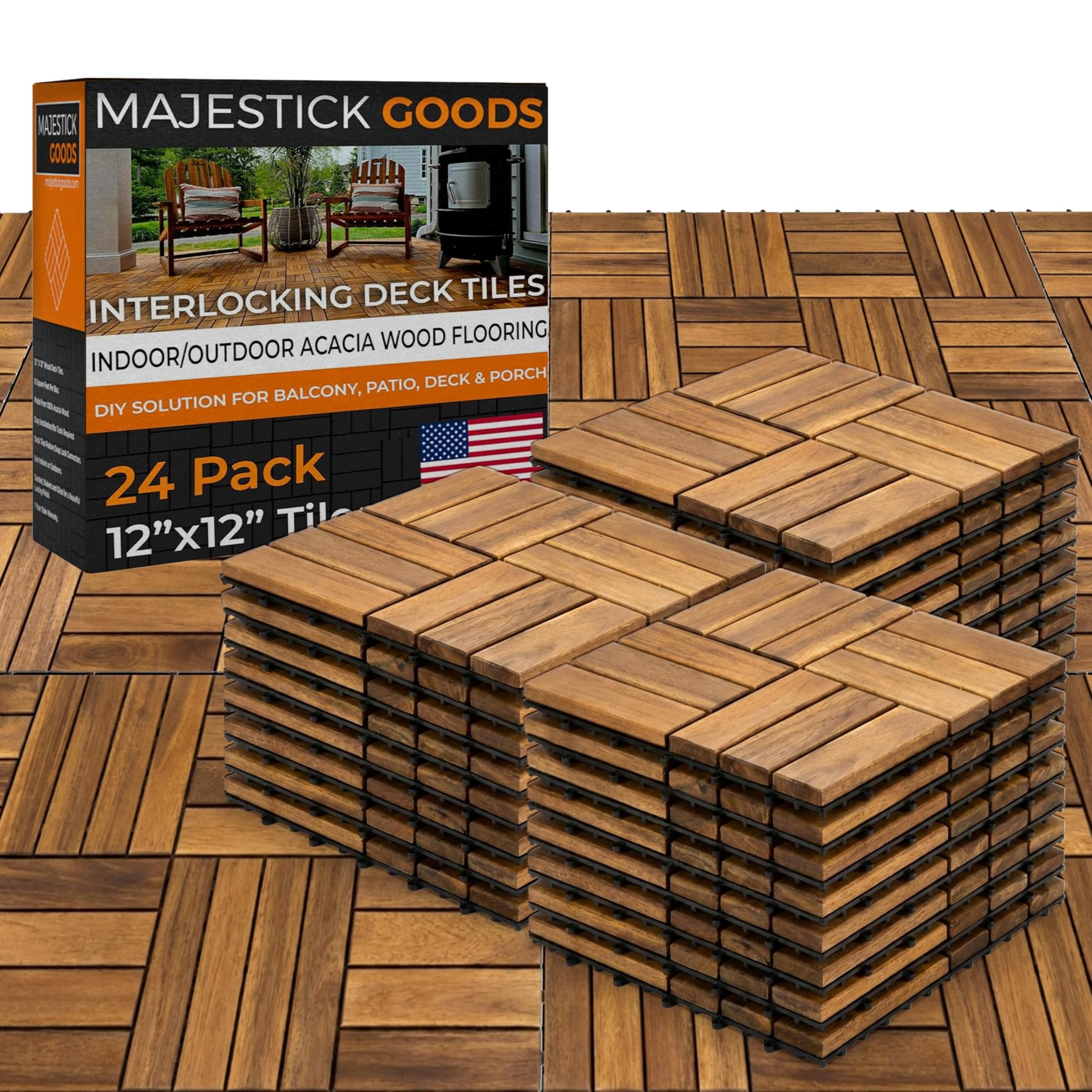
This premium version from Majestick Goods swaps the painted finish for a premium sealer that better protects the acacia against moisture intrusion and sun bleaching. The 0.9-inch thickness is noticeably more substantial underfoot than thinner hardwood tiles, and the slatted design with a raised PPC base ensures water drains straight through rather than pooling between slats.
Installation is tool-free peg-and-hook: place the tile and click it into the neighbor. That convenience makes it fast to lay down a 10×10-foot patio in under an hour alone. The natural acacia color warms up any concrete or old deck surface, and the wood grain provides slip resistance that outperforms painted finishes in wet conditions.
Long-term durability depends entirely on protecting the wood. Owners who applied an additional outdoor sealant before the rainy season reported zero splitting after two years, while those who left the factory finish exposed to direct sun saw bleaching and some edge cupping. The plastic pegs are the mechanical weak point — avoid sliding heavy furniture across the tiles to prevent shear stress on the connectors.
Why it’s great
- Thick 0.9″ acacia feels solid and stable underfoot
- Warm natural wood appearance elevates balcony and patio aesthetics
- Tool-free click assembly for fast weekend installation
Good to know
- Requires periodic oil or sealer to maintain wood color and prevent rot
- Plastic peg connectors can snap under lateral pressure from heavy furniture
3. Majestick Goods Interlocking Slat Deck Tiles (Painted Finish)

This entry-level wood deck tile from Majestick Goods brings the same acacia hardwood core and PPC base as the premium version but uses a painted finish rather than a premium sealer. The saving is real, and for covered patios, screened porches, or partial-shade balconies, the painted surface holds up well for at least a season or two before needing a fresh coat.
The slatted layout and 0.9-inch thickness match the premium version exactly, meaning the drainage performance is identical — water passes cleanly through the gaps and the raised base keeps the tile elevated. Assembly remains tool-free; click the peg-and-hook system together and trim with a fine-tooth saw for tight fits against walls or posts.
The painted finish is the main divergence point. Owners in full-sun exposures report bleaching and minor paint peeling after 18 to 24 months. The acacia underneath is still structurally sound if kept dry, but the visible wear means this is better suited to low-traffic, covered environments where aesthetics matter less than function.
Why it’s great
- Real acacia wood at a lower entry cost than sealed wood tiles
- Solid 0.9″ thickness with proper drainage base
- Quick peg-and-hook installation with no tools required
Good to know
- Painted finish fades and chips faster in direct UV exposure
- Planks can split under chair legs without protective furniture pads
4. VEVOR Interlocking PVC Tiles (50 Pack)

The VEVOR 50-pack takes a different approach: instead of rigid plastic or wood, it uses soft PVC with 0.6-inch drainage pins that create a cushioned, non-slip surface ideal for pool bathrooms, laundry rooms, and shower stalls. At 46.5 pounds for the 50-pack, the density is substantial, but the individual tiles remain pliable enough to trim with standard scissors.
The drainage architecture here is the key differentiator. The pins elevate the tile well above standing water, and the closely spaced holes allow hair and small debris to rinse through with a hose. Owners report that the surface feels similar to a car tire — grippy even when wet, comfortable enough for barefoot standing during long showers, yet supportive enough to park an 800-pound motorcycle on without deformation.
A strong chemical smell on opening is the most noted initial drawback, but it dissipates within 48 hours of airing. The flexible PVC is not UV-stabilized for year-round direct sun, so this tile belongs in mostly covered or indoor-outdoor transitional spaces rather than an open treetop deck.
Why it’s great
- Soft PVC cushion is comfortable on feet during extended standing
- Hair and oil resistant — rinse clean with a hose
- Handles extreme weight loads without permanent compression
Good to know
- Strong temporary odor that requires airing out for a day or two
- Not UV-stable for long-term direct sunlight exposure
5. Big Floors GarageDeck Coin Pattern Tiles

The GarageDeck from Big Floors is technically a garage tile, but its coploymer construction and coin-texture surface make it an ideal heavy-duty deck flooring choice for roof decks, workshop patios, and high-traffic walkways that need chemical resistance and extreme load capacity. Rated to support 40,000 pounds of rolling load, it laughs at parked cars, ATVs, and industrial shelving.
The matte coin pattern provides excellent slip resistance in wet conditions, and the interlocking PowerLock connectors create a permanent floor covering that does not shift or gap. Each tile is 0.5 inches thick with a square edge, and the 48-pack covers exactly 48 square feet. Installation requires a rubber mallet for a tight fit, and the material cuts cleanly with a table saw or jigsaw for border trims.
Owners consistently report that the GarageDeck transforms cracked, spalling concrete into a showroom-quality surface without the expensive prep work of epoxy. The cost versus professional coating is a fraction, and individual tiles are replaceable if damaged. The hard plastic surface makes a slight hollow sound when walked on with hard soles, but a utility mat in high-traffic zones solves that noise.
Why it’s great
- Extreme load rating handles vehicles, tools, and heavy shelving without denting
- Chemical resistant to oil, grease, antifreeze, and common solvents
- Individual tiles are replaceable if the surface gets damaged
Good to know
- Hard plastic surface echoes underfoot — area rugs help with sound deadening
- Pre-assembled in 4-tile sections that are difficult to separate without pliers
FAQ
Can deck tiles be installed directly over grass or dirt?
How do I clean mold off outdoor deck tiles?
Will interlocking deck tiles damage my existing wood deck?
Final Thoughts: The Verdict
For most users, the best deck flooring winner is the Big Floors DuraGrid because it balances UV-stable polymer construction, true drainage, and tool-free mallet-lock security at a mid-range price that outperforms both budget PVC and untreated wood. If you want the warm natural wood aesthetic for a covered patio, grab the Majestick Goods Premium Acacia Tiles and seal them before installation. And for high-traffic garage decks or workshop patios exposed to chemicals and heavy loads, nothing beats the Big Floors GarageDeck for raw strength and replaceability.

Mo Maruf
I created WellFizz to bridge the gap between vague wellness advice and actionable solutions. My mission is simple: to decode the research and give you practical tools you can actually use.
Beyond the data, I am a passionate traveler. I believe that stepping away from the screen to explore new environments is essential for mental clarity and physical vitality.