Our readers keep the lights on and my smoothie glass nicely filled. As an Amazon Associate, I earn from qualifying purchases.
Handing off a single locomotive through a block of track is a workaround, not a solution. A real Digital Command Control system lets three, five, or a dozen trains move independently on the same rails with no toggle switching, no messy wiring, and no starting over every time you want to change speed. The controller you choose — its throttle feel, programming depth, and power delivery — is the single component that either unlocks your layout or bottlenecks every operating session.
I’m Mohammad Maruf — the founder and writer behind WellFizz. I’ve spent hundreds of hours dissecting the hardware specs, firmware limits, and real-world compatibility of DCC systems across every major brand to find which controllers actually deliver clean motor control and seamless addressing out of the box.
Here is the best dcc controller guide for modelers who want a clear, honest look at what each system offers before spending a cent on a command station that doesn’t match their scale or ambition.
How To Choose The Best DCC Controller
A DCC controller is the brain of your layout. It sends digital packets down the rails that each locomotive decodes into speed, direction, and function commands. The wrong controller means your sound-equipped engine might not respond to lighting keys, your programming track could be too weak to read decoder CVs, or you simply run out of throttle addresses halfway through a session. Matching the controller to your scale, fleet size, and programming needs is the only way to avoid buying a system you outgrow in six months.
Power Output and Amp Draw
Amperage determines how many locomotives a single command station can power simultaneously. A 1.5-amp system might handle two small N-scale switchers with basic DC motors, but a 5-amp system is necessary for an O-scale layout running sound-equipped engines that each draw over an amp during audio playback. Check the continuous current rating of the booster section — peak ratings are marketing fluff.
Throttle Feel and Walkaround Form Factor
If you operate alone, a walkaround throttle that tethers directly to the command station via a phone-cord-style plug lets you follow the train around the layout rather than standing fixed at a panel. The weight, button travel, and knob tension in your hand matter for hours of continuous operation. Dual-throttle units let you run two trains independently from one handset — essential for large yards or helper operations.
Programming Depth and Decoder Compatibility
Not all controllers can read every configuration variable (CV) on a modern sound decoder. Some allow only direct programming on a separate programming track; others support ops-mode (programming-on-the-main) so you adjust momentum, volume, or lighting effects while the locomotive is moving. If you install aftermarket decoders from ESU, TCS, or SoundTraxx, verify the controller supports 28, 128, and 14 speed-step modes.
Quick Comparison
On smaller screens, swipe sideways to see the full table.
| Model | Category | Best For | Key Spec | Amazon |
|---|---|---|---|---|
| Märklin CS 3 | Premium | Multi-protocol command center | 5.0A booster, color touchscreen | Amazon |
| Lionel Base3 | Premium | O-Gauge universal control | Wi-Fi, Bluetooth, Legacy, TMCC | Amazon |
| Digitrax Zephyr Express | Mid-Range | All-in-one starter set | 3.0A, 29 functions, 9000+ addresses | Amazon |
| NCE Power Cab | Mid-Range | First-time DCC / walkaround | 2.0A starter set, ergonomic throttle | Amazon |
| Bachmann E-Z Command Booster | Mid-Range | Power expansion for existing systems | 5.0A booster for all scales | Amazon |
| Digitrax DT602 Throttle | Mid-Range | Dual-throttle operation | LocoNet, 2 locomotive control | Amazon |
| Märklin Booster 60175 | Mid-Range | Large digital system booster | Multi-protocol power amplifier | Amazon |
| LGB 51079 | Premium | G Scale / garden railroad control | 5.0A electronic speed controller | Amazon |
| Prodigy Advance Squared | Entry-Level | Budget walkaround upgrade | LCD screen, expansion handset | Amazon |
In‑Depth Reviews
1. Märklin 60226 Central Station CS 3

The Märklin CS 3 is the most feature-dense command station on the current market, supporting mfx, mfx+, DCC, and Motorola protocols from a single metal housing. Its high-definition color touchscreen replaces the cryptic two-line LCDs of older systems, letting you assign up to 32 locomotive functions, edit CVs directly from the display, and manage a fleet of 320 Motorola or 2,048 DCC accessory decoders. The built-in 5.0-amp booster is paired with a switching network recommendation for serious multi-track layouts, and the SD card slot allows firmware updates and layout backups without a computer tethered permanently.
The ergonomics are distinctly European — two large industrial knobs for speed control, a central stop button, and direct connection for two Mobile Stations plus a bus expansion device. USB host ports let you connect a mouse and keyboard for easier programming, which is a genuine lifesaver for older modelers who find touchscreen buttons finicky. The metal chassis dissipates heat better than the plastic enclosures of competing systems, a real advantage during all-day operating sessions or shows where the unit runs continuously.
Setup requires a separate switching power supply — the box does not include one — so factor that into your total build cost. The learning curve is steeper than a starter set like the NCE Power Cab, especially for users new to DCC or Märklin’s unique addressing structure. Advanced users will appreciate the road control mode for shuttle train automation and the ability to run trains from an iPhone or iPad via the CS 3’s network connection.
Why it’s great
- Truly multi-protocol — runs mfx, DCC, and Motorola on the same layout
- Large color touchscreen with intuitive CV editing interface
- 5.0A continuous booster output powers large fleets
Good to know
- Switching power supply must be purchased separately
- Interface is complex for first-time DCC users
- Premium tier investment, not for small starter layouts
2. Lionel Base3 Command Base
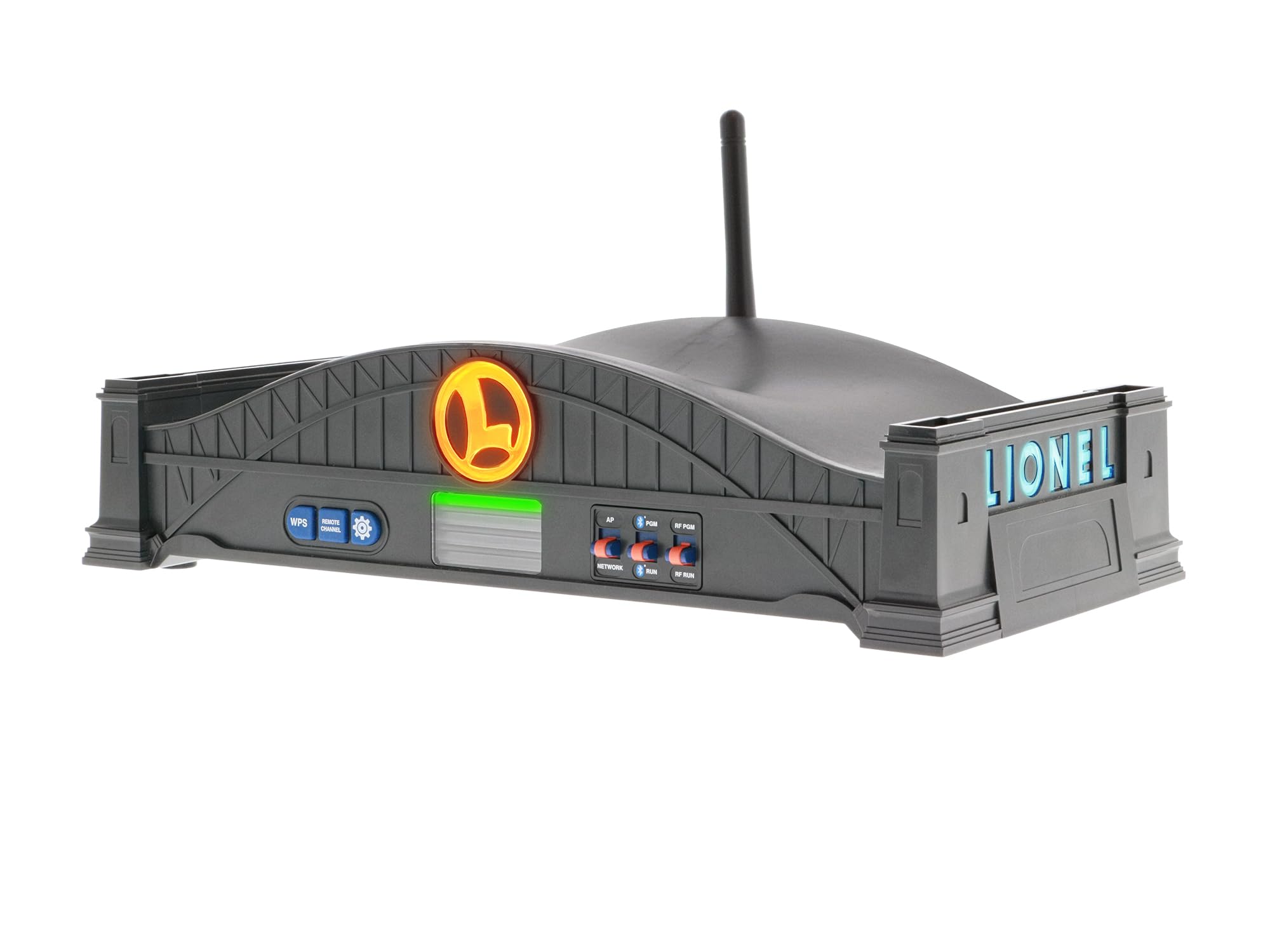
The Lionel Base3 is the only command base on this list designed to unite Legacy, TMCC, LionChief, LionChief+, FlyerChief, and conventional locomotives under a single interface. Its built-in Wi-Fi enables full control through the Lionel Cab3 App on a phone or tablet, which eliminates the need to buy multiple remote controllers if you operate in a group — each operator can run their own train from their own screen. The base also supports CAB-1L and CAB2 remotes, so existing Lionel users can upgrade without immediately replacing every throttle they own.
Three PDI ports expand into the Lionel Layout Control System for accessories like switches, uncouplers, and signals. The built-in circuit monitoring protects the base from PDI short circuits, a common pain point in older command stations. A writable memory module lets you transfer engine rosters from a Base2 system, and the unit even supports older Legacy orange memory modules, making it a genuine drop-in upgrade rather than a complete rebuild.
The Base3 does not include a power supply for the track — you need a separate transformer or Power Master to deliver track voltage. The app-based control is intuitive, but the lack of printed wiring instructions means most users will need YouTube videos to complete initial setup. Modelers expecting DCC compliance should note that Base3 uses Lionel’s proprietary protocols, not NMRA DCC, so it is strictly for O gauge and cannot run HO or N scale DCC locomotives.
Why it’s great
- Unifies all Lionel command protocols in one base
- Wi-Fi app control lets multiple operators run simultaneously
- Writable memory module for easy Base2 roster migration
Good to know
- Does not support NMRA DCC — O gauge only
- Setup instructions require external video resources
- Expensive new remotes may be needed for full multi-user setup
3. Digitrax Zephyr Express Starter Set DGTZEPE

The Digitrax Zephyr Express is the most capable all-in-one starter set in the mid-range tier. It delivers 3.0 amps of continuous power straight from the box, which is enough to run a handful of HO or N scale locomotives simultaneously without an external booster. The system supports over 9,000 locomotive addresses and 29 function keys (F0-F28), so you can trigger long-bell whistles, ditch lights, and cab interior lighting on modern sound decoders without missing a code.
A standout feature is the Jump Port, which allows you to plug in a standard DC power pack and use it as an additional analog throttle — a budget-friendly way to add a second operator station for kids or visitors without buying a second DCC command station. The built-in programming track supports ops-mode on the main, so you can adjust momentum rates or volume levels while the locomotive is moving. The form factor is a compact desktop box, not a walkaround handset, which works well for fixed-panel operators but limits how far you can follow a train on a large layout.
The Zephyr Express has no included walkaround throttle, so adding a separate DT602 or UT4 handset increases total cost. The menu navigation uses Digitrax’s traditional button-sequence programming, which takes time to memorize compared to the NCE Power Cab’s intuitive knob interface. For modelers who want a single box that manages programming, power, and throttles for a medium-sized layout, this is the most efficient path into the Digitrax ecosystem.
Why it’s great
- 3.0A power supply runs multiple trains without a booster
- Jump Ports reuse old DC power packs as additional throttles
- Ops-mode programming on the main while trains move
Good to know
- No walkaround throttle included in the starter set
- Button-sequence menu requires a learning curve
- Desktop form factor limits operator mobility
4. NCE Power Cab DCC Starter Set

The NCE Power Cab is the most recommended DCC starter set for a reason: it includes everything needed to run trains in one box and fits comfortably in your hand. The walkaround throttle is tethered via a thin phone-cord-style cable to a compact interface box, so you can follow your locomotive around the layout bench without standing behind a panel. The single knob controls speed intuitively — twist clockwise to accelerate, counterclockwise to brake — which feels natural even for operators with no prior DCC experience.
The system supports all NMRA standard speed-step modes (14, 28, and 128), and its programming track can read and write CV values on most aftermarket decoders without needing a separate programming station. The manual is one of the clearest in the industry, walking through address setting, consists, and function mapping step by step. The starter set is rated at 2.0 amps, which is adequate for layouts with up to about 6 HO engines or 8 N scale units running at once, but large club layouts will require an additional booster.
The 2.0-amp limit means you will hit the ceiling quickly if you run sound-equipped locomotives that draw close to an amp each during audio playback. Expanding with the NCE Smart Booster or a larger command station is possible, but the Power Cab’s interface box becomes a throttle-only unit once you outgrow its standalone capacity. For modelers building their first or second layout, the Power Cab remains the least frustrating way to get trains moving digitally.
Why it’s great
- Ergonomic walkaround throttle with intuitive single-knob control
- Clear manual and extensive online community support
- Comprehensive CV read/write on programming track
Good to know
- 2.0A limit will require a booster for large sound fleets
- Not expandable to full NCE system without significant upgrade investment
- Phone cord tether can be short on large layouts without extension
5. Bachmann E-Z Command DCC 5 Amp Power Booster

The Bachmann E-Z Command 5 Amp Booster is a pure power-distribution unit designed to increase the capacity of an existing DCC system, not a standalone command station. It includes the booster unit, its own charger, and connecting cables, allowing you to add up to eight additional sound-equipped F7 engines to a layout that previously maxed out at three or four. The 5-amp rating is substantial enough to support G scale garden railroads where track length and multiple locomotives create heavy current demand.
Installation is straightforward: you wire the booster between the track and your existing command station, and the unit handles current-sensing and short-circuit protection internally. The booster is compatible with any NMRA-compliant DCC system, not just Bachmann’s own E-Z Command, so it works equally well alongside NCE or Digitrax stations. The metal chassis is robust enough for permanent layout installation and includes mounting flanges for under-bench placement.
The instructions are vague and contradictory according to multiple reports, and the booster has been discontinued in some models — verifying firmware version before purchase is smart. The unit died within months for at least one user with no customer support available, a risk amplified by Bachmann’s spotty post-2020 service. Modelers should buy from a retailer with a solid return policy and test immediately upon arrival.
Why it’s great
- Easy plug-and-play expansion for existing DCC systems
- 5.0A output supports G scale and high-current sound layouts
- Works with any NMRA-compliant DCC command station
Good to know
- Vague documentation and limited post-purchase support
- Some units reported dead-on-arrival or short lifespan
- Requires existing command station — not a standalone controller
6. Digitrax DT602 Advanced Super Throttle

The Digitrax DT602 is a standalone throttled handset that connects to any Digitrax LocoNet-based system (Zephyr, Super Chief, etc.) and provides dual-throttle control — you can run two locomotives independently from a single handheld. The display is a two-line LCD with backlighting, showing speed, direction, and function status for each of the two active locomotives. The throttle includes a rotary knob for speed and a separate numeric keypad for direct address entry, which is far faster than scrolling through a menu on a command station panel.
The DT602 supports 29 function keys (F0-F28) with two-way keys for toggling effects like ditch lights or cab light brightness. LocoNet compatibility means you can plug this throttle into any Digitrax layout and immediately control any locomotive without needing to pair or assign it — ideal for club layouts where multiple operators share a common system. The plastic housing is lightweight at 7.4 ounces, comfortable for extended operating sessions, and the phone-cord-style tether is replaceable if damaged.
This is a throttle only — it does not include a command station, booster, or power supply, so it only makes sense as an upgrade for an existing Digitrax layout. Some users report that connecting the DT602 to Bachmann E-Z Command track requires additional interface equipment, and the lack of a corded power supply means you need a LocoNet-powered layout to use it. Modelers switching from a starter set to a full Digitrax ecosystem will find this the most capable handset in the lineup.
Why it’s great
- Dual-throttle control from a single walkaround handset
- Direct address entry keypad for fast locomotive switching
- Fully compatible with all Digitrax LocoNet systems
Good to know
- Requires existing Digitrax command station and LocoNet
- No command station or booster included in the box
- May need additional gear for non-Digitrax track compatibility
7. Märklin Booster 60175

The Märklin Booster 60175 is a power amplifier designed for large digital systems operating in multi-protocol environments (mfx, DCC, Motorola). It takes the digital signal from a Märklin Central Station (CS2 or CS3) and amplifies the current to drive additional layout sections with power-hungry sound decoders and lighting circuits. The booster is a pure signal amplifier — it does not decode commands or store CV data; it simply provides clean, regulated current to prevent voltage drop across long track runs.
German engineering is evident in the compact metal housing (5.91 x 4.33 x 1.65 inches) with heat-dissipating fins that allow continuous high-current operation without thermal shutdown. The booster includes short-circuit detection and automatic restart, a critical feature for garden-scale layouts where leaves, moisture, or debris can create temporary shorts. Connection is via the Märklin bus, which is a simple two-wire interface that daisy-chains to existing bus wiring.
This booster requires a separate power supply — no wall plug is included, and the input voltage requirements are specific to Märklin systems, so it will not work with generic DC power packs. The 0.54 kg shipping weight is misleading; the actual unit weighs only 0.02 pounds, which suggests the product description may include packaging or documentation weight. Modelers adding track sections to an existing Märklin digital layout will find this the most direct power solution.
Why it’s great
- Multi-protocol compatible (mfx, DCC, Motorola)
- Short-circuit detection with automatic restart
- Compact metal housing for under-layout mounting
Good to know
- Separate power supply required — not included
- Only compatible with Märklin bus systems
- Specs list contradictory weights — confirm actual product
8. LGB 51079 Electronic Speed Controller 5A

The LGB 51079 is a 5-amp electronic speed controller engineered specifically for G-scale garden railroads, where track is exposed to the elements and locomotives often draw higher current due to larger motors and heavy brass construction. The new design includes LED indicators for stop status and a fuse for short-circuit protection, both critical for outdoor layouts where a fallen branch or damp track can create a fault. The controller provides smooth, low-voltage starting for large G-scale locomotives without the jerky takeoff that plagues analog controllers on heavy rolling stock.
The primary pain point is power connectivity: the unit does not include a power cord, and the input connector is a proprietary LGB/Märklin style that is not compatible with standard wall-wart adapters. Multiple buyers discovered this only after receiving the unit, rendering it unusable until a separate power supply is sourced. The controller itself, once connected, delivers significantly better running qualities compared to older LGB analog controllers — users report much smoother slow-speed creep and more consistent speed regulation on grades.
At 0.32 ounces, the LGB 51079 is deceptively light — it is intended as a sub-unit inside a control panel or under-layout enclosure rather than as a desktop device. The fuse-protected output and stop-status LEDs add a layer of safety that outdoor layouts genuinely need, especially for club-owned tracks where multiple operators share the same system. Despite the power cord omission, the running improvement is dramatic enough that G-scale operators frequently call it a must-have upgrade.
Why it’s great
- Silky-smooth low-speed control for heavy G-scale locomotives
- LED stop-status indicators and short-circuit fuse protection
- Compact enough for under-layout installation
Good to know
- No power cord included — proprietary connector required
- Lightweight build may feel less substantial than expected
- Compatibility limited to LGB/Märklin garden railroad systems
9. Prodigy Advance Squared LCD Walkaround

The Prodigy Advance Squared LCD is an expansion walkaround handset for MRC (Model Rectifier Corporation) DCC systems, adding a large backlit LCD screen to an existing Prodigy Advance layout. The screen displays locomotive address, speed steps, and function status in a single glance, which represents a significant upgrade over the older non-LCD handsets that required memorizing numeric codes. At 7.4 ounces, it is the lightest walkaround handset in this roundup, reducing wrist fatigue during long operating sessions — important for operators who are older or deal with hand strain.
Users report that the unit synced seamlessly with existing Prodigy Advance setups, allowing simultaneous control of both sides of a layout and multiple trains without compatibility issues. The handset uses a phone-line cable for connection rather than a traditional corded tether, which some users found limiting in length — the included cable is not long enough for a large walkaround layout without an extension. MRC support was praised for helping with initial sync and programming guidance.
The LCD handset is an expansion-only device — it requires an existing MRC Prodigy Advance command station to function, so it is not a standalone controller. The phone-line connection system is less rugged than the LocoNet-type cables used by Digitrax and NCE, and the lack of a corded power supply means the handset relies entirely on bus power from the command station, which can cause dimming on large layouts with excessive cable runs. For modelers already in the MRC ecosystem, this is the most affordable way to add a second operator station with readable display feedback.
Why it’s great
- Large backlit LCD screen makes address and function status readable
- Lightweight ergonomics reduce hand fatigue during operations
- Seamless expansion for existing MRC Prodigy Advance layouts
Good to know
- Requires existing Prodigy Advance command station — not a starter system
- Phone-line tether may be too short for full layout walkaround
- Bus-powered only — can struggle with dimming on longer cable runs
FAQ
Can I run a DCC controller with my existing DC transformer?
What does ops-mode programming mean and do I need it?
Is a walkaround throttle worth the extra cost?
Final Thoughts: The Verdict
For most modelers, the best dcc controller winner is the Digitrax Zephyr Express because it delivers the most balanced combination of power, expandability, and programming depth at a reasonable investment point. If you want an intuitive walkaround experience with minimal setup frustration, grab the NCE Power Cab. And for multi-protocol command centers running Märklin mixed fleets, nothing beats the Märklin Central Station CS 3.

Mo Maruf
I created WellFizz to bridge the gap between vague wellness advice and actionable solutions. My mission is simple: to decode the research and give you practical tools you can actually use.
Beyond the data, I am a passionate traveler. I believe that stepping away from the screen to explore new environments is essential for mental clarity and physical vitality.