Our readers keep the lights on and my smoothie glass nicely filled. As an Amazon Associate, I earn from qualifying purchases.
Getting clean, stable DC power from a bench supply is the difference between troubleshooting a circuit design and chasing a phantom caused by a noisy power source. The right DC power supply doesn’t just turn on; it holds steady voltage under load, delivers precise current limits, and protects your project from accidental shorts or overvoltage. Many makers and technicians start with cheap units that drift, hum, or lack basic output controls, wasting hours of debugging time.
I’m Mohammad Maruf — the founder and writer behind WellFizz. I spend hours analyzing datasheets, reading circuit forums, and comparing precision measurements so you don’t have to sift through specs that read like part numbers. My research focuses on voltage stability, ripple noise, and the real-world build quality that keeps your work reliable.
This guide walks through the top options across different needs — from high-voltage programmable units to high-current linear supplies — to help you find the best dc power supply for your specific bench projects and budget.
How To Choose The Best DC Power Supply
Selecting a bench power supply isn’t just about voltage and current ratings. The real performance comes from build quality, output stability, and protection circuitry. Whether you’re a hobbyist, a repair technician, or an engineer, matching the supply to your actual load behavior is critical for accurate results.
Voltage and Current Range vs. Resolution
Chasing a high voltage range often means sacrificing resolution at low voltages. A 50V 6A supply like the HYELEC offers coarse and fine adjustment knobs, which makes dialing in 0.1V increments easier than a single rotary encoder. For circuits that operate at 1.8V or 3.3V, a 0-30V supply with 10mV resolution is far more useful than a 60V supply that jumps in 100mV steps.
Linear vs. Switching Topology
The old debate matters here. Linear supplies, such as the Tekpower TP3005T or the KORAD KD3005D, use a heavy transformer to regulate DC, resulting in extremely low ripple and noise — essential for analog audio circuits and communications gear. Switching supplies are lighter, more efficient for high-current loads up to 50 amps, and often programmable, but they can introduce high-frequency noise that may interfere with sensitive loads. If you’re charging LiFePO4 batteries or running a small motor, a switching supply works fine.
Memory and Programmability
If you repeatedly test the same three voltage-current combinations (e.g., 12V 1A, 5V 2A, 3.3V 0.5A), memory slots will save you setup time. Higher-end units also allow timed output sequencing through PC software, which is useful for automated battery or LED testing. The HANMATEK and Kiprim units both support programmable sequence output, while the HYELEC keeps three physical memory buttons.
Protection Features and Output Safety
An output enable/disable switch is not a luxury; it lets you set voltage and current before connecting the load, preventing accidental surges. Overvoltage protection (OVP) and overcurrent protection (OCP) that can be user-set are crucial for sensitive prototype boards. Units like the Siglent SPD3303X-E include a dedicated lock function to prevent setting drift. If you work with batteries or high-power loads, reverse polarity protection and a thermal cut-off are equally important.
Quick Comparison
On smaller screens, swipe sideways to see the full table.
| Model | Category | Best For | Key Spec | Amazon |
|---|---|---|---|---|
| HYELEC HY50-06A | Switching | General bench & battery charging | 0-50V / 0-6A, 150W, 3 memory slots | Amazon |
| Tekpower TP3005T | Linear | Low-noise analog & audio | 0-30V / 0-5A, 300W, metal chassis | Amazon |
| HANMATEK HM310T | Programmable | Automated testing & charging | 0-30V / 0-10A, 300W, USB & software | Amazon |
| KORAD KD3005D | Linear | High-current lab & electrolysis | 0-30V / 0-5A, 1mV resolution | Amazon |
| Kiprim DC605S | Programmable | Programmable high-voltage tasks | 0-60V / 0-5A, 300W, color LCD | Amazon |
| Jesverty SPS-50II | Switching | Ham radio & high-power amps | 13.8V fixed, 9-15V adjustable, 50A | Amazon |
| Siglent SPD3303X-E | Linear | Professional lab & multi-channel | 32V/3.2A x2, 2.5/3.3/5V x1, 220W | Amazon |
In‑Depth Reviews
1. HYELEC HY50-06A

The HYELEC HY50-06A delivers a wide 0-50V range with 0-6A output, making it a versatile choice for projects from battery charging to mobile phone repair. It uses a code-type potentiometer for coarse and fine adjustment from the same knob, a design that eliminates the jumpy voltage seen on cheap encoder-based units. The 4-digit LED display reads 0.01V and 0.001A steadily without flicker, which is critical when you need to trust the display at low voltages.
Three physical memory buttons (M1/M2/M3) let you save your most-used voltage and current settings, so you can switch between 12V charging and 5V digital logic without re-dialing. A front 5V 2A USB port charges a phone or powers a small microcontroller board directly, freeing up the main output for other loads. The output enable/disable switch with surge protection prevents accidental connection damage — a feature often missing on budget units.
At only 2.7 lb and with a compact plastic chassis, it occupies minimal bench space yet passed a 72-hour full-load burn-in test. The temperature-controlled fan is quiet during normal operation. Users report stable 48V output for EV battery balancing and clean 13.8V for SLA charging. The only trade-off is single-channel output and a 110V-only input, but for most home labs this is not a limiting factor.
Why it’s great
- Wide voltage range (50V) suitable for multi-chemistry batteries
- Memory slots and USB port add daily convenience
- Fine and coarse adjustment from a single knob
Good to know
- Output jack remains connected even when supply is off
- Plastic enclosure feels less durable than a metal chassis
2. Tekpower TP3005T
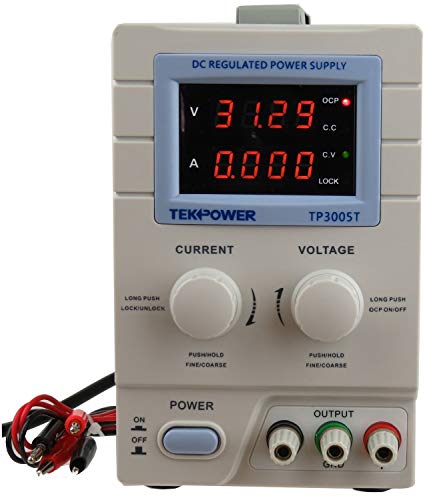
The Tekpower TP3005T is a classic linear supply that prioritizes low ripple and stable output over compact size. Weighing 12 lb, it houses a large transformer and substantial heatsinks that keep noise to a minimum. This makes it a go-to for audio circuit testing, communications bench work, and any scenario where switching noise would corrupt measurements. The back-lit LED display shows voltage with 0.1V and current with 0.01A resolution — adequate for most repair and prototyping tasks.
Two operational modes (constant voltage and constant current) are selected automatically by the electronics, and the fan kicks in only when internal temperature rises thanks to a built-in thermo-sensor. Users report the fan stays quiet at loads under 1A, which is common for low-power analog circuits. The metal body and gold-capped internal resistors reflect an emphasis on build quality that many mid-range switching units lack.
The control interface uses a digit-by-digit rotary encoder that takes ten minutes to learn but offers precise fine adjustment. Some users found the intermittent banana plugs to be the weakest link and replaced them. After curing, the initial paint smell disappears. For technicians who demand a clean, low-noise supply at an approachable price point, the TP3005T delivers reliable performance without the complexity of programmable menus.
Why it’s great
- Very low output noise ideal for sensitive analog circuits
- Heavy transformer construction for stable, drift-free output
- Temperature-controlled fan stays quiet at low loads
Good to know
- Control interface takes practice to master
- Banana plugs can be intermittent and may need replacement
3. HANMATEK HM310T

The HANMATEK HM310T is a programmable switching supply that brings PC control and six memory groups to the bench at a mid-range price. Its 0-30V, 0-10A output is double the current of many linear alternatives, making it well-suited for charging large battery packs (like LiFePO4 top-balancing) or driving motors. The 4-digit display reads voltage, current, and power simultaneously, plus a timer that counts up for tracking charge sessions.
Five protection functions — OVP, OCP, OPP, OTP, and SCP — can all be set by the user, and the automatic temperature-controlled fan engages only when internal temperature exceeds 45°C. The front panel includes two USB ports (5V 1.5A total) for charging small devices or powering a Raspberry Pi. The one-key output on/off switch lets you preset values safely before connecting the load, which is a workflow saver for repetitive testing.
The included PC software supports the Modbus instruction set, enabling automated sequences with up to 10 editable points per waveform. Bear in mind that the software may trigger antivirus alerts on some systems, and the bundled CD is less convenient than a direct download. Users who need sustained 10A output without the weight of a linear transformer will appreciate the compact 2 kg form factor. The display viewing angles are narrower than ideal, but for the current range it’s a strong value.
Why it’s great
- 10A max current handles large battery banks
- Programmable sequencing via PC software
- Five adjustable protection mechanisms
Good to know
- PC software may be flagged by antivirus programs
- Display has narrow optimal viewing angle
4. KORAD KD3005D

The KORAD KD3005D is a well-known linear supply that balances precision with current capacity. With 1mV voltage resolution and 1mA current resolution, it gives you the fine control needed for curve tracing, constant-current LED testing, and electrochemical processes. The dual 4-digit LED displays show both the set value and the actual output simultaneously, so you always know if the load is pulling the voltage down.
Circuit protection covers overload, short circuit, and over temperature. The auto-switching display between mA and A saves you from misreading current on delicate low-power loads. Users have run this unit non-stop for a week during silver refining electrolysis and noted it stayed cool thanks to the automatic variable-speed fan. The compact footprint (~10.5″ x 4.4″ x 6.5″) fits alongside other gear without dominating the bench.
Some users report that current metering accuracy is about 1% and that the reverse polarity protection diode (1N5480) can blow if you accidentally connect the supply backward to a battery. The fan noise measures 57 dB SPL at the rear when running at higher loads, which is noticeable but not intrusive in a typical workshop. For applications that require stable linear output at up to 5A, the KD3005D remains a trusted reference.
Why it’s great
- 1mV and 1mA resolution for precision work
- Simultaneous set/actual value display
- Proven linear reliability under continuous heavy load
Good to know
- Reverse polarity protection diode is vulnerable
- Fan noise is moderate at higher load levels
5. Kiprim DC605S

The Kiprim DC605S stands out with a 2.8-inch color LCD that displays voltage, current, power, and cumulative runtime — and can show measurement data as a real-time curve. Rated for 0-60V at 5A (300W), it covers higher-voltage applications like charging 48V e-bike batteries or testing automotive modules. The setting resolution is 10mV voltage and 1mA current, and the readback matches when working within the nominal range.
Programmability is a strong suit: four memory groups (M1-M4) store full channel parameters, and the list output function allows a waveform of up to 10 editable points, each with voltage, current, and duration. The rear USB port supports PC control via the included software, and a front 5V 1A USB port is available for phone charging. Five protection types (OVP, OCP, OPP, OTP, SCP) are user-settable, and the intelligent fan cooling engages at 85°C.
Customer reports note unit-to-unit variation: the first unit may have a fan that runs constantly or a slow output adjustment response, while the replacement works flawlessly. The on/off switch is on the rear, which is inconvenient if the supply sits on a shelf. Below 5mA the ammeter reads zero. For users who need high voltage in a compact programmable package and can confirm calibration on arrival, the DC605S offers excellent feature density.
Why it’s great
- Color LCD with curve display for trend analysis
- 60V output covers high-voltage battery chemistry
- PC software with list waveform editing
Good to know
- Quality control can vary between units
- Rear on/off switch is awkward for shelf placement
6. Jesverty SPS-50II

The Jesverty SPS-50II is a purpose-built high-current supply for ham radio operators and anyone needing continuous 50A at 13.8V. Unlike general-purpose variable supplies, this unit focuses on a fixed 13.8V output with a 9-15V adjustable range for fine-tuning. The screw-type main terminals handle large-gauge wire without adapters, and two auxiliary snap-in terminals plus a front cigarette lighter socket provide extra connectivity for radios, amplifiers, and test equipment.
Analog V/A meters give real-time monitoring without the latency of digital displays. A noise offset circuit shifts switching frequency artifacts away from critical bands, which is essential for interference-free transmission. Users running 100W transceivers report zero voltage drop during transmission and a fan that only engages under heavy duty-cycle loads. The unit has been used reliably for over two years in continuous standby operation.
Advanced short circuit protection and automatic current limiting protect both the supply and the connected gear. At 6.17 lb, it’s portable enough to move between benches or take to field events. If you need 40A continuous (50A surge) for CB, ham, or mobile radio setups, the SPS-50II delivers stable, clean power in a well-organized chassis. It is not a general-purpose variable bench supply, but for high-current comms work it is the right tool.
Why it’s great
- 50A surge capacity for high-power amplifiers
- Screw terminals and cigar socket for radio gear
- Noise offset circuit minimizes RF interference
Good to know
- Not a general-purpose variable voltage supply
- Analog meters lack the precision of digital readouts
7. Siglent SPD3303X-E
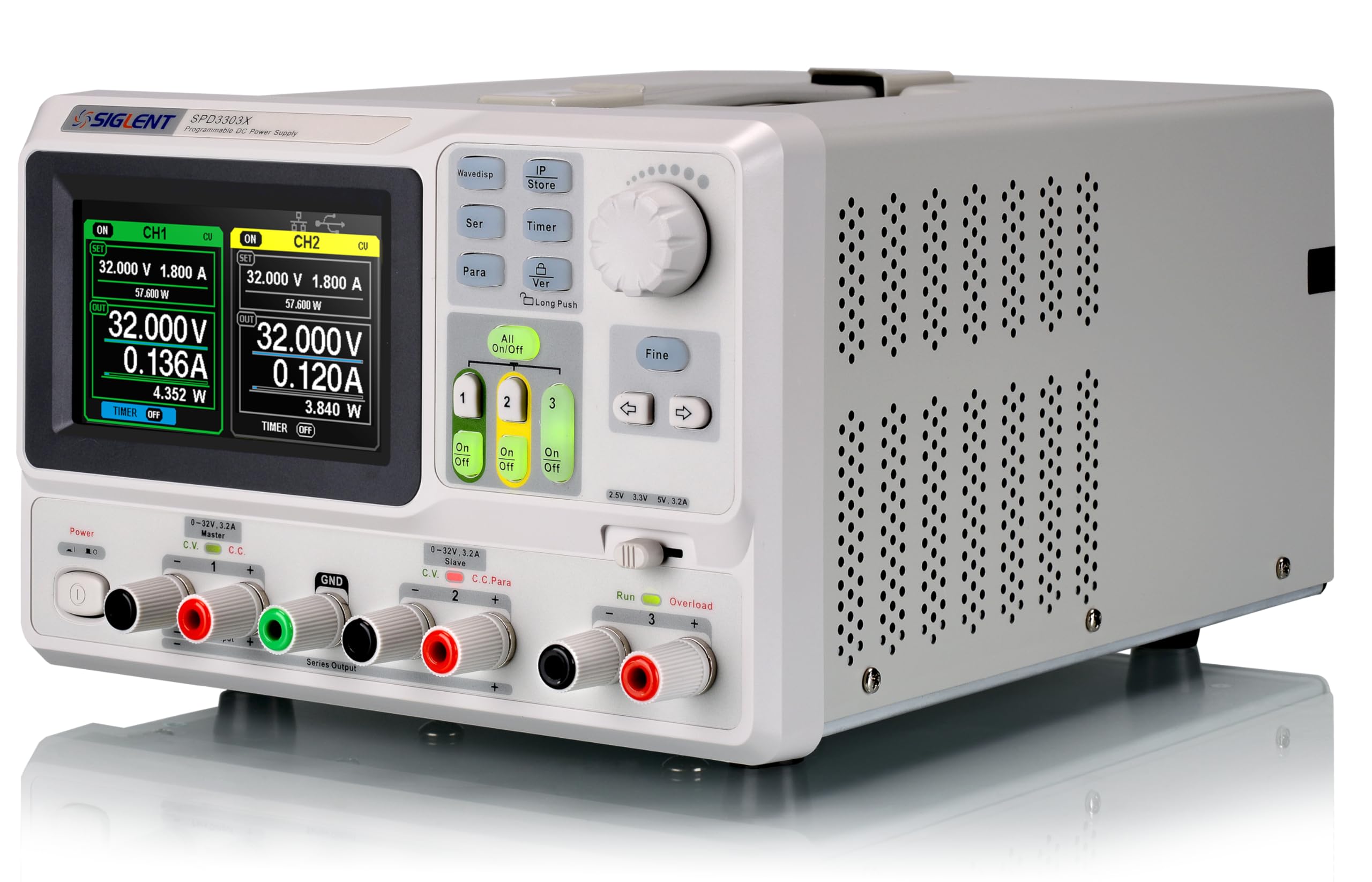
The Siglent SPD3303X-E is a professional-grade triple-output linear supply that brings lab-level performance to a benchtop package. Two independent channels deliver 0-32V at 3.2A each, and a third channel provides fixed 2.5V, 3.3V, and 5V selections at 3.2A, for a total of 220W. The outputs can operate in independent, series (up to 60V), or parallel modes, covering nearly any low-to-medium current requirement you’ll encounter.
Voltage accuracy is reported at <0.016% from 1-30V, with residual AC ripple around 0.5mV — numbers that justify the price for precision work. The 1mV/1mA resolution is essential for micro-power circuits. A timing output function and trending graphs let you monitor voltage or current over time, useful for production testing or characterizing battery drain profiles. The variable-speed fan is silent at idle and only becomes audible above 50% load.
Connectivity includes USB and Ethernet ports that work with Python scripting on Linux, though the Windows software has been noted to be less reliable. The third fixed channel lacks the fine control of the main outputs and does not display current, which is a limitation. Some purchased units (pre-December 2023) had firmware-related reboot issues that have since been resolved. For engineers and dedicated makers who need dual independent channels, low noise, and remote programmability, the SPD3303X-E is the clear choice.
Why it’s great
- Two fully independent channels for dual-rail circuits
- Sub-0.5mV ripple for critical analog projects
- Ethernet/USB for automated testing and scripting
Good to know
- Third output channel is fixed and not linear-controlled
- Included test leads are only 1 meter long
FAQ
Can I use a switching power supply for audio circuits?
How do I set the overcurrent protection on a programmable supply?
What does it mean when a power supply shows constant current mode?
Final Thoughts: The Verdict
For most users, the best dc power supply winner is the HYELEC HY50-06A because it packs a wide voltage range, memory slots, and a USB port into a lightweight, affordable package that handles 90% of bench tasks. If you need ultra-low noise for analog work, grab the Tekpower TP3005T. And for high-current radio setups, nothing beats the Jesverty SPS-50II.

Mo Maruf
I created WellFizz to bridge the gap between vague wellness advice and actionable solutions. My mission is simple: to decode the research and give you practical tools you can actually use.
Beyond the data, I am a passionate traveler. I believe that stepping away from the screen to explore new environments is essential for mental clarity and physical vitality.