Our readers keep the lights on and my smoothie glass nicely filled. As an Amazon Associate, I earn from qualifying purchases.
That drawer full of mismatched wall warts and the endless hunt for the right barrel plug to power just one device ends here. A capable DC charger replaces a dozen specialized bricks with a single adjustable unit that delivers precise voltage across a wide range of household electronics, from LED strips and routers to security cameras and 3D printers. The difference between a frustrating tangle of cables and a clean, organized power solution comes down to the voltage range, current capacity, and tip selection of the unit you choose.
I’m Mohammad Maruf — the founder and writer behind WellFizz. I’ve spent countless hours cross-referencing manufacturer specifications, customer field reports, and real-world voltage measurements to isolate the DC chargers that actually deliver clean, stable power across their advertised range.
Whether you need to revive a BMS-protected battery bank or simply consolidate your workbench power, this guide to the best dc charger options breaks down the five most capable units for home, garage, and mobile use.
How To Choose The Best DC Charger
Selecting the right DC charger requires matching three core parameters: voltage range, current output, and connector compatibility. Overlooking any single spec risks frying your device or leaving you with a charger that simply won’t plug in. Here is what you need to check before you buy.
Voltage Adjustment and Regulation
A universal DC charger that advertises 3V to 24V output is only useful if the voltage stays steady under load. Cheap regulators produce noisy output with voltage spikes and dips that can confuse or damage sensitive circuits. Look for units with digital voltage displays and fine-adjustment knobs that allow precise setting rather than coarse jumps that skip over intermediate voltages.
Amperage and Total Wattage Limits
The 72W rating on most universal adapters means they can deliver up to 3 amps across the entire voltage range. A device that draws 2.5 amps at 12V will work fine, but trying to power a 5-amp pump from a 3-amp supply will trigger overload protection or cause the voltage to sag. Always verify that your device’s current requirement is less than the adapter’s maximum rating, and consider leaving a 20% headroom margin for startup surges.
Tip Selection and Polarity
Barrel connector sizes vary widely among consumer electronics, and a missing tip means a useless charger. The best universal kits include at least a dozen tips covering 5.5×2.1mm, 5.5×2.5mm, 4.0×1.7mm, 3.5×1.35mm, and USB-C or Micro-USB connectors. Polarity is equally critical — most devices expect center-positive, but some require center-negative, making a polarity converter a valuable inclusion for troubleshooting legacy gear.
Quick Comparison
On smaller screens, swipe sideways to see the full table.
| Model | Category | Best For | Key Spec | Amazon |
|---|---|---|---|---|
| LiTime 12V 20A | Dedicated Battery Charger | Deep-cycle LiFePO4 battery banks | 20A output at 14.6V | Amazon |
| SUPERONE 6-in-1 | Car Charger | Multi-device in-vehicle charging | 99W total with retractable cables | Amazon |
| Wefomey Universal 72W | Universal Adapter | Multi-device bench supply | 3V-24V with 14 tips and 4-way splitter | Amazon |
| Minidodoca 72W Adjustable | Universal Adapter | Budget-conscious hobbyists | 3V-24V with 16 tips and LED display | Amazon |
| Hzevn 32W PD Car Charger | Car Charger | Compact everyday phone charging | Dual 20W PD-C ports in 2-pack | Amazon |
In‑Depth Reviews
1. LiTime 12V 20A Lithium Battery Charger

This dedicated LiFePO4 charger delivers a flat 20A at 14.6V, hitting the exact absorption voltage required to fully charge a 12.8V lithium deep-cycle battery. The three-stage smart charging algorithm — pre-charge, constant current, and constant voltage — ensures your battery reaches full capacity without the overvoltage stress that a generic adjustable supply might induce. Users report that a completely drained 100Ah battery climbs from 0% to full in roughly five hours with no noticeable heat buildup in the charger housing thanks to the aluminum shell and temperature-controlled fan.
Safety coverage includes reverse polarity protection, over-temperature cutoff, and 0V activation to wake up batteries whose BMS has entered protection mode. The Anderson 50A connector and M8 ring terminals make permanent installation straightforward for RV, marine, or off-grid solar setups where vibration resistance matters. The LED indicator panel shows charge status clearly from across a garage.
Where this unit excels is reliability at sustained high current — the cooling fan and fin design keep internal temperatures low even during a full 20A cycle. Customers who upgraded from lead-acid chargers note the LiTime unit does not taper off prematurely, squeezing the last 10-15% of capacity into the battery that generic chargers often leave behind.
Why it’s great
- True 20A continuous output with three-stage LiFePO4 profile
- 0V activation revives deeply discharged BMS-protected batteries
- Anderson and M8 terminal options suit permanent installations
Good to know
- Only works with 12V LiFePO4 chemistry — not for lead-acid or NiMH
- Heavier and bulkier than universal adapters
- No voltage adjustment; fixed at 14.6V
2. SUPERONE 6-in-1 Retractable Car Charger
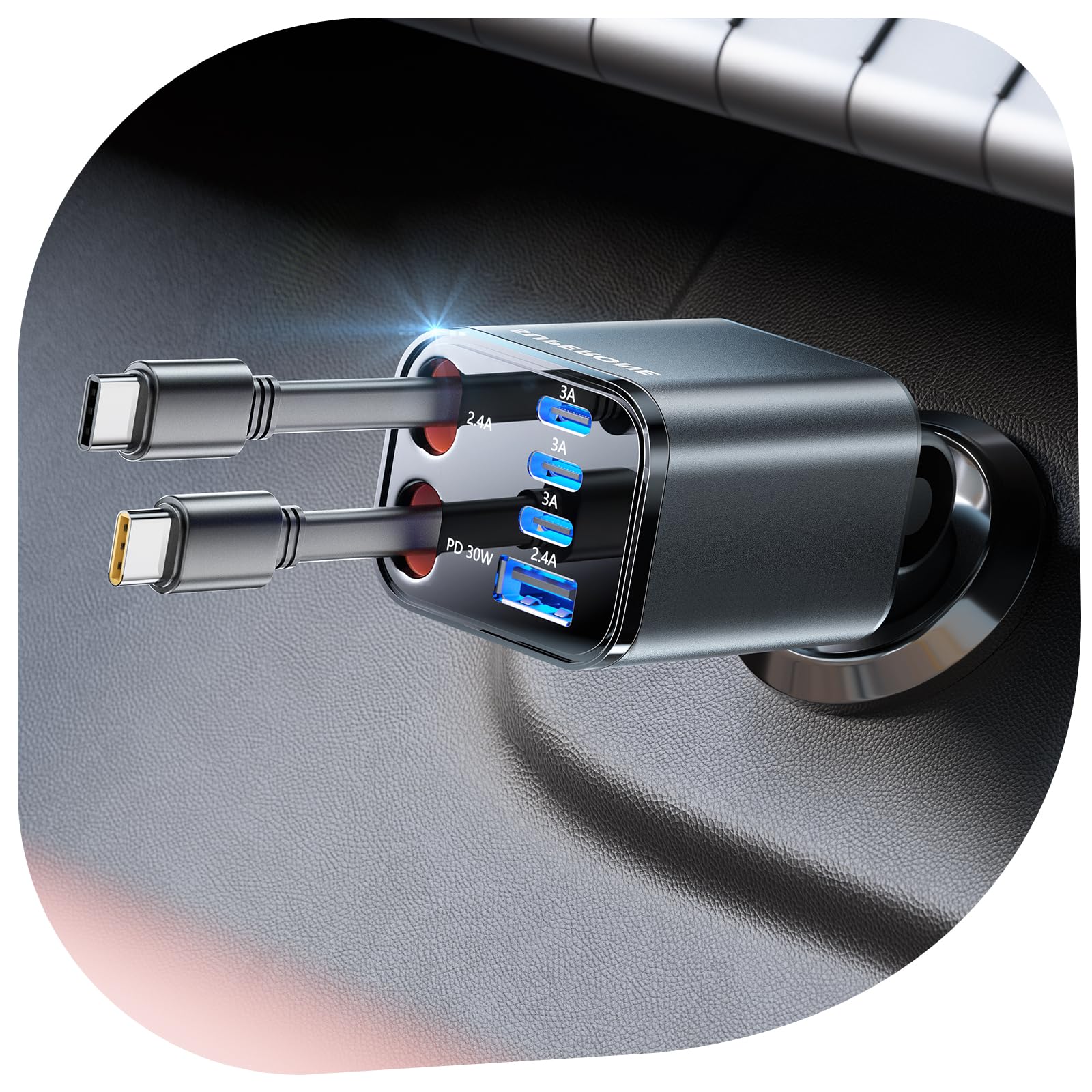
The SUPERONE packs six charging points into a body that is roughly 60% smaller than typical retractable models, solving the common problem of bulky chargers blocking gear shifters and center console controls. Its 180-degree adjustable head lets you angle the unit away from the dash, and the dual retractable cables — one 30W PD-C and one 12W USB-C — extend up to 31.5 inches and lock at any intermediate length. The remaining four ports consist of three 15W USB-C and one 12W USB-A, providing enough bandwidth to charge two phones, a tablet, and a GPS unit simultaneously without port contention.
Real-world testing shows the 30W PD-C cable tops off an iPhone 16 from 0% to 80% in under 30 minutes. The retraction mechanism feels smooth and snappy, and the built-in buckle plus anti-slip base keeps the charger seated firmly even on rough roads. The unit includes overcurrent, overvoltage, and overheat protection, backed by UL, CE, FCC, and RoHS certifications.
The main trade-off is that total output is capped at 99W shared across all ports, so plugging six high-drain devices simultaneously will throttle individual port speeds. Users also note that the retractable cables, while convenient, are permanently attached and cannot be replaced if damaged.
Why it’s great
- Dual retractable cables eliminate dash clutter
- 180° pivoting head fits tight console spaces
- 30W PD-C charges a phone to 80% in 30 minutes
Good to know
- Total 99W shared limit throttles port speed under heavy load
- Retractable cables are non-replaceable
- Slightly longer than ultra-compact fixed-port chargers
3. Wefomey Universal Power Supply 3V-24V 72W

The Wefomey kit stands out for its generous accessory bundle: 14 DC tips covering everything from 6.5×4.4mm down to 2.5×0.7mm, a reverse polarity converter, alligator clip test leads, and a 4-way power splitter cable. The splitter is the hidden gem — it lets a single 72W adapter power up to four low-current LED strips or security cameras simultaneously, provided the total draw stays under 3 amps. The LCD voltage display offers a crisp readout of the set voltage, and the adjustment knob allows fine-tuning across the full 3V to 24V range.
Output stability is acceptable for general household electronics, though some users report a sensitivity issue with the knob — a light bump can swing voltage by several volts, which poses a risk for sensitive devices if the unit is placed in a high-traffic area. The included 6-foot power cable provides good reach for mounting the adapter on a workshop wall, and the plastic enclosure is lightweight at just over half a pound.
Where this adapter truly shines is the breadth of included connectors. Customers who power LED strip arrays, USB fans, or multiple cameras praise the splitter as a space-saving alternative to individual wall warts. The alligator clips also make it handy for testing motors or pumps before committing to a permanent supply.
Why it’s great
- 4-way splitter powers multiple low-current devices from one adapter
- 14 tips plus polarity converter for maximum device compatibility
- Lightweight form factor with 6-foot cable for flexible placement
Good to know
- Voltage knob is overly sensitive and easily bumped off setting
- Output cable is 24 AWG; voltage drop of ~0.57V at 3A load
- No amperage adjustment or current limiting feature
4. Minidodoca 72W Adjustable AC/DC Adapter

The Minidodoca adapter covers the same 3V-24V range as the Wefomey but adds some unique extras: a built-in protruding rotary knob with an off position so you can kill power without unplugging, and 16 tips that include alligator clips and a 5.5×2.5mm female-to-alligator-clip adapter. The LED display shows real-time output voltage, and several customers confirm the unit doubles as a basic battery voltage meter when unplugged from AC — reading the battery’s resting voltage through the alligator clips.
The most common praise from verified buyers involves the adapter’s ability to charge tool battery docking stations — users report feeding 18V, 20V, and 21V battery packs from the same unit by dialing in the correct voltage and selecting the appropriate tip. The small footprint and lightweight 0.7-pound body make it easy to stow in a tool bag. Safety protections include automatic over-voltage, over-current, over-temperature, and short-circuit cutoffs.
Critical feedback centers on output noise. One reviewer measured a 60 kHz ripple spike and voltage swing from 3.7V to 6.4V when the dial was set to 5V, confirming this adapter is not suitable for precision electronics labs or Arduino projects where clean DC is required. For general-purpose bench work and powering household gadgets, the noise level is acceptable, but hobbyists working with sensitive analog circuits should look elsewhere.
Why it’s great
- Unique off-gear on knob eliminates need to unplug
- Doubles as a battery voltage meter in unplugged state
- 16 tips cover most consumer barrel sizes
Good to know
- High output ripple and voltage spikes unsuitable for sensitive electronics
- Display and knob feel cheap; long-term durability is questionable
- No USB-A female output for powering micro devices
5. Hzevn USB C Car Charger 2-Pack 32W
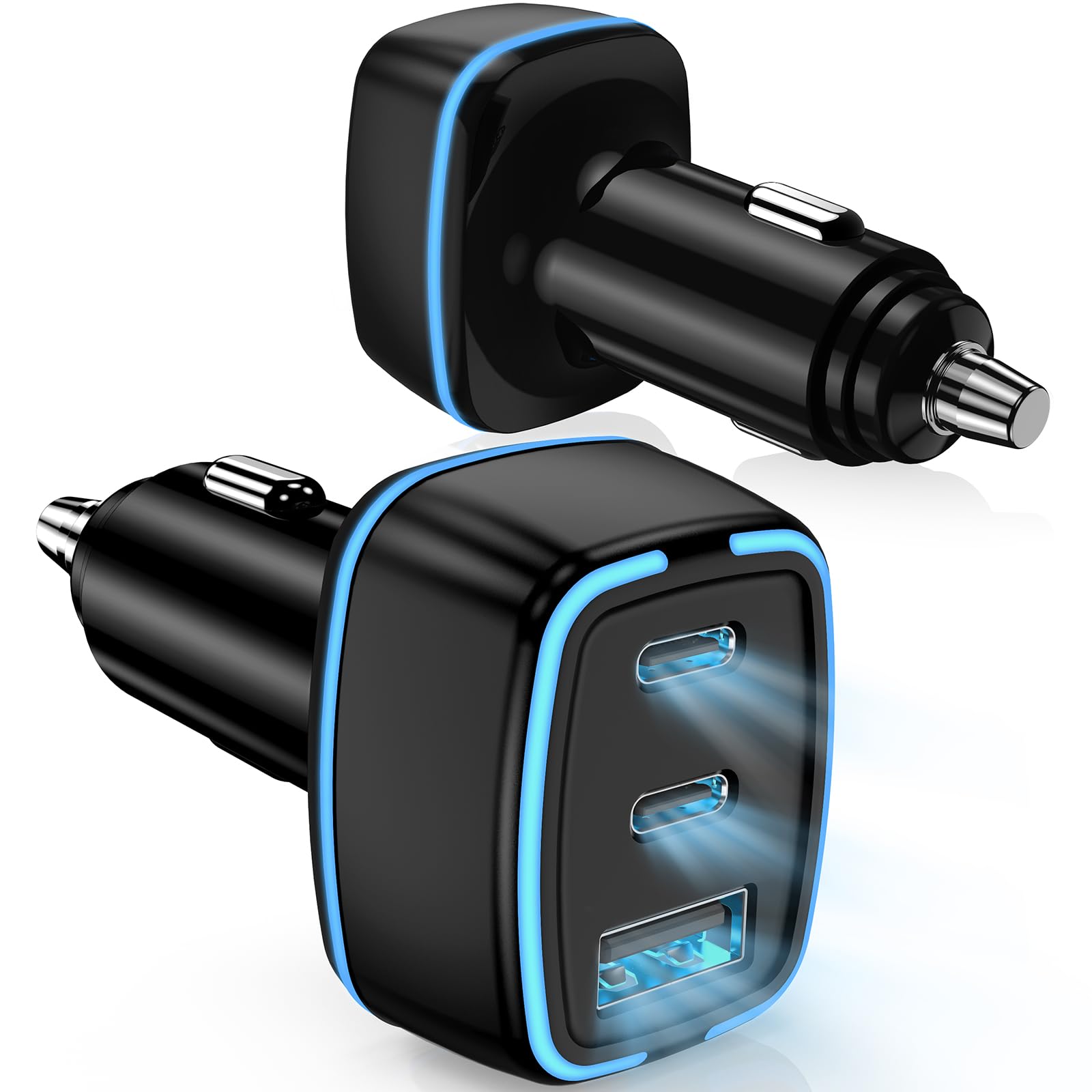
This 2-pack from Hzevn is the most straightforward entry on the list — no adjustable voltage, no tip selection, just reliable PD and QC fast charging in a compact package. Each charger offers two USB-C ports at 20W each and one USB-A port at 12W, for a total of 32W shared output. That is enough to fast-charge an iPhone 16 to 60% in 35 minutes while simultaneously topping off a second phone or a pair of wireless earbuds. The blue LED ring provides a subtle night-driving glow without being distracting.
The polycarbonate and ABS shell feels sturdy in hand, and the form factor is short enough to sit flush in most cigarette lighter sockets without protruding into the gear shift area. Safety includes the standard 8-protection smart chip for over-current, over-voltage, and over-temperature. The 3-year warranty is a strong vote of confidence for a product in this price tier.
Where the Hzevn falls short is total power. At 32W total, plugging three high-drain devices simultaneously will throttle each port significantly. It also cannot charge larger devices like an iPad Pro at full speed due to the 20W per-port ceiling. For drivers who need a simple, cheap way to keep two phones charged on a road trip, the 2-pack conceit is a smart value — one charger for each family vehicle.
Why it’s great
- Two chargers included for multiple vehicles or spares
- Compact body fits older cars with shallow sockets
- Blue LED is functional without being distracting at night
Good to know
- 32W total limits simultaneous fast charging
- No USB-C cable included
- 20W per-port ceiling is insufficient for iPad Pro fast charging
FAQ
Can a universal DC charger damage my device if I set the wrong voltage?
Why does my universal adapter show a different voltage on my multimeter than the display reads?
Can I use a universal DC charger to charge LiFePO4 or lead-acid batteries?
What is the difference between a retractable car charger and a fixed-port car charger?
Final Thoughts: The Verdict
For most users, the best dc charger winner is the Wefomey Universal 72W because it combines the widest accessory bundle with decent voltage stability for everyday household use and a useful 4-way splitter for multi-device setups. If you need to charge a deep-cycle LiFePO4 battery bank, grab the LiTime 12V 20A for its dedicated three-stage charging and robust safety protections. And for mobile use where cable clutter is the enemy, nothing beats the SUPERONE 6-in-1 Retractable for keeping your car clean and your devices charged on the go.

Mo Maruf
I created WellFizz to bridge the gap between vague wellness advice and actionable solutions. My mission is simple: to decode the research and give you practical tools you can actually use.
Beyond the data, I am a passionate traveler. I believe that stepping away from the screen to explore new environments is essential for mental clarity and physical vitality.