Our readers keep the lights on and my smoothie glass nicely filled. As an Amazon Associate, I earn from qualifying purchases.
Measuring a voltage drop across a resistor over a twelve-hour charge cycle, or tracking the thermal profile of a power supply under load, is how theory becomes real data. An entry-level handheld multimeter gives you a snapshot, but it cannot give you the 48,000-point time-series plot you need for a lab report or senior design project. That is why a purpose-built logger—with its own memory, programmable sample intervals, and direct USB or SD-card export—has become the essential tool for turning a circuit experiment into a publishable graph.
I’m Mohammad Maruf — the founder and writer behind WellFizz. I’ve spent hundreds of hours cross-referencing datasheets, testing software compatibility, and analyzing build quality across the most popular data loggers on the market.
Whether you are logging thermocouple output from a solar panel test rig or monitoring humidity inside a 3D-print enclosure, this guide to the best data loggers for electrical engineering students breaks down channel count, sample rate, data export options, and real-world durability you can trust for every semester project.
How To Choose The Best Data Loggers For Electrical Engineering Students
Selecting the right data logger for lab work means matching the device’s measurement capability to the type of experiment. A logger built for monitoring a freezer’s temperature every hour is not the right tool for capturing a fast transient voltage spike on a breadboard. Understanding these four decision points will help you buy once and log accurately.
Channel Count and Input Type
The number of simultaneous measurement points determines how many variables you can track in a single test run. For an electrical engineering student, a four-channel logger allows you to monitor input voltage, output voltage, current through a shunt, and ambient temperature all at once. Multi-channel units typically accept K-type thermocouples for temperature, but some models also include voltage inputs or external probes, making them more versatile across different lab setups.
Sampling Rate and Data Resolution
For steady-state characterization—like overnight thermal drift—a one-sample-per-minute logger is perfectly adequate. For transient analysis or motor startup current profiles, you need sub-second sampling. Check the device’s fastest sampling interval and whether resolution (bit depth) degrades at higher speeds. Loggers that output at 0.1°C or 0.01V resolution provide enough granularity for most undergraduate experiments without overwhelming the memory buffer.
Data Export and Software Compatibility
A logger that writes directly to a CSV or TXT file on an SD card eliminates driver headaches and works with any spreadsheet or plotting tool. Units that require a specific Windows executable for data retrieval can be restrictive, especially if you use Linux or macOS in your lab. Battery-powered models that also function as USB flash drives when plugged in offer the most convenient workflow for students moving between lab benches and dorm rooms.
Power Source and Runtime
Long-duration logging over several days or weeks demands efficient battery management. Some units rely on a single lithium coin cell that lasts six months of intermittent use, while others use larger AA or 9V batteries that power the logging circuit for weeks. Rechargeable lithium-ion packs, like those found in higher-end models, offer the convenience of USB-C charging but require planning for recharging intervals during extended experiments. Always verify the battery type before purchasing, as some proprietary cells are difficult to replace.
Quick Comparison
On smaller screens, swipe sideways to see the full table.
| Model | Category | Best For | Key Spec | Amazon |
|---|---|---|---|---|
| HOBO MX1101 | Bluetooth Logger | Wireless environmental monitoring | 128 KB storage / 84,650 readings | Amazon |
| Gain Express 4-Channel (B0FJFGVV9B) | 4-Ch Thermocouple | Multi-point lab temp logging | 48,000 records / USB-C / 120h runtime | Amazon |
| Lascar EL-USB-3 | Voltage Logger | DC voltage monitoring (0-30V) | 0.1V resolution / 32,000 readings | Amazon |
| Tekcoplus 4-Channel (B01HD4WMS8) | SD Card Logger | High-temp multi-channel logging | 8 GB SD card / 4 K-type inputs | Amazon |
| DANOPLUS 4-Channel (B092967M67) | SD Card Logger | Scheduled start & high/low alarms | 8 GB SD card / 4 x K-type inputs | Amazon |
| AZ Instruments 4-Channel (B00M9Z3JJ8) | SD Card Logger | Unlimited auto logging / independent alarms | 8 GB SD card / 4 x K-type inputs | Amazon |
| Extech RHT10 | Temp/RH Logger | Indoor humidity and temperature logging | 16,000 data points / USB direct | Amazon |
| Lascar EL-USB-2 | Temp/RH Logger | Dew point calculation / IP67 rated | Internal replaceable battery / USB | Amazon |
| Elitech RC-5 (5 Pack) | Temp Logger | Multi-point budget temp monitoring | 32,000 points each / IP65 rated | Amazon |
In‑Depth Reviews
1. HOBO by Onset MX1101

This is the gold standard for environmental monitoring in an electrical engineering lab. With a storage capacity of 84,650 measurements and Bluetooth Low Energy that works through walls at up to 100 feet, the MX1101 lets you check temperature and relative humidity trends from your laptop without touching the logger. The built-in LCD shows current readings, battery level, and logging status at a glance, which saves time when you are setting up multiple test points across a large workspace.
Sensor accuracy is top-tier: ±0.21°C for temperature and ±2% typical for relative humidity. The accompanying HOBOmobile app generates presentation-ready graphs and exports CSV data for further analysis in MATLAB or Python. The unit runs on a single AAA battery, making it easy to swap when depleted, though some users report the battery door feels less robust than the rest of the device. For senior design projects that require wireless data collection over weeks, this is the most polished tool in the lineup.
The primary limitation for electrical engineering students is that the MX1101 is strictly an environmental logger—it does not accept external probes for voltage, current, or thermocouple inputs. If your experiment is limited to ambient conditions, this is an excellent choice, but for circuit-specific measurements you will need a different tool.
Why it’s great
- Wireless Bluetooth connectivity for remote monitoring
- Massive 84,650-point memory for long-duration tests
- High accuracy sensors (±0.21°C, ±2% RH)
Good to know
- No external probe inputs—environmental logging only
- Requires smartphone or tablet for direct data access
2. Gain Express 4-Channel Thermocouple Logger (B0FJFGVV9B)
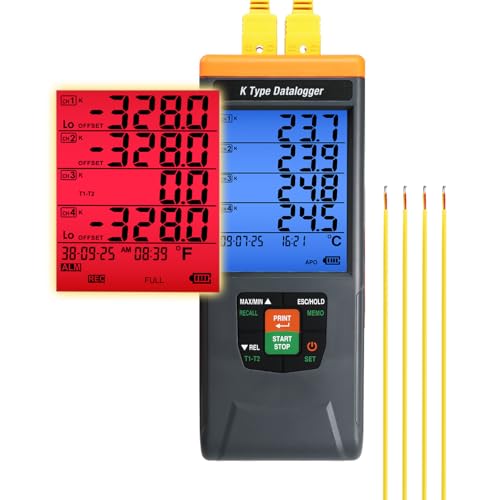
This four-channel thermocouple logger earns the top spot for engineering students who need precise multi-point temperature logging without spending a premium. It supports K-type thermocouples across a range of -200°C to +1370°C with 0.1°C resolution, making it suitable for everything from PCB thermal profiling to motor winding temperature checks. The auto-logging memory of 48,000 records, adjustable sampling from one second to 90 minutes, and a programmable start delay give you full control over data collection schedules.
Connectivity is modern and student-friendly: a USB-C port handles both charging and data transfer. The unit exports logs directly as text files via a helper EXE that appears when plugged in, though some users note the files are UTF-16LE format rather than pure CSV, requiring a quick conversion step. The rechargeable battery delivers a stated 120 hours of runtime, which covers a full week of continuous logging without recharging. Each channel has independently programmable high/low alarms with both buzzer and LED alerts, a useful feature for unsupervised experiments.
Build quality is decent for the price point, but the included hard plastic case lacks padding, and the display’s blue backlight can be difficult to read at certain angles. The menu system requires some trial-and-error navigation, so students should practice setting parameters before starting a critical data run. For the channel count and accuracy, this is the strongest value in the mid-range category.
Why it’s great
- Four simultaneous K-type channels with high resolution
- 48,000 record storage and USB-C charging
- 120-hour rechargeable battery for extended use
Good to know
- Data export requires a helper EXE, not mass storage
- Menu navigation can be unintuitive at first
3. Lascar Electronics EL-USB-3

For electrical engineering students who need to monitor DC voltage over time—such as battery discharge curves, solar panel output, or power supply stability—the Lascar EL-USB-3 is a purpose-built solution. It measures 0 to 30V DC with 0.1V resolution and stores over 32,000 readings with a time and date stamp on each record. The sampling interval is user-programmable, from one second for capturing fast events up to 30 minutes for multi-day trends, giving a maximum runtime exceeding one year at the slowest rate.
Setup is simple: plug the logger into a USB port, configure parameters with the free Windows software, then attach the input leads to your circuit using the included clip leads or optional Anderson connectors. Data retrieval is equally straightforward—reconnect to USB and use the software to generate graphs or export to Excel. The device runs on an internal replaceable lithium battery, which is a double-edged sword: it provides long life but is not rechargeable and can be difficult to source.
One quirk reported by users is that the logger can lock up if left connected to USB power for extended periods, requiring a battery reset to restore function. Additionally, the software is x86/x64 only, so Mac M1 users running Windows via emulation will not be able to configure the device. For Windows-based lab environments where tracking a single 12V or 5V rail is the primary task, this logger is both effective and affordable.
Why it’s great
- Designed specifically for 0-30V DC logging
- Programmable sample rate from 1s to 30min
- Clear time-stamped data export to Excel
Good to know
- Non-rechargeable battery, not user-friendly to replace
- Software incompatible with Mac M1 architecture
4. Tekcoplus 4-Channel K-Type Logger (B01HD4WMS8)

This self-contained 4-channel K-type thermocouple logger comes with an 8GB SD card, providing effectively unlimited storage for long-term projects. The measurement range spans -200°C to +1370°C at 0.1°C resolution, with accuracy rated at ±(0.3% + 1°C). The large LCD shows all four channels simultaneously along with real-time clock data, and the device includes MAX/MIN/HOLD functions plus programmable high/low alarms per channel with both buzzer and LED indicators.
The key advantage for students is the SD card export: data is written as a simple text file that can be read directly on any computer without proprietary software. This makes the workflow seamless for sharing data across lab groups or importing into MATLAB for analysis. The unit runs on a standard 9V battery, which is widely available, and also accepts an optional 9VDC adapter for long-duration experiments. Users report the battery lasts over 39 hours of continuous logging, sufficient for overnight and weekend runs.
The downsides center on user interface and build quality. The included manual is poorly translated from Chinese, making initial setup a process of trial and error. The SD card cover tab broke on some units, and the display blanks during active logging unless you press a button to wake it. Despite these inconveniences, the core accuracy and data output quality make it a capable tool for thermal characterization labs.
Why it’s great
- Unlimited logging via included 8GB SD card
- No software needed—data exports as simple text files
- Wide measurement range with 0.1°C resolution
Good to know
- Display blanks during logging unless manually woken
- Poorly translated manual makes initial setup fiddly
5. DANOPLUS 4-Channel Thermocouple Logger (B092967M67)

This DANOPLUS 4-channel logger shares the same K-type thermocouple platform as the Tekcoplus model but adds a few extra features that are valuable for controlled experiments: a scheduled start function that lets you begin logging at a precise future time, and per-channel high/low alarm thresholds that trigger both a loud buzzer and flashing red LED. The 4.1-inch backlit LCD displays all four temperature readings at once, making it easy to monitor thermal gradients across a PCB or heat sink array.
Data storage is handled by an included 8GB SD card, and the logger outputs .TXT files that open in Excel or any text editor without extra software. The device runs on four AA batteries (included), giving you the option of standard alkaline or rechargeable cells. The unit also features a T1-T2 differential mode, which is useful for measuring the temperature difference between two points—for example, the inlet and outlet of a liquid cooling loop.
Accuracy is within 2-3°C out of the box, but each channel has an adjustable offset correction that lets you calibrate against a known standard. Some users report occasional glitches on channels 3 and 4, though resetting the logger usually resolves the issue. The manual is printed in very small font, making it nearly unreadable without magnification. For the price, this is a solid multi-channel option for students who need scheduled logging and alarm capabilities.
Why it’s great
- Scheduled start for automated logging sessions
- Per-channel alarms with buzzer and LED indicators
- T1-T2 differential mode for delta temperature analysis
Good to know
- Manual print is extremely small and hard to read
- Occasional channel glitches may require resetting
6. AZ Instruments (Gain Express) 4-Channel Logger (B00M9Z3JJ8)

The AZ Instruments four-channel logger from Gain Express is a time-tested workhorse for lab temperature logging. It offers the same core specs as the other SD-card based units—K-type thermocouple support from -200°C to +1370°C, 0.1°C resolution, and an 8GB SD card for unlimited storage—but it also provides independent high/low alarm settings for each channel, a 2×2 display layout for viewing all probes at once, and a real-time clock that stamps every reading with date and time.
What sets this unit apart is its proven reliability in long-term installations. Users have reported using it for boiler efficiency monitoring, kiln temperature tracking up to 1350°F, and walk-in cooler audits, with data logging for months at a time. The included bead-type K-type probes are functional but short, so plan to order longer probes if your test points are far apart. The unit requires a USB card reader to transfer the SD card data to a PC, but the output is a clean text file that imports easily into any analysis software.
One design weakness is that the logger is susceptible to electrical noise: readings can jump by approximately 3°C when the unit is placed near motors or power supplies. This is a known limitation of the unshielded input design, so keep the logger physically separated from high-voltage equipment. The manual translation is also poor, but the device is intuitive enough to operate without it. For students who plan to leave a logger running for weeks, this is a dependable choice.
Why it’s great
- Rock-solid reliability for long-duration experiments
- Independent alarms per channel for critical thresholds
- Clean text file output, easy to import into any software
Good to know
- Readings drift ~3°C near electrical noise sources
- Requires separate USB card reader for data transfer
7. Extech RHT10 Humidity and Temperature Logger

The Extech RHT10 is a compact, no-frills temperature and humidity logger that plugs directly into a USB port for both setup and data retrieval. It measures relative humidity from 0 to 100% and temperature from -40°C to +70°C with accuracy of ±1°C, and automatically calculates dew point—a useful feature for condensation studies in electronics enclosures. The device stores up to 16,000 time-stamped readings, which is enough for a typical week of monitoring at one sample per minute.
Setup is straightforward: install the free Windows software, configure the logging interval, and unplug the logger to activate recording. When plugged back in, the software generates graphs and allows export to .XLS or .TXT. The unit is powered by an internal lithium battery that is not rechargeable via USB, but the battery life is long enough for months of intermittent use. The small form factor and protective cap make it easy to drop into a tool bag or install inside a small enclosure.
The biggest operational caveat is that downloading data stops the logging session and resets the device, so you cannot spot-check mid-experiment without interrupting the recording. The software also runs only on Windows, limiting cross-platform use. For students who need a simple, reliable temperature and humidity logger for enclosure monitoring or environmental validation, this is a proven tool that has been on the market for years.
Why it’s great
- Direct USB connection, no extra cables needed
- Automatic dew point calculation
- Compact and durable with protective cap
Good to know
- Data download stops and resets the logging session
- Internal battery is not rechargeable via USB
8. Lascar EL-USB-2 Temp/Humidity/Dew Point Logger

The Lascar EL-USB-2 is a highly capable temperature, humidity, and dew point logger housed in an IP67-rated enclosure, meaning it is fully dust-tight and can survive submersion in water. The measurement range is -35°C to +80°C for temperature and 0 to 100% RH, with user-programmable alarm thresholds and status indication via red and green LEDs. Dew point is calculated automatically by the included Windows software, which also allows you to adjust the logging rate and plot trend lines.
The logger is fully self-contained: a replaceable internal lithium battery provides power, and the USB interface is built directly into the device—no cables or card readers needed. Setup and data retrieval are simple plug-and-play operations through the free Lascar software. Users praise the unit’s accuracy and reliability in environments ranging from server rooms to refrigerators, with consistent performance over weeks of continuous logging.
The primary concern for students is the cost and availability of the replacement battery, which is proprietary and non-standard. Additionally, the software is Windows-only, so macOS and Linux users will need to find a compatible machine for configuration. Despite these considerations, the EL-USB-2 is the go-to choice when you need a rugged, sealed logger for damp or dusty experimental conditions—such as a greenhouse control project or outdoor equipment monitoring.
Why it’s great
- IP67 rated—fully waterproof and dustproof
- Measures temperature, humidity, and dew point
- Plug-and-play USB setup and data retrieval
Good to know
- Replacement battery is proprietary and expensive
- Software is Windows-only; no Mac or Linux support
9. Elitech RC-5 USB Temperature Logger (5 Pack)
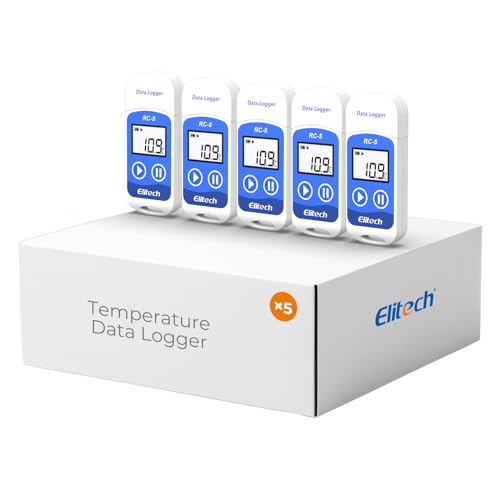
If your budget is tight but you need to monitor temperature across multiple locations, the Elitech RC-5 five-pack offers the best per-unit value. Each logger stores 32,000 data points across a range of -30°C to +70°C, with a replaceable CR2032 battery that lasts up to six months. The built-in USB connector means no cable is needed to download data or generate PDF reports, and the LCD shows temperature, logged points, and alarm status clearly.
Setup involves installing the free Windows software, connecting the logger via USB, setting the logging parameters, then pressing the play button for four seconds to start. Data uploads to the software and can be exported as an .XLS file. The IP65 protection rating allows use in damp environments, and the temperature alarm can be configured to alert on out-of-range conditions. For group projects where each team member needs their own logger, buying this five-pack is more economical than purchasing five individual units.
Quality control is the biggest risk with this pack. Multiple user reports cite defective units—loggers that ignore software commands, fail to communicate, or have an internal thermistor lag of 15-25 minutes to ambient temperature. The software download location has also moved away from what is printed in the manual. For non-critical logging where losing a few data points is acceptable, the RC-5 is a functional entry-level tool. For important lab experiments with strict deadlines, a more reliable single logger is recommended.
Why it’s great
- Extremely low cost per unit for multi-point logging
- 32,000-point memory with PDF report generation
- IP65 rated for use in humid or dusty environments
Good to know
- Inconsistent quality control; defective units reported
- Internal thermistor has slow response (up to 25 min lag)
FAQ
Can I measure voltage with a temperature data logger?
What does IP65 or IP67 mean for a data logger?
Why does my data logger stop recording when I plug it into USB?
Final Thoughts: The Verdict
For most users, the best data loggers for electrical engineering students winner is the Gain Express 4-Channel Thermocouple Logger because it offers four simultaneous input channels, 48,000-record storage, and modern USB-C connectivity at a price that fits a student budget. If you need wireless environmental monitoring for a senior design project, grab the HOBO MX1101. And for tracking a single DC voltage rail over weeks, nothing beats the Lascar EL-USB-3.

Mo Maruf
I created WellFizz to bridge the gap between vague wellness advice and actionable solutions. My mission is simple: to decode the research and give you practical tools you can actually use.
Beyond the data, I am a passionate traveler. I believe that stepping away from the screen to explore new environments is essential for mental clarity and physical vitality.