Our readers keep the lights on and my smoothie glass nicely filled. As an Amazon Associate, I earn from qualifying purchases.
A single low-quality frame at the wrong moment can turn a trivial side-swipe into an insurance nightmare. The difference between a useless motion blur and a plate you can read often comes down to the sensor inside your dash cam and how well it handles the transition from daylight to tunnel. That gap in clarity is what separates a gadget from actual protection.
I’m Mohammad Maruf — the founder and writer behind WellFizz. I’ve spent hundreds of hours analyzing market data, poring over spec sheets, and cross-referencing real-world user reports to isolate the hardware that genuinely delivers when the light drops and the action starts.
Whether you need cabin coverage for a rideshare fleet or simple front-and-rear evidence for the daily commute, picking the right setup means knowing which sensors, resolutions, and parking modes actually matter. This guide breaks down the seven best contenders to help you find the best dash cameras for your specific driving reality.
How To Choose The Best Dash Cameras
The market is flooded with specs that sound impressive on paper but fail in real-world scenarios. A 4K label means nothing if the sensor crushes shadows into black pits at dusk. To cut through the noise, you need to focus on five core areas that define whether a dash cam will actually deliver usable footage when you need it most.
Sensor Generation: STARVIS 1 vs. STARVIS 2 vs. Older CMOS
The image sensor is the heart of the camera. Older CMOS sensors often produce grainy, washed-out footage the moment the sun dips below the horizon. Sony’s STARVIS 2 generation — specifically the IMX678 (8MP) and IMX675 (5MP) — offers dramatically improved sensitivity in near-darkness, reducing motion blur and pulling detail out of shadows. If night driving is a regular part of your routine, prioritize a model with STARVIS 2 on at least the front camera.
Channel Count: Dual vs. Triple Coverage
A standard front-and-rear dual-channel setup covers 90 percent of typical accident scenarios. For rideshare drivers, families with new teen drivers, or anyone who wants full situational awareness, a triple-channel system (front, cabin, rear) adds a view of what happens inside the vehicle — critical for Uber/Lyft disputes or proving distraction wasn’t a factor. The trade-off is higher file volume and the need for a larger memory card.
Parking Mode Realism: Time-Lapse vs. Event Detection vs. Low Bitrate
Not all parking modes are created equal. Time-lapse records 1 frame per second, saving space but missing split-second impacts. Motion detection wakes the camera only when movement occurs, which often misses the first hit. The most reliable setups use a buffered event detection mode that saves 15 seconds before and 30 seconds after a trigger — capturing the full incident. All parking modes require a hardwire kit, sold separately.
Quick Comparison
On smaller screens, swipe sideways to see the full table.
| Model | Category | Best For | Key Spec | Amazon |
|---|---|---|---|---|
| VIOFO A229 Pro 3CH | Premium Triple | Ultimate 3-channel clarity | Front 4K HDR + STARVIS 2 IMX678 | Amazon |
| REDTIGER F17 Elite | Premium Triple | Full-color night vision | Front 4K + 128GB card included | Amazon |
| ROVE R2-4K Dual PRO | Premium Dual | License plate reading at speed | Dual STARVIS 2 IMX678 + IMX675 | Amazon |
| 70mai T800E | Mid-Range Triple | Affordable 3-channel coverage | Front 4K + Wi-Fi 6 + 64GB card | Amazon |
| Vantrue S1 Pro | Mid-Range Dual | Smooth 60fps front recording | Front 1440P@60fps + STARVIS 2 | Amazon |
| Coolcrazy N8 4K | Value Dual | Budget-friendly 4K starter kit | Front 4K@60fps + 128GB card | Amazon |
| FAIMEE 4K+2K | Value Dual | Simple plug-and-play dual cam | Front 4K + 64GB card included | Amazon |
In‑Depth Reviews
1. VIOFO A229 Pro 3CH

The VIOFO A229 Pro 3CH sits at the top of the market because it uses the flagship IMX678 sensor on the front and the IMX675 on the rear, both paired with true HDR processing across all three channels. The front camera captures 4K with a wide dynamic range that preserves plate detail even when headlights or direct sunlight punch into the frame. The cabin camera includes four infrared LEDs for black-and-white recording in total darkness, a critical feature for rideshare drivers who need clear interior evidence at night.
Build quality is industrial-grade: the supercapacitor handles temperature swings from 14°F to 158°F without swelling or degrading, and the included CPL filter snaps onto the front lens to cut windshield reflections. The GPS module supports quad-mode satellite positioning (GPS, GLONASS, Galileo, BeiDou) for precise speed and route overlay. Parking mode offers three options — auto event detection, low bitrate, and time-lapse — all buffered to capture 15 seconds before trigger and 30 seconds after, which is the gold standard for incident capture.
The major gap here is the lack of an included memory card. VIOFO recommends their own industrial-grade microSD cards for reliable continuous recording, and you will want at least 256GB if you plan to run all three channels in parking mode. The app is functional but bare-bones, and the interior camera cable is longer than necessary for most sedans, requiring some creative routing to hide the slack. Despite these small friction points, the A229 Pro 3CH delivers the most consistent, high-detail footage across all lighting conditions of any consumer dash cam tested in this price bracket.
Why it’s great
- True 4K HDR on front, 2K HDR on rear, 1080P on cabin — all three channels benefit from STARVIS 2 sensors.
- Buffered parking mode captures 15 seconds before and 30 seconds after an event trigger.
- Quad-mode GPS module syncs with four satellite systems for accurate speed and route logging.
Good to know
- No memory card is included in the box.
- App requires you to disable CarPlay or VPN during connection, which can be inconvenient.
- Interior camera cable is overly long, making clean cable management more challenging in compact cars.
2. REDTIGER F17 Elite
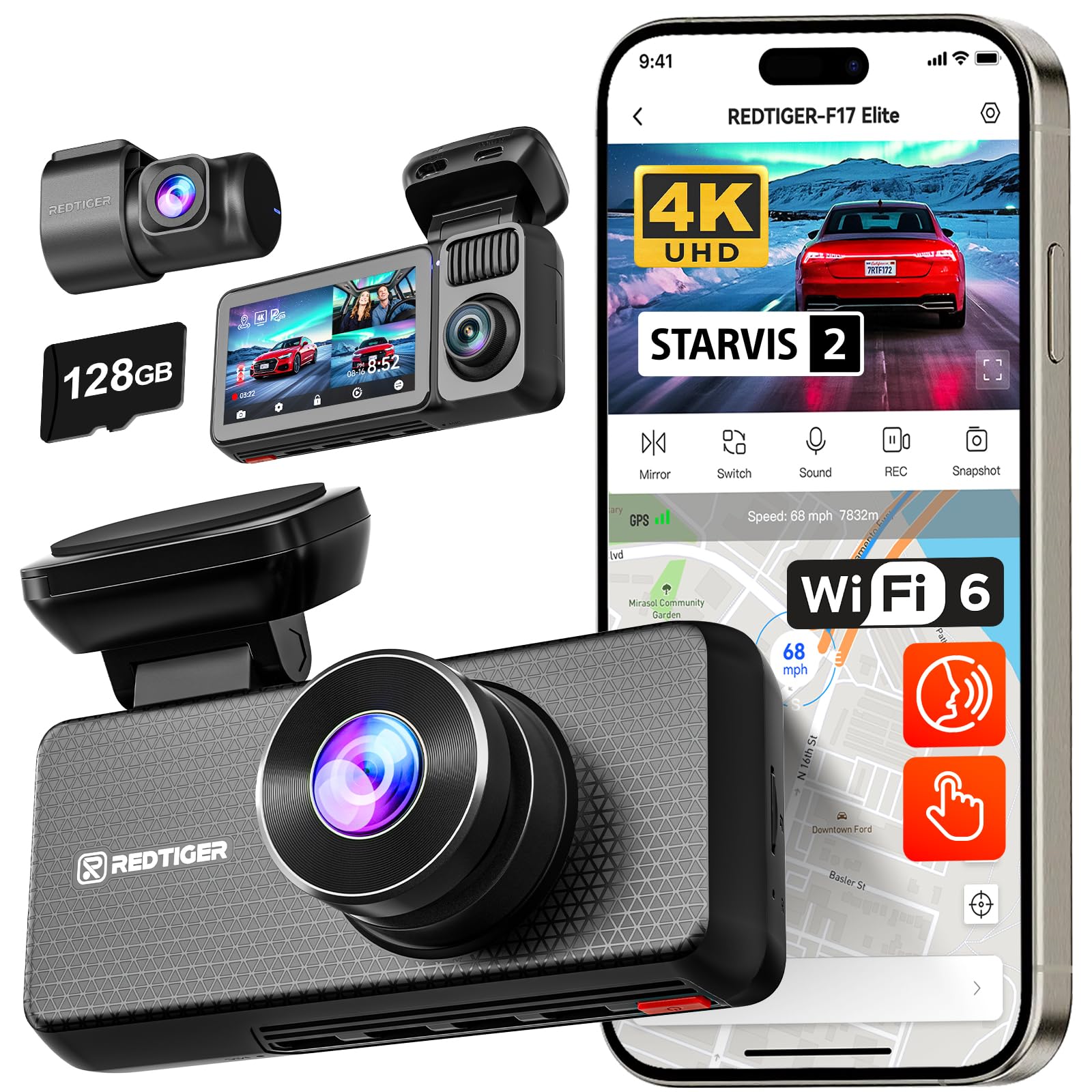
The REDTIGER F17 Elite stands apart from nearly every other triple-channel dash cam because its front and cabin cameras capture full-color footage at night instead of switching to grainy black-and-white infrared. The IMX678 8MP sensor on the front and IMX675 4MP on the rear deliver 4K front, 2.5K rear, and 1080P cabin coverage, and the color night vision works without visible IR glow — a major advantage if you need to identify a face or a license plate color after dark. The touchscreen interface is responsive, and the voice control set handles common commands like locking video or snapping a photo without fumbling for buttons.
Out of the box, this is the most complete package in the premium tier: a 128GB microSD card is pre-installed, the 5.8GHz WiFi 6 module supports download speeds up to 30MB/s, and the supercapacitor ensures stable operation in extreme heat. The GPS module logs speed, route, and coordinates directly onto the video overlay. Parking mode requires a separate hardwire kit, but when connected, the full-color front and cabin cameras continue recording in vivid detail rather than switching to a monochrome time-lapse.
Some early reports note that the adhesive mount (no suction cup option) can struggle with heavily tinted windows, and the screen timeout is capped at three minutes — it will not stay on permanently, which may frustrate users who want constant visual confirmation. File sizes are large due to the high bitrate, so transferring footage over WiFi, while fast, still takes time for lengthy clips. For drivers who prioritize color accuracy in low-light evidence, the F17 Elite is a clear front-runner.
Why it’s great
- Full-color night vision on front and cabin cameras, not black-and-white IR.
- 128GB card pre-installed and ready to record out of the box.
- 5.8GHz WiFi 6 enables 30MB/s download speeds for quick file transfers.
Good to know
- Adhesive mount only — no suction cup option for temporary installation.
- Screen timeout maxes out at three minutes and cannot be set to stay on permanently.
- OBD power source can cause random restarts; a dedicated hardwire kit is recommended for parking mode.
3. ROVE R2-4K Dual PRO
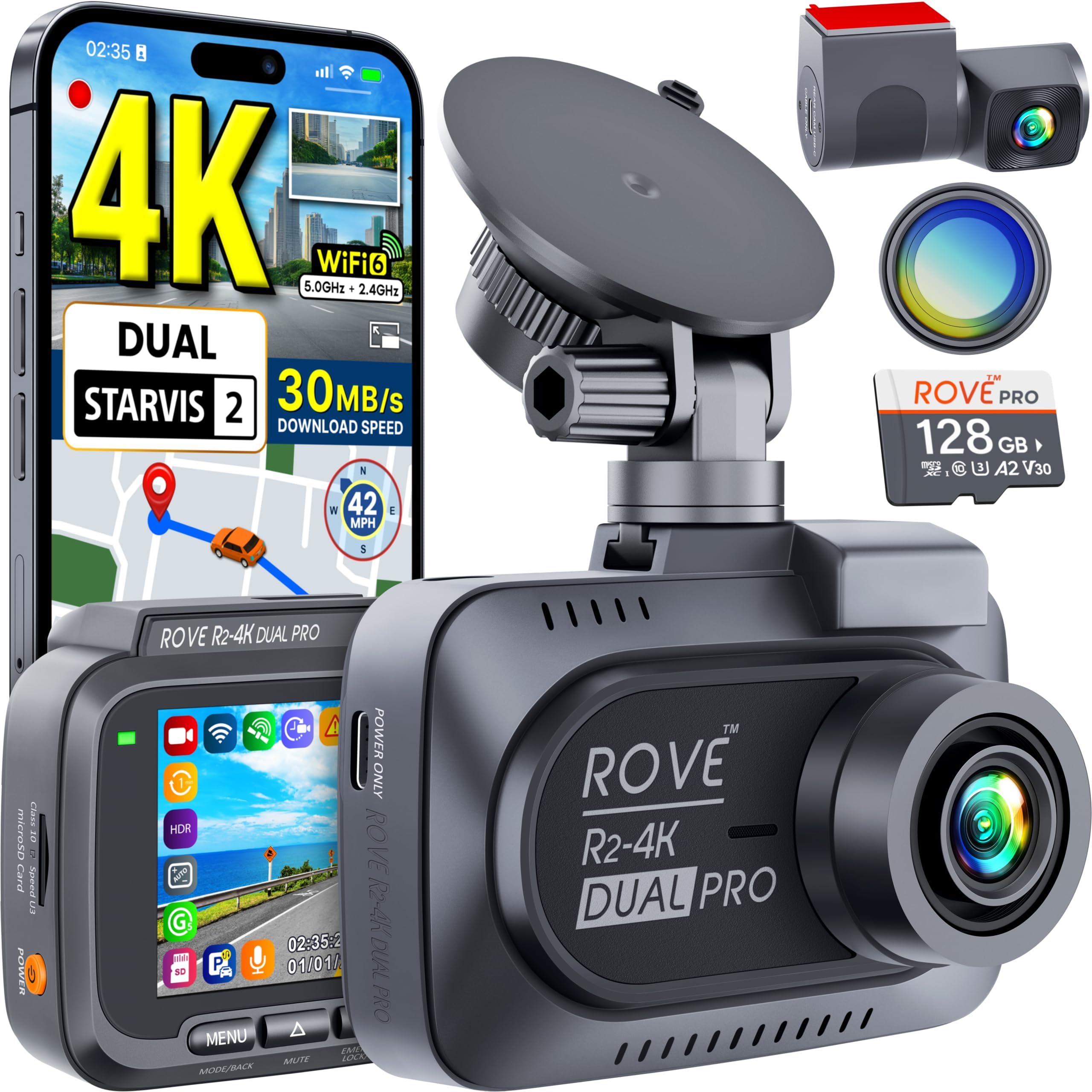
The ROVE R2-4K Dual PRO is the only dual-channel dash cam in this guide that pairs the same flagship IMX678 and IMX675 STARVIS 2 sensors found in triple-channel flagships, but at a lower price point. The front captures 4K at 30fps, and the rear records 2K at 30fps — no resolution sacrifice on the second camera. Combined with F1.7 front and F1.55 rear apertures, the sensor handles rapid light transitions like entering a tunnel or passing under streetlights without washing out or crushing shadow detail.
ROVE packs the box with everything you need: a 128GB ROVE PRO microSD card, a CPL filter that screws onto the front lens to eliminate dashboard reflections, a suction cup mount in addition to the adhesive mount, and a comprehensive installation tool kit. The quad-mode GPS syncs with GPS, BeiDou, Galileo, and GLONASS for fast satellite lock, and the free ROVE Dash Cam GPS Player lets you replay trips with full speed, route, and location overlay on a computer. The dual-band WiFi 6 supports transfer speeds up to 30MB/s, making it practical to pull 4K clips wirelessly.
User reports note that the rear camera can occasionally freeze after long idle periods when using the hardwire kit, requiring a quick reboot to restore functionality — possibly related to voltage dips in extreme cold. Learning the app interface takes a short adjustment period, but once configured, the auto-start and loop recording work reliably. If you want STARVIS 2 performance for both front and rear without paying for a third channel you do not need, the R2-4K Dual PRO is the smartest investment in this segment.
Why it’s great
- Dual STARVIS 2 sensors (IMX678 front, IMX675 rear) deliver top-tier low-light performance on both channels.
- Includes 128GB card, CPL filter, suction mount, and adhesive mount — a true out-of-box solution.
- Quad-mode GPS locks quickly and supports free desktop playback software.
Good to know
- Rear camera may freeze after extended idle periods in cold weather when using hardwire kit.
- App has a learning curve and occasional WiFi connection timeouts during initial pairing.
- Power-off delay can trigger on some vehicle models (e.g., Honda), requiring setting adjustment.
4. 70mai T800E

The 70mai T800E brings triple-channel recording (front 4K, cabin 1080P, rear 1080P) to a mid-range price point without cutting corners on the core sensor. The front camera uses an F1.55 aperture and HDR with 3D noise reduction, which keeps footage clean in low-light conditions even without the STARVIS 2 branding found on pricier models. The interior camera features switchable infrared — you can toggle IR LEDs on or off depending on whether you want discreet cabin recording or full night visibility.
Wi-Fi 6 is included, enabling file transfers up to 10MB/s, and the 70mai app supports live view and OTA firmware updates. The built-in 5-mode GPS tracks location, speed, and route, and voice control responds to commands like “Take photo” and “Lock video” hands-free. A 64GB SD card is included, and the unit supports expansion up to 512GB. The supercapacitor power system handles extreme temperatures from 14°F to 140°F without the battery degradation that plagues lithium-based cameras.
The 3-channel video quality is good but not top-tier: the cabin and rear cameras at 1080P show noticeably less detail than the front, particularly in low light, and the app connection can be unreliable during initial setup. Some users report slow file transfer despite Wi-Fi 6, likely due to app-side bottlenecks rather than hardware limitations. For rideshare drivers or parents who need three angles of coverage without spending premium money, the T800E hits a strong value point.
Why it’s great
- Three-channel coverage (front 4K, cabin 1080P, rear 1080P) at a mid-range price.
- Switchable IR on cabin camera offers flexibility for discreet interior monitoring.
- Wi-Fi 6 and 5-mode GPS provide modern connectivity and accurate location tracking.
Good to know
- 1080P rear and cabin cameras lack the detail of front 4K in low-light conditions.
- App connection can be unreliable during initial setup and file transfer is slower than expected.
- Hardwire kit (UP06 or UP03) required for 24-hour parking mode and sold separately.
5. Vantrue S1 Pro
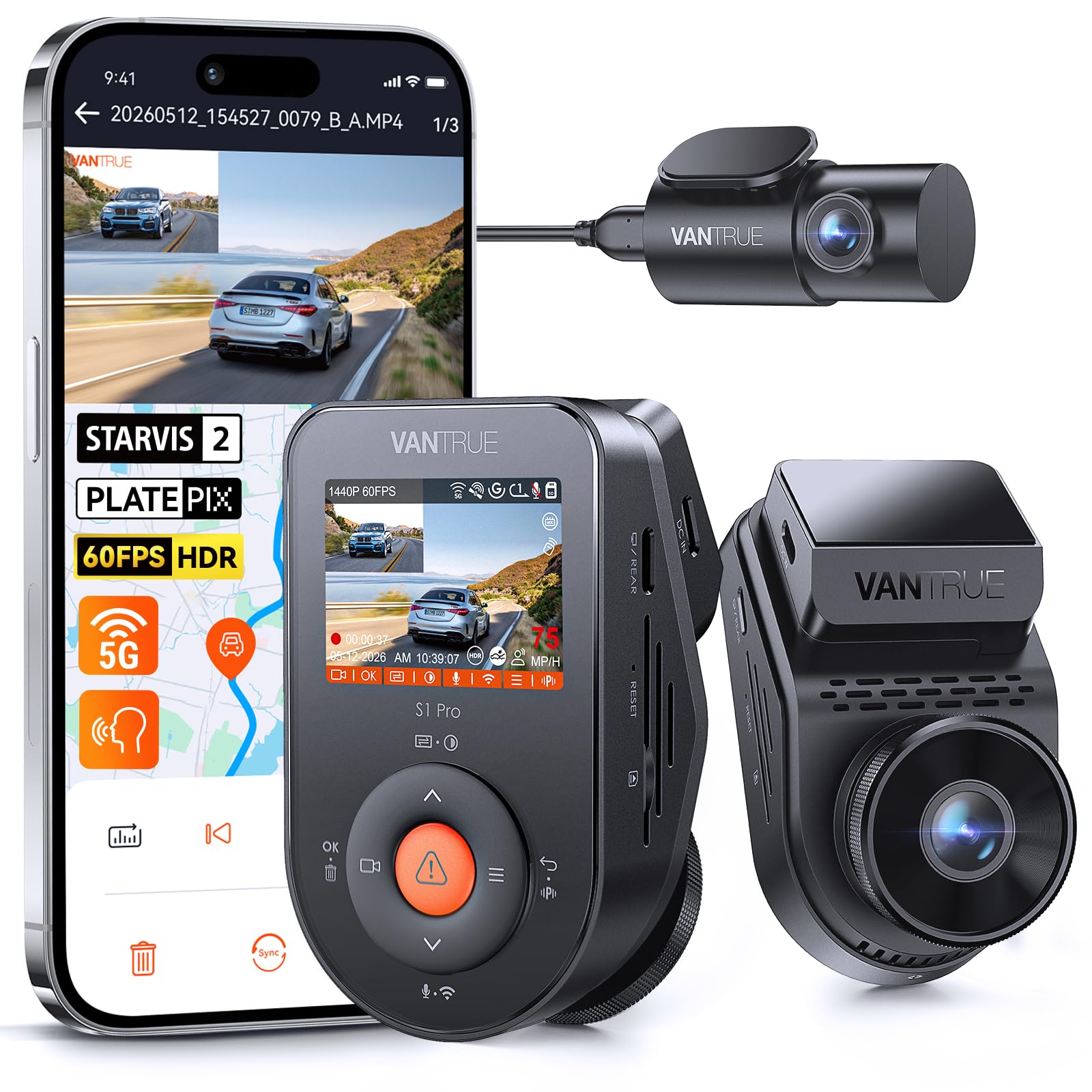
The Vantrue S1 Pro takes a different approach than the 4K-heavy competition: it runs the front camera at 1440P resolution but at 60 frames per second. For drivers who frequently encounter high-speed scenarios — highway merges, passing zones, or rapid lane changes — the doubled frame rate means significantly less motion blur on license plates and signs. The rear camera records at 1080P@30fps, keeping the system balanced without overloading the memory card.
Vantrue’s PlatePix technology combines a STARVIS 2 sensor with dual HDR on both front and rear lenses to dynamically balance exposure across bright and dark areas simultaneously. The result is footage that avoids blown-out headlight halos while still pulling detail from shadowed curbsides. AI safety features include ADAS (forward collision, lane departure warnings) and BSD (blind spot detection), which are unusual in a dual-channel system at this price tier. The GPS module is subscription-free and records route, speed, and location directly onto the video stream.
The menu system uses a button layout that reviewers consistently describe as non-intuitive — the controls do not follow standard navigation logic, so you will need the manual handy for the first few trips. The adhesive mount is secure but lacks a suction cup alternative, making it less ideal for rental cars or frequent vehicle swaps. Parking mode supports four options with buffered pre-recording, and a hardwire kit is available separately. For drivers prioritizing smooth, blur-free front video over raw megapixel count, the S1 Pro delivers where many 4K cameras stumble.
Why it’s great
- 1440P front recording at 60fps reduces motion blur for clear plate captures at highway speeds.
- PlatePix technology with dual HDR balances extreme light contrasts for readable night footage.
- AI ADAS and BSD safety alerts add an extra layer of awareness beyond standard recording.
Good to know
- Button layout for menu navigation is confusing and requires frequent reference to the manual.
- Only adhesive mount included — no suction cup option for temporary or multi-vehicle use.
- Default G-sensor sensitivity is high and may need adjustment for vehicles with stiff suspension.
6. Coolcrazy N8 4K
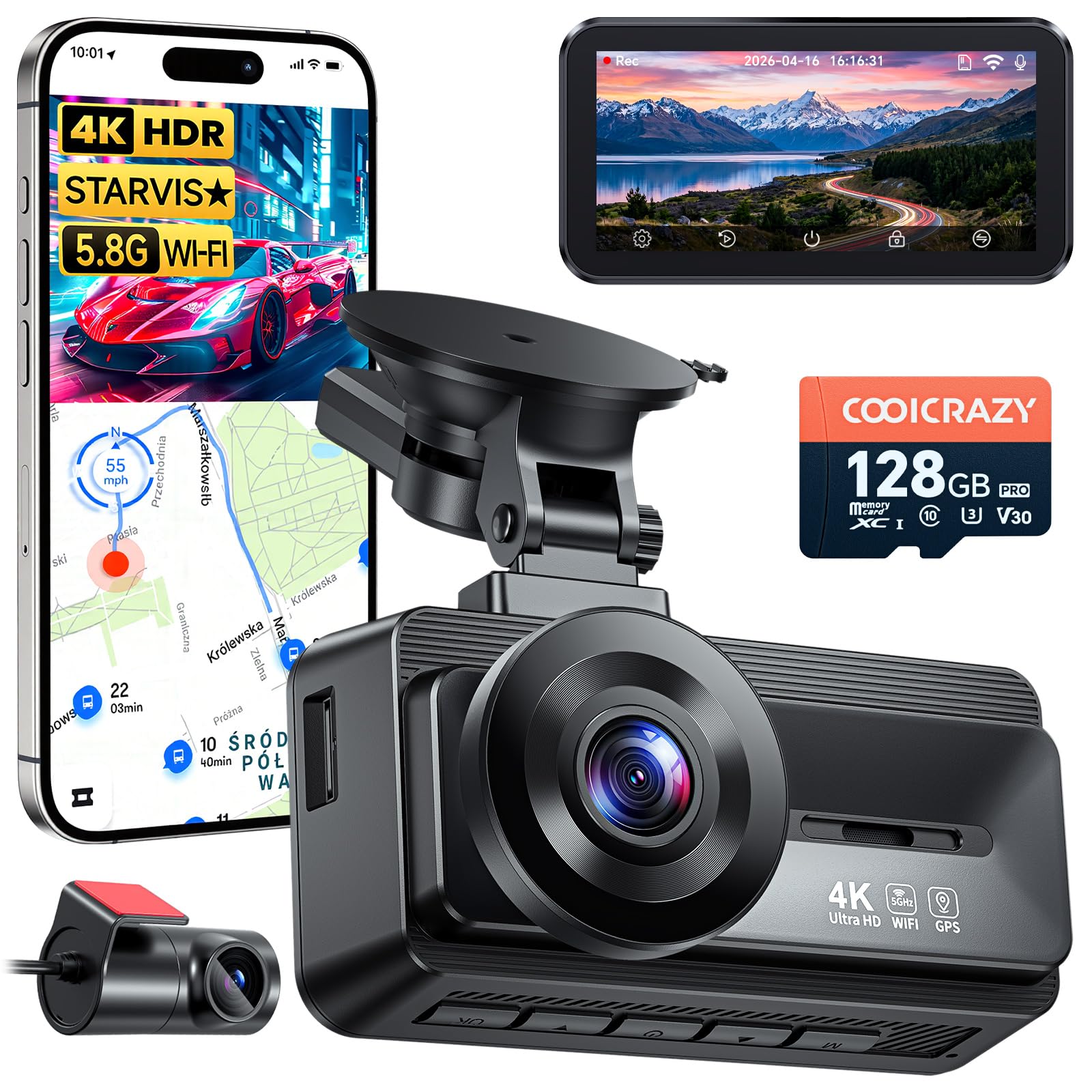
The Coolcrazy N8 4K proves that you do not need to spend premium money to get usable 4K footage. The front camera records at 4K UHD with a 170-degree wide-angle lens, and the rear camera captures 1080P with a 150-degree lens. The STARVIS sensor (first generation, not the newer STARVIS 2) combined with WDR technology cuts glare from oncoming headlights and improves visibility in rain and tunnels. The 60fps frame rate on the front camera helps reduce motion blur, which is rare at this price level.
This dash cam includes a 128GB memory card in the box, so you can start recording immediately. Built-in GPS logs speed and coordinates onto the video, and the 5GHz WiFi connection supports downloads up to 20MB/s — fast enough for quick clip transfers through the mobile app. The 24-hour parking mode uses G-sensor collision detection to lock footage when an impact is detected, and the loop recording automatically overwrites the oldest unprotected files. Installation is straightforward with the included electrostatic stickers and cable clips.
The app connection can be finicky during initial pairing, and several users note that the camera prompts you to reformat the SD card at every startup, which becomes annoying over time. The adhesive for the rear camera mounting has been reported to fail in hot climates on some units. The STARVIS 1 sensor is a clear step behind the STARVIS 2 cameras in extreme low light, but for daytime and well-lit evening driving, the N8 4K delivers sharp, reliable footage that covers the basics without breaking your budget.
Why it’s great
- 4K front recording at 60fps provides smooth, detailed video typically found on more expensive units.
- 128GB memory card is included, saving the cost and hassle of a separate purchase.
- Built-in GPS and 5GHz WiFi add connectivity features rare at this budget tier.
Good to know
- STARVIS 1 sensor is noticeably less capable in very low light compared to STARVIS 2 models.
- Camera prompts SD card reformatting at each startup, which becomes repetitive.
- Rear camera adhesive may fail in hot climates, requiring a replacement mounting solution.
7. FAIMEE 4K+2K
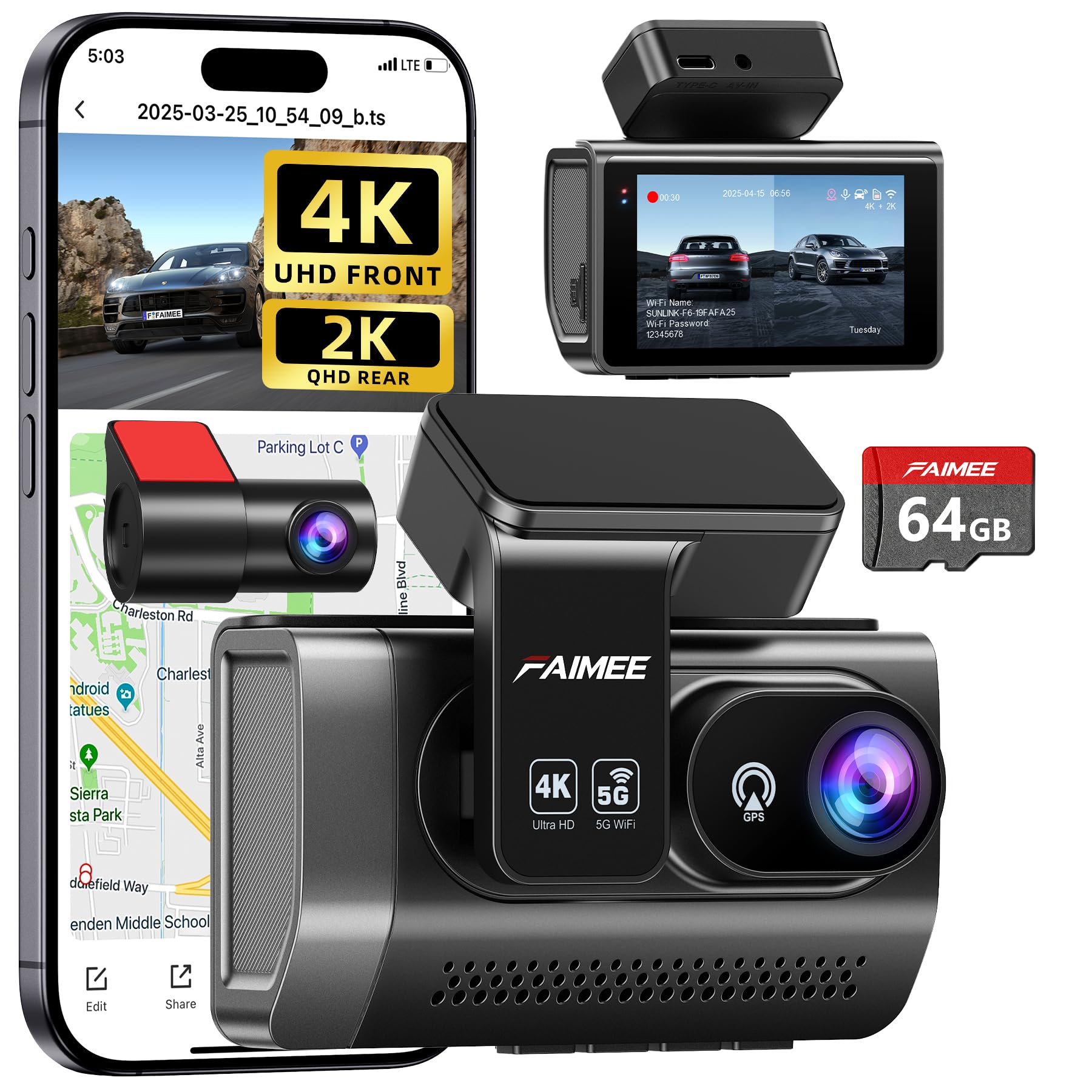
The FAIMEE 4K+2K dash cam is the simplest entry point into dual-channel 4K recording. The front camera captures 4K UHD at 3840x2160P, while the rear records at 2K (2304x1296P), creating a noticeable resolution gap between the two cameras that favors the front view. The F1.8 aperture and WDR assist in balancing exposure across high-contrast scenes, though without STARVIS branding, the low-light performance settles into the average range for this tier. The 170-degree front lens covers up to six lanes of traffic.
Setup is genuinely plug-and-play: mount the adhesive bracket, route the rear camera cable, and plug the included 64GB card into the slot. The dual-band WiFi (5.8GHz/2.4GHz) connects to the FAIMEE app for live view and file downloads, though transfer speeds are moderate. Built-in GPS logs speed, route, and coordinates directly onto the footage. The time-lapse parking mode runs at low frame rate to conserve power, but full 24-hour event detection requires the separately sold hardwire kit.
Video quality from the front camera is solid in good light but struggles with plate detail at night, and the rear camera at 2K still produces softer images than the front. The on-device menu is described as poorly translated and occasionally confusing. Cabin coverage is available via an optional interior camera, but this is a dual-channel system at its core. For first-time buyers who want 4K front recording and basic dual-channel protection without complexity, the FAIMEE offers a clean starting point.
Why it’s great
- Genuine 4K front recording with 2K rear at an accessible price point.
- Dual-band WiFi (5.8GHz/2.4GHz) and built-in GPS provide modern connectivity basics.
- 64GB card included — no need for an immediate accessory purchase.
Good to know
- Low-light performance is average; plate readability drops significantly at night.
- On-device menu translations are poor, making initial configuration frustrating.
- Rear camera cable may be too short for larger vehicles like vans and trucks.
FAQ
Do I really need STARVIS 2 sensors for night driving?
Is a 3-channel dash cam worth it for non-rideshare drivers?
Why does parking mode need a hardwire kit instead of using the car battery directly?
Final Thoughts: The Verdict
For most users, the best dash cameras winner is the VIOFO A229 Pro 3CH because it combines the best sensor hardware (STARVIS 2 across all channels) with true HDR processing, buffered parking mode, and reliable GPS logging in a build quality that handles extreme temperatures without compromise. If you want full-color night vision on both the front and cabin cameras, grab the REDTIGER F17 Elite. And for budget-conscious buyers who still need dual-channel 4K, the Coolcrazy N8 4K delivers solid daytime footage and a complete accessory kit at an entry-level price.

Mo Maruf
I created WellFizz to bridge the gap between vague wellness advice and actionable solutions. My mission is simple: to decode the research and give you practical tools you can actually use.
Beyond the data, I am a passionate traveler. I believe that stepping away from the screen to explore new environments is essential for mental clarity and physical vitality.