Our readers keep the lights on and my smoothie glass nicely filled. As an Amazon Associate, I earn from qualifying purchases.
The monthly subscription trap has crept into nearly every corner of car tech, but your dash cam should never hold your footage hostage for a recurring fee. The entire value of a dash cam — capturing critical evidence the moment you need it — collapses if the camera stops working when you stop paying. That is why this guide focuses exclusively on models that deliver continuous, reliable recording with no monthly commitment attached.
I’m Mohammad Maruf — the founder and writer behind WellFizz. I’ve spent countless hours analyzing technical specifications, real-world customer feedback, and feature sets across dozens of models to identify the dash cams that give you full control over your data without an ongoing bill.
Whether you drive for a rideshare service, manage a fleet, or simply want peace of mind on your daily commute, finding the right dash cam without subscription means understanding which features actually matter and which are just marketing noise.
How To Choose The Best Dash Cam Without Subscription
The no-subscription dash cam market is crowded, but the differences that actually affect your day-to-day use come down to a few core specs. Focusing on these will help you avoid paying for cloud storage you don’t need or features that sound impressive but offer little real-world benefit.
Image Sensor and Night Vision Quality
The sensor is the heart of any dash cam. Sony STARVIS and STARVIS 2 sensors are the gold standard for low-light performance, capturing license plates and road signs in near darkness. Without a strong sensor, even a 4K resolution camera will produce unusable footage at night. Look for models with F1.5 or F1.8 aperture lenses and WDR (Wide Dynamic Range) to handle high-contrast scenes like tunnel exits or oncoming headlights.
Recording Channels and Coverage
Single-channel cameras cover only the front view. Dual-channel systems add a rear camera, which is critical for rear-end collisions and parking protection. Three-channel and four-channel systems add interior cabin views — essential for rideshare drivers, parents monitoring back-seat passengers, or anyone wanting full 360-degree coverage. More channels mean more cables to route and more storage consumed, so match the channel count to your actual need.
Parking Mode Without Subscription
Many dash cams advertise 24/7 parking monitoring, but this feature usually requires a hardwire kit (sold separately) to draw power from your car’s fuse box. The camera itself should have G-sensor triggering and time-lapse recording built in — no cloud subscription required. If a model requires a monthly fee to enable parking alerts or cloud storage, it defeats the purpose of a subscription-free device.
App Connectivity and Local Storage
Wi-Fi and app control let you view, download, and share footage on your phone without removing the SD card. Dual-band Wi-Fi (2.4GHz and 5.8GHz) provides faster transfer speeds. The camera should support at least 256GB of expandable storage via microSD card — and ideally come with a card included. Built-in GPS is a plus, as it embeds speed, route, and location data directly into the video file without any ongoing service cost.
Quick Comparison
On smaller screens, swipe sideways to see the full table.
| Model | Category | Best For | Key Spec | Amazon |
|---|---|---|---|---|
| Vantrue S1 Pro | Premium | Night vision & AI safety alerts | STARVIS 2 sensor, 1440p@60fps | Amazon |
| REDTIGER F7N Pro | Mid-Range | Overall performance & build quality | STARVIS 2 sensor, 4K+1080p | Amazon |
| 70mai T800E | Mid-Range | 3-channel recording with Wi-Fi 6 | 4K front, 1080p interior, 1080p rear | Amazon |
| FAIMEE 4K+2K+2K (B0FPM8XMXR) | Mid-Range | Triple recording & 128GB card included | 4K+2K+2K, 170° front lens | Amazon |
| AZDOME M550 Max | Premium | Triple cams with dual STARVIS sensors | 4K+2.5K+1080p, magnetic mount | Amazon |
| FAIMEE 4K+2K (B0GT4L41VN) | Entry-Level | Budget-friendly dual cam with GPS | 4K+2K dual recording, 64GB card | Amazon |
| Vantrue N5 | Premium | Full 360° four-channel coverage | 2.7K+1080p×3, 4 lenses | Amazon |
In‑Depth Reviews
1. Vantrue S1 Pro
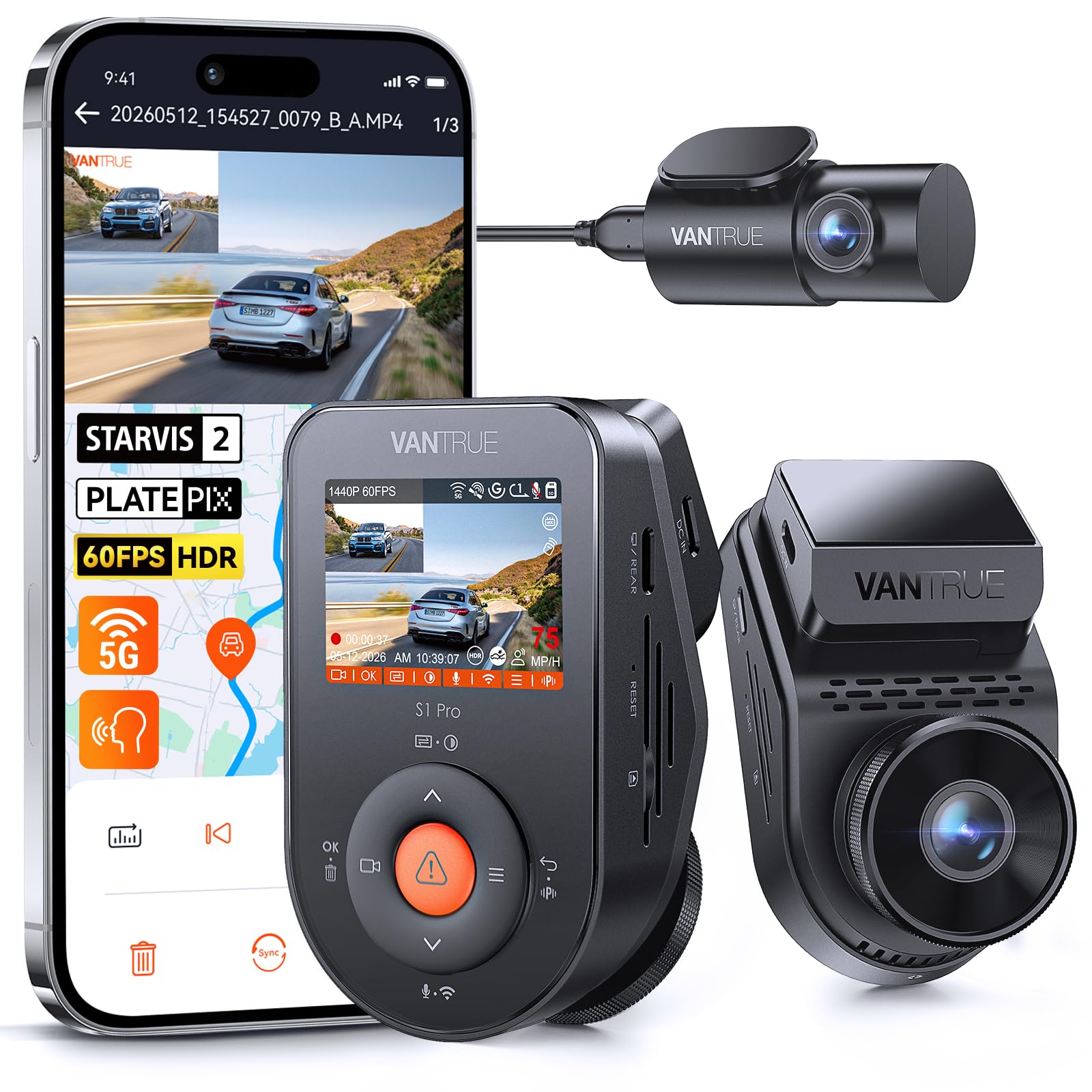
The Vantrue S1 Pro earns the top spot because it combines a premium STARVIS 2 image sensor with 1440p resolution at 60 frames per second — a combination that captures fast-moving license plates and road signs without motion blur. The dual HDR on both front and rear cameras means the footage remains balanced whether you are driving into a sunrise or through a dimly lit parking garage. Vantrue’s PlatePix technology further enhances low-light readability, making this model one of the most capable for nighttime evidence gathering.
Beyond recording quality, the S1 Pro includes AI-powered ADAS (Advanced Driver-Assistance Systems) and BSD (Blind Spot Detection) alerts that work entirely offline — no subscription needed. The built-in 5GHz Wi-Fi connects to the Vantrue app for live preview, playback, and OTA firmware updates. The GPS module logs your speed and route directly into the video file, and the supercapacitor power source ensures reliable operation in extreme temperatures from 14°F to 158°F without the swelling or failure risks of lithium batteries.
Some users note that the menu button layout takes some getting used to, and the G-sensor can feel oversensitive on vehicles with stiff suspension until you adjust the sensitivity. The mount uses 3M adhesive rather than a suction cup, which is more secure but makes transfer between vehicles harder. These minor quirks do not detract from the S1 Pro’s position as the most well-rounded subscription-free dash cam available today.
Why it’s great
- STARVIS 2 sensor delivers exceptional night clarity
- 60fps front recording captures details at high speed
- AI ADAS and BSD alerts work without any monthly fee
- Supercapacitor handles extreme temperatures safely
Good to know
- Button layout requires learning curve for menu navigation
- Adhesive mount not ideal for frequent vehicle swaps
- Only 2K front resolution, not 4K
2. REDTIGER F7N Pro
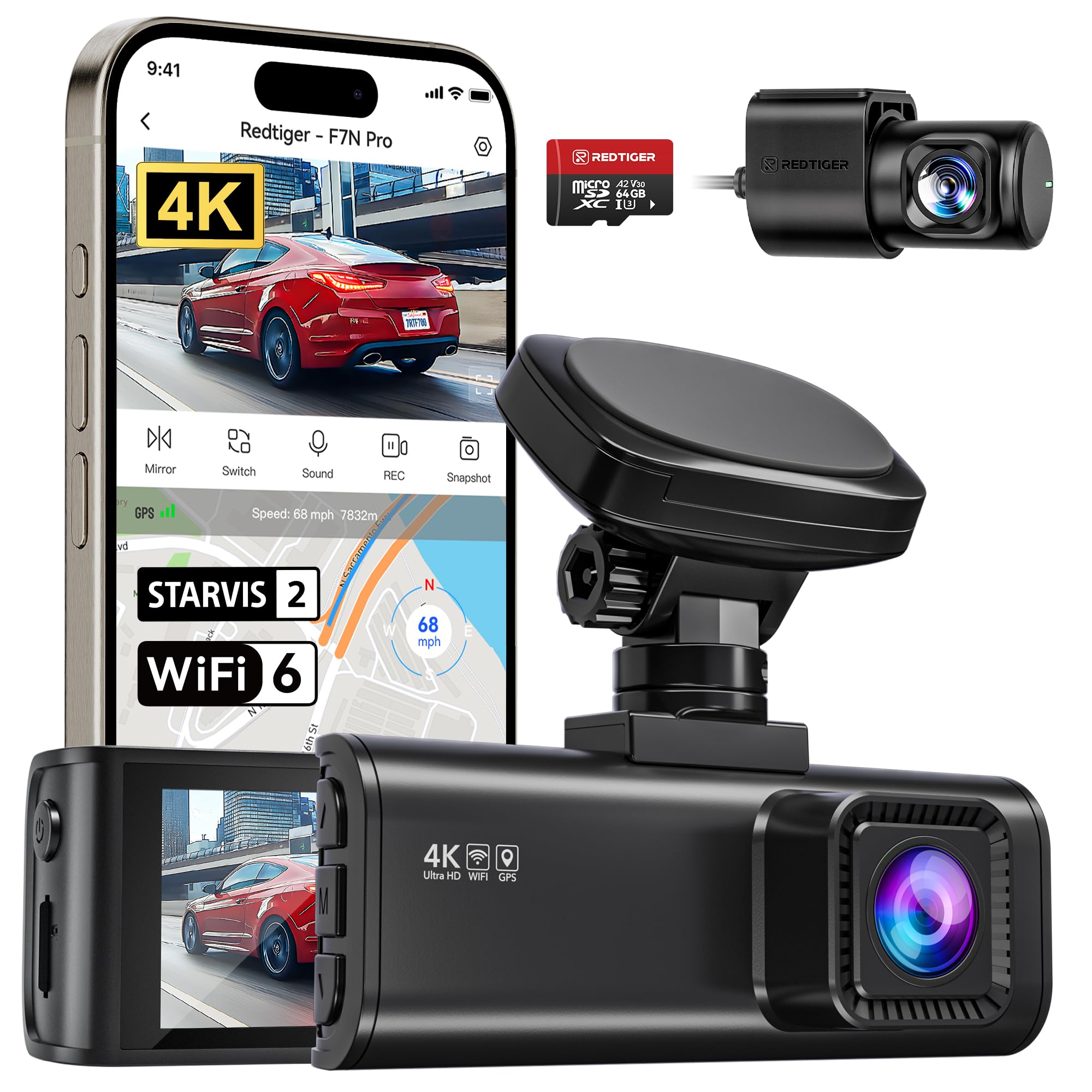
The REDTIGER F7N Pro delivers a strong 4K front and 1080p rear combination with a STARVIS 2 image sensor at a price point that undercuts many competitors. The sensor, paired with an F1.5 front aperture and F1.8 rear aperture and six-layer optical lenses, pulls in enough light to keep footage usable in low-light conditions where entry-level cams typically wash out. The 170-degree front and 140-degree rear angles cover multiple lanes with minimal distortion.
Built-in GPS records your route, speed, and location data directly into the video metadata — no cellular plan or cloud account required. The REDTIGER app provides Wi-Fi connectivity for live preview and file downloads, though some users find the app interface less polished than competitors. The included 64GB memory card gets you started immediately, and the camera supports expansion up to 256GB. Parking mode offers both motion-triggered and time-lapse recording, though you will need to purchase a hardwire kit separately.
Customer reports consistently praise the build quality and the clarity of the 4K front footage, with several users noting the camera still performs reliably after a year of daily use. The main drawback is the 24fps frame rate on the 4K front channel, which means fast-moving objects can show some blur in low-light conditions. The app experience and on-screen menus feel a few years behind the hardware, but for a set-and-forget device, this is rarely an issue.
Why it’s great
- STARVIS 2 sensor with F1.5 aperture for night recording
- 4K front footage provides sharp detail
- Includes 64GB card, supports up to 256GB
- GPS tracking embedded in video without subscription
Good to know
- 24fps frame rate can cause motion blur at night
- App interface feels clunky compared to rivals
- No interior cabin camera option
3. 70mai T800E

The 70mai T800E provides three-channel recording (4K front, 1080p interior, 1080p rear) making it a strong choice for rideshare drivers who need cabin coverage alongside road footage. The interior camera features switchable infrared recording for clear night footage inside the vehicle, and the F1.55 aperture across all lenses helps maintain detail in dim conditions. The ultra-wide angles cover 402 degrees total field of view across the three channels.
Wi-Fi 6 connectivity sets the T800E apart from most competitors — file transfers through the 70mai app reach up to 10 MB/s, roughly five times faster than standard Wi-Fi 4 models. The built-in 5-mode GPS provides accurate location, speed, and route tracking without any subscription. Voice control allows hands-free photo capture, recording start, and footage locking. A 64GB SD card is included, and the camera supports expansion up to 512GB for extended recording.
The supercapacitor power system ensures stable performance in extreme temperatures from 14°F to 140°F, avoiding the overheating and swelling problems common in battery-powered units. Some users report that the app connection can be inconsistent during initial setup, and the 64GB card fills quickly when recording three channels at high bitrate — filling up in under half a day of constant driving. Hardwire kit required for parking mode is sold separately.
Why it’s great
- Three-channel recording covers front, cabin, and rear
- Wi-Fi 6 provides much faster file transfers
- Switchable IR on interior camera for night cabin clarity
- Supercapacitor handles temperature extremes safely
Good to know
- 64GB card fills quickly with three-channel recording
- App connection can be finicky during setup
- Parking mode hardwire kit sold separately
4. FAIMEE 4K+2K+2K Triple Channel (B0FPM8XMXR)
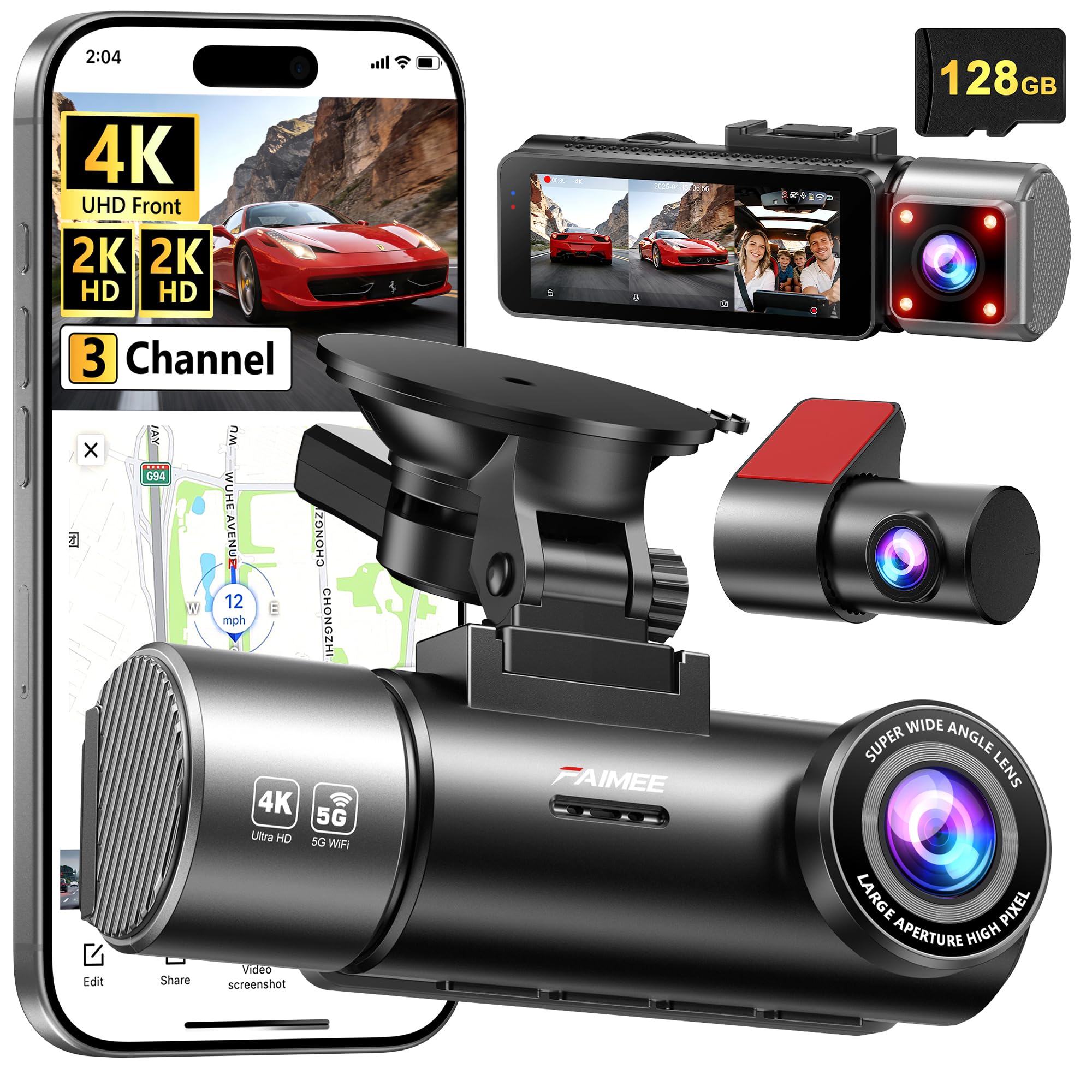
The FAIMEE triple-channel system records 4K UHD at 25fps on the front and 2K resolution on both the interior and rear cameras — a notable upgrade over the common 1080p rear and interior sensors found on many triple-cam models. The 170-degree front lens and 150-degree rear lenses provide wide coverage that minimizes blind spots. The F1.8 aperture and six-layer glass optics, combined with WDR technology, help balance high-contrast scenes effectively.
Unlike many competitors that include a basic 32GB or 64GB card, FAIMEE packs a 128GB high-endurance memory card in the box, giving you nearly double the out-of-box recording time. The dual-band Wi-Fi (5.8GHz/2.4GHz) connects to the FAIMEE app for live viewing, playback, and file downloads. Built-in GPS logs speed, route history, and location coordinates viewable on Google Maps — again, no subscription required. The G-sensor locks footage automatically during collisions, and the parking mode supports time-lapse recording with an optional hardwire kit.
Cable length is adequate for most sedans and SUVs, but some users report the rear camera cable does not reach the tailgate on larger vans and trucks. The on-screen menu and instruction manual could be clearer, and the lithium metal battery component raises questions about long-term durability in hot climates compared to supercapacitor-based units. For the price, the footage quality and included storage make this a compelling mid-range option.
Why it’s great
- Triple 2K rear and interior recording (not 1080p)
- 128GB card included saves immediate upgrade cost
- Dual-band Wi-Fi for faster app connectivity
- GPS tracking embedded without ongoing fees
Good to know
- Rear cable may not reach on large vans or trucks
- On-screen menus and instructions need improvement
- Lithium battery less heat-tolerant than supercapacitor
5. AZDOME M550 Max
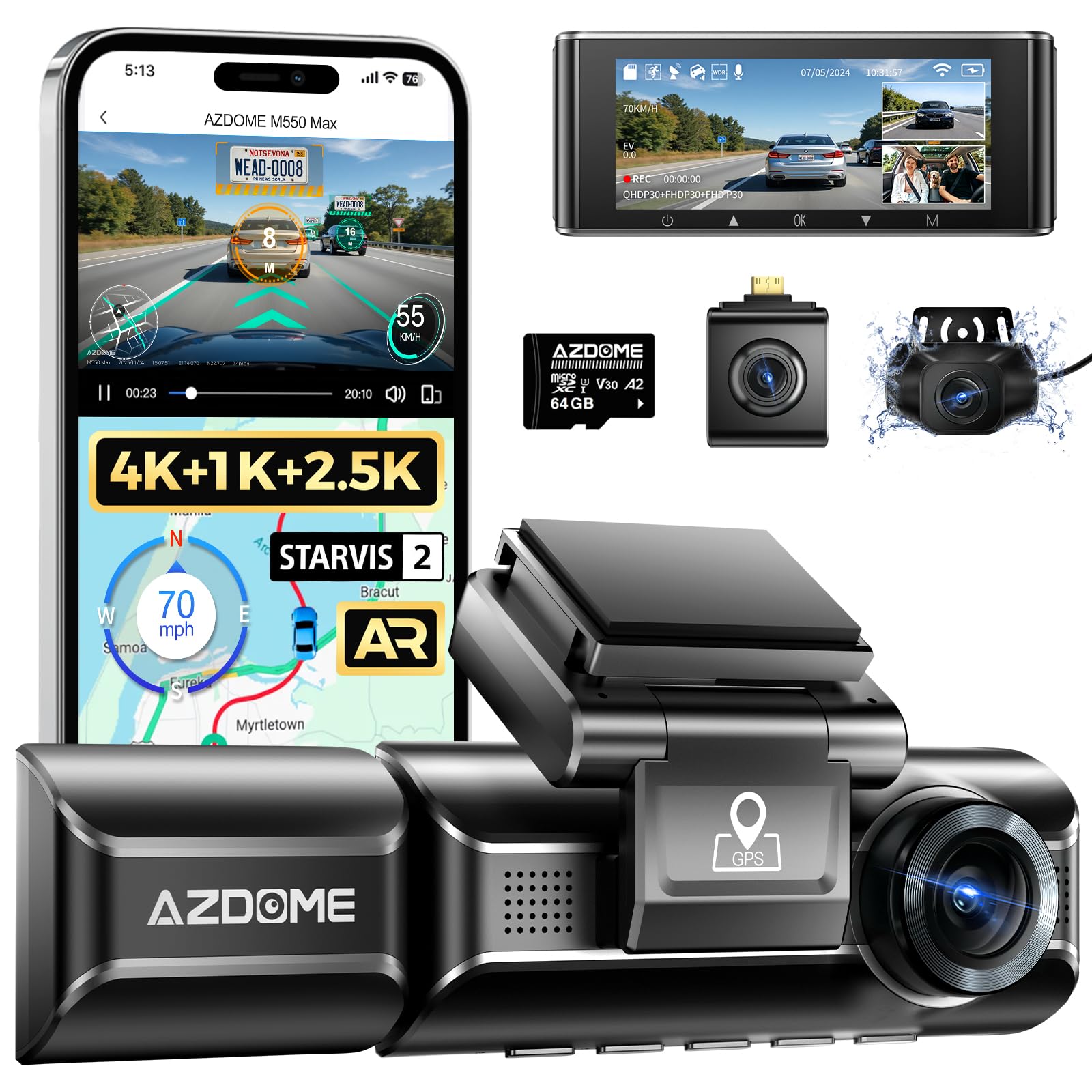
The AZDOME M550 Max differentiates itself with dual STARVIS sensors — one on the front and one on the rear — providing low-light performance that outpaces single-sensor triple-cam systems. The rear camera records at 2.5K resolution, giving you sharper detail on tailgating incidents and rear-end collisions than the standard 1080p found on most three-channel units. The front camera records 4K, while the interior camera captures 1080p with IR night vision for cabin visibility.
A magnetic mount makes removing and reattaching the camera quick and effortless, which is particularly useful if you park in areas where a visible dash cam might attract theft. The AZDOME app includes timeline playback, route map review, and OTA updates. Parking mode supports motion detection, collision-triggered recording, and time-lapse capture. The included 64GB card works out of the box, and the camera supports expansion up to 512GB. A fatigue-driving reminder adds an extra layer of safety for long-distance drivers.
Some users report that the front camera angle can point too high due to steep windshield slopes, requiring a replacement bracket or shim to correct. The app experience, while feature-rich, can occasionally feel buggy with slower-than-expected file transfers. The rear camera is IP68-rated for weather resistance, but the interior camera’s IR lights can create glare on the windshield at night if not positioned carefully. These are minor issues in an otherwise well-specced unit.
Why it’s great
- Dual STARVIS sensors for superior front and rear night vision
- 2.5K rear recording captures more detail than 1080p
- Magnetic mount allows quick removal and reattachment
- IP68-rated rear camera resists dust and water
Good to know
- Front camera angle may need adjustment on steep windshields
- App file transfers can be slower than advertised
- Interior IR lights may cause windshield reflection
6. FAIMEE 4K+2K Dual (B0GT4L41VN)
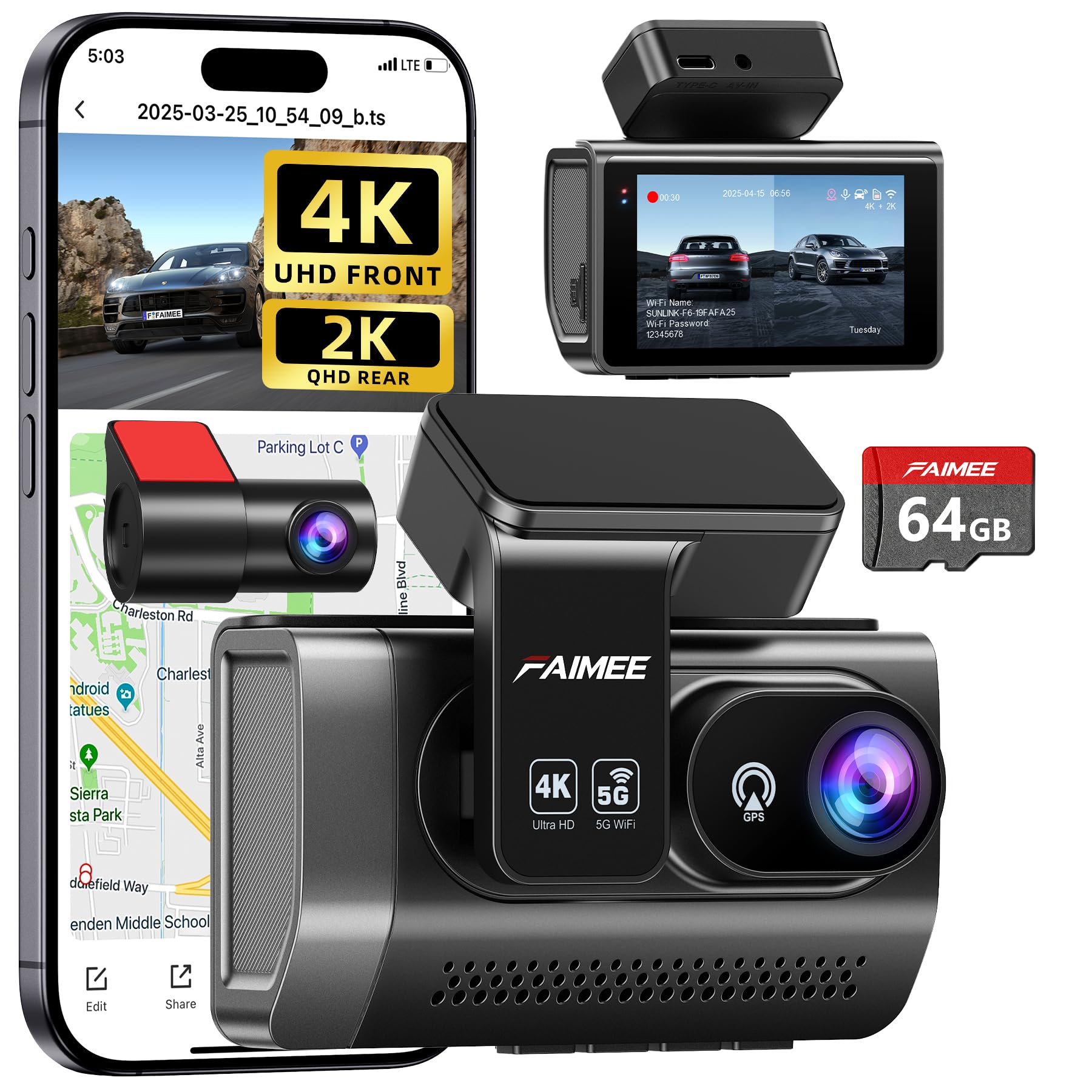
The FAIMEE 4K+2K dual-channel system provides a solid entry point into subscription-free dash cams without cutting too many corners. The front camera records 4K UHD at 3840×2160p, and the rear captures 2K at 2304×1296p — a meaningful step above the 1080p rear resolution common at this tier. The F1.8 aperture with six-layer optics and WDR support produces usable footage in low-light situations, though it does not match the low-light performance of STARVIS-equipped units.
This model includes a 64GB high-endurance memory card out of the box and supports expansion up to 256GB. The dual-band Wi-Fi (5.8GHz/2.4GHz) connects to the FAIMEE app for live preview and file downloads. Built-in GPS logs speed, route, and location data directly into your recordings. Parking mode offers time-lapse recording with G-sensor impact detection, though you will need to purchase a hardwire kit separately for continuous 24-hour monitoring. The compact 3-inch IPS screen sits discreetly behind the rearview mirror.
Setup is straightforward, and most users report reliable recording with auto power-on functionality. The rear camera cable length is adequate for standard passenger vehicles but may not reach the tailgate area on larger vans or trucks. The on-screen menu and printed instructions are less polished than premium competitors. The lithium-ion battery cell raises heat concerns in very hot climates, though most users do not encounter issues in normal driving conditions.
Why it’s great
- 4K front and 2K rear recording at an entry-level price
- 64GB card included, supports up to 256GB
- Dual-band Wi-Fi for reliable app connectivity
- Built-in GPS without subscription or data plan
Good to know
- No STARVIS sensor — night performance is adequate but not exceptional
- Rear cable may be too short for large vehicles
- Lithium battery less heat-tolerant than supercapacitor models
7. Vantrue N5 4 Channel

The Vantrue N5 is the only model in this guide that uses four separate cameras to deliver true 360-degree coverage — front, rear, front cabin, and rear cabin. The front camera records at 2.7K (1944p), while the three other cameras each capture 1080p. The rear cabin camera is unique to this model, covering the trunk area, back seat, and side windows — areas completely invisible to traditional dual or triple-cam setups. STARVIS 2 technology on the front sensor, combined with IR night vision on both cabin cameras, ensures usable footage in complete darkness.
All four channels operate without any subscription or cloud service. The 5GHz Wi-Fi provides fast file transfers to the Vantrue app, and the dual-system GPS module logs location and speed with high accuracy. Voice control supports multiple languages including English, Russian, Chinese, French, and Japanese. The 24-hour buffered parking mode captures the 15 seconds before a trigger event, ensuring you see the full context of any impact or motion. Magnetic mounts on the main unit and rear cameras make removal straightforward.
The N5 is expensive and does not include an SD card in the box — you will need to purchase a high-endurance card separately, and 512GB is the maximum supported capacity. Some users report that the double-sided tape mounts can fail on textured surfaces, and the adhesive pads for the rear cameras may not hold indefinitely. A few customers have experienced reliability issues with parking mode and customer service responsiveness. For drivers who demand absolute coverage — rideshare operators, commercial fleets, or parents wanting to monitor back-seat activity — the N5 offers capability no other subscription-free dash cam matches.
Why it’s great
- Four-channel 360° coverage with no blind spots
- Rear cabin camera monitors trunk and back seat areas
- STARVIS 2 front sensor with IR cabin night vision
- Buffered parking mode captures 15 seconds before impact
Good to know
- No memory card included despite premium price
- Adhesive mounts may fail on textured or hot surfaces
- Some users report reliability and support issues
- Expensive compared to triple-channel alternatives
FAQ
Do I really need a dash cam without subscription, or is cloud storage useful?
How much storage do I need for a dual or triple-channel dash cam?
Can I use parking mode without hardwiring the dash cam?
What is the difference between supercapacitor and lithium battery dash cams?
Final Thoughts: The Verdict
For most users, the dash cam without subscription winner is the Vantrue S1 Pro because it combines a STARVIS 2 sensor with 60fps front recording, AI safety alerts, and a supercapacitor power source — all without any recurring fee. If you want three-channel coverage with the fastest Wi-Fi transfers for a rideshare or family vehicle, grab the 70mai T800E. And for absolute 360-degree protection with four separate cameras, nothing beats the Vantrue N5.

Mo Maruf
I created WellFizz to bridge the gap between vague wellness advice and actionable solutions. My mission is simple: to decode the research and give you practical tools you can actually use.
Beyond the data, I am a passionate traveler. I believe that stepping away from the screen to explore new environments is essential for mental clarity and physical vitality.