Our readers keep the lights on and my smoothie glass nicely filled. As an Amazon Associate, I earn from qualifying purchases.
Whether you are defending yourself against a false insurance claim, tracking your daily commute routes, or trying to log the exact moment a speed limit changes, a dash cam that simultaneously records GPS location and vehicle speed is your only reliable witness. The challenge is that not all GPS modules log data the same way—some embed coordinates only in the file metadata, while others overlay the actual speed reading directly onto the video frame, creating a timestamped record that can make or break your case. Choosing the wrong unit means you get grainy footage with a generic satellite lock—not the hard evidence you actually need.
I’m Mohammad Maruf — the founder and writer behind WellFizz. I’ve spent hundreds of hours analyzing dash cam hardware, from lens aperture values and STARVIS sensor generations to GPS chipset accuracy and real-world speed overlay behavior across dozens of models.
This guide breaks down the key specs that separate a usable GPS speed log from a decorative gadget, so you can confidently select the best dash cam with gps and speed recording that actually matches your driving conditions and insurance needs.
How To Choose The Best Dash Cam With GPS And Speed Recording
GPS integration goes far beyond knowing where you drove. The way a dash cam handles speed data—whether it burns the number into the video, updates at 1Hz or 10Hz, and how it handles GPS signal loss in tunnels—determines whether that footage becomes a verifyable record or a frustrating blank. These are the factors that matter.
GPS Overlay vs Metadata-Only
Some dash cams embed speed and coordinate data into the video file’s metadata, meaning you can only see that info by playing the file through a proprietary desktop player. Others burn the speed, route, and timestamp directly into the visible video frame. For insurance claims and police reports, the overlay method is significantly stronger because the data cannot be separated from the footage by casual viewing. Always check whether the camera you are considering displays speed data on the video itself, or requires special software to extract it.
Sensor Generation and Light Handling
The best GPS speed log in the world is useless if your footage is too dark to read a license plate. Sony STARVIS sensors (Generation 2 specifically) dramatically improve low-light sensitivity and reduce motion blur—both critical when you are trying to verify whether a car was traveling 35 or 55 MPH at night. A dash cam with an older sensor and a GPS module is still better than no dash cam, but a STARVIS 2 unit gives you readable plates at 20 MPH in dim urban light, which is where most disputes happen.
Parking Mode and Buffered Recording
If you park on the street, a parking mode that records 15 seconds before and 30 seconds after an impact (buffered motion detection) is far more useful than one that simply starts recording when the car shakes. That buffer is often the difference between catching the license plate of the car that hit you and watching an empty frame of the aftermath. Not all dash cams with GPS and speed recording support this feature—check the fine print under “parking mode” and see whether it requires a hardwire kit (sold separately) to function.
Quick Comparison
On smaller screens, swipe sideways to see the full table.
| Model | Category | Best For | Key Spec | Amazon |
|---|---|---|---|---|
| REDTIGER F17 Elite | Premium 3CH | Full-Color Night with Speed Overlay | 4K/2.5K/1080P, STARVIS 2, 128GB card | Amazon |
| ROVE R2-4K Dual PRO | Premium Dual | STARVIS 2 Dual Sensors | 4K+2K, IMX678+IMX675, 128GB | Amazon |
| Vantrue N5S 4CH | Pro 360° | Full Vehicle Coverage | 2.7K+1080P*2+1440P, 1TB support | Amazon |
| Vantrue E2 Dual | Mid-Range | 2.7K Dual SHarpness | 2.7K+2.7K, STARVIS, voice control | Amazon |
| 70mai T800E | Mid-Range 3CH | Ridesh Coverage | 4K/1080P/1080P, Wi-Fi 6, 64GB | Amazon |
| AZDOME M550 Max | Mid-Range 3CH | Functional Triple Coverage | 4K+2.5K+1080P, magnetic mount | Amazon |
| FAIMEE 4K+2K Dual | Budget Dual | Entry-Level GPS Logging | 4K+2K, 170° wide, 64GB | Amazon |
In‑Depth Reviews
1. REDTIGER F17 Elite
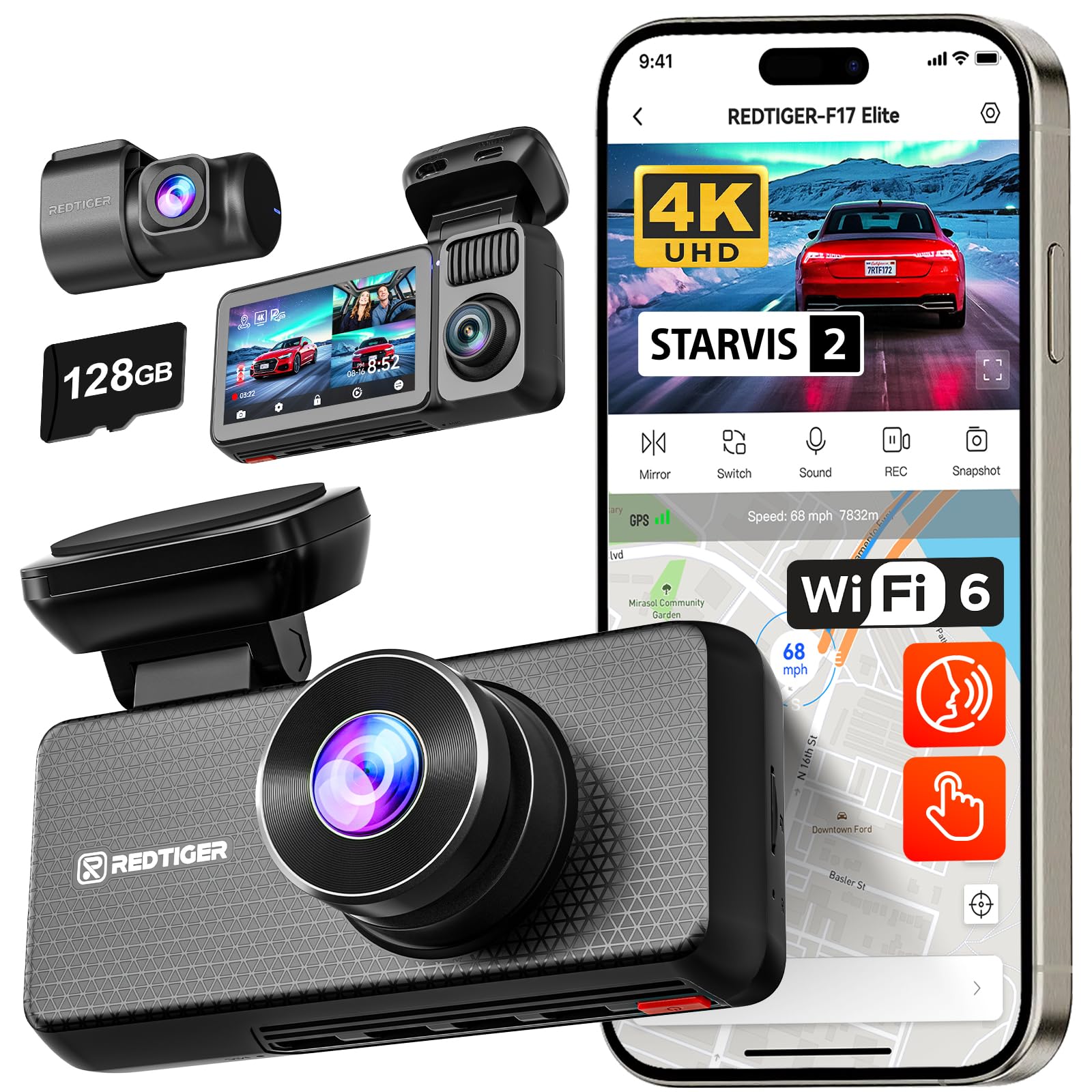
The REDTIGER F17 Elite occupies the premium sweet spot by delivering true 4K front, 2.5K rear, and 1080P cabin recording through dual STARVIS 2 sensors (IMX678 front, IMX675 rear), and it burns your GPS speed directly into the video overlay. Unlike standard dash cams that show a monochrome IR image at night, the F17 Elite records in full color for both the front and interior cameras—so you can identify faces and license plates in dim parking lots without guesswork. The built-in GPS module logs route, location, and speed, and you can review everything through the REDTIGER Cam app with support for 5.8GHz WiFi 6 that pushes download speeds up to 30 MB/s.
Voice commands and a full touchscreen make daily operation far less fiddly than button-based menus, and the included 128GB card means you can start recording immediately without a separate purchase. Parking mode supports time-lapse and G-sensor event detection, though activating 24/7 coverage does require a separate hardwire kit. The super capacitor construction also eliminates battery swelling risks in extreme summer heat, which is a common failure point in cheaper lithium-ion units.
Customer feedback consistently praises the color night vision and the clarity of the three-channel recording, though a few users note that the adhesive mount is permanent (no suction cup option) and the app connection can be finicky during initial pairing. The voice command system works reliably but requires exact phrasing. For anyone who needs verifiable speed data and nighttime color evidence, this is the strongest option on the list.
Why it’s great
- Full-color night vision front and cabin eliminates black-and-white guesswork in low light.
- True 4K/2.5K/1080P three-channel recording with STARVIS 2 sensors for sharp plates at speed.
- GPS speed overlay embedded directly into video for verifiable evidence without special software.
Good to know
- Adhesive mount is semi-permanent—moving the camera to another vehicle requires a new mount.
- Parking mode hardwire kit is not included and must be purchased separately for 24/7 buffered recording.
2. ROVE R2-4K Dual PRO
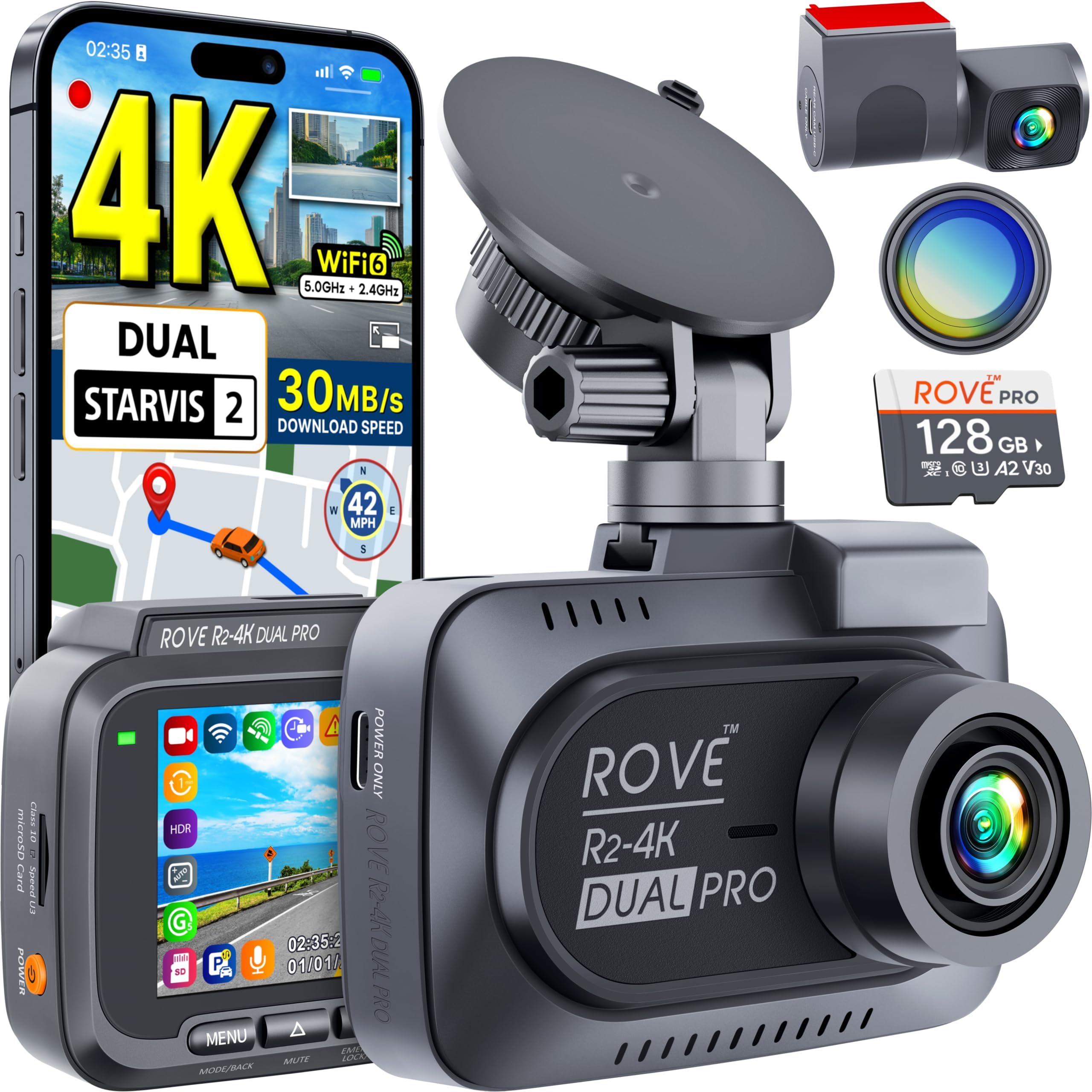
The ROVE R2-4K Dual PRO is built for drivers who want the highest possible sensor pedigree and the fastest wireless transfer speeds. It uses Sony STARVIS 2 sensors on both the front (IMX678 8MP) and rear (IMX675 5MP), delivering 4K front and 2K rear video with HDR and wide F1.7 and F1.55 apertures. The Quad-Mode GPS locks onto GPS, BEIDOU, GALILEO, and GLONASS simultaneously, which drastically improves acquisition time and maintains speed tracking consistency even in urban canyons or under heavy tree cover. The speed overlay is visible directly on the 3-inch IPS display and is embedded into the video file for desktop GPS player playback.
Wireless connectivity uses dual-band WiFi 6 (5GHz and 2.4GHz), and the ROVE app supports downloads at up to 30 MB/s—dramatically faster than older 2.4GHz-only WiFi dash cams. The package includes a 128GB ROVE PRO microSD card and a CPL filter to cut windshield glare, which saves you about in accessories compared to buying separately. Parking mode offers three options: 1FPS time-lapse, motion detection, and collision-triggered recording, with voice alerts the next time you start your vehicle.
User feedback is overwhelmingly positive regarding video clarity and build quality, though some owners mention that the app takes a few sessions to learn, and the rear camera in the hardwire configuration can freeze after multiple idle days in cold weather, requiring a full reboot. The included suction mount is a rare convenience at this price tier, making it easy to transfer between vehicles without buying extra mounts.
Why it’s great
- Dual STARVIS 2 sensors (IMX678 + IMX675) deliver exceptional low-light detail and speed readability.
- Quad-Mode GPS ensures faster satellite lock and more consistent speed tracking in challenging environments.
- 128GB card and CPL filter included means no hidden accessory costs after purchase.
Good to know
- Rear camera may freeze after extended idle periods when connected to hardwire kit—requires manual reboot.
- App interface has a learning curve; initial WiFi connection can be unintuitive for first-time users.
3. Vantrue N5S 4 Channel
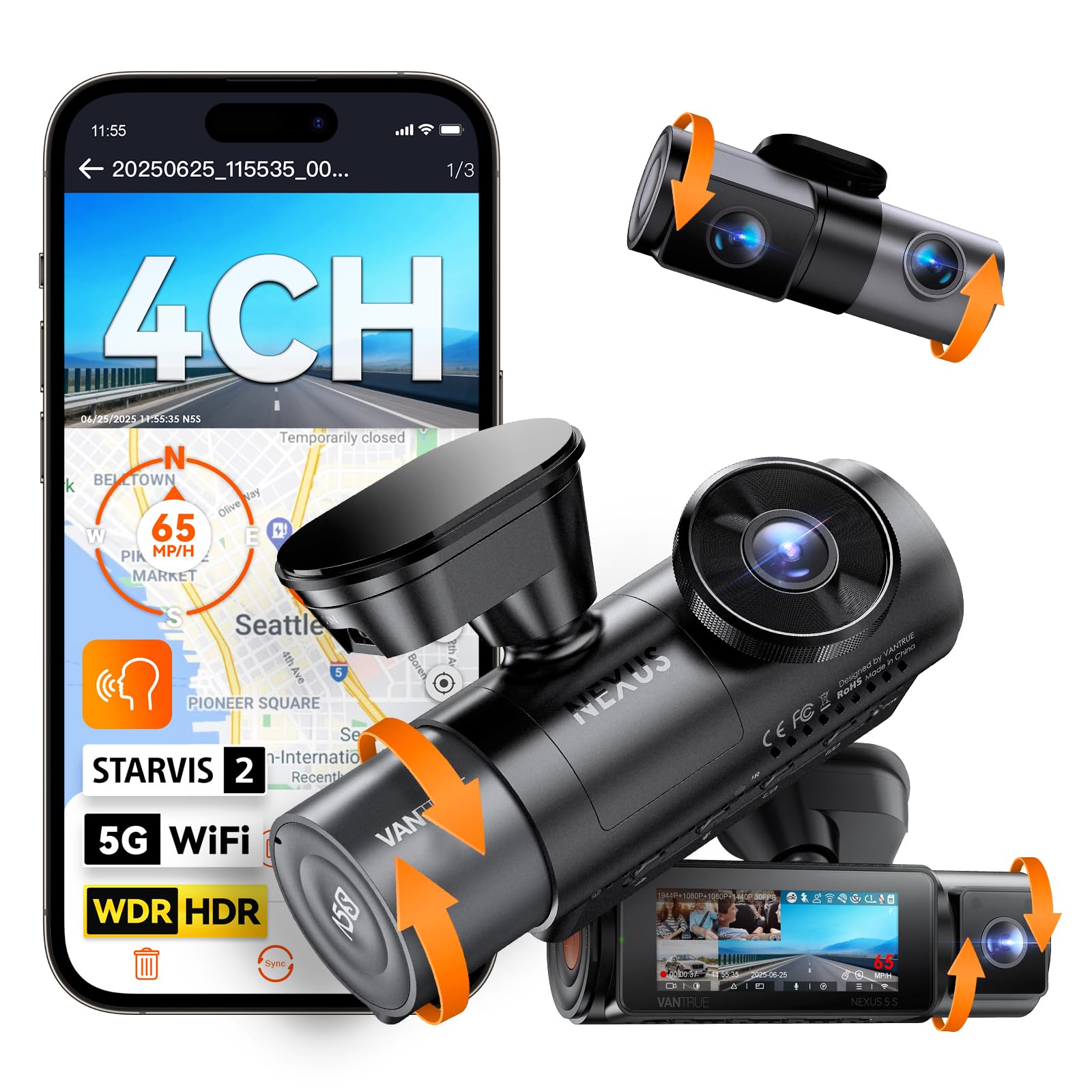
The Vantrue N5S is the only model on this list with a true four-channel configuration—front (2.7K), rear cabin (1080P), rear exterior (1440P), and a second cabin camera that covers blind spots like the back seat and trunk area. Every channel uses Sony STARVIS 2 sensors, which means the GPS speed and location data is paired with the highest low-light capture capability available in a consumer dash cam. The dual-system GPS (GPS + GLONASS) provides redundant satellite positioning that remains accurate even if one constellation is weak, and the speed overlay is visible in real time on the LCD screen and embedded in the video metadata.
The N5S supports buffered parking mode with 10-second pre-recording, so you don’t miss the moment before an impact—a critical feature when you need to prove whether a car was stationary or moving when hit. Storage supports up to 1TB (using a U3/A2 microSD card), which is essential because four channels chew through capacity quickly. The hardwire kit is sold separately, but once installed, the buffered motion detection and G-sensor collision detection cover all four cameras simultaneously.
Customer reviews highlight the exceptional video quality and the completeness of the 360-degree coverage, though the 5GHz WiFi connection has been reported as unreliable on both iOS and Android, and some units have shipped with a non-functional rear cabin camera. The menu system is dense and can feel overwhelming during initial setup. For ride-share drivers, parents, or fleet operators who need indisputable speed data and interior visibility, this is the most complete hardware package available.
Why it’s great
- Four separate STARVIS 2 channels eliminate all vehicle blind spots and record speed data across every angle.
- Dual-system GPS (GPS + GLONASS) maintains satellite lock in urban environments where single-system units drop out.
- Buffered 10-second pre-recording parking mode captures the event leading up to an impact, not just the aftermath.
Good to know
- WiFi connectivity is inconsistent on both Android and iOS, making wireless file transfers unreliable.
- Four-channel recording consumes storage rapidly—invest in a high-endurance U3/A2 card with at least 256GB.
4. Vantrue E2 Dual

The Vantrue E2 is a dual-channel system that records both front and rear at 2.7K resolution—a rarity in the mid-range space where rear cameras often drop to 1080P. Both lenses use STARVIS sensors (Generation 1) with 160-degree fields of view, and the GPS module is integrated into the adhesive mount, keeping the main unit compact. GPS speed and coordinates are embedded into the video file and viewable in the Vantrue GPS player on a computer, plus they appear on the 2.45-inch IPS screen during playback. The 5GHz WiFi module allows faster downloads than older 2.4GHz units.
Voice control supports English, Japanese, Russian, and Chinese, which is useful for hands-free operation. Parking mode offers four options: buffered motion detection, low-bitrate continuous recording, low framerate (1/5/10/15fps), and standard collision detection. The included wireless remote button makes emergency saves easier than fumbling with the camera body. The rear camera cable is 20 feet, long enough for most SUVs and trucks without needing an extension.
Owner feedback is generally positive regarding day and night video clarity, with particularly strong low-light performance for a non-STARVIS 2 sensor. The most consistent complaints involve the unit arbitrarily stopping recording (suspected software bug) and the Apple CarPlay wireless interference affecting app connectivity. The parking mode can also drain the car battery if hardwired incorrectly, so professional installation is recommended. This is a solid mid-range choice for drivers who want dual 2.7K recording and GPS logging without the premium cost.
Why it’s great
- Both front and rear cameras record at 2.7K resolution, providing sharper rear-end evidence than 1080P.
- Voice control and wireless remote button enable hands-free emergency video locking while driving.
- GPS speed overlay is viewable both on screen and in desktop software for insurance and legal review.
Good to know
- Units have been reported to stop recording arbitrarily—a potential software reliability issue.
- Wireless Apple CarPlay can interfere with the Vantrue app’s WiFi connection, complicating file transfers.
5. 70mai T800E

The 70mai T800E is a three-channel dash cam (4K front, 1080P interior, 1080P rear) that uses Sony STARVIS 2 sensors and an F1.55 aperture to maintain strong low-light performance at a significantly lower price than the premium options. The built-in GPS supports five different location modes, logging speed, route, and position data that can be reviewed through the 70mai app or exported for analysis. The speed overlay is visible on the video itself, and the GPS module locks quickly after startup.
WiFi 6 connectivity gives it a real advantage over budget competitors—file transfers hit 10 MB/s, which is roughly five times faster than a standard WiFi 4 dash cam. Voice control supports hands-free photo capture, video lock, and recording start. The interior camera features switchable infrared, letting you toggle night vision for the cabin on or off depending on your privacy needs. Parking mode supports motion and collision detection, but like most units, a hardwire kit is required for 24-hour continuous monitoring. A 64GB SD card is included, but heavy users will want to upgrade to a 256GB or 512GB card.
Reviewers highlight the excellent build quality and video clarity for the price, especially for rideshare drivers who need clear cabin footage. Some users report that the app connection can be unreliable during initial pairing and that the included SD card fills up quickly when recording three channels simultaneously. The super capacitor design handles temperature extremes better than battery-powered rivals, and the 18-month warranty adds reassurance for long-term use.
Why it’s great
- Three-channel recording with STARVIS 2 sensors and GPS speed overlay at a mid-range price point.
- WiFi 6 provides dramatically faster file downloads than standard 2.4GHz dash cams when you need quick evidence offload.
- Switchable IR cabin camera allows both daytime color and nighttime black-and-white interior recording.
Good to know
- The app connection can be finicky during initial pairing, requiring multiple retry attempts.
- 64GB card fills quickly with three-channel 4K recording; upgrading to at least 256GB is recommended for daily drivers.
6. AZDOME M550 Max
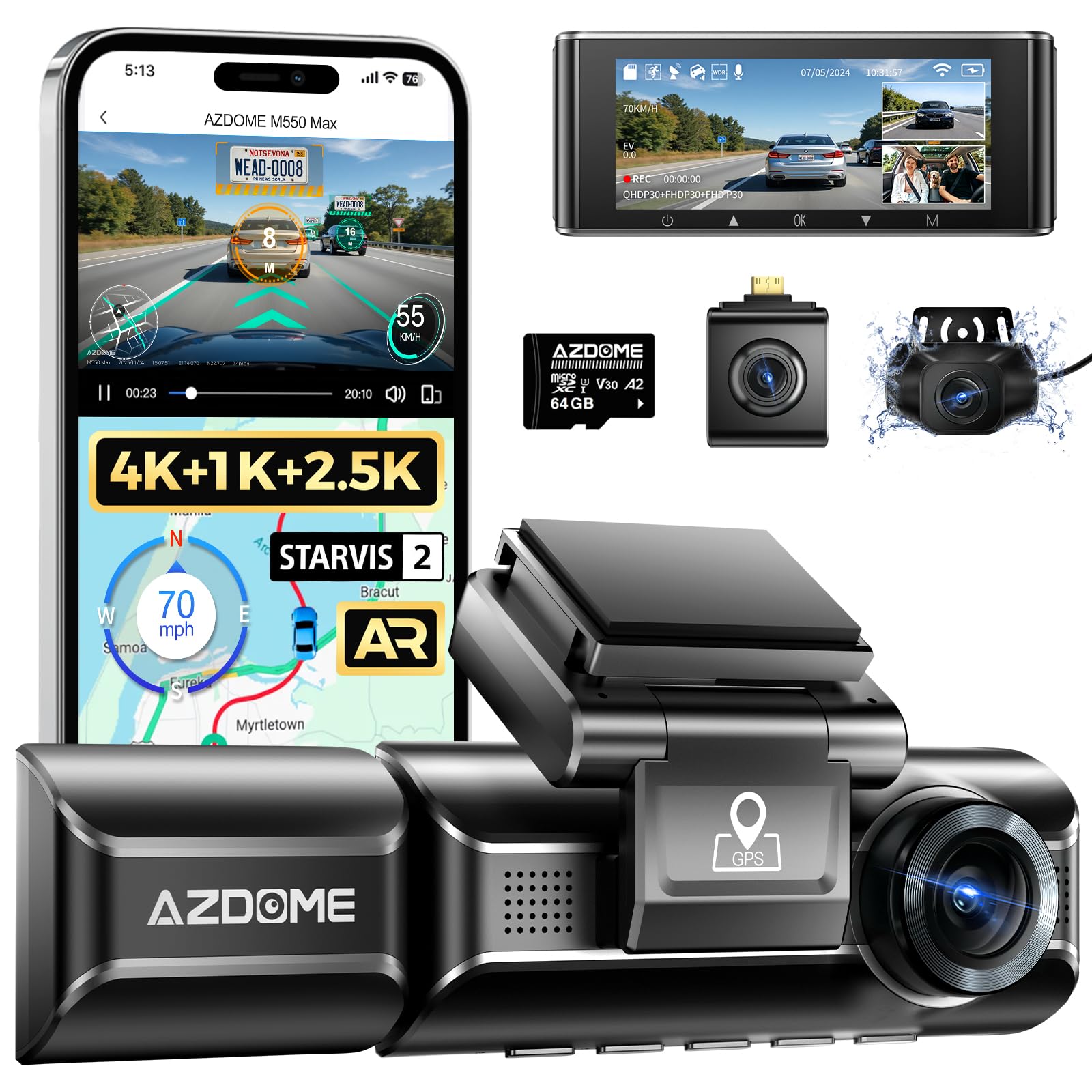
The AZDOME M550 Max records three channels at 4K front, 2.5K rear, and 1080P interior—a higher rear resolution than many competitors at this price bracket. Both the front and rear cameras use STARVIS sensors for low-light performance, and the built-in GPS module logs speed and route data that can be reviewed on the AZDOME app with timeline playback and route map overlay. The GPS speed is embedded into the video for use as evidence. The 3.19-inch LCD screen is larger than most units, making it easier to review footage without pulling out your phone.
The magnetic mount is a standout feature—detaching and reattaching the camera is effortless compared to traditional slide-in or screw mounts, which is convenient for those who want to remove the camera when parking in high-theft areas. Parking mode supports motion detection, collision-triggered recording, and time-lapse, though again a hardwire kit is needed for continuous operation. A fatigue driving reminder is included for long-distance drivers, and the IR night vision on the interior camera improves cabin visibility in complete darkness. The IP68-rated rear camera is also more weather-resistant than most, which matters if you are mounting it outside the vehicle on a pickup or SUV.
Customer feedback is generally positive regarding video sharpness and the overall value package, though some users note the front camera angle can be too high depending on your windshield’s slope, requiring additional adjustment or a replacement mount from support. The app experience is functional but can occasionally feel buggy, and the rear camera resolution, while higher than average, is not as sharp as the front. For drivers who want a mid-range triple camera with a flexible mounting system and solid GPS speed logging, this is a dependable pick.
Why it’s great
- Magnetic mount enables super quick camera removal for theft prevention or windshield cleaning.
- Triple-channel recording with 2.5K rear capture offers sharper behind-the-car details than standard 1080P.
- IP68-rated rear camera resists moisture exposure for external mounting on trucks and SUVs.
Good to know
- Front camera lens angle may point too high on sloped windshields, requiring manual adjustment or a replacement part.
- App connectivity can be buggy, with occasional crashes during video playback or settings changes.
7. FAIMEE 4K+2K Dual
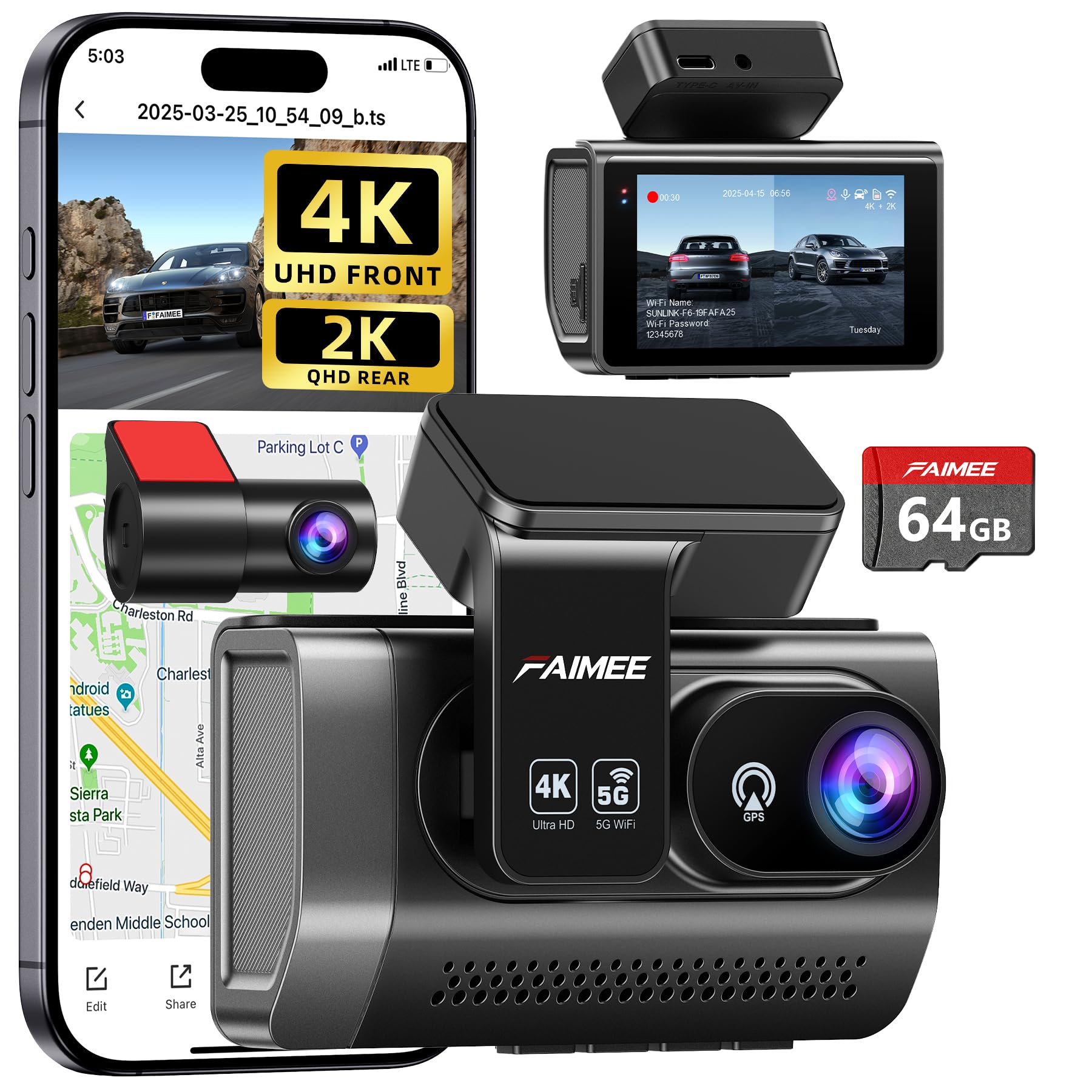
The FAIMEE 4K+2K Dual dash cam is the most affordable option on this list that still includes a functional built-in GPS module for speed and location tracking. It records 4K UHD (3840×2160P) front and 2K (2304×1296P) rear video using an F1.8 aperture and 170-degree wide-angle lenses, with WDR and night vision to handle high-contrast lighting. The GPS data logs real-time speed, route history, and coordinates, and the speed overlay is visible on the 3-inch IPS screen during playback. The dual-band WiFi (5.8GHz and 2.4GHz) allows connection to the FAIMEE app for live preview and downloads.
The kit includes a 64GB high-endurance memory card, which saves you a separate purchase. Loop recording automatically overwrites the oldest files when the card is full, and the G-sensor locks event videos on impact so critical evidence is not overwritten. Parking mode supports time-lapse and collision-triggered recording, but again a hardwire kit (not included) is needed for 24-hour use. The mount uses a secure stick-on adhesive, and the compact 3-inch design fits behind the rearview mirror without blocking visibility.
Customer reviews emphasize the straightforward installation and good video quality for the price, with particular praise for the 4K front resolution and strong daytime clarity. Some users find the instructions and on-device menu poorly written, which complicates initial configuration. The rear camera cable may not reach the tailgate on larger vans and trucks without an extension. For budget-conscious drivers who still need verifiable GPS speed logging and dual-channel recording, this is the most cost-effective entry point in the guide.
Why it’s great
- Built-in GPS with speed overlay at the lowest entry cost on this list—no hidden fees for GPS capability.
- 4K front and 2K rear recording with 170-degree wide-angle lenses captures more road context per frame.
- 64GB card included means the camera is fully functional out of the box with no additional purchases.
Good to know
- On-screen menus and printed instructions are poorly translated and can be confusing for first-time users.
- Rear camera cable length may not reach the back of larger vehicles like vans and SUVs without a separate extension.
FAQ
Will the GPS speed overlay show an accurate reading if I am driving in a tunnel?
Can I turn off the GPS speed recording if I do not want my speed visible on video?
How much storage do I need for a 3-channel dash cam recording GPS speed data?
Final Thoughts: The Verdict
For most users, the best dash cam with gps and speed recording winner is the REDTIGER F17 Elite because it combines full-color night vision, three-channel STARVIS 2 sensors, and a reliable GPS speed overlay at a mid-premium price that undercuts the competition while including a 128GB card. If you want the absolute fastest wireless file transfers and a Dual STARVIS 2 setup for both front and rear, grab the ROVE R2-4K Dual PRO. And for drivers who need every blind spot covered—rear seat, trunk, and side windows—nothing beats the Vantrue N5S 4 Channel with its four-camera 360-degree protection and dual-system GPS.

Mo Maruf
I created WellFizz to bridge the gap between vague wellness advice and actionable solutions. My mission is simple: to decode the research and give you practical tools you can actually use.
Beyond the data, I am a passionate traveler. I believe that stepping away from the screen to explore new environments is essential for mental clarity and physical vitality.