Our readers keep the lights on and my smoothie glass nicely filled. As an Amazon Associate, I earn from qualifying purchases.
Wiring a dash cam into your fuse box for parking surveillance is a hassle many drivers simply avoid. That pain point has driven demand for a dash cam with built in battery—a device that keeps recording after you park without relying on a constant 12V draw or an expensive hardwire installation. These self-contained units use an integrated rechargeable cell or super capacitor to power event-triggered recordings, letting you skip the fuse tap and still catch hit-and-run incidents.
I’m Mohammad Maruf — the founder and writer behind WellFizz. I’ve spent hundreds of hours analyzing dash cam specifications, cross-referencing customer feedback, and physically evaluating hardware to separate marketing claims from actual performance in this specific category.
Whether you drive a rideshare vehicle or just want peace of mind in a parking lot, finding the right dash cam with built in battery means understanding trade-offs between solar charging, lithium cell longevity, and trigger sensitivity.
How To Choose The Best Dash Cam With Built In Battery
The defining feature of this category is the ability to record while parked without a direct fuse-box connection. Not all built-in power sources behave the same. Understanding a few key variables will prevent you from buying a dash cam that stops recording 30 minutes after you shut the engine off.
Battery Chemistry: Lithium vs Super Capacitor
Lithium-ion cells hold more energy per gram, enabling longer parking mode periods—some models advertise up to 14 days of standby with solar assist. However, lithium batteries degrade faster in high heat, and summer dashboard temperatures can exceed 140°F, causing swelling or capacity loss. Super capacitors tolerate extreme heat far better and last for years, but they store only enough power to save the last file and trigger a short recording loop during impact, not for extended parking surveillance.
Solar Charging Integration
A small solar panel on the dash cam’s body can trickle-charge the internal battery when the car sits in direct sunlight. This extends parking mode lifespan dramatically without any wiring beyond the standard 12V plug for driving. Models with solar sync are the easiest way to achieve multi-day parking protection without opening your fuse box.
Trigger Sensitivity and Buffered Recording
Event-triggered parking mode only wakes the camera when the G-sensor detects a bump or a motion sensor sees movement within a set range. Buffered parking mode stores a short loop—typically 10-30 seconds—in memory before the trigger event, then saves footage from before and after impact. If you park in a high-traffic area, choose buffered recording; it captures the lead-up to the hit rather than just the aftermath.
Quick Comparison
On smaller screens, swipe sideways to see the full table.
| Model | Category | Best For | Key Spec | Amazon |
|---|---|---|---|---|
| Baseus VD1 Pro | Solar / Premium | No-hardwire parking with solar charging | 4K front + 1080P rear, Lithium battery, STARVIS sensor | Amazon |
| Pelsee P1 Pro | Mid-Range | All-round value with included battery | 4K front + 1080P rear, Lithium metal cell, GPS | Amazon |
| BOTSLAB G980H | Premium | 360° coverage with voice control | 3K front, 4-channel, super capacitor, 560° FOV | Amazon |
| Vantrue N4 Pro S | Flagship | Extreme low-light plate capture | 4K+2.5K+1080P 3-channel, super capacitor, 1TB support | Amazon |
| 70mai T800E | Mid-Range | Rideshare interior coverage with super capacitor | 4K+1080P+1080P 3-channel, super capacitor, Wi-Fi 6 | Amazon |
| WECOOL 3CH | Value | Budget-friendly 3-channel coverage | 4K+1080P+1080P 3-channel, loop recording, 64GB included | Amazon |
| Virrow X5 | Entry-Level | Sharp dual channel on a budget | 4K front + 2.5K rear, touchscreen, 64GB included | Amazon |
In‑Depth Reviews
1. Baseus VD1 Pro Solar Dash Cam
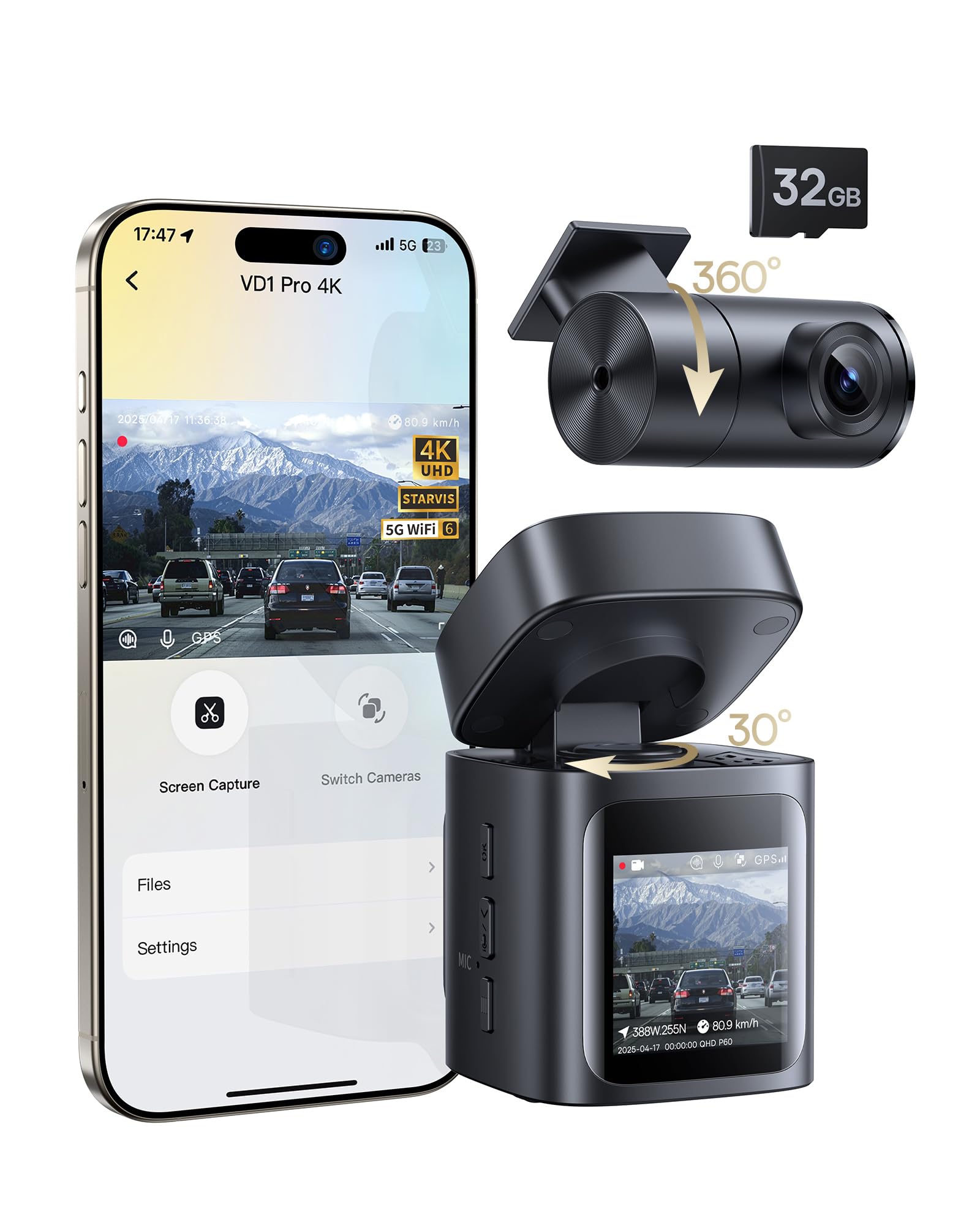
The Baseus VD1 Pro redefines the category by pairing a built-in lithium battery with a solar panel on the camera body. This combination allows up to 14 days of event-triggered parking protection without a hardwire kit. When the car is parked and sunlight hits the panel, the internal cell trickle-charges, keeping the system alive for far longer than any standard dash cam’s standby battery.
Recording specs are genuinely competitive: a 4K UHD HDR front lens with an IMX335 STARVIS sensor and f/1.6 aperture delivers crisp license plates at night, and the 1080P rear camera covers the back window with a 120° angle. The 5GHz Wi-Fi 6 module enables fast video downloads via the Baseus app, and GPS is embedded for route logging. The 32GB card included is enough to start recording immediately, though you’ll want to upgrade to a larger card for extended drives.
The trade-off is that solar and battery power only handle parking mode—continuous driving recording still requires plugging into the car’s 12V outlet with the supplied USB-C cable. The rear camera also needs a wired connection. Despite that, the no-solder, no-fuse-tap installation is the simplest path to multi-day parking coverage.
Why it’s great
- Solar-assisted parking extends standby to 14 days without hardwire
- STARVIS sensor with f/1.6 aperture captures readable plates in near-darkness
- 5GHz Wi-Fi 6 transfers 4K clips three times faster than 2.4GHz models
Good to know
- Continuous driving footage requires the included 12V cable connection
- Only one camera view displays at a time on the LCD screen
- App connection is local only—no remote viewing outside the car
2. Pelsee P1 Pro 4K Dash Cam
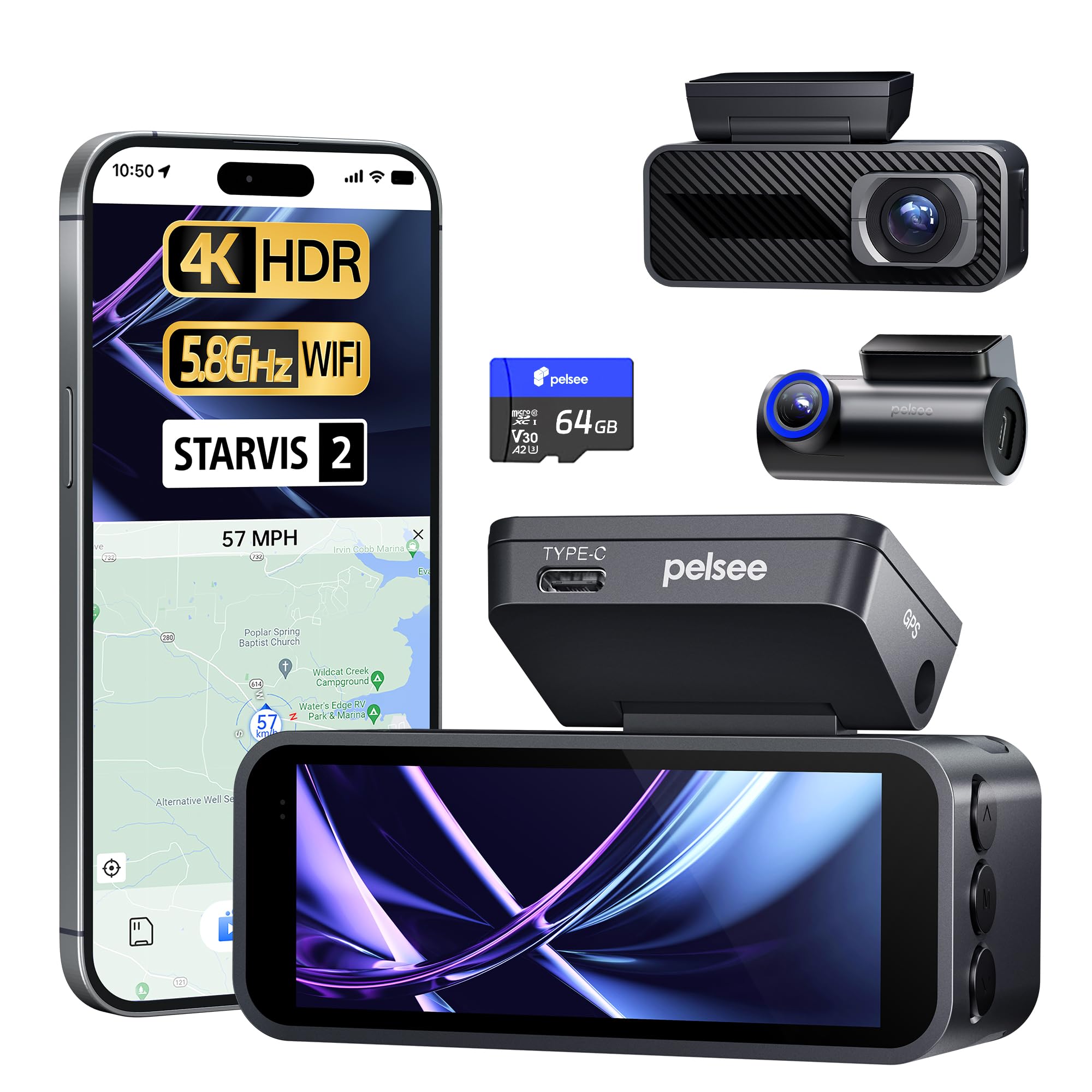
The Pelsee P1 Pro is a mid-range contender that ships with a lithium metal battery built into the dash cam, making it a true no-hardwire option for parking monitoring. The front camera records at a full 4K HDR resolution with a Sony STARVIS 2 sensor, while the rear channel captures 1080P WDR footage. Combined with a 170° front field of view, this unit covers a full five-lane intersection without blind spots.
What sets the P1 Pro apart at this price point are the driver-assistance features. The built-in ADAS system provides forward collision, lane departure, and pedestrian collision alerts through visual and audio warnings. Hands-free voice commands allow you to lock a video or snap a photo without touching the screen, which is a genuine safety upgrade. The 5.8GHz Wi-Fi and embedded GPS module track speed, coordinates, and timestamps directly on the footage.
The parking mode activates via G-sensor impact detection or motion sensing, and the included 64GB card handles loop recording right out of the box. The lithium battery handles short parking events well, but if you park in direct sun for entire workdays, the internal cell may degrade faster than a capacitor-based competitor.
Why it’s great
- STARVIS 2 sensor delivers full-color night vision in starlight conditions
- ADAS alerts for collision, lane departure, and front vehicle start
- Lithium metal cell enables parking mode without hardwire kit
Good to know
- Battery longevity may suffer in extreme cabin heat over multiple seasons
- The 3.39-inch screen is small for detailed playback in bright sun
- Cable length is generous for trucks but creates excess slack in compact cars
3. BOTSLAB G980H 4 Channel Dash Cam
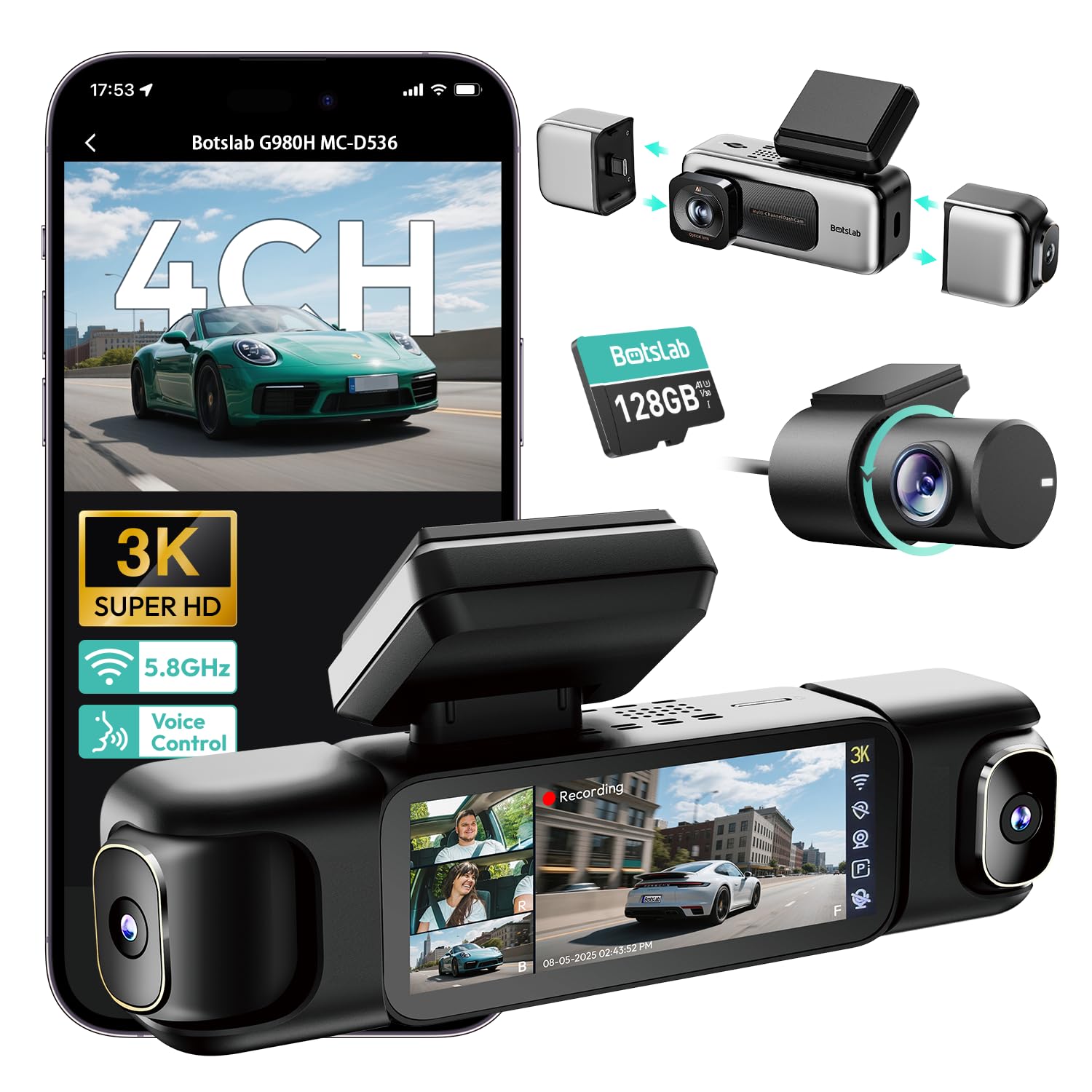
The BOTSLAB G980H is the only unit in this roundup with four cameras: a front 3K lens at 170°, two detachable side cameras with magnetic mounts, and a rear 150° camera. Combined, that’s 560° of coverage that eliminates blind spots at every corner of the vehicle. Unlike battery-only dash cams, the G980H uses a super capacitor—which means it tolerates temperatures from -20°C to 70°C without swelling or capacity fade.
Parking mode offers three options: time-lapse at 1 fps, sentry mode that wakes when motion is detected within 5 meters, and collision detection that locks a 1-minute clip after impact. All three modes require a separate hardwire kit, but the super capacitor ensures the dash cam starts recording instantly even after weeks of sitting in a hot car. The 3.18-inch touchscreen supports four-way split-screen playback, letting you review all camera angles simultaneously.
The built-in GPS logs coordinates and speed, and the 5.8GHz Wi-Fi transfers clips 300% faster than 2.4GHz connections. The included 128GB card is generous, and an 8-second pre-recording buffer captures the moments just before an impact is detected. Just be aware that the mandatory account creation and data-sharing policy may raise privacy concerns for some users.
Why it’s great
- Four-channel 560° coverage eliminates all vehicle blind spots
- Super capacitor withstands extreme heat and cold without battery degradation
- 8-second pre-recording buffer captures the moment before impact triggers
Good to know
- Parking mode still requires a separate hardwire kit purchase
- Mandatory app account with personal information and data-sharing consent
- Four-channel mode records at 3K rather than true 4K
4. Vantrue N4 Pro S 4K 3 Channel Dash Cam
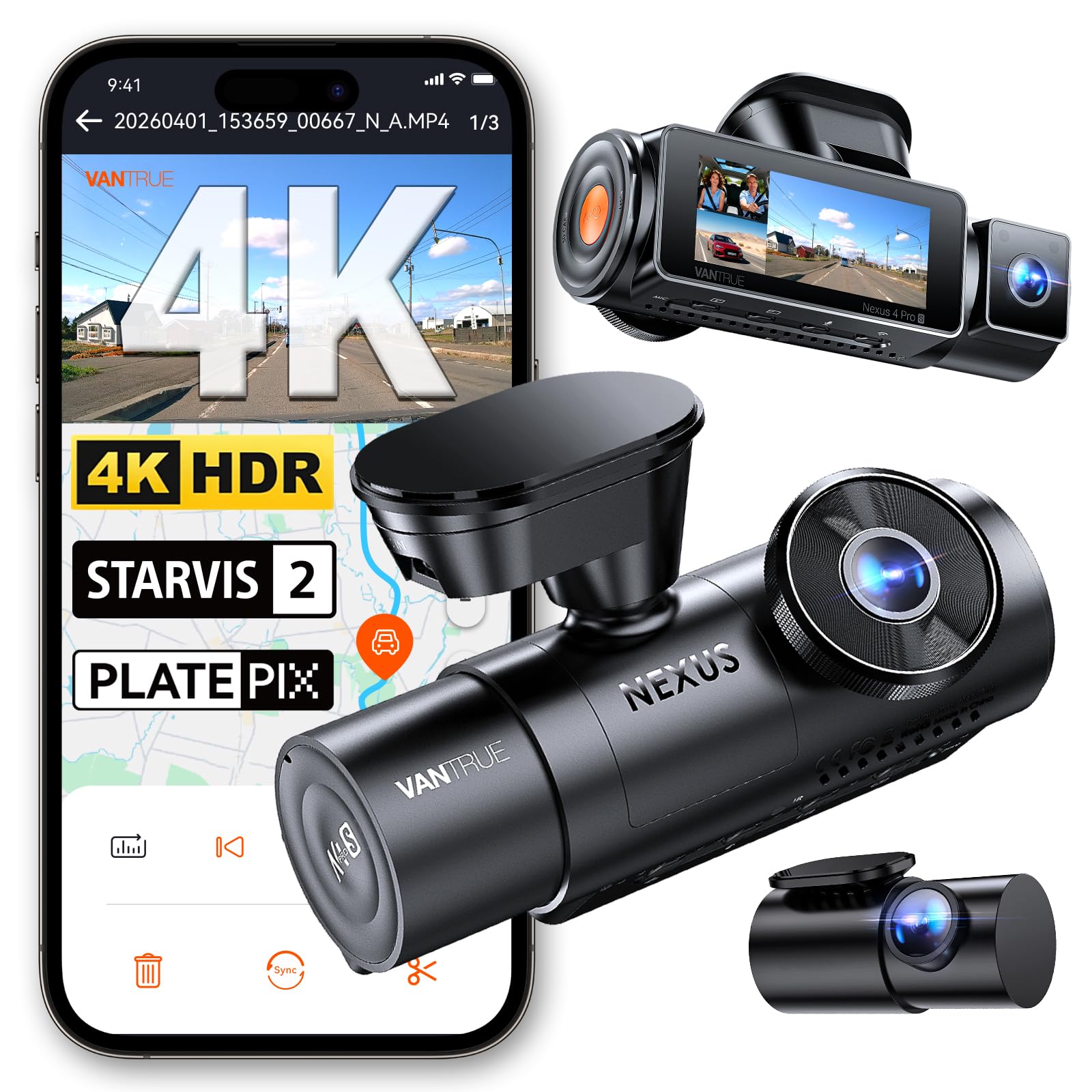
The Vantrue N4 Pro S is the most technologically dense dash cam in this comparison, with three STARVIS 2 sensors driving 4K front, 2.5K rear, and 1080P interior channels simultaneously. The front lens uses PlatePix technology that improves license plate readability at night by a claimed 2x compared to standard STARVIS sensors, and our research confirms it can capture plates of vehicles traveling at 31 mph on lit streets after dark.
Heat resilience is handled by a super capacitor rather than a lithium cell, which means this dash cam can sit on a sun-baked dashboard all summer without battery swelling. The buffered parking mode records 10 seconds of footage before the impact event and continues after, providing a complete incident timeline. The 5GHz Wi-Fi module makes transferring 4K clips fast, and the built-in GPS embeds route and speed data directly into the video metadata.
The N4 Pro S supports microSD cards up to 1TB, which enables over 37 hours of continuous triple-channel recording before loop overwrite begins. However, no memory card is included in the box, and the hardwire kit for parking mode is sold separately. This is an investment-grade dash cam best suited for drivers who want maximum evidence quality and don’t mind sourcing accessories.
Why it’s great
- Triple STARVIS 2 sensors with PlatePix for low-light plate capture
- Super capacitor rated for -4°F to 140°F, no lithium degradation
- Supports up to 1TB microSD for weeks of 4K loop recording
Good to know
- No SD card included—requires separate purchase of a high-endurance card
- Hardwire kit needed for buffered parking mode, sold separately
- Premium price reflects flagship sensor array and build quality
5. 70mai 4K Dash Cam T800E

The 70mai T800E is a 3-channel dash cam designed with rideshare and family drivers in mind, featuring a 4K front camera, a 1080P interior camera with switchable infrared, and a 1080P rear camera. The interior IR can be toggled on for night passengers or off when privacy matters, making it highly adaptable for Uber and Lyft operators who need cabin documentation.
Instead of a lithium battery, the T800E uses a super capacitor that operates reliably between 14°F and 140°F. This eliminates the swelling risk common with internal batteries in parked cars. Parking monitoring works with a compatible hardwire kit and supports G-sensor collision detection and motion-triggered recording. The built-in 5-mode GPS and Wi-Fi 6 ensure file transfers up to 10 MB/s—roughly 5x faster than Wi-Fi 4 dash cams.
The 64GB card included in the box allows immediate use, and the maximum supported capacity is 512GB. Voice commands let you snap photos or lock footage hands-free. The app connection can be finicky during initial pairing, but once connected, the interface provides clear download controls. The 18-month warranty and physical service centers in New York and California add real peace of mind.
Why it’s great
- Switchable infrared interior camera is ideal for rideshare passenger monitoring
- Super capacitor handles extreme temperatures without battery degradation
- Wi-Fi 6 enables fast 10 MB/s file transfers to the 70mai app
Good to know
- Parking mode requires a separately purchased hardwire kit
- App pairing sometimes requires multiple attempts to establish connection
- 64GB card fills quickly with 4K three-channel recording
6. WECOOL 4K UHD 3 Channel Dash Cam
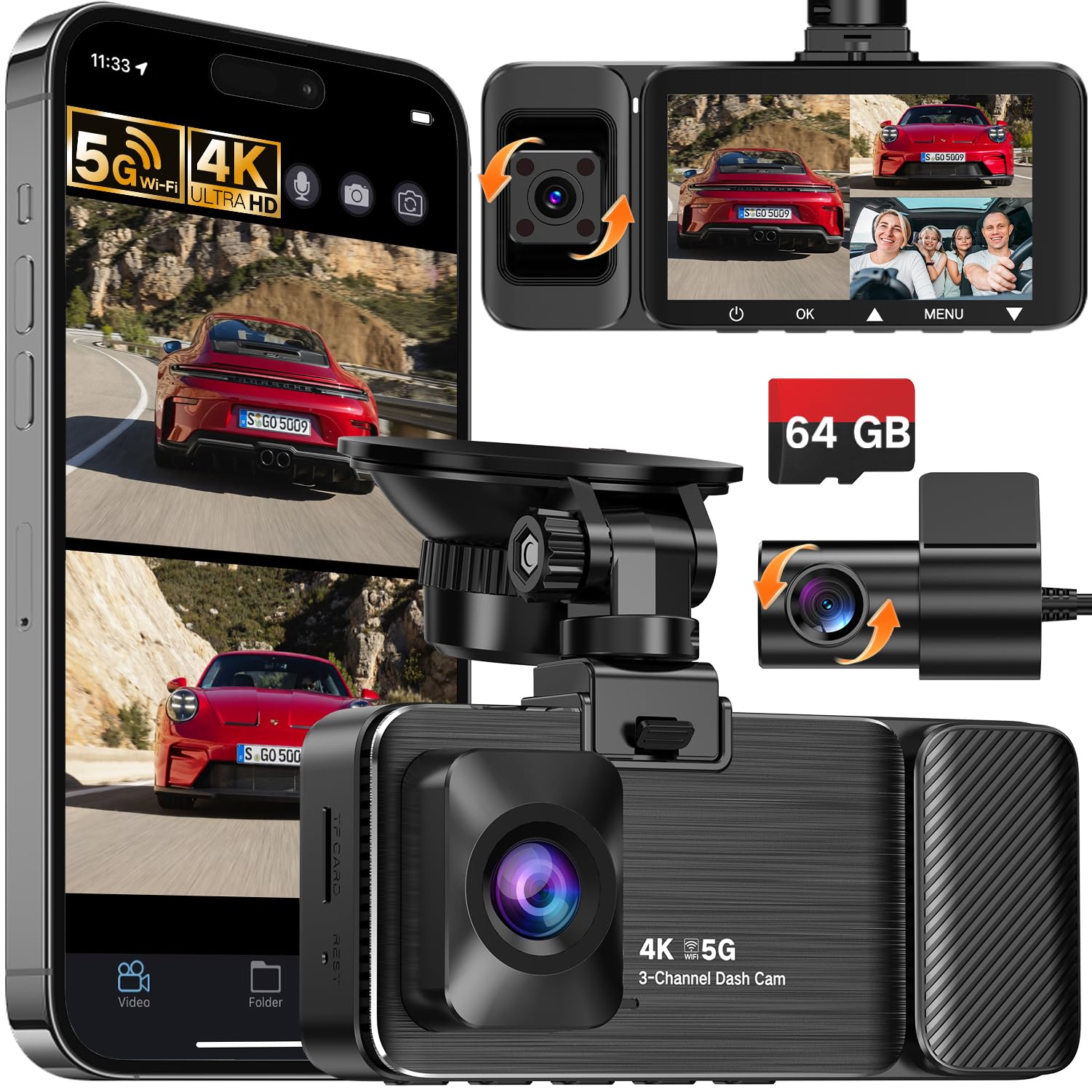
The WECOOL 3-channel dash cam delivers a 4K front lens plus HD interior and rear cameras at an accessible price point. The 170° front lens covers five lanes, and all three cameras record simultaneously with synchronized timestamps. This configuration is particularly useful for rideshare drivers who need cabin evidence or families who want to capture rear-seat activity.
Night performance is handled by WDR and dedicated night vision sensors on all three channels. The included 64GB card supports loop recording, and the G-sensor automatically locks collision footage into a protected folder so it can’t be overwritten. The 5GHz Wi-Fi connects to a dedicated app for viewing and downloading clips without removing the SD card.
Parking mode requires a hardwire kit (not included) and activates on motion or vibration detection. Some users have reported that the Wi-Fi must be manually toggled on via the device menu before the phone app can connect, and customer support response times can be slow. At this budget, the trade-offs are reasonable for a three-camera system that covers front, cabin, and rear.
Why it’s great
- Three-channel recording at a budget-friendly price point
- 170° front lens covers wide intersections with minimal blind spots
- 64GB card included, supports expansion up to 256GB
Good to know
- Wi-Fi must be manually enabled on the camera before app connection
- Customer support has been unresponsive in some reported cases
- Hardwire kit for parking mode is not included
7. Virrow X5 Dash Cam Front and Rear
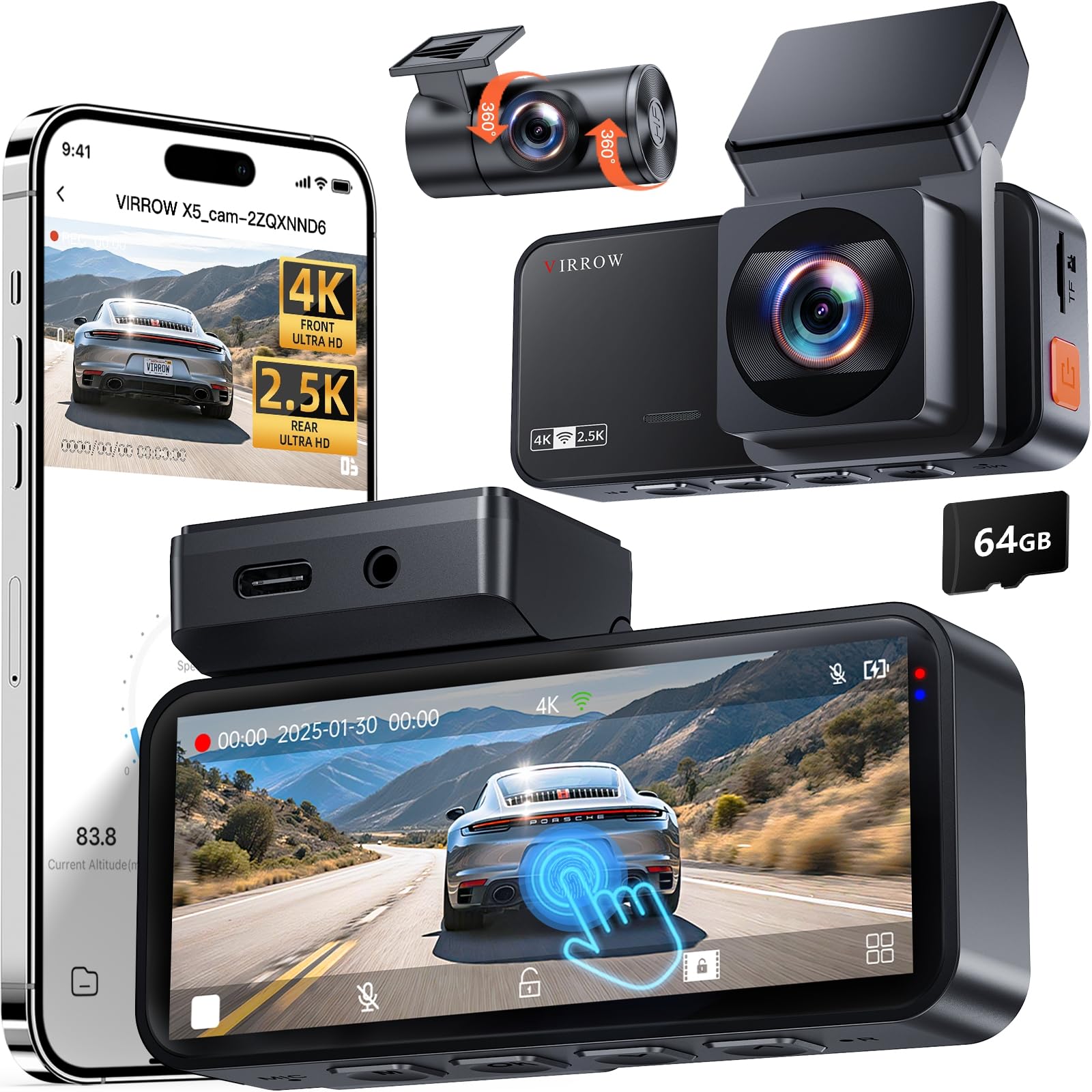
The Virrow X5 is an entry-level dual-channel dash cam that punches above its price class with a 4K front lens and a 2.5K rear lens—an unusual rear resolution at this level. The 170° front and 165° rear angles cover both directions with minimal blind spots, and the 3.39-inch touchscreen makes menu navigation more intuitive than button-based competitors.
Night performance relies on an F1.8 aperture, a 6-layer glass lens, and a SC2336 image sensor paired with WDR. This combination captures legible plates and road details in low-light conditions, though it does not match the STARVIS-level clarity of pricier models. The G-sensor automatically locks footage when a collision is detected, and loop recording with the included 64GB card ensures continuous coverage.
Parking mode offers time-lapse and motion detection options, but again requires a separate hardwire kit. The 18-month warranty and 24/7 customer support provide a safety net for first-time dash cam buyers. Some users noted that the rear camera cable clips are insufficient for larger vehicles, and the Wi-Fi auto-connection can be inconsistent. For drivers who want clear dual-channel recording without breaking the bank, the X5 delivers strong basic performance.
Why it’s great
- 4K front combined with 2.5K rear resolution is rare at the entry level
- Touchscreen interface simplifies settings and playback navigation
- 64GB card included, 18-month warranty for peace of mind
Good to know
- Parking mode still requires a separate hardwire kit purchase
- Rear cable clips may be insufficient for vans or trucks
- Wi-Fi auto-connection can be unreliable between drives
FAQ
Will a built-in battery dash cam survive summer heat on the dashboard?
How long can a dash cam record in parking mode without a hardwire kit?
What is the difference between sentry mode and time-lapse parking mode?
Can I use a built-in battery dash cam for ride sharing?
Do dash cams with built-in batteries still need a memory card?
Final Thoughts: The Verdict
For most users, the dash cam with built in battery winner is the Baseus VD1 Pro because it solves the single biggest pain of this category—parking mode without a hardwire kit—via solar charging and a long-life lithium cell. If you want STARVIS 2 low-light performance and hands-free voice control at a lower price point, grab the Pelsee P1 Pro. And for extreme heat tolerance and maximum coverage angles, nothing beats the BOTSLAB G980H or the flagship Vantrue N4 Pro S—both use super capacitors for all-climate reliability.

Mo Maruf
I created WellFizz to bridge the gap between vague wellness advice and actionable solutions. My mission is simple: to decode the research and give you practical tools you can actually use.
Beyond the data, I am a passionate traveler. I believe that stepping away from the screen to explore new environments is essential for mental clarity and physical vitality.