Our readers keep the lights on and my smoothie glass nicely filled. As an Amazon Associate, I earn from qualifying purchases.
The single biggest frustration with a dash cam that has its own battery is discovering your parked car just got bumped, yet there is no footage because the internal battery died before the event happened. Built-in lithium cells simply cannot sustain the continuous power draw that true 24-hour surveillance demands. That is why the best modern approach combines a supercapacitor for reliable startup and a hardwire kit to draw from your car’s electrical system, not a tiny onboard cell that fades in hours.
I’m Mohammad Maruf — the founder and writer behind WellFizz. I have spent hundreds of hours analyzing dash cam specifications, sensor performance, parking mode logic, and real-world battery behavior to separate marketing claims from actual daily usability.
best dash cam with battery models now rely on hardwire kits and supercapacitors rather than disposable internal packs for genuine round-the-clock parking protection.
How To Choose The Best Dash Cam With Battery
Selecting the right car camera for parking security means looking past the marketing. You need to understand three critical aspects: the power system, the night sensor, and the parking mode logic. Ignore any of these and you risk buying a unit that misses the one incident it was supposed to catch.
Power System: Lithium-Ion vs Supercapacitor
Lithium-ion batteries degrade in heat and fail to hold a charge after a few summers on a windshield. Supercapacitors handle extreme temperatures far better and ensure the camera boots up reliably every time you start the engine. They do hold less energy, which is why a hardwire kit is essential for parking mode. Never choose a dash cam based on its internal battery capacity alone — that spec is misleading.
Sensor Quality: STARVIS 2 vs Standard CMOS
The sensor is the heart of night performance. Sony STARVIS 2 sensors (IMX678, IMX675) deliver roughly four times the low-light sensitivity of standard sensors. This directly translates to readable license plates in dim parking lots and on poorly lit streets. If you park in unlit areas or drive frequently at dusk, prioritize a camera with STARVIS 2 on at least the front channel.
Parking Mode Types
Three main parking modes exist: time-lapse (1 frame per second recording), motion detection (records only when movement is sensed), and low-bitrate continuous recording. Time-lapse offers the best balance of coverage and storage efficiency. Motion detection can miss slow bump events. Low-bitrate consumes the most card space. Choose based on how long your car sits unattended and how much storage you carry.
Quick Comparison
On smaller screens, swipe sideways to see the full table.
| Model | Category | Best For | Key Spec | Amazon |
|---|---|---|---|---|
| VIOFO A329S | Premium | 4K 60FPS & ultra-low power parking | Dual STARVIS 2, up to 4TB SSD | Amazon |
| VIOFO A229 Pro 3CH | Premium | Three-channel coverage (front, cabin, rear) | Dual STARVIS 2, HDR all channels | Amazon |
| ROVE R2-4K Dual PRO | Premium | Included 128GB card + CPL filter | Dual STARVIS 2, WiFi 6, Quad GPS | Amazon |
| BOTSLAB 4K | Mid-Range | Included hardwire kit & ADAS | IMX415 sensor, 1.5TOPS AI NPU | Amazon |
| 70mai T800E 3CH | Mid-Range | Three-channel & supercapacitor design | F1.55 aperture, Wi-Fi 6, GPS | Amazon |
| Pelsee P1 Pro | Mid-Range | STARVIS 2 at a budget-friendly price | STARVIS 2, 5.8GHz WiFi, ADAS | Amazon |
| FAIMEE 4K+2K | Entry-Level | 4K front + 2K rear with 64GB card | 170° wide angle, dual-band WiFi | Amazon |
In‑Depth Reviews
1. VIOFO A329S 4K 60FPS
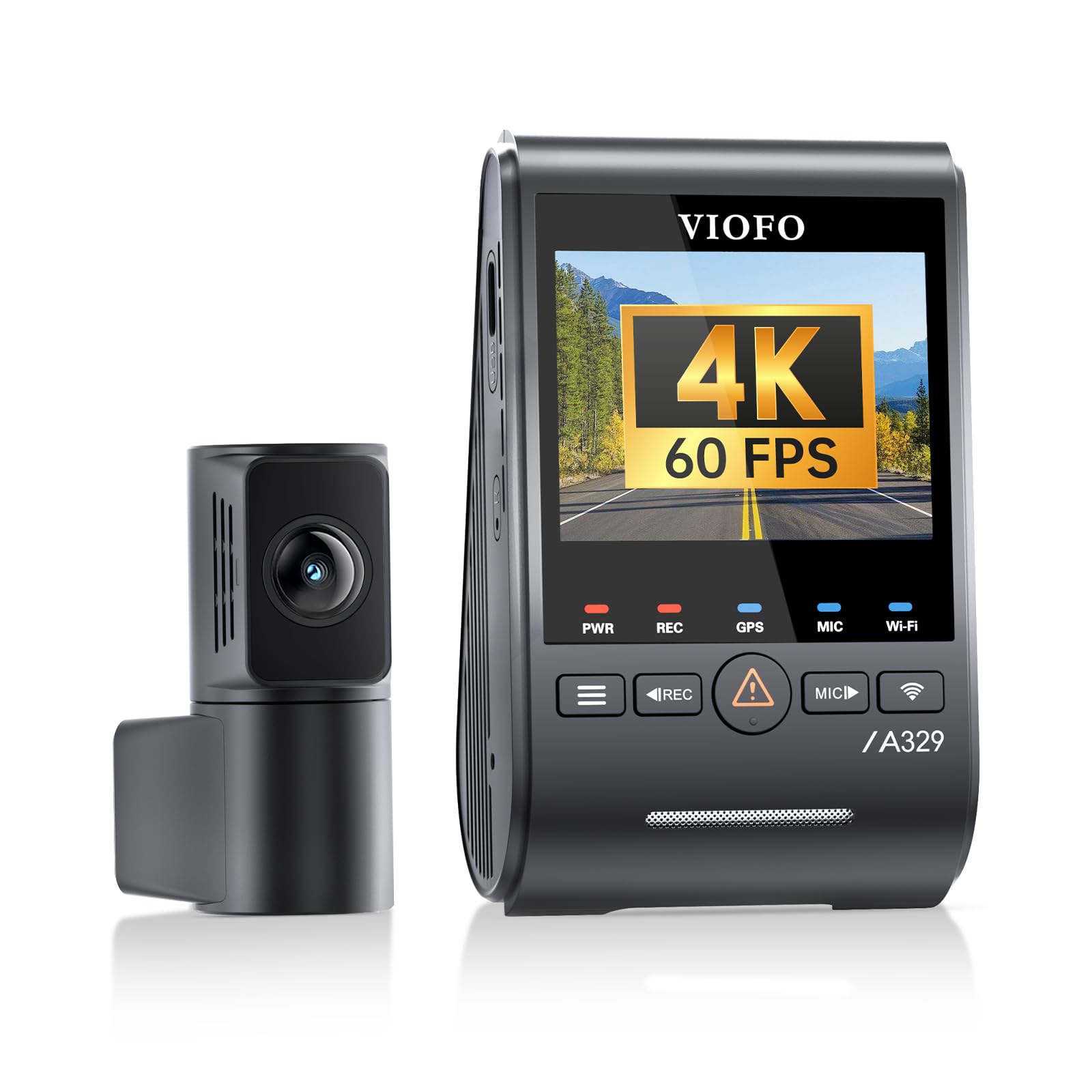
The VIOFO A329S sets the highest bar for image fluidity with 4K recording at 60 frames per second on the front channel. Combined with a rear 2K stream and dual STARVIS 2 sensors (IMX678 front, IMX675 rear), this unit delivers the sharpest license plate reads in both daytime motion and low-light parking lots. The HDR feature must be disabled to achieve 60FPS, but at 4K 30FPS with HDR enabled, the dynamic range is exceptional for capturing plates under harsh headlight glare.
Its ultra-low-power parking mode is the key advantage for anyone worried about battery drain. The camera uses impact detection to start recording instantly from a near-zero power state, preserving your vehicle’s starter battery over days of inactivity. The built-in supercapacitor ensures reliable boot-up even after a week of sitting in summer heat, making it the most trustworthy option for long-term parking surveillance.
The 2.8mm coaxial rear cable resists electromagnetic interference, and the included CPL filter nearly eliminates windshield reflections. The VIOFO app is functional rather than flashy, and the unit supports external SSDs up to 4TB — enough for weeks of continuous recording without overwriting.
Why it’s great
- 4K 60FPS front recording for ultra-smooth playback
- Impact-detection parking mode with near-zero standby drain
- Supports SSDs up to 4TB for extended trip recording
Good to know
- HDR and 60FPS cannot run simultaneously
- No SD card included in the box
- Hardwire kit must be purchased separately
2. VIOFO A229 Pro 3 Channel

The A229 Pro is the definitive three-channel solution for Uber, Lyft, and family drivers who need front, cabin, and rear coverage simultaneously. It uses dual STARVIS 2 sensors (IMX678 front, IMX675 rear) plus a separate STARVIS sensor for the interior camera, with HDR active on all three channels. This ensures that even a passenger in the back seat is clearly visible at night, and the rear camera reads plates from following vehicles.
Three parking modes — auto event detection, low bitrate, and time lapse — give you flexibility based on your storage capacity. The buffered event detection records 15 seconds before and 30 seconds after a trigger, capturing the full context of a parking lot bump rather than just the aftermath. A built-in temperature sensor shuts the camera down in extreme heat to protect internal components, a feature that supercapacitor-equipped dash cams handle better than battery-dependent models.
Voice control with 12 commands allows hands-free operation, and the 5GHz Wi-Fi provides faster app previews than older 2.4GHz units. The CPL filter is included, but no memory card ships with the camera, so budget for a high-endurance microSD.
Why it’s great
- Three-channel recording with HDR on every camera
- Buffered parking mode captures 15 seconds before an event
- Supercapacitor design for extreme temperature reliability
Good to know
- No SD card included in the package
- Interior camera cable length may be awkward for some vehicles
- Hardwire kit HK4 required for parking mode (sold separately)
3. ROVE R2-4K Dual PRO
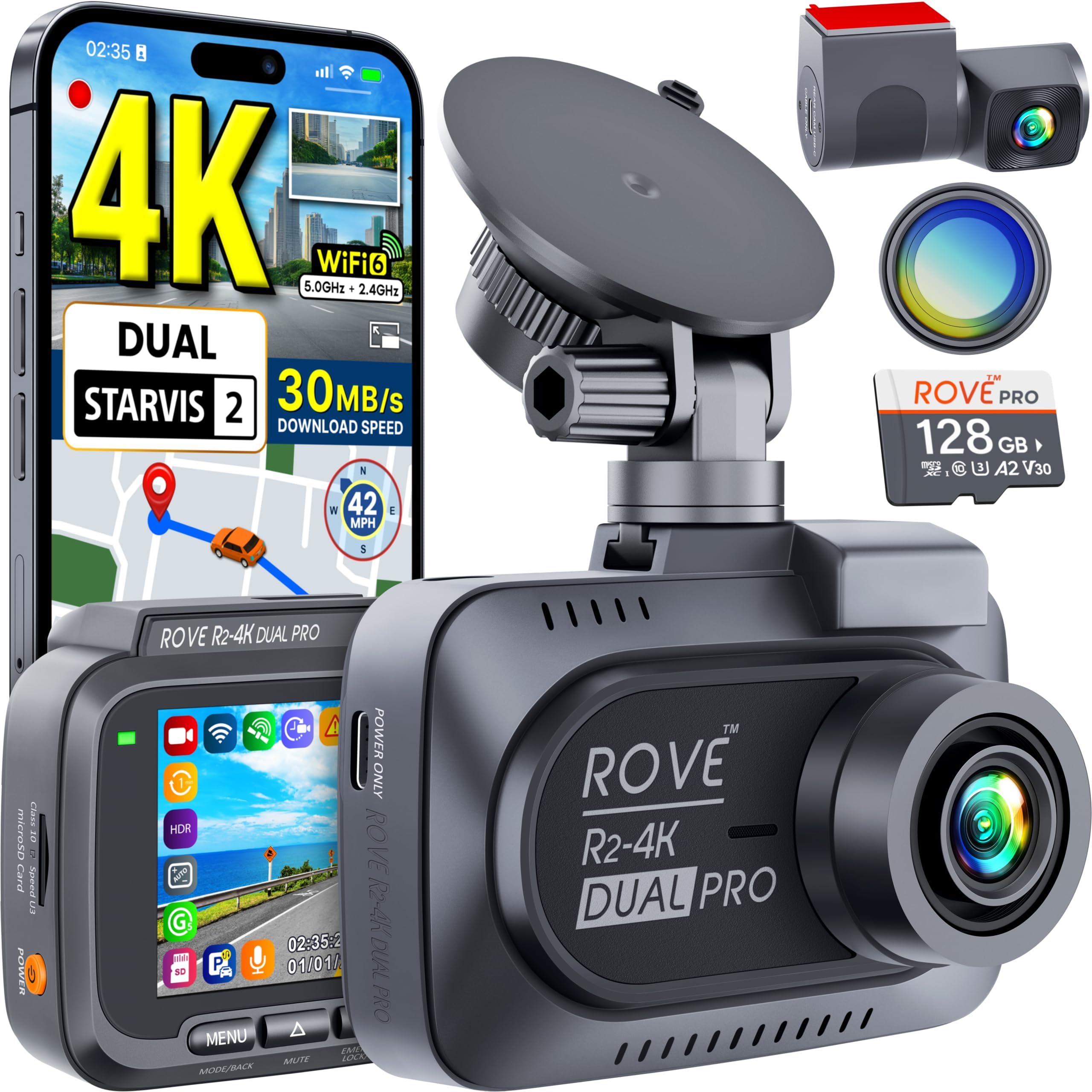
The ROVE R2-4K Dual PRO delivers premium sensor hardware — dual STARVIS 2 IMX678 (8MP front) and IMX675 (5MP rear) — at a price that undercuts most competitors with equivalent silicon. The front records true 4K at 30FPS and the rear captures 2K, both with wide apertures (F1.7 front, F1.55 rear) that pull in enough light for readable plates in dim conditions. The included 128GB ROVE PRO microSD card is pre-tested for reliable 4K writing, removing the guesswork of card compatibility.
The parking mode offers time-lapse, motion detection, and collision detection options, but requires a separate hardwire kit for continuous use. When triggered, it records a full 1-minute locked video and provides a voice alert on your next startup — a useful notification that something occurred while you were away. The quad-mode GPS logs route data across GPS, BeiDou, Galileo, and GLONASS, and the free ROVE GPS Player lets you overlay your exact driving path onto the footage.
WiFi 6 transfers at up to 30MB/s, making 4K file downloads from the app significantly faster than typical dash cams. The included CPL filter effectively cuts windshield glare, and the electrostatic film mount leaves no adhesive residue.
Why it’s great
- Dual STARVIS 2 sensors at a mid-range price point
- 128GB high-endurance card included and tested
- WiFi 6 with 30MB/s transfer speed for quick downloads
Good to know
- Hardwire kit must be purchased separately for parking mode
- Rear camera may freeze after extended idle periods in cold climates
- App interface takes some time to learn
4. BOTSLAB 4K Dash Cam Front and Rear
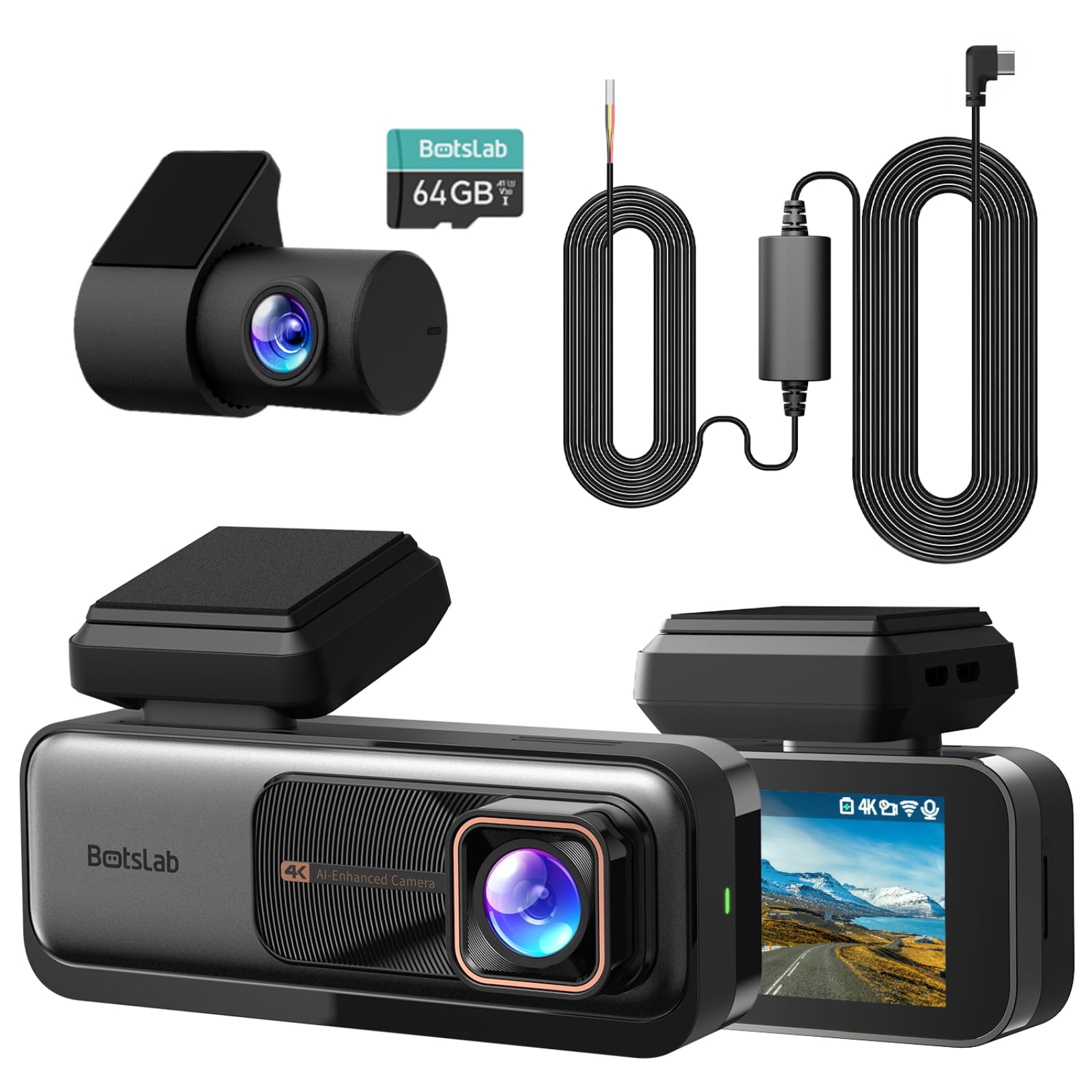
BOTSLAB stands out by including the hardwire kit in the box, removing the most common hidden cost that budget buyers encounter. The front camera uses a true 4K IMX415 sensor, while the rear records at 2K and swivels 360 degrees, allowing it to double as an interior cabin monitor when needed. This flexibility is useful for rideshare drivers who want passenger visibility without adding a third dedicated camera.
The 1.5TOPS AI NPU chip powers ADAS features including forward collision, pedestrian collision, lane departure, and vehicle-distance warnings. These alerts are genuinely helpful for highway driving, though they can become intrusive in stop-and-go city traffic. The 24/7 parking mode works without additional wiring because the hardwire kit ships with the unit. WDR and night vision handle tunnel entries and glare reasonably well, though the IMX415 sensor is a step below STARVIS 2 in extreme low-light scenarios.
Dual-band 5G/2.4G WiFi provides stable app connectivity, and the built-in GPS logs speed and route data. The included 64GB card is enough for short commutes, but you will want to upgrade to a larger capacity for extended parking coverage.
Why it’s great
- Hardwire kit included — no additional purchase needed
- 360-degree swiveling rear camera doubles as interior view
- AI ADAS with real-time collision and lane departure alerts
Good to know
- IMX415 sensor is good, but not STARVIS 2 level for night plates
- Maximum supported card is only 64GB according to specs
- Bluetooth and app pairing can be inconsistent
5. 70mai T800E 3 Channel

The 70mai T800E offers a three-channel setup (4K front, 1080P interior, 1080P rear) with a supercapacitor power system that eliminates battery swelling concerns. The front camera uses an F1.55 aperture and Sony STARVIS 2 sensors for excellent low-light capture, and the interior camera features switchable infrared LEDs for black-and-white cabin recording in total darkness — a critical feature for rideshare drivers documenting passenger behavior.
Wi-Fi 6 greatly speeds up file transfers through the 70mai app, reaching about 10MB/s, which is roughly five times faster than older Wi-Fi 4 dash cams. The 5-mode GPS logs speed, route, and location with high accuracy, and the voice control responds well to eight commands even with road noise. The 64GB card included in the box allows immediate use, and the system supports cards up to 512GB.
One notable downside is that the parking monitor requires a separate hardwire kit (UP06 or UP03), and the camera does not support 4G connectivity for remote alerts. The supercapacitor ensures stable operation between 14°F and 140°F, making it a safer choice for hot climates than lithium-battery dash cams.
Why it’s great
- Three-channel recording with switchable IR for cabin
- Supercapacitor handles extreme heat and cold reliably
- Wi-Fi 6 and 64GB card included for immediate setup
Good to know
- Parking mode requires a separate hardwire kit purchase
- No 4G module for remote parking alerts
- App connection can be finicky on first setup
6. Pelsee P1 Pro 4K
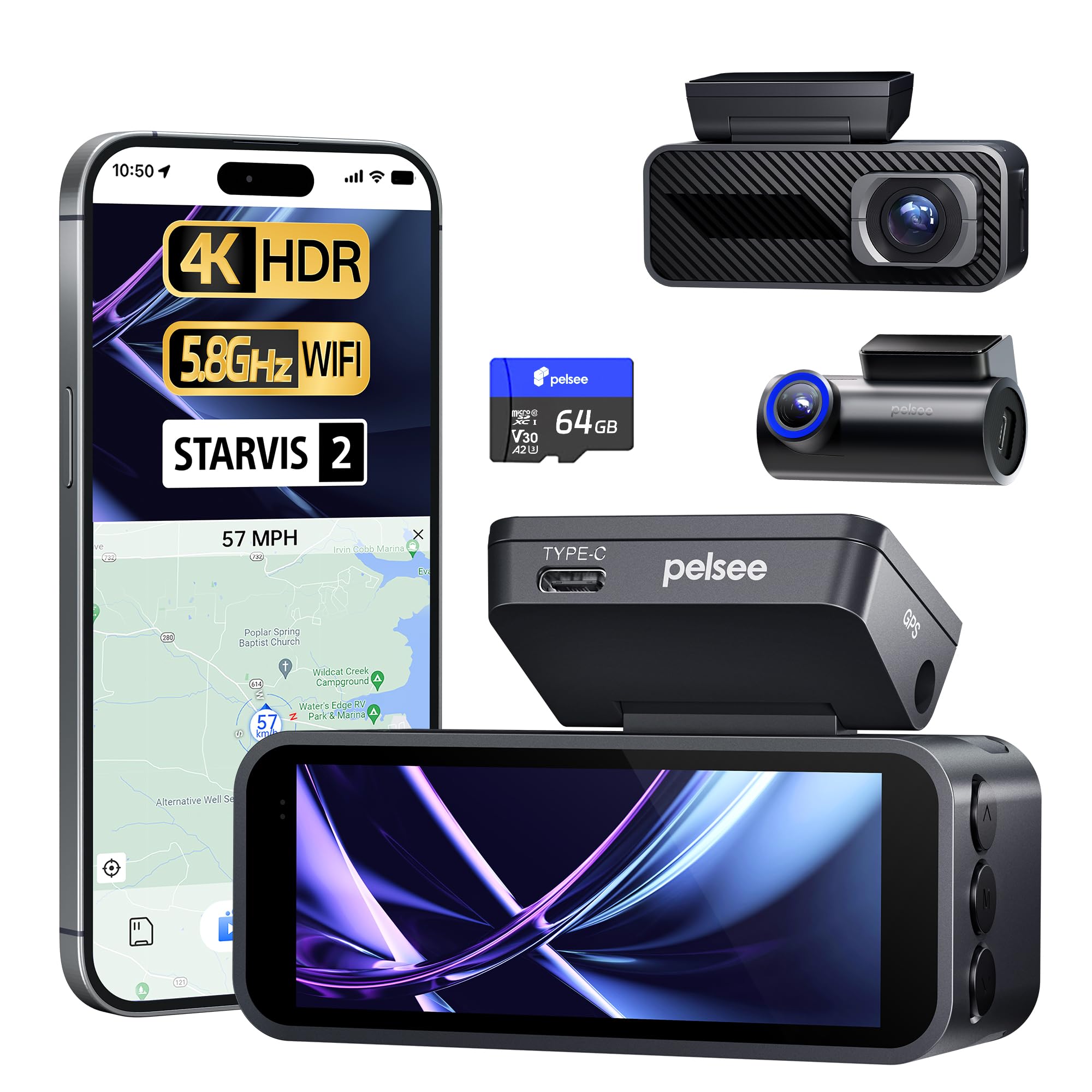
The Pelsee P1 Pro brings Sony STARVIS 2 technology to the front camera at a price point that undercuts most premium competitors. The front records 4K with HDR, which handles bright sunlit scenes and backlit tunnels without washing out license plates. The rear camera records at 1080P with WDR for balanced exposures. Full-color night vision in starlight conditions is genuinely impressive — plates become readable in environments where standard sensors produce only grainy silhouettes.
The ADAS system provides forward collision, pedestrian collision, and lane departure warnings with a claimed 0.8–2 second reaction time. While not as refined as dedicated ADAS systems, these alerts serve as useful secondary reminders on long drives. The 5.8GHz Wi-Fi enables fast app previews and downloads, and the built-in GPS logs speed and coordinates directly onto the video overlay. Voice control with eight commands works reliably and allows hands-free video locking.
Parking mode requires a hardwire kit (sold separately) for 24-hour time-lapse or motion-activated recording. The 3.39-inch IPS screen is bright enough for quick playback checks, and the included 64GB card gets you started immediately. The rear camera cable is generous for larger vehicles, but the 12V adapter socket may need replacement if the fit is loose.
Why it’s great
- STARVIS 2 sensor at a budget-friendly cost
- Full-color night vision in starlight conditions
- Effective noise-canceling voice control
Good to know
- Hardwire kit required for 24/7 parking mode
- 12V adapter may fit loosely and require replacement
- Rear camera cable is quite long for smaller cars
7. FAIMEE 4K+2K Dash Cam
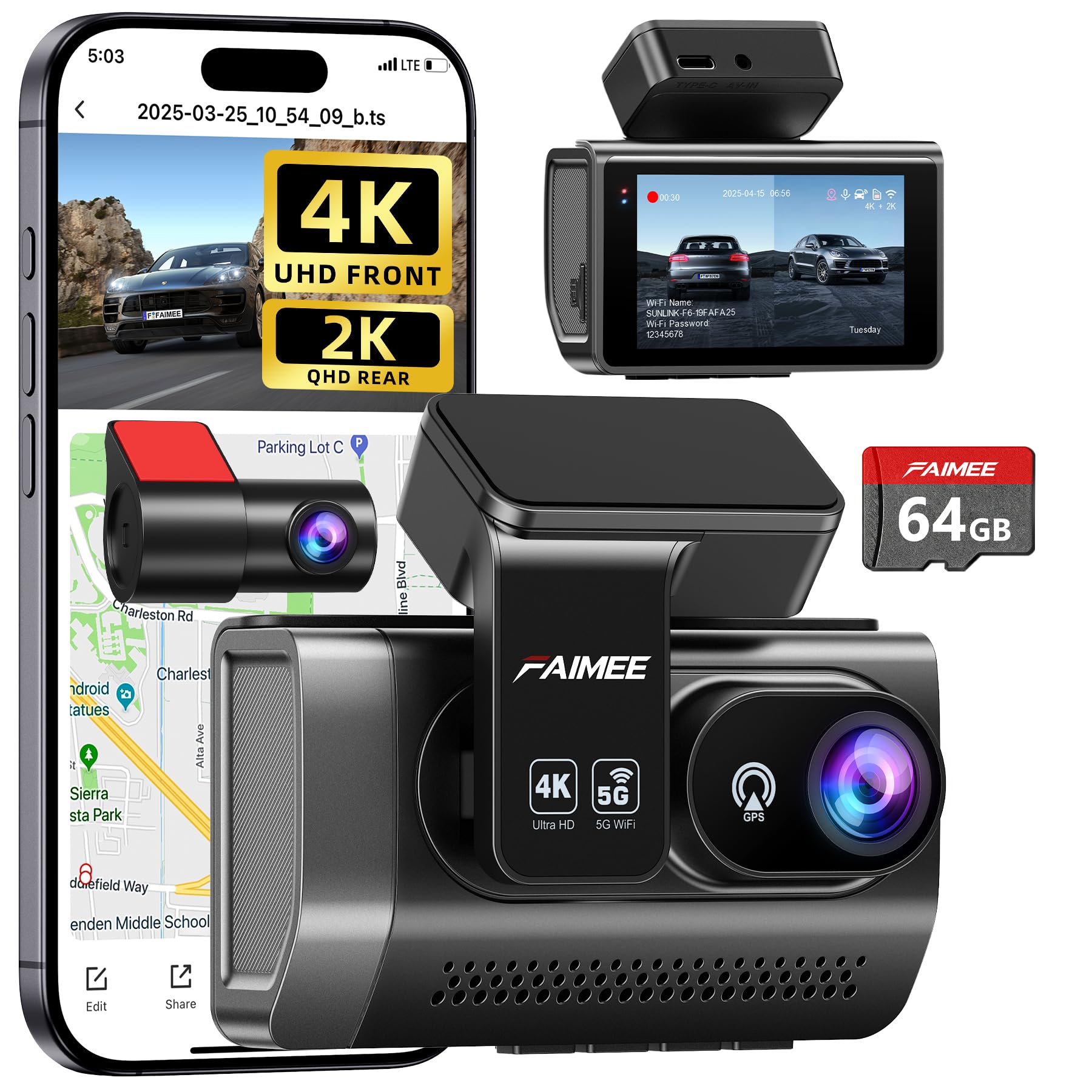
The FAIMEE dash cam provides an honest entry into 4K front and 2K rear recording without charging for premium extras. The front camera captures 3840x2160P with an F1.8 aperture and 170-degree field of view, covering up to six lanes. The rear records at 2304x1296P, which is higher resolution than typical 1080P rear cameras. WDR and night vision handle basic low-light scenarios, though the sensor is not STARVIS 2, so extreme dim conditions will show more noise than higher-end units.
Time-lapse parking mode operates at a low frame rate with minimal power draw, but requires a hardwire kit (not included) for continuous 24-hour use. The G-sensor locks footage on collision impact, and loop recording ensures the card never fills up. The built-in dual-band WiFi (5.8GHz/2.4GHz) connects to the FAIMEE app for live viewing and file downloads, and the GPS logs speed and route data. A 64GB high-endurance card is included.
The 3-inch IPS screen is small but adequate for quick setup menus. The compact design mounts discreetly behind the rearview mirror. Customer support provides an 18-month warranty and 24/7 assistance. This is a solid choice for drivers who want reliable dual-channel recording without needing advanced parking analytics or extreme low-light performance.
Why it’s great
- Affordable 4K+2K dual recording with 64GB card included
- Dual-band WiFi for stable app connectivity
- Compact design with 18-month warranty
Good to know
- Hardwire kit required for 24-hour parking mode (not included)
- Rear camera cable may be too short for large vans or trucks
- On-device menu navigation is not very intuitive
FAQ
Do I really need a hardwire kit for parking mode?
What is the real difference between HDR and WDR?
Can I use any microSD card in a dash cam?
Will a supercapacitor dash cam hold a charge when the car is off?
Final Thoughts: The Verdict
For most users, the best dash cam with battery winner is the VIOFO A329S because its impact-detection parking mode combined with 4K 60FPS front recording and dual STARVIS 2 sensors delivers the highest all-around performance for day and night protection. If you need three-channel coverage for a rideshare vehicle or family trips, grab the VIOFO A229 Pro 3CH. And for the best value with an included 128GB card and CPL filter, nothing beats the ROVE R2-4K Dual PRO.

Mo Maruf
I created WellFizz to bridge the gap between vague wellness advice and actionable solutions. My mission is simple: to decode the research and give you practical tools you can actually use.
Beyond the data, I am a passionate traveler. I believe that stepping away from the screen to explore new environments is essential for mental clarity and physical vitality.