Our readers keep the lights on and my smoothie glass nicely filled. As an Amazon Associate, I earn from qualifying purchases.
A dash cam is no longer an optional accessory—it’s the silent witness that settles disputes, protects against fraud, and captures the unexpected moments on the road. Whether you are a daily commuter, rideshare driver, or weekend road-tripper, the right system can mean the difference between a he-said-she-said headache and clear, undeniable evidence. The challenge is cutting through the marketing noise to find a camera that delivers reliable footage when it matters most.
I’m Mohammad Maruf — the founder and writer behind WellFizz. I’ve spent many hours analyzing dash cam hardware specifications, comparing sensor performance, and evaluating real-world recording behavior to bring clarity to this crowded market.
After reviewing dozens of models and analyzing hours of test footage, I’ve curated this guide to help you pick the best dash cam for car based on your driving habits, budget, and need for night clarity or parking protection.
How To Choose The Best Dash Cam For Car
Picking the right dash cam means matching its hardware capabilities to your specific driving environment. Not every camera needs to shoot in 4K, and not every driver needs a triple-channel setup. Focus on the specs that directly affect your peace of mind.
Image Sensor: The Heart of Night Vision
The sensor determines how the camera handles low light, motion blur, and shadow detail. Sony STARVIS 2 sensors (IMX678 or IMX675) are the gold standard because they deliver superior sensitivity and reduced noise in darkness. A 4K camera with a generic sensor will often look worse at night than a 2K camera with a STARVIS 2 sensor. If you drive often after sunset or in poorly lit parking garages, prioritize the sensor over the resolution number.
Channel Count: Coverage vs. Complexity
A two-channel system (front and rear) covers the most common accident scenarios. Three-channel systems add an interior camera, which is essential for rideshare drivers documenting passenger behavior, or for parents who want a view of the back seat. More channels mean more wiring, especially in SUVs and sedans where rear camera cables need to be routed through headliners and door trim.
Parking Mode: Passive vs. Active Protection
Parking modes come in three flavors: time-lapse (compresses hours into a short file), motion detection (wakes on movement), and collision detection (locks footage on impact). All three require a hardwire kit to maintain power from the car’s fuse box, since relying on the cigarette lighter socket will drain the battery or limit functionality. If you street park frequently, time-lapse parking mode gives the most comprehensive coverage per gigabyte of storage.
Quick Comparison
On smaller screens, swipe sideways to see the full table.
| Model | Category | Best For | Key Spec | Amazon |
|---|---|---|---|---|
| REDTIGER F17 Elite | Premium 3CH | Full Color Night Vision | Dual STARVIS 2, 4K+2.5K+1080P | Amazon |
| ROVE R2-4K DUAL PRO | Premium 2CH | Best All-Around Dual Cam | Dual STARVIS 2 IMX678+675 | Amazon |
| VIOFO A229 Pro 3CH | High-End Triple | Ultimate Video Quality | HDR on all 3 channels, 4K+2K+1080P | Amazon |
| FAIMEE 3CH 4K+2K+2K | Mid-Range 3CH | Value Triple Channel | 128GB card in box, F1.8 aperture | Amazon |
| Pelsee P1 Pro | Mid-Range 2CH | ADAS & Voice Control | STARVIS 2, full-color night, 3.39″ screen | Amazon |
| 70mai T800E | Mid-Range Front + Int | Rideshare & Taxi | F1.55 aperture, Wi-Fi 6, voice control | Amazon |
| FAIMEE 4K+2K Dual | Budget Dual | Entry Level + 64GB Included | 4K front, 2K rear, built-in GPS | Amazon |
In‑Depth Reviews
1. REDTIGER F17 Elite
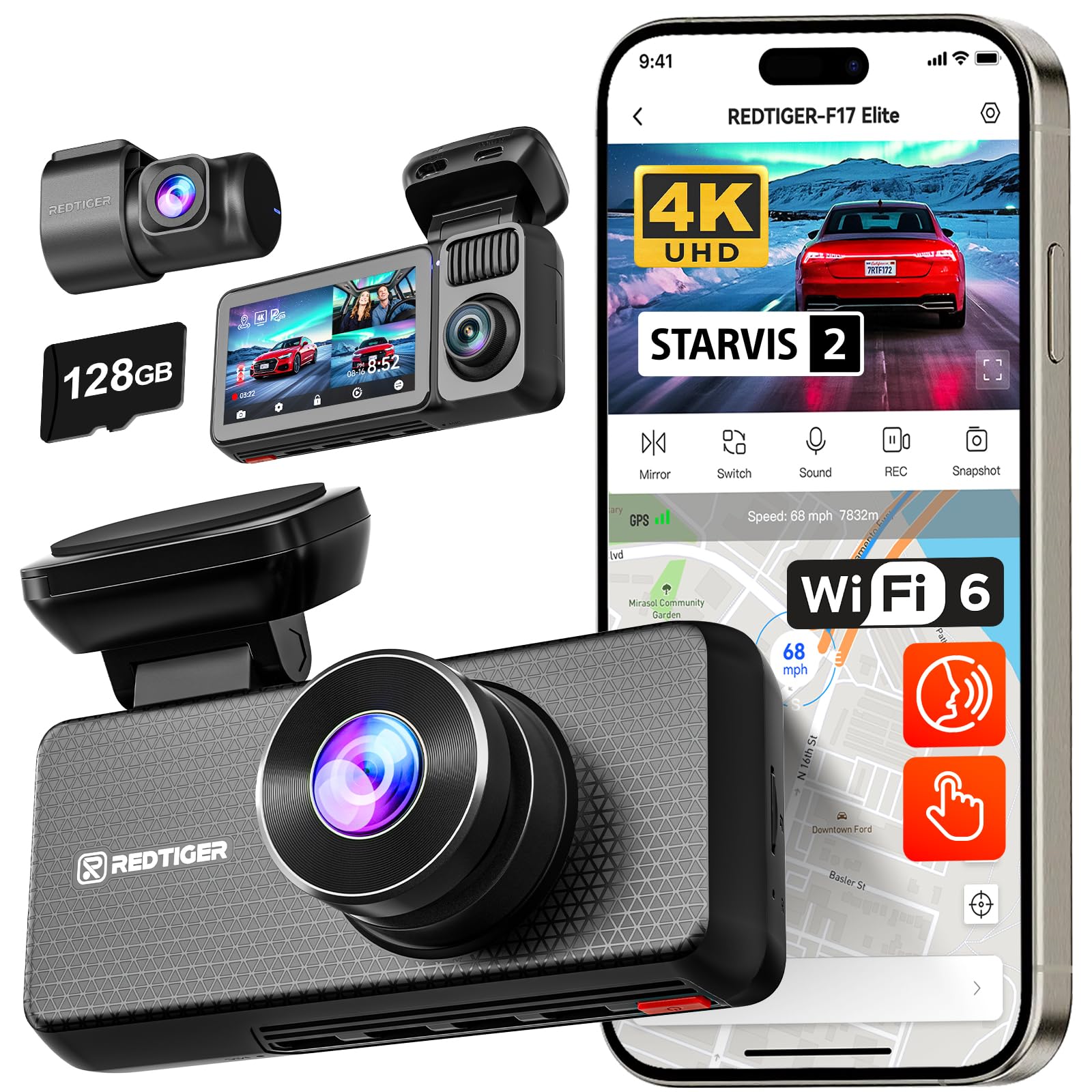
The REDTIGER F17 Elite stands out for combining dual STARVIS 2 sensors—the same IMX678 front and IMX675 rear found in cameras double its price—with a true full-color night vision system that works for both the front and cabin cameras. The front records at true 4K while the rear delivers 2.5K, and the interior camera captures 1080P, making this a strong contender for rideshare drivers who need clear in-cabin footage without relying on infrared black-and-white.
Voice commands and the 5.8GHz Wi-Fi 6 connection allow 30MB/s downloads through the app, which is noticeably faster than the 2.4GHz-only alternatives. Privacy-conscious users will appreciate the ability to toggle the interior camera on and off. The pre-installed 128GB card means you can start recording immediately, and the supercapacitor design avoids battery swelling in hot interiors.
Setup requires routing a rear cable and the adhesive mount may not stick well to certain windshield tints, but the video quality is hard to fault at this price tier. The parking mode uses time-lapse and G-sensor event detection, though the hardwire kit is sold separately. Overall, this is one of the most balanced triple-channel systems currently available.
Why it’s great
- Full-color night vision for front and cabin cameras.
- Fast Wi-Fi 6 (5.8GHz) with app download speeds up to 30MB/s.
- Touchscreen interface and responsive voice control.
Good to know
- Adhesive mount only, no suction cup option included.
- Parking mode hardwire kit not in box.
- Default menu language may need manual adjustment.
2. ROVE R2-4K Dual PRO
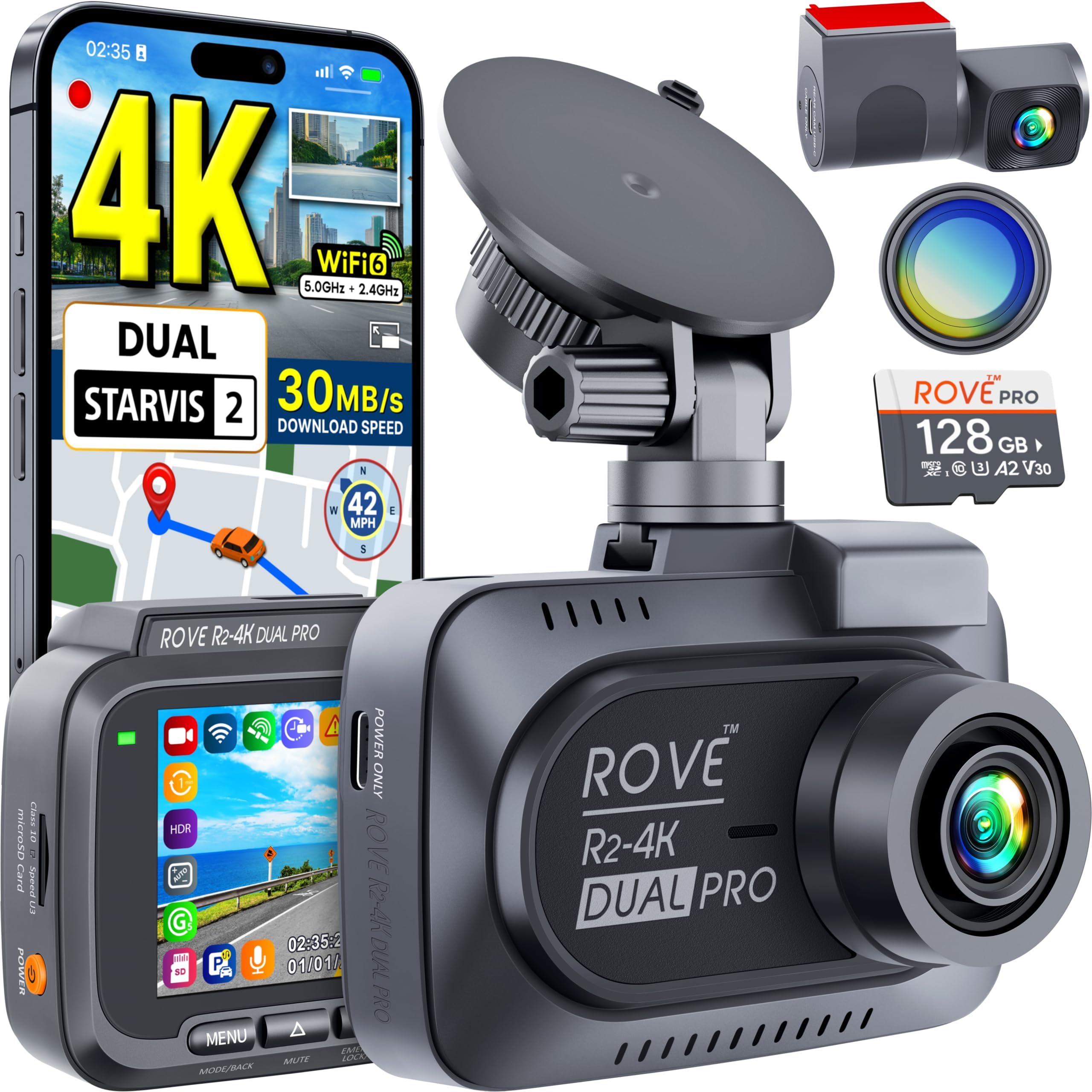
The ROVE R2-4K Dual PRO is the reference standard for a premium two-channel setup. It pairs Sony’s IMX678 sensor (8MP) up front with the IMX675 sensor (5MP) in the rear, delivering true 4K at 30fps up front and 2K at 30fps in the rear. The F1.7 front aperture and F1.55 rear aperture, combined with HDR on both channels, produce stable exposure transitions in tunnels, against headlight glare, and on rainy highways.
Beyond the hardware, ROVE includes a CPL filter to cut windshield reflections and a 128GB PRO microSD card that has been endurance-tested for dash cam use. The dual-band Wi-Fi 6 (5GHz and 2.4GHz) supports downloads at up to 30MB/s, and the quad-mode GPS (GPS, BEIDOU, GALILEO, GLONASS) locks position faster than single-system modules. The ROVE Dash Cam GPS Player software is useful for reviewing trips with full route overlay on a computer.
The 24-hour parking mode offers three options: time-lapse at 1FPS, motion detection, and collision detection. When an event is triggered, the camera stores a 1-minute locked file and gives a voice alert at the next startup. Some users report the rear camera freezing after extended idle periods in cold climates, requiring a reboot, but ROVE’s US-based support team is responsive. The included electrostatic film mounts are a thoughtful touch for owners of rental vehicles or tinted windows.
Why it’s great
- Sony’s two best STARVIS 2 sensors in one box.
- Includes CPL filter and 128GB endurance-tested SD card.
- Fast Wi-Fi 6 with 30MB/s app transfer.
Good to know
- Rear camera may freeze after long idle periods in cold weather.
- Hardwire kit required for parking mode, sold separately.
- App interface takes some time to learn.
3. VIOFO A229 Pro 3CH

The VIOFO A229 Pro is widely regarded as the benchmark for video quality in the triple-channel segment. It applies HDR to all three cameras—front (4K IMX678), rear (2K IMX675), and cabin (1080P STARVIS)—so every channel benefits from expanded dynamic range. The front lens has a circular polarizer included to eliminate windshield glare, and the cabin camera uses infrared LEDs for black-and-white recording in complete darkness.
What sets the A229 Pro apart is its buffering parking mode. The camera pre-records 15 seconds before a detected event and 30 seconds after, ensuring you capture the full context of an incident. The quad-mode GPS module holds stable positioning, and voice control covers 12 commands for hands-free operation. VIOFO’s app, while functional, is best used for settings alignment rather than live streaming, and disabling VPN on your phone is required for app connectivity.
The biggest caveat is that VIOFO does not include a memory card in the box, and the manufacturer recommends using VIOFO-branded industrial endurance microSD cards for reliability. The interior camera cable may be longer than necessary for compact cars, and the ferrite core on the hardwire power cable can create a bulge when routing along the headliner. Despite these small quirks, the A229 Pro remains the choice for those who demand the absolute best image processing across all three channels.
Why it’s great
- True HDR on front, rear, and interior cameras simultaneously.
- Buffered parking mode (15s pre/30s post event).
- Infrared cabin recording for complete darkness clarity.
Good to know
- No SD card included; requires purchase of branded card.
- App requires VPN to be turned off for connection.
- Ferrite core on power cable can be bulky for clean installs.
4. FAIMEE 4K+2K+2K 3 Channel
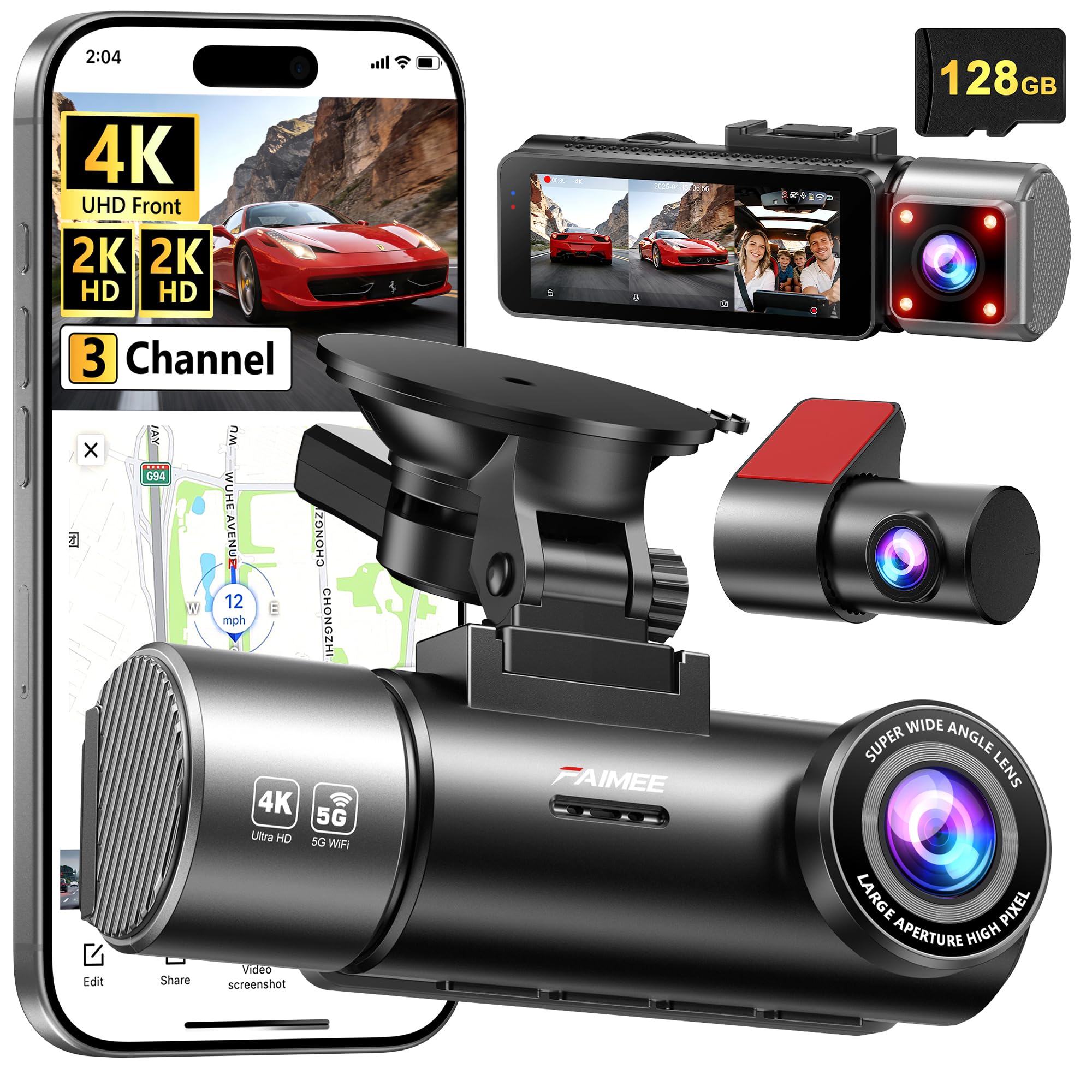
The FAIMEE triple-channel camera brings 4K+2K+2K recording to a price point typically reserved for dual-channel systems. The 170-degree front lens and 150-degree rear lens minimize blind spots, and the F1.8 aperture paired with WDR ensures balanced exposure in high-contrast lighting. The interior camera captures at 2K resolution, which is higher than the 1080P interior found on many competitors.
Out of the box, you get a 128GB high-endurance microSD card, which reduces the total cost of ownership significantly compared to systems that require a separate card purchase. Dual-band Wi-Fi (5.8GHz and 2.4GHz) connects to the FAIMEE app for live view and downloads, and built-in GPS logs speed, route, and coordinates viewable on Google Maps. The compact 3-inch IPS display provides a clear live preview without being intrusive.
The rear camera cable may be too short for full-size SUVs and vans, and the installation instructions are not very detailed. Parking mode requires a hardwire kit (not included). However, the 18-month warranty and 24/7 technical support add confidence for those on a tighter budget who still want full tri-channel coverage. The video quality is very good during the day, with acceptable night performance that is slightly behind STARVIS 2-equipped models.
Why it’s great
- Highest interior resolution (2K) in the mid-range segment.
- Includes 128GB endurance microSD card.
- Dual-band Wi-Fi (5.8GHz) for faster app connection.
Good to know
- Rear camera cable may be short for large SUVs.
- Parking mode hardwire kit not included.
- Menu instructions could be clearer.
5. Pelsee P1 Pro
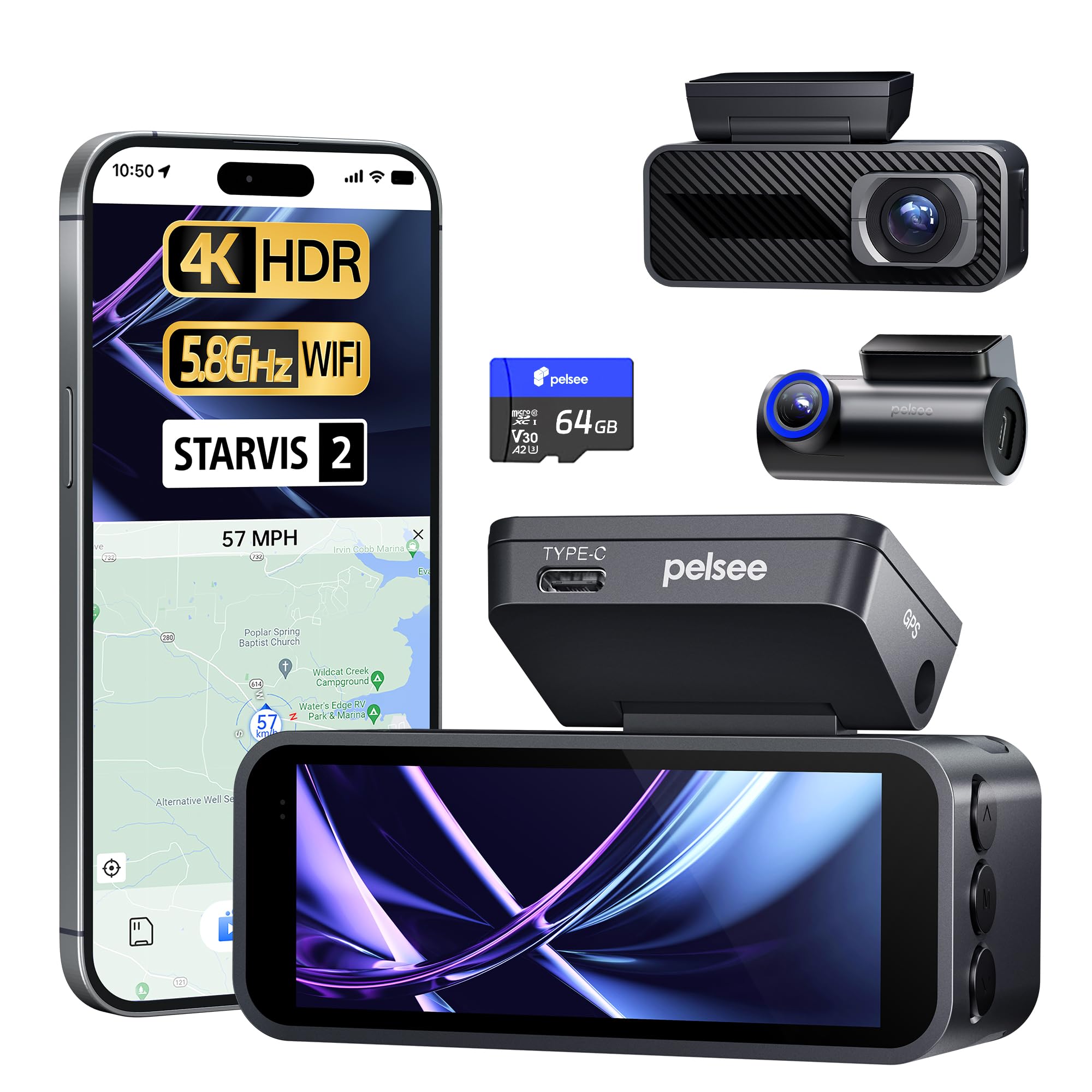
The Pelsee P1 Pro uses a STARVIS 2 sensor in the front camera to achieve full-color night vision in starlight conditions, outperforming typical IR-based systems. The front records 4K with HDR to combat direct sunlight glare, while the rear camera handles WDR for tunnel exit transitions. The large 3.39-inch IPS display makes menu navigation and live preview genuinely useful without squinting.
What sets the P1 Pro apart is the built-in ADAS (Advanced Driver Assistance System) that provides audio and visual warnings for forward collisions, pedestrian detection, lane departure, and front vehicle start. The response time of 0.8 to 2 seconds is fast enough for highway use but not overly sensitive in stop-and-go traffic. Voice control handles eight commands including “Lock the video!” and the noise-canceling microphones filter out road noise effectively.
The 64GB card included in the box is enough for daily commutes but may fill quickly on long road trips at 4K resolution. The lighter adapter on some units has needed replacement due to a loose fit, and the power cables are longer than necessary for compact sedans, making cable tidy-up more work. The 24-hour parking mode works with G-sensor and time-lapse, but again requires a separate hardwire kit.
Why it’s great
- ADAS with forward collision, lane departure, and pedestrian alerts.
- Full-color night vision via STARVIS 2 sensor.
- Large 3.39-inch display for easy live viewing.
Good to know
- Included 64GB card fills quickly at 4K resolution.
- Car charger adapter may have fitment issues on some vehicles.
- Power cables are long and require careful tucking.
6. 70mai T800E (4K HDR)
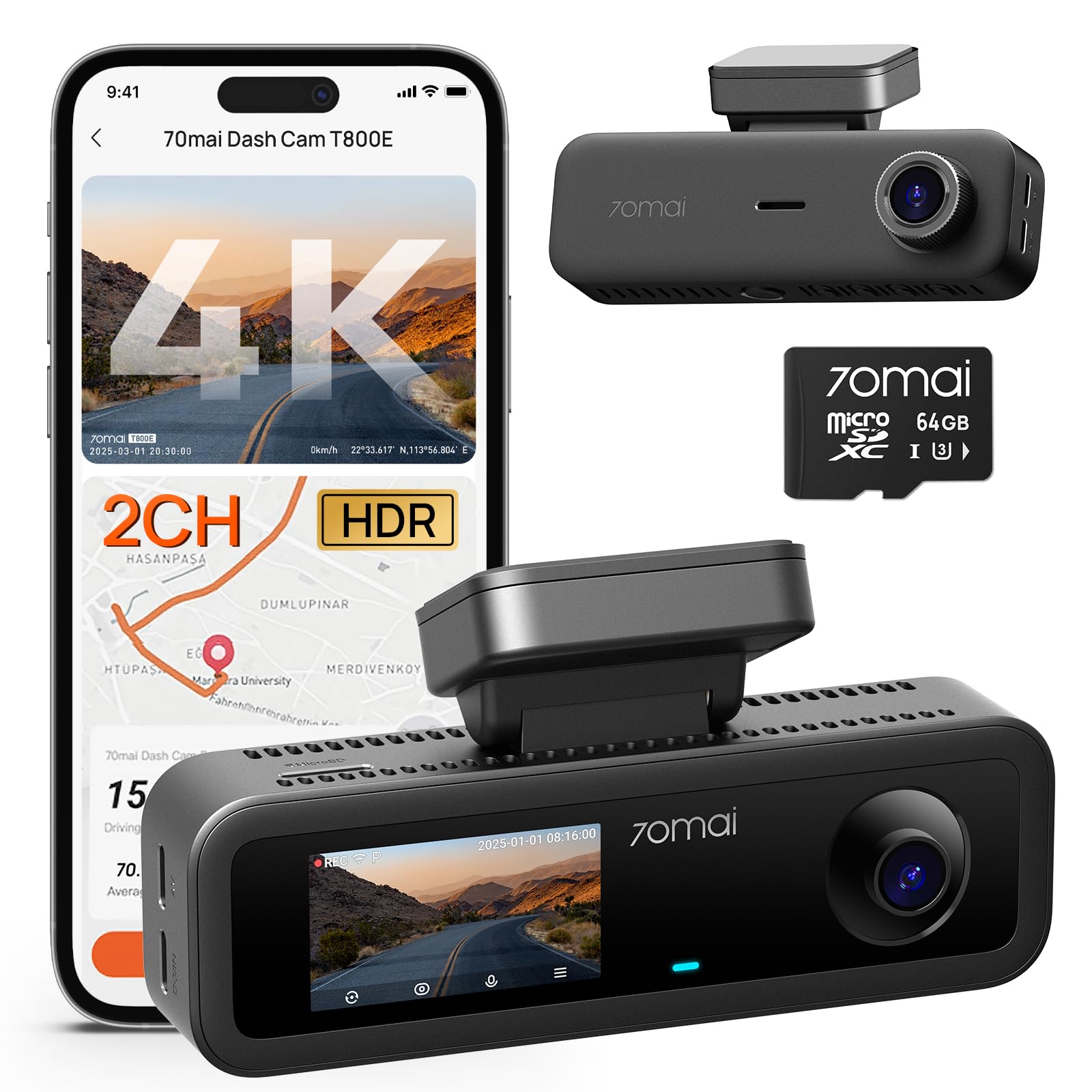
The 70mai T800E is specifically designed for the rideshare and taxi market, pairing a high-aperture 4K front camera (F1.55) with a 1080P interior camera aimed at the cabin. The MaiColor Vivid+ Solution improves color accuracy in mixed lighting, while the 70mai Night Owl Vision mode reduces noise in low-light cabin conditions. The front and interior setup is ideal for drivers who need to document passenger behavior without the complexity of a full tri-channel install.
Wi-Fi 6 provides fast wireless transfers through the app, and voice control allows hands-free operation for locking footage or snapping photos. Built-in GPS logs speed and route data for trip verification. The included 64GB microSD card is sufficient for daily recording, but rideshare drivers may want to upgrade to a larger card for multi-shift coverage. The heat-resistant supercapacitor design improves longevity in hot cars.
App connectivity can be inconsistent, with some users reporting difficulty maintaining a stable connection for live preview. The interior camera does not include infrared LEDs, so low-light cabin footage relies on ambient light or streetlights. For those who prioritize cabin recording for passenger safety over a rear-facing view, this is a streamlined and reliable option that installs in minutes without complex wiring.
Why it’s great
- Large F1.55 aperture for superior low-light front recording.
- Integrated interior camera ideal for rideshare documentation.
- Wi-Fi 6 for fast downloads and voice control for safety.
Good to know
- Interior camera lacks infrared for pitch-black cabin recording.
- App connection sometimes unstable for live preview.
- 64GB card may need upgrading for extended rideshare shifts.
7. FAIMEE 4K+2K Dual Cam
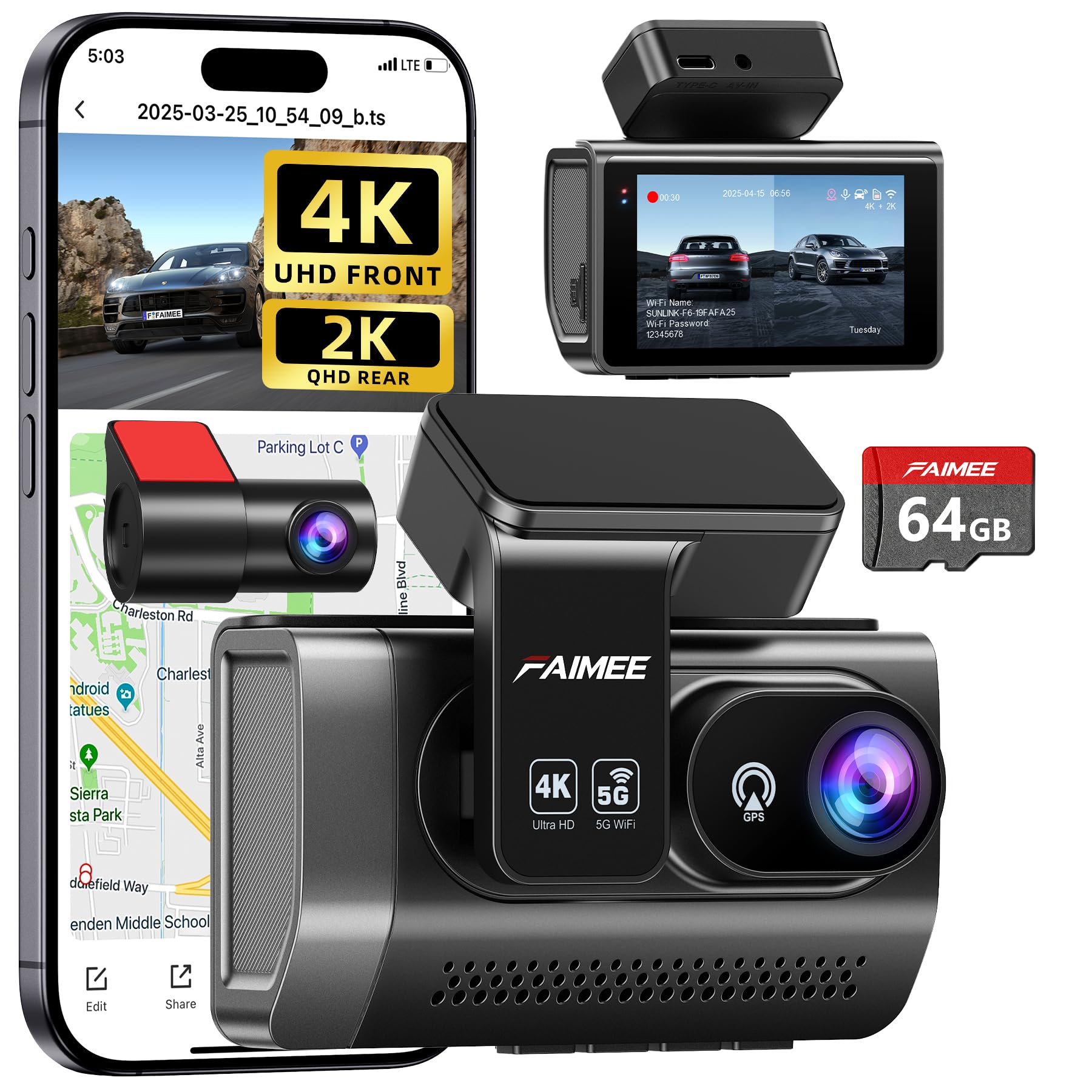
The entry-level FAIMEE dual camera brings 4K front and 2K rear recording with built-in GPS at a price point that undercuts most competitors. The F1.8 aperture and 170-degree wide-angle lenses provide solid coverage of up to six lanes, and WDR handling helps balance overexposed skies and shadowed dashboards. Time-lapse parking mode and G-sensor emergency lock offer basic but functional protection when the car is parked.
A 64GB microSD card is included and ready to record immediately, with support for expansion up to 256GB. Dual-band Wi-Fi (5.8GHz and 2.4GHz) enables app connection for previews and downloads, and the built-in GPS logs speed and location data viewable through the FAIMEE app. The compact 3-inch display tucks behind the rearview mirror without obstructing the driver’s view.
The rear camera cable may be too short for larger vehicles like vans and trucks, and the suction mount, while easy to install, may not feel as secure as adhesive mounts in extreme heat. Night video is acceptable but lacks the fine detail and color accuracy of STARVIS 2-equipped units. For a no-frills entry into dual-camera recording with GPS, this is a functional and affordable starting point.
Why it’s great
- Includes 64GB memory card, no separate purchase needed.
- Built-in GPS logs speed, route, and coordinates.
- Dual-band Wi-Fi (5.8GHz) for faster app connectivity.
Good to know
- Rear camera cable may be too short for larger vehicles.
- Night video quality is decent but behind STARVIS 2 sensors.
- Suction mount may feel less secure than adhesive in high heat.
FAQ
Do I need a hardwire kit for parking mode on a dash cam?
What SD card speed class is required for 4K dash cam recording?
Can a dash cam drain my car battery overnight?
Final Thoughts: The Verdict
For most users, the best dash cam for car winner is the REDTIGER F17 Elite because it delivers full-color night vision, dual STARVIS 2 sensors, and a complete triple-channel setup with a pre-included 128GB card at a price that undercuts premium rivals. If you want the absolute best dual-cam hardware with a CPL filter and the fastest Wi-Fi downloads, grab the ROVE R2-4K DUAL PRO. And for the ultimate in HDR video quality across all three channels and buffered parking recording, nothing beats the VIOFO A229 Pro 3CH.

Mo Maruf
I created WellFizz to bridge the gap between vague wellness advice and actionable solutions. My mission is simple: to decode the research and give you practical tools you can actually use.
Beyond the data, I am a passionate traveler. I believe that stepping away from the screen to explore new environments is essential for mental clarity and physical vitality.