Our readers keep the lights on and my smoothie glass nicely filled. As an Amazon Associate, I earn from qualifying purchases.
A Bluetooth DAC isn’t just a convenience adapter — it’s a dedicated bridge that reclaims the resolution your phone’s headphone jack or your old receiver’s internal conversion discards. The wrong receiver can introduce noise, band-limit your streaming service, or lock you into a single codec. The right one, paired with a clean power supply, will make a album sound like a turntable rig through the same speakers.
I’m Mohammad Maruf — the founder and writer behind WellFizz. I’ve spent hundreds of hours cross-referencing DAC chip datasheets, Bluetooth codec performance reports, and user-verified measurements so you don’t have to sort through the marketing noise yourself.
You need a unit that delivers the right DAC chip, supports your device’s best codec, and matches your output needs (RCA, XLR, balanced headphone out, or optical). This buying guide covers the best dac with bluetooth options across form factors and budgets, with every spec choice explained so you can match a unit to your specific system.
How To Choose The Best DAC With Bluetooth
Three core decisions define every purchase in this category: the DAC chip and its implementation, the Bluetooth codec support, and the output configuration. Ignoring any one of these can strand you with a device that decodes high-res audio but sends it through a noisy analog stage, or pairs perfectly with your phone but has no way to connect to your amplifier.
DAC Chip and Analog Stage Quality
The DAC chip (ESS ES9018K2M, ES9038Q2M, or the dual ES9219C) determines the theoretical ceiling for dynamic range and noise floor. But the implementation — the op-amps, the power filtering, and the PCB layout — determines whether that ceiling is reachable. A device like the Topping DX3pro+ uses an ES9038Q2M with an NFCA amplifier stage, delivering measured THD+N of 0.00013%. A cheaper unit with the same chip but no power regulation can introduce audible hum. Look for units with separate voltage regulators for the digital and analog sections.
Codec Support: LDAC vs. aptX HD vs. AAC
Your listening device dictates which codec matters most. Android phones with Android 8.0+ support LDAC at up to 990 kbps, which is the closest wireless gets to lossless. iPhones are capped at AAC (256 kbps), so an expensive LDAC receiver does nothing for an iPhone user. aptX HD (24-bit/48 kHz) is a middle ground supported by many Android devices and some laptops. The QCC5125 chipset covers all current codecs including aptX Adaptive, which adjusts bitrate dynamically based on signal strength. Always match the receiver’s codec support to your phone or computer, not to the product’s best-sounding spec.
Output Types: RCA, XLR, 4.4mm, Optical
Amplifiers and active speakers typically use unbalanced RCA inputs. If you have a long cable run (over 3 meters) or studio monitors with XLR inputs, a receiver with balanced XLR output (like the blafili B3) eliminates ground-loop hum. Portable units like the FiiO BTR7 and iFi GO blu offer 4.4mm balanced headphone outputs, which double the voltage swing and power output compared to a 3.5mm single-ended jack. If you’re connecting to an older AV receiver with only optical input, choose a unit that includes a Toslink output. Most desktop units also function as USB DACs for a computer, so check for a USB-C or USB-B input if that’s part of your setup.
Quick Comparison
On smaller screens, swipe sideways to see the full table.
| Model | Category | Best For | Key Spec | Amazon |
|---|---|---|---|---|
| Topping DX3pro+ | Desktop DAC/Amp | Critical listening at a desk | ES9038Q2M, 700mW @32Ω, 0.00013% THD+N | Amazon |
| FiiO BTR7 | Portable DAC/Amp | High-impedance headphones on the go | Dual ES9219C, 4.4mm balanced, MQA 8x | Amazon |
| iFi GO blu | Ultra-Portable DAC/Amp | IEMs and easy-driving headphones | Qualcomm 5100, 4.4mm/3.5mm, XBass/XSpace | Amazon |
| blafili B3 | Pro Grade Receiver | Studio monitors with XLR inputs | ES9018K2M, XLR/RCA/Coax/Optical, RP-SMA antenna | Amazon |
| SLASH 3 | Direct Plug RCA | Clean cable-free home stereo upgrade | ESS ES9219 Quad DAC, 130dB SNR, Direct Plug RCA | Amazon |
| 1Mii B06HD+ | Battery-Powered Receiver | Portable receiver with long battery life | ES9018K2M, LDAC 990kbps, 13-hour battery | Amazon |
| FiiO BR13 | Budget Receiver | Entry-level system upgrade on a budget | ES9018K2M, QCC5125, OLED display, EQ presets | Amazon |
In‑Depth Reviews
1. Topping DX3pro+

The Topping DX3pro+ sets the benchmark for a desktop DAC with Bluetooth under . Its ES9038Q2M DAC chip paired with the NFCA amplifier stage delivers dead-neutral reference tuning with THD+N measuring 0.00013%, making it one of the cleanest measuring units in its class. The XU208 USB interface handles PCM up to 384kHz and native DSD256, and the built-in amplifier punches out 700mW into 32Ω — enough to drive 300-ohm Sennheiser HD 600 and even power-hungry planar magnetics like the LCD-X with high gain engaged.
Bluetooth performance is handled by the QCC5125 chipset with full codec support including LDAC, aptX HD, and aptX LL. The remote control gives you volume, input switching, and filter selection without reaching for the desktop unit. Owners consistently report a dead-silent soundstage with ultra-clear stereo separation and no audible noise floor, even with sensitive IEMs. The large dimmable display shows codec and sample rate clearly.
The digital volume control eliminates left-right channel imbalance at low listening levels, a common issue with mechanical potentiometers. The single-ended 6.35mm output covers most headphone connections, but there’s no balanced output option. The included 15V DC power adapter is substantial and ensures clean power delivery. The lack of a 4.4mm balanced output is the only omission for users with balanced cables.
Why it’s great
- Reference-grade audio measurements with dead-neutral tuning
- Powers 300-ohm headphones with authority via high gain
- Full Bluetooth codec support including LDAC
Good to know
- No balanced headphone output (4.4mm or XLR)
- No internal battery — requires wall power
2. FiiO BTR7

The FiiO BTR7 is a portable Bluetooth DAC and headphone amplifier that punches far above its size. It uses dual ES9219C DAC chips — one per channel — paired with a THX amplifier stage that delivers a dead-silent background and drives 300-ohm Sennheiser HD6XX and HifiMan Sundaras with authority. The 4.4mm balanced output provides 320mW into 32Ω, while the 3.5mm single-ended output handles most IEMs easily. It supports Bluetooth 5.1 with every major codec: LDAC, aptX Adaptive, aptX HD, aptX LL, AAC, and SBC.
The XMOS XUF208 chip enables USB DAC mode with PCM up to 384kHz and native DSD256, plus MQA 8x rendering. The internal battery means it doesn’t drain your phone’s battery when used wirelessly. The built-in microphone with cVc 8.0 noise cancellation allows for hands-free calls. Users consistently praise its clean, distortion-free sound that rivals desktop units like the Audioquest Cobalt at half the footprint.
The color display shows codec, sample rate, and volume but the menu system is unintuitive and requires some patience during initial setup. The FiiO Control app offers parametric EQ and gain settings once you learn the navigation. Battery life takes a hit when using the larger color screen compared to older BTR models. Occasional Bluetooth dropouts happen when paired to multiple devices simultaneously.
Why it’s great
- Dual DAC architecture with THX amp for reference sound
- 4.4mm balanced output drives high-impedance headphones
- Supports MQA rendering in USB DAC mode
Good to know
- Menu system is clunky and not intuitive
- Battery life shorter than previous BTR generation
3. iFi GO blu

The iFi GO blu packs Bluetooth 5.1 with aptX Adaptive and LDAC support into a 27-gram aluminum chassis, making it one of the lightest full-featured Bluetooth DAC/amps available. It uses the Qualcomm 5100 series chipset and a separate analog amplifier stage with iFi’s S-Balanced circuitry, which cuts distortion by 50% when using single-ended headphones. The 4.4mm balanced output and 3.5mm single-ended output cover nearly every headphone and IEM configuration, and the analog volume knob provides precise level control without the step changes common in digital volume circuits.
Two signature iFi features — XBass and XSpace — let you add low-end punch and widen the soundstage without digital EQ. The built-in microphone handles hands-free calls clearly, and the battery provides solid run time for a device this small. Owners describe the sound as warm and musical with a wide soundstage, particularly impressive with LDAC from an Android source. The volume knob’s tactile feel and the satisfying click of the buttons contribute to a premium tactile experience.
The GO blu lacks a display entirely — you control everything via the physical buttons and knob, which some users find limiting when trying to check codec or battery status. The included case clip is too short and slides off easily. No USB cable is included in the box. Some users report slight background noise at low volumes with sensitive IEMs, though this was reduced in later firmware updates. The 3.5mm output is sufficient for most IEMs but lacks the raw power of the BTR7 for demanding headphones.
Why it’s great
- Ultra-lightweight at just 27 grams
- Analog volume knob and physical control buttons
- S-Balanced circuitry cuts single-ended distortion
Good to know
- No internal display for codec or status info
- Included case clip is poorly designed
4. blafili B3

The blafili B3 is the only Bluetooth receiver in this roundup with balanced XLR outputs, making it the definitive choice for studio monitors, pro audio gear, and long cable runs. It pairs the ESS ES9018K2M DAC with the Qualcomm QCC5125 chipset and offers LDAC, aptX HD, aptX Low Latency, AAC, and SBC. All four output types — XLR, RCA, coaxial, and optical — are active simultaneously, so you can feed multiple devices without splitting cables. The removable RP-SMA antenna extends range up to 100 feet, and a high-gain replacement can push it even further.
The 1.3-inch display shows codec and connection status behind a protective acrylic window. The unit powers via USB-C, and a custom Bluetooth broadcast name and pairing password feature helps in multi-unit installations — useful for DJs or commercial spaces. The silent pairing mode eliminates loud beeps or voice prompts that announce connection status audibly. Owners praise the rock-solid connection stability and the clean, distortion-free audio quality that rivals wired connections in blind testing.
The XLR outputs are split left and right individually — there is no single stereo XLR send, so you’ll need two XLR cables for a stereo signal. The optical port is output-only, not input, so you cannot connect a TV’s optical output to this unit. The USB DAC mode is limited to 16-bit 48kHz, not full 24-bit 192kHz. No power adapter is included, only a USB cable. The unit also lacks Wi-Fi streaming — it’s Bluetooth and USB audio only.
Why it’s great
- Balanced XLR outputs eliminate ground loop hum
- Removable antenna allows range extension
- All four outputs active simultaneously
Good to know
- USB DAC limited to 16-bit 48kHz
- Optical port is output only, not input
5. SLASH 3
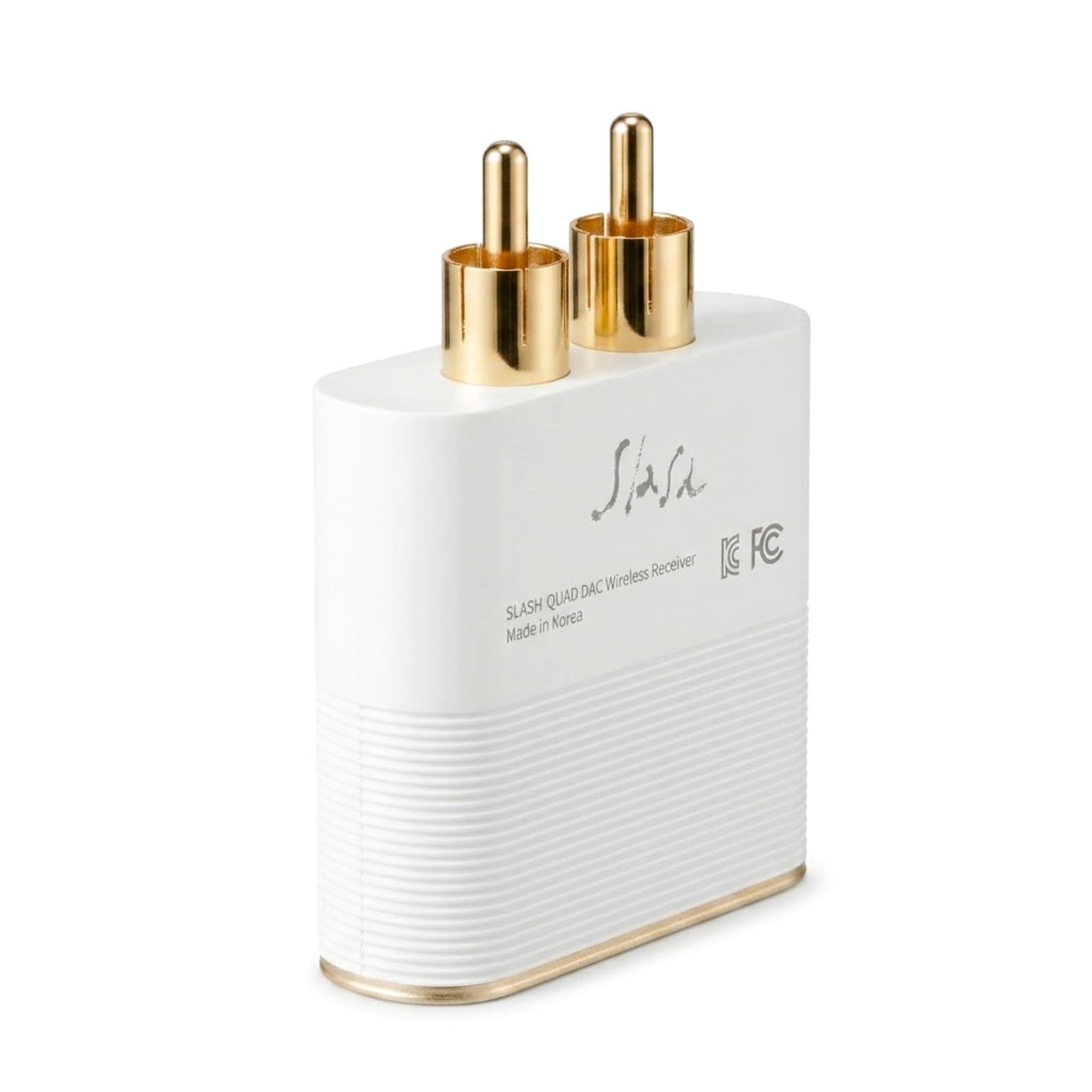
The SLASH 3 takes a unique approach by offering a Direct Plug RCA design that connects straight into your amplifier’s RCA inputs without any cable between the unit and the amp. This eliminates a potential noise source and keeps the setup clean, which is especially useful behind a desk or in commercial environments. It uses the ESS ES9219 Quad DAC and the Qualcomm QCC5125 chipset, delivering a 130dB signal-to-noise ratio — among the highest in this roundup. The codec support covers LDAC (24-bit/96kHz), aptX Adaptive, and aptX HD.
Setup is genuinely plug-and-play with no app required: pair via Bluetooth and the unit auto-reconnects on return. The aluminum panel and high-purity copper RCA connectors feel solid, and the South Korean manufacturing points to careful quality control. Owners who have compared it side-by-side with cheaper competitors consistently note superior dynamics and electric guitar presence in blind listening tests, especially with LDAC from Android. The included RCA extension cable offers flexibility if your amplifier’s RCA jacks are recessed.
Performance noticeably improves when paired with a 5V linear power supply instead of the included USB-C power — bass tightens and the noise floor drops further. The unit is not rechargeable, so it requires constant USB power, limiting portability. Switching between paired devices can be slow, requiring manual reconnection. The direct plug design means it may physically block adjacent RCA inputs on some amplifiers.
Why it’s great
- Cable-free Direct Plug design reduces noise
- 130dB SNR with ESS Quad DAC
- Made in South Korea with premium build quality
Good to know
- Requires USB power constantly — not rechargeable
- Device switching can be slow
6. 1Mii B06HD+
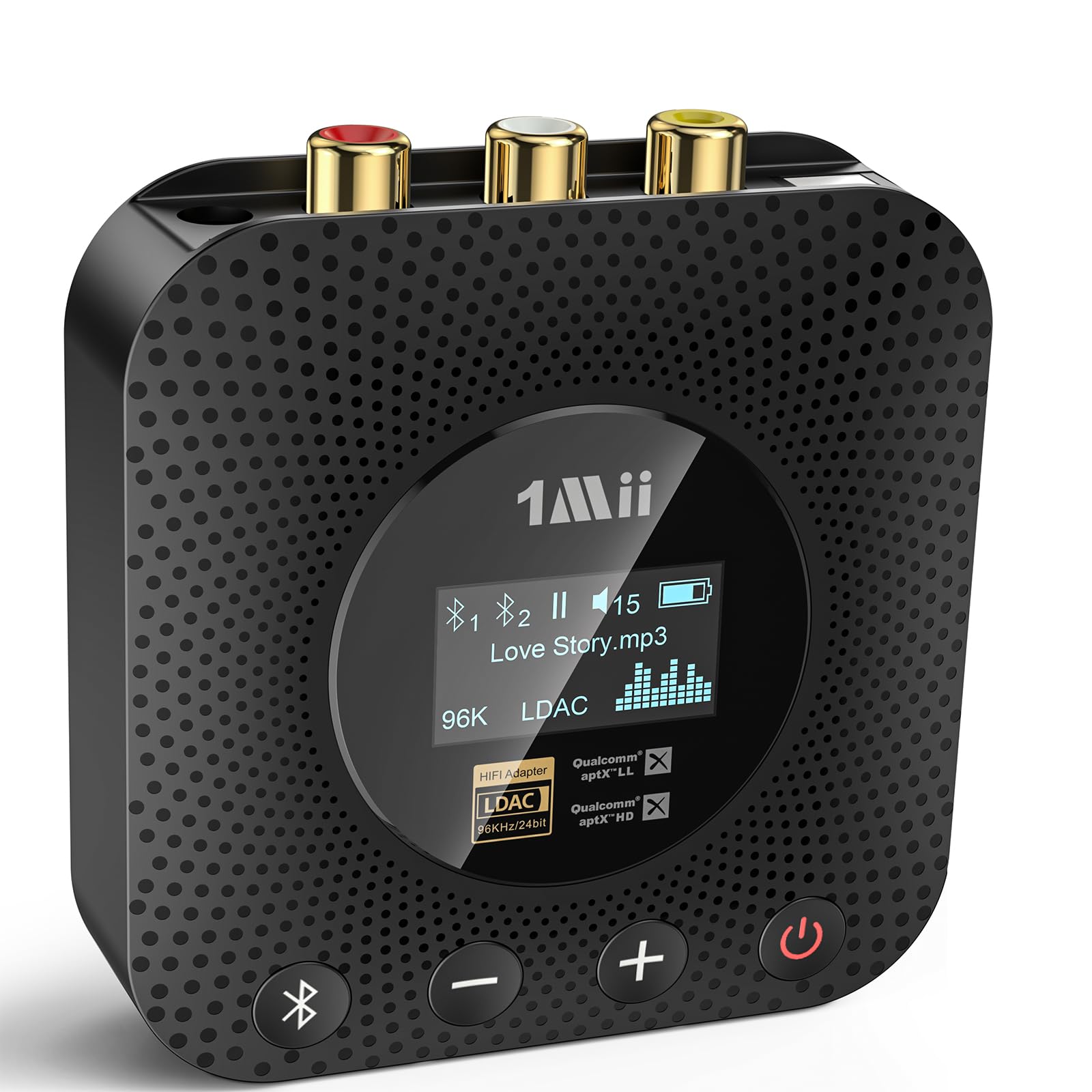
The 1Mii B06HD+ delivers the same ES9018K2M DAC and QCC5125 chipset found in receivers costing twice as much, but adds a built-in rechargeable battery that offers 13 hours of playtime. This makes it the most portable standalone receiver in the roundup — you can move it from a living room stereo to a workshop speaker setup without a power outlet. The OLED screen shows the song name, sampling rate, codec in use, and battery level. Codec support includes LDAC at 990 kbps, aptX HD, aptX Low Latency, and AAC.
The output options cover RCA analog, optical Toslink, and coaxial digital, giving you flexibility for connecting to vintage receivers, modern AV amps, or powered studio monitors. The push-button controls allow track skipping and volume adjustment directly on the unit. Bluetooth range extends up to 50-80 feet indoors. Owners consistently report excellent sound quality that matches vinyl in clarity, with clear highs and tight bass, and describe the build as sturdy with a well-laid-out interface.
The unit has an auto power-off feature after 10 minutes of idle time — intended to save battery, but frustrating when using a switched outlet on a receiver because the unit powers off rather than staying on standby. The auto-shutdown requires a manual button press to reconnect. Some users report faint hum when using RCA output on vintage tube amplifiers, though digital optical output eliminates this. No power adapter is included, only a USB-C cable.
Why it’s great
- Built-in rechargeable battery for portable use
- Full codec support including LDAC
- Clear OLED display shows codec, sample rate, battery
Good to know
- Auto power-off after idle can be disruptive
- Faint hum on vintage RCA-only systems
7. FiiO BR13

The FiiO BR13 is the entry point for anyone wanting to add Bluetooth to an older receiver without spending more than necessary. It uses the ESS ES9018K2M DAC with the Qualcomm QCC5125 chipset — the same DAC/Bluetooth pairing found in units costing twice as much. It supports all seven common codecs: LDAC, aptX HD, aptX Low Latency, aptX, AAC, SBC, and MP3. The OLED display shows codec and volume, and the included FiiO Control app allows 7 preset EQ curves plus 2 customizable ones. The USB, optical, coaxial I/O offers flexible connectivity in a compact aluminum chassis.
The BR13 also serves as a SPDIF converter, allowing coaxial-to-optical or optical-to-coaxial conversion with bypass mode. The dual device pairing works seamlessly — reviewers report smooth transitions between an Apple TV (using AAC) and an Android phone (using aptX) without manual reconnection. The OTA firmware updates add features over time, including screen protection settings. The metal case and clear LCD screen give it a premium feel that contradicts its price point.
Build quality is the main concern — multiple reports of the power button failing after 1-2 months of use, with the unit becoming stuck on or completely dead. This suggests a switch quality issue rather than a circuit failure. The app crashes on initial use and requires a firmware update via PC to stabilize. The unit ships with only a USB cable; you need to supply an audio cable (RCA, optical, or coaxial) and a 5V power brick separately. The low noise floor is excellent for the price, but the power button reliability is a real risk.
Why it’s great
- Same core DAC and chipset as much pricier competitors
- App-controlled 10-band EQ with presets
- Dual Bluetooth device pairing with seamless switching
Good to know
- Power button reliability issues reported
- Requires separate audio cables and power brick
FAQ
Does LDAC work with iPhone?
Can I use a Bluetooth DAC with a TV that has only optical output?
Is there a difference in sound quality between XLR and RCA output?
Final Thoughts: The Verdict
For most users, the best dac with bluetooth winner is the Topping DX3pro+ because it combines reference-grade measurement performance, full LDAC support, and enough amplifier power for demanding headphones in a clean desktop package. If you need portable power for high-impedance headphones on the go, grab the FiiO BTR7. And for connecting a Bluetooth source to a professional setup with XLR inputs, nothing beats the blafili B3.

Mo Maruf
I created WellFizz to bridge the gap between vague wellness advice and actionable solutions. My mission is simple: to decode the research and give you practical tools you can actually use.
Beyond the data, I am a passionate traveler. I believe that stepping away from the screen to explore new environments is essential for mental clarity and physical vitality.