Our readers keep the lights on and my smoothie glass nicely filled. As an Amazon Associate, I earn from qualifying purchases.
Your in-ear monitors are only as good as the signal feeding them. Plugging high-sensitivity IEMs into a noisy phone jack or a bargain-basement dongle introduces hiss, compresses the soundstage, and buries the micro-details you paid for. A dedicated DAC bypasses that internal audio circuitry and delivers a cleaner, more powerful signal tailored to the low-impedance, high-sensitivity nature of IEMs.
I’m Mohammad Maruf — the founder and writer behind WellFizz. I’ve spent hundreds of hours analyzing DAC chipsets, output impedance specs, and noise floor measurements to separate true hi-fi upgrades from marketing fluff in this specific category.
Whether you want to eliminate background hiss, unlock balanced output, or simply hear your favourite tracks with proper separation, choosing the right dac for iems is the single most impactful upgrade you can make to your portable listening setup.
How To Choose The Best DAC For IEMs
IEMs are uniquely sensitive to the source. Their low impedance and high efficiency mean they pick up every flaw in the audio chain — hiss, distortion, channel imbalance. Choosing the right DAC means prioritizing specs that matter for IEMs, not just raw wattage.
Output Impedance and Noise Floor
A DAC’s output impedance should be near zero — ideally under 1 ohm — to avoid altering the frequency response of your IEMs. High output impedance can boost bass unpredictably or roll off treble. Equally important is the noise floor: a quiet background lets you hear reverb tails and subtle decays without a constant hiss layer.
Balanced vs. Single-Ended Output
A 4.4mm balanced output doubles the voltage swing and typically halves crosstalk, giving you a wider, more three-dimensional soundstage. Many IEMs, especially multi-driver hybrids, benefit from the lower noise floor and added headroom of a balanced connection. If you plan to upgrade your cable, a balanced-capable DAC future-proofs your setup.
DAC Chipset and Power Delivery
The chipset dictates decoding capability and tonal character. Cirrus Logic CS43198 and ESS ES9038Q2M are two common flagships found in this space — each has a distinct house sound (warmer vs. more analytical). Power matters less for most IEMs (30–80mW is usually plenty), but having extra headroom ensures clean transients without clipping on dynamic tracks.
Quick Comparison
On smaller screens, swipe sideways to see the full table.
| Model | Category | Best For | Key Spec | Amazon |
|---|---|---|---|---|
| Moondrop Dawn Pro 2 | Mid-Range | Customizable EQ on the go | Dual CS43198, 124mW@4.4mm | Amazon |
| Questyle M12i | Mid-Range | Ultra-low noise floor | ESS ES9281AC, noise< -130dB | Amazon |
| Fosi Audio DS1 | Mid-Range | High-power balanced output | ES9038Q2M, 220mW@4.4mm | Amazon |
| Surfans X10 | Premium | OLED screen + physical controls | ES9028Q2M, 522mW@4.4mm | Amazon |
| Protocol Max | Premium | 10-band parametric EQ | Dual CS43198, 600mW@4.4mm | Amazon |
| Questyle M15C | Premium | Smooth, non-fatiguing sound | Quad CMA engines, 4.4mm/3.5mm | Amazon |
| FiiO JadeAudio KA1 | Entry-Level | Budget-friendly entry point | 32bit/384kHz, MQA 8x rendering | Amazon |
In‑Depth Reviews
1. Moondrop Dawn Pro 2
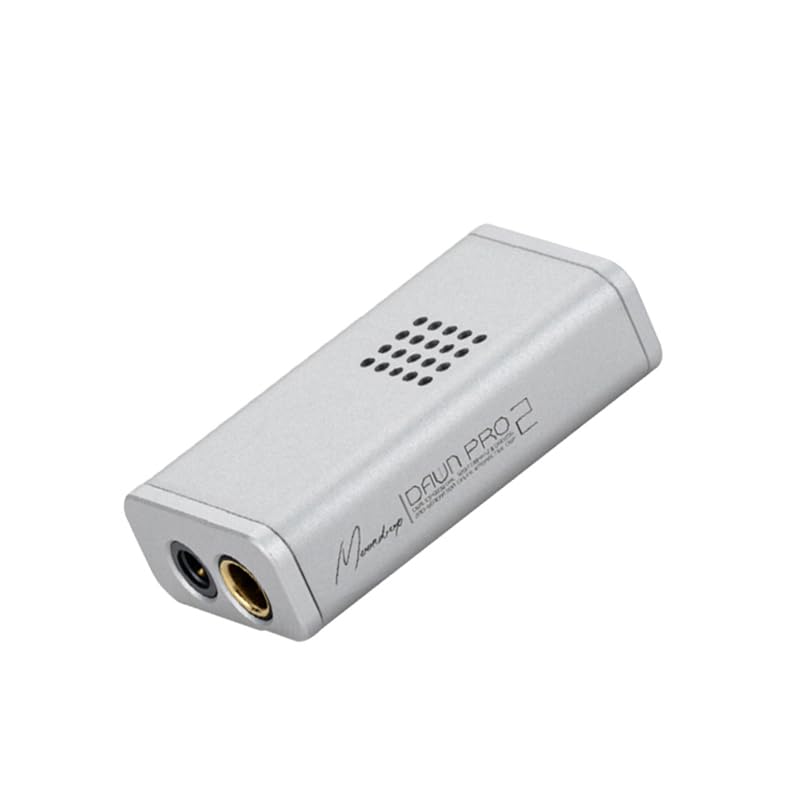
The Moondrop Dawn Pro 2 packs dual Cirrus Logic CS43198 DAC chips into a compact aluminium body, delivering 124mW per channel through its 4.4mm balanced output. This power level is more than sufficient for the vast majority of IEMs on the market, providing clean headroom without wasted heat. The independent crystal oscillator architecture keeps jitter low, preserving the micro-detail retrieval that makes high-end IEMs shine.
What sets the Dawn Pro 2 apart is its app-based parametric EQ, which allows you to tune the frequency response directly on the device. The 100-level volume control operates independently from your phone, preventing the signal compression common with digital volume sliders. The aviation-grade aluminium housing doubles as a heat sink, keeping the dual DACs stable during extended listening sessions.
Owners praise its synergy with IEMs like Kiwi Ears and Monarch MkII, noting a clean, slightly warm signature that balances detail with musicality. The stock sound is satisfying out of the box, but the EQ gives you the freedom to experiment without buying new hardware. For most IEM users, this is the one DAC that does everything well at a mid-range price point.
Why it’s great
- Dual CS43198 chips provide exceptional clarity and low distortion
- App-based 100-level volume control prevents signal compression
- Compact metal build with effective heat dissipation
Good to know
- EQ resets to factory when unplugged, requiring re-application
- No Lightning cable included for iPhone users
- Some units report finicky 4.4mm connection requiring careful seating
2. Questyle M12i

The Questyle M12i is built around the ESS ES9281AC flagship DAC and uses Questyle’s patented Current Mode amplifier technology to achieve a noise floor below -130dB. For IEM users, this is the single most important metric — it means the background stays absolutely silent, letting you hear reverb tails and low-level detail without any hiss. This is a critical advantage for multi-driver and electrostatic IEMs that are extremely sensitive to source noise.
MFi certification ensures seamless integration with iOS devices, meaning no driver hassles, no power negotiation glitches, and full support for high-resolution playback on iPhone and iPad. The 3.5mm output delivers clean, controlled power tailored to low-impedance loads, and the volume/track buttons on the cable work natively with most IEM cables. The build is all-metal and weighs next to nothing at roughly 10 grams.
Reviewers consistently call it a noticeable step up from the FiiO KA11, with cleaner mids and a more open/airy presentation. It pairs particularly well with Shure Aonic 4 and UM Mest MK2. The only quirk is a slight fade-in effect when starting playback, which skips the first ~2 seconds of a track. If that doesn’t bother you, this is an ultra-clean DAC for IEMs at a compelling price.
Why it’s great
- Ultra-low noise floor (-130dB) ideal for sensitive IEMs
- MFi certified for flawless iOS compatibility
- Punches above its price, often compared to more expensive DACs
Good to know
- Fade-in effect skips the first ~2 seconds of each song
- Reports of weak solder joints on some units after a few months
- Noticeable battery drain on smartphones at higher gain
3. Fosi Audio DS1

The Fosi Audio DS1 uses the flagship ESS ES9038Q2M DAC chip and delivers up to 220mW of clean power through its 4.4mm balanced output — notably more than many competitors at a similar price. This extra headroom is useful for IEMs with higher impedance (like 150 ohm models) where voltage swing matters as much as current. The THD+N rating sits below 0.0006%, meaning vanishingly low distortion even at high volumes.
Dual outputs — 3.5mm single-ended and 4.4mm balanced — give you flexibility with different cables. The volume rocker allows local control independent of the source, and the signal-to-noise ratio exceeds 120dB. The aluminium housing stays cool at 32-bit/384kHz, though some users report it heats up noticeably during extended use. A USB-A converter is included for desktop use.
Listeners describe the sound as crisp highs, forward mids, and fast, tight bass with excellent separation. It’s an analytical presentation that reveals mistakes in poorly mastered tracks, so it suits critical listeners rather than casual background listening. The main caveat is compatibility: some Android phones (Google Pixel 8) have reported static or disconnection issues, so check your device before buying.
Why it’s great
- 220mW balanced output drives demanding IEMs and headphones
- ES9038Q2M chip delivers detailed, analytical sound
- Local volume rocker prevents signal compression from source
Good to know
- Runs hot during extended use
- Incompatible with some Android phones (Pixel 8 reported)
- Volume control lacks a visual indicator
4. Surfans X10
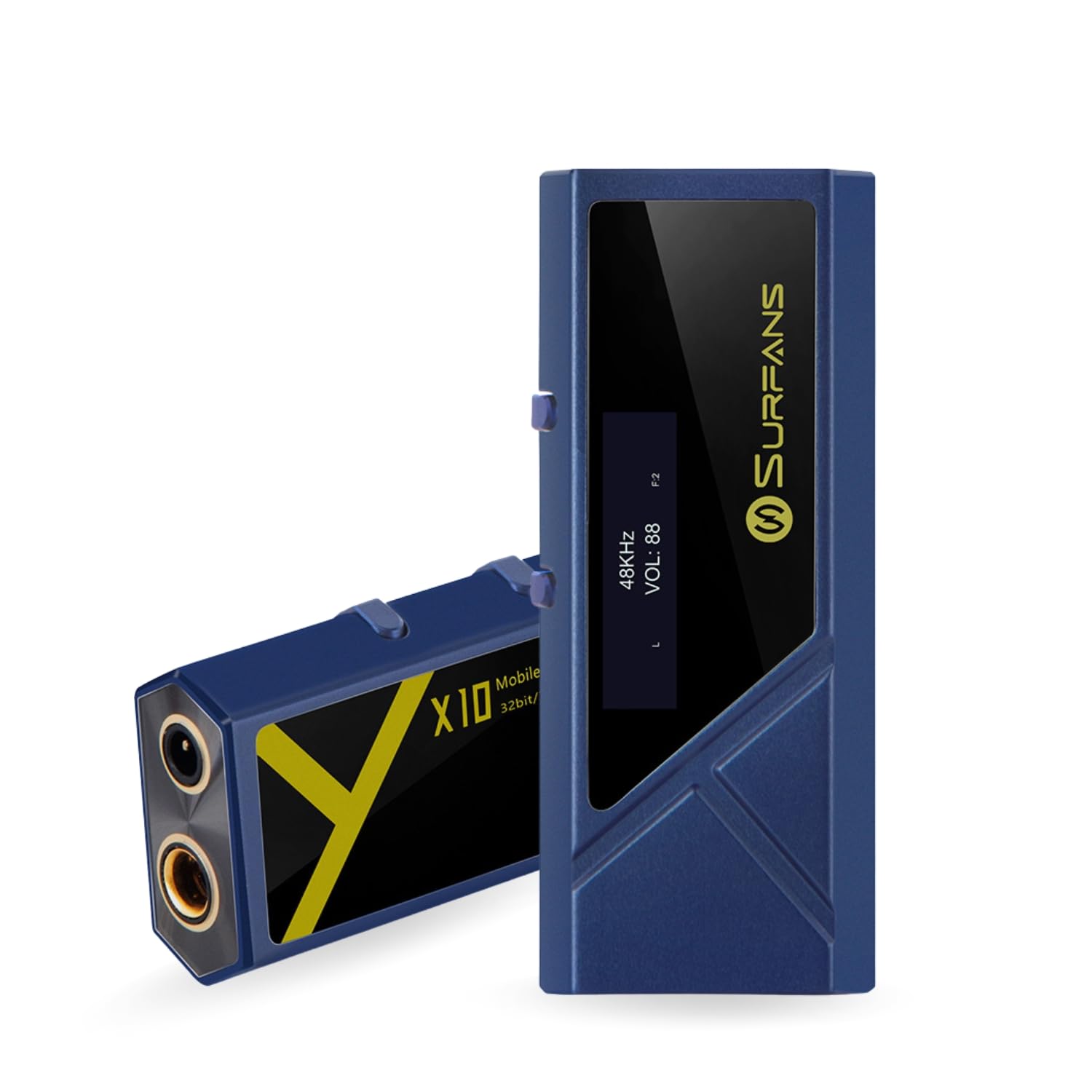
The Surfans X10 is a versatile USB-C dongle that combines an ES9028Q2M DAC with an ES9603Q amplifier, capable of 522mW through its 4.4mm balanced output. That’s enough power to drive not only sensitive IEMs but also full-size headphones like the Sennheiser HD600 with ease. The 0.87-inch OLED screen displays sample rate, gain mode, and digital filter settings — a rare convenience for a dongle DAC.
Physical buttons let you adjust gain (high/low) and switch between five digital filters (fast roll-off, slow roll-off, etc.) to tailor the sound signature. The aluminium body stays portable, and the blue anodized finish adds a visual flair without feeling cheap. No battery is required — it draws power from the USB-C connection. Plug-and-play compatibility spans Android, iOS (USB-C), Windows, and macOS.
Reviewers mention that the X10 reveals details previously masked by weaker sources, with tight bass and excellent instrument separation. The soundstage is described as clean but slightly narrower than some rivals, and the slow roll-off filter is preferred by those who want a more analog-like presentation. For IEM users who also occasionally drive over-ear headphones, the X10 offers rare flexibility in a tiny package.
Why it’s great
- 522mW balanced output drives IEMs and full-size headphones
- OLED screen with gain and filter controls
- Compact aluminium design with plug-and-play setup
Good to know
- Soundstage is narrower than some premium competitors
- Not all phones deliver full power via USB-C
- Some users prefer alternative filter settings out of the box
5. Protocol Max
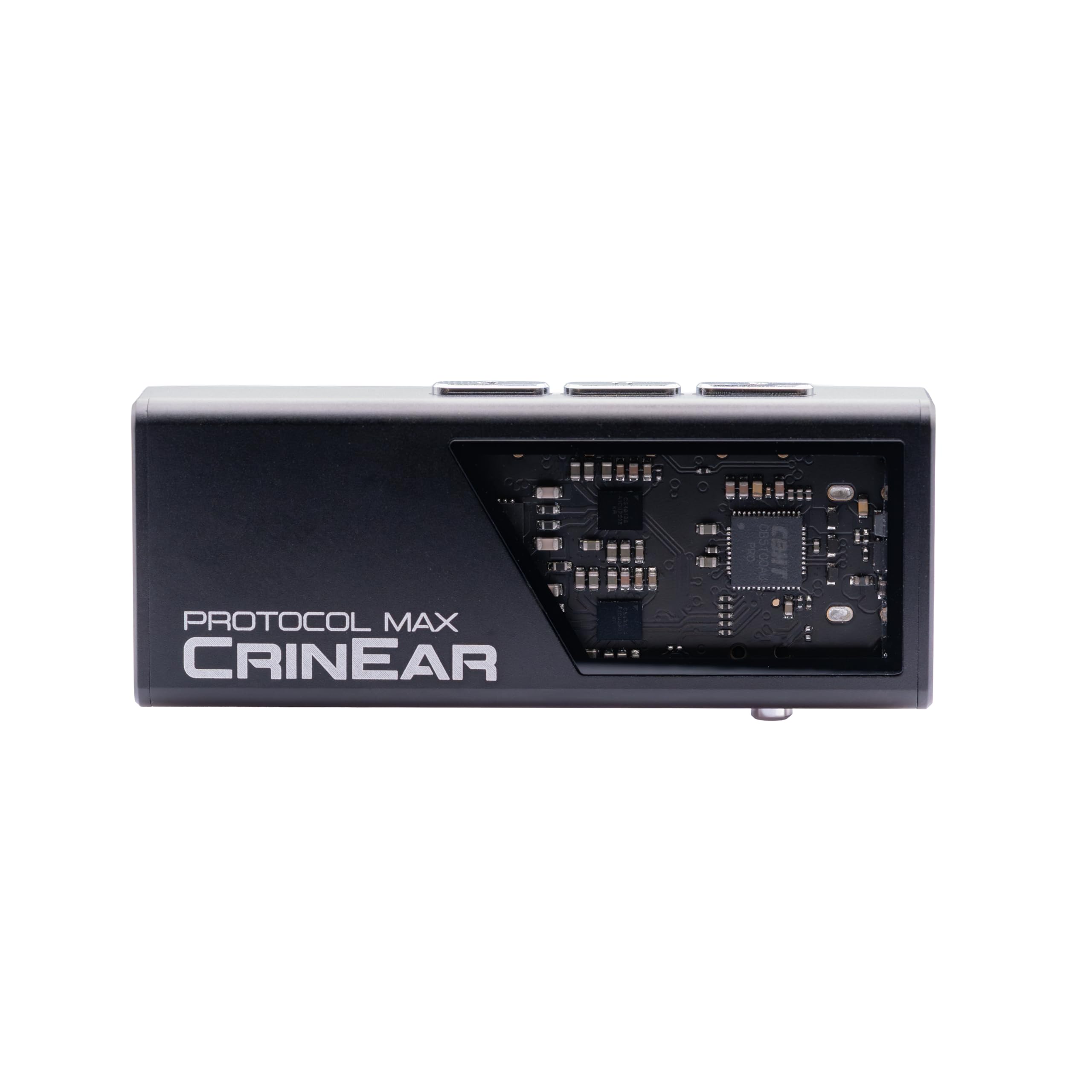
The Protocol Max from CrinEar is a serious tool for IEM enthusiasts who want full control over their sound. It features dual Cirrus Logic CS43198 DAC chips paired with dual SG Micro SGM8262-2 operational amplifiers, delivering up to 600mW through the 4.4mm balanced output. That’s enough to drive even power-hungry IEMs like the Monarch MkII or full-size headphones like the HD 650 to deafening levels with headroom to spare.
The headline feature is the 10-band parametric EQ, which is configured via a browser-based interface on your PC. You can dial in precise frequency adjustments, save profiles directly to the device, and apply them without any app running. This essentially lets you tune any IEM to match your preferred target curve — Harman, diffuse-field, or your own custom target — without buying new hardware. Dual power modes (Eco and Boost) let you balance battery draw against output performance.
Users report that the Protocol Max transforms the listening experience by cleaning up the bass region and eliminating muddiness. The PEQ is a genuine game-changer for those who want to experiment with different sound signatures. However, the setup process is clunky — there is no mobile app, and the documentation is sparse. The unit also draws significant power from the phone battery, and some early units had quality control issues with buzzing or static.
Why it’s great
- 10-band PEQ allows precise sound tuning saved to device
- 600mW balanced output drives even the most demanding IEMs
- Eco/Boost modes give flexibility for battery conservation
Good to know
- No mobile app, EQ setup requires a PC browser
- Significant battery drain on smartphones
- Quality control reported as inconsistent across units
6. Questyle M15C

The Questyle M15C uses four Current Mode Amplifier (CMA) engines to deliver a smooth, rich, and musical sound that stands apart from the more analytical DACs in this category. It supports PCM up to 32-bit/384kHz and DSD256, with both 3.5mm single-ended and 4.4mm balanced outputs. The gain switch (standard/high) adapts the output to the sensitivity of your IEMs, making it easy to avoid hiss with ultra-sensitive models.
MFi certification ensures seamless iOS compatibility, and the compact housing is built to Questyle’s typically high standards — all-metal, no sharp edges, with a braided USB-C cable that resists tangling. The sound signature is described as warm and engaging without dulling detail, making it ideal for long listening sessions where treble fatigue is a concern. It pairs especially well with Hifiman planar IEMs and Audeze models.
Reviewers consistently praise the M15C for reducing digital harshness, cleaning up muddiness, and improving voice clarity on tracks from the 80s and modern high-bitrate streams alike. The main drawback is that some users report intermittent disconnections on certain devices (phone, tablet, or PC), which may require an exchange. If you get a functional unit, the M15C offers a forgiving, fatigue-free presentation that makes it a top pick for all-day listening.
Why it’s great
- Warm, smooth sound that reduces digital fatigue
- Quad CMA engines deliver clean power with low distortion
- MFi certified for plug-and-play iOS integration
Good to know
- Some units experience intermittent disconnection issues
- Sound may be too warm for those seeking analytical detail
- Less powerful than the Questyle M15i for over-ear headphones
7. FiiO JadeAudio KA1

The FiiO JadeAudio KA1 is a tiny USB-C dongle — just 43x15x8mm and 10 grams — that supports PCM up to 32-bit/384kHz and DSD512, plus MQA 8x rendering for Tidal users. It uses a single DAC chip (the exact model is notably unspecified, but decoding performance is solid for the price). The 3.5mm output is single-ended only, making this a straightforward entry point into high-resolution portable audio.
The aluminium body feels premium for its size, and the braided cable adds durability. It draws power from the connected device and works with Android, Windows, and Mac out of the box — though iOS requires a Lightning-to-USB-C adapter. Reviewers note a clear improvement over standard phone dongles, with better soundstage, natural bass, and overall clarity. It drives IEMs and mid-range headphones like the ATH-M50x and Sennheiser 560s well without needing to max the volume.
The biggest trade-off at this price point is build fragility — several owners report the cable failing at the connector after months of use. The KA1 also runs warm at high sample rates, and the lack of a balanced output means you can’t take advantage of 4.4mm IEM cables. Still, as a low-cost way to hear what a dedicated DAC can do for your IEMs, the KA1 is an honest performer that punches above its weight for the first few months of ownership.
Why it’s great
- Noticeable soundstage and clarity improvement over phone dongles
- Extremely compact and lightweight at 10 grams
- MQA 8x rendering for lossless Tidal streaming
Good to know
- Cable is fragile and prone to failure at the connector
- Single-ended 3.5mm only, no balanced 4.4mm option
- Runs warm at high sample rates during extended use
FAQ
Do I need a balanced DAC for my IEMs?
What is the ideal output impedance for IEMs?
Can a DAC make my cheap IEMs sound much better?
Does MQA support matter for streaming on Tidal?
Final Thoughts: The Verdict
For most users, the dac for iems winner is the Moondrop Dawn Pro 2 because it combines dual flagship DAC chips, a built-in parametric EQ, and a clean balanced output in a compact, well-cooled chassis that works across phones and computers without compromise. If you want an ultra-low noise floor and flawless iOS compatibility, grab the Questyle M12i. And for full EQ customization plus raw power to drive any IEM and many full-size headphones, nothing beats the Protocol Max.

Mo Maruf
I created WellFizz to bridge the gap between vague wellness advice and actionable solutions. My mission is simple: to decode the research and give you practical tools you can actually use.
Beyond the data, I am a passionate traveler. I believe that stepping away from the screen to explore new environments is essential for mental clarity and physical vitality.