Our readers keep the lights on and my smoothie glass nicely filled. As an Amazon Associate, I earn from qualifying purchases.
Your PC’s internal sound card is a noise factory. Electrical interference from the motherboard, GPU coil whine, and cheap capacitors inject a layer of mud and hiss into every track and every footstep. A dedicated external DAC bypasses that polluted internal circuit entirely, while a built-in headphone amplifier supplies the clean current your headphones actually need to produce their intended frequency response and dynamic swing.
I’m Mohammad Maruf — the founder and writer behind WellFizz. I’ve spent hundreds of hours analyzing DAC chip architectures, amplifier topologies, output impedance curves, and noise-floor measurements across the desktop audio category to separate genuinely engineered products from marketing fluff.
Whether you drive sensitive IEMs or hungry 600-ohm planars, selecting the right dac and amp for pc means matching real measured output power to your headphone impedance and understanding which digital-to-analog conversion circuit fits your sonic priorities.
How To Choose The Best DAC And Amp For PC
The desktop DAC and amp market has matured rapidly. What once required a stack of two separate boxes now fits inside a single chassis smaller than a paperback. But compact size does not automatically equal good performance. Before you click buy, you need to understand three core parameters that define every product in this category.
Output Power and Headphone Impedance Matching
Milliwatts per channel at a given impedance is the only honest power spec. A unit rated 280mW into 32Ω will drive most desktop over-ear headphones to satisfying levels. But if you own high-impedance headphones like the Sennheiser HD 600 series (300Ω) or Beyerdynamic DT 990 (250Ω), you need a unit that delivers at least 50mW into 300Ω to avoid a thin, anemic sound. Check the manufacturer’s specification table — not the marketing headline.
DAC Chip Architecture and Measured Noise Floor
The DAC chip performs the actual conversion from digital ones and zeros to an analog voltage waveform. Modern chips like the ESS ES9039Q2M and AKM AK4493S achieve theoretical dynamic ranges above 120dB. The more meaningful metric is the real-world noise floor in microvolts (µV). A DAC with a noise floor below 2.0µV ensures that even sensitive IEMs remain silent during quiet passages — no hiss, no static, no background hash.
Connection Types and Balanced vs Single-Ended Output
Your PC connects most easily via USB, but optical (TOSLINK) and coaxial (S/PDIF) inputs matter if you also want to clean up audio from a TV, game console, or CD transport. Balanced 4.4mm or XLR outputs double the voltage swing and effectively cancel common-mode noise picked up along the cable path. For desktop use with long cable runs or electrically noisy environments, balanced output delivers a blacker background and wider stereo image than the standard 3.5mm or 6.35mm single-ended jack.
Quick Comparison
On smaller screens, swipe sideways to see the full table.
| Model | Category | Best For | Key Spec | Amazon |
|---|---|---|---|---|
| Topping DX5 II | Premium | Audiophile desktop with PEQ | 7600mW x2 balanced, dual ES9039Q2M | Amazon |
| FiiO K11 | Mid-Range | Desktop balanced all-in-one | 1400mW output, 4.4mm balanced + RCA | Amazon |
| SMSL DS100 | Mid-Range | MQA decoding, dual headphone jacks | CS43131 chip, THD+N 0.00017% | Amazon |
| Topping DX1 | Mid-Range | Entry-level desktop with LNRD | 280mW x2 @32Ω, AK4493S | Amazon |
| SMSL D1 | Budget | Touch-control desktop DAC | ROHM BD34352EKV, touch buttons | Amazon |
| Douk Audio K5 | Budget | Versatile inputs + tone control | 560mW @32Ω, ESS9038Q2M | Amazon |
| Fosi Audio DS1 | Budget | Ultra-portable on-the-go | 220mW, ES9038Q2M, 4.4mm balanced | Amazon |
In‑Depth Reviews
1. Topping DX5 II
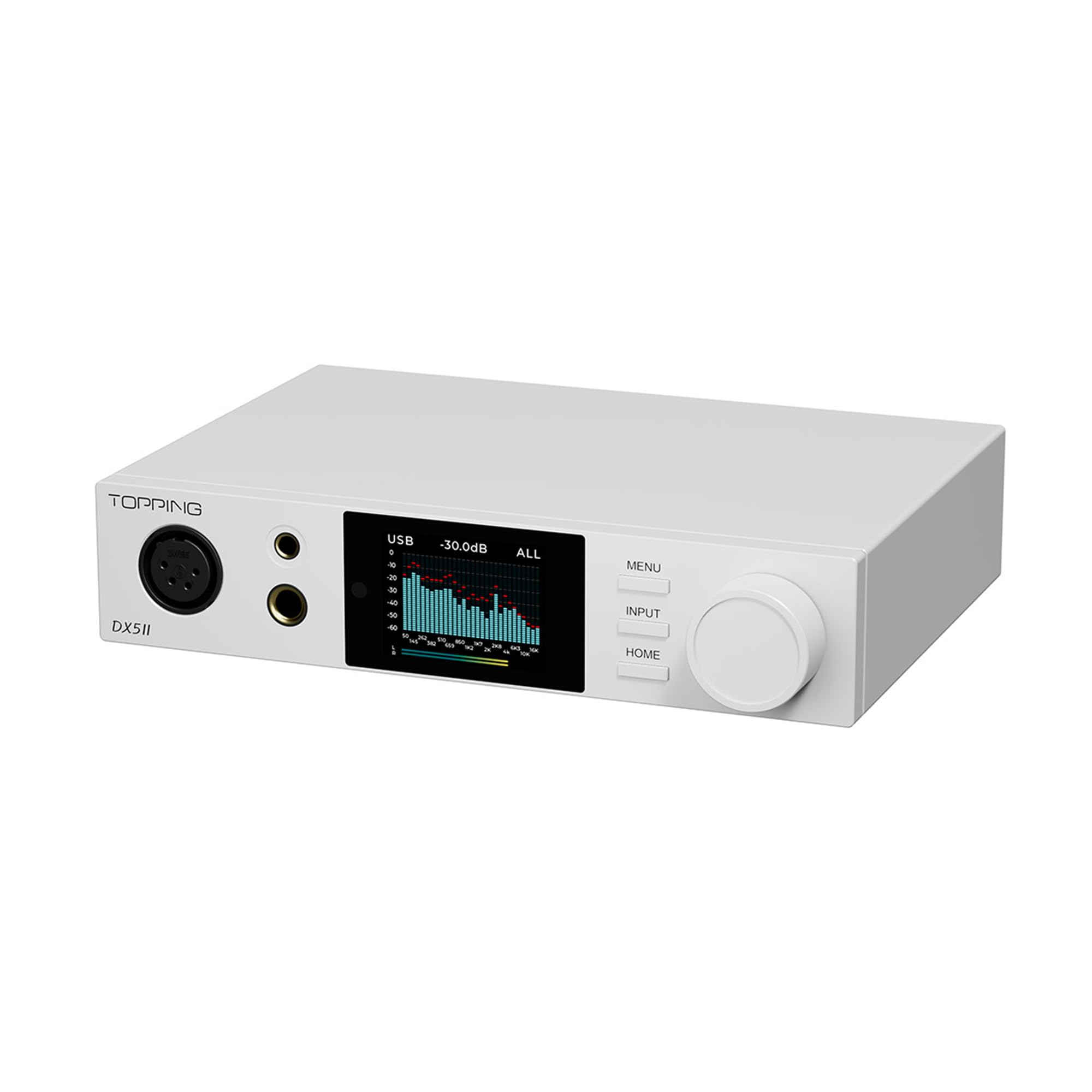
The DX5 II is the most feature-dense desktop DAC and amp combo in this roundup. Dual ESS ES9039Q2M DAC chips feed an X-Hybrid amplifier that delivers 7600mW per channel into a balanced 4.4mm output — enough headroom to drive the most power-hungry planar magnetic headphones without breaking a sweat. The 10-band parametric EQ lets you tailor the frequency response to your headphones and room acoustics directly in the hardware, bypassing any software DSP that could degrade signal purity.
Bluetooth 5.1 with LDAC, aptX Adaptive, and aptX HD makes the DX5 II a genuine wireless-capable hub. The 2.0-inch Aurora UI display with nine customizable themes and a pressable knob gives you intuitive control over input selection, gain staging, and PEQ profiles. Connection options include USB, coaxial SPDIF, optical SPDIF, and a 12V trigger for seamless Hi-Fi system integration. The noise floor is vanishingly low — even sensitive IEMs connected to the balanced output remain silent during quiet sections.
Reports of reliability issues with hot-swapping headphone cables exist, though the firmware is user-updatable via USB. If you want a single box that covers every desktop audio scenario — critical listening, gaming, streaming, and EQ correction — the DX5 II is the reference standard at this price tier.
Why it’s great
- 7600mW balanced output drives demanding planars easily
- 10-band hardware PEQ for precise sound tuning
- LDAC Bluetooth 5.1 adds wireless streaming flexibility
- Fully featured Aurora UI with customizable display themes
Good to know
- Some units have reported failure when hot-swapping headphone cables
- Remote control is not compatible with other Topping devices
2. FiiO K11

The FiiO K11 brings a rare combination of balanced amplification and a high-definition VA display to a chassis that occupies almost no desktop footprint. Its 1400mW maximum output (measured at 32Ω) pushes headphones up to 350 ohms with clean authority. USB, coaxial, and optical inputs feed a dual-DAC architecture that supports PCM up to 384kHz/24-bit and native DSD256. The 4.4mm balanced headphone output gives you genuine channel separation improvement over the 6.35mm single-ended jack.
Users consistently describe the sound as neutral, detailed, and clean with a low noise floor that makes it suitable for both critical music listening and competitive gaming where positional audio clarity matters. The aluminum alloy body feels substantial, and the VA screen clearly indicates sampling rate, volume, gain level, and output mode without any guesswork. The included USB-C to USB-A cable powers the unit directly from your PC.
The K11 does not include Bluetooth or any form of wireless connectivity, so it remains purely a wired desktop solution. Some Linux users have reported needing a USB-C to USB-C cable for proper detection instead of the included USB-A adapter. For a compact, no-compromise wired DAC and amp with a balanced output path, the K11 is hard to beat.
Why it’s great
- 1400mW output handles most over-ear headphones easily
- 4.4mm balanced output for improved channel separation
- Clear VA display shows real-time sampling rate and volume
- Compact aluminum chassis saves desk space
Good to know
- No Bluetooth or wireless connectivity
- Linux detection may require a USB-C to USB-C cable
3. SMSL DS100

The SMSL DS100 is built around the Cirrus Logic CS43131 DAC chip, a component known for its exceptionally low distortion — the DS100 measures a THD+N of 0.00017% (-115dB). This translates to a perfectly transparent signal where every instrument in the mix retains its own space without smear. It supports MQA and MQA-CD decoding, which matters if your streaming service of choice (Tidal) uses MQA for master-quality tracks. The XMOS XU-316 USB controller handles PCM up to 32-bit/768kHz and DSD256.
Dual headphone outputs — 6.35mm single-ended and 4.4mm balanced — give you flexibility. The balanced output reaches 7Vrms into 600Ω, meaning even high-impedance studio headphones will reach realistic listening levels without strain. The CK-03 clock processing circuit minimizes jitter, and the low-noise LDO power supplies isolate the analog stages from USB power rail noise. Build quality uses a CNC-machined aluminum alloy chassis with gold-plated connectors.
The volume control uses a four-LED indicator system rather than a numeric display, which some users find less precise than a screen. Windows users must install a driver from the SMSL website before the DS100 will output audio. If MQA compatibility and vanishing distortion numbers are your priorities, the DS100 delivers in a compact, attractive package.
Why it’s great
- Ultra-low THD+N of 0.00017% for transparent sound
- Supports MQA and MQA-CD full decoding
- 4.4mm balanced output with 7Vrms into 600Ω
- Gold-plated jacks and CNC aluminum body
Good to know
- Windows driver installation required
- Volume indicated by four LEDs instead of a numeric display
4. Topping DX1
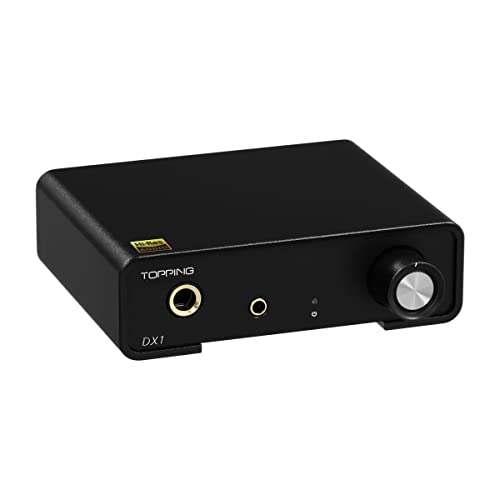
The Topping DX1 uses AKM’s AK4493S Velvet Sound DAC chip, which delivers 120dB of dynamic range in a completely USB-powered design. The Discrete LNRD (Low Noise Reference Driver) circuit filters USB 5V noise down to under 2.0µV on the DAC side and under 1.0µV on the amp side. This low noise floor is the DX1’s standout feature — it means even high-sensitivity IEMs will not hiss or buzz when no audio is playing. Output power reaches 280mW x2 into 32Ω and 51mW x2 into 300Ω.
Two headphone jacks — 6.35mm and 3.5mm — pair with a two-stage gain switch to match low-impedance IEMs and full-size over-ear headphones. When used as a pure DAC, the fixed line output sends a full-volume signal to an external amplifier or powered speakers. The DX1 is plug-and-play on Windows 10/11, macOS, Linux, iOS, and Android without driver installation for basic playback (ASIO applications on Windows require a driver).
The limited power into high-impedance headphones (51mW at 300Ω) means it works adequately with Sennheiser HD 600 series but will not reach deafening levels. Some applications, including Fortnite and Winamp, may not recognize the DX1 at its native 32-bit/384kHz depth without adjusting Windows sound settings. For an affordable entry point with an exceptionally clean noise floor, the DX1 is a smart choice.
Why it’s great
- AK4493S DAC with 120dB dynamic range
- LNRD circuit achieves sub-2.0µV noise floor
- USB-powered, no external wall adapter needed
- Two gain modes match IEMs and headphones
Good to know
- Limited power for headphones above 250Ω
- Some applications require manual audio format adjustment
5. SMSL D1
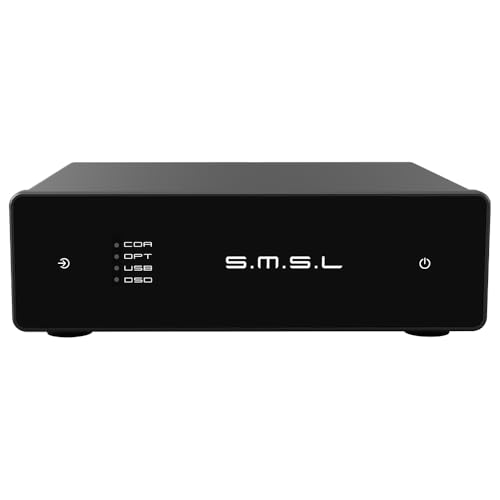
The SMSL D1 takes a different engineering path by using the ROHM BD34352EKV DAC chip — a component less common in the budget desktop space but known for a slightly warmer, more musical presentation compared to the analytical ES series. The XMOS XU-316 USB controller handles PCM up to 32-bit/768kHz and native DSD512. Inputs include USB, optical, and coaxial, while output is limited to stereo RCA — there is no headphone amplifier built in, so this is a pure DAC intended for feeding an external amp or powered speakers.
Build quality stands out at this price bracket. The anodized CNC aluminum unibody chassis has zero visible seams, and capacitive touch controls replace mechanical buttons for input selection. The internal power filtering system allows USB bus power to deliver clean enough voltage that many users report no audible noise when connected directly to a computer. Frequency response is neutral but with slightly warmer mids than the ESS-based competitors, which some listeners prefer for long listening sessions.
Reliability reports are mixed — some units fail after a few weeks. USB-powered noise can be an issue if other peripherals share the same USB hub. Without a headphone amplifier built in, the D1 will not work as a standalone desktop solution for headphone users. It is a pure, compact decoder that excels when paired with a separate amplifier or active studio monitors.
Why it’s great
- ROHM BD34352EKV delivers a warm, musical sound signature
- CNC aluminum unibody with responsive touch controls
- Supports DSD512 and 32-bit/768kHz PCM
- USB bus powered, no external power brick required
Good to know
- No built-in headphone amplifier — external amp needed
- USB noise can appear when sharing a hub with other devices
6. Douk Audio K5

The Douk K5 packs an extraordinary number of features into a small aluminum chassis. It uses the ESS9038Q2M DAC — the same chip found in many mid-range dedicated DACs — paired with a SA9312 DSP and SGM8262 amplifier stage. The headline output power is 560mW per channel into 32Ω, which comfortably drives headphones from 16Ω to 600Ω thanks to the selectable high and low gain modes. SNR exceeds 121dB with a noise floor of only 3µV.
What sets the K5 apart is the physical tone control section. Independent treble and bass knobs with center detents allow you to boost or cut frequencies before the signal reaches your headphones. A dedicated PURE bypass switch removes the tone circuit entirely, sending a flat, uncolored signal through the amplifier. Inputs include USB-C and optical SPDIF; outputs include 6.35mm and 3.5mm headphone jacks, RCA line-out, and optical out — the latter turns the K5 into a USB-to-optical converter for older DACs or soundbars.
Build quality reports mention that the headphone mini-jack can be mechanically unreliable. The integrated volume and power button simplifies use but takes some adjustment. If you want a DAC that doubles as a preamp with tone controls and optical conversion, the K5 offers flexibility no other unit at this tier matches.
Why it’s great
- Physical bass and treble tone control with PURE bypass
- ESS9038Q2M DAC with 560mW output power
- USB to optical converter function
- Supports headphones from 16Ω to 600Ω
Good to know
- Headphone mini-jack quality reported as inconsistent
- Combined volume and power knob may take getting used to
7. Fosi Audio DS1

The Fosi Audio DS1 is a dongle-style DAC and amp that fits in the palm of your hand. Despite its size, it houses the ESS ES9038Q2M DAC chip — the same chip that anchors many desktop units — and delivers 220mW of output power. It offers both a 3.5mm single-ended headphone jack and a 4.4mm balanced output, an unusual feature for a portable device at this tier. The balanced output improves channel separation and noise rejection when used with compatible cables and headphones.
Sound quality is described as detailed with crisp highs, forward mids, and fast, controlled bass. The DS1 drives headphones up to 300Ω without audible strain, though it needs a few extra volume steps compared to a desktop unit. The volume control is independent from the source device, which means you can fine-tune levels without touching your PC’s software slider. It runs cool to the touch at standard 32-bit/384kHz playback and only gets warm during extended high-resolution streaming.
Some Android phones, particularly the Google Pixel 8 series, have reported compatibility issues with static or distortion over USB-C. The unit draws power from the connected device, which can drain phone batteries faster. If your primary use case is laptop or desktop with USB-A (via the included adapter), the DS1 is an affordable path to balanced output and ES9038Q2M performance.
Why it’s great
- ES9038Q2M DAC with 4.4mm balanced output in a portable dongle
- Independent volume control from source device
- Drives headphones up to 300Ω in a compact form
- Includes USB-A converter for PC compatibility
Good to know
- Compatibility issues reported with some Android phones
- Runs warm during high-resolution playback sessions
FAQ
Why does my PC sound muddy through the built-in audio jack?
Do I need a balanced 4.4mm cable for my headphones?
Can I use a USB-powered DAC like the Topping DX1 with my gaming console?
Final Thoughts: The Verdict
For most users, the dac and amp for pc winner is the Topping DX5 II because it combines reference-grade output power, dual ESS DAC chips, hardware parametric EQ, and LDAC Bluetooth in a single desktop unit that outperforms everything else in this roundup. If you want a compact balanced desktop solution without wireless, grab the FiiO K11. And for affordable entry into clean USB-powered desktop audio, nothing beats the Topping DX1.

Mo Maruf
I created WellFizz to bridge the gap between vague wellness advice and actionable solutions. My mission is simple: to decode the research and give you practical tools you can actually use.
Beyond the data, I am a passionate traveler. I believe that stepping away from the screen to explore new environments is essential for mental clarity and physical vitality.