Our readers keep the lights on and my smoothie glass nicely filled. As an Amazon Associate, I earn from qualifying purchases.
The difference between a muddy midrange and a holographic soundstage often comes down to a single decision: the quality of your digital-to-analog conversion and amplification chain. A DAC Amp Combo merges these two critical stages into one unit, eliminating cable clutter and potential signal degradation while delivering a unified listening experience.
I’m Mohammad Maruf — the founder and writer behind WellFizz. My approach to this guide involved analyzing the technical specifications, decoding chip architectures, and output power figures of over thirty current models to identify the units that deliver real, measurable performance improvements.
Whether you are powering sensitive in-ear monitors or high-impedance planar magnetic headphones, finding the right dac amp combo transforms your listening from ordinary to reference-grade.
How To Choose The Best DAC Amp Combo
The best DAC Amp Combo for your desk or portable rig depends entirely on three interconnected factors: the impedance and sensitivity of your headphones, the input sources you plan to use, and whether you need tone-shaping tools like parametric EQ. Ignoring any of these leads to an underpowered, noisy, or inflexible setup.
Matching Power to Headphone Impedance
Headphone impedance, measured in ohms, dictates how much voltage the amplifier stage must swing. Low-impedance IEMs (16–32 ohms) require less voltage but need a clean, low-noise floor to avoid hiss. High-impedance dynamic drivers (150–600 ohms) need voltage gain — look for units delivering at least 500mW into 32 ohms for comfortable headroom. Balanced outputs double the voltage swing, making them essential for demanding planars like the Hifiman Edition XS or Sennheiser HD 800 S.
DAC Chip Architecture and Tonal Character
The DAC chip is the heart of the conversion process. ESS Sabre chips (ES9038Q2M, ES9039Q2M) are known for their transparency, wide dynamic range, and extended treble air, but can sound clinical on poorly recorded tracks. Cirrus Logic CS43131 and CS43198 offer a slightly warmer, more musical presentation with rich midrange body. Burr-Brown (found in the iFi Hip-dac) delivers a smooth, organic tonality that many listeners describe as analogue-like. Your choice depends on whether you want analytical detail or forgiving musicality.
Connectivity and Source Compatibility
USB-C input is nearly universal for modern computers and smartphones, but optical and coaxial inputs are crucial if you plan to connect a TV, CD player, or game console. Bluetooth with LDAC support adds wireless flexibility without sacrificing high-resolution playback. RCA line outputs let you connect the combo to powered speakers or a separate amplifier, turning your unit into a preamp hub.
Built-in Equalization and DSP Features
Parametric EQ (PEQ) is no longer exclusive to expensive studio gear. Mid-range and premium combos now include browser-based or on-device PEQ that lets you correct headphone frequency response dips and peaks with surgical precision. If you own multiple headphones with different tuning, PEQ saves you from buying new gear to chase a different sound signature. Fixed presets like XBass or bass boost are simpler but less flexible.
Quick Comparison
On smaller screens, swipe sideways to see the full table.
| Model | Category | Best For | Key Spec | Amazon |
|---|---|---|---|---|
| Topping DX5 II | Premium Desktop | High-end desktop reference | 7600mW x2 @ 32Ohm Balanced | Check Price |
| Chord Mojo 2 | Premium Portable | Ultra-detailed portable listening | UHD DSP with 40,000 Taps | Check Price |
| FiiO K11 | Mid-Range Desktop | Versatile desktop all-rounder | 1400mW @ 32Ohm Balanced | Check Price |
| Topping DX3pro+ | Mid-Range Desktop | Bluetooth LDAC desktop setup | 700mW @ 32Ohm Balanced | Check Price |
| iFi Hip-dac 3 | Portable Battery | On-the-go high-fidelity | Battery-Powered with PowerMatch | Check Price |
| Fosi Audio ZD3 | Desktop DAC Preamp | Home stereo with HDMI ARC | DSD512, PCM 32bit/768kHz | Check Price |
| Fosi Audio SK02 | Compact Desktop | Compact desktop with optical input | 1100mW @ 32Ohm Balanced | Check Price |
| S.M.S.L DS100 | Value Desktop | MQA decoding on a budget | 7Vrms 600 Ohm Output | Check Price |
| CrinEar Protocol Max | Portable PEQ | 10-band PEQ on a budget | 600mW @ 32Ohm Balanced | Check Price |
In‑Depth Reviews
1. TOPPING DX5 II
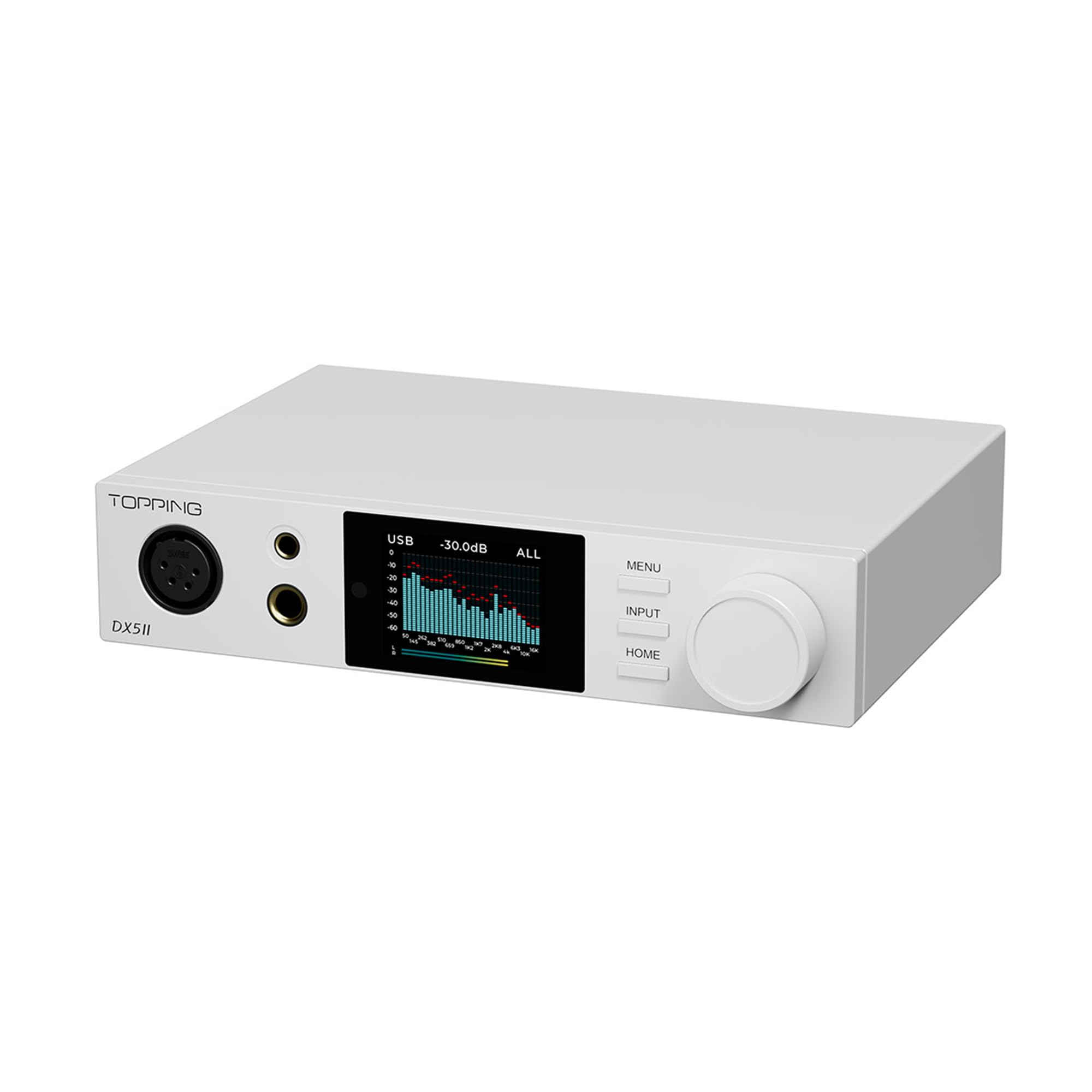
The DX5 II is a desktop powerhouse that sets a new benchmark for all-in-one DAC/amp combos. Dual ES9039Q2M DAC chips handle PCM up to 768kHz and DSD512 natively, while the X-Hybrid amplifier circuit delivers a staggering 7600mW per channel into 32 ohms via the balanced 4.4mm output — enough to drive even the most current-hungry planar headphones like the Hifiman Susvara to satisfying levels. The 10-band parametric EQ is adjustable directly on the device or via a free PC application, allowing you to correct room modes or tune headphones to your preferred target curve.
The 2-inch Aurora UI display is crisp, responsive, and offers nine customizable themes, though some users report that changing the system language requires a firmware reflash — a minor quirk in an otherwise polished experience. The built-in Bluetooth 5.1 with LDAC support streams at up to 990 kbps, making wireless listening genuinely high-fidelity for the first time. A 12V trigger input and output allows seamless integration with powered speakers or a separate amplifier, turning the DX5 II into the nerve center of a complete desktop audio system.
Key connectivity includes USB, optical, coaxial, balanced 4.4mm, and single-ended 6.35mm outputs, plus RCA line outs for preamp duty. The volume knob is pressable for menu navigation, and the included remote covers all essential functions without reaching for the unit. Some long-term users note that hot-swapping headphones with the unit powered on may cause protection circuit tripping, so it is best to power down before switching cans.
Why it’s great
- Dual DAC architecture for exceptional stereo separation
- Massive balanced output power for any headphone
- Built-in 10-band PEQ with on-device adjustment
- LDAC Bluetooth and 12V trigger for complete integration
Good to know
- Firmware flash required for language change
- Hot-swapping headphones may trigger protection mode
- Remote is specific to this model
2. CHORD ELECTRONICS Mojo 2

The Mojo 2 is a portable DAC/Amp that punches far above its size thanks to Chord’s proprietary FPGA-based WTA (Watts Transient Aligned) filter with 40,000 taps — delivering transient response and micro-detail retrieval that rivals many full-sized desktop units. The UHD DSP engine lets you adjust frequency response in four bands with no audible loss of resolution, a feature that is rare in portable gear. The unit accepts up to 768kHz PCM via USB and coaxial inputs, and 96kHz via optical TOSLINK, making it compatible with virtually any high-resolution streaming service.
Battery life is rated at eight hours of continuous playback, and the aluminum chassis feels armor-grade in the hand. However, the user interface relies entirely on color-coded spherical buttons — red, green, blue, and white combinations indicate volume, filter settings, and input selection — which requires memorization or the included quick reference card. Some users report that the Mojo 2 is finicky with certain USB cables and may not function correctly with Apple devices without a powered USB hub due to power negotiation quirks.
Output is via dual 3.5mm jacks, each capable of 600mW into 32 ohms, but there is no balanced 4.4mm output — a limitation for those who have invested in balanced cables. The crossfeed feature, which blends left and right channels slightly to reduce listening fatigue, is a thoughtful touch for long headphone sessions. Users pairing it with high-impedance dynamic drivers like the Sennheiser HD 800 S report a synergy that borders on magical, with an expansive soundstage and black background.
Why it’s great
- Industry-leading transient detail with 40,000-tap filter
- Four-band UHD DSP with lossless EQ adjustment
- Tank-like aluminum construction
- Crossfeed reduces listening fatigue for long sessions
Good to know
- No balanced headphone output (4.4mm/XLR)
- Button-based UI requires manual memorization
- May need powered hub for Apple device compatibility
3. FiiO K11

The FiiO K11 brings premium DAC/amp performance to the mid-range desktop category without cutting corners on essential features. Its high-definition VA display shows sampling rate, volume level, gain setting, and output mode clearly, making real-time monitoring effortless. The amplifier stage delivers 1400mW into 32 ohms via the 4.4mm balanced output, providing ample headroom for headphones up to 350 ohms — including classics like the Sennheiser HD 600 and Beyerdynamic DT 1990 Pro.
Connectivity options include USB, optical, and coaxial inputs, plus 6.35mm and 4.4mm headphone outputs, RCA line outs, and even a coaxial output for daisy-chaining to an external DAC. The aluminum alloy body is compact at under ten inches wide, fitting neatly into crowded desktop setups. Users report that the K11’s sound signature is neutral and slightly on the analytical side, with digital filters that range from bright to dark — filter 6 (bypass) is widely considered the most natural option.
Some Linux users have reported USB-C power delivery issues that require a dedicated USB-C to USB-C cable rather than the included USB-C to USB-A adapter. The volume knob is smooth and has satisfying detents, and the device supports 384kHz/24-bit and DSD256 decoding. For the price this FiiO offers the most comprehensive feature set in its size class.
Why it’s great
- Bright, informative VA display with sampling rate readouts
- 1400mW balanced output drives 350-ohm headphones
- Multiple digital filters for tonal adjustment
- Compact footprint with extensive I/O
Good to know
- USB power may need C-to-C cable on Linux
- Sound leans analytical with some filter compression
- RCA outputs are line-level only
4. Topping DX3pro+

The DX3 Pro+ is a compact desktop DAC/amp that has earned a reputation as one of the best value propositions in the audio world. At its core is the ESS ES9038Q2M DAC chip paired with the XMOS XU208 USB controller, supporting PCM up to 384kHz and DSD256. The amplifier section pushes 700mW into 32 ohms via the 6.35mm single-ended output — not the highest power on this list, but enough to drive the vast majority of dynamic headphones like the Sennheiser HD 600 to satisfying levels even on medium gain.
Bluetooth 5.0 with LDAC, aptX HD, aptX LL, AAC, and SBC codecs makes wireless streaming genuinely high-fidelity, though the antenna must be attached manually for stable range. The included remote control is fully functional and lets you adjust volume, switch inputs, and cycle through filters from across the room. The display is bright and dimmable, showing sample rate, volume, and codec information. Some users note that the filter settings are largely inaudible and best left on default.
For gaming, the DX3 Pro+ provides pinpoint imaging and a dead-neutral reference tuning that reveals directional cues without artificial coloration. The unit works plug-and-play on Windows, Mac, Linux, and Android, with no driver installation required for most operating systems. The build quality is solid with a brushed aluminum enclosure, though the volume knob has a slight click noise when pressed that can be distracting in quiet listening environments.
Why it’s great
- Excellent LDAC Bluetooth implementation
- Dead neutral reference tuning for critical listening
- Compact size fits any desk
- Fully functional remote control included
Good to know
- No balanced headphone output
- Max output limited to 700mW single-ended
- Volume knob click audible in quiet rooms
5. iFi Hip-dac 3

The Hip-dac 3 is a battery-powered portable DAC/amp that prioritizes clean, engaging sound over raw power figures. Inside, the Burr-Brown true-native DAC chip handles PCM up to 384kHz, DSD256, and full MQA decoding, while the analog stage uses a balanced circuit that includes the same PowerMatch gain toggle and iEMatch output found in iFi’s desktop gear. The PowerMatch feature provides two gain levels — one for sensitive IEMs and one for inefficient headphones — preventing hiss on low-impedance drivers without sacrificing headroom.
Battery life is approximately eight hours at moderate volume, and the unit charges via a dedicated USB-C port separate from the data input, allowing simultaneous charging and listening — a thoughtful detail for long flights or extended sessions. The black aluminum enclosure with tactile volume knob feels premium in the hand and fits comfortably in a pocket or bag. Users report that the Hip-dac 3 pairs beautifully with the Sennheiser HD 600 series, providing a warm yet detailed presentation that tames the HD 600’s treble peak.
Output options include a 4.4mm balanced and an S-Balanced 3.5mm jack, which reduces crosstalk on single-ended cables. The XBass feature adds a gentle shelf boost at low frequencies without muddying the midrange, ideal for electronic or hip-hop genres. However, the unit lacks any digital inputs other than USB-C, so it cannot accept optical or coaxial signals. Some users note that the USB-C cables included are short, so a longer aftermarket cable may be needed for convenience.
Why it’s great
- Warm, organic Burr-Brown DAC sound signature
- PowerMatch and iEMatch for impedance matching
- Dedicated charging USB-C port
- Compact, pocket-friendly aluminum build
Good to know
- USB-C input only — no optical or coaxial
- Battery life limited to ~8 hours
- Included cables are relatively short
6. Fosi Audio ZD3

The Fosi Audio ZD3 is a fully balanced desktop DAC preamp designed to anchor a stereo system rather than a headphone-only setup. Its ES9039Q2M DAC chip, combined with the XMOS XU316 microcontroller, supports DSD512 and PCM 32bit/768kHz, placing it among the most capable decoding platforms in its tier. The standout feature is HDMI ARC input, allowing direct connection to a TV for lossless audio from streaming services and gaming consoles — a rare inclusion at this price point.
Output options include balanced XLR and single-ended RCA line outs, so you must pair it with an active speaker or amplifier. The ZD3 has a 1.5-inch OLED display, a preamp bypass switch for integrating into an existing chain, and a 12V trigger for automatic power on/off with compatible amplifiers. Users report that the stock LME49720 op-amps deliver a clean and spacious sound, while swapping to NJR or Sparkos op-amps can tailor the tonal character — the ZD3 is op-amp socketed for easy upgrades.
The remote control covers volume, input selection, and preamp bypass, though the bypass switch is not accessible from the remote — a minor inconvenience. Bluetooth is handled by the QCC3031 chip with support for aptX but not LDAC. The ZD3 runs warm but stable, and the idle power draw is around 1 watt with no stand-by mode. For users building a desk-to-speakers system, this Fosi pairs beautifully with the ZA3 amplifier to form a compact stack.
Why it’s great
- HDMI ARC input for TV integration
- User-swappable op-amps for tonal customization
- Fully balanced XLR and RCA outputs
- 12V trigger for synchronized power control
Good to know
- No headphone amplifier built-in
- No stand-by mode — idle at ~1W
- Bypass switch not on remote
7. Fosi Audio SK02

The Fosi Audio SK02 proves that big sound can come from a small chassis. Barely larger than a deck of cards, this desktop DAC/amp packs the ESS Sabre ES9038Q2M DAC chip and SGM8262 operational amplifiers to deliver 1100mW into 32 ohms via the 4.4mm balanced output — enough to drive 300-ohm headphones comfortably. The USB-C and optical inputs cover the most common desktop sources, and the device operates without drivers on Windows, Mac, and Linux.
The multi-functional control knob handles power, volume, play/pause, and track skipping, while a gain switch adapts the output to different headphone sensitivities. Colorful LED indicators on the knob display the current sampling rate and input mode, though the lack of a numeric volume readout may bother users who want precise level tracking. The entire enclosure is CNC-machined from a single block of aluminum with a sandblasted finish, giving it a surprisingly substantial feel for its weight.
User reviews consistently highlight the SK02’s neutral and clean presentation, with a slight emphasis on midrange and treble detail — typical of the ESS Sabre signature. Some users note that the single LED volume indicator is vague, making it difficult to set the same listening level consistently. The SK02 also functions as a preamp when paired with an amplifier, outputting via 3.5mm or 4.4mm connections to active speakers. For budget-conscious audiophiles who prioritize power density, this is a compelling choice.
Why it’s great
- High power in a truly compact form factor
- USB and optical inputs with plug-and-play operation
- Neutral, detailed ESS Sabre sound signature
- Sturdy aluminum alloy construction
Good to know
- Vague single-LED volume indication
- No coaxial or balanced inputs
- Operates warm after extended use
8. S.M.S.L DS100

The S.M.S.L DS100 is a compact desktop DAC amplifier that punches above its price tag with a Cirrus Logic CS43131 chipset and XMOS XU-316 decoding platform. It supports full MQA and MQA-CD unfolding, PCM up to 32bit/768kHz, and DSD256 — specifications that rival units costing three times as much. The dedicated CK-03 clock processing circuit reduces jitter significantly, contributing to a distortion figure of just 0.00017 percent.
Output options include a 6.35mm single-ended jack and a 4.4mm balanced jack, with the latter providing up to 7Vrms for 600-ohm headphones — ideal for true high-impedance studio monitors. The aluminum alloy enclosure is CNC-machined with gold-plated connectors, and the overall size is a mere 3.5 inches square, making it one of the most space-efficient options available. The device includes USB, optical, and coaxial inputs, and a physical volume knob with step-detent feel.
Users report that the DS100 is completely transparent and noise-free, with a sound signature that neither colors nor flatters the recording — ideal for critical listening and mixing purposes. The headphone stage is clean but not the most powerful for inefficient planars. Windows systems require a driver download from the S.M.S.L website, while Mac and Linux are plug-and-play. Some users note that the included instruction manual is sparse, so visiting the support page for driver installation guidance is recommended.
Why it’s great
- Full MQA decoding support
- Ultra-low distortion at 0.00017% THD+N
- High voltage output for 600-ohm headphones
- Very compact desktop footprint
Good to know
- Windows driver installation required
- Limited power for planar headphones
- Sparse documentation included
9. CrinEar Protocol Max
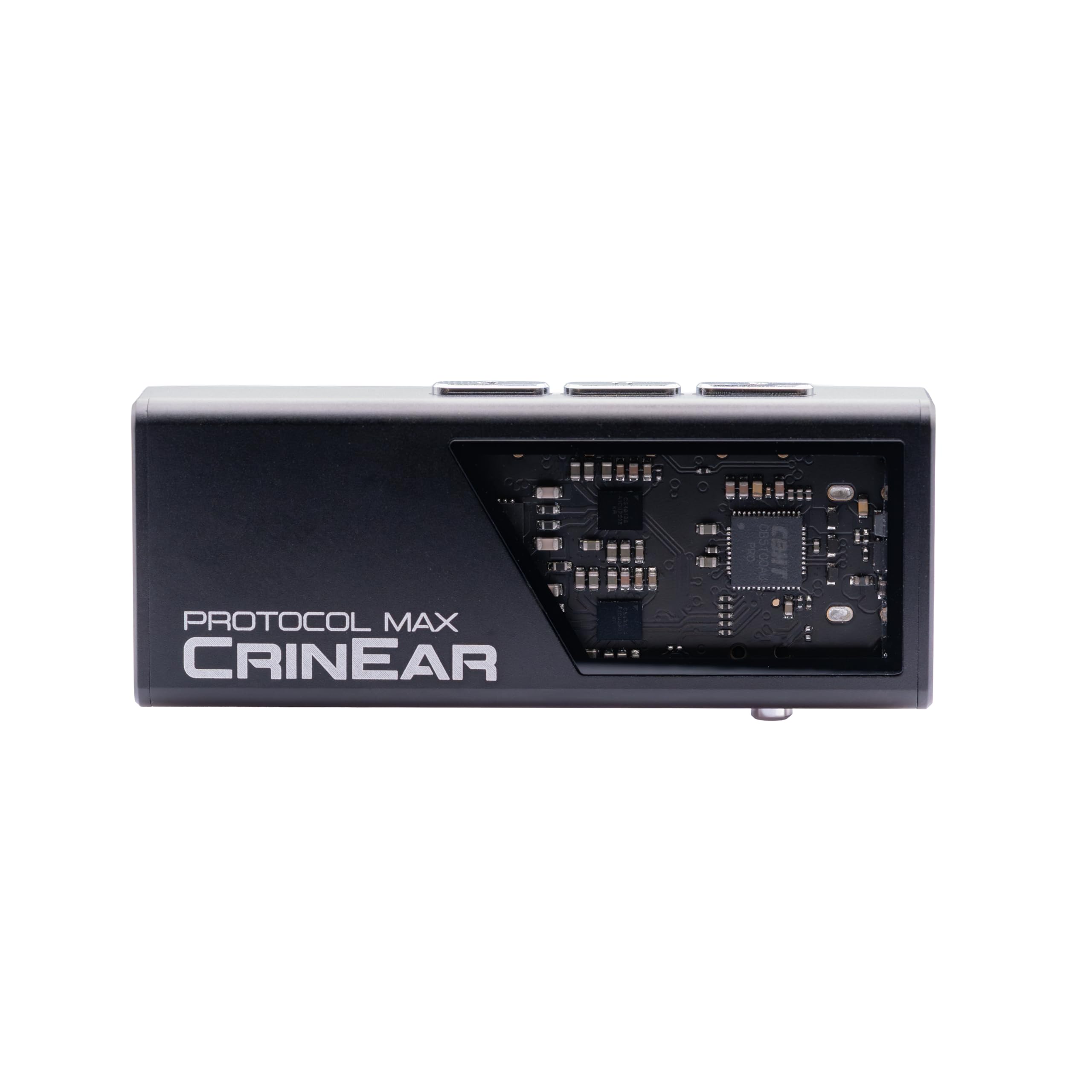
The Protocol Max from CrinEar is a portable DAC/amp that democratizes parametric EQ by offering a browser-based 10-band PEQ with on-device storage. Dual Cirrus Logic CS43198 DAC chips provide the conversion stage, while dual SG Micro SGM8262-2 op-amps handle the current output. The unit delivers up to 600mW via the 4.4mm balanced connection, which is enough for most dynamic headphones including the Sennheiser HD 600 and Beyerdynamic DT 900 Pro X.
The browser-based EQ configuration is a clever design choice — there is no app to install. You connect the device to a PC via USB, open any browser, and the interface appears instantly. You can adjust up to 10 bands with customizable frequency, gain, and Q-factor, and save multiple profiles directly to the device’s internal memory. The unit also includes two power modes: Eco for extended battery life with sensitive IEMs, and Boost for maximum output with high-impedance headphones.
Battery drain from the host device is higher than some competitors because the Protocol Max pulls power exclusively from the USB source — there is no internal battery. Some early units exhibited right-channel static noise, but the manufacturer addressed this with a revision. The aluminum housing is sleek and compact, and the included USB-C to C and USB-C to A cables add convenience. For users who want to EQ their headphones to a specific target without spending desktop money, this is an enticing option.
Why it’s great
- 10-band PEQ with browser-based configuration
- Dual Cirrus Logic DAC chips for clear conversion
- Portable form factor with balanced output
- Eco and Boost power modes
Good to know
- No internal battery — drains host device power
- EQ setup requires desktop browser
- Early units had right-channel static issues
FAQ
Do I need a balanced cable to hear the benefit of a balanced output?
What is the difference between PCM and DSD formats?
Can I use a DAC Amp Combo as a preamp for powered speakers?
How important is MQA decoding in a DAC Amp Combo?
Final Thoughts: The Verdict
For most users, the dac amp combo winner is the TOPPING DX5 II because its dual DAC chips, massive balanced power, and built-in 10-band PEQ deliver reference-grade performance without needing a separate stack or external DSP. If you want transparent, portable high-fidelity with lossless EQ, grab the Chord Mojo 2. And for a budget-friendly desktop all-rounder that leaves nothing essential behind, nothing beats the FiiO K11.

Mo Maruf
I created WellFizz to bridge the gap between vague wellness advice and actionable solutions. My mission is simple: to decode the research and give you practical tools you can actually use.
Beyond the data, I am a passionate traveler. I believe that stepping away from the screen to explore new environments is essential for mental clarity and physical vitality.