Our readers keep the lights on and my smoothie glass nicely filled. As an Amazon Associate, I earn from qualifying purchases.
Indoor cycling shouldn’t sound like a jet engine taking off in your living room. The friction of a magnetic resistance unit, the vibration through a hard floor, and the hum of knobby tires can turn a healthy workout into a household nuisance. A quality indoor trainer isolates that noise, delivers smooth resistance that mimics the road, and folds away when you’re done.
I’m Mohammad Maruf — the founder and writer behind WellFizz. I’ve spent countless hours analyzing resistance types, frame stability metrics, and decibel ratings to separate the trainers that deliver a premium ride from those that just take up space.
This guide looks at wheel-on, fluid, smart, and roller-style units to help you find the best cycling trainer for your bike type, space, and training goals without burning through your budget on features you won’t use.
How To Choose The Best Cycling Trainer
Every indoor trainer makes a promise about resistance, noise, and stability. The difference between a frustrating experience and a smooth one comes down to understanding how these specs match your bike, your floor, and your tolerance for decibels. Before you buy, consider these three aspects.
Resistance Type: Fluid vs. Magnetic vs. Electromagnetic
Fluid resistance uses a sealed impeller spinning in thick silicone oil to create progressive resistance — the harder you pedal, the more drag you feel. It’s the quietest wheel-on option and feels most like outdoor riding. Magnetic resistance relies on magnets pulling against a metal flywheel; it’s adjustable via a dial but can be noisier, especially with treaded tires. Electromagnetic resistance (found on smart trainers like the Saris M2) uses a motor to vary resistance instantly based on app commands or gradient changes. It’s the most precise but requires a power outlet and a higher budget.
Smart Connectivity for Structured Training
Smart trainers communicate via ANT+ FE-C and Bluetooth, allowing apps like Zwift, Rouvy, and TrainerRoad to automatically adjust resistance in real time. If you plan to follow coached workouts or ride virtual routes, look for a trainer with built-in power, speed, and cadence sensors. Wheel-on smart trainers (like the M2) are more affordable but slightly less accurate than direct-drive units (like the Tacx Neo 2T), which replace the rear wheel entirely for direct power measurement.
Stability and Noise Control
Noise comes from three sources: the resistance unit, the tire contacting the roller, and the frame vibrating against the floor. A fluid trainer is inherently quieter than magnetic, but any trainer will be louder with knobby mountain bike tires than with smooth slicks. Look for a wide base, non-slip rubber feet, and a low center of gravity to prevent wobble during out-of-saddle sprints. A front wheel riser block levels the bike and improves stability, and a dedicated trainer tire (or trainer mat) reduces vibration transfer.
Quick Comparison
On smaller screens, swipe sideways to see the full table.
| Model | Category | Best For | Key Spec | Amazon |
|---|---|---|---|---|
| Garmin Tacx Neo 2T | Direct-Drive Smart | Serious virtual training | 2,200W max / 32 neodymium magnets | Amazon |
| Saris M2 Smart | Wheel-On Smart | App-based interval training | +/- 5% accuracy / ANT+ FE-C + Bluetooth | Amazon |
| Alpcour Fluid | Fluid Wheel-On | Quiet, progressive resistance | 300 lb capacity / stainless steel frame | Amazon |
| Saris Fluid2 | Fluid Wheel-On | Road-like feel at mid-range price | 69 dB noise level / foldable frame | Amazon |
| Elite Arion Mag | Folding Rollers | Balance and bike handling | 520W at 40 km/h / 3 resistance levels | Amazon |
| Elite Cubo Power Fluid | Fluid Wheel-On | Smart-ready starter trainer | Elastogel roller reduces noise 50% | Amazon |
| ROCKBROS Rollers | Aluminum Rollers | Balance practice on a budget | 6.5 kg weight / foldable / sealed bearings | Amazon |
| Fitvids Fluid | Fluid Wheel-On | Budget-wise quiet training | 330 lb capacity / quick-release clamp | Amazon |
| Topeakmart Magnetic | Magnetic Wheel-On | Entry-level on a small budget | 8 magnetic levels / M-shaped steel frame | Amazon |
In‑Depth Reviews
1. Garmin Tacx Neo 2T Smart Trainer

The Tacx Neo 2T uses 32 neodymium magnets for electromagnetic resistance and produces zero noise — you only hear your chain and tires. It delivers up to 2,200 watts of maximum resistance and simulates road surfaces like cobblestones through vibration, adding a layer of realism that wheel-on trainers can’t match. The direct-drive design removes the rear wheel entirely, eliminating tire wear and slippage.
Setup requires installing your own cassette and choosing the correct spacer stack. Once configured, the unit connects instantly via ANT+ and Bluetooth to Zwift, Rouvy, and Tacx Premium apps. The virtual flywheel gives the pedal feel of a heavy rear wheel, and dynamic inertia adjusts resistance based on speed and gradient changes seamlessly.
The built-in power meter is accurate to within 1 percent, so you can trust your data for structured training. The unit is heavy at 47.4 pounds, but the integrated handle and foldable legs make it manageable for storage. The price is the main barrier, but for dedicated cyclists using smart training platforms, the NEO 2T is hard to beat.
Why it’s great
- Virtually silent operation
- Realistic road surface simulation
- Direct-drive eliminates tire wear
Good to know
- Expensive upfront investment
- Heavy at 47.4 pounds
- Requires cassette installation
2. Saris M2 Smart Indoor Trainer

The Saris M2 is a wheel-on smart trainer that brings electromagnetic resistance and app control at a price much lower than direct-drive alternatives. It delivers +/- 5 percent power accuracy, built-in speed, cadence, and power sensors, and dual ANT+ FE-C and Bluetooth connectivity. Noise is around 69 decibels at 20 mph — quieter than most magnetic trainers but not silent.
Assembly requires some patience with the frame alignment and careful tightening of the tension knob. Over-tightening can cause tire wear, so you want a slight indent on the tire rather than a full crank. The unit folds nicely for storage and supports up to 300 pounds of rider and bike weight. A power outlet is required for the electromagnetic unit.
Compatibility with Zwift, Rouvy, and TrainerRoad is solid once you calibrate with the Saris app. The resistance curve handles steep gradients well, though sustained climbs above 10 percent may push the wheel-on design to its limit. For riders who want app-controlled training without the direct-drive price, the M2 is a strong middle ground.
Why it’s great
- Accurate power and cadence sensors
- Works with Zwift and Rouvy out of box
- Folds flat for easy storage
Good to know
- Requires a power outlet
- Assembly instructions are unclear
- Noisier than fluid trainers
3. Alpcour Fluid Bike Trainer Stand

The Alpcour Fluid Trainer uses a sealed fluid impeller to produce smooth, progressive resistance that ramps up naturally as your speed increases. The stainless steel frame feels solid under heavy riders (tested up to 270 pounds), and the wide base with anti-slip pads keeps the unit planted during out-of-saddle efforts. Noise is significantly lower than magnetic trainers — most users report hearing only tire hum.
Assembly is straightforward with a single bolt and included wrench. The dual-lock system uses a tension knob and lock ring to secure the bike, and the quick-release skewer makes mounting and dismounting easy. The included front wheel riser block levels the bike for a true road position. A canvas storage bag is also included for portability.
One realistic limitation: the fluid resistance is not adjustable on the fly. The harder you pedal, the more resistance you get, which mimics outdoor riding but means you can’t drop to a low resistance for warm-up without shifting gears. The front riser block can crack under heavy use, but the main trainer holds up well. For a quiet, stable, and durable wheel-on trainer at a mid-range price, this is the top pick.
Why it’s great
- Very quiet operation
- Sturdy stainless steel frame
- Progressive resistance feels like road
Good to know
- Resistance not adjustable on the fly
- Front riser block may crack over time
- Not smart-enabled without add-on sensor
4. Saris Fluid2 Indoor Bike Trainer
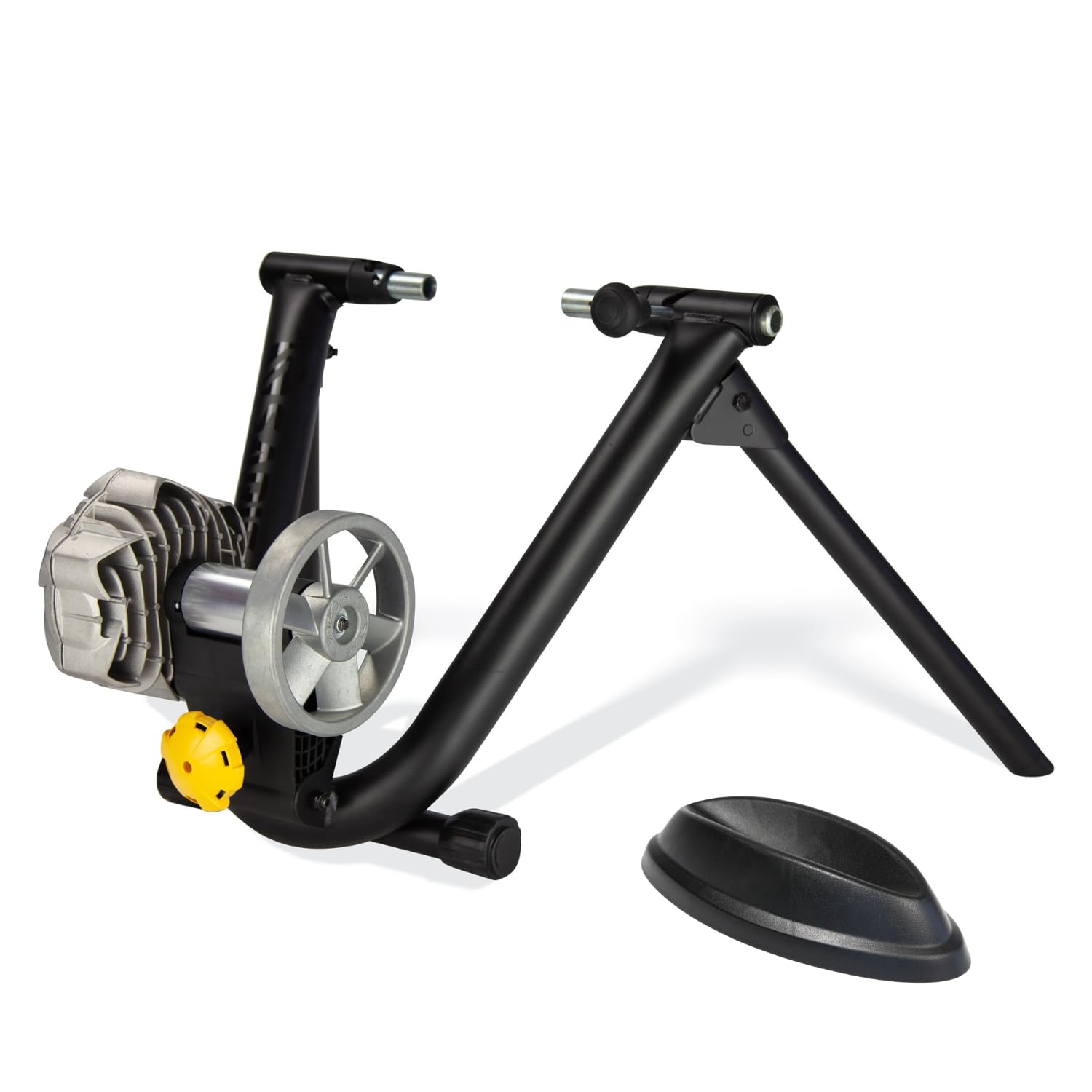
The Saris Fluid2 uses a precision-balanced flywheel and patented fluid chamber to deliver quiet, consistent resistance that mimics real-road feel. At 69 decibels, it’s one of the quieter wheel-on trainers, making it suitable for apartment use with a trainer tire. The aluminum frame folds flat for storage and the legs lock open with a positive click.
Setup requires some attention to detail — the beveled tube end must slide into the frame first, and the folding legs require moderate force to close. The included quick-release skewer replaces your existing axle, making bike mounting straightforward once the legs are set. The Fluid2 works with Zwift and Rouvy when paired with a speed or cadence sensor, though these are sold separately.
Stability is excellent, even during standing sprints, and the fluid resistance provides a smooth curve that doesn’t spike or drop unexpectedly. The lack of smart resistance control means you adjust intensity through your bike’s gearing. Some units have arrived with minor cosmetic damage, but the trainer performs well once assembled. It’s a solid choice for riders who want the feel of fluid without paying for smart features they don’t need.
Why it’s great
- Quiet enough for apartment use
- Smooth, progressive resistance curve
- Stable during out-of-saddle riding
Good to know
- Speed/cadence sensor sold separately
- Folding legs require force to operate
- Occasional quality control issues
5. Elite Arion Mag Parabolic Folding Rollers

Rollers are a different beast — they train balance, pedal stroke smoothness, and bike handling. The Elite Arion Mag uses parabolic-shaped drums that naturally return the bike to center if you drift, making them safer than straight rollers. Three levels of magnetic resistance via a central drum selector let you adjust intensity mid-ride without stopping. The unit generates up to 520 watts at 40 km/h, enough for intense interval work.
The frame folds for compact storage and adjusts wheelbase length with an Allen key, fitting bikes from compact road frames to larger touring models. Noise is very low — you hear the tires humming on the drums rather than any mechanical grinding. A step stool and a doorway for support are recommended while you learn the balance, which usually takes 15 to 20 minutes.
The Arion is not a smart trainer; there’s no Bluetooth or ANT+ connectivity, so you’ll need separate sensors and an app for power data. Some units have arrived missing bolts or with cracked adjustment plates, though Elite generally responds to replacement requests. For cyclists who want to improve their pedaling efficiency and core stability, these rollers deliver a workout that no wheel-on trainer can replicate.
Why it’s great
- Improves balance and pedal stroke
- Quiet operation
- Three resistance levels on the fly
Good to know
- Learning curve for mounting/dismounting
- No smart connectivity
- Occasional missing parts out of box
6. Elite Cubo Power Fluid Trainer

The Elite Cubo Power combines a fluid resistance unit with a special Elastogel roller that absorbs vibration and reduces noise by 50 percent compared to standard fluid trainers. It also cuts tire wear by 20 percent, extending the life of your training tire. The resistance is progressive and smooth, building naturally as cadence increases.
The frame uses reinforced 50mm steel tubes and a wide contact base for stability, plus an Fast Fixing quick-release lock system for easy bike mounting. The Cubo Power can be upgraded with the Misuro B+ sensor adapter (sold separately), turning it into a non-interactive smart trainer that works with apps like My E-Training. This makes it a good entry point for riders who want to test app-based training without buying a full smart trainer.
One reported safety issue: the rear wheel can unlock under heavy pedaling if the quick-release skewer is not fully tightened. This is a rare but serious risk that requires careful setup. The unit works with road, hybrid, and mountain bikes up to 120kg rider weight. Foldable design makes storage simple. For the price, it offers quiet fluid feel with an upgrade path to basic smart features.
Why it’s great
- Very quiet Elastogel roller
- Can convert to smart trainer
- Reduces tire wear significantly
Good to know
- Risk of rear wheel unlocking if loose
- Misuro sensor sold separately
- Not for beginners due to setup sensitivity
7. ROCKBROS Bike Rollers

The ROCKBROS rollers use three parabolic aluminum drums mounted in an adjustable frame that fits wheelbases from 16-inch folding bikes up to 29-inch mountain bikes. Sealed bearings keep the rollers spinning smoothly, and the frame folds flat for storage. The set weighs only 6.5 kg, making it one of the most portable roller options available.
Setup requires loosening the factory-over-tightened nuts on the roller bearings to allow free spin — a common issue noted by users. The front axle alignment holes must be positioned directly above the roller center for stable riding. Beginners will want a doorway or wall nearby for balance; most riders find the learning curve between 15 and 60 minutes before riding hands-free.
Noise is moderate with treaded tires and acceptable for short sessions. Some units arrive with dents on the roller drums or loose end caps, which create wobble and vibration. ROCKBROS customer support has been inconsistent in handling these defects. For the price, the rollers are functional but the quality control is hit-or-miss. They work best for riders who want an affordable introduction to roller training and are willing to do some DIY tuning.
Why it’s great
- Very affordable roller entry point
- Folds small for storage
- Fits many wheel sizes
Good to know
- Quality control issues with roller drums
- Needs adjustment out of box
- Steep learning curve for new riders
8. Fitvids Bike Trainer Stand Fluid
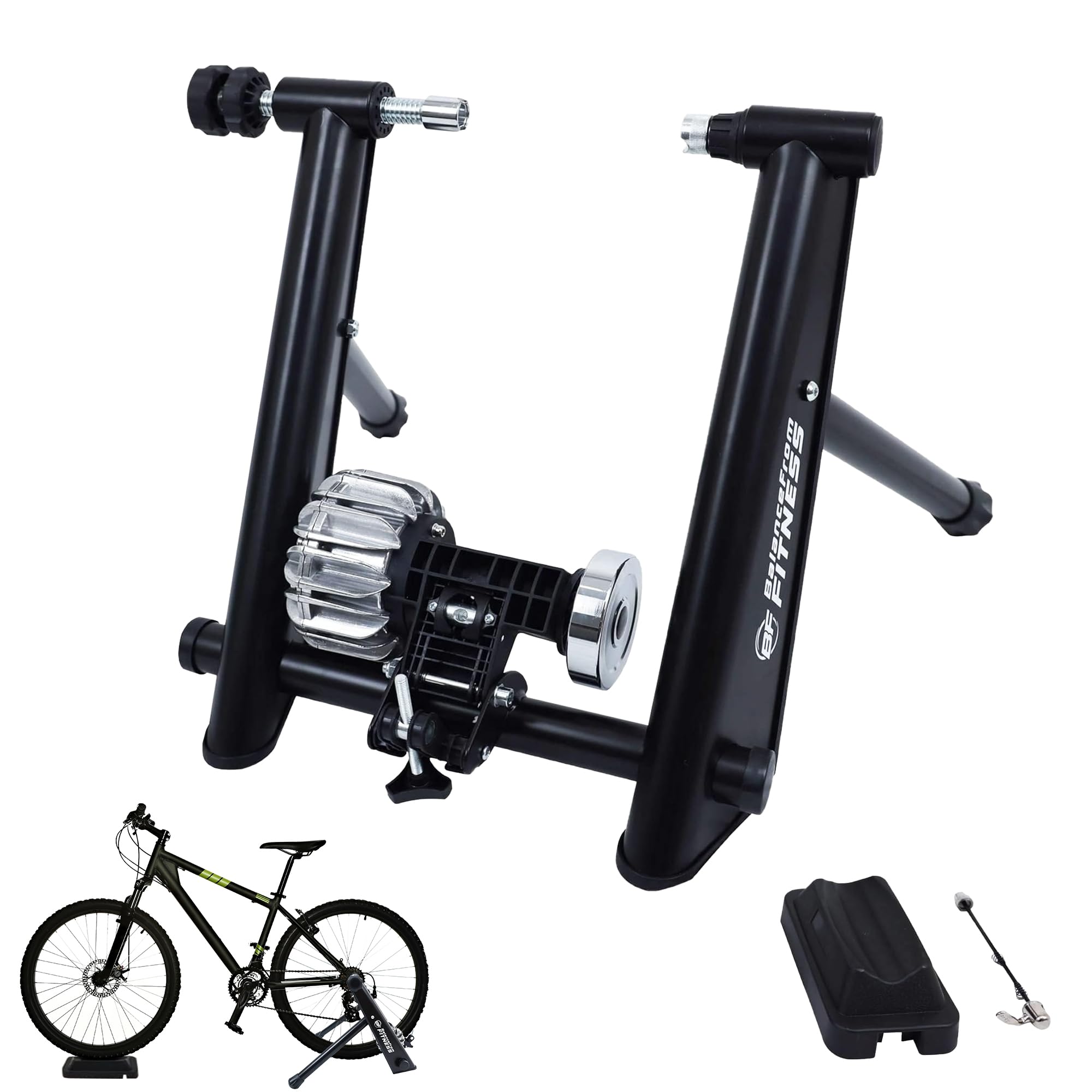
The Fitvids fluid trainer delivers quiet, progressive resistance at a price that undercuts most competitors. The alloy steel frame supports up to 330 pounds and uses a wide base with rubber feet to prevent floor scratching and reduce vibration. The quick-release clamp makes bike installation and removal fast, and the front wheel riser is included to level the bike.
Assembly is straightforward, though some users report that the resistance control cable doesn’t disconnect cleanly from the unit. The fluid unit provides smooth resistance that builds with speed, and the low stance adds stability. Noise is much lower than magnetic trainers — comments note the unit is suitable for apartment use with the right tire. Knobby mountain bike tires increase the noise significantly, so a slick trainer tire is recommended.
The folding design makes storage easy, and the trainer fits 26 to 28-inch and 700C wheels with quick-release axles. Thru-axle bikes will need an adapter. A few users mentioned the initial setup instructions were confusing and required online videos for clarification. For a first trainer purchase or a budget-friendly fluid option, the Fitvids offers excellent value for its quiet performance and sturdy build.
Why it’s great
- Quiet fluid resistance for the price
- High 330 lb weight capacity
- Easy quick-release installation
Good to know
- Instructions are difficult to follow
- Resistance cable can be fiddly
- Not suitable for thru-axle bikes
9. Topeakmart Magnetic Bike Trainer Stand

The Topeakmart magnetic trainer uses an 8-level manual resistance dial for on-the-fly adjustments, giving you control over workout intensity without shifting gears. The M-shaped carbon steel frame is powder-coated and supports up to 264 pounds. The non-slip feet have a gear-like cap system that rotates to level the trainer on uneven floors, preventing wobble during hard efforts.
Assembly is straightforward with included tools, and the unit folds for storage. Noise is moderate — acceptable with slick tires but noticeably loud with hybrid or mountain bike treads. A thick mat or carpet underneath helps dampen sound transmission. The trainer fits 26 to 28-inch and 700C wheels with quick-release axles; thru-axle bikes need a separate adapter.
Stability is good for seated efforts, but out-of-saddle riding can cause some vibration. The magnetic resistance curve is consistent, though it doesn’t feel as natural as fluid resistance. Some users noted the resistance mechanism humming at higher settings. For riders on a tight budget who want simple variable resistance and a foldable frame, the Topeakmart is a solid entry-level choice that won’t break the bank.
Why it’s great
- Adjustable magnetic resistance on the fly
- Leveling feet work on uneven floors
- Folds compact for storage
Good to know
- Noisy with treaded tires
- Not suitable for thru-axle bikes
- Resistance less natural than fluid
FAQ
Do I need a special tire for my cycling trainer?
Can I use a mountain bike on a standard cycling trainer?
How much space do I need for a folding roller trainer?
What is the difference between a wheel-on and a direct-drive smart trainer?
How do I calibrate my smart trainer for accurate power readings?
Final Thoughts: The Verdict
For most riders, the best cycling trainer to buy is the Alpcour Fluid because it balances quiet fluid resistance, a sturdy stainless steel frame, and a reasonable price without forcing you into smart features you may not need. If you want app-controlled workouts with precise resistance changes, the Saris M2 delivers electromagnetic smart training at the best value. For max realism and silent operation, the Garmin Tacx Neo 2T is the premium choice, though it requires a bigger budget. Each of these trainers meets a different training need, but the Alpcour Fluid offers the most practical quality for the largest number of cyclists.

Mo Maruf
I created WellFizz to bridge the gap between vague wellness advice and actionable solutions. My mission is simple: to decode the research and give you practical tools you can actually use.
Beyond the data, I am a passionate traveler. I believe that stepping away from the screen to explore new environments is essential for mental clarity and physical vitality.