Our readers keep the lights on and my smoothie glass nicely filled. As an Amazon Associate, I earn from qualifying purchases.
You push hard on the pedals, but without real-time metrics, you’re riding blind. A reliable cycle computer transforms every ride into a data-rich session, revealing your speed, distance, cadence, and heart rate so you can gauge effort and progress with precision. Whether you’re training for an event or chasing a personal best, the right unit changes how you ride.
I’m Mohammad Maruf — the founder and writer behind WellFizz. To build this guide, I spent weeks cross-referencing satellite lock speeds, battery runtimes, sensor compatibility lists, and real-world rider feedback across dozens of models to isolate the units that deliver genuine value at every performance tier.
This review focuses on the best cycling speedometer options available today, ranking them by navigation capability, battery endurance, and sensor ecosystem support to match your specific riding style.
How To Choose The Best Cycling Speedometer
The perfect head unit balances positioning accuracy, battery endurance, and the data fields you actually need mid-ride. Here are the three most important factors to consider before buying.
GPS Chipset and Satellite Systems
Units that support multiple constellations (GPS + GLONASS + Galileo + BeiDou) lock faster and maintain accuracy under tree cover or near buildings. Entry-level models may only use GPS, which works fine on open roads but can drift in urban canyons. Multi-band GNSS, found on premium models, delivers sub-meter precision ideal for narrow singletrack and navigation.
Battery Life and Charging Port
Long-distance riders need at least 20 hours of real-world use. Look for a USB-C port — it charges faster and is now the universal cable. Units with 40-hour claims often get 25–30 hours in mixed conditions, but that still covers multi-day brevets. If you ride fewer than five hours a week, a 15-hour unit will still give you a week between charges.
Sensor Ecosystem and Data Compatibility
A speedometer that speaks both ANT+ and Bluetooth gives you the widest accessory support — power meters, heart rate straps, speed/cadence sensors, and smart trainers. Check whether the unit uploads .fit files to Strava, TrainingPeaks, or Komoot natively or requires a companion app. Riders who want ClimbPro-style gradients or cycling dynamics need a model compatible with a power meter.
Quick Comparison
On smaller screens, swipe sideways to see the full table.
| Model | Category | Best For | Key Spec | Amazon |
|---|---|---|---|---|
| Garmin Edge 540 | Premium | Performance training & navigation | 26 hrs / multi-band GNSS | Amazon |
| Garmin Edge Explore 2 | Premium | Easy navigation & touring | 3-in. touchscreen / 16 hrs | Amazon |
| Magene C606 V2 | Premium | ClimbPro & live segments | 2.8-in. color / 25 hrs | Amazon |
| iGPSPORT BSC300T | Mid-Range | Touchscreen navigation & eBike | 2.4-in. touch / 20 hrs | Amazon |
| Magene C506 | Mid-Range | Color touch & smart features | 2.4-in. touch / 24 hrs | Amazon |
| COOSPO BC107 | Mid-Range | Budget ANT+ with GPS | 2.4-in. LCD / IP67 | Amazon |
| iGPSPORT BSC100S | Budget | Value GPS with long battery | 2.6-in. LCD / 40 hrs | Amazon |
In‑Depth Reviews
1. Garmin Edge 540

The Garmin Edge 540 sets the standard for button-controlled cycling computers, pairing multi-band GNSS with up to 42 hours in battery saver mode. Its ClimbPro feature displays remaining ascent and grade on every ride — no route required — letting you pace climbs with surgical precision. The Power Guide tool recommends watt targets across a course when paired with a compatible power meter, which is a genuine training differentiator.
Daily suggested workouts adapt to your recovery load and event calendar, pushing you toward fitness goals without guesswork. The ability to classify your strengths as a cyclist and compare them to course demands helps focus training where it matters. Stamina insights show real-time remaining energy reserves during a ride — a metric most competing units omit entirely.
Navigation is robust with ride type-specific maps and searchable POIs, though the initial learning curve is steep due to the deep menu structure. Setup requires time (the manual runs 84 pages online), but once configured, the button interface works flawlessly even in heavy rain with gloved hands. USB-C charging and fast Wi-Fi syncing round out a premium package built for serious cyclists.
Why it’s great
- Multi-band GNSS holds lock in dense tree cover and urban canyons
- ClimbPro and Power Guide provide race-level pacing tools
- Training Peaks and Strava sync via Wi-Fi without a phone
Good to know
- Setup documentation is overwhelming for first-time users
- Price is significantly higher than mid-range competitors
- Small buttons can feel cramped with thick winter gloves
2. Garmin Edge Explore 2

The Edge Explore 2 prioritizes navigation ease with a 3-inch touchscreen that works in direct sunlight and responds accurately even when wet or gloved. Preloaded road, off-road, and indoor profiles get you rolling immediately, and eBike compatibility adds battery-level routing and range alerts. The high-resolution map shows traffic-congested roads, helping you avoid busy routes during group rides.
Pairing with Varia rearview radar turns the display into a visual car-detection hub, and incident detection paired with smartphone notifications adds a genuine safety layer. Music control from the device is a welcome touch for indoor trainer sessions. The 16-hour battery covers century rides, and the USB-C port means one cable serves your phone and computer.
Where it sacrifices depth is in performance analytics — there is no ClimbPro, no Power Guide, and no stamina metrics. Navigation rerouting sometimes fails to recalculate the full route, instead returning you to the original course. Heading data relies solely on movement because the unit lacks a magnetometer. For riders focused on exploration over training metrics, however, it delivers a simpler, cleaner experience than the Edge 540.
Why it’s great
- Large, responsive touchscreen with excellent sunlight readability
- eBike integration with battery range and assist-level routing
- Varia radar pairing provides audible and visual traffic alerts
Good to know
- No ClimbPro, Power Guide, or advanced training metrics
- Navigation rerouting does not recalculate the full planned route
- No magnetometer means heading only updates while moving
3. Magene C606 V2
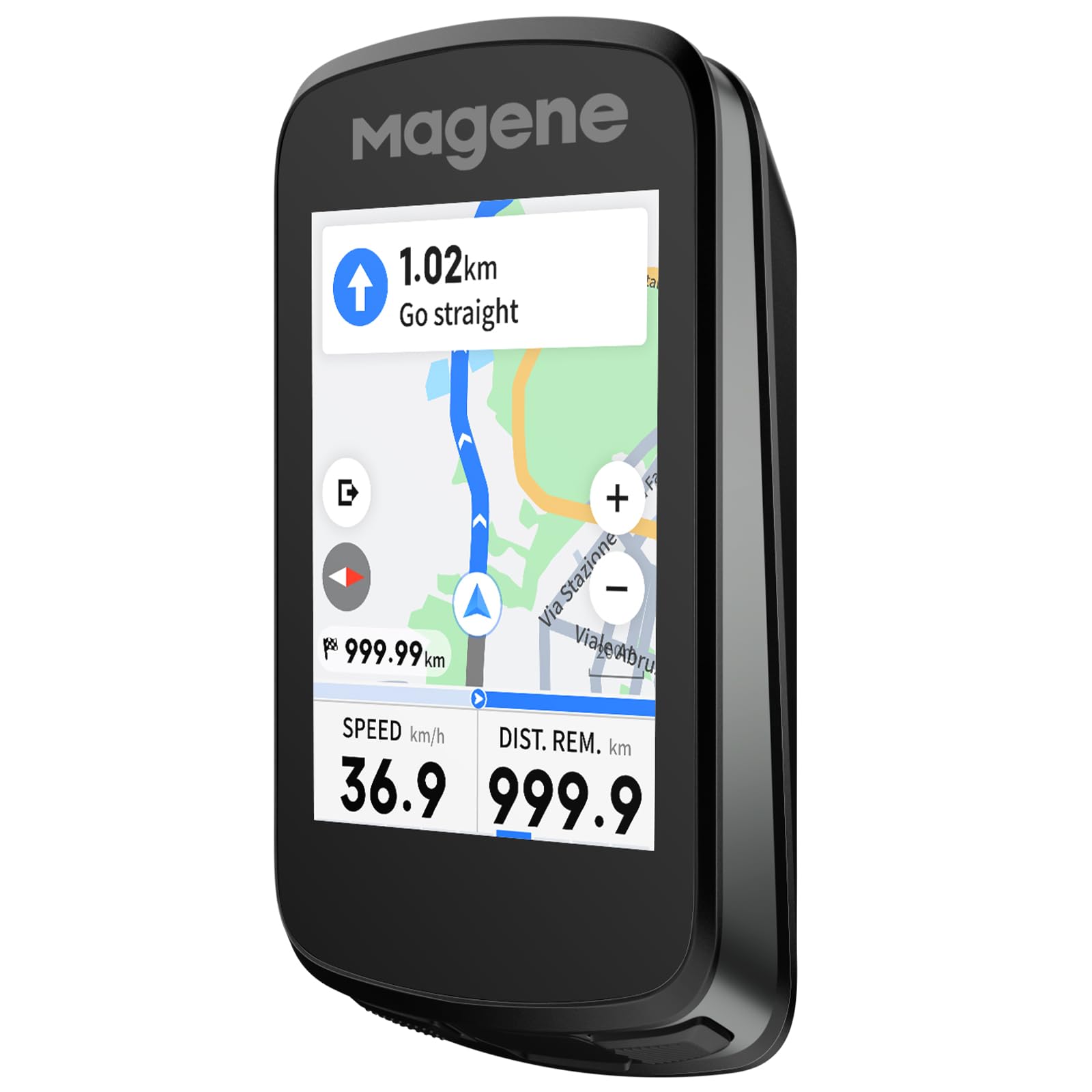
The Magene C606 V2 directly challenges Garmin by packing ClimbPro-grade multi-scenario climb planning, Strava Live Segments, and cycling dynamics (power phase, seated/standing time) into a 2.8-inch vibrant color touchscreen. The display is responsive and readable in rain, and battery endurance hits 25 hours — competitive with the Edge 540 — with Wi-Fi that uploads data 28 times faster than Bluetooth alone.
Wireless camera control for DJI Action and Insta360 cameras is a unique feature for content-creating cyclists. The unit supports up to 12 riding modes with 10 customizable data pages each, totaling 110+ data fields. The offline smart navigation includes online rerouting with dual strategies and a one-tap back-to-start function. Indoor training recreates outdoor FIT routes on smart trainers and supports TrainingPeaks course import.
Users report the screen can appear slightly dim in very bright sunlight, and radar integration lacks the color-bar differentiation found on Garmin units. The battery drains around 6% per hour at 60% brightness, which is reasonable. For riders who want ClimbPro-level climbing tools, live segments, and cycling dynamics without paying Garmin prices, the C606 V2 delivers outstanding value.
Why it’s great
- Multi-scenario ClimbPro and Strava Live Segments included out of box
- Cycling dynamics unlock power phase and seated/standing metrics
- Camera control for DJI and Insta360 is a unique differentiator
Good to know
- Screen brightness in direct sunlight is slightly less than premium Garmins
- Radar color-bar differentiation is less clear than Garmin’s implementation
- Battery life decreases noticeably with higher screen brightness
4. iGPSPORT BSC300T

The iGPSPORT BSC300T brings touchscreen navigation and offline global map downloads to the mid-range, supported by five-satellite positioning (GPS, BeiDou, GLONASS, Galileo, QZSS) for fast locks. The 2.4-inch touch panel is responsive, and six physical buttons provide a backup when gloves reduce touch sensitivity. An off-course warning buzzes until you return to your planned route — a simple but effective navigation safety net.
With 130+ data fields, the BSC300T covers everything an enthusiast needs: speed, distance, grade, cadence, calories, and temperature. eBike support displays power level and range, making it versatile for both acoustic and electric riders. Real-time tracking shares your location with teammates during group rides, reducing the chance of wrong turns. Battery life holds at 20 hours with GPS active, which is adequate for all-day weekend rides.
The screen is bright but small — users with larger fingers occasionally find touch targets tight. Navigation works well for preloaded routes but does not recalculate if you stray far off course; it simply alerts you. USB-C charging is included (cable sold separately), and the unit pairs easily with Cyplus radar for traffic alerts. For riders who want touchscreen navigation without premium pricing, this is a strong pick.
Why it’s great
- Touchscreen plus six-button backup for gloved operation
- Off-course warning prevents missed turns during navigation
- eBike support with battery-level display broadens compatibility
Good to know
- Touch targets can feel small for riders with larger fingers
- Does not recalculate the full route when you go off course
- USB-C cable sold separately, not included in the box
5. Magene C506
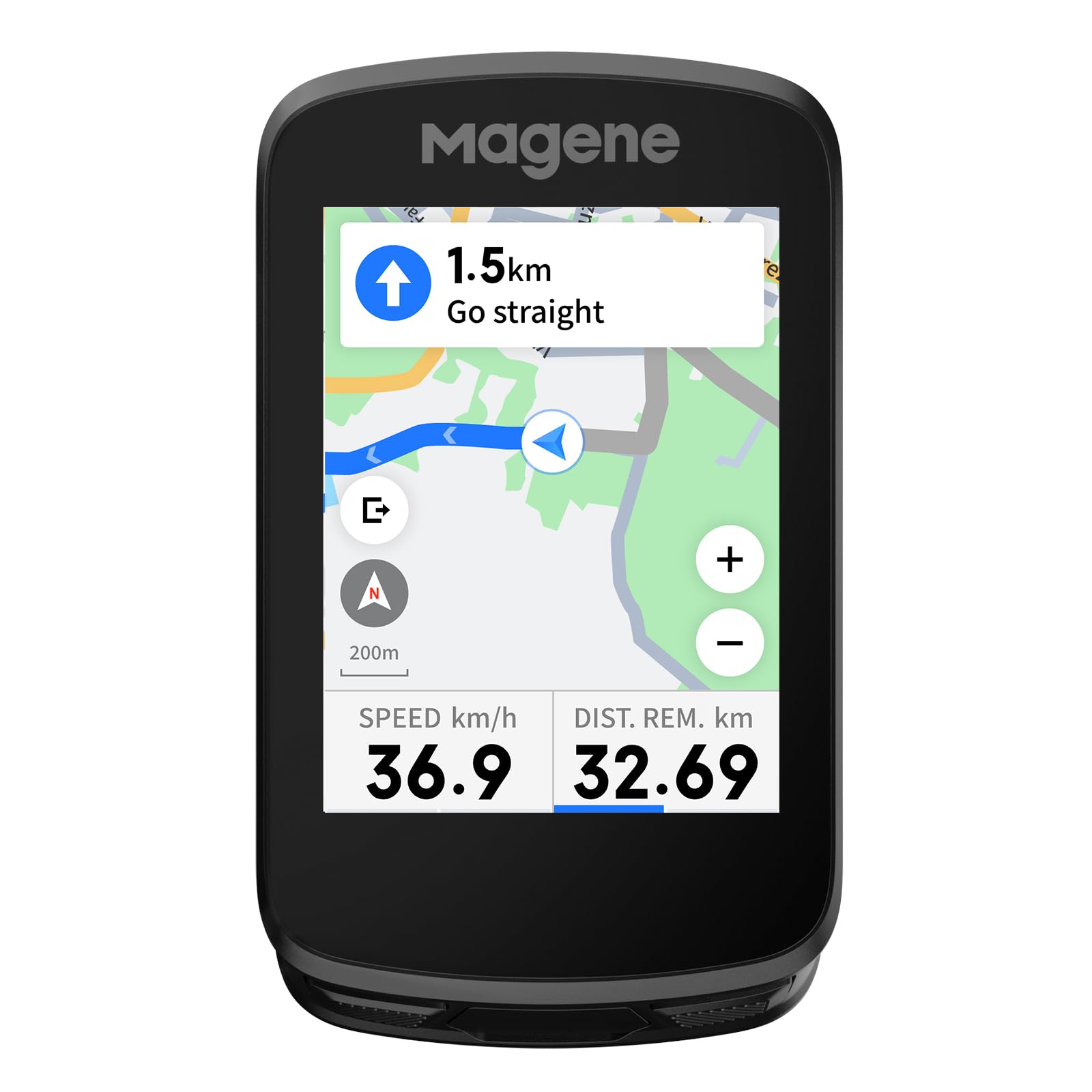
The Magene C506 packs a 2.4-inch color touchscreen, Wi-Fi, and Bluetooth into a lightweight 76-gram body that costs a fraction of feature-equivalent Garmins. The Airoha chipset achieves GPS lock in as fast as 5 seconds thanks to AGNSS support and over 300 days of calibration data. Turn-by-turn navigation with free global map downloads works well for structured routes, and the touchscreen is responsive, though occasionally unresponsive in cold rain.
The Smart Riding Assistant automates tail-light control (Magene L508/L308), sends hydration and nutrition reminders, and even triggers a return-time alert based on battery and distance remaining — thoughtful touches for long days. Indoor training is covered too: upload FIT files to a smart trainer and simulate outdoor rides with power targets and gradient control. The unit connects to nine device types, including SRAM eTap and Shimano Di2 electronic shifting.
Battery life reaches 24 hours in endurance mode, which easily covers multiple long rides between charges. The OnelapFit app has a steep learning curve with poor English translation, and map downloads require a multi-step process via the app then device settings. For riders willing to navigate the app’s quirks, the C506 offers excellent customization with 105 data items across 14 display categories.
Why it’s great
- Color touchscreen at a price well below competing color units
- Smart Riding Assistant automates light control and ride reminders
- Connects to 9 device types including electronic shifting groupsets
Good to know
- OnelapFit app suffers from poor English translation and slow performance
- Touchscreen can become unresponsive in cold or wet conditions
- Map download process is unintuitive and requires multiple steps
6. COOSPO BC107

The COOSPO BC107 proves that accurate GPS data and ANT+ sensor compatibility don’t require triple-digit spending. The 2.4-inch LCD shows heart rate, speed, grade, and cadence clearly, and its dual-mode positioning (GPS or GPS+BeiDou) provides reliable tracks worldwide. The unit is compact and lightweight — wrapped in glass-filled ABS and TPU — making it robust enough for daily commutes and weekend gravel rides.
ANT+ connectivity pairs with heart rate monitors, speed/cadence sensors, and power meters, though Bluetooth is reserved for the CoospoRide app (no direct Bluetooth sensor pairing). The app handles device setup, GPS track route loading, and activity syncing to Strava via .fit file export. Battery life is strong, with users reporting minimal drain even after back-to-back long rides. The IP67 rating offers full dust and water immersion protection.
The main limitation is the ANT+-only sensor protocol — if your heart rate strap uses Bluetooth, it won’t connect. The app has experienced auto-sync issues with Strava requiring manual intervention. There is no onboard navigation or map display, just data fields. For riders who want a reliable GPS speedometer with accurate sensor data and don’t need navigation, the BC107 delivers exceptional value at its price point.
Why it’s great
- Accurate GPS tracking with dual-mode satellite positioning
- Full ANT+ support for power meters, HR straps, and cadence sensors
- IP67 dust and water protection handles any weather
Good to know
- ANT+ only for sensors — no Bluetooth sensor pairing supported
- No onboard navigation, maps, or turn-by-turn directions
- CoospoRide app has occasional Strava auto-sync bugs
7. iGPSPORT BSC100S
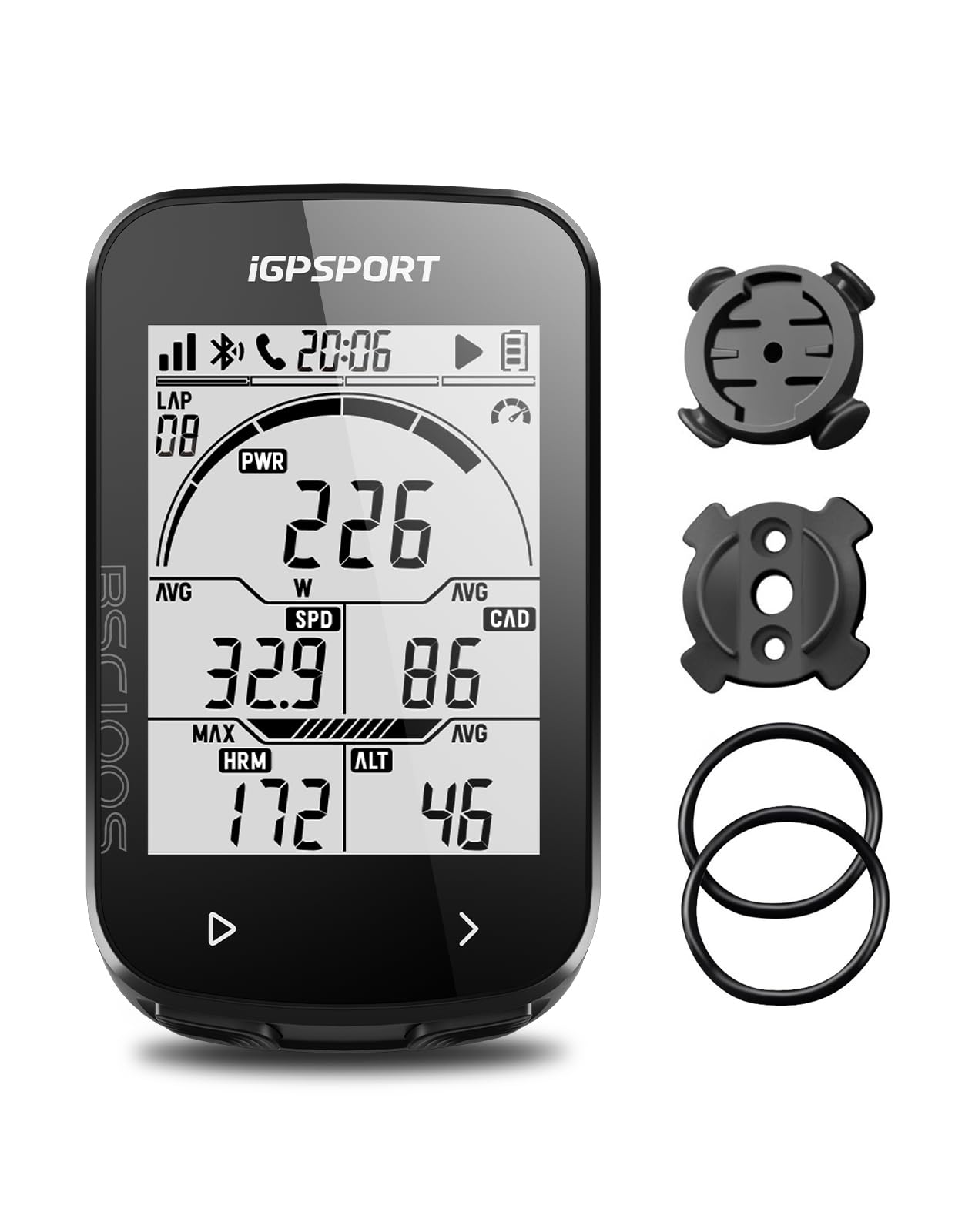
The iGPSPORT BSC100S is the budget champion for riders who prioritize battery life above all else. The 600mAh cell delivers up to 40 hours of runtime, enough for multi-day touring or a full week of commuting without charging. The 2.6-inch anti-glare LCD is one of the bigger screens in the budget tier, and the five-satellite positioning (GPS, BeiDou, GLONASS, Galileo, QZSS) locks quickly and provides accurate tracks across all terrains.
Over 40 riding data fields cover speed, distance, grade, cadence, calories, and temperature — enough for any non-racer. The iGPSPORT app syncs rides to Strava and Komoot, and the unit supports ANT+ and Bluetooth 5.0 dual protocol for wide sensor compatibility, including power meters. The IPX7 waterproof rating handles heavy rain without concern. The two-button interface is simple and reliable, though it lacks a customizable display.
Common criticisms include a placeholder mount that can break, a Type-C cable that must be purchased separately, and an instruction manual with poor English translation. Some users report battery life dropping faster than the claimed 40-hour figure in cold conditions. The screen is readable but reflective in certain angles. For the price-conscious rider who values battery endurance above color screens or navigation, the BSC100S is a practical, no-nonsense choice.
Why it’s great
- Exceptional 40-hour battery covers multi-day touring
- Five-satellite support ensures fast and accurate GPS lock
- ANT+/Bluetooth dual protocol works with most sensors
Good to know
- Type-C charging cable not included in the box
- Rubber band mount is low-quality and can break during rides
- Manual is poorly translated and often less helpful than online guides
FAQ
Can I use a cycling speedometer without a smartphone?
What is the difference between ANT+ and Bluetooth for cycling computers?
How accurate are GPS bike computers compared to wheel-mounted speed sensors?
Do I need a speedometer with navigation features?
What does IPX7 waterproof rating mean for a bike computer?
Final Thoughts: The Verdict
For most riders, the best cycling speedometer winner is the Garmin Edge 540 because it combines training analytics, robust navigation, and multi-band GPS reliability in a button-controlled package that works flawlessly in any weather. If you want a color touchscreen and ClimbPro-level climbing tools without the premium price, grab the Magene C606 V2. And for budget-conscious riders who need 40-hour battery life and reliable GPS data, nothing beats the iGPSPORT BSC100S.

Mo Maruf
I created WellFizz to bridge the gap between vague wellness advice and actionable solutions. My mission is simple: to decode the research and give you practical tools you can actually use.
Beyond the data, I am a passionate traveler. I believe that stepping away from the screen to explore new environments is essential for mental clarity and physical vitality.