Our readers keep the lights on and my smoothie glass nicely filled. As an Amazon Associate, I earn from qualifying purchases.
That wrist-based optical sensor on your cycling computer is fine for casual cruising, but when you start chasing power intervals or pacing a century ride, the gap between “close enough” and beat-by-beat accuracy becomes a real problem. A dedicated cycling heart rate monitor eliminates the motion artifacts and signal drift that plague wrist-worn sensors during bent-over aero positions and high-cadence sprints.
I’m Mohammad Maruf — the founder and writer behind WellFizz. I’ve spent months cross-referencing optical sensor patents, battery cycle counts, and Bluetooth/ANT+ pairing logs to find the hardware that actually holds a lock under load.
Whether you ride gravel, race crits, or grind on the trainer, the best cycling heart rate monitor is the one that stays locked to your real effort without dropouts or lag.
How To Choose The Best Cycling Heart Rate Monitor
Picking the right monitor for the bike comes down to three things: how fast you need the reading to update, what gear you already own, and whether you’re willing to wear a strap every ride. Let the type of riding you do guide the decision.
Chest Strap vs Optical Armband
Chest straps use electrical impulse detection (ECG) to measure your heartbeat directly. This gives you nearly instant reactivity — ideal for high-intensity intervals where a two-second lag in cadence data can mean the difference between hitting your target zone and blowing past it. Optical armbands use light to sense blood volume changes under the skin. They’re more comfortable, especially in aero tuck positions, but they introduce a slight delay during rapid effort changes. If you ride steady-state endurance miles, an armband’s convenience wins. If you chase power spikes on the trainer or in a crit, a chest strap is the more precise tool.
Bluetooth 5.0, ANT+ and Simultaneous Connections
A cycling heart rate monitor that talks to your bike computer, smart trainer, and phone at the same time saves you from re-pairing mid-ride. ANT+ is the standard for Garmin Edge, Wahoo ELEMNT, and Hammerhead Karoo units. Bluetooth 5.0 lets you stream to Zwift, Peloton, or your phone simultaneously. The best units support both protocols and allow at least two concurrent Bluetooth connections — so your head unit stays locked while your phone records the session for later analysis.
Battery Runtime and Charging Method
Riders logging five-plus hours per session need monitors that last through a week of training without a mid-week recharge. Rechargeable lithium-ion packs in the 20–35 hour range cover most commuters and weekend warriors, while coin-cell batteries (CR2032) run for a year but require a trip to the drawer when they die. Magnetic charging cables are a premium convenience — they eliminate wear on the port and make it easier to top off before a group ride. If you routinely forget to charge, a user-replaceable battery is the safer bet.
Quick Comparison
On smaller screens, swipe sideways to see the full table.
| Model | Category | Best For | Key Spec | Amazon |
|---|---|---|---|---|
| COOSPO HW9 | Optical Armband | Trainer & outdoor riders wanting 35h battery | 35-hour rechargeable, ±1BPM, vibration alert | Amazon |
| Polar H10 | Chest Strap | ECG-grade accuracy for HRV & intervals | 400-hour battery, dual BT + ANT+, 30m waterproof | Amazon |
| Wahoo TRACKR | Chest Strap | Rechargeable convenience with Zwift & Wahoo ecosystem | 200-hour rechargeable, BT + ANT+, LED status | Amazon |
| Garmin HRM 600 | Chest Strap | Advanced running dynamics & offline recording | 2-month rechargeable, swim-ready, running dynamics | Amazon |
| Scosche Rhythm+ 2.0 | Optical Armband | Armband comfort with HRV/RRi data for recovery | 24-hour rechargeable, IP68, RRi & HRV output | Amazon |
| COOSPO HW807 | Optical Armband | Budget entry with color zone LED and broad gym compatibility | 20-hour rechargeable, IP67, ±1BPM optical | Amazon |
| Garmin HRM 200 | Chest Strap | Reliable Garmin-native chest strap for simple pairing | 1-year CR2032, 3 ATM, machine-washable strap | Amazon |
In‑Depth Reviews
1. COOSPO HW9

The HW9 hits the sweet spot between battery endurance and optical accuracy. Its 35-hour runtime means you can ride all week and charge once — no mid-week anxiety about a drained sensor. The ±1BPM error margin is competitive with chest straps for steady-state efforts, and the five-color LED zone indicator gives you instant visual feedback without glancing at your head unit. The vibration warning, which triggers when your heart rate exceeds your programmed maximum, is a genuine safety feature for hard interval sessions on a trainer.
Dual Bluetooth 5.0 and ANT+ connectivity let it pair simultaneously with your bike computer and phone, so you can record on Zwift while your Garmin Edge captures the same feed. The included soft nylon strap stays breathable during hot summer centuries, and the magnetic charger eliminates the fiddly micro-USB plug that older armbands use. The only real caveat is that the strap runs small for upper-arm placement — most riders get a better lock on the forearm, which is fine for cycling but may shift slightly on rough gravel descents.
Customizable max heart rate via the Coosporide app is a nice touch for riders whose true lactate threshold doesn’t align with the default 200 bpm formula. The HRV data stream also works with third-party recovery apps, though it’s not as refined as the Polar H10’s offering. For the price, the HW9 delivers the longest rechargeable battery in this guide without sacrificing connection stability or optical precision.
Why it’s great
- 35-hour battery covers a full training week on one charge
- Simultaneous dual Bluetooth + ANT+ connections for head unit + phone
- Vibration alert when exceeding max heart rate prevents overexertion
Good to know
- Armband too snug for bicep placement on larger riders
- Optical lag during rapid sprint-to-recovery transitions
2. Polar H10
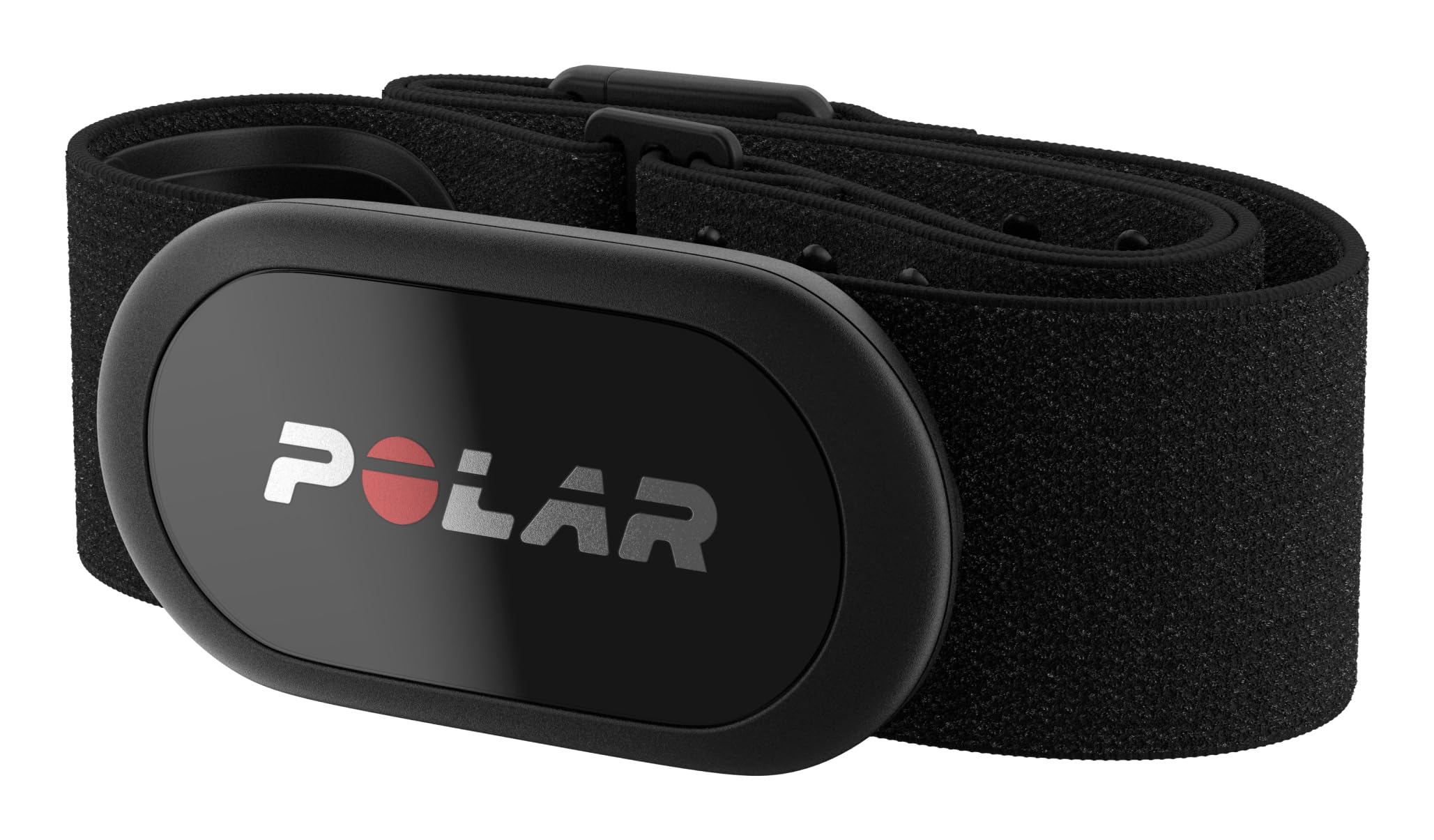
The Polar H10 remains the gold standard for ECG-based chest strap heart rate monitoring. Its ±2ms accuracy during cycling (99.3 percent of readings within 10 ms) makes it the definitive tool for HRV analysis, recovery tracking, and interval training where instantaneous feedback on effort changes matters. Internal memory stores one full session without a connected device — useful for track days or team sports where you can’t carry a phone. The 400-hour battery life from a single CR2025 coin cell means you might replace it once per year if you ride daily.
The Pro chest strap uses silicone grippers and a contoured buckle that prevents slipping during aggressive out-of-saddle efforts. The sensor pod snaps off easily for strap washing, and the 30-meter waterproof rating handles pool swims and monsoon rides alike. Dual Bluetooth plus ANT+ connectivity supports two simultaneous Bluetooth links — so your Garmin Edge and Zwift iPad can both receive live data without dropouts. The only frustration is the proprietary strap attachment: if the strap fails after six to eight months of heavy use, replacement straps that fit the H10 pod are slightly more expensive than generic chest straps.
Riders coming from optical armbands will notice the instant reactivity — when you surge from zone 2 to zone 4 in a sprint, the H10 reflects the change on your head unit within a single pedal stroke. That speed comes at the cost of comfort: chest straps feel restrictive to some riders, especially in the aero tuck. If HRV data and millisecond-precision timing matter for your training, the H10 is still the benchmark that every other sensor is measured against.
Why it’s great
- Sub-10ms ECG accuracy for HRV and interval analysis
- 400-hour battery from a user-replaceable coin cell
- Internal memory stores one session without a connected device
Good to know
- Chest strap can feel restrictive during long aero-tuck positions
- Strap longevity varies; replacement cost is higher than generic straps
3. Wahoo TRACKR

The Wahoo TRACKR solves the biggest headache of coin-cell chest straps: you never have to buy a replacement battery. Its USB-C rechargeable lithium cell delivers up to 200 hours of active use, which for most riders works out to charging once every six to eight weeks even with daily trainer sessions. The slim strap profile and soft fabric feel less intrusive than the thicker Polar or Garmin bands, making it a strong pick for riders who dislike chest straps but want the accuracy of an ECG sensor.
Pairing is nearly instant with Wahoo ELEMNT computers and the Wahoo Fitness app, but it also connects seamlessly to Zwift, Cyclemeter, and any Bluetooth/ANT+ compatible head unit. The LED indicator on the pod confirms heart rate detection and battery status at a glance — a minor detail that saves confusion during early-morning trainer sessions. User feedback consistently reports zero disconnects and stable readings during threshold intervals, matching the Polar H10 in practical accuracy for most cyclists who are not doing HRV-specific recovery analysis.
The one-size strap fits average chests well, but larger riders (over 44 inches) may find the included strap too short and will need a third-party strap that accommodates the Wahoo pod. The hook-and-loop buckle is secure but fiddlier to fasten than the snap-closure design used by Garmin. For Zwift racers and indoor riders who want a set-and-forget chest strap that never needs a trip to the battery drawer, the TRACKR is the most convenient option on this list.
Why it’s great
- 200-hour rechargeable battery eliminates coin-cell replacement
- USB-C charging works with standard bike lights and phone cables
- Instant pairing with Wahoo ELEMNT and Zwift without dropouts
Good to know
- Strap too short for chest sizes above 44 inches
- Proprietary pod attachment limits third-party strap options
4. Garmin HRM 600

The Garmin HRM 600 is the most feature-dense chest strap in this guide, packing running dynamics (stride length, vertical oscillation, ground contact time balance) alongside standard heart rate and HRV data. For triathletes and cyclists who also run, this single sensor covers both disciplines without needing a second device. The rechargeable battery lasts roughly two months with typical usage, and charging uses the same proprietary clip cable as Garmin Edge computers — one fewer cable to carry on race weekends.
Offline recording is the standout feature: during activities where you can’t wear a watch (team sports, pool swims, or track sessions), the HRM 600 stores up to 20 hours of data including heart rate, calories, estimated speed, and distance, then syncs to the Garmin Connect app when you finish. This makes it uniquely useful for crit racers who stow their computer in a pocket during a race but still want a full heart rate trace afterward. The three ATM water rating handles pool swimming and heavy rain without concern.
The trade-off is price — the HRM 600 is the most expensive sensor in this guide, and many of its running dynamics features require a compatible Garmin watch to display, meaning the bike-only rider won’t use half of its capability. Fit sizing is also finicky: the XS-S option runs snug for smaller frames, and the M-XL can feel loose for riders between sizes. If you live in the Garmin ecosystem and want a single HRM for bike, run, and swim, the HRM 600 is a powerful tool. For pure cycling use, the Polar H10 or Wahoo TRACKR offers comparable accuracy for less.
Why it’s great
- Offline recording stores 20 hours of data without a paired device
- Running dynamics add stride metrics for triathletes and duathletes
- Same charger cable as Garmin Edge computers reduces cord clutter
Good to know
- Running features require a compatible Garmin watch to display
- Premium price over simpler chest straps with identical HR accuracy
5. Scosche Rhythm+ 2.0

The Scosche Rhythm+ 2.0 is the only optical armband in this guide that ranks near chest-strap accuracy for HRV and RR interval data. Its dual-LED optical sensor streams RRi data to HRV4Training, Morpheus, and Welltory — a feature usually reserved for ECG chest straps — making it a unique tool for recovery-focused riders who want armband comfort without sacrificing HRV insight. The IP68 rating is genuinely waterproof (not just sweatproof), so it handles rain rides and even pool sessions without worry.
Battery life sits at 24 hours per charge, which is adequate for a week of moderate riding but falls short of the COOSPO HW9’s 35-hour runtime for ultra-distance cyclists. The breathable polyester strap adjusts to forearm, bicep, or tricep positions and stays in place during rough pavement sections. Pairing with Bluetooth and ANT+ is reliable across Garmin, Wahoo, and smartphone apps, though a minority of users report occasional signal dropouts that require a quick power cycle to resolve — a known inconsistency that the Scosche support team addresses via lifetime tech support.
For riders who prioritize post-ride recovery data over real-time zone feedback, the Rhythm+ 2.0’s HRV output is a genuine differentiator. The proprietary charger is a minor annoyance — it’s a magnetic clip rather than standard USB-C — but the overall package is the most comfortable way to get HRV-grade data without a chest strap. If you’re an endurance cyclist who lives in zone 2 and wants to monitor daily recovery trends, this is the armband to choose.
Why it’s great
- HRV and RRi data output for recovery analysis without a chest strap
- IP68 waterproof rating handles rain rides and pool sessions
- Breathable strap stays secure on forearm during aero positioning
Good to know
- 24-hour battery requires more frequent charging than top competitors
- Proprietary magnetic charger; not standard USB-C
6. COOSPO HW807

The COOSPO HW807 is the entry-level gateway to optical armband monitoring without sacrificing the core features that matter for cycling. Its patented optical sensor claims ±1BPM accuracy, and real-world tests from users confirm it tracks within a beat or two of chest straps during steady-state zone 2 and 3 riding. The color-coded LED ring on the sensor face flashes green (zone 1), blue (zone 2), yellow (zone 3), orange (zone 4), and red (zone 5), giving you instant zone awareness without staring at your bike computer — a genuine safety advantage for group rides and busy roads.
Compatibility is the HW807’s strongest card: it pairs with Peloton bikes, Concept2 rowers, Nordictrack treadmills, Garmin Edge computers, Wahoo ELEMNT units, and over 200 smartphone apps including Zwift, Strava, and Polar Beat. The IP67 waterproof rating handles sweat and heavy rain, though it is not rated for swimming. Battery endurance sits at 20 hours per charge — enough for four to five long weekend rides — and the included two arm straps (one small, one large) ensure a snug fit for forearm placement.
The plastic housing feels less premium than the COOSPO HW9’s build, and the micro-USB charging port is less convenient than the magnetic connector used by the HW9. Some users report that the LED color differentiation between green and yellow is hard to read in direct sunlight. For the price, the HW807 delivers reliable optical data and broad compatibility that matches monitors costing significantly more, making it the smart entry point for riders testing the armband form factor for the first time.
Why it’s great
- Color LED zone indicator provides instant visual feedback without a head unit
- Broad compatibility with Peloton, Garmin, Wahoo, and 200+ apps
- Two included arm straps accommodate different forearm sizes
Good to know
- Micro-USB charging less durable than magnetic connections
- LED zone colors hard to distinguish in bright daylight
7. Garmin HRM 200

The Garmin HRM 200 is the most straightforward chest strap in this guide: no rechargeable battery, no running dynamics, no offline memory — just reliable ECG heart rate transmission that pairs instantly with Garmin Edge computers and smartwatches. The CR2032 coin cell lasts up to a year, making it the lowest-maintenance option for riders who hate charging things. The sensor pod clips into a soft, machine-washable strap that is available in two sizes (XS-S and M-XL) for a better fit across different body types.
Accuracy during cycling is on par with the Polar H10 for steady-state and moderate interval work, though the HRM 200 lacks the advanced HRV features that recovery-focused riders need. The 3 ATM water rating means it survives rain rides and sweaty trainer sessions but isn’t rated for swimming. Pairing is effortless with Garmin Edge 540, 840, and 1040 series computers, and it also connects to Zwift via ANT+ dongle without hiccups. The button on the sensor pod makes manual pairing simple — a small but appreciated detail when troubleshooting mid-ride connectivity.
The trade-off for the simplicity and battery longevity is the lack of onboard recording or dual-device streaming. You cannot broadcast to two devices simultaneously, and there is no internal memory for standalone use. The strap material feels durable but some users report the elastic loses tension after six to eight months of weekly washing. For Garmin ecosystem riders who want a set-and-forget chest strap that doesn’t require weekly charging or app configuration, the HRM 200 is the most dependable workhorse on the list.
Why it’s great
- One-year battery life from a user-replaceable CR2032 coin cell
- Machine-washable strap with two size options for better fit
- Instant pairing with Garmin Edge computers and smartwatches
Good to know
- No onboard memory for offline recording during races
- Single-device connection only; no simultaneous Bluetooth streaming
FAQ
Is an optical armband accurate enough for structured cycling intervals?
Can I use a cycling heart rate monitor with Zwift and my bike computer at the same time?
How do I know which chest strap size fits my torso?
Does storing a chest strap wet affect its accuracy?
Final Thoughts: The Verdict
For most cyclists, the best cycling heart rate monitor winner is the COOSPO HW9 because it combines 35-hour rechargeable battery life, dual Bluetooth and ANT+ connectivity, and a comfortable optical armband design at a price that undercuts premium chest straps while delivering comparable accuracy for steady-state and tempo efforts. If you need ECG-grade precision for HRV analysis and interval reactivity, grab the Polar H10. And for the rider who wants the lowest-maintenance chest strap with instant Garmin pairing and a one-year battery, nothing beats the Garmin HRM 200.

Mo Maruf
I created WellFizz to bridge the gap between vague wellness advice and actionable solutions. My mission is simple: to decode the research and give you practical tools you can actually use.
Beyond the data, I am a passionate traveler. I believe that stepping away from the screen to explore new environments is essential for mental clarity and physical vitality.