Our readers keep the lights on and my smoothie glass nicely filled. As an Amazon Associate, I earn from qualifying purchases.
Whether you’re a weekend warrior chasing Strava segments or a daily commuter navigating busy intersections, the right gear transforms a good ride into a great one. From ultra-bright headlights that carve through the darkest trails to GPS computers that log every inch of your route, modern cycling gadgets are smarter, more durable, and more affordable than ever.
I’m Mohammad Maruf — the founder and writer behind WellFizz. I’ve spent hundreds of hours cross-referencing technical specs, analyzing real-world battery performance, and comparing lumen outputs and sensor accuracy to find the gear that actually delivers on its promises.
Here is my curated selection of the best cycling gadgets that offer real safety, performance, and value for riders at every level.
How To Choose The Best Cycling Gadgets
Choosing the right cycling gadget isn’t just about picking the brightest light or the cheapest computer. You need to match the feature set to your specific riding environment, whether that means prioritizing a long-lasting taillight for city commuting or a GPS unit with ANT+ compatibility for serious training. The most important factors are lumen output, battery life, mounting security, and sensor network support.
Lumen Output and Beam Pattern
For front lights, lumen output determines how far and wide you can see. A 1000-lumen light is sufficient for dark suburban roads, while trail riders benefit from 4800-lumen units that illuminate the entire path. Beam pattern matters just as much: a collimator lens provides even peripheral coverage, which helps you spot obstacles at the edge of your vision. Tail lights should be visible from at least 500 meters during daylight; look for COB LED technology for consistent brightness.
Battery Life and Charging Standard
Battery life varies wildly depending on the mode you use. A tail light may last 50 hours in flash mode but only 5 in steady-on mode. GPS computers range from 20 to 42 hours depending on satellite usage. USB-C charging is becoming the standard, and it’s worth prioritizing because micro-USB cables are harder to find on the road. Check the capacity in mAh and whether the device supports fast charging.
Sensor Compatibility and Data Tracking
If you want to track heart rate, cadence, or power, your bike computer must support ANT+ or Bluetooth sensors. The Garmin Edge 540 and CooSpo BC107 both support ANT+ sensors, allowing you to pair with a heart rate monitor and power meter. Basic GPS units without sensor connectivity are fine for distance and speed, but they won’t give you training load analysis or recovery recommendations.
Mounting Security and Weather Resistance
A gadget that falls off mid-ride is worse than no gadget at all. Look for dual-bolt or silicone-lined mounts that grip handlebars and seatposts firmly. IP64 or IPX7 ratings ensure the device survives rain, mud, and splash. For tail lights, vibration-triggered alarms add a layer of security when you park your bike, and motion-sensing auto-on/off features save battery and prevent accidental drain.
Quick Comparison
On smaller screens, swipe sideways to see the full table.
| Model | Category | Best For | Key Spec | Amazon |
|---|---|---|---|---|
| Garmin Edge 540 | Premium GPS Computer | Serious training & navigation | 26 hrs battery, multi-band GNSS | Amazon |
| Siuyiu JW617 4800 Lumens | Premium Headlight | Night trail & mountain riding | 4800 lumens, 10000mAh battery | Amazon |
| NiteRider Lumina Boost 1000 | Mid-Range Headlight | Road & MTB commuting | 1000 lumens, IP64, Boost mode | Amazon |
| COOSPO BC107 | Mid-Range GPS Computer | Training with ANT+ sensors | 2.4″ LCD, IP67, GPS+BeiDou | Amazon |
| WSDCAM Smart Tail Light | Mid-Range Tail Light | Safety & anti-theft for cargo bikes | 160 lumens, 2000mAh, 5-in-1 | Amazon |
| ROCKBROS Tail Light | Value Tail Light | Budget-friendly rear visibility | 50 hrs runtime, IPX6, USB-C | Amazon |
| Bikevee GPS Computer | Value GPS Computer | Basic GPS tracking without sensors | 28 hrs battery, 2.4″ LCD, IPX7 | Amazon |
In‑Depth Reviews
1. Garmin Edge 540

The Garmin Edge 540 is the definitive choice for riders who demand accuracy, training intelligence, and navigation in a button-operated package. Its multi-band GNSS technology locks onto satellites in challenging environments like dense forests or urban canyons, ensuring your route data is never corrupted by signal dropout. The 26-hour battery life in demanding use — and up to 42 hours in battery saver mode — means you can tackle multi-day tours without hunting for a wall outlet.
What truly sets the Edge 540 apart is its adaptive coaching and ClimbPro ascent planner. Based on your current training load and recovery, the unit suggests daily workouts that adjust in real time. When climbing, you see remaining ascent and grade, allowing precise effort management. The power guide feature recommends power targets throughout a course when paired with a compatible power meter.
The button interface is glove-friendly, which matters on cold morning rides. The USB-C charging port aligns with modern device ecosystems, and the out-front mount keeps the 2.3-inch display in your natural line of sight. The initial setup and screen customization do require a learning curve, but once configured, the Edge 540 is the most reliable cycling companion available.
Why it’s great
- Multi-band GNSS for precise positioning in forests and cities
- Adaptive training plans that adjust to your actual recovery
- 26-hour battery life covers virtually any ride distance
- Intuitive button controls work with winter gloves
Good to know
- Setup and menu navigation require a learning curve
- Premium price places it beyond casual riders’ budgets
2. Siuyiu JW617 4800 Lumen Bike Light

With 4800 lumens from 17 LED beads, the Siuyiu JW617 produces light comparable to a quality car headlight. The beam range extends to 2624 feet in high-beam mode, making it suitable for high-speed descents on unfamiliar trails. The 10000mAh internal battery delivers 7 to 16 hours of runtime depending on the mode, and the built-in fast charging chip charges three times faster than standard USB-C implementations.
The digital battery display shows both percentage and estimated remaining usage time, removing guesswork before a long ride. The IP65 waterproof rating means rain and mud won’t cause issues, and the dual-nut aluminum bracket with silicone cushion holds the light steady over aggressive jumps and ruts. The mount is tool-free and quick to attach or detach.
Four modes — flood, spot, bright, and flashing — adapt to different conditions: flood for group rides, spot for high-speed straights, bright for the steepest descents, and flash for daytime visibility. The unit can also charge a phone in an emergency, adding utility beyond illumination. The only downside is the weight, but that is offset by the sheer battery capacity.
Why it’s great
- 4800 lumens illuminates entire trail width
- Digital display shows battery percentage and time remaining
- 10000mAh battery lasts multiple rides without recharge
- Tool-free aluminum mount with silicone cushion stays tight
Good to know
- Heavier than standard 1000-lumen lights
- High beam mode drains battery faster than advertised in cold weather
3. NiteRider Lumina Boost 1000
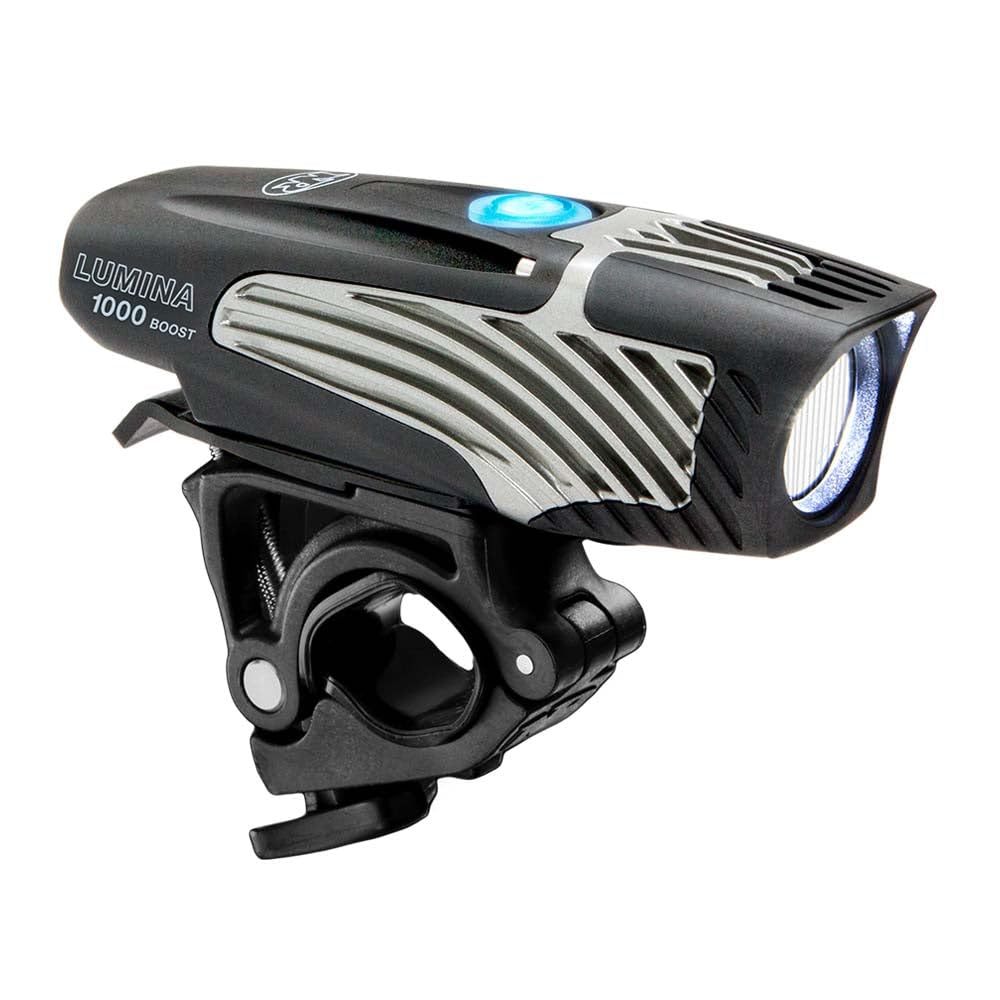
The NiteRider Lumina Boost 1000 has earned a reputation for rugged dependability. Its 1000-lumen boost mode — activated by double-tapping the power button — delivers maximum trail and road visibility when you need it most. The custom-engineered collimator lens produces a wide, even beam with strong peripheral coverage, so you spot obstacles at the edge of the trail without blind spots.
The IP64-rated fiberglass-reinforced nylon body with an integrated aluminum heat sink handles sustained high output without overheating. The mount fits handlebars up to 35mm and is rock-solid over rough terrain. Runtimes range from 1 hour in boost mode to 26 hours in walk mode, making it flexible for both fast training rides and casual evening commutes.
Lock-out mode prevents accidental activation in a bag, and FL1 testing verifies the lumen and runtime claims. The micro-USB charging port is the main drawback in an era where USB-C is standard, but the overall build quality, brightness, and battery life still make it a top contender for road and mountain bikers. The heat sink gets hot in the hand when running high mode continuously, but that is normal for a light of this class.
Why it’s great
- 1000 lumen boost mode for maximum visibility
- Collimator lens provides wide, even beam pattern
- IP64 rated for rain and dust resistance
- Lock-out mode prevents accidental battery drain
Good to know
- Uses micro-USB instead of USB-C
- Heatsink gets hot during extended high-mode use
4. COOSPO BC107 GPS Bike Computer

The CooSpo BC107 punches well above its weight class with ANT+ sensor compatibility that is usually reserved for more expensive units. It connects to heart rate monitors, speed and cadence sensors, and power meters, giving you a full training data set without requiring a Garmin-level budget. The dual-mode GPS and BeiDou satellite positioning ensures fast signal lock and accurate tracking even on tree-covered routes.
The 2.4-inch LCD display is clear and easy to read in daylight, and the auto-backlight feature kicks in automatically in low light. The IP67 waterproof rating means it can survive being submerged briefly, which is more than sufficient for heavy rain. The CoospoRide app lets you configure the device, upload routes, and sync activity files to Strava.
The compact chassis weighs only 140 grams and fits neatly on the included standard mount. The battery lasts long enough for multi-day trips between charges, and the USB-C charging port is convenient. The main limitation is that Bluetooth is used only for app syncing — sensor connectivity is strictly ANT+. For riders who already own ANT+ sensors, this is an exceptional value with no compromises.
Why it’s great
- Supports ANT+ heart rate, cadence, and power sensors
- GPS and BeiDou dual-mode for fast and accurate positioning
- IP67 waterproof for all-weather durability
- Syncs easily with Strava via CoospoRide app
Good to know
- Bluetooth only used for app sync, not sensor connection
- App integration has occasional Strava sync glitches
5. WSDCAM Smart Bike Tail Light

The WSDCAM Smart Tail Light packs five functions into a single cargo-rack-mounted unit: rear light, brake light, turn signals, a 110-decibel horn, and an anti-theft vibration alarm. The 160-lumen output from 31 LED lights is bright enough for daytime visibility, and the six light modes — including slow flash, breathing, fast blink, steady, emergency, and off — adapt to any riding condition.
The wireless remote clamps to handlebars between 0.78 and 0.94 inches and provides left and right turn signal buttons with a distinct click sound. The brake light triggers automatically via an integrated sensor when you slow down, improving rear-end collision prevention. The anti-theft alarm has seven sensitivity levels, so you can set it to trigger from a gentle touch or only from a hard impact.
The 2000mAh lithium battery provides up to 70 hours of fast blinking on a full charge, and the IP65 rating keeps the unit safe in wet weather. The turn signals are close together on the remote, which takes some getting used to, and the included hard plastic mount may require a silicone upgrade for a perfect fit. Overall, this is the most comprehensive safety system you can add to a cargo e-bike or commuter.
Why it’s great
- 5-in-1 design saves space and money
- 110dB horn is loud enough for traffic
- Anti-theft alarm with 7 sensitivity levels
- 70-hour runtime in fast blink mode
Good to know
- Turn signal buttons are close together on the remote
- Included mount may need a silicone replacement for a tight fit
6. ROCKBROS Bike Tail Light

The ROCKBROS Tail Light delivers brake-sensing technology at a price that makes adding rear visibility to a second bike painless. The high-intensity COB LED activates a 5-second flash when it detects deceleration, giving following riders and drivers a clear signal that you are slowing. Four modes — normal flash, breathing flash, fast flash, and steady on — cover day and night conditions.
The smart auto on/off feature uses motion and light sensors to turn the light off after 30 seconds of inactivity and reignite when the bike moves. The 400mAh Li-ion battery provides up to 50 hours of usage, which means you can charge it weekly for daily commutes. The four blue breathing lights indicate battery capacity in 25% increments.
The aluminum alloy body feels premium, and the IPX6 waterproof rating shrugs off rain and road spray. Two mounting options are included: a metal under-seat mount and a rubber band seatpost mount. The clamp can feel slightly loose on some seat rails, but a wrap of electrical tape fixes the problem instantly. For riders wanting an affordable way to add brake-light safety, this is a no-brainer.
Why it’s great
- Brake sensing activates a high-visibility flash on deceleration
- 50-hour runtime on a single charge
- Smart auto on/off saves battery
- Aluminum alloy body feels durable
Good to know
- Clamp can be loose on some seat rails
- Motion sensor may trigger in wind or when parked indoors
7. Bikevee GPS Bike Computer
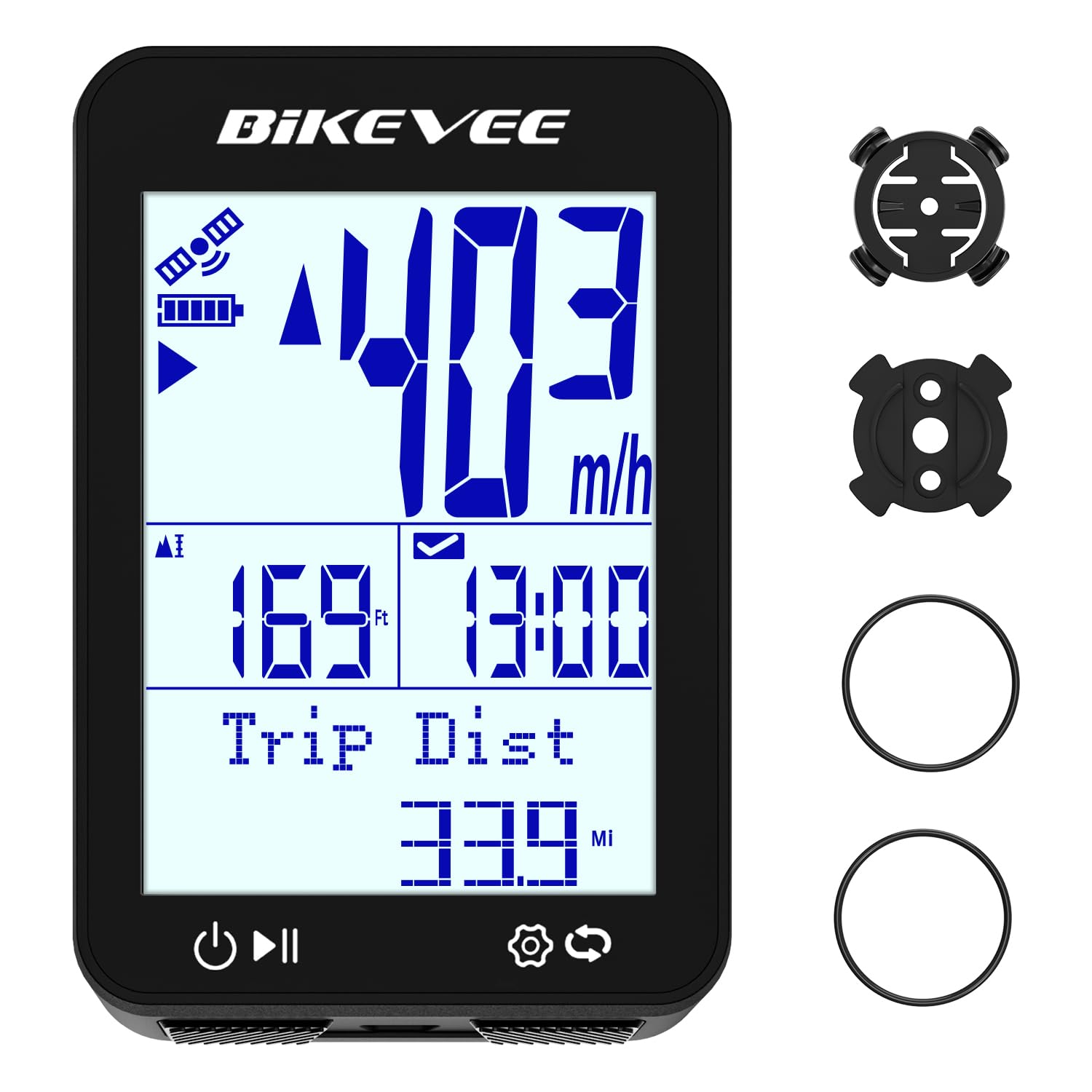
The Bikevee GPS Computer strips away complexity and focuses on what most riders actually need: accurate speed, distance, ride time, and elevation tracking. There are no wheel magnets or wiring to deal with — the GPS positioning means you simply mount the unit and ride. The 650mAh rechargeable battery provides up to 28 hours of runtime, which is enough for weekend epics and multi-day tours without recharging.
The 2.4-inch LCD screen is large enough to read at a glance, and the auto-backlight improves visibility in tunnels and after dark. The IPX7 rating means it can handle being submerged in shallow water, so heavy rain is no concern. The device supports 9 languages, making it accessible for international riders. Data fields include speed, average speed, max speed, distance, ride time, temperature, altitude, gradient, and ascent distance.
The biggest trade-off is that there is no Bluetooth, ANT+, or smartphone connectivity — this is a standalone computer with no sensor support and no app sync. GPS acquisition can take up to half a mile on first use, and the main display layout is not configurable. For riders who simply want a reliable odometer and speedometer without any of the extra complexity, this unit delivers excellent value.
Why it’s great
- Wireless GPS setup with no wheel magnets
- 28-hour battery life handles long rides
- IPX7 rating for total weather protection
- Large 2.4-inch display with auto backlight
Good to know
- No Bluetooth, ANT+, or sensor compatibility
- GPS acquisition can be slow on initial startup
FAQ
How many lumens do I need for a bike headlight at night?
Can I use ANT+ heart rate monitors with an entry-level GPS computer?
How do I mount a tail light to a cargo rack?
What is the difference between IPX6 and IP67 waterproof ratings?
Final Thoughts: The Verdict
For most users, the best cycling gadgets winner is the Garmin Edge 540 because it combines precise multi-band GNSS navigation with adaptive coaching that adjusts to your actual fitness. If you want a trail-illuminating headlight that rivals a car’s high beams, grab the Siuyiu JW617. And for a smart tail light that adds turn signals and an anti-theft alarm to your cargo bike, nothing beats the WSDCAM Smart Tail Light.

Mo Maruf
I created WellFizz to bridge the gap between vague wellness advice and actionable solutions. My mission is simple: to decode the research and give you practical tools you can actually use.
Beyond the data, I am a passionate traveler. I believe that stepping away from the screen to explore new environments is essential for mental clarity and physical vitality.