Our readers keep the lights on and my smoothie glass nicely filled. As an Amazon Associate, I earn from qualifying purchases.
You’re ready to ditch the phone mount and the anxiety of a dead battery mid-ride. A dedicated cycling computer delivers the one thing your phone cannot: reliable, all-day performance with a screen you can actually read in direct sunlight. But with models ranging from stripped-down data loggers to full-color navigation hubs, choosing the right unit means knowing which specs match your riding style.
I’m Mohammad Maruf — the founder and writer behind WellFizz. I’ve spent countless hours dissecting GPS chipset accuracy, battery endurance tests, display readability metrics, and ecosystem lock-in factors to separate genuine performance from marketing hype in this category.
This guide breaks down nine units across every price tier, examining satellite positioning speed, map navigation quality, sensor compatibility, and real-world battery life — so you can confidently select the best cycling computer for your road, gravel, or commuting needs.
How To Choose The Best Cycling Computer
Selecting a cycling computer isn’t about picking the most expensive unit. It’s about matching the device’s core strengths — battery endurance, navigation depth, and sensor ecosystem — to your weekly riding habits. Below are the three most critical decision filters.
Battery Life vs. Display Demands
A GPS computer’s battery rating is rarely a single number. Manufacturers list two figures: one for “demanding use” (full brightness, continuous GPS tracking, Bluetooth sensors connected) and another for “battery saver mode” (dimmed screen, reduced GPS polling, fewer sensor connections). A 35-hour rated unit may only deliver 12 to 14 hours of real-world use with a color touchscreen and dual-band GNSS active. If you ride centuries, brevets, or multi-day tours, prioritize a device with at least 20 hours of standard-use battery life and a replaceable mount so you can swap a backup without tools.
Navigation Depth: Offline Maps vs. Breadcrumb Trails
Not all navigation is the same. Basic units show a simple line (breadcrumb) on a blank background, requiring you to carry a phone for actual map context. Mid-range and premium computers store full-color offline maps with street names, points of interest, and searchable addresses. The critical differentiator is rerouting: once you veer off course, does the device automatically recalculate a new path or simply warn you? Models with real-time rerouting handle detours and wrong turns gracefully. Models without it force you to backtrack or pull out your phone — a major frustration on unfamiliar routes.
Sensor Ecosystem and Data Integration
Your computer is the dashboard for your power meter, heart rate monitor, speed sensor, cadence sensor, electronic shifting groupset (Shimano Di2, SRAM eTap, Campagnolo EPS), and rear radar. Before buying, verify the number of simultaneous sensor connections (ANT+ and Bluetooth) and whether the device supports custom data screens for metrics like Power Phase, Seated/Standing Time, and Pedal Platform Center Offset. The best units also sync wirelessly to TrainingPeaks, Strava, and Komoot — no cable required.
Quick Comparison
On smaller screens, swipe sideways to see the full table.
| Model | Category | Best For | Key Spec | Amazon |
|---|---|---|---|---|
| Garmin Edge 1040 | Premium | Long-distance touring | 35 hrs standard use | Amazon |
| SRAM Hammerhead Karoo | Premium | Smartphone-like UI | 3.2″ Touch + 64GB | Amazon |
| Wahoo ELEMNT Bolt V3 | Mid-Range | Button control + radar | 20 hrs / IPX7 | Amazon |
| Garmin Edge 540 | Mid-Range | Adaptive coaching | 42 hrs battery saver | Amazon |
| iGPSPORT BiNavi | Mid-Range | Large screen + music | 3.5″ Touch + 35 hrs | Amazon |
| Bryton Rider 650 | Mid-Range | 33-hr endurance | 33 hrs / Preloaded USA | Amazon |
| Magene C606 V2 | Mid-Range | ClimbPro + cycling dynamics | 25 hrs / IPX7 | Amazon |
| iGPSPORT BSC300T | Budget-Friendly | Offline maps + touch | 20 hrs / 5 sat systems | Amazon |
| Magene C506 | Budget-Friendly | Lightweight entry-level | 24 hrs / 76g weight | Amazon |
In‑Depth Reviews
1. Garmin Edge 1040

The Garmin Edge 1040 is the benchmark for GPS bike computers, delivering a massive 3.5-inch color touchscreen with exceptional sunlight readability and multi-band GNSS for pinpoint accuracy even in dense tree cover or urban canyons. The streamlined interface lets you adjust data fields directly on the device or from the Garmin Connect app, and the included premium heart rate monitor plus speed and cadence sensors make this a complete out-of-the-box training solution.
Battery life is the standout: 35 hours of demanding use extends to 70 hours in battery saver mode — enough for multi-week bikepacking trips without recharging. The Power Guide feature recommends real-time wattage targets through a course, and the Stamina metric shows how much longer you can sustain your current effort when paired with a compatible power meter. Riders report seamless pairing with SRAM Force AXS groupsets, perfect shifting data, and flawless Wi-Fi Strava route sync.
The Edge 1040 also supports electronic shifting integration (Di2, eTap, Campagnolo EPS), group ride tracking, and surface-specific maps for road, gravel, or MTB trails. The IP54 rating means it resists splashes but is not fully submersible — take care during heavy downpours. The mount is sold separately and may require readjustment on rough terrain.
Why it’s great
- Industry-leading 35-hour standard battery life
- Multi-band GNSS locks satellites in seconds under canopy
- Complete kit includes HRM, speed & cadence sensors
- Power Guide and Stamina metrics for race-ready pacing
Good to know
- Mount sold separately from the device
- IP54 rating is splash-resistant but not fully waterproof
- Large footprint may feel bulky on small handlebars
2. SRAM Hammerhead Karoo

The SRAM Hammerhead Karoo breaks away from the Garmin ecosystem by offering a smartphone-like interface with a 3.2-inch high-resolution display that renders maps and data fields with exceptional clarity. The combination of a responsive touchscreen and hardware buttons means you can operate it in any condition — sweaty summer rides, muddy gravel racing, or winter gloves. Multi-band GNSS technology locks your position precisely even in crowded cities and tight singletrack.
With 64GB of onboard storage and 4GB of RAM, the Karoo renders maps faster than any competitor in this list. Free global offline maps include road, MTB, and gravel routing profiles. The automatic climb detection activates whether or not you have a route loaded, and the instant route syncing from Strava, TrainingPeaks, and Komoot means you spend zero time moving files around. Riders appreciate the easy setup, clear screen, and seamless connection to SRAM AXS drivetrains and ANT+ sensors.
The 15-hour rated battery life is significantly shorter than the Edge 1040 or iGPSPORT BiNavi — long-distance riders will need to plan recharging stops on all-day epics. The trail map rendering with singletrack routes has been noted as less detailed than Garmin’s Trailforks integration, and calorie calculation relies on power meter data rather than heart rate. The price positions it firmly as a premium unit for riders who prioritize interface polish over raw battery endurance.
Why it’s great
- Fastest map rendering of any cycling computer tested
- 64GB storage holds global maps without compromise
- Touch + button hybrid works in any weather condition
- Surface-specific routing for road, gravel, and MTB
Good to know
- Battery life capped at 15 hours in standard GPS mode
- Trail map styling is less detailed than dedicated MTB rivals
- Calorie tracking requires a power meter for accuracy
3. Wahoo ELEMNT Bolt V3
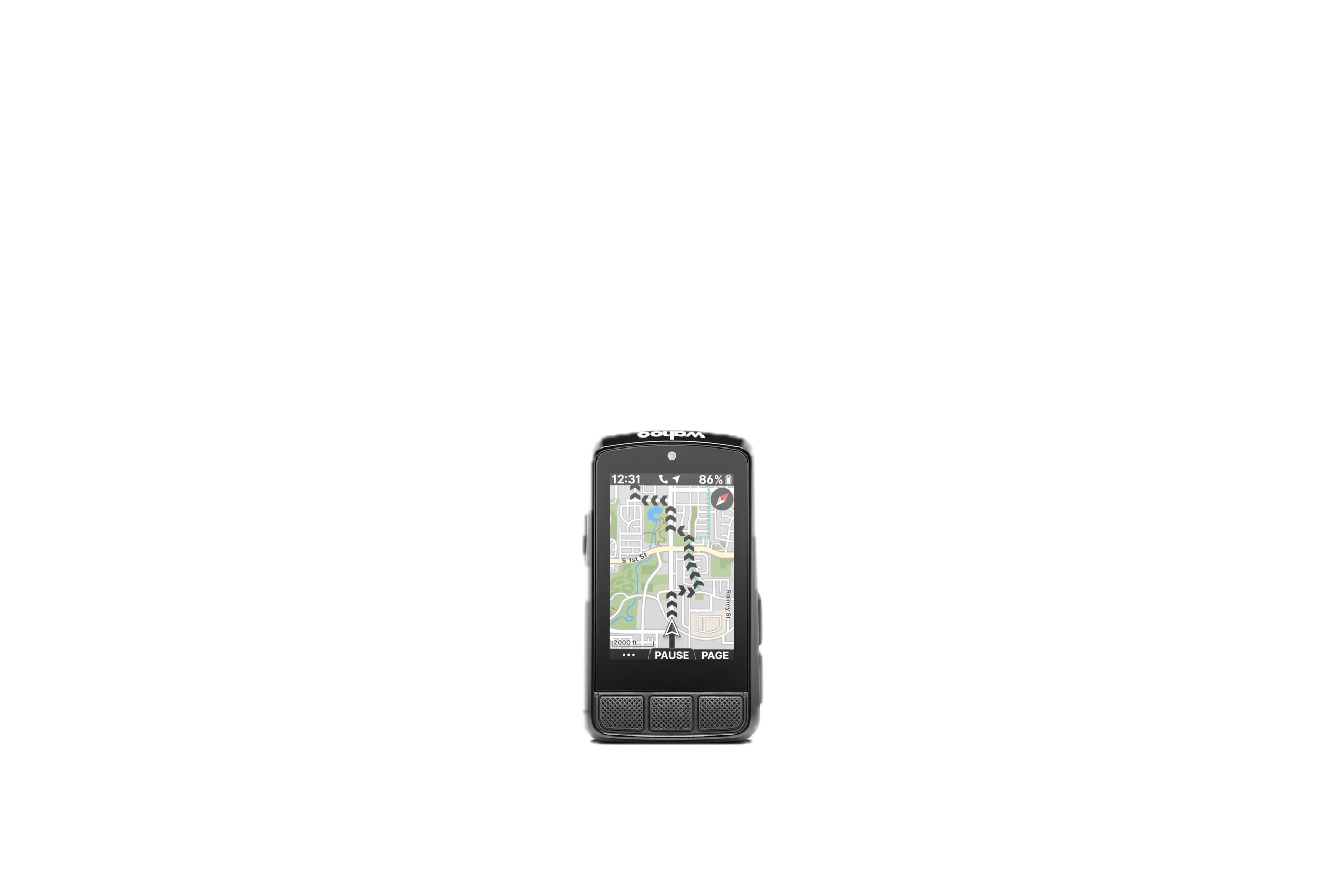
The Wahoo ELEMNT Bolt V3 delivers the button-based navigation that many cyclists prefer over touchscreens for gloved or wet-weather riding. The 2.3-inch monochrome LCD with colored LED strips provides glanceable turn notifications, rear radar alerts, and heart rate zone indications without requiring you to look directly at the screen. The IPX7 waterproof rating means it survives complete submersion — a genuine advantage over the Edge 1040’s IP54.
Automatic route downloads from Strava, Ride With GPS, Komoot, and Best Bike Split work flawlessly in the background. The Take Me To feature generates on-demand turn-by-turn directions from any address or point of interest. ANT+ radar integration displays approaching vehicles from behind on-screen with LED warnings — a critical safety feature for road riders. The Bolt V3 weighs only 84 grams, making it one of the lightest mid-range options.
The app migration from the original ELEMNT app to the new Wahoo app has frustrated some long-time users who now need to manually upload Strava files. The pan and zoom map navigation was removed in the V3 update, reducing the Bolt’s ability to explore routes directly on the device. Despite these software hiccups, the hardware reliability is proven — many riders report seven years of daily use from the original Bolt model before battery degradation.
Why it’s great
- Physical buttons work flawlessly with gloves and in rain
- IPX7 full waterproofing for any weather confidence
- Lightweight 84g design for weight-conscious riders
- Excellent ANT+ radar integration with on-screen vehicle display
Good to know
- Mapping lost pan-and-zoom functionality in V3 update
- New Wahoo app lacks some ELEMNT app features
- Manual Strava upload required if auto-sync fails
4. Garmin Edge 540

The Garmin Edge 540 packs the same multi-band GNSS engine as the Edge 1040 into a smaller, lighter chassis with button-only controls — no touchscreen to complicate gloved operation. Battery life reaches 26 hours in demanding mode and stretches to 42 hours in battery saver mode, making it a serious contender for multi-day events. The daily suggested workouts adapt to your current training load and recovery based on data from a compatible power meter and heart rate monitor.
ClimbPro ascent planner now works without a pre-loaded route, showing remaining ascent, grade, and percentage of climb completed on any ride. The Power Guide feature recommends specific wattage targets through a course — a race-day tool that helps you avoid going out too hard. Stamina insights display a real-time gauge of how much longer you can sustain your current effort. Riders upgrading from the Edge 530 report faster GPS acquisition and seamless pairing with HRM, cadence, and speed sensors via USB-C.
The 84-page online-only manual is overwhelming for new users. Setting up data screens requires careful reading to configure instead of relying on the intuitive on-device tool available on touchscreen Garmins. The button navigation, while reliable, requires memorizing multi-click sequences to jump between screens — not as immediate as a touchscreen for data field adjustments mid-ride.
Why it’s great
- Multi-band GNSS for accurate positioning in difficult environments
- Adaptive coaching adjusts workouts based on recovery status
- ClimbPro works on every ride without a pre-planned route
- 42-hour battery saver mode for long endurance events
Good to know
- Button-only interface has a steep learning curve for multi-screen setups
- Manual is online-only and 84 pages long
- No touchscreen for quick data field edits during a ride
5. iGPSPORT BiNavi

The iGPSPORT BiNavi offers a 3.5-inch color touchscreen — the same display diagonal as the Garmin Edge 1040 — at a significantly lower price point. Dual-band GPS supports L1 and L5 frequencies simultaneously, reducing signal interference in dense environments and improving lane-level positioning accuracy. The battery is rated at 35 hours, though real-world use with full brightness and sensor connections brings that closer to 12 hours — still sufficient for most long-distance rides.
Music control from the handlebars is a unique feature: you can play, pause, skip tracks, and adjust volume from the touchscreen without reaching for your phone. The BiNavi also supports yaw planning — if you go off course, it automatically plots a new route back to the original path. iClimb Pro offers hill profile previews with gradient color coding to help pace ascents. Riders report excellent turn-by-turn navigation with rerouting after a power cycle and appreciate the unlimited custom data screens.
The rerouting algorithm is slow and sometimes buggy — it can take over 30 seconds to calculate a detour, and route closures require manual intervention. The included manual is sparse, and most users find detailed setup instructions only on YouTube. Battery life claims are optimistic: full-brightness GPS tracking with an HR sensor connected drains roughly 8% per hour, so plan for shorter ride durations unless you reduce screen brightness.
Why it’s great
- Large 3.5-inch color screen for easy data reading mid-ride
- Dual-band L1+L5 GNSS for improved urban accuracy
- Music control from handlebars adds convenience
- Yaw planning automatically recalculates off-course routes
Good to know
- Rerouting can be slow and occasionally buggy
- Real-world battery life is much shorter than 35-hour rating
- Instruction manual is minimal; YouTube setup videos essential
6. Bryton Rider 650
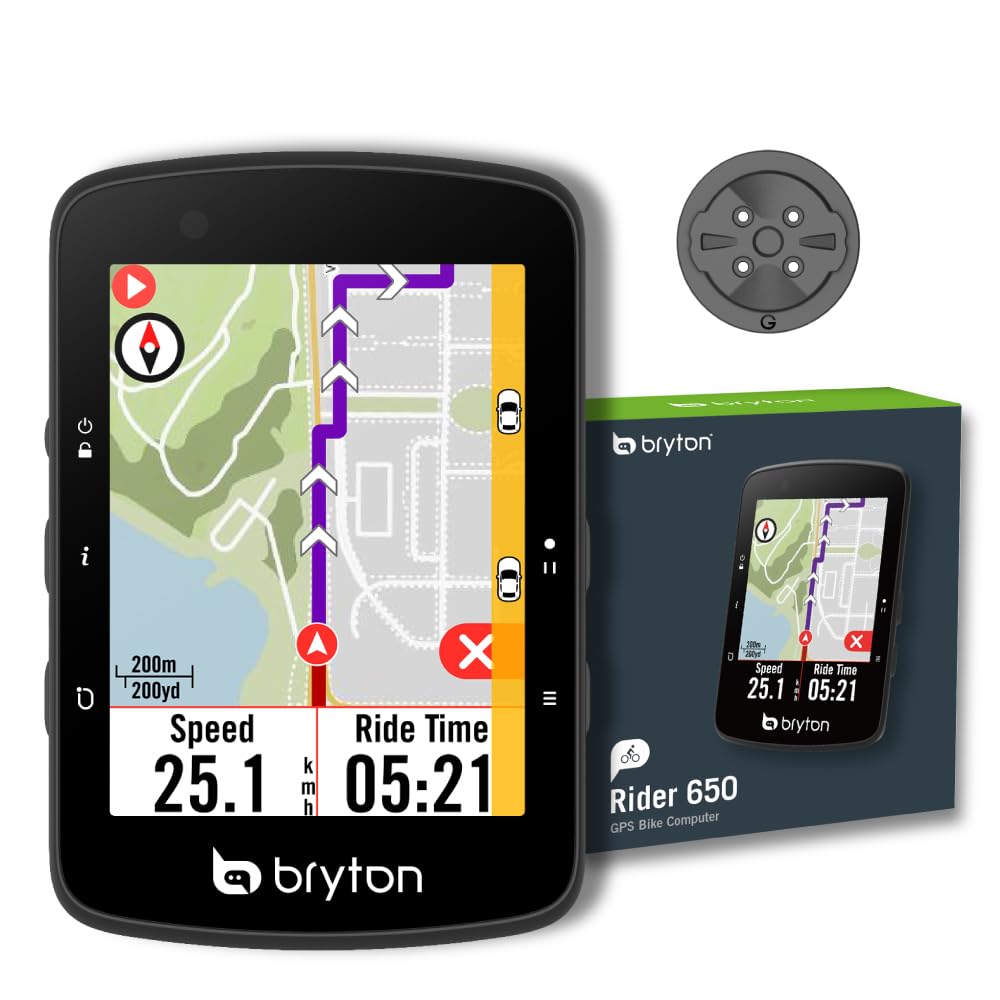
The Bryton Rider 650 prioritizes battery endurance above all else. With a rated 33-hour battery life, it outlasts every mid-range competitor in this guide and even beats the Garmin Edge 1040’s 35-hour standard mode on paper. The 2.8-inch color LCD touchscreen includes an ambient light sensor that automatically adjusts brightness to conserve power while maintaining readability. Preloaded OSM USA maps with street names and points of interest eliminate the need to download map files before a ride.
Climb Challenge 1.0 provides color-coded grade sections on a pre-planned route, showing distance to summit and total ascent — useful for conserving energy on long climbs. Live Tracking lets family or friends follow your real-time location, and rear-view radar support warns of approaching traffic. The Rider 650 pairs with ANT+ sensors for speed, cadence, heart rate, and power, and supports electronic shifting groupsets including Di2 and eTap.
The user interface lacks the polish of Garmin and Wahoo. The screen is not as bright or crisp — some riders report that the display appears “washed out” compared to higher-end models. The Bryton does not connect directly to Wi-Fi; all syncs go through the Bryton Active phone app, which must remain open for background uploads. Customer support for initial setup can be slow, with requests for video evidence of syncing failures.
Why it’s great
- 33-hour battery life leads the mid-range category
- Preloaded USA maps with street names and POIs out of the box
- Ambient light sensor auto-adjusts brightness for readability
- Live Tracking and radar support for solo safety
Good to know
- Screen brightness and contrast lag behind Garmin/Wahoo
- No direct Wi-Fi — syncs exclusively through phone app
- First-time setup can require patience and support interaction
7. Magene C606 V2
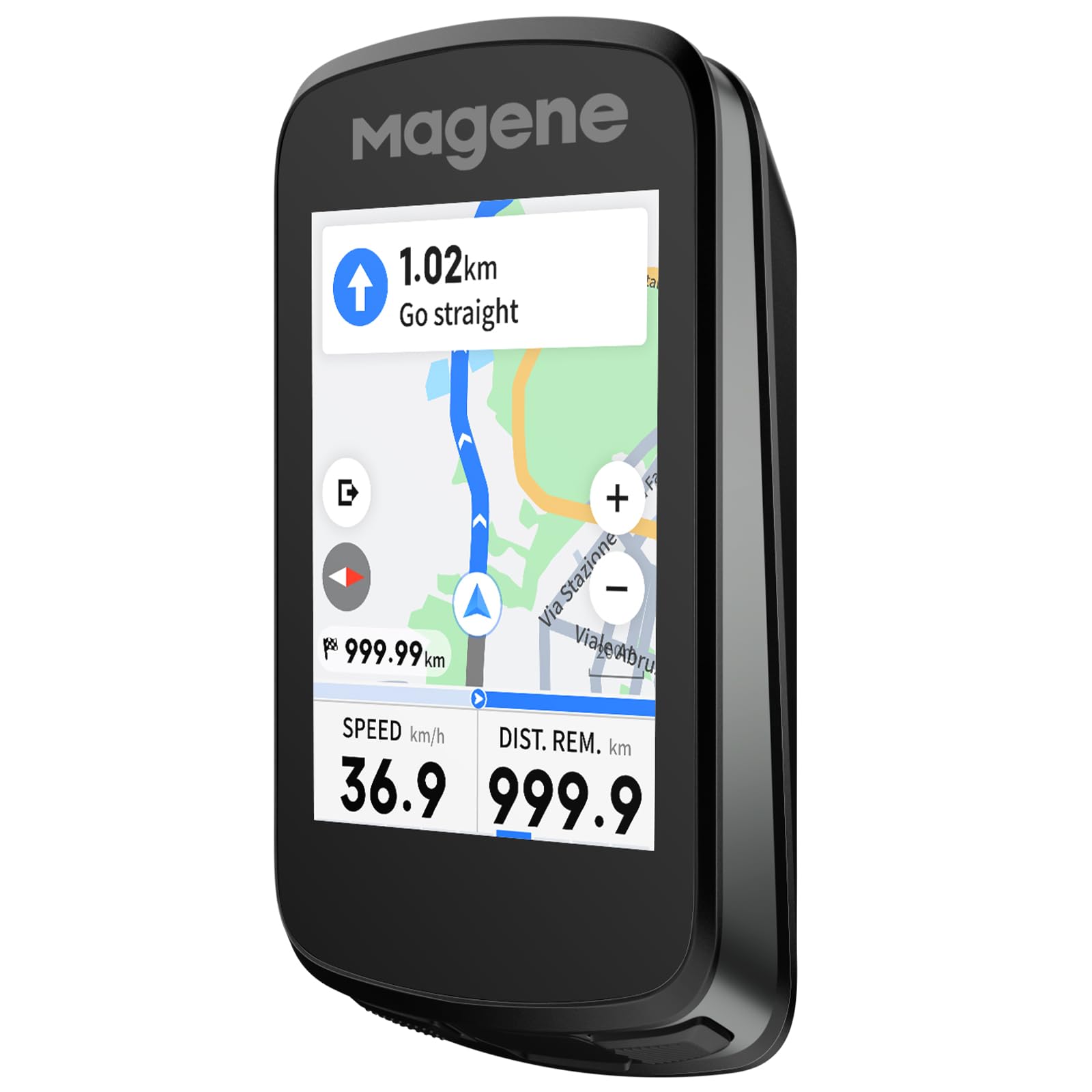
The Magene C606 V2 brings ClimbPro-style route climb planning and cycling dynamics features typically reserved for premium Garmins into the mid-range bracket. The 2.8-inch color touchscreen with a responsive TFT display works with gloved fingers and is readable in direct sunlight. Multi-scenario ClimbPro offers full route climb planning before the ride plus automatic mid-ride detection with real-time gradient, remaining distance, elevation gain, and two customizable data fields.
Cycling Dynamics unlocks Power Phase, Seated/Standing Time, and Platform Center Offset when paired with compatible power meters like the Magene P715, Garmin Rally, or Favero Assioma — data that helps optimize pedal stroke efficiency. The C606 V2 also supports Strava Live Segments with real-time PK battles, wireless offline smart navigation with online rerouting, and smart camera control for DJI Action and Insta360 cameras with battery and storage status displayed on-screen.
Some riders note that the contrast could be stronger — in very bright midday sun, the screen loses legibility compared to the Garmin Edge 1040. Radar integration, while functional, is less mature than the Wahoo ELEMNT Bolt’s implementation. Battery drain runs at approximately 6% per hour with full brightness and sensors connected, giving a real-world range closer to 16 hours than the rated 25.
Why it’s great
- ClimbPro-style planning with mid-ride auto-detection
- Cycling Dynamics metrics for power phase optimization
- Smart camera control for DJI and Insta360 one-tap operation
- Strava Live Segments with real-time competitive comparison
Good to know
- Screen contrast fades in brightest midday light
- Radar integration less polished than dedicated competitors
- Real-world battery life falls short of claimed endurance
8. iGPSPORT BSC300T

The iGPSPORT BSC300T combines a 2.4-inch touchscreen with six physical buttons, giving riders two ways to interact with the device. The screen supports global offline map downloads with turn prompts and off-course warnings — if you drift from your planned route, the unit vibrates or alerts until you correct your position. Five-satellite positioning (GPS, Beidou, GLONASS, Galileo, QZSS) ensures fast lock times and accurate tracks across different regions.
Over 130 data fields cover speed, distance, grade, cadence, calories, temperature, and time. The BSC300T supports eBike connectivity and displays battery level for electric assist riders. Real-time tracking allows group rides to see each other’s location, reducing the chance of wrong turns. Data analysis through the iGPSPORT app syncs automatically to Strava and Komoot. Riders report fast GPS lock, responsive start/stop, and dependable Strava uploads.
While the touchscreen is responsive, the interface lacks the fluidity of higher-end units — there is a slight delay when swiping between data pages. The navigation works well for pre-planned routes but cannot recalculate if you go off course; it simply notifies you. Battery life is rated at 20 hours but drains faster with the touchscreen active and multiple sensors connected — expect closer to 12–14 hours in heavy use.
Why it’s great
- Hybrid touch + button interface works for all conditions
- Offline map downloads with off-course alerts
- eBike compatible with battery level display
- Real-time group tracking for safer team rides
Good to know
- No automatic rerouting — only off-course warnings
- Touchscreen response has a slight delay
- Battery life falls short of 20-hour claim with sensors active
9. Magene C506
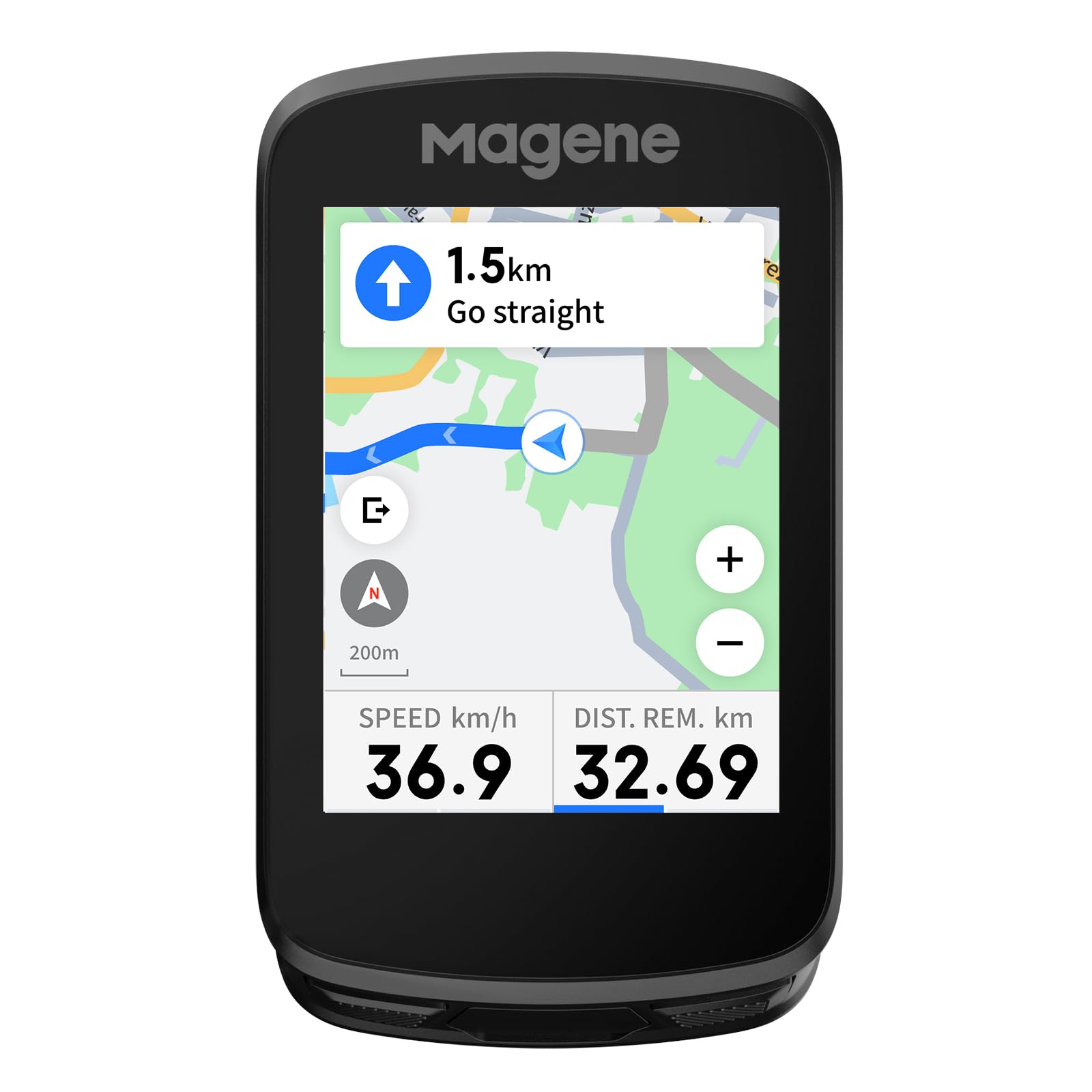
The Magene C506 is the lightest unit in this guide at 76 grams — barely heavier than a pack of energy gels. The 2.4-inch touchscreen with three physical buttons provides a low-cost entry into GPS navigation without the bulk of a phone mount. The Airoha chipset achieves GPS lock in as fast as five seconds thanks to 300+ days of calibration data and AGNSS support. Supports nine device types via ANT+ and Bluetooth, including speed, cadence, heart rate, power meters, smart trainers, radar tail lights, and electronic shifting groupsets.
Free global offline map downloads enable turn-by-turn navigation with street names visible on-screen. The Smart Riding Assistant feature auto-activates Magene L508 and L308 tail lights at 10 km/h, plus offers hydration and return-time reminders. The C506 displays 105 data items across 14 categories, including circular dials, line graphs, and bar charts. Indoor training mode simulates outdoor rides by uploading FIT files to a smart trainer with power targets and gradient control.
The companion app (OnelapFit) has a slow interface and poorly translated menu text — downloading maps is unintuitive and may frustrate first-time users. The touchscreen requires multiple presses to register inputs, and the screen is small enough that reading data fields while riding at speed takes a focused glance. The battery reaches its 24-hour rating only in endurance mode with reduced screen responsiveness; standard use delivers closer to 14 hours.
Why it’s great
- Ultra-light 76g body for weight weenies and minimal handlebars
- Fast 5-second GPS lock from cold start
- Smart tail light control with auto-activation at speed
- Indoor training mode with smart trainer control
Good to know
- OnelapFit app is slow with poor translation
- Touchscreen requires multiple presses for reliable input
- Small display makes data fields hard to read at speed
- Real-world battery life significantly shorter than claim
FAQ
Do I need a cycling computer if I already have a phone mount?
What is ClimbPro and why does it matter for hill climbing?
Can I pair a cycling computer with my eBike motor system?
How many sensors can a cycling computer connect to at once?
Final Thoughts: The Verdict
For most users, the best cycling computer is the Garmin Edge 1040 because it combines the longest standard battery life (35 hours) with multi-band GNSS accuracy, full-color mapping, and the most mature performance metrics ecosystem available today. If you want a lightweight button-operated unit with seamless radar integration, grab the Wahoo ELEMNT Bolt V3. And for riders seeking a Magene C606 V2 who need ClimbPro-style planning with cycling dynamics on a budget, no other unit delivers that feature set at the price point.

Mo Maruf
I created WellFizz to bridge the gap between vague wellness advice and actionable solutions. My mission is simple: to decode the research and give you practical tools you can actually use.
Beyond the data, I am a passionate traveler. I believe that stepping away from the screen to explore new environments is essential for mental clarity and physical vitality.