Our readers keep the lights on and my smoothie glass nicely filled. As an Amazon Associate, I earn from qualifying purchases.
Indoor cycling season hits hard every year, and the difference between a productive winter of structured training and a monotonous slog often comes down to the resistance unit bolted to your rear dropout. Whether you are chasing watts on Zwift, maintaining fitness through a blizzard, or just trying to survive a sweat session while watching Netflix, the right trainer determines whether you look forward to riding indoors or dread every pedal stroke.
I’m Mohammad Maruf — the founder and writer behind WellFizz. I have spent hundreds of hours analyzing resistance mechanisms, noise data, power accuracy specs, and real-world consumer feedback across the widest range of cycle trainers available today to separate marketing claims from genuine performance.
This guide cuts through the noise to deliver a focused, data-backed comparison of the best cycle trainer options on the market, from budget-friendly fluid stands to premium direct-drive smart units that rival the road experience.
How to choose the best cycle trainer
Selecting the right trainer comes down to matching your riding goals with the mechanical architecture of the unit. Before you look at brand names, lock in your budget tier and decide how much noise and tire wear you are willing to tolerate.
Resistance type determines ride quality
Fluid trainers use a sealed impeller spinning in silicone liquid, creating progressive resistance that ramps up naturally as you pedal faster. The result is the most road-like feel among wheel-on options, with near-silent operation. Magnetic trainers use a flywheel and adjustable magnets to create drag, offering multiple resistance levels but often producing a louder whir and a less fluid pedal stroke. Electromagnetic resistance, found in smart trainers, uses an eddy-current brake controlled by a chip, enabling app-controlled gradient simulation and extremely precise power measurement.
For most riders, fluid strikes the best balance of cost and realism. For data-driven athletes training with structured workouts, electromagnetic smart trainers are non-negotiable.
Wheel-on versus direct drive
Wheel-on trainers clamp onto your rear wheel and create resistance against the tire. They are cheaper, foldable, and let you swap bikes quickly, but they wear down your rear tire, can slip under high power, and introduce noise from tire-to-roller friction. Direct-drive trainers replace the rear wheel entirely, with the bike’s cassette mounting directly onto the trainer’s hub. Direct drive eliminates tire wear, operates much more quietly, and delivers higher power accuracy (as low as ±1%). The trade-off is a higher price and a heavier, less portable frame. If you plan to train seriously more than three hours a week, direct drive is the superior long-term investment.
Smart connectivity and app compatibility
A trainer is only as good as its connection to your training platform. Look for dual ANT+ FE-C and Bluetooth FTMS support — this ensures compatibility with Zwift, TrainerRoad, Rouvy, Mywhoosh, and Wahoo SYSTM. Smart trainers use these protocols to automatically adjust resistance based on virtual terrain or structured interval targets. Some units, like the Garmin Tacx Neo 2T and Wahoo KICKR V6, also simulate road surface vibrations, adding a layer of immersion that can break the monotony of indoor riding.
Quick comparison
On smaller screens, swipe sideways to see the full table.
| Model | Category | Best For | Key Spec | Amazon |
|---|---|---|---|---|
| Alpcour Fluid Bike Trainer Stand | Fluid | Quiet, road-like feel on a budget | Progressive fluid resistance | Amazon |
| ThinkRider XXPRO Direct Drive Smart Trainer | Direct Drive | Affordable direct drive with self-power | ±1% accuracy, 2500W max | Amazon |
| Saris M2 Smart Indoor Electromagnetic Resistance Bike Trainer | Smart Wheel-On | Entry-level smart trainer for Zwift | ±5% accuracy, dual ANT+/BLE | Amazon |
| Saris H3 Series Smart Direct Drive Trainer | Direct Drive | Quietest operation at 59 dB | ±2% accuracy, 12-speed compatible | Amazon |
| Wahoo KICKR CORE 2 | Direct Drive | Balanced performance and value | Integrated WiFi, 11-speed cassette | Amazon |
| Fitvids Fluid Bike Trainer Stand | Fluid | Entry-level fluid resistance on a tight budget | 330 lb max load capacity | Amazon |
| ROCKBROS Bike Rollers | Rollers | Balance and technique practice | Aluminum rollers, foldable, 6.5 kg | Amazon |
| Garmin Tacx Neo 2T Smart Trainer | Direct Drive | Ultimate realism and road feel | 32 neodymium magnets, 2200W max | Amazon |
| Wahoo KICKR V6 Smart Indoor Trainer | Direct Drive | Gold standard for serious training | ±1% accuracy, 2200W, WiFi | Amazon |
In‑depth reviews
1. Alpcour Fluid Bike Trainer Stand

The Alpcour Fluid trainer delivers the most convincing road-feel simulation at a mid-range price point, thanks to its sealed fluid impeller that creates progressive resistance without step changes. The stainless steel frame feels substantially more rigid than budget magnetic stands, and the dual-lock system with tension knob and lock ring keeps the bike securely planted even during standing efforts. Riders report that the resistance curve climbs naturally with speed, mimicking real hills rather than the on-off feel of magnetic units.
Noise levels hover around 70 dB at cruising speed — comparable to a television at moderate volume — which makes it acceptable for shared living spaces when paired with a trainer tire. The included front wheel riser block and anti-slip rubber pads prevent creep across hardwood or tile floors. Assembly takes under ten minutes with the single-bolt design, and the unit folds flat for storage inside the included carry bag.
One limitation is that the progressive resistance can feel insufficient for strong riders pushing sustained power above 250 watts, since the fluid chamber has a finite upper range. The front riser block also shows some durability concerns after extended use, though replacements are affordable. For general fitness riders and early-season base training, the Alpcour offers an unbeatable combination of quiet operation, stability, and value.
Why it’s great
- Near-silent fluid resistance (70 dB) with progressive, road-like feel
- Stainless steel frame is rock-solid under hard efforts up to 300 lb load capacity
- Folds flat and includes a carry bag for easy storage and transport
Good to know
- Progressive resistance caps out for very powerful riders (above ~250W sustained)
- Front wheel riser block may crack over time with heavy use
- Initial setup instructions can be frustrating; consult video guides
2. ThinkRider XXPRO Direct Drive Smart Trainer

The ThinkRider XXPRO is a direct-drive smart trainer that undercuts the premium competition by over a third while delivering ±1% power accuracy and a self-powering design that eliminates the need for a wall outlet during most rides. Its motor-driven electromagnetic resistance produces up to 2,500 watts and simulates a 25% gradient, which covers even the steepest virtual climbs on Zwift or Mywhoosh. The unit generates its own electricity from pedaling, so you only need a power adapter for downhill simulation where the motor spins freely without resistance.
Users consistently report that the ride feel closely mirrors the road, with smooth freewheeling and realistic resistance transitions. The dual ANT+ FE-C and Bluetooth FTMS connectivity pairs reliably with Garmin devices, laptop apps, and Apple TV. Assembly requires minor attention — the 7-speed cassette spacer is not included and a through-axle spacer may come pre-installed, needing removal for quick-release frames. The included power adapter plugs in for the optional downhill motor function, but most riders can leave it unplugged entirely.
The 242-pound load capacity is lower than steel-framed competitors, which may be a concern for heavier riders or those doing max-effort sprints. The iron frame is relatively heavy at around 40 pounds, though this adds stability rather than portability. For the price, the ThinkRider XXPRO offers direct-drive performance and smart features that previously required spending significantly more.
Why it’s great
- ±1% power accuracy at a fraction of the price of premium direct-drive trainers
- Self-generating power — no wall adapter needed for normal riding
- Handles up to 2,500 watts and 25% gradient for realistic climbing
Good to know
- Load capacity limited to 242 pounds — not ideal for larger riders
- Cassette spacer for 7- to 10-speed drivetrains not included
- Setup requires swapping pre-installed through-axle spacer for QR frames
3. Saris M2 Smart Indoor Electromagnetic Resistance Bike Trainer

The Saris M2 is the entry point into smart training without committing to a direct-drive price tag. This wheel-on unit uses electromagnetic resistance controlled via ANT+ FE-C and Bluetooth FTMS to automatically adjust load based on virtual terrain, making it fully compatible with Zwift, Rouvy, and TrainerRoad. The built-in power, cadence, and speed sensors eliminate the need for extra accessories, and the ±5% accuracy is sufficient for most structured training zones.
Assembly requires attention to the tension knob — reviewers warn not to tighten it until the specified indentation on the tire is achieved, as over-tightening can cause slipping or damage. The 20-pound steel frame provides a stable platform, and the unit folds for storage, though wheel-on trainers inherently produce more noise than direct-drive models. At 69 dB measured at 20 mph, the sound is comparable to a vacuum cleaner in the next room, so a trainer-specific tire is recommended to reduce friction noise.
Several users reported that the trainer can flex during maximal sprints, and one serious incident involved an ejection during a 700-watt effort, though this appears to be an edge case linked to incorrect setup. The thru-axle adapter for modern bikes is not included, so factor that cost in if your bike uses 12mm axles. For riders graduating from fluid trainers into the smart ecosystem, the M2 offers genuine app-controlled resistance at a budget-friendly entry point.
Why it’s great
- Zwift-certified electromagnetic resistance with dual ANT+/BLE connectivity
- Built-in power, cadence, and speed sensors — no extra pods needed
- Folds for compact storage when not in use
Good to know
- Tension setup is finicky; over-tightening causes slipping or damage
- Thru-axle adapter must be purchased separately for most modern road bikes
- Can flex under extreme sprint power; not ideal for max-effort workouts
4. Saris H3 Series Smart Direct Drive Trainer

The Saris H3 delivers the quietest operation in this lineup at 59 dB — roughly the sound level of a quiet library — making it the definitive choice for apartment dwellers or riders who train while others sleep. The direct-drive design eliminates tire friction noise entirely, leaving only chain and drivetrain sounds. Precision-crafted components deliver ±2% power accuracy, and the unit supports 12-speed drivetrains out of the box, future-proofing your investment as groupset technology evolves.
The H3 uses an electromagnetic eddy-current brake that produces smooth, repeatable resistance across gradients up to 20%. The built-in power meter requires no calibration, and the included freehub comes pre-installed with an 8- to 11-speed Shimano/SRAM spacer, though you will need to supply your own cassette. The unit is noticeably heavy at 52 pounds, which adds stability but makes relocation a two-hand job. Users report thousands of trouble-free miles with reliable Bluetooth and ANT+ connections, though the Saris app is necessary for firmware updates and calibration verification.
Despite the heavy build, the H3 lacks the road surface simulation features found on the Garmin Tacx Neo 2T and Wahoo KICKR V6, so you won’t feel cobblestones or boardwalk textures. The metal frame is built like a tank and handles steep gradients without any flex. For riders who prioritize silence and accuracy over virtual gimmicks, the H3 is a focused, high-performance tool.
Why it’s great
- Industry-leading quietness at 59 dB — barely audible during training
- ±2% power accuracy with zero calibration required after setup
- 12-speed drivetrain compatible for modern groupsets
Good to know
- Very heavy at 52 pounds, difficult to move regularly
- No virtual road surface simulation features
- Customer service can be slow for adapter compatibility questions
5. Wahoo Fitness KICKR CORE 2
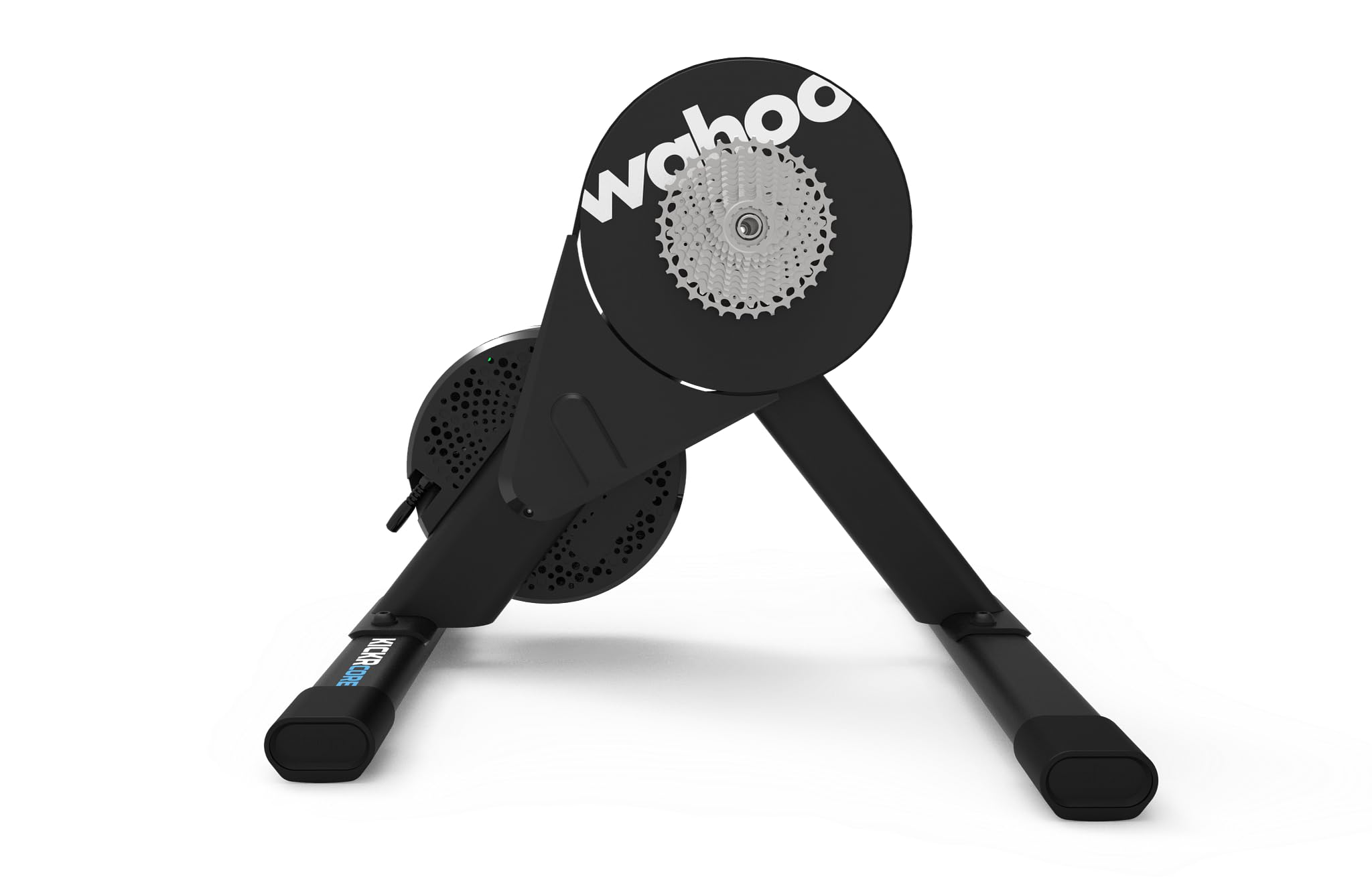
The KICKR CORE 2 builds on Wahoo’s trusted platform by adding integrated WiFi for faster pairing and automatic firmware updates, eliminating the Bluetooth dropouts that plagued earlier models. The direct-drive design delivers the same smooth, road-like resistance feel that made the original CORE a favorite, now packaged in a lighter aluminum frame that weighs under 30 pounds. The included 11-speed cassette means you can unbox, mount your bike, and start riding immediately without sourcing extra components.
Users consistently praise the stability of the CORE 2 during hard efforts, with no rocking or lateral movement even during out-of-the-saddle climbs. The resistance range covers realistic gradients up to 16% with a maximum power of 1,800 watts, sufficient for all but the strongest elite sprinters. Noise levels are near-silent, with only the sound of the drivetrain audible. The unit pairs seamlessly with Zwift, Mywhoosh, and TrainerRoad, and the integrated WiFi ensures stable data transmission without competing for bandwidth on your home network.
The load capacity is rated at 250 pounds, which may be restrictive for heavier riders or those carrying significant gear. Some users report that the included quick-release links in the documentation are misleading and recommend following the physical manual instead. The CORE 2 occupies the sweet spot of the Wahoo lineup — more affordable than the KICKR V6 while retaining the core features most riders actually need.
Why it’s great
- Integrated WiFi for stable, drop-free app connectivity and automatic updates
- Comes with an 11-speed cassette pre-installed for out-of-box usability
- Lightweight aluminum frame (30 lb) without sacrificing stability
Good to know
- Load capacity capped at 250 pounds
- Documentation includes misleading QR link; refer to printed manual
- Max gradient of 16% is lower than some direct-drive competitors
6. Fitvids Bike Trainer Stand Fluid Magnetic Stand
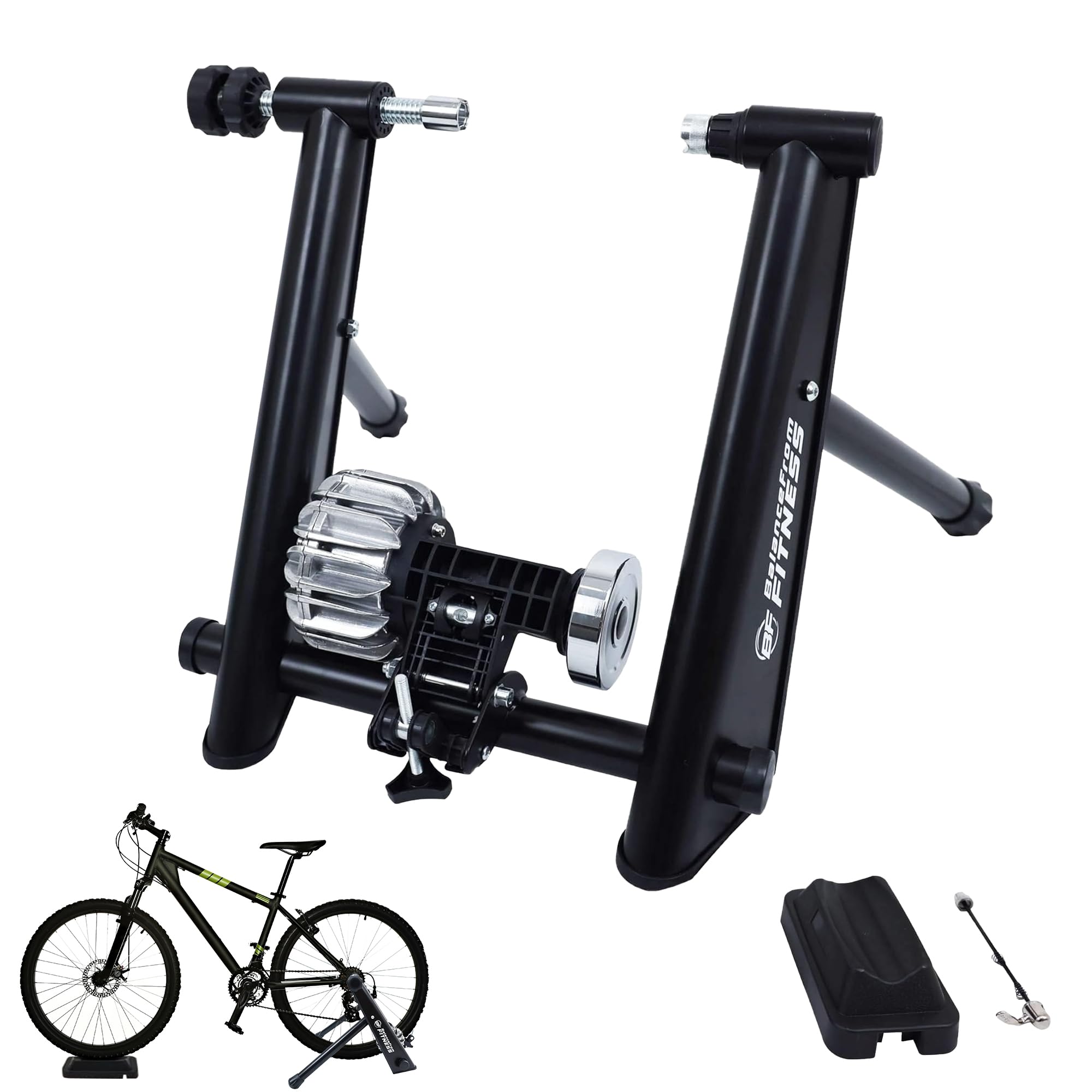
The Fitvids trainer combines fluid resistance with a magnetic control dial, offering eight adjustable resistance levels in a single budget-friendly package. The wide base and low stance provide impressive stability for a unit at this price point, with a maximum load of 330 pounds that accommodates heavier riders and mountain bikes alike. The quick-release clamp makes installation and removal straightforward, and the unit folds for storage when not in use.
Customer feedback highlights a significant caveat: noise levels spike dramatically with knobby mountain bike tires, making the trainer nearly unusable in shared apartments. With smooth road tires, the noise drops to acceptable levels, but the fluid chamber still produces a distinct whir at higher speeds. The included instructions are purely illustrative, leading to confusion during setup, particularly regarding rear wheel fitting and tension adjustment for the flywheel.
The resistance range from the magnetic dial combined with gearing offers reasonable variety, but the feel is less smooth than dedicated fluid-only trainers. Some units arrived with minor cosmetic imperfections, though function remains unaffected. For the price, the Fitvids delivers a surprising amount of value for riders who need a basic indoor solution and already own smooth tires.
Why it’s great
- Highest load capacity in this review at 330 pounds
- Eight magnetic resistance levels plus fluid damping for range
- Quick-release clamp makes bike installation and removal fast
Good to know
- Extremely loud with knobby mountain bike tires; smooth tires essential
- Illustration-only instructions can be confusing during assembly
- Fluid chamber noise is present at higher speeds even with road tires
7. ROCKBROS Bike Rollers Adjustable Trainer

The ROCKBROS rollers take a completely different approach to indoor training, replacing the stationary resistance unit with three free-spinning aluminum drums that require constant balance and pedal control. Parabolic drum profiles improve stability compared to straight rollers, but beginners will still need a doorway or wall for support until they develop the muscle coordination to ride freely. The adjustable frame accommodates wheelbases from 16 to 29 inches, covering everything from folding bikes to mountain bikes.
Assembly is straightforward but requires loosening the factory-tightened drum tension with a 17mm wrench before use — a step many users miss, leading to an unrideable first experience. The sealed bearings allow smooth rotation, but quality control is inconsistent: some units arrive with slightly out-of-round drums that create wobble, and the plastic end caps can vibrate loose. At just 6.5 kg, the rollers fold flat for storage under a bed or in a closet.
Rollers produce more drivetrain noise than fluid trainers because the rear wheel is spinning freely with no resistance unit absorbing sound. A rubber mat underneath is essential to dampen vibrations. ROCKBROS rollers are not a replacement for a resistance trainer — they serve a specific purpose for improving pedal stroke smoothness and bike handling, making them a complementary tool rather than a primary training platform.
Why it’s great
- Lightweight at 6.5 kg and folds for easy storage in small spaces
- Parabolic drums improve stability over traditional straight rollers
- Adjustable wheelbase fits a wide range of bike types
Good to know
- Requires significant balance practice; not for high-intensity workouts
- Factory drum tension is often excessive and must be adjusted
- Quality control is inconsistent — some drums arrive out of round
8. Garmin Tacx Neo 2T Smart Trainer

The Tacx Neo 2T is the benchmark for indoor ride realism, using 32 neodymium magnets to create electromagnetic resistance that is completely silent — there is no mechanical contact, only the sound of your drivetrain. The advanced road feel simulation vibrates the unit to mimic cobblestones, gravel, and wooden boardwalks, pulling you deeper into the virtual world. The dynamic inertia algorithm adjusts flywheel behavior based on speed and gradient, so coasting downhill feels natural rather than artificially damped.
Setup requires attention to cassette spacer count to avoid noisy shifting, but once configured, the Neo 2T connects instantly to Zwift via ANT+ or Bluetooth. The built-in power meter requires no calibration and maintains ±1% accuracy, matching dedicated power meters on outdoor bikes. The unit supports gradients up to 25% and a maximum power of 2,200 watts, covering every realistic scenario a rider will encounter. The 47-pound weight ensures the trainer stays planted even during maximum efforts.
The main barrier is the price, which positions the Neo 2T firmly at the top of the market alongside the Wahoo KICKR V6. The included front wheel support and quick-release adapters cover most frame standards, but the Tacx Premium app subscription adds ongoing cost. For riders who prioritize immersion, silence, and accuracy above all else, the Neo 2T is the definitive indoor training experience.
Why it’s great
- Fully silent electromagnetic resistance with no mechanical contact
- Road surface simulation adds immersive feedback for cobbles and gravel
- ±1% power accuracy with zero calibration required
Good to know
- Significant investment that puts it at the top of the market
- Cassette spacer count is critical for proper shifting setup
- Heavy at 47 pounds, making relocation a two-person job
9. Wahoo KICKR V6 Smart Indoor Trainer

The Wahoo KICKR V6 is the reference standard against which all other smart trainers are measured, combining WiFi connectivity, ±1% power accuracy, and the KICKR AXIS feet that introduce up to 5 degrees of lateral movement for a more natural riding feel. The high-inertia flywheel and advanced algorithms create a smooth, road-like resistance curve that responds instantly to gradient changes in Zwift or TrainerRoad. The unit automatically calibrates itself every ride, eliminating the manual calibration routine required by competitors.
With a maximum power output of 2,200 watts and gradient simulation up to 20%, the KICKR V6 handles everything from gentle rollers to sustained climbs. The integrated WiFi provides a stable connection that avoids the bandwidth congestion that can cause Bluetooth dropouts during group rides. The KICKR AXIS feet are a genuine differentiator — the side-to-side movement significantly reduces hip and lower back fatigue during long indoor sessions. The unit folds for storage and weighs approximately 48 pounds.
The price is the highest in this review, reflecting the premium build and ecosystem integration with Wahoo SYSTM and the ELEMNT bike computers. Some users reported initial WiFi pairing hiccups that required disconnecting other devices, but once connected, the connection is rock solid. The V6 comes with a comprehensive adapter kit covering quick-release and thru-axle standards, though riders with unusual dropout widths should verify compatibility beforehand. For serious athletes who treat indoor training as a primary training tool, the KICKR V6 is the definitive choice.
Why it’s great
- KICKR AXIS feet enable lateral movement for reduced fatigue on long rides
- ±1% power accuracy with automatic calibration every ride
- Integrated WiFi delivers stable, fast connection to training apps
Good to know
- Highest price tag in this lineup — a serious investment
- Initial WiFi pairing can require troubleshooting
- Heavy and bulky, designed for a semi-permanent training setup
FAQ
How loud is a fluid trainer compared to a direct-drive trainer?
Can I use a cyclocross or mountain bike on a wheel-on trainer?
What is the real difference between ±1% and ±5% power accuracy?
Do I need a smart trainer if I only want to ride while watching Netflix?
Final thoughts: The verdict
For most users, the best cycle trainer winner is the Alpcour Fluid Trainer because it delivers near-silent fluid resistance and a rock-solid stainless steel frame at a price that undercuts smart trainers while still providing a realistic road feel. If you want direct-drive accuracy with smart features but need to keep costs down, grab the ThinkRider XXPRO. And for the premium experience with KICKR AXIS lateral movement and WiFi connectivity, nothing beats the Wahoo KICKR V6.

Mo Maruf
I created WellFizz to bridge the gap between vague wellness advice and actionable solutions. My mission is simple: to decode the research and give you practical tools you can actually use.
Beyond the data, I am a passionate traveler. I believe that stepping away from the screen to explore new environments is essential for mental clarity and physical vitality.