Our readers keep the lights on and my smoothie glass nicely filled. As an Amazon Associate, I earn from qualifying purchases.
Loading a bike onto a roof rack shouldn’t feel like an extreme sport. The real pain isn’t the lift — it’s the worry: will the fork mount hold, will the frame get scratched, will the whole thing rattle loose at highway speeds? A quality cycle roof rack solves all of that with secure, low-profile engineering.
I’m Mohammad Maruf — the founder and writer behind WellFizz. I’ve spent hundreds of hours analyzing the specifications, customer reports, and real-world durability data for the top roof-mounted bike carriers on the market to separate the rock-solid designs from the metal that bends after one trip.
Whether you drive a sedan, an SUV, or a wagon, the right carrier keeps your bike stable, your paint safe, and your mind at ease. This guide breaks down the nine best models to help you find the ultimate best cycle roof rack for your vehicle and riding style.
How To Choose The Best Cycle Roof Rack
Buying a cycle roof rack is a multi-year commitment. The wrong choice means wobbly bikes, scratched paint, or even damage to your car’s roof. Focus on these three factors to narrow down the field.
Fork Mount vs. Wheel-On Design
The most critical decision. Fork-mount racks (like the Kuat Trio or Yakima ForkLift) require removing the front wheel and clamping the fork directly. This results in the most secure hold and lowest wind noise, but it takes an extra minute to load. Wheel-on racks (like the RockyMounts BrassKnuckles or Thule UpRide) cradle the bike by the tires — ideal for quick trips and riders who don’t want to touch greasy hubs. Carbon-frame owners should lean toward wheel-on or frame-contact-free designs.
Crossbar Compatibility and Clamp Style
Roof racks aren’t one-size-fits-all. Your vehicle’s crossbars can be round, square, factory aero, or streamlined Yakima/Thule tracks. Some carriers ship with universal steel straps that adapt to any shape; others (like the Yakima ForkLift) require specific crossbar profiles. Always check the maximum bar width listed in the specs — anything over 3 inches demands a rack with an adjustable clamp.
Load Capacity and Locking Security
A typical mountain bike weighs 30–35 pounds, but e-bikes and downhill rigs can exceed 40 pounds. Budget-friendly options often top out at 35 lbs, while premium models handle 40–45 lbs. For theft protection, look for integrated cable locks (Kuat Trio) or SKS lock compatibility (Yakima, Thule). Remember: a lock is only as good as the metal it’s made from — plastic-core locks can be twisted open with pliers.
Quick Comparison
On smaller screens, swipe sideways to see the full table.
| Model | Category | Best For | Key Spec | Amazon |
|---|---|---|---|---|
| Kuat Trio | Fork Mount | Versatile axle compatibility | 45 lb capacity, integrated cable lock | Amazon |
| Thule UpRide | Wheel-on | Carbon & high-end frames | 44 lb capacity, no frame contact | Amazon |
| Yakima FrontLoader | Wheel-on | Quick loading & folding storage | 40 lb capacity, tool-free install | Amazon |
| RockyMounts Tomahawk | Wheel-on | Fat tires & rough roads | 35 lb capacity, 5-inch tire fit | Amazon |
| RockyMounts BrassKnuckles | Wheel-on | Heavy-duty, no wheel removal | 45 lb capacity, stainless straps | Amazon |
| SportRack Crest 2 | Hanging | Two bikes, folding access | 45 lb per bike, integrated locks | Amazon |
| Yakima ForkLift | Fork Mount | Low-profile, no frame touch | 35 lb capacity, sliding wheel tray | Amazon |
| Swagman Standard Fork Mount | Fork Mount | Budget-friendly, universal | 35 lb capacity, 9mm QR skewer | Amazon |
| Kuat Beta | Hitch | Lightweight, easy rear access | 80 lb total, anti-sway design | Amazon |
In‑Depth Reviews
1. Kuat Trio Fork Mount Carrier

The Kuat Trio is the most versatile fork-mount rack on the market. Its 3-Way system accepts 9mm, 12mm, 15mm, and 20mm thru-axles straight out of the box — no adapters to hunt for. The 45-pound load rating handles everything from carbon road bikes to burly mountain rigs, and the low-profile aerodynamic design minimizes wind noise on the highway.
Installation takes about 30 minutes with basic tools. The sliding rear tire strap provides an extra layer of stability, and the integrated cable lock secures both the frame and rear wheel. Customer reports confirm the rack holds up well over rough roads, though one reviewer noted the cable lock’s magnet can weaken over time, potentially causing the cable to drop.
Kuat backs the Trio with a limited lifetime warranty, and their customer service is praised for quick replacement parts. The only real complaint is that loading a bike onto a roof rack is inherently awkward for shorter users — but that’s true of every roof-mounted carrier.
Why it’s great
- Accepts 9mm to 20mm axles without extra adapters
- Integrated cable lock adds security without separate purchase
- Low-profile design reduces wind drag and noise
Good to know
- Cable lock retention magnet may need monitoring over time
- Roof height can make loading difficult for shorter riders
2. Thule UpRide Roof Bike Rack

The Thule UpRide is the gold standard for riders who refuse to let a carrier touch their frame. It secures the bike by clamping the front wheel — the rear wheel rests in a padded cradle — making it compatible with carbon frames, rear suspension, and non-traditional geometry. The 44-pound capacity covers most bikes, though heavy e-bikes will exceed the limit.
Assembly requires watching a YouTube video (the included manual is notoriously cryptic), but once set up, loading takes under 30 seconds. The ratcheting wheel strap and hook are quick to operate, and the carrier can be swapped from driver to passenger side without tools. Some users note a bit of sway at highway speeds, but the bike remains securely locked in place even in crosswinds.
Locks are sold separately, which adds to the already premium cost. A few owners have reported that the clamping components are detachable and could be lost if not stowed properly. Still, for protecting an expensive carbon race bike, the UpRide is the most trustworthy option.
Why it’s great
- Zero contact with the bike frame — ideal for carbon fiber
- Tool-free side swapping for flexible installation
- Fits wheels from 20 to 29 inches with up to 3‑inch tires
Good to know
- Assembly instructions are poor; YouTube guides essential
- Locks and fat tire adapter sold separately
3. Yakima FrontLoader
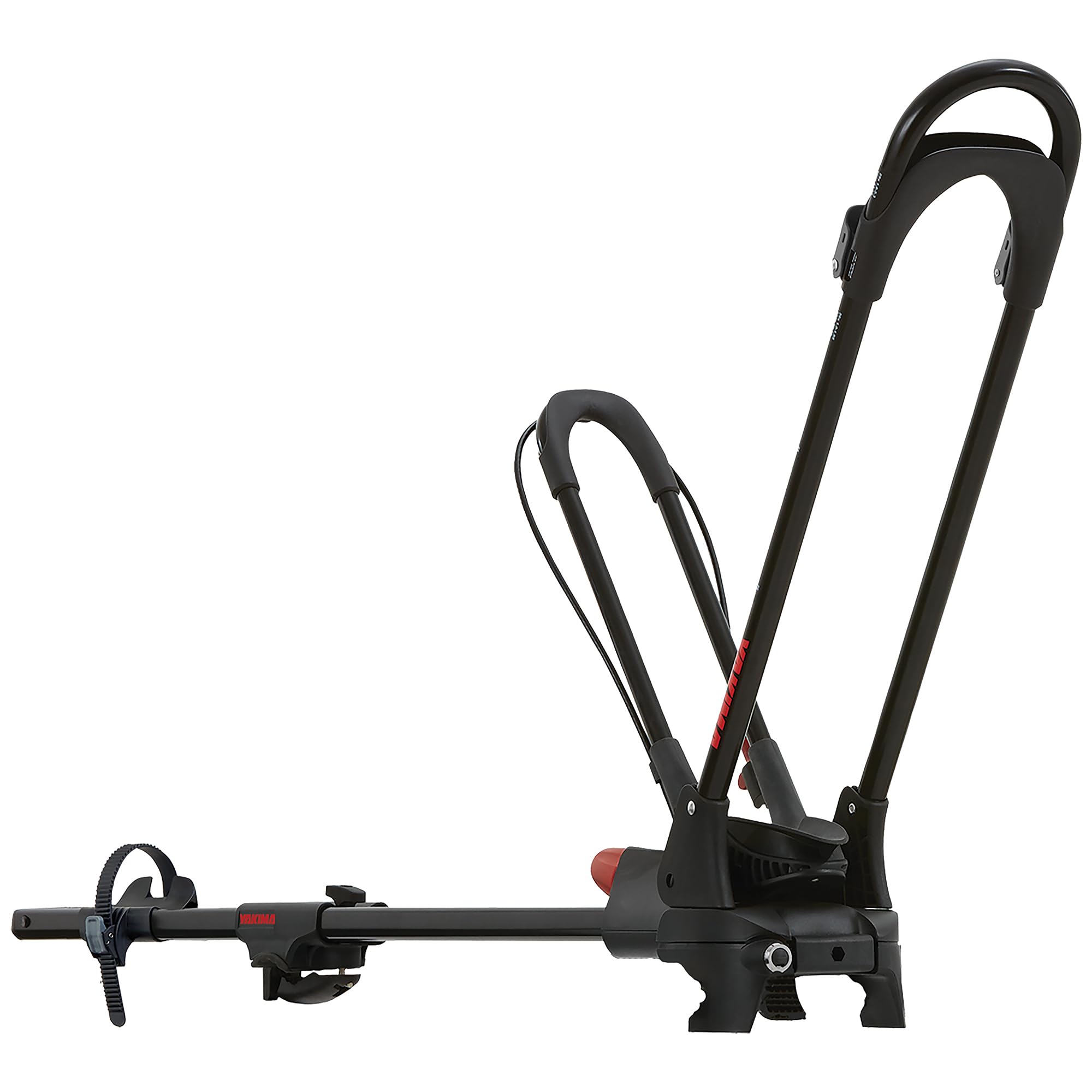
The Yakima FrontLoader is a folding wheel-on carrier that combines quick loading with compact storage. It installs tool-free on most crossbar shapes in under 10 minutes, and the foldable design means it takes up minimal space when not in use. The 40-pound capacity suits most trail and gravel bikes, and the ratcheting arm locks the front wheel securely without touching the frame.
Wheel adjustment is straightforward: the front tray slides to fit 20 to 29-inch wheels, and the rear strap cinches down the back tire. A few owners with 27.5-inch bikes and wide rims (2.4–2.5 inches) report that the rear strap only has a few clicks of adjustment, so test fit your specific tires before a long trip. The included SKS lock system is convenient, though some reviewers found the plastic lock housing flimsy enough to turn with moderate force.
Highway performance is excellent — bikes stay rock-solid up to 80 mph with minimal wind noise. The only downside beyond the lock quality is the thin cable that comes with the security kit; consider upgrading to a separate cable lock for extended parking.
Why it’s great
- Folds flat for easy trunk storage when not on the car
- Tool-free mounting on round, square, and aero bars
- Quiet at highway speeds with minimal movement
Good to know
- SKS lock housing can be turned with force — upgrade for security
- Rear strap may be short for extra-wide 27.5-inch rims
4. RockyMounts Tomahawk

The RockyMounts Tomahawk is built for riders who run fat tires and plus-size rubber. It accepts tires up to 5 inches wide straight out of the box (the included extensions handle the extra girth), and the upright design secures the bike by the front wheel — no frame contact. The composite body is surprisingly rugged, and the ratcheting hook locks onto the tire with a satisfying click.
Installation on round, square, and aero crossbars is straightforward, though the included instructions are sparse — allow 45 minutes for first-time assembly. Owners report that the rack stays quiet on the highway and holds 38-pound bikes securely over bumps and dips. The load rating is listed at 35 pounds on Amazon, but the box reads 40 pounds, so double-check your bike’s weight.
The main drawbacks: lock cores are sold separately, and the swingarm pivot can be stiff to adjust on tall vehicles. For fat bike enthusiasts, however, the Tomahawk is the most capable wheel-on roof rack at this price point.
Why it’s great
- Ready for up to 5-inch tires with included strap extensions
- No frame contact protects paint and carbon parts
- Composite construction resists corrosion and stays solid
Good to know
- Instructions are poor — expect to use online resources
- Lock cores not included; need separate purchase for theft protection
5. RockyMounts BrassKnuckles
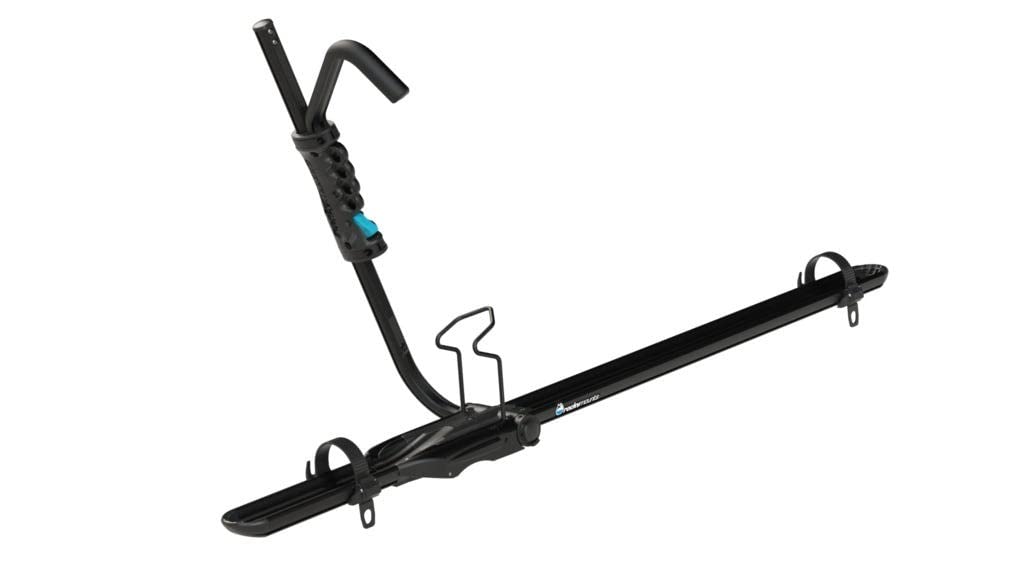
The RockyMounts BrassKnuckles is a no-nonsense wheel-on rack built from beefy aluminum and stainless steel. It’s heavier than most competitors (18 pounds), but that weight translates into rock-solid stability. The form-fitting stainless steel mounting straps adapt to square, round, factory, and aero crossbars without any plastic weak points.
Loading is simple: roll the bike into the wheel trays, ratchet the front arm over the tire, and secure the rear strap. There’s no front wheel removal, so it’s ideal for quick trips. The 45-pound capacity covers almost all non-e-bikes, and the design avoids contact with the frame. A few owners report that the paint on the main housing chipped early, but the structural integrity remains unaffected.
One notable drawback: the ratcheting arm can be stiff to pivot on taller vehicles, and the tension screw for adjusting to different wheelbases is hard to fine-tune. Still, for riders who value durability over aesthetics, the BrassKnuckles is a top-tier choice that outlasts many premium brands.
Why it’s great
- Stainless steel mounting straps are virtually indestructible
- 45-pound capacity handles heavy mountain bikes with ease
- No wheel removal makes loading fast and simple
Good to know
- Heavy at 18 pounds; may not suit frequent install/removal
- Paint finish may chip on the main housing
6. SportRack Crest 2 Locking

The SportRack Crest 2 is a hanging-style roof rack that holds two bikes, each up to 45 pounds. It’s manufactured by Thule but sold under the SportRack brand, which means you get Thule engineering at a mid-tier price. The rubberized hooks adjust to fit most frame shapes, and the center section folds down to allow rear hatch access on SUVs and wagons.
Integrated locks secure both the bikes to the rack and the rack to the crossbars — a nice security package that many competitors treat as an add-on. Assembly is straightforward, though the instructions skip one crucial step (users reported missing a washer installation). Once set up, the rack feels sturdy even with two heavy bikes (41 and 40 pounds) on a 7.5-hour drive.
The main complaints: the rack sticks out a bit too far from the roof, and the 2-inch hitch adapter on some versions feels flimsy. For a two-bike roof solution, however, the Crest 2 offers excellent lockability and durability for the money.
Why it’s great
- Integrated locks for both bikes and rack attachment
- Center folds down for rear vehicle access
- Holds two 45-pound bikes securely on long highway trips
Good to know
- Assembly instructions are missing a step — use online video guides
- Some versions have a flimsy 2-inch hitch adapter
7. Yakima ForkLift
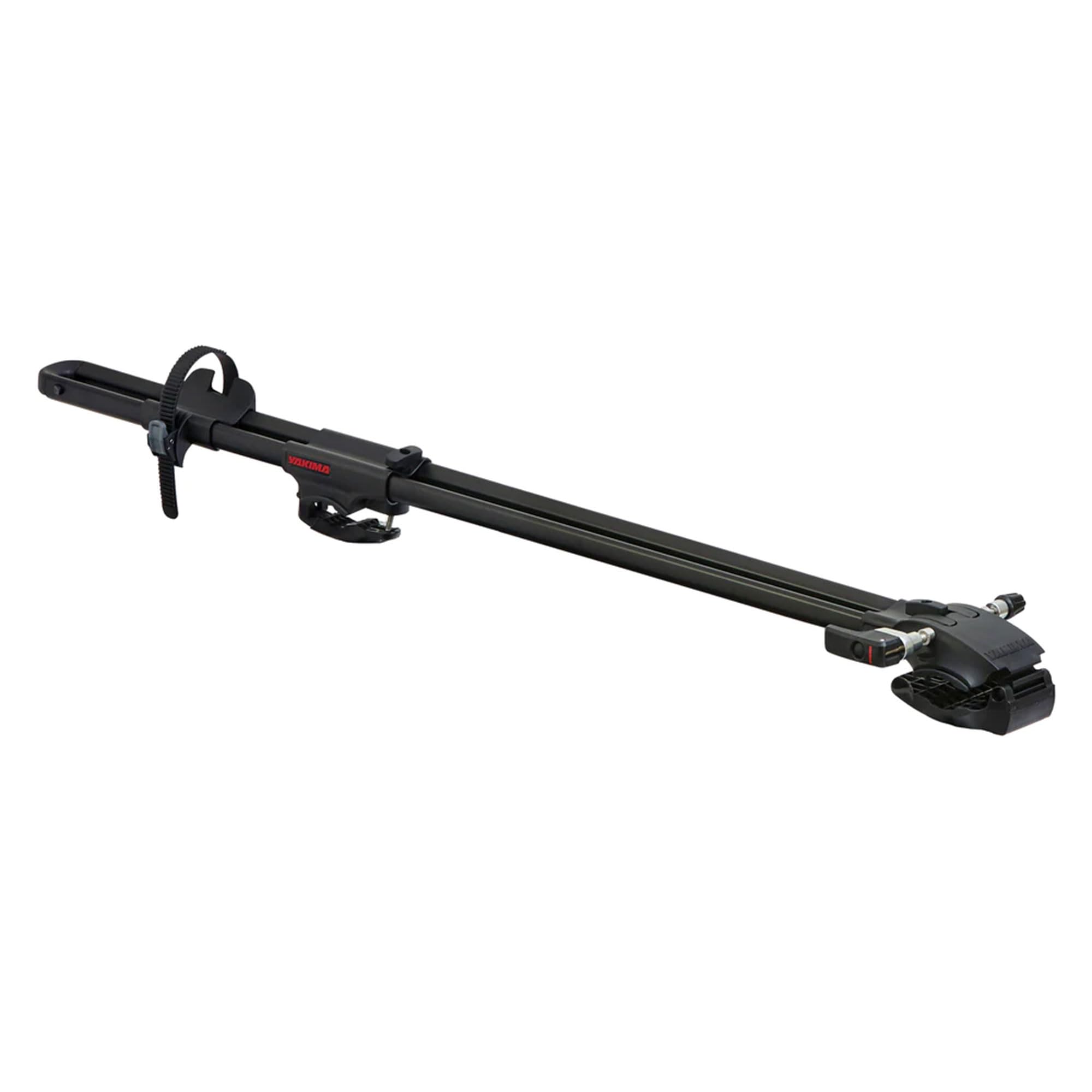
The Yakima ForkLift is a classic fork-mount carrier that prioritizes low weight and easy installation. At just 7 pounds, it’s one of the lightest roof racks available, and the sliding wheel tray adjusts to accommodate different bike lengths without tools. The design holds the bike by the front axle and rear wheel, so the frame never gets scratched.
Installation on Yakima round, square, factory, and aero bars takes minutes — no tools required. The cam lever for releasing the fork feels precise, though some owners note the lever needs a dial adjustment each time to fit their specific fork. Highway stability is excellent: one user reported a secure ride at 75 mph in 35 mph winds.
The load capacity is 35 pounds, which is fine for most road and trail bikes but won’t work for heavy electric models. SKS locks are sold separately, which is standard for this category. For Subaru owners with factory aero bars, the ForkLift is a near-perfect fit.
Why it’s great
- Very lightweight at 7 pounds — easy to install and remove
- Sliding wheel tray adjusts to various bike lengths
- No frame contact preserves paint and carbon finishes
Good to know
- 35-pound limit excludes many e-bikes
- Cam lever requires dial adjustment each use for some forks
8. Swagman Standard Fork Mount

The Swagman Standard Fork Mount is the entry-level workhorse of the roof rack world. It attaches to square, round, and oval crossbars up to 3 inches wide, and the 9mm quick-release skewer secures the fork in seconds. At 16 ounces, it’s incredibly light, and the aluminum construction keeps rust at bay.
Assembly takes about 15 minutes with no tools required — just follow the included instructions (which some users found sparse but manageable). Once mounted, the rack holds a 35-pound bike firmly at highway speeds. One owner drove 1,100 miles at 65–80 mph with minimal wind noise and no loosening. The universal design fits most vehicles, making it a solid first rack for budget-conscious riders.
The downsides are real: a few users reported that the U-bolts warped after two uses, and the rack lacks any built-in locking mechanism. You’ll need a separate cable lock if you plan to leave your bike unattended. For occasional use and lighter bikes, it’s a great value — but not for daily heavy lifting.
Why it’s great
- Extremely light and easy to install with no tools
- Works on square, round, and oval bars up to 3 inches
- Affordable entry point for occasional roof-top bike transport
Good to know
- No integrated lock — requires separate cable for security
- Some units show metal warping after repeated use
9. Kuat Beta Hitch-Mounted Rack

The Kuat Beta is a hitch-mounted rack that serves as a compelling alternative for drivers who want to avoid roof height issues. It’s crafted from lightweight aluminum (just 14 pounds) with a powder-coat finish that resists scratches. The hanging-style design holds two bikes, each up to 40 pounds, and the anti-sway carriages prevent bike-to-bike contact during transit.
Installation is tool-free: slide it into a 2-inch receiver, hand-tighten the cam system, and lock the gated hitch pin. The rack tilts down for rear hatch access without needing to remove the bikes, and it folds up compactly for trunk storage. Owners consistently praise the rattle-free fit — the hand-tightened screws press the rack tightly against the receiver, eliminating the wobble common with cheaper hitch racks.
One caveat: this is a hitch rack, not a roof rack. It won’t fit vehicles without a receiver hitch. But for those with a hitch, the Beta offers the easiest loading and the best stability of any rack on this list. The only minor complaint is that the hitch pin isn’t lockable out of the box, though Kuat sells a locking pin separately.
Why it’s great
- Extremely lightweight at 14 pounds — easy to handle
- Rattle-free design with hand-tightened cam system
- Tilts down for rear access without removing bikes
Good to know
- Requires a 2-inch hitch receiver; not for roof-only setups
- Hitch pin is not lockable — consider aftermarket lock
FAQ
How do I know if a cycle roof rack will fit my car?
Can I use a roof rack with a carbon fiber bike?
What’s the difference between a 1.25-inch and 2-inch hitch rack?
How do I prevent my bike from swaying on a roof rack?
Final Thoughts: The Verdict
For most users, the best cycle roof rack winner is the Kuat Trio Fork Mount because it combines the widest axle compatibility, an integrated cable lock, and a 45-pound capacity that covers nearly every non-e-bike. If you want absolute frame protection for a carbon race bike, grab the Thule UpRide. And for riders who prefer the simplicity of a hitch setup, nothing beats the Kuat Beta for its lightweight, rattle-free design.

Mo Maruf
I created WellFizz to bridge the gap between vague wellness advice and actionable solutions. My mission is simple: to decode the research and give you practical tools you can actually use.
Beyond the data, I am a passionate traveler. I believe that stepping away from the screen to explore new environments is essential for mental clarity and physical vitality.