Our readers keep the lights on and my smoothie glass nicely filled. As an Amazon Associate, I earn from qualifying purchases.
A cycle pump is the single most overlooked survival tool on any ride. You can have the lightest frame and the most dialed drivetrain, but a flat tire a mile from home turns your perfect day into a long walk. The real problem isn’t flats—it’s carrying a pump that either takes forever to reach pressure or fails at the valve connection when you need it most. That’s the gap this guide closes, looking at the pumps that actually solve the physics of moving air efficiently into tires.
I’m Mohammad Maruf — the founder and writer behind WellFizz. I’ve spent hundreds of hours cross-referencing cylinder volumes, maximum pressure ratings, valve compatibility, and real-world inflation times across dozens of cycle pump models to find the units that save you effort, not cost you it.
Whether you need a high-volume floor pump for stiff road tires or a compact portable for trail repairs, the best cycle pump comes down to getting the right balance of barrel displacement, hose length, and gauge accuracy for your specific bike type.
How To Choose The Best Cycle Pump
Buying a cycle pump without understanding barrel volume and valve type is like buying tires by color. These three criteria separate the pumps that make inflation effortless from the ones that sit unused in a garage corner.
Barrel Volume vs. Max Pressure
Narrow barrels generate high pressure with less effort per stroke, making them ideal for road tires requiring 80 to 120 PSI. Wide barrels move more air per stroke but top out at lower pressures, which suits mountain and fat bike tires at 30 to 50 PSI. A pump with a 322cc cylinder, like the Topeak JoeBlow Max HP, hits a sweet spot: high volume for fast inflation and enough leverage to push past 100 PSI for road tires.
Valve Compatibility and Chuck Design
Presta valves are standard on road and higher-end mountain bikes; Schrader valves appear on lower-end bikes, car tires, and shock absorbers. A pump that requires flipping or swapping a rubber insert to switch between the two wastes time on the trail. The best designs use a dual-sided head or a threaded chuck like the LEZYNE ABS-1 Pro, which screws directly onto Presta threads for a zero-leak seal. Avoid pumps with cheap snap-on chucks that pop off under 80 PSI.
Gauge Accuracy and Readability
Digital gauges offer ±1 PSI precision and auto-shutoff features that prevent overinflation, which is vital for carbon rims that have strict pressure limits. Large analog gauges with a 3.5-inch or bigger face stay readable in direct sunlight without batteries. The internal spring mechanism—forged from special alloy steel in quality units—resists elasticity decay that causes cheaper gauges to read five or more PSI off after a few months of use.
Quick Comparison
On smaller screens, swipe sideways to see the full table.
| Model | Category | Best For | Key Spec | Amazon |
|---|---|---|---|---|
| LEZYNE Classic Floor Drive 3.5 | Premium Floor Pump | High-Pressure Road Tires | 220 PSI max / 3.5″ analog gauge | Amazon |
| Topeak JoeBlow Max HP | Mid-Range Floor Pump | Home and Shop Daily Use | 322cc cylinder volume / 160 PSI | Amazon |
| ETENWOLF S0 Mini | Electric Portable | Quick Top-Ups on Group Rides | 150 PSI / 2400 mAh battery | Amazon |
| HOTO Mini Bike Pump | Electric Portable | Pocket-Sized Emergency Backup | 150 PSI / 2000 mAh / 0.56 lbs | Amazon |
| Fanttik X10 Ace | Ultra-Compact Electric | Minimalist Saddle Bag Kit | 120 PSI / 0.26 lbs / 2.8″ tall | Amazon |
| AUXITO Tire Inflator | Multi-Purpose Electric | Car and Bike Dual Duty | 26 L/min flow / 5200 mAh | Amazon |
| Tiakia Bike Pump | Budget Handheld | Emergency Carry | 220 PSI max / 180g weight | Amazon |
In‑Depth Reviews
1. LEZYNE Classic Floor Drive 3.5

The LEZYNE Classic Floor Drive 3.5 uses a steel barrel and aluminum piston to generate up to 220 PSI with a pump stroke that doesn’t require gorilla force. The smaller-diameter barrel trades raw volume per stroke for the torque needed to seat tubeless tires and inflate latex tubes on road bikes to 110 PSI without the handle fighting back. The 3.5-inch gauge face is large enough to read at a glance without squatting down.
What sets this floor pump apart is the threaded ABS-1 Pro chuck. Instead of flipping a lever that can slip off a Presta valve, the chuck screws directly onto the valve threads, creating an airtight seal that eliminates the hissing loss common with snap-on heads. The varnished wood handle adds grip comfort during the last 20 strokes when forearm fatigue starts to set in. The foot brace is broad and stable, keeping the base planted through aggressive pumping.
Owners report the pump still reading accurate pressure after five years of regular use, which speaks to the quality of the gauge’s internal spring mechanism. The only adjustment is that the screw-on chuck takes a second longer to attach than a lever head, but that trade-off buys a perfect seal every time. For riders who value precision and long-term durability over speed of attachment, this is the benchmark.
Why it’s great
- Screw-on chuck creates a zero-leak seal on Presta valves, outperforming lever designs at high pressure
- Full steel and aluminum construction with a varnished wood handle feels premium and lasts years
- Large 3.5-inch analog gauge stays readable in bright sun without batteries
Good to know
- Screw-on attachment is slightly slower than a quick-lock lever for riders who only use Schrader valves
- Heavier at 3.09 pounds compared to compact composite pumps
2. Topeak JoeBlow Max HP

The Topeak JoeBlow Max HP sits in the sweet spot of floor pump engineering: a 322cc barrel that moves enough air per stroke to inflate a 29×2.3 MTB tire to 30 PSI in under 15 strokes, but with enough leverage to reach 160 PSI for road bike tires. The steel barrel and composite base give it a planted feel that doesn’t wobble or tip over when you lean into hard pumping. The large analog gauge is front-facing and easy to read while the pump is vertical.
Its TwinHead design eliminates the need for adapters or flipping internal parts when switching between Presta and Schrader valves. The ergonomic lever locks onto the valve stem without pinching or slipping, a common failure point on cheaper heads. The oversized padded handle distributes palm pressure evenly, which matters when you’re inflating a fat tire e-bike that needs 50 PSI and 40 strokes to get there. The included ball and bladder needles store neatly in a dock on the base.
After two and a half years of weekly use, owners report the gauge staying accurate and the pumping action remaining smooth without any creaking or resistance. The valve lock lever has a stiff engagement that can be uncomfortable if your hand slips, but the seal it produces is reliable. This pump handles the full range from road to mountain to kids’ bikes without needing a different tool for each.
Why it’s great
- High 322cc barrel volume inflates MTB and fat tires quickly while still reaching 160 PSI
- TwinHead works with Presta and Schrader without removing or flipping any parts
- Padded handle and stable composite base make repeated high-pressure pumping less tiring
Good to know
- Valve lock lever is stiff and can be painful if your hand slips during engagement
- Heavy-duty build at 1.39 kg is not designed for portability
3. ETENWOLF S0 Mini Electric Pump
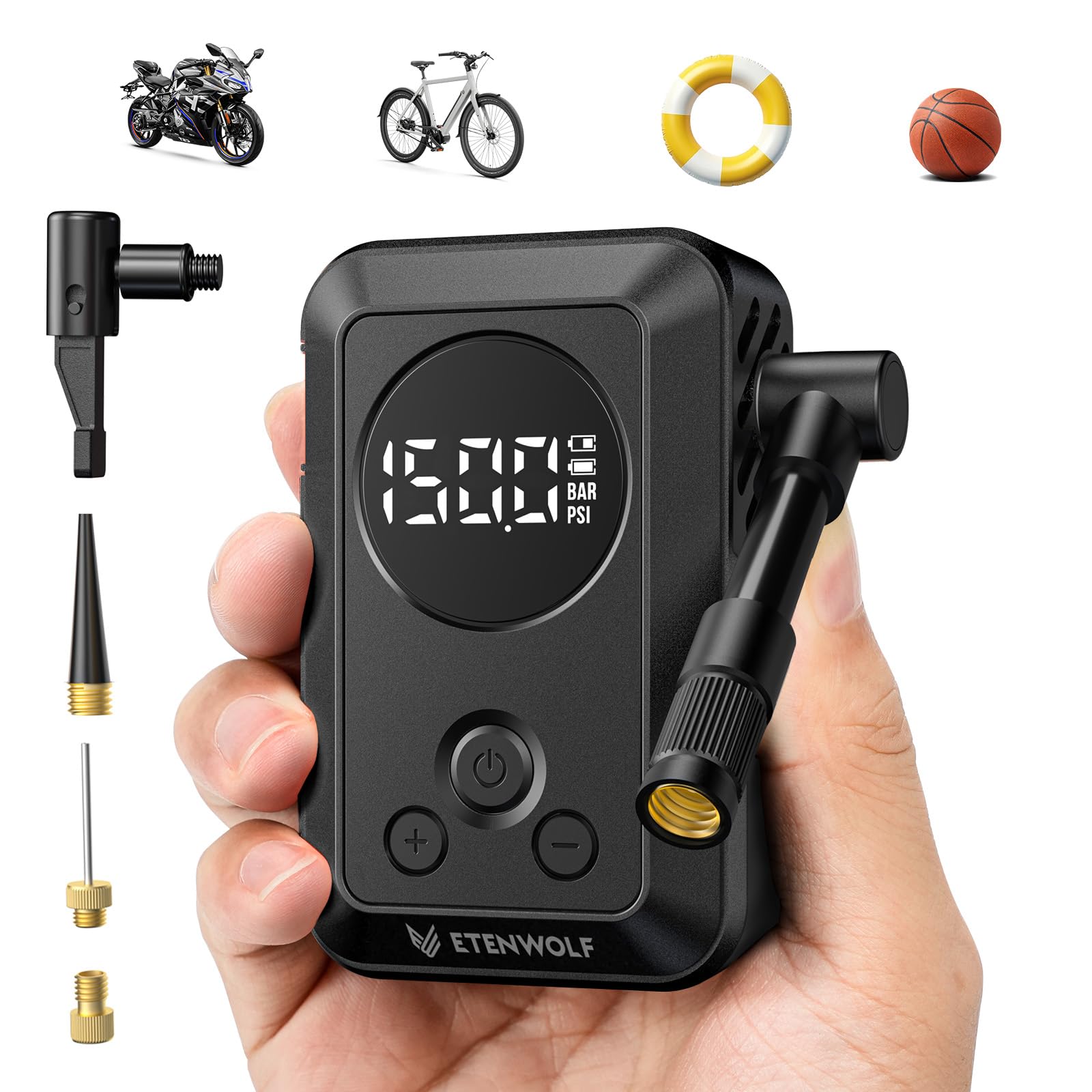
The ETENWOLF S0 Mini electric pump delivers 150 PSI with an 18-liter-per-minute airflow, cutting the inflation time for a 700x23C tire from 80 to 100 PSI down to about 20 seconds. That speed makes it practical not just for emergency flats but for topping up pressure before every ride. The 2400 mAh lithium battery can handle eight fully flat tires or eighteen low-pressure top-ups on a single charge, which covers a week of group rides without needing to recharge.
The digital pressure gauge reads pressure in real time with ±1 PSI accuracy. Set your target pressure, press start, and the pump’s auto-shutoff stops when it hits the number. No squatting to check a gauge, no overinflating a carbon rim. The 360-degree rotating hose attaches at any angle, solving the awkward reach problem on rear valves. The memory function saves your last two pressure settings, so if you consistently run 95 PSI on the road bike and 40 PSI on the mountain bike, the pump remembers both.
At 0.54 pounds and roughly palm-sized, this pump fits inside a small saddle bag or jersey pocket. The included drawstring bag keeps the four attachments organized. Owners note that the hose arm doesn’t bend much, so getting the head onto a tight rear valve requires a little more maneuvering. The included Presta adapter is a separate piece that must be attached to the valve first, adding one extra step, but the quick-connect chuck then locks on with no air loss.
Why it’s great
- Fast 20-second inflation from 80 to 100 PSI on 700x23C road tires
- Auto-shutoff with ±1 PSI accuracy prevents overinflation damage
- Memory function remembers two pressure settings for different bikes
Good to know
- Presta adapter is a separate piece that must be attached before use
- Hose arm’s limited bend angle can be awkward for rear wheel valves
4. HOTO Mini Bike Pump

The HOTO Mini Bike Pump packs a 2000 mAh battery and a brushless motor into a chassis that’s just 3.66 inches tall and weighs 0.56 pounds. It inflates a 700x23C road tire from flat to 80 PSI in about 60 seconds, and from 80 to 100 PSI in roughly 25 seconds. The pressure is enough to handle road bike tires at full race pressure, but the compact size also makes it ideal as a backup for mountain bikers who want to ditch CO2 cartridges.
The flick-to-start design is uniquely intuitive: swing the hose out from the body and the pump turns on. Stow the hose and it turns off. No separate power button to hunt for when you’re crouched on the side of a trail. The 360-degree rotation hose eliminates awkward angles, and the LED display shows real-time pressure with ±1 PSI accuracy. Two memory presets let you save your regular pressure for road and gravel setups, and auto-shutoff stops the pump when the target is reached.
One charge inflates up to eight fully flat tires or eighteen low-pressure top-ups. The pump is noticeably effective at higher pressures, and owners report it easily hits 75 PSI without strain. The unit is louder than a traditional floor pump, closer to a power drill, but the noise is the trade-off for the pocket-sized convenience. For Presta valves, you must slide the separate adapter onto the valve before attaching the pump head, and some users find the digital gauge reads about 10 PSI low—adding 10 PSI to the target compensates reliably.
Why it’s great
- Flick-to-start mechanism powers on automatically when hose is extended
- Incredibly compact at 3.66 inches tall, fitting easily in a pocket or seat pack
- USB-C charging and 2000 mAh battery covers multiple rides between charges
Good to know
- Some units show the digital gauge reading 10 PSI lower than actual pressure
- Operation noise level is comparable to a power drill, not discreet
5. Fanttik X10 Ace Mini Bike Pump
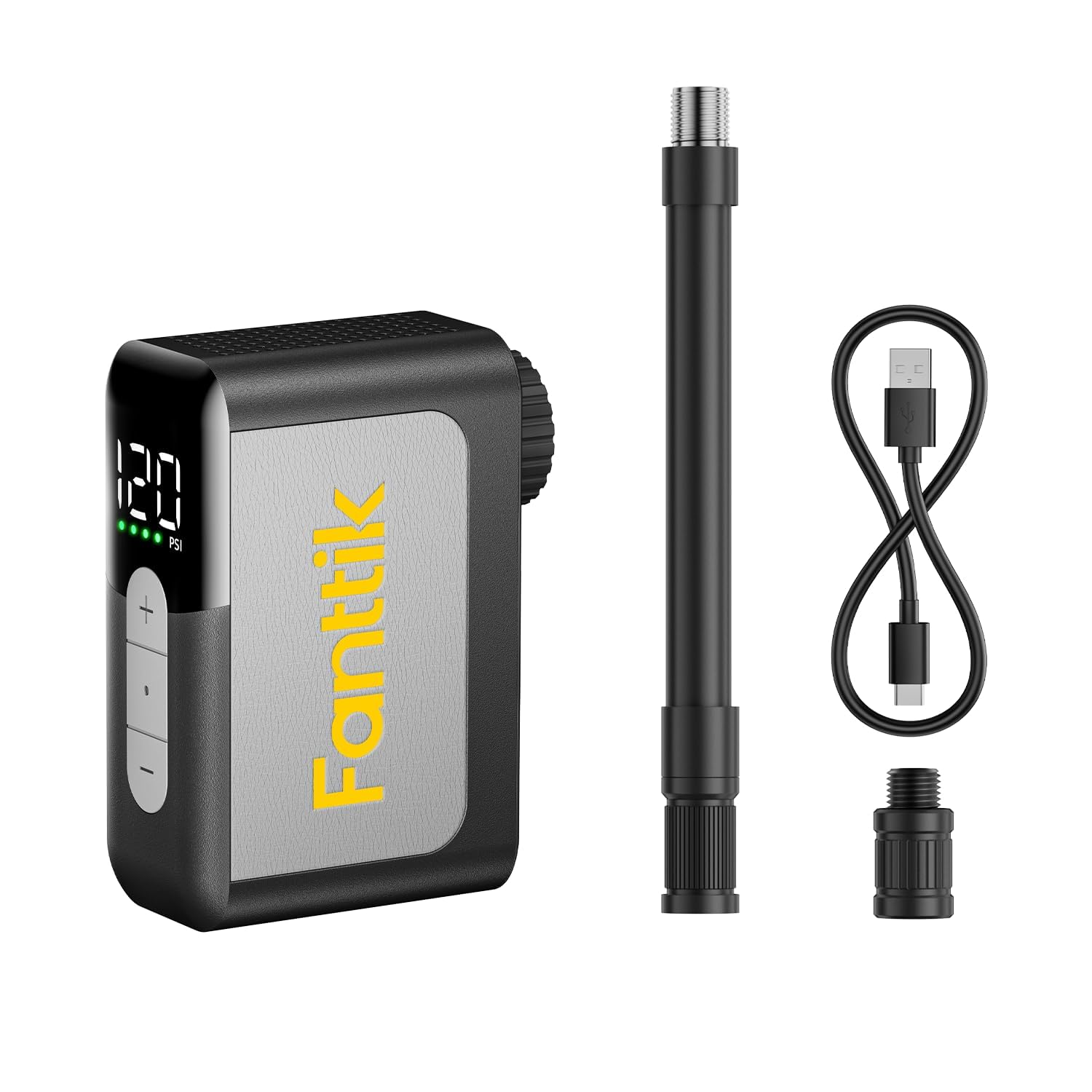
The Fanttik X10 Ace is the lightest electric cycle pump on this list at 0.26 pounds—roughly the weight of three eggs—and it’s small enough to fit inside a Specialized top tube stash box. Despite the featherweight build, it inflates a 700x23C road tire from 0 to 100 PSI in about 80 seconds. The gear-fan integrated heat dissipation design keeps the motor from overheating during that sustained high-pressure run, which is a real concern for pumps this small.
The Accuinflate Technology uses a high-precision sensor and shows real-time pressure on an LED screen with ±1 PSI accuracy. The pump supports preset pressure values, automatic pause, and a memory function that saves your last setting. This eliminates the guesswork of thumb-pressing a tire to check pressure. The straight-line internal structure and motor weight balancing keeps vibration to a minimum—no hand numbness during the 80-second inflation cycle.
The biggest caveat is battery capacity. Owners report getting only about four full inflations of 27.5-inch plus tires before the battery runs out, and the pump can get noticeably hot after consecutive uses. The pump also activates an overheat protection shutdown during prolonged use, which is a safety feature but can interrupt a multi-bike session. At 80 decibels, it’s loud. This pump is best viewed as a CO2 replacement that you can use repeatedly, not as a full-fledged floor pump substitute. It shines as a discrete on-bike inflation tool for riders who weigh every gram.
Why it’s great
- Extremely lightweight at 0.26 lbs, barely noticeable in a jersey pocket or stash box
- Accuinflate sensor with auto-stop and memory function provides precise, hands-off inflation
- Low-vibration design prevents hand numbness during the inflation cycle
Good to know
- Battery only supports about four full MTB tire inflations before needing recharge
- Gets hot during extended use and activates automatic overheat shutdown
6. AUXITO Tire Inflator
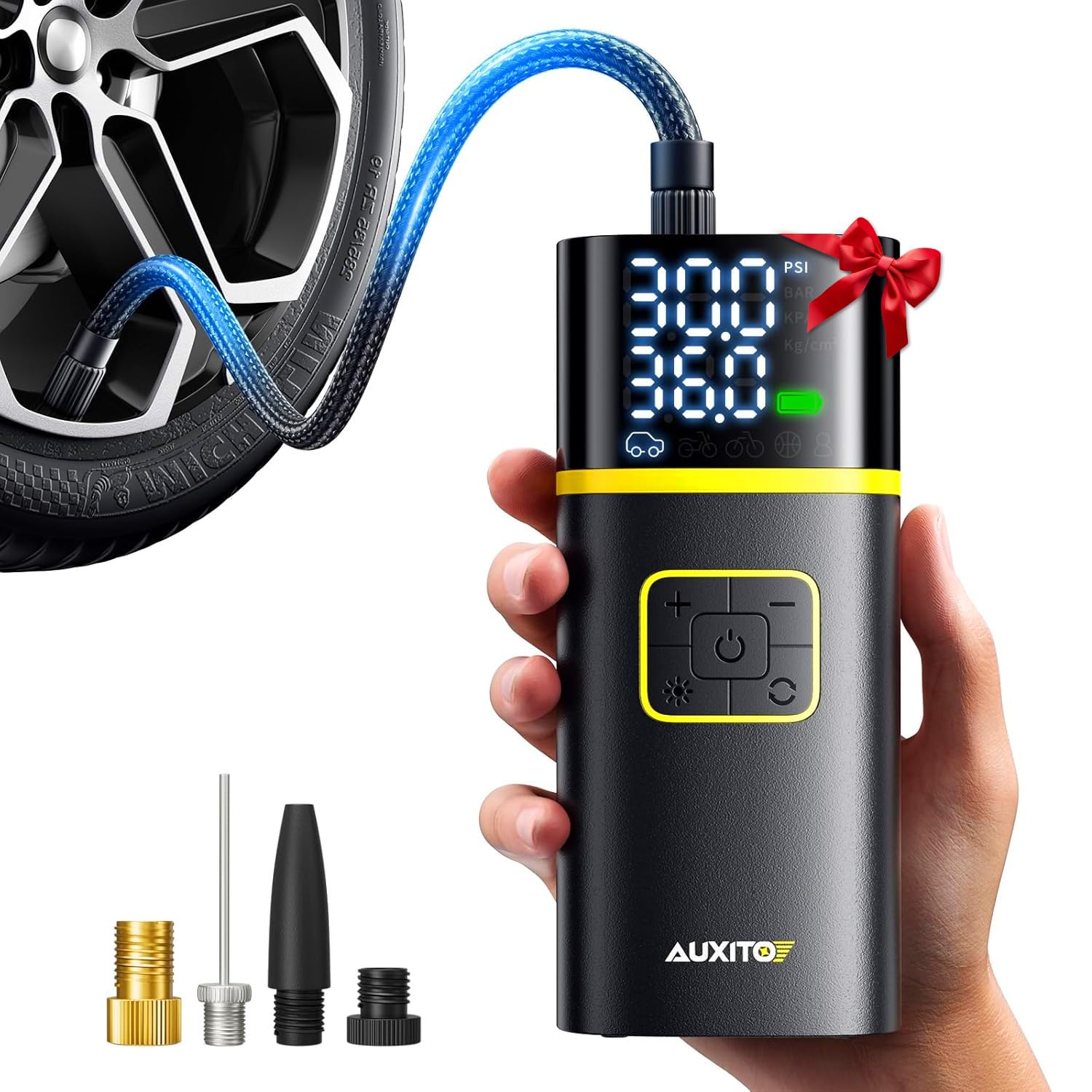
The AUXITO Tire Inflator prioritizes raw airflow over compactness, with a 26-liter-per-minute motor that inflates a compact car tire from 30 to 35 PSI in about a minute. For cyclists, that same power means filling a mountain bike tire from zero to 30 PSI in seconds. The 5200 mAh battery is the largest on this list, supporting multiple full vehicle tire inflations or weeks of bike tire top-ups before needing a charge. The dual-screen display shows both the current pressure and the target pressure simultaneously, so you can watch the number climb.
Four preset modes (Car, Motorcycle, Bike, Ball) and a custom mode make this inflator genuinely useful beyond bike tires. The included adapters cover Presta, Schrader, Woods valves, ball needles, and swim ring nozzles, meaning it can inflate everything from a road bike tire to a basketball to a pool float. A super-bright LED flashlight with SOS mode and a 5V/2A USB output for charging a phone turn this into a legitimate emergency tool for road trips and night rides.
Owners report the auto-shutoff works consistently, and the pump remembers the last pressure setting between uses. The design lacks a precise air release button for when you overshoot the target—the only way to bleed air is to disconnect the hose. The pump body is larger than dedicated bike pumps at 6.6 inches tall, so it’s not a jersey pocket item. It’s better suited for a car trunk or a home garage where you want one inflator that handles bikes, cars, and sports gear without carrying multiple tools.
Why it’s great
- High 26 L/min airflow inflates bike tires in seconds and car tires in about a minute
- Massive 5200 mAh battery handles multiple vehicle tire sessions between charges
- Integrated LED flashlight and phone charging port add genuine emergency utility
Good to know
- Larger and heavier than dedicated bike pumps; not pocketable
- No built-in air release valve for fine-tuning pressure if you overshoot
7. Tiakia Bike Pump with Gauge

The Tiakia Bike Pump is a manual handheld pump that weighs just 180 grams and measures 7.1 inches tall, making it small enough to slide into a saddle bag or even a jersey pocket without creating a noticeable bulge. The 220 PSI maximum pressure rating comes from an aluminum alloy barrel with CNC-machined construction that resists flexing at high pressure. Each stroke delivers 80cc of air, which is enough to top off a road tire without taking 100 strokes.
The T-shape dual valve system on this pump supports Presta, Schrader, and Dunlop valves without any conversion parts. The head simply aligns and tightens onto the valve stem. The foldable foot pedal provides extra stability when you need both hands to pump, and the 12.9-inch hose is long enough to lay the pump on the ground rather than wrestling it against the tire. The mechanical gauge reads pressure from 0 to 140 PSI with an internal spring made from special alloy steel that resists the elasticity drift that plagues budget gauges.
Some owners report a quality issue with the connector’s internal piece popping out after about six uses on Presta valves, though the same connector holds firm on Schrader. The plastic base also raises durability questions for long-term frequent use. This pump is ideal as a backup when weight is the primary concern, but for riders who pump multiple tires every day, the connector reliability makes a floor pump a better choice. The included PU storage bag and adapters for balls and pool toys add practical versatility for family trips.
Why it’s great
- Very lightweight at 180 grams with a compact 7.1-inch profile for easy carry
- Aluminum alloy CNC barrel rated to 220 PSI handles road tire pressures
- Dual-valve T-shape head works with Presta, Schrader, and Dunlop without adapters
Good to know
- Connector’s internal Presta piece can fail after several uses on some units
- Plastic base may not hold up to years of daily heavy use
FAQ
Is 160 PSI enough for a road bike tire?
Can an electric mini pump replace my floor pump?
What does a portable pump’s 80cc stroke volume mean for inflation time?
Final Thoughts: The Verdict
For most riders, the best cycle pump winner is the LEZYNE Classic Floor Drive 3.5 because it combines a threaded chuck that never leaks with a durable steel barrel and a readable gauge that stays accurate for years. If you want electric convenience for top-ups and trail repairs, grab the ETENWOLF S0 Mini for its fast auto-shutoff and twin memory presets. And for the minimalist cyclist who carries only what fits in a jersey pocket, nothing beats the Fanttik X10 Ace at just 0.26 pounds.

Mo Maruf
I created WellFizz to bridge the gap between vague wellness advice and actionable solutions. My mission is simple: to decode the research and give you practical tools you can actually use.
Beyond the data, I am a passionate traveler. I believe that stepping away from the screen to explore new environments is essential for mental clarity and physical vitality.