Our readers keep the lights on and my smoothie glass nicely filled. As an Amazon Associate, I earn from qualifying purchases.
Navigating unfamiliar roads on a bike used to mean juggling a handlebar-mounted phone, worrying about battery drain, and hoping a notification doesn’t interrupt your route. A dedicated cycle computer with navigation changes that entirely, offering a glanceable, rugged, and power-efficient solution purpose-built for the rider who wants to explore without second-guessing every turn.
I’m Mohammad Maruf — the founder and writer behind WellFizz. This guide is the result of cross-referencing hundreds of user reports and spec sheets to isolate the hardware and software features that actually matter for on-bike navigation, not just the marketing claims.
The right device transforms a stressful ride into a confident one, which is why we curated this list of the best cycle computer for navigation to help you find the perfect co-pilot for your next adventure.
How To Choose The Best Cycle Computer For Navigation
Selecting a navigation-focused cycle computer means prioritizing features that get you from point A to point B reliably, without needing your phone. Not all GPS bike computers are created equal for this task. Focus on these four pillars to separate a capable navigator from a basic data logger.
Map Visibility & Core Navigation Features
The screen is your primary interface. A vibrant, high-contrast color display with excellent sunlight readability is non-negotiable. Look for pre-loaded or easily downloadable regional maps (OSM-based maps are common) and clear turn-by-turn prompts. The device should handle route recalculation if you stray off course, and a ‘Back to Start’ feature is invaluable for spontaneous exploration. The speed and smoothness of map rendering is what separates a fluid experience from a frustrating lag.
GPS Accuracy & Satellite Connectivity
For navigation, ‘good enough’ GPS isn’t good enough. Multi-band GNSS (accessing multiple satellite constellations like GPS, GLONASS, Galileo, and Beidou) delivers pinpoint accuracy, especially under heavy tree cover on singletrack, between tall buildings in a city, or in deep mountain valleys. This prevents your on-screen position from jumping around or losing the route entirely at critical junctions.
Battery Life for the Distance
Battery life is measured differently by every manufacturer. A device claiming 25 hours might only get 10 hours with the screen at full brightness, maps actively rendering, and multiple sensors connected. Look for a high-capacity battery (3500mAh or more) and understand that ‘demanding use’ is the real-world benchmark. For multi-day tours, a device with reliable battery saver modes that still keep navigation active is a must.
Ecosystem & Route Integration
A navigation computer is only as good as its ability to accept routes. Ensure seamless syncing with the apps you use — Strava, Komoot, RideWithGPS, or TrainingPeaks. The companion app should make route creation and transfer easy. Features like ClimPro (which shows remaining ascent) and live segments add depth, but the core is getting a GPX file onto the device and following it without errors.
Quick Comparison
On smaller screens, swipe sideways to see the full table.
| Model | Category | Best For | Key Spec | Amazon |
|---|---|---|---|---|
| Garmin Edge 540 | Button Control | All-weather reliability & coaching | Up to 42 hrs battery saver | Amazon |
| Magene C706 | Touch + Voice | Value packed with voice guidance | 3.3″ display + star ring | Amazon |
| Wahoo ELEMNT ROAM V3 | Premium All-Rounder | Intuitive navigation & route sharing | Dual-Band GPS + public routes | Amazon |
| Garmin Edge 1040 | Flagship Navigator | Ultra-long battery & full mapping | Up to 70 hrs battery saver | Amazon |
| SRAM Hammerhead Karoo | Smartphone-Like UX | Best display & quick UX | 3.2″ HD + 64GB storage | Amazon |
| Bryton Rider S810 | Endurance Explorer | Ultra-long tours & bikepacking | 50 hr battery life | Amazon |
| iGPSPORT BiNavi | Feature-Packed Value | Large screen & music control | 3.5″ touch + 35 hr battery | Amazon |
| Bryton Rider 650 | Mid-Range Workhorse | Solid navigation at a fair price | 33 hr battery + color maps | Amazon |
| Magene C606 V2 | Entry-Level Navigator | Budget-friendly touchscreen start | 2.8″ touch + 25 hr battery | Amazon |
In‑Depth Reviews
1. Garmin Edge 540

The Garmin Edge 540 is the gold standard for riders who demand reliable navigation without worrying about a touchscreen failing in the wet. Its physical button interface is a deliberate advantage, allowing for precise control with gloves or in a downpour, making it a favorite for endurance cyclists in variable climates. The device also features ClimbPro, which now works on any ride without a pre-planned course, showing you remaining ascent and grade at a glance.
Under the hood, the multi-band GNSS provides exceptional accuracy, keeping you on course through dense tree cover and urban canyons where lesser units falter. The intelligent battery management delivers up to 26 hours in demanding mode and an astonishing 42 hours in battery saver, easily covering multi-day events. It also offers targeted adaptive coaching, using power meter and heart rate data to suggest daily workouts and adjust training load, going beyond simple navigation into performance strategy.
Setup is streamlined via the Garmin Connect app, and the device pairs seamlessly with a wide ecosystem of sensors, including Shimano Di2 and SRAM eTap. The only real drawback is the cost of entry, which places it firmly in the mid-to-premium tier, but for the reliability and feature depth, serious cyclists consistently find it worth the investment. The completely stable operation and intuitive, albeit deep, menu system make it a near universal recommendation.
Why it’s great
- Rock-solid button controls work in any weather.
- Excellent multi-band GNSS for reliable navigation.
- Adaptive coaching and training metrics.
- Superior battery management with up to 42 hrs in saver mode.
Good to know
- Learning curve for complex menu customization.
- No touchscreen which some users prefer for map scrolling.
- Premium-tier pricing compared to entry-level units.
2. Garmin Edge 1040

The Edge 1040 is Garmin’s ultimate touring machine, built for the rider who wants every feature fully realized. The 3.5-inch color touchscreen is large, bright, and incredibly clear even in direct sunlight, making map reading effortless. Its inclusion of a speed and cadence sensor in the box is a welcome bonus, saving you a significant additional purchase. The battery life is its headline act: up to 35 hours in demanding use and a staggering 70 hours in battery saver mode, virtually eliminating range anxiety.
Navigation is powered by multi-band GNSS for enhanced accuracy and pre-loaded maps with ride-type-specific highlights, showing popular roads for road cyclists and trails for mountain bikers. The device classifies your strengths as a cyclist and then compares your ability against specific course demands, offering Power Guide targets for pacing when connected to a compatible power meter. The stamina feature provides a real-time estimate of how much energy you have left, helping you avoid hitting the wall.
Beyond navigation, the Edge 1040 acts as a sophisticated training partner, providing daily suggested workouts that adapt to your recovery and load. The interface is fluid and responsive, with both touchscreen and button control for all conditions. The higher price point limits it to those who demand the absolute best, but for long-distance touring, multi-day races, or obsessive data analysis, this computer delivers an unmatched experience.
Why it’s great
- Exceptional battery life with up to 70 hrs in saver mode.
- Large, bright, and responsive 3.5-inch color touchscreen.
- Comes with speed, cadence, and HR sensors included.
- Advanced training metrics and Power Guide feature.
Good to know
- Highest price point in the lineup.
- Large form factor may not suit minimalists.
- Mount is a separate purchase.
3. SRAM Hammerhead Karoo

The Hammerhead Karoo is the closest thing to a smartphone on your handlebars, and for many, that’s a huge compliment. Its 3.2-inch HD display offers unparalleled clarity, responsiveness, and color vibrancy for cycling computers, making map detail easy to parse at a glance. Powered by 4GB of RAM and 64GB of onboard storage, the Karoo renders maps with zero lag, even when panning and zooming on complex routes. The combination of a responsive touch screen and hardware buttons gives you control in any condition, whether you’re bare-handed or gloved.
Navigation is a standout feature, with free global maps pre-loaded and instant sync from popular platforms like Strava, Komoot, and RideWithGPS. It features multi-band GNSS for pinpoint accuracy, and its automatic climb detection functions for any route you take, not just pre-planned ones. The user interface is intuitive, with surface-specific routing for road, gravel, and MTB, ensuring the device directs you to appropriate terrain. The open Android operating system also allows for third-party app installation, offering flexibility that Garmin’s walled garden does not.
The battery life of around 15 hours is its weakest point, falling short of the class-leading endurance of the Garmin 1040 or Bryton S810. It’s not a device for multi-day ultramarathons without a power bank. However, for long day rides, gran fondos, and gravel adventures where a brilliant screen and fast navigation are paramount, the Karoo is a joy to use. The premium price reflects this focus on user experience hardware.
Why it’s great
- Best-in-class HD display for unparalleled map clarity.
- Fast, lag-free performance with 64GB storage.
- Intuitive smartphone-like user interface.
- Free global maps with automatic climb detection.
Good to know
- Battery life is significantly shorter than competitors.
- Premium pricing with some reports of software bugs.
- Minor issues with trail map line rendering reported.
4. Wahoo ELEMNT ROAM V3
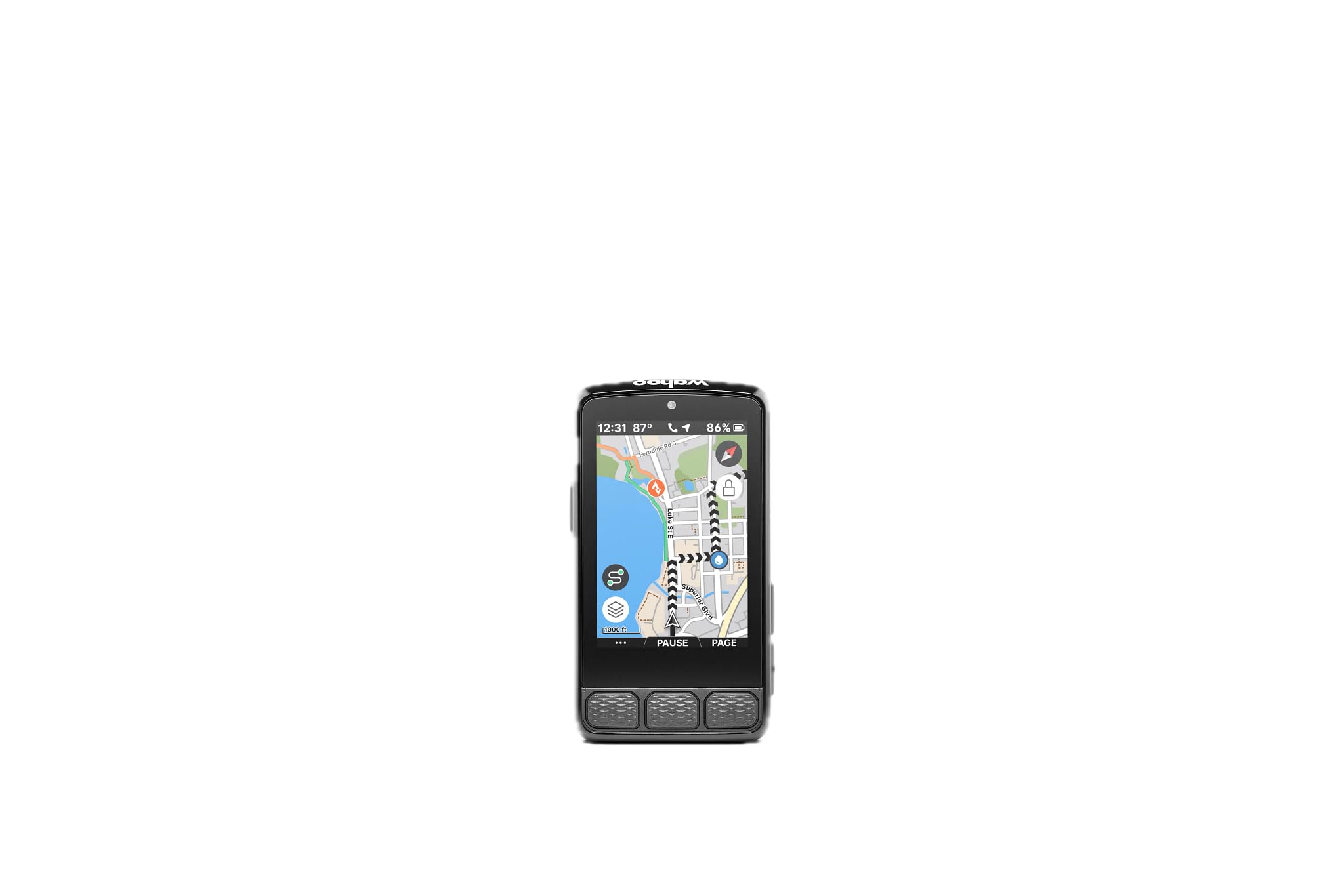
Wahoo’s ELEMNT ROAM V3 is built for the rider who values intuitive, effortless navigation above all else. Its standout feature is Public Route Sharing, allowing any nearby ELEMNT user to load your route on the fly — a killer feature for group rides. The dual-band GPS provides incredibly stable and accurate positioning, ensuring you stay on course even in signal-challenged environments. The device excels at on-demand route generation, letting you simply pan and zoom on the map to select a destination and get instant turn-by-turn directions.
The 2.8-inch color LCD is easy to read, with an adaptive brightness sensor that adjusts automatically. It supports both touchscreen and physical button interaction, giving you options depending on the conditions. The navigation logic is some of the best in the business, handling route recalculations quickly and seamlessly with spoken turn prompts when paired with a Bluetooth headset. It imports routes seamlessly from a wide range of apps, acting as a universal hub for your planned rides.
Some users have reported minor connectivity issues with GoPro and music controls, and the screen can be slightly difficult to read in heavy shade. The battery life of up to 25 hours is solid but not class-leading. For the rider who wants a simple, clean, and accurate navigation experience without the complexity of a Garmin, the ROAM V3 is a top contender. Its premium pricing is justified by the exceptional user interface and unique route-sharing functionality.
Why it’s great
- Unique Public Route Sharing for group rides.
- Excellent on-demand route generation.
- Intuitive interface with easy setup.
- Dual-band GPS for accurate positioning.
Good to know
- Screen can be hard to read in deep shade.
- Minor reported connectivity issues with third-party devices.
- Customization must be done via the app, not on the device.
5. Bryton Rider S810

The Bryton Rider S810 is engineered for the ultra-distance rider and bikepacker who measures rides in days, not hours. Its 50-hour battery life is the headline feature, offering more endurance than any device from Garmin or Wahoo at a similar price point. The 3.5-inch color touchscreen is large and clear, complemented by tactile buttons that provide reliable control on rough, vibration-heavy gravel terrain. A built-in ambient light sensor ensures the screen is readable from bright sunlight to deep forest shade.
Navigation is genuinely offline, functioning entirely from pre-loaded maps and GPS satellite data, meaning you don’t need cell service to recalculate a route, a critical feature for remote adventures. The Climb Challenge 2.0 feature gives a beautiful visual breakdown of upcoming gradients and remaining ascent, helping you pace climbs perfectly. It supports all major ANT+ sensors, including power meters and rear-view radar, and works seamlessly with smart trainers for indoor riding when the weather turns.
The Bryton Active app handles route planning and data sync, and the setup process is straightforward, though some users find the software interface less polished than Garmin’s Connect. A small number of users report reliability issues with random shutdowns and sensor pairing. For the serious tourer or gravel adventurer who prioritizes sheer battery endurance and reliable offline navigation, the S810 is an exceptional value proposition that doesn’t compromise on core performance.
Why it’s great
- Exceptional 50-hour battery life for multi-day trips.
- Full offline navigation with route recalculation.
- Large 3.5-inch screen with excellent sunlight readability.
- Great value for the feature set compared to premium brands.
Good to know
- Some users report software reliability bugs.
- App interface is less refined than competitors.
- No dedicated out-front mount; Garmin adapter included.
6. Magene C706
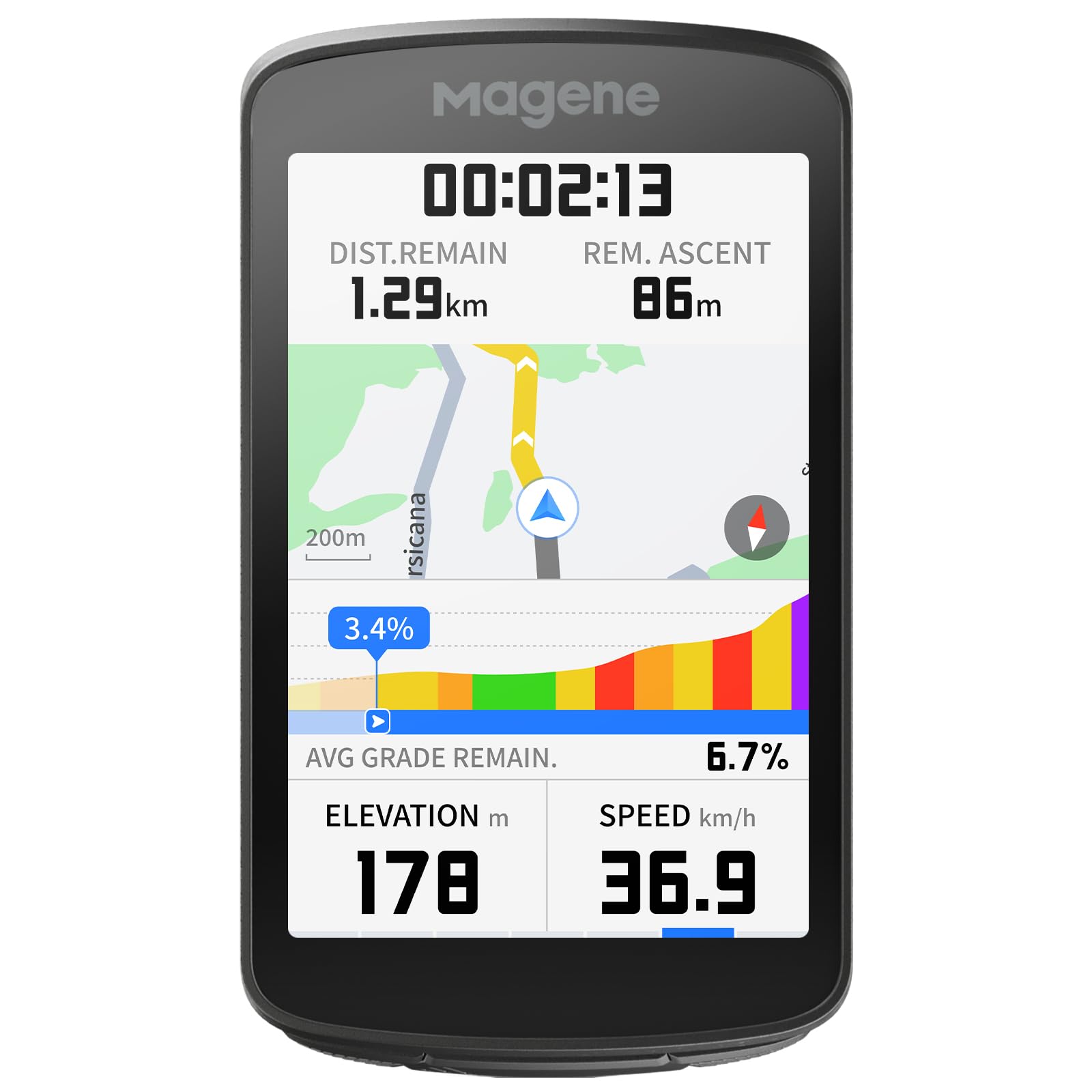
The Magene C706 is a mid-range marvel that packs a surprising number of premium features into a budget-friendly package. The 3.3-inch vibrant color touchscreen is large and responsive, and the unique Star Ring (a 12-color ambient light ring around the display) adds a visual alert system for notifications, turns, and segments. Its standout feature is voice guidance, providing spoken turn-by-turn directions, climb alerts, and segment updates in 13 languages via a built-in speaker, so you can navigate without looking down.
Dual-band 5-satellite GNSS ensures excellent positioning accuracy, and the Freeride ClimbPro feature allows you to plan climbs on the fly based on your current location. It supports smart camera and light control, Strava Live Segments, and advanced indoor training with direct smart trainer control. The premium metal mount adds a feeling of quality to the cockpit. With 25 hours of battery life, it’s well-equipped for long day rides.
The main compromises come in software polish. Users have reported bugs with Strava live segments and the route recognition tool failing to properly detect some trails. The navigation, while functional, is not as seamless as a Garmin or Wahoo in handling complex reroutes. For the price-conscious rider who wants a large, brilliant screen and the convenience of voice guidance, the C706 offers incredible value if you’re willing to accept a few rough edges in the user experience.
Why it’s great
- Voice navigation guidance for heads-up riding.
- Large, vivid 3.3-inch color touchscreen.
- Unique and customizable Star Ring ambient light.
- Excellent value for a premium feature set.
Good to know
- Software can have occasional bugs and glitches.
- Navigation route recognition is not perfect.
- Battery life drops with all features active.
7. iGPSPORT BiNavi

The iGPSPORT BiNavi is a mid-range contender that focuses on core navigation features at an attractive price point, making it a strong option for the budget-conscious rider who still wants a dedicated navigator. Its 3.5-inch touchscreen is one of the largest in this class, providing excellent map visibility. The built-in music control is a clever addition, allowing you to skip tracks or adjust volume from the bike computer without touching your phone. It features dual-band GPS for improved accuracy and 35 hours of battery life.
Navigation is handled through Yaw Planning, which automatically recalculates a route back to your course when you stray off the planned path, and it also supports Saved Point Navigation for returning to favorite spots. The iClimb Pro feature provides climb planning with route previews. It supports advanced training analytics and can import routes from third-party apps like Strava and Komoot. The robust build quality is particularly praised by mountain bikers who subject it to rough terrain.
The main drawback is that its rerouting speed is slower than premium units from Garmin or Wahoo, and users have reported some software glitches like screen flickers. The app and instructions are not as polished as the market leaders. For the rider who wants a big, clear screen for navigation and music control without spending premium money, the BiNavi is a compelling value, especially if you can tolerate a slightly slower rerouting process.
Why it’s great
- Large 3.5-inch touchscreen for easy map reading.
- Built-in music control for safer riding.
- Excellent battery life of up to 35 hours.
- Solid build quality for MTB use.
Good to know
- Rerouting speed is slower than competitors.
- Some software bugs and screen flicker issues.
- App and documentation are less refined.
8. Bryton Rider 650
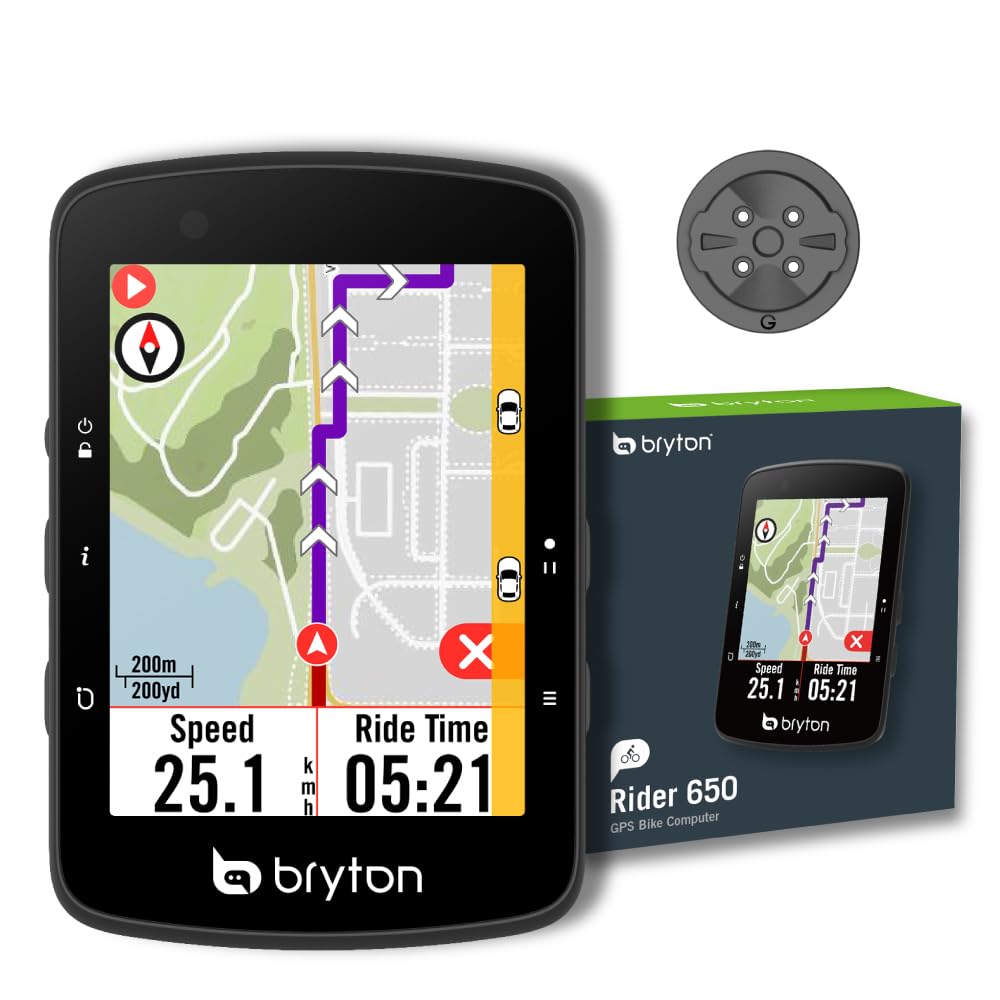
The Bryton Rider 650 is the sensible mid-range hero for the rider who needs reliable navigation but doesn’t need the absolute top-end features. Its 2.8-inch color touchscreen and 33-hour battery life provide a solid foundation for long-distance riding. The device is particularly strong for navigation, featuring pre-loaded OSM maps for full-color visual context rather than just simple breadcrumb lines. The clear turn-by-turn guidance, complete with street names and points of interest, makes it easy to navigate unfamiliar streets.
The Climb Challenge 1.0 feature provides a useful color-coded visual of upcoming grade and ascent, helping you manage your energy on the hills. It supports a wide range of ANT+ sensors, including electronic shifting and rear-view radar, and offers Live Tracking for peace of mind on solo rides. Setup and sync are handled through the Bryton Active app, which is functional if not the most polished. The physical button control, combined with the touchscreen, offers flexibility for different riding conditions.
The main drawbacks are that the screen is not as bright or crisp as more expensive Garmin units, and some users find the interface less refined. It doesn’t connect directly to Wi-Fi, relying on the phone app for syncing. For the rider looking for a significant step up from a basic GPS unit that only shows lines, the Rider 650 delivers a robust navigation experience with excellent battery life at a very reasonable mid-range price.
Why it’s great
- Pre-loaded color OSM maps for intuitive navigation.
- Excellent 33-hour battery life for long rides.
- Intuitive touch and button control combination.
- Climb Challenge provides clear ascent information.
Good to know
- Screen brightness and clarity trails premium units.
- Lacks direct Wi-Fi connectivity.
- App and interface are less polished than competitors.
9. Magene C606 V2
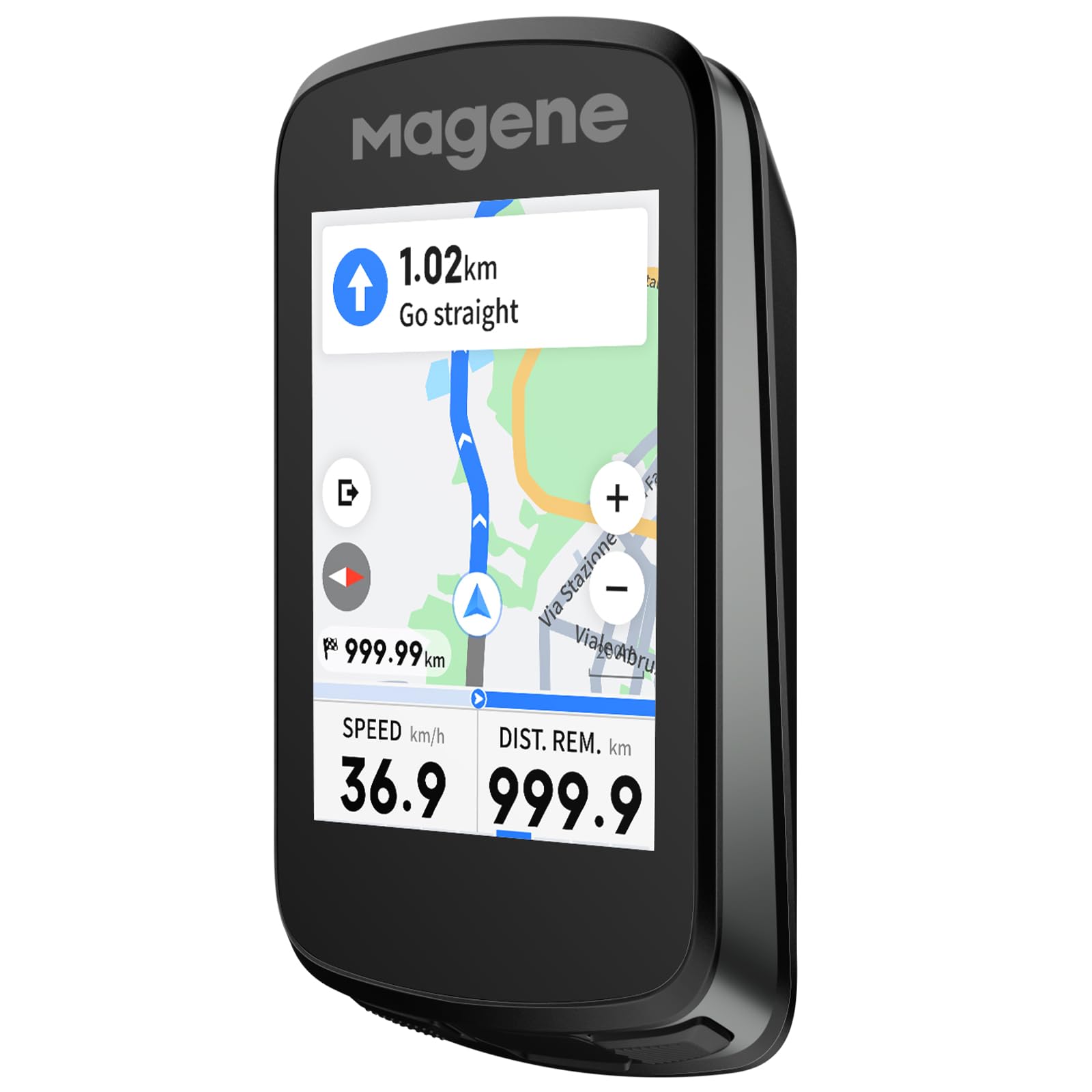
The Magene C606 V2 is the entry-level darling that proves you don’t need to spend a fortune to get a feature-rich touchscreen navigator. Its 2.8-inch color touchscreen is responsive and clear, offering a smartphone-like experience at a budget-friendly price point. It is the best value proposition for the rider who is ready to move on from a phone app but still wants a modern, high-resolution display. Wireless offline smart navigation functions via GPX import or route planning in the app, and it can handle routes up to 1,000 km.
For the technical rider, it includes a Multi-Scenario ClimbPro, showing full route climb planning with real-time gradient and elevation profile. It supports Strava Live Segments and cycling dynamics when paired with a compatible power meter. The 25-hour battery life is adequate for all but the longest multi-day tours, and the IPX7 waterproof rating combined with an included protective case and tempered glass protector shows they’ve considered real-world durability. Wi-Fi and Bluetooth sync is fast, with 28x faster data upload over Bluetooth alone.
The screen contrast can be a bit low in very bright sunlight, and the build, while good, doesn’t feel as premium as a Garmin or Wahoo. Some users report the radar support lacks certain color differentiations. For the budget-conscious cyclist who wants a full-color map navigation experience with Strava integration and advanced climb features, the C606 V2 is an outstanding entry point that delivers a surprisingly complete package for the price.
Why it’s great
- Very affordable color touchscreen GPS navigator.
- Full offline navigation with smart routing.
- Includes ClimbPro, Strava Live Segments, and cycling dynamics.
- Fast Wi-Fi sync and durable IPX7 build.
Good to know
- Screen can be hard to read in bright sunlight.
- Build quality feels less premium than more expensive options.
- Radar support lacks some visual detail.
FAQ
Do I need a cycle computer with offline maps, or can I just use my phone for navigation?
What is ClimbPro and why is it important for navigation?
Can I use a cycle computer for navigation without a phone signal?
Final Thoughts: The Verdict
For most users, the best cycle computer for navigation winner is the Garmin Edge 540 because it offers the best balance of reliable button-based navigation, excellent multi-band GPS, and long battery life at a premium but justifiable price. If you want the largest screen and a smartphone-like experience, grab the SRAM Hammerhead Karoo. And for ultra-distance touring and bikepacking where battery endurance is king, nothing beats the Bryton Rider S810.

Mo Maruf
I created WellFizz to bridge the gap between vague wellness advice and actionable solutions. My mission is simple: to decode the research and give you practical tools you can actually use.
Beyond the data, I am a passionate traveler. I believe that stepping away from the screen to explore new environments is essential for mental clarity and physical vitality.