Our readers keep the lights on and my smoothie glass nicely filled. As an Amazon Associate, I earn from qualifying purchases.
Nothing kills the driving experience faster than a shuddering or slipping CVT. Finding the right fluid can mean the difference between a silky-smooth commute and a costly transmission replacement. The wrong fluid accelerates wear, while the right one keeps your pulleys and belt happy for thousands of miles.
I’m Mohammad Maruf — the founder and writer behind WellFizz. I’ve spent countless hours analyzing formulation sheets, viscosity charts, and owner feedback to identify which CVT fluids truly protect against shudder, slippage, and heat breakdown.
After cross-referencing OEM specifications with real-world drain intervals and additive packages, I’ve narrowed the field to the top five that deliver reliable, long-lasting performance. This guide ranks the best cvt transmission fluid for protecting your belt-driven transmission across temperature extremes.
How To Choose The Best CVT Transmission Fluid
Selecting the correct CVT fluid is more nuanced than picking a random synthetic oil. Every CVT manufacturer designs its steel belt and pulley system around a specific friction coefficient and viscosity range. The wrong fluid causes slip, shudder, or overheating, while the correct one keeps hydraulic pressure stable and wear minimal. Here are the three factors that matter most.
OEM certification vs. universal compatibility
Honda, Nissan, Subaru, and Audi each specify a unique fluid formulation — Honda CVT-1, Nissan NS-2 or NS-3, Subaru CVTF — each with a distinct friction modifier package. Using an uncertified fluid risks belt slip or abnormal wear. Universal fluids like Pentosin CVT1 or Red Line CVT are designed to cover multiple standards, but always verify that the fluid lists your vehicle’s OEM reference number before buying.
Viscosity grade and cold-temperature flow
CVT fluids typically carry a 5W-20 or 10W-20 viscosity grade from SAE J300 testing. The winter rating (the first number) determines how well the fluid flows at cold starts — critical for reaching the transmission’s internal oil pump and avoiding dry-start wear. A fluid with 5W-20 flows more easily than 10W-20 below freezing. Check your owner’s manual for the recommended grade.
Additive package and thermal stability
High-quality CVT fluids include anti-wear additives (ZDP/ZDDP) for metal-to-metal protection in torque converter clutches, friction modifiers to maintain consistent belt grip, and defoaming agents to prevent air entrapment. Synthetic base stocks — especially PAO/ester blends — resist oxidation and maintain viscosity over longer drain intervals, typically 30,000 miles for premium fluids versus 15,000 to 25,000 for standard formulations.
Quick Comparison
On smaller screens, swipe sideways to see the full table.
| Model | Category | Best For | Key Spec | Amazon |
|---|---|---|---|---|
| Red Line 30804 | Premium Synthetic | Extended drain intervals | PAO/Ester blend, up to 30k mi | Amazon |
| Genuine Honda 08200-9006 | OEM Certified | 1st-gen Honda CVTs | 5W-20, Honda CVT-1 spec | Amazon |
| Pentosin CVT1 1120107 | Universal Synthetic | Multi-brand compatibility | OE Ref covers 15+ automakers | Amazon |
| Mannol NS-3 | Value Synthetic | Nissan/Mitsubishi NS-3 | 10W-20, cold rating -45°C | Amazon |
| Genuine Nissan 999MP-CV0NS2 | OEM Certified | Nissan NS-2 vehicles | NS-2 spec, superior hot stability | Amazon |
In‑Depth Reviews
1. Red Line 30804 Synthetic Non-Slip CVT Fluid

Red Line 30804 stands apart with its PAO/ester fully synthetic base stock, which delivers exceptional shear stability and thermal resistance far beyond conventional hydroprocessed oils. The non-slip formulation is engineered specifically for metal belt-type CVTs from Nissan, Subaru, and Mini, and its anti-wear additive package provides strong metal-to-metal protection in torque converter clutches.
Many owners report that a Red Line drain-and-fill eliminated grabby take-off and highway shudder within 10 miles of driving, even on high-mileage transmissions above 150k. The fluid maintains consistent friction characteristics across a broad temperature range, from freezing winter starts to summer stop-and-go traffic, without significant viscosity drop-off.
Red Line recommends up to 30,000-mile drain intervals after a full saturation process — typically requiring three drain/fill cycles at 5,000- to 10,000-mile intervals. A small number of users note that a failed transmission may not recover fully, so this fluid performs best as a preventive upgrade or a cure for moderate wear rather than a last-ditch fix.
Why it’s great
- True PAO/ester synthetic for maximum thermal stability
- Up to 30,000-mile drain interval reduces service frequency
- Restores smooth acceleration in slipping CVTs quickly
- Broad compatibility across Honda, Nissan, Subaru, Dodge
Good to know
- Requires 3 drain/fills for full saturation at first change
- May not fix transmissions with severe internal damage
2. Genuine Honda Fluid 08200-9006 CVT-1

Genuine Honda CVT-1 fluid is the only fluid Honda approves for its first-generation CVT transmissions. The 5W-20 viscosity grade provides excellent cold-weather fluidity for easier starting, while the newest base oils and additives improve oxidation resistance and reduce deposit buildup inside the valve body over time. Owners of older Honda CVTs — Fit, Civic Hybrid, Insight — report immediate cessation of shudder after switching from generic fluid to this OEM formulation.
Customer feedback highlights its effectiveness in eliminating transmission thumping and restoring fuel economy. Many long-term users perform a partial drain and refill of roughly 3 quarts every other oil change as a cheap insurance policy. Some note that the fluid comes in a smaller 1-quart bottle, so a full capacity drain requires multiple bottles.
It is critical to verify your transmission generation. Second-generation Honda CVTs (2014+ Fit, 2016+ Civic) require HCF-2 fluid, not CVT-1. Using CVT-1 in a gen-2 transmission can cause damage, so always double-check the specification before pouring.
Why it’s great
- OEM-certified for Honda CVTs — eliminates guesswork
- 5W-20 winter rating for easier cold starts
- Proven to stop shudder and thumping in first-gen units
Good to know
- Not compatible with second-gen Honda CVTs (HCF-2)
- Small bottle size means large jobs need multiple quarts
3. Pentosin CVT1 1120107

Pentosin CVT1 is a German-engineered full-synthetic fluid that covers one of the widest cross-brand application lists on the market. The OE reference sheet includes Acura, Audi, Dodge, Ford, Honda, Jeep, Mercedes-Benz, Mini, Mitsubishi, Nissan, Saturn, Subaru, and Suzuki — a dozen-plus automakers under one bottle. This level of compatibility makes it a go-to for DIYers managing multiple vehicles or for shops that stock a single universal CVT fluid.
The formulation uses high-quality synthetic base oils with modern additive technology that provides high shear stability and excellent defoaming properties, which are essential for keeping hydraulic pressure stable in belt-driven CVTs. The fluid also delivers high wear resistance for chains, belts, and pulleys under sustained torque. Buyers with Audi A4s and Mitsubishi Outlanders often use this as a direct replacement for the vastly more expensive dealer fluid.
Some Audi and Mitsubishi owners report a slight difficulty verifying the fluid’s viscosity grade for specific applications, and while the fluid is mixable with other high-quality CVT fluids, a full drain is recommended for best results. The price per liter is competitive with other premium options.
Why it’s great
- Covers 15+ automakers — Acura, Audi, Honda, Nissan, Subaru
- High shear stability and low foam tendency
- Mixable with other high-quality CVT fluids
Good to know
- Viscosity grade not always published on bottle
- Some users find it expensive compared to OEM alternatives
4. Mannol NS-3 Synthetic CVT Fluid
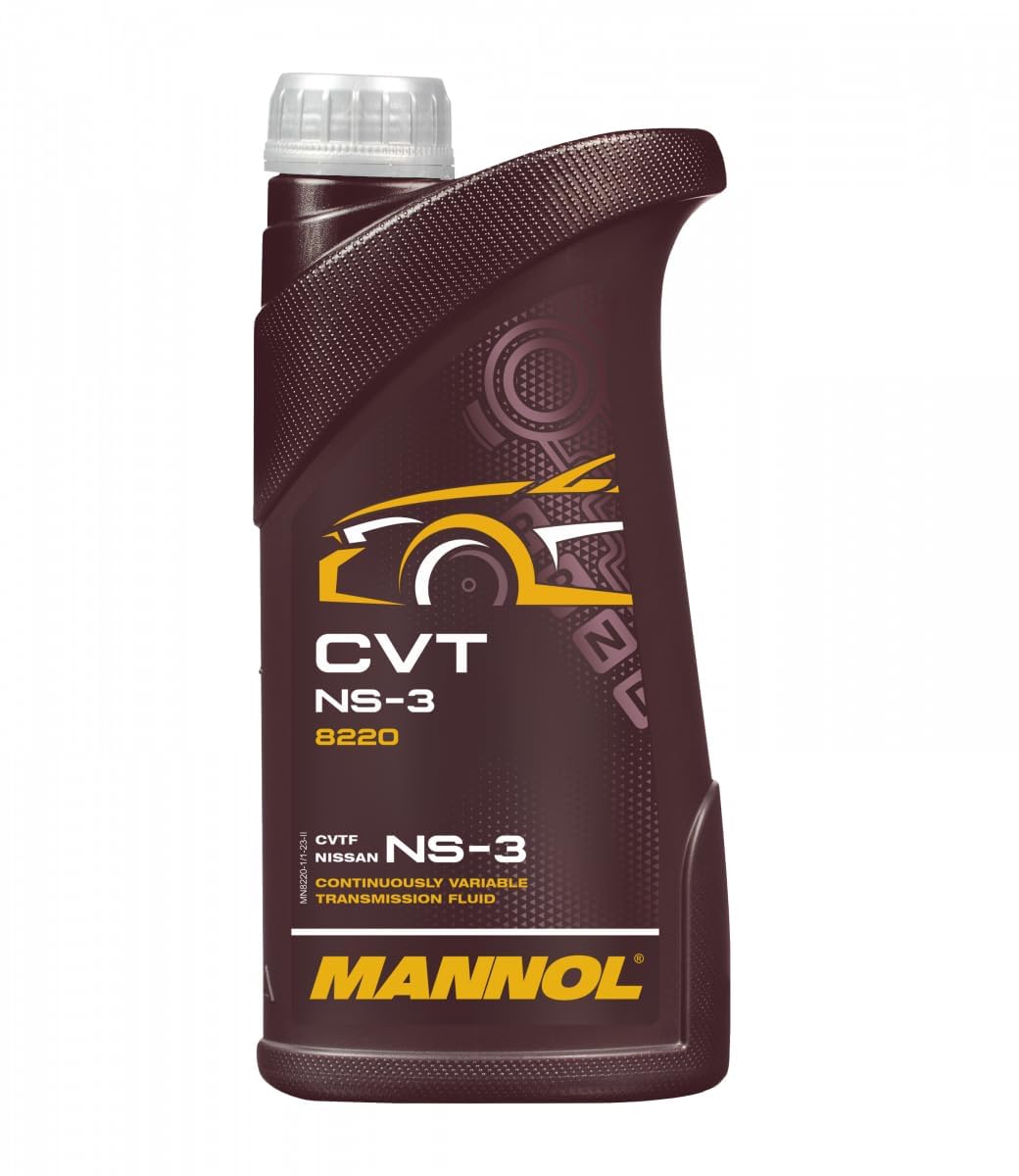
Mannol NS-3 is built around a high-viscosity synthetic formula that targets Nissan and Mitsubishi CVTs requiring the NS-3 spec. Its standout claim is a -45°C cold-flow rating, meaning it remains pumpable even in extreme northern winters. The anti-wear additives reduce belt and gear stress under high torque loads, while the seal-conditioning chemistry prevents swelling or shrinkage that can lead to seepage.
Nissan Pathfinder and Sentra owners have reported noticeable improvements in acceleration smoothness and elimination of low-speed shudder after a simple drain and fill. The fluid also resists foaming and carbon buildup, keeping the valve body clean and maintaining consistent hydraulic pressure over time. Several customer reviews note that after thousands of miles, the transmission continues to shift smoothly with no return of slip.
Some users note that the fluid is not a direct OEM replacement for every Nissan CVT — early models require NS-2 fluid. Always check the specific OE reference on your dipstick or owner’s manual. Mannol NS-3 works best as a value-forward option for routine fluid changes rather than a high-mileage emergency fix.
Why it’s great
- -45°C cold-flow rating for extreme winter starts
- Seal-compatible chemistry prevents leaks
- Restores smooth acceleration in NS-3 vehicles
Good to know
- Not certified for Nissan NS-2 applications
- Some users question long-term durability vs. high-end synthetics
5. Genuine Nissan Fluid 999MP-CV0NS2

Genuine Nissan NS-2 fluid is the exact OEM fill that came in Nissan and Infiniti models requiring the NS-2 specification. The unique blend of high-quality friction modifiers ensures stable and precise belt-to-pulley clamping force, which is the single most critical factor for CVT longevity in Nissan’s earlier transmissions. The formulation also offers superior low-temperature fluidity for smooth shifting at cold start and maintains proper hydraulic pressure during hot weather driving.
Many Nissan Rogue and Altima owners report that a fluid change using NS-2 resolves the problematic “no acceleration above 2,500 RPM after long highway drives” symptom caused by fluid thermal breakdown. The fluid also reverses shudder from incorrect prior fluids or extended intervals. Users with high-mileage units above 100k find that a drain-and-fill restores smooth pickup and gets rid of clutch stutter.
The main downside is the cost — Nissan OEM fluid typically runs roughly double the price of equivalent universal fluids. However, owners consistently say that the price is mandatory because using non-OEM fluid in a Nissan CVT can void the warranty and accelerate transmission failure. The bottle size is 1 quart, so a full flush typically requires 10 to 12 quarts depending on the model.
Why it’s great
- OEM-spec friction modifiers for proper belt clamping
- Resolves hot-weather acceleration sag in Nissans
- Maintains warranty compliance for NS-2 vehicles
Good to know
- Higher cost per quart than universal alternatives
- Requires large quantity for a full system flush
FAQ
Can I mix two different brands of CVT fluid in a pinch?
What happens if I use the wrong CVT fluid in my Nissan or Honda?
How often should I change CVT fluid?
Is a full flush or a drain-and-fill better for a high-mileage CVT?
Final Thoughts: The Verdict
For most users, the best cvt transmission fluid winner is the Red Line 30804 because its PAO/ester fully synthetic base offers superior thermal stability and the longest recommended drain interval (up to 30,000 miles) while restoring smoothness in a wide range of Nissan, Subaru, and Honda CVTs. If you want true OEM security for a first-gen Honda, grab the Genuine Honda 08200-9006. And for an entry-level price that handles harsh winters without a hitch, nothing beats the Mannol NS-3.

Mo Maruf
I created WellFizz to bridge the gap between vague wellness advice and actionable solutions. My mission is simple: to decode the research and give you practical tools you can actually use.
Beyond the data, I am a passionate traveler. I believe that stepping away from the screen to explore new environments is essential for mental clarity and physical vitality.