Our readers keep the lights on and my smoothie glass nicely filled. As an Amazon Associate, I earn from qualifying purchases.
A diamond purchase or estate sale find shouldn’t be a guessing game. The difference between a genuine natural diamond, a lab-grown moissanite, and a worthless cubic zirconia often comes down to a single tool: a reliable tester. With thermal conductivity probes, UV fluorescence detection, and audible alerts, the right pen separates your investment from a clever imitation in seconds.
I’m Mohammad Maruf — the founder and writer behind WellFizz. I’ve spent countless hours analyzing the specifications, accuracy claims, and user feedback on thermal conductivity diamond testers, particularly for identifying CVD and HPHT synthetic diamonds from natural ones.
This guide breaks down the top contenders for a cvd hpht diamond tester, focusing on what actually matters: thermal response time, stone size calibration, UV light utility, and build durability for both pros and hobbyists.
How To Choose The Best CVD HPHT Diamond Tester
Whether you’re a pawnbroker, jeweler, or a hobbyist hitting estate sales, every diamond tester on this list works on the same core principle: thermal conductivity. Real diamonds dissipate heat faster than simulants like cubic zirconia or moissanite. However, not all testers handle CVD and HPHT stones the same way. You’re looking for a tool that will not mistake a diamond for metal (which conducts heat similarly) or a moissanite for a diamond.
Thermal Sensor Response Time
The fastest testers deliver a reading in 0.5 seconds. Slower pens may require a 20-30 second warm-up and steady hand contact. For high-volume checking, a fast sensor reduces fatigue and speeds up workflow. Look for models that explicitly state their detection speed and have a clear LED scale that lights up proportionally to thermal conductivity.
UV Light Integration (365nm)
A built-in 365nm UV light is a powerful secondary check. Natural diamonds often fluoresce blue or other colors under UV, while CZ and moissanite react differently or not at all. This feature won’t pass a lab test, but in the field it adds a quick visual cue that confirms or questions the thermal reading. Many mid-range and premium testers now include this as standard.
Stone Size Calibration
Small stones (under 0.02 carats) can be tricky because the probe tip may not make full contact. Budget testers often struggle here. Quality pens allow you to adjust the sensitivity via a button or dial — typically you set a lower threshold for larger stones (1 green light / high threshold) and a higher sensitivity for tiny melee diamonds (3-4 green lights). Without this, you risk false negatives on small but genuine diamonds.
Build and Power Source
Consider whether you want a rechargeable pen (USB or AC adapter) or a standard 9V battery model. Rechargeable units save battery costs but die if you forget to charge. Battery-powered testers are instantly ready with a spare pack. Durability also matters: metal tips need protection, and a carrying case or vinyl pouch keeps the fragile sensor safe in a travel bag.
Quick Comparison
On smaller screens, swipe sideways to see the full table.
| Model | Category | Best For | Key Spec | Amazon |
|---|---|---|---|---|
| Gain Express JEM-II | Premium | Professional daily use | Thermal sensor + UV | Amazon |
| Presidium Diamond Mate PDMT-C | Professional | Jewelers & pawn shops | Rechargeable battery + AC adapter | Amazon |
| UVER Diamond Tester Kit | Mid-Range Kit | Value-focused buyers | Includes 200g/0.01g pocket scale | Amazon |
| UVER Rechargeable Tester | Mid-Range | USB rechargeable convenience | 365nm UV + LCD screen | Amazon |
| Valkynos Professional Pen | Mid-Range | Fast 0.5s detection | Handheld thermal + UV | Amazon |
| GTE Purity Testing Kit | Multi-Tool Kit | Complete appraisal setup | Includes acid solutions + touchstone | Amazon |
| Hqdz Rechargeable Pen | Budget-Friendly | Entry-level verification | USB-C rechargeable + UV | Amazon |
In‑Depth Reviews
1. GAIN EXPRESS Diamond Tester Pen (JEM-II)

The Gain Express JEM-II sits at the top of this competitive field because it combines a reliable thermal conductivity sensor with a built-in 365nm UV light, multi-level volume calibration, and an AC adapter option for stationary use. It’s been a staple in retail jewelry stores and pawn shops since 2014, which tells you something about its real-world durability. The unit comes with a vinyl pouch, testing platform for loose stones, and an instructional manual that doesn’t assume you already know the procedure.
Accuracy is the headline here: the JEM-II is unresponsive to CZ and moissanite, two of the most common diamond simulants. It also audibly warns you when the probe touches a metal setting, which is a helpful safety net for beginners who might drag the tip across a prong. You’ll need to calibrate the sensitivity for the stone size you’re testing, but the single-button operation keeps the learning curve shallow.
On the downside, some users have reported that the unit can give a false reading on glass if not calibrated properly, and the battery compartment is standard 9V (included). It also cannot distinguish between natural diamond and synthetic CVD/HPHT diamond — but this is true of every thermal conductivity tester on the market today. For professional-grade mobile verification, this is as good as it gets under .
Why it’s great
- Proven reliability in professional retail environments for over a decade
- Built-in UV light adds a second verification layer for fluorescence
- Metal contact audible alarm prevents false positives from settings
Good to know
- Requires calibration adjustment for stone size each use
- Cannot differentiate natural from lab-grown diamonds
- Some reports of false positives on glass with incorrect calibration
2. Presidium Diamond Mate C (PDMT-C)

Presidium is a household name in gemological tools, and the Diamond Mate C (PDMT-C) is one of the most recognized portable thermal conductivity testers on the market. Its key advantage over the competition is the built-in rechargeable battery paired with an AC adapter, so you can run it cordless all day on the sales floor or plug it in for consistent power at a bench. The LED indicator system is simple: a green diamond-shaped LED lights up to confirm a real diamond, and you’re done in seconds.
The operating temperature range (18-27°C) is a crucial spec to note — this tester is designed for indoor, climate-controlled environments. If you’re testing outside at a flea market or in a cold garage, the sensor may not warm up properly or could produce inaccurate readings. The tip requires a 90-degree perpendicular hold on a clean stone, and the probe should never touch metal, as it will beep and mislead you.
Users consistently praise its accuracy and ease of use, but the auto-shutoff feature means you must wait for it to warm up again if idle too long. The tip cover is also notoriously tight to remove. For jewelers and serious buyers who need a reliable tool with a trusted brand name, the PDMT-C is the top choice, but you pay a premium for that badge.
Why it’s great
- Trusted brand name with professional-grade build quality
- Rechargeable battery plus AC adapter for flexible power
- Simple one-button operation with clear LED indicator
Good to know
- Auto-shutoff requires warm-up restart after delay
- Operating temperature range is limited to 18-27°C
- Tip cover is difficult to remove initially
3. UVER Diamond Tester Pen with Pocket Scale

The UVER Diamond Tester Kit delivers exceptional bang for your buck by pairing a thermal conductivity pen with a 200g/0.01g pocket scale and a stabilized power cord option. The scale reads in grams, ounces, carats, and more, making this a near-complete appraisal starter kit for anyone who needs to weigh and test loose stones. The pen itself uses the same thermal sensor found in many mid-range models, with a 365nm UV light built into the tip for fluorescence checking.
One standout feature is the dual power supply: you can run the pen from a stabilized power cord for more accurate voltage output (recommended for consistent results) or use the included 9V battery for portable testing. The probe responds in about 0.5 seconds and the LED scale lights up proportionally to the thermal conductivity of the stone. The package also includes a protective case and user manual. However, the power cord is only 33 inches long, which can be restrictive without an extension cord.
User feedback is generally positive, but some note that the UV light’s purpose is not clearly explained in the manual, and the tester may beep on yellow sapphires as well as diamonds. The scale lacks a calibration weight, and the included battery tray can be tight when the battery is connected. Still, for the combined value of a tester, scale, UV light, and power adapter, this kit is a smart buy for the price-conscious enthusiast.
Why it’s great
- Comes with a 200g/0.01g pocket scale for weighing stones and gold
- Dual power supply (stabilized cord + 9V battery) for consistent accuracy
- Built-in 365nm UV light for secondary fluorescence check
Good to know
- Power cord is only 33 inches long
- May give false high beep on some colored sapphires
- Scale does not include a calibration weight
4. UVER Rechargeable Diamond Tester Pen
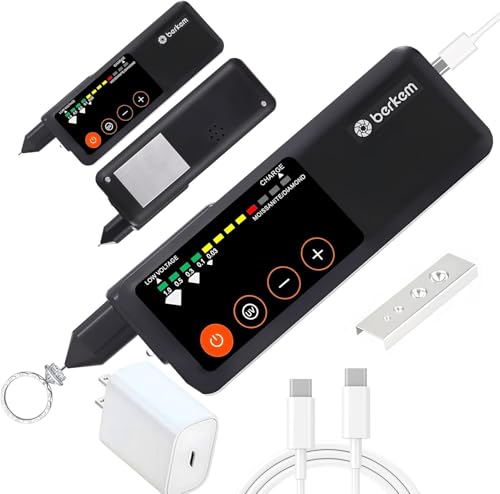
This UVER model strips away the extra scale and focuses purely on a rechargeable diamond tester with a clear LCD screen and 365nm UV light. It’s essentially the same thermal sensor as the kit version above but in a self-contained, USB-rechargeable body. The LCD display shows a numeric scale that corresponds to the strength of the thermal reading — anything over 9 with an audible beep indicates a real diamond. The UV light helps you spot fluorescence, which is especially useful for checking loose stones at estate sales.
The pen is lightweight and compact, fitting easily into a pocket or bag. It comes with a testing platform for loose stones, a USB charging cable, and a power adapter. Users highlight that it accurately distinguishes diamonds from moissanite and sapphires when used correctly. However, the charging process requires 2-3 hours for a full charge, and some units have arrived dead on arrival with no charging indicator light to confirm the process has started.
Several reviews mention that the build quality feels “cheaply made” because of the light plastic construction. The instructions are sparse, and you’ll likely need to watch a YouTube video to understand the proper technique for holding the probe at 90 degrees while touching the conductive panel. For the price, it performs well for most users, but it’s not built for commercial daily abuse.
Why it’s great
- USB rechargeable — no need to buy replacement 9V batteries
- LCD display provides a clear numeric reading of thermal conductivity
- UV light adds a helpful secondary verification method
Good to know
- Plastic build feels light and may not withstand heavy daily use
- Some units have failed to charge or turn on initially
- Instructions are minimal — need to learn technique online
5. Valkynos Professional Diamond Tester Pen

The Valkynos Professional pen is a solid mid-range contender that delivers fast 0.5-second detection with both a thermal sensor and a 365nm UV light. It’s powered by a single 9V battery (included) and arrives in a compact, portable size with a protective leather pouch. The operating principle is the same as others: hold the conductive panel on top with bare skin, touch the probe tip to the stone at a 90-degree angle, and wait for the red LED and audible beep if it’s a real diamond.
One of the key advantages here is the consistency users report. Multiple verified reviews mention the tester has been reliable for months of regular use. It works well on stones as small as 0.02 carats, which covers most melee diamonds you’ll encounter. The UV light is effective at revealing fluorescence, giving you an extra data point before making a purchase decision. The included battery is a standard 9V zinc-carbon type, which you can easily replace with an alkaline version for longer life.
The main drawbacks are the lack of a rechargeable option (it’s strictly battery-only) and the fact that it does not detect lab-created diamonds any differently than natural ones (again, this is a thermal conductivity limitation). The instructions recommend a room temperature of 10-35°C for best results. For the price, it’s a well-balanced tool that won’t break the bank and performs admirably for both novices and experts.
Why it’s great
- Fast 0.5-second thermal sensor response time
- Consistent performance reported over months of use
- Compact, portable design with protective pouch included
Good to know
- Uses disposable 9V batteries only, not rechargeable
- Cannot differentiate natural from lab-grown diamonds
- Requires bare-hand contact with conductive panel for circuit completion
6. GTE Purity Testing Kit

The GTE Purity Testing Kit is not just a diamond tester — it’s a complete jewelry appraisal station. The package includes a digital electronic diamond tester, a GTE 3×6 inch jewelry touchstone, acid solutions for gold/silver/platinum testing, a triplet magnifier (loupe), and an acid neutralizer. This is the kit to buy if you’re evaluating the metal content alongside the stone, which is essential for estate buyers and pawnbrokers who need to know both the karat and the diamond authenticity.
The diamond tester itself is a standard thermal conductivity pen that works reliably for distinguishing real diamonds from cubic zirconia. It’s not the fastest or the most feature-rich thermal pen on this list, but it gets the job done for the vast majority of stones you’ll encounter. Users report that the acid solutions are effective and clearly labeled, and the touchstone allows for safe metal testing without damaging the item’s visible surface.
The biggest criticism is that the included “testing stone” is actually glass, not a real stone, so it scratches easily and doesn’t perform well for streak testing. A separate SE brand real stone tester under is a common recommendation to replace it. The kit also comes in a plastic bag rather than a carrying case, and some users found the small gram scale missing from their delivery. Still, for the breadth of what you get in one box, it’s a fantastic value for anyone getting started in jewelry identification.
Why it’s great
- All-in-one kit: diamond tester, acid solutions, touchstone, and loupe
- Acid testing determines gold/silver/platinum karat value
- Great starter bundle for estate sale and thrift store buyers
Good to know
- Included testing stone is glass, not real stone — scratches easily
- Comes in a plastic bag, not a sturdy carrying case
- Small gram scale sometimes missing from shipment
7. Hqdz Diamond Tester Pen (Rechargeable)

The Hqdz tester is the entry-level option that makes diamond verification accessible without a big upfront cost. It’s a rechargeable pen with a USB-C cable, a built-in UV light, and an LCD display with a 9-level LED scale that lights up and beeps when it detects a real diamond. For the price, you get a functional thermal conductivity sensor that can handle most stones above 0.5 carats with proper calibration. It even includes a small testing platform for loose stones.
Operation is straightforward: turn it on, wait about a minute for the warm-up cycle (the LEDs will blink from 4 green down to 1), and then touch the probe tip to the stone while holding the conductive panel on the pen. The main catch is that you must calibrate the sensitivity based on the stone size — 1 green light for stones over 1.0 carat, 2 green lights for 0.5 carat, and 3-4 for smaller gems. Failure to do this correctly will give you wrong results. The UV light is a nice bonus but some units have had spotty performance.
Unfortunately, this is the most inconsistent tester on the list. Some users report it works great for months, while others claim it’s “very inaccurate” and “died within a few months.” The build quality is adequate for occasional use at home, but not for daily professional work. If you’re on a tight budget and only need to verify the occasional thrift store find, it can work — but be ready for potential reliability issues and consider this a disposable tool.
Why it’s great
- Rechargeable via USB-C, no need for disposable batteries
- Includes UV light for fluorescence checking
- Very affordable price point for entry-level buyers
Good to know
- Accuracy is inconsistent — some units give false results
- Build quality is low; may stop working within months
- Requires careful stone-size calibration to avoid errors
FAQ
Can a thermal diamond tester tell the difference between a natural diamond and a lab-grown CVD or HPHT diamond?
Why does my diamond tester beep on metal, and how do I avoid this?
How do I calibrate my diamond tester for different carat weights?
Final Thoughts: The Verdict
For most users, the cvd hpht diamond tester winner is the Gain Express JEM-II because it offers professional-grade reliability, a built-in UV light, and a decades-long track record in the jewelry industry at a mid-range price. If you want a complete appraisal kit with acid solutions and a scale, grab the GTE Purity Testing Kit. And for the best value in a single tool that includes a UV light and a pocket scale, nothing beats the UVER Diamond Tester Kit.

Mo Maruf
I created WellFizz to bridge the gap between vague wellness advice and actionable solutions. My mission is simple: to decode the research and give you practical tools you can actually use.
Beyond the data, I am a passionate traveler. I believe that stepping away from the screen to explore new environments is essential for mental clarity and physical vitality.