Our readers keep the lights on and my smoothie glass nicely filled. As an Amazon Associate, I earn from qualifying purchases.
Aluminum is soft, sticky, and thermally conductive—three properties that make it a nightmare to cut, tap, or drill without the right lubricant. Use the wrong cutting oil and you will fight built-up edge, torn threads, and a dulled tool in under five passes.
I’m Mohammad Maruf — the founder and writer behind WellFizz. I have spent hundreds of hours analyzing chemical blends, customer reports, and machinist forum data to separate the fluids that actually break the boundary layer on aluminum from those that just smell like a garage.
This guide focuses exclusively on lubricants formulated for nonferrous metals and aluminum alloys. If you want clean holes, mirror-like surface finishes, and taps that survive more than one project, you need to read this review of the best cutting oil for aluminum on the market right now.
How To Choose The Best Cutting Oil For Aluminum
Aluminum is a gummy metal. Unlike steel, where chips break cleanly, aluminum forms a continuous chip that welds itself to the cutting edge if the lubricant fails to create a pressure-resistant boundary layer. You need a fluid that both cools the cut zone and chemically bonds to the aluminum surface to reduce friction below the seizure point.
Chemical Composition and Aluminum-Specific Additives
Standard petroleum-based cutting oils rely on sulfur or chlorine extreme-pressure (EP) additives. These work on steel, but they can stain or corrode aluminum. The best fluids for aluminum use methyl laurate, vegetable esters, or chlorinated paraffins in a low-viscosity carrier that penetrates the tool-workpiece interface instantly.
Viscosity and Flash Point
Thin enough to wick into a tight tap flute, but thick enough to stay on a vertical surface — that is the ideal viscosity range for aluminum cutting fluid. A viscosity grade around SAE 0W to 10W is typical. Flash point above 150°C ensures the fluid won’t vaporize or smoke during high-speed CNC operations.
Application Method and Bottle Design
For hand tapping and drilling, precision tip squeeze bottles give you drop-by-drop control without waste. For horizontal milling or bandsaw work, a flood system or brush application is better. Look for a container that matches your workflow — a pint-sized can with a flip spout is hobbyist-friendly, while a 16-ounce squeeze bottle suits field use.
Quick Comparison
On smaller screens, swipe sideways to see the full table.
| Model | Category | Best For | Key Spec | Amazon |
|---|---|---|---|---|
| Relton A9 | Aluminum-Specific | Precision tapping & threading | SAE 0W viscosity, 473 ml pint | Amazon |
| Tap Magic 20016A | Aluminum-Specific | General drilling & lathe work | Petroleum/vegetable blend, 16 oz | Amazon |
| Tap Magic EP-Xtra | All-Metal Premium | Multi-metal shop use | SAE 30 viscosity, 16 oz | Amazon |
| Forney 20858 | Multi-Purpose Pro | Bandsaw & heavy threading | Flash point 300°C, 16 oz | Amazon |
| Relton Rapid Tap | Entry-Level | Light duty drilling & threading | Anti-mist formula, 16 oz | Amazon |
In‑Depth Reviews
1. Relton A9 Aluminum-Cutting Tapping Fluid (Pint)

The Relton A9 is engineered specifically for aluminum — not steel, not brass, not a universal blend that compromises on everything. Its SAE 0W viscosity means it flows into the tightest tap flutes and micro-gaps between drill margins and the workpiece. The chemical package uses polar additives that bond to the aluminum surface, forming a boundary lubricant that stays intact even under high shear.
Machinists report achieving mirror finishes on 6061 aluminum after two hours of continuous milling with no built-up edge on the tool. The anti-mist component keeps vapor down in the shop, and the pint can holds enough fluid to last a serious hobbyist several years of hand tapping and small CNC work. Users consistently note that switching from WD-40 to A9 reduces tapping torque noticeably on the first turn.
The container is a simple metal can with a small spout — functional but not fancy. A precision tip squeeze bottle would make application easier for tight spaces, but the low viscosity pours cleanly. If you work with aluminum every day, this is the fluid to keep on the bench.
Why it’s great
- Ultra-low SAE 0W viscosity penetrates tight threads instantly
- Polar additives bond to aluminum for extreme-pressure protection
- Anti-mist formulation keeps air cleaner in small shops
Good to know
- Metal can spout drips if tilted too fast
- Not formulated for ferrous metals or high-speed steel
2. Tap Magic 20016A Aluminum Fluid with Spout Top
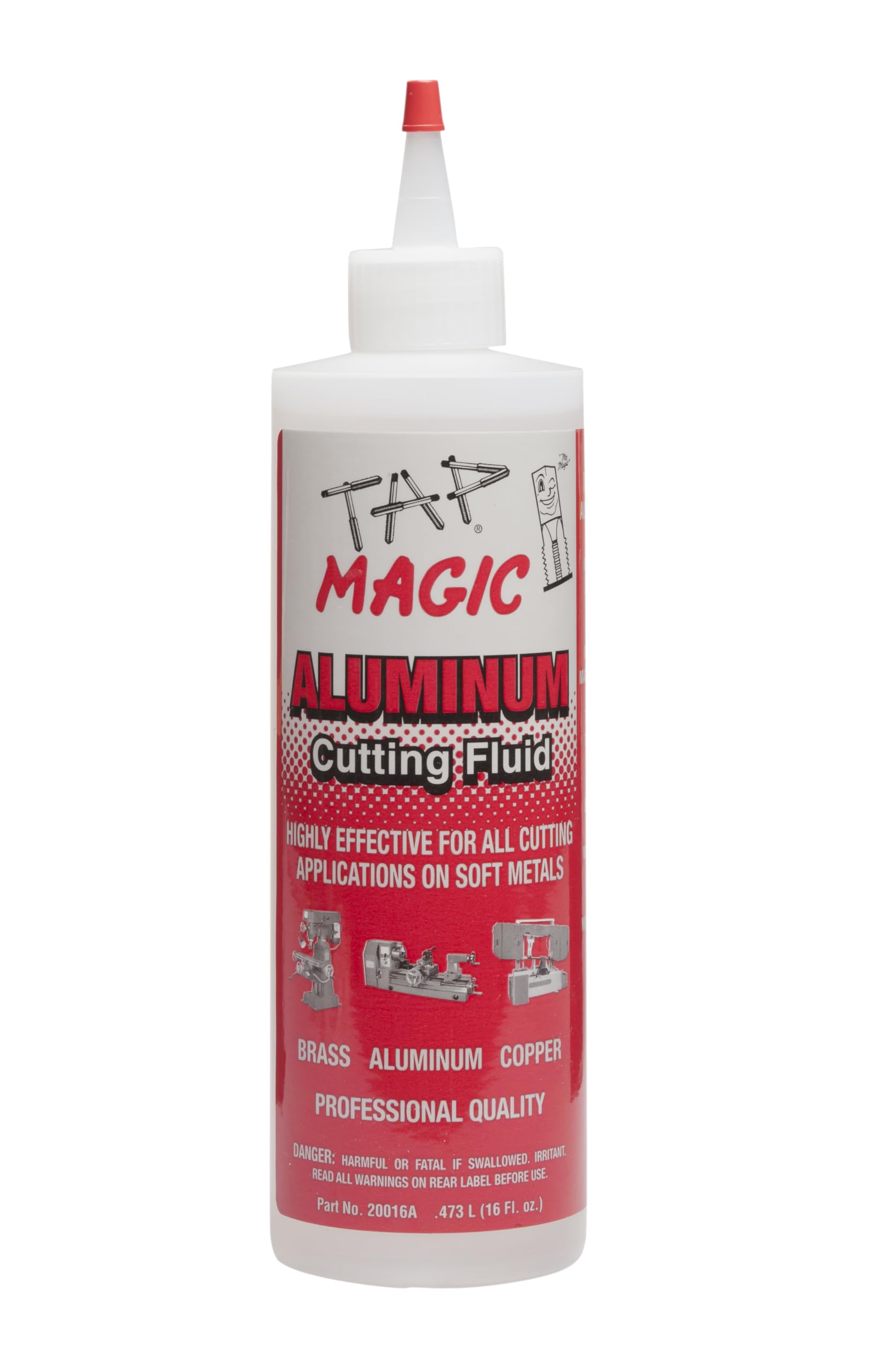
Tap Magic 20016A uses a hybrid base of petroleum distillate, methyl laurate, and vegetable oil — a balanced approach that provides both cooling and boundary-layer lubrication without the strong chemical odor of pure mineral oils. Users consistently describe a “pleasant” smell, which matters in a closed garage or small machine shop where you breathe the mist all day.
The fluid is surprisingly thin — almost like water — which allows it to wick into every crevice during tapping. An 84-year-old long-term user reports eliminating heat buildup and cutting edge buildup on aluminum lathe work, producing a near-shiny finish. It works equally well on magnesium and other nonferrous metals, making it a versatile option if you occasionally switch materials.
The spout-top bottle gives excellent drop control for hand operations. The only trade-off is the thin consistency: it can run off vertical surfaces faster than a higher-viscosity fluid, so you may need to reapply during deep drilling. For tapping holes in extruded aluminum up to moderate depths, this is a near-perfect lubricant.
Why it’s great
- Very low odor compared to sulfur-based cutting oils
- Fine spout top allows precise application on taps and drills
- Eliminates built-up edge on aluminum with consistent use
Good to know
- Thin viscosity may drip off vertical workpieces quickly
- Not ideal for high-speed CNC flood systems due to low viscosity
3. Tap Magic EP-Xtra Improved Cutting Fluid
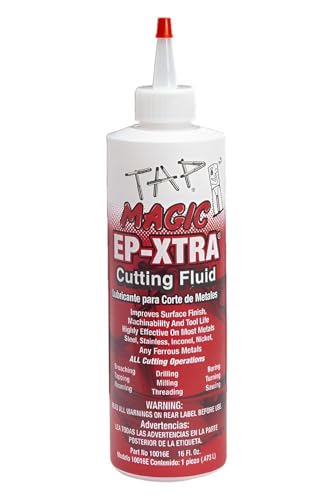
Tap Magic has held a reputation since 1953, and the EP-Xtra formula is the one machinists grab when they work on mixed materials — mild steel, stainless, titanium, cast iron, and aluminum all in the same session. The SAE 30 viscosity is noticeably heavier than aluminum-specific fluids, which helps it cling to drill bits and taps on vertical or overhead work.
On 6061 aluminum, EP-Xtra reduces drilling torque significantly compared to dry cutting, but it does not achieve the same micro-fine finishes as the lower-viscosity, aluminum-dedicated fluids. Users report it works best on medium-thread tapping (#10-32 and larger) where the heavier body prevents the lubricant from being pushed out of the thread zone. For fine threads on stainless or titanium, the same viscosity provides excellent seizure protection.
The 16-ounce squeeze bottle with precision tip allows one-handed application. The flash point of 150°C is acceptable for most manual and low-RPM operations but may smoke under aggressive CNC feeds. If you run a mixed-material shop and want one bottle that covers everything, EP-Xtra is your best bet.
Why it’s great
- SAE 30 viscosity stays on vertical surfaces without running
- Works on all metals from aluminum to Inconel
- Trusted brand with decades of industrial use
Good to know
- Heavy viscosity wicks slowly into small tap flutes
- Not optimized for the highest finish quality on aluminum
4. Forney 20858 Industrial Pro Tap Magic

The Forney 20858 is formulated for heavy-duty operations where heat buildup is the primary enemy. Its flash point of 300°C is double that of standard cutting fluids, meaning it withstands the extreme temperatures generated by bandsaw blades cutting thick aluminum plate or high-speed drilling without flash-off or smoking. This makes it a strong choice for production environments rather than occasional home use.
Users report excellent performance on stainless steel and fine threads (0-90 and metric), which speaks to the lubricity of the base formulation. The fluid contains anti-rust and anti-corrosion additives that protect both the workpiece and the tooling after the job is done — a practical benefit if you leave parts overnight. However, multiple customers note a strong, unpleasant odor reminiscent of fish or feet, which can be off-putting in a small shop.
The 16-ounce bottle has a screw cap rather than a flip spout or precision tip, which means you either pour directly or use a brush. Some users report the cap pops off in a toolbox, causing a messy spill. If you need a high-temperature cutting fluid that stays on vertical surfaces and lasts through heavy cuts, the Forney delivers — just be prepared for the smell.
Why it’s great
- Extremely high 300°C flash point ideal for bandsaw and heavy drilling
- Rust and corrosion protection on tools and workpieces
- One bottle lasts months even with daily use
Good to know
- Strong unpleasant odor limits indoor use
- Bottle cap can pop off in a crowded toolbox
5. Relton Rapid Tap Heavy Duty Cutting Fluid

The Relton Rapid Tap is the most budget-conscious option in this lineup, and it fills a specific niche: light-to-moderate drilling and threading on aluminum where the job volume does not justify a dedicated aluminum formulation. The anti-mist component reduces airborne vapor, and the fluid extends tool life by providing consistent boundary lubrication across multiple operations.
On low-RPM hand tapping of 6061 aluminum, Rapid Tap performs adequately — it reduces friction enough to prevent the tap from seizing, and the chips clear cleanly. Users who drill 80% lowers for AR-15 builds report good results. However, compared to the Relton A9 or Tap Magic 20016A, the finish quality is less consistent, and the fluid does not cling as well to vertical surfaces during milling operations.
The packaging is straightforward: a plain bottle with a simple spout. It will not win any awards for scent or precision application. But if you need a single bottle for occasional aluminum work and do not want to invest in a specialized blend, Rapid Tap gets the job done without drama.
Why it’s great
- Anti-mist formula reduces airborne oil particles
- Works well for light drilling and hand tapping of aluminum
- Tool life extension noticeable on small job volumes
Good to know
- Less effective on deep tapping or vertical milling operations
- Finish quality on aluminum trails dedicated fluids
FAQ
Can I use standard cutting oil on aluminum?
What does SAE 0W mean in a cutting fluid?
How do I apply cutting oil to aluminum for the best finish?
Why does my cutting fluid smell bad?
Final Thoughts: The Verdict
For most users, the best cutting oil for aluminum winner is the Relton A9 because it combines an ultra-low SAE 0W viscosity with aluminum-specific polar additives, delivering the highest-quality mirror finishes and lowest tapping torque in its class. If you want a low-odor, multi-metal fluid for a mixed-material shop, grab the Tap Magic EP-Xtra. And for heavy bandsaw cuts and production environments where heat is the primary concern, nothing beats the Forney 20858 with its 300°C flash point.

Mo Maruf
I created WellFizz to bridge the gap between vague wellness advice and actionable solutions. My mission is simple: to decode the research and give you practical tools you can actually use.
Beyond the data, I am a passionate traveler. I believe that stepping away from the screen to explore new environments is essential for mental clarity and physical vitality.