Our readers keep the lights on and my smoothie glass nicely filled. As an Amazon Associate, I earn from qualifying purchases.
A cutting board that dulls your knives in a week or harbors bacteria in its cracks is not a tool—it’s a liability. The average kitchen sees daily chopping, slicing, and mincing, making the board you choose a direct factor in knife longevity and food safety. The material, size, and maintenance requirements separate a smart investment from a frustrating mistake.
I’m Mohammad Maruf — the founder and writer behind WellFizz. I’ve spent hundreds of hours analyzing production specs, customer durability reports, and material science data to identify which cutting boards deliver on their promises without hidden flaws.
Whether you prioritize dishwasher-safe convenience, eco-friendly materials, or a large work surface for heavy meal prep, this guide breaks down the five best options to help you pick the right cutting boards for kitchen use without guesswork.
How To Choose The Best Cutting Boards For Kitchen
The right board depends on what you cut most, how you clean, and your tolerance for maintenance. Three factors separate a daily workhorse from a shelf-warming regret.
Material Matters: Wood, Bamboo, or Stainless Steel
Wood and bamboo are naturally knife-friendly because their grain fibers close back up after cuts, reducing blade dulling. Bamboo is harder and more water-resistant than many hardwoods, but requires periodic oiling to prevent cracking. Stainless steel offers unmatched sanitation for raw proteins and zero absorption of odors, but the hard surface will accelerate knife edge wear over time. Plastic and composite boards are lightweight and dishwasher-safe, but develop deep grooves that trap bacteria and shed microplastics into food.
Size, Thickness, and Weight Distribution
A board under 0.6 inches thick tends to warp or slide under heavy pressure. Aim for at least 0.75 inches if you chop dense vegetables or large cuts of meat. Larger surface area—14 by 20 inches or more—gives you room to work without crowding ingredients off the edge. Weight is a trade-off: heavier boards stay put but are harder to wash and store; lighter boards are portable but may require a damp towel underneath for stability.
Cleaning Compatibility and Maintenance
Hand-wash-only boards demand more discipline, but they last longer. Dishwasher-safe bamboo boards (specially engineered to resist heat and moisture) eliminate the labor but must still be oiled occasionally to maintain their finish. Disposable plastic sheets solve cross-contamination instantly but contribute to waste and won’t survive heavy knife use. Look for boards with juice grooves if you frequently cut proteins or juicy fruits—they keep countertops dry and reduce cleanup time.
Quick Comparison
On smaller screens, swipe sideways to see the full table.
| Model | Category | Best For | Key Spec | Amazon |
|---|---|---|---|---|
| Keechee Bamboo | Dishwasher-Safe Bamboo | All-around meal prep with easy cleanup | 0.4 inch thickness, 14 x 10.6 inch surface | Amazon |
| Farberware Extra-Large Bamboo | Large Bamboo Board | Heavy chopping and charcuterie serving | 0.75 inch thickness, 14.17 x 20.08 inch area | Amazon |
| AXIOM CREATIONS 2-Piece Wheat Straw | Eco-Friendly Composite | Sustainable knife-friendly daily use | 0.6 inch thickness, 15.8 x 9.5 inch large board | Amazon |
| BILLAMB Stainless Steel | Stainless Steel Board | Sanitary raw meat prep and easy sanitizing | 0.06 inch thickness, 15.7 x 11.8 inch surface | Amazon |
| Crown Display 50 Count Disposable Sheets | Disposable Plastic Sheets | Cross-contamination prevention and on-the-go use | 0.79 inch total pack thickness, 13.51 x 10.01 inch per sheet | Amazon |
In‑Depth Reviews
1. Keechee Dishwasher Safe Bamboo Cutting Board
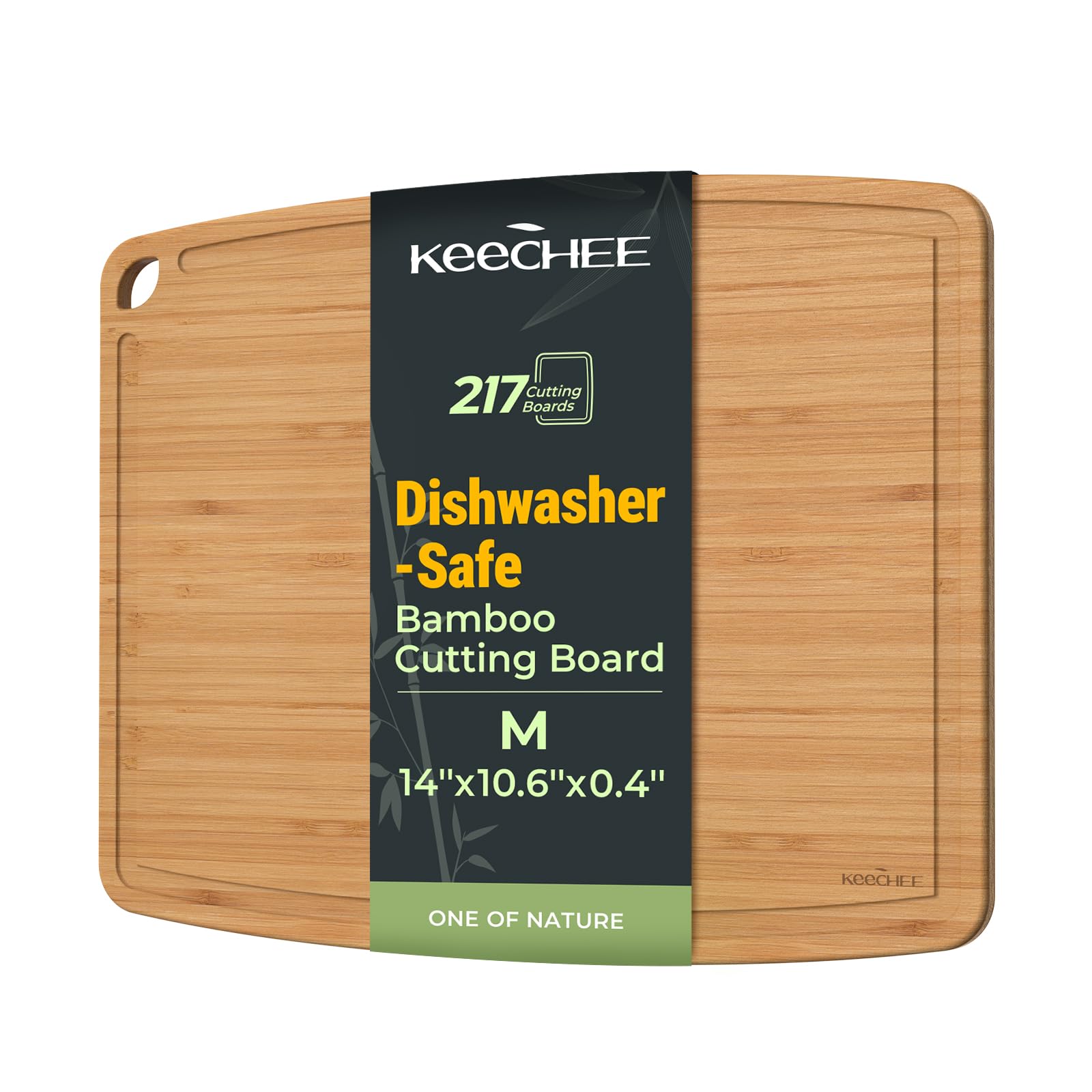
This board solves the classic bamboo frustration: water damage. Specially engineered to withstand heat and moisture without warping or cracking, it passes lab testing for dishwasher durability up to 217 cycles. The carbonized bamboo construction runs 0.4 inches thick—slim enough to store easily but dense enough to resist splintering.
The reversible design gives you a dedicated cutting side and a serving side for cheese or charcuterie. Reviewers consistently note it comes out of the dishwasher looking like new, a rare claim among wooden boards. The lightweight 1.56-pound frame makes it easy to carry from prep station to table or bring along on picnics and RV trips.
On very smooth marble or steel countertops, the board can slide during heavy chopping. Keechee addresses this with an optional non-slip mat, though some users prefer placing a damp towel underneath for immediate stability. Occasional oiling is still recommended to keep the bamboo conditioned over the long term.
Why it’s great
- Engineered to survive dishwasher heat without warping
- Dual-sided design cuts prep and serving in one board
- Light enough for camping or counter-to-table use
Good to know
- Can slide on polished surfaces without a non-slip pad underneath
- Shows standard knife marks after repeated use
2. Farberware Extra-Large Wood Cutting Board
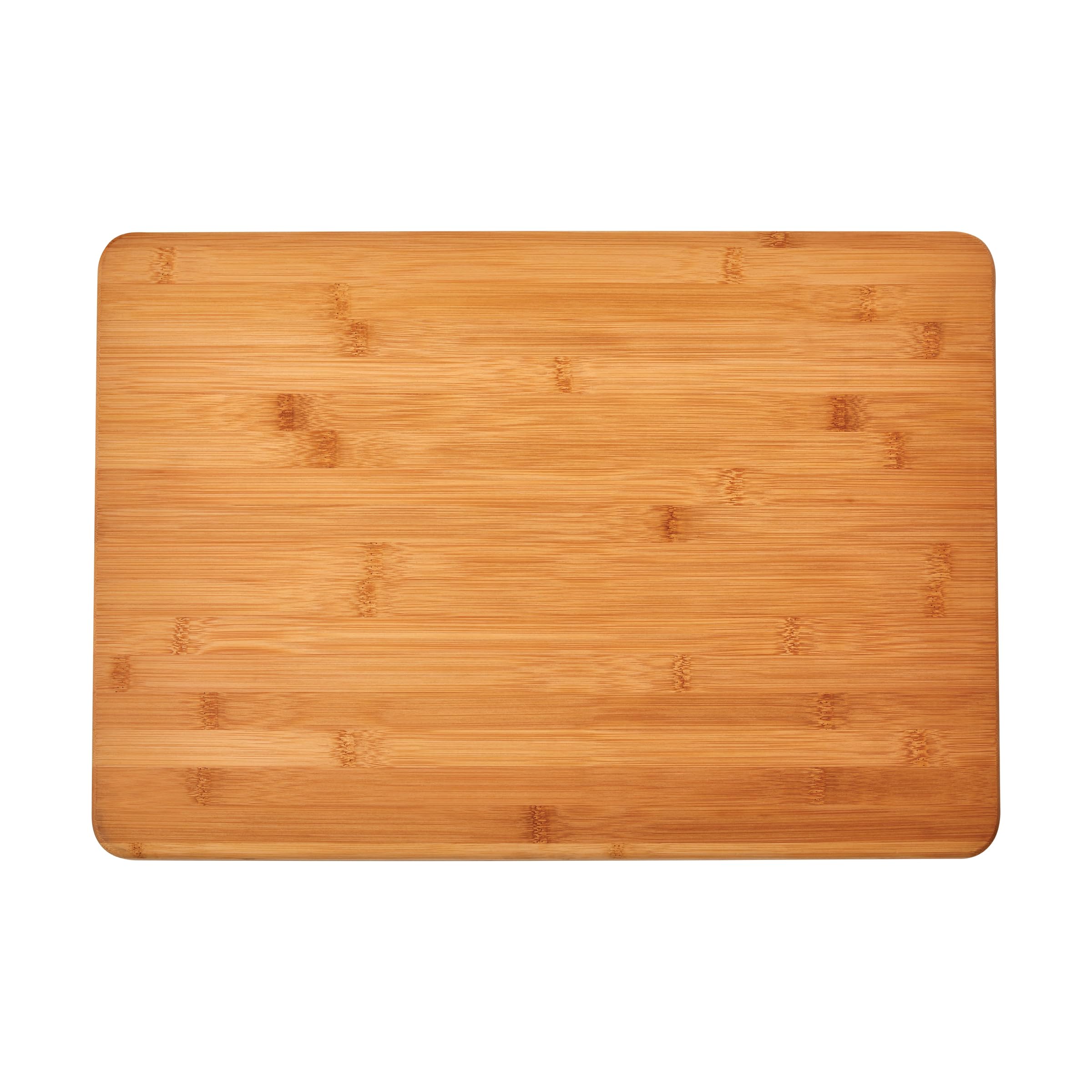
When you need a massive work surface for big meal prep—whole vegetables, multiple protein portions, or dough rolling—this board delivers. At 14.17 by 20.08 inches with a full 0.75-inch thickness, it provides a stable platform that won’t flex under heavy knife pressure. The bamboo material is harder than typical hardwoods, offering natural resistance to moisture absorption while staying gentle on blade edges.
It doubles as a charcuterie board for entertaining, which extends its utility beyond chopping. The reversible surface means you can use one side for raw ingredients and the other for serving without cross-contamination. Reviewers emphasize its sturdy build, lack of warping over time, and the fact that it requires only hand washing and periodic oiling to maintain its appearance.
This board does not include rubber feet or a juice groove, which can be a drawback for very wet prep. The heavy 4.8-pound weight keeps it planted but makes it less convenient to carry or store upright. Some owners note that bamboo can stain if not oiled regularly, especially after cutting beets or berries.
Why it’s great
- Extra-large surface handles whole ingredients without crowding
- Reversible and thick enough for heavy-duty chopping tasks
- Doubles as an attractive serving board for appetizers
Good to know
- Lacks rubber feet—slides on smooth countertops
- No juice groove to catch liquid runoff
3. AXIOM CREATIONS 2-Piece Reversible Cutting Board Set

This set replaces conventional plastic with a composite of wheat straw fiber and food-grade polypropylene, reducing your kitchen’s plastic footprint. The material is noticeably softer than standard plastic boards, which is precisely what makes it gentle on knife edges—cuts leave surface marks but the blades stay sharper longer. Two sizes (9.5 x 15.8 inches and 7.8 x 12.5 inches) cover both large prep and small quick tasks.
Anti-slip pads keep the boards stable during use, and juice grooves on both sizes contain liquid spills effectively. The reversible design and integrated cutout handles make them easy to grab and flip. Reviewers highlight the dishwasher-safe construction, the absence of microplastic shedding, and how well the boards hold up after repeated washes without warping.
Because the wheat straw composite is softer than traditional plastic, deep scratches and cut marks are more visible over time. Some users note that the boards are thinner than they expected, which can feel less substantial under heavy knives. Compact storage is a benefit, but the boards may flex slightly during aggressive chopping.
Why it’s great
- Eco-friendly wheat straw composite reduces plastic use significantly
- Knife-friendly surface helps maintain blade sharpness longer
- Dishwasher-safe with anti-slip pads and juice grooves
Good to know
- Soft material shows visible cut marks more quickly than harder boards
- Thinner build may flex under heavy chopping pressure
4. BILLAMB Stainless Steel Cutting Board

Stainless steel offers the most hygienic surface for raw meat, fish, and poultry because it won’t absorb juices or develop bacteria-harboring grooves. This board uses 0.06-inch thick stainless steel with a smooth, non-porous finish that rinses clean in seconds and withstands dishwasher sanitization cycles. Two attached silicone pads at the base prevent sliding on countertops, addressing the slippage complaint common to metal boards.
The 15.7 by 11.8 inch surface provides ample room for single-protein prep, and the lightweight 2.09-pound frame is easy to grab, wash, and store. Reviewers consistently praise its odorless nature—no garlic or onion smells linger after washing—and its space-saving profile that hooks onto counter edges for vertical storage. Many users switched to this board specifically to eliminate the sanitation concerns of wood and plastic.
Cutting on stainless steel is noticeably louder than on wood or composite surfaces, which can be jarring in a quiet kitchen. The hardness of the metal will also accelerate knife blade dulling over time, making this a poor choice for cooks who value edge retention above all. Some users find the edges sharp enough to require caution during handling, though most report the edges are safe as designed.
Why it’s great
- Non-porous surface eliminates bacterial absorption and odors
- Dishwasher-safe and rinses completely clean in seconds
- Non-slip silicone pads keep the board stable during prep
Good to know
- Cutting produces a loud metallic sound compared to wood boards
- Hard metal surface dulls knives faster than wood or composite
5. Crown Display 50 Count Premium Quality Disposable Cutting Sheets

When cross-contamination is your primary concern—handling raw chicken, fish, or meat in a shared kitchen—disposable sheets offer a simple zero-cleanup solution. Each sheet measures 13.5 by 10 inches and is made from a premium recyclable plastic that is flexible enough to fold for ingredient transfer yet sturdy enough to withstand moderate cutting without tearing. The patent-pending design allows both single use and gentle reuse for light tasks.
Reviewers report that individual sheets resist cut-through surprisingly well, with some lasting three months of daily use before the first full puncture. The opaque white color makes the sheets easy to spot on busy countertops, and the smooth surface cleans up quickly if you choose to reuse them for vegetables only. They are great for camping, travel, or any situation where washing a full-size board is impractical.
The sheets are thin—about 0.013 inches according to customer measurements—and can slide on smooth counters during cutting. They are marketed as recyclable, but some users found no recycle mark, so disposal waste is a real trade-off. Heavy chopping with a large chef’s knife will eventually cut through the plastic, potentially leaving tiny particles in your food.
Why it’s great
- Eliminates cross-contamination risk entirely after each use
- Flexible enough to fold and transfer ingredients to a pan
- Great for travel, camping, or kitchens with limited cleaning access
Good to know
- Thin sheets can slide without a stable base underneath
- Single-use model generates plastic waste over time
FAQ
Can I put a bamboo cutting board in the dishwasher?
Is stainless steel bad for my knives?
How often should I oil a wood or bamboo cutting board?
Are disposable cutting sheets safe for raw meat?
Final Thoughts: The Verdict
For most users, the cutting boards for kitchen winner is the Keechee Dishwasher Safe Bamboo Board because it delivers the convenience of machine cleaning without the warping and cracking that plagues standard bamboo boards. If you need a massive work surface for heavy prep and entertaining, grab the Farberware Extra-Large Bamboo Board. And for raw meat sanitation where cleanup speed matters most, nothing beats the BILLAMB Stainless Steel Board or the Crown Display Disposable Sheets.

Mo Maruf
I created WellFizz to bridge the gap between vague wellness advice and actionable solutions. My mission is simple: to decode the research and give you practical tools you can actually use.
Beyond the data, I am a passionate traveler. I believe that stepping away from the screen to explore new environments is essential for mental clarity and physical vitality.