Our readers keep the lights on and my smoothie glass nicely filled. As an Amazon Associate, I earn from qualifying purchases.
Thin abrasive wheels that disintegrate mid-cut or vanish after a single pass are the real bottleneck in metal fabrication. The right cut off wheel for an angle grinder transforms a grinder from a crude notching tool into a precision slitting machine that chews through rebar, channel iron, and stainless tubing without choke.
I’m Mohammad Maruf — the founder and writer behind WellFizz. I’ve spent hundreds of hours analyzing wheel geometries, bond compositions, and diamond-embedment processes to isolate which discs actually survive side-loading and deliver straight kerfs through repeated abuse.
Welding and metal-shop budgets suffer most from consumable waste — the best cut off wheels for angle grinder marry thin-kerf efficiency with enough structural fiber to resist shattering under torque.
How To Choose The Best Cut Off Wheels For Angle Grinder
A wheel that loads up with aluminum, explodes on side pressure, or vaporizes after three bolts costs far more than its sticker suggests. Matching the bond and geometry to your material makes the difference between a surgical cut and a shower of sparks with no progress.
Bond Material: Bonded Abrasive vs. Diamond Electroplate
Bonded aluminum oxide wheels shed dull grains to expose fresh cutting edges — ideal for carbon steel and general fabrication. Diamond-rimmed wheels use a steel core with electroplated diamonds that last dozens of times longer but require steady pressure and work best on harder alloys, tile, and concrete where bonded wheels glaze.
Wheel Thickness and Kerf Width
.040-inch ultra-thin wheels cut fast with less material waste and generate less heat, but they flex under aggressive side loads. .045-inch and .050-inch wheels add stiffness for plunge cuts and are more forgiving on uneven material surfaces. Thinner wheels favor speed; thicker wheels favor durability.
Type 1 Flat vs. Type 27 Depressed Center
Type 1 flat wheels sit flush against the guard and excel at straight slotting and chop-saw use. Type 27 depressed center wheels let the grinder nut sit recessed, allowing the wheel to reach into tight corners and flush-cut against a surface without the guard body interfering.
Quick Comparison
On smaller screens, swipe sideways to see the full table.
| Model | Category | Best For | Key Spec | Amazon |
|---|---|---|---|---|
| FOXBC 4-1/2 Inch Diamond Disc | Diamond Multi-Material | Multi-material with minimal dust | 0.04 in thickness, diamond grit | Amazon |
| WildBossy Diamond Metal Wheel | Diamond Metal | Rebar, steel, INOX precision | .068 in segment thickness | Amazon |
| Benchmark Abrasives Type 1 AO | Aluminum Oxide Bonded | General metal fabrication volume | .040 in, 25-pack, 13300 RPM | Amazon |
| BHA Depressed Center AO | Type 27 Bonded | Flush cutting and angle access | .045 in, 25-pack, depressed center | Amazon |
| Lincoln Abrasives Value Pack | Bulk Aluminum Oxide | High-volume disposable cutting | .040 in, 100-pack, EN 12413 cert | Amazon |
In‑Depth Reviews
1. FOXBC 4-1/2 Inch Indestructible Multi-Material Cut Off Disc
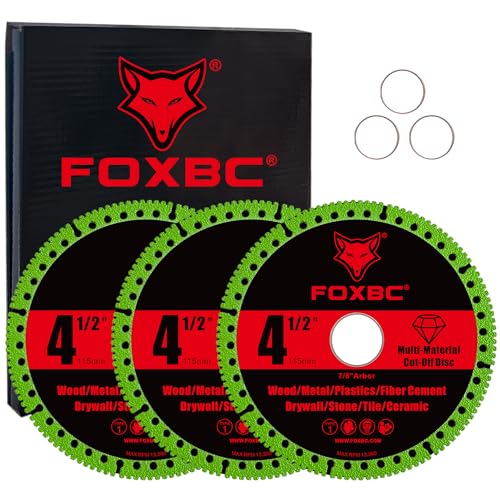
The steel core diamond rim delivers a completely different cutting experience from bonded abrasives. Users report cutting through cast iron hydraulic motor components without any wheel breakage — the solid body resists shattering on drop and handles side load that would explode a fiber wheel.
The open slot design actively reduces noise and dust while letting the wheel run cooler during continuous cuts on metal, concrete, and tile. Diamond electroplating provides consistent grit exposure through the life of the disc, so the cut quality does not degrade as the wheel wears down.
At 0.04 inches thick, this wheel produces a narrow kerf that minimizes material loss. Multiple reviewers confirm aggressive cuts on aluminum — especially when paired with a light wax lubricant — and the three-pack provides enough life to replace dozens of traditional abrasive discs.
Why it’s great
- Diamond grit lasts 50-100x longer than standard bonded wheels
- Steel core eliminates shattering hazard during side loading
- Open slot design cuts dust, noise, and heat buildup
Good to know
- Slow feed rate required on hard metals — forcing causes glazing
- Three-pack may feel expensive upfront despite long-term savings
2. WildBossy Diamond Cutting Wheel 4-1/2 Inch

The new brazing process on this wheel bonds diamond segments to a high-manganese steel substrate, creating a cutting edge that stays sharp through hundreds of passes on rebar, iron, and stainless. Users noted straight, chip-free cuts on iron stair spindles with no gradual diameter loss — unlike fiber wheels that shrink as they wear.
Segment thickness sits at .068 inches, notably thicker than the .040 ultra-thin category, which gives this wheel excellent resistance to flex during deep plunge cuts. The 7/8-inch arbor includes reducer washers for 5/8 and 4/5 spindles, covering nearly every standard angle grinder on the market.
Multiple reviewers switched from bonded fiber wheels specifically because this disc eliminates flying fragments and maintains a consistent cutting path. Body panel cuts came out straight and clean without the snagging and grabbing common with coarse-grit abrasives.
Why it’s great
- Brazed diamond segments resist wear on hardened steel and INOX
- Thicker segment profile reduces wheel flex during deep cuts
- Consistent diameter throughout life — no shrinking kerf
Good to know
- Not ideal for thin sheet metal — prefers heavier stock
- Some users felt it could not match Diablo speed out of the box
3. Benchmark Abrasives Grinder Cut Off Wheels 4 1/2 Inch

This 25-pack of Type 1 flat wheels delivers what a professional welder or fabricator needs — consistent cuts at a per-disc cost far below big-box store singles. The aluminum oxide grain structure is engineered for fast burr-free cuts on steel, stainless, aluminum, and copper with a reinforced fiberglass mesh binding that prevents explosive failure.
At .040 inches thick and rated to 13,300 RPM, these wheels balance a thin kerf with enough structural integrity for daily abuse. Professional reviewers who burn through four to five budget wheels per shift report getting equivalent life from a single Benchmark disc without the shrapnel hazard.
The flat Type 1 profile works seamlessly in chop saws, die grinders, and angle grinders from every major brand. Multiple long-term users specifically praised the absence of catastrophic blow-ups — when these wheels do fail, they crack rather than fragment into dangerous projectiles.
Why it’s great
- Per-wheel cost crushes big-box retail pricing on name brands
- Fiberglass reinforcement prevents explosive shattering
- Thin kerf reduces material waste and motor strain
Good to know
- Type 1 flat design limits flush-cutting capability
- Wears faster than diamond wheels on hardened steel
4. BHA Metal and Stainless Steel Depressed Center Cut Off Wheels

The depressed center (Type 27) geometry is the defining advantage here — the recessed hub allows the wheel to cut flush against a surface while the grinder guard and body sit back. This matters when cutting off bolts, trimming fence posts at ground level, or making coping cuts on handrails where a flat wheel cannot reach.
BHA uses a proprietary aluminum oxide grain that delivers aggressive cutting action through the full .045-inch thickness. Multiple reviewers noted that these wheels last noticeably longer than premium-brand singles costing per wheel, and the 25-pack keeps the shop stocked for weeks of heavy use.
Users specifically highlighted straight cuts on 1/4-inch channel iron and steel fence posts with no wobble. The .045 profile adds stiffness over ultra-thin wheels, making this set a strong choice for less experienced operators who may apply uneven side pressure during a cut.
Why it’s great
- Depressed center enables flush cutting against workpieces
- .045 thickness resists flex better than .040 wheels
- Consistent straight kerfs on structural steel up to 1/4 inch
Good to know
- Type 27 profile requires flanged nut to seat properly
- Slightly thicker kerf generates more material waste than ultra-thin discs
5. Lincoln Abrasives 100 Pack 4.5 Inch Cut-Off Wheels

One hundred wheels in a single box means you stop counting per-disc cost and start cutting without hesitation. Lincoln Abrasives has engineered these Type 1 flat wheels with aluminum oxide grain and fiberglass reinforcement, meeting both MPA-Hannover and EN 12413 certification standards for safety and performance.
The .040-inch thickness delivers fast cuts on carbon steel, stainless, aluminum, and copper. Users report that these wheels run best when the grinder weight alone provides the feed pressure — forcing the cut accelerates wear and can induce cracking in the thinner profile.
Some users noted that initial cuts on heavy 5/16-inch plate required a break-in period of three to four cuts before the wheel reached full aggression. After break-in, the discs cut cleanly and consistently without the blow-up failures that plague lower-end bulk packs. The 100-pack comes organized as four 25-packs, making shop distribution simple.
Why it’s great
- 100-pack bulk format eliminates per-disc anxiety in high-volume shops
- EN 12413 certification confirms safety and quality standards
- Fast cutting action once wheel breaks in after initial cuts
Good to know
- Thin .040 profile cracks under aggressive side loading
- Break-in period needed on thick plate before optimal performance
FAQ
What thickness cut off wheel should I use for general metal fabrication?
Can I use a diamond cut off wheel on aluminum without loading the rim?
What is the difference between Type 1 and Type 27 cut off wheels for angle grinders?
Final Thoughts: The Verdict
For most users, the best cut off wheels for angle grinder winner is the FOXBC 4-1/2 Inch Diamond Disc because its steel-core diamond rim eliminates shattering risk and outlasts dozens of bonded wheels on mixed materials. If you want precision cuts on rebar and INOX with a consistent diameter, grab the WildBossy Diamond Wheel. And for high-volume metal fabrication where per-disc cost matters most, nothing beats the Benchmark Abrasives 25-Pack.

Mo Maruf
I created WellFizz to bridge the gap between vague wellness advice and actionable solutions. My mission is simple: to decode the research and give you practical tools you can actually use.
Beyond the data, I am a passionate traveler. I believe that stepping away from the screen to explore new environments is essential for mental clarity and physical vitality.