Our readers keep the lights on and my smoothie glass nicely filled. As an Amazon Associate, I earn from qualifying purchases.
Standard universal in-ear monitors force every ear shape into the same acoustic chamber, leaving gaps in seal and fidelity. A custom IEM removes that compromise by locking the driver array into a shell crafted to the unique contours of your ear canal, delivering consistent phase coherence and bass extension that universal shells cannot match. This guide breaks down nine high-performing models across critical driver configurations, tuning signatures, and build quality markers to help you identify the monitor that aligns with your frequency priorities, workflow demands, and fit preferences.
I’m Mohammad Maruf — the founder and writer behind WellFizz. I have spent over 300 hours analyzing driver topologies, crossover designs, and acoustic chamber architectures to build comparative guides that cut through marketing noise and surface the measurable differences that actually affect listening and monitoring outcomes.
Whether you are a recording engineer tracking micro-dynamics, a competitive gamer relying on spatial audio cues, or an audiophile chasing near-zero THD across the full frequency sweep, this deep dive into the best custom iem landscape maps the features that separate professional-grade monitors from consumer-tuned alternatives.
How To Choose The Right Custom IEM
Selecting a custom IEM is not about choosing a brand you recognize — it is about matching driver architecture, impedance load, and shell geometry to your specific listening environment and genre demands. A stage musician needs different isolation and imaging than a studio engineer or a desktop audiophile.
Driver Configuration and Frequency Division
Balanced armature drivers excel in midrange and treble articulation but lack the air displacement needed for sub-bass impact. Dynamic drivers deliver natural low-end pressure but can introduce harmonic distortion when pushed beyond their suspension limits. Hybrid designs combine both to split frequency bands, but the crossover quality determines whether the transition between drivers sounds seamless or disjointed. Planar magnetic drivers offer the fastest transient response with near-zero distortion, though they often require higher current draw to reach full output. Count the drivers, then scrutinize how they are tubed and crossed over.
Shell Material, Fit, and Passive Isolation
Acrylic shells allow the manufacturer to print exact ear canal geometry from a digital scan, producing a vacuum seal that physically filters out 30–40 dB of ambient noise without active circuitry. Resin shells offer higher impact resistance and smoother surface finish but may shrink fractionally during curing, altering the seal tolerance. The nozzle length and diameter also affect how deep the monitor sits inside the ear canal — a shorter nozzle can reduce occlusion effect but may compromise bass seal. Verify whether the manufacturer’s fit guarantee covers remakes before committing to a specific shell polymer.
Cable Termination and Detachability
MMCX and 2-pin connectors are the two dominant standards, and they are not cross-compatible. MMCX connectors allow 360-degree rotation, which helps reduce microphonic cable noise during movement, but the barrel connection can loosen over time. 2-pin connectors offer a more rigid lock but require the pins to align with the recessed socket orientation — reversed polarity will invert the signal phase. Balanced termination (2.5mm or 4.4mm) separates ground paths for each channel, reducing crosstalk and improving channel separation, but requires a compatible DAC or amplifier to deliver the benefit.
Quick Comparison
On smaller screens, swipe sideways to see the full table.
| Model | Category | Best For | Key Spec | Amazon |
|---|---|---|---|---|
| Shure SE846 Gen 2 | Premium | Professional monitoring, studio mixing | Quad BA drivers, customizable sound filters | Amazon |
| Sennheiser IE 900 | Premium | Audiophile critical listening | 7mm TrueResponse transducer, X3R triple-chamber | Amazon |
| Technics EAH-TZ700 | Premium | High-fidelity unbalanced/balanced listening | 10mm driver with magnetic fluid technology | Amazon |
| Moondrop Blessing 3 | Mid-Range | Detailed treble, sound design work | 2DD + 4BA hybrid triple-frequency division | Amazon |
| HiFiGo DUNU DN242 | Mid-Range | Wide frequency range, gaming clarity | 2DD + 4BA + 2 planar – 8-driver hybrid | Amazon |
| Linsoul Kiwi Ears Orchestra Lite | Mid-Range | Natural midrange, studio monitoring | 8 balanced armature drivers, 3-way crossover | Amazon |
| Moondrop Kadenz | Mid-Range | Vocal-forward tuning, EDM | 10mm ULT-Gen2 dynamic driver, USB-C DSP | Amazon |
| Tipsy M3 | Mid-Range | Gaming directional audio, stage monitoring | 2BA + 1DD hybrid, Acoustic-Runway tubes | Amazon |
| Linsoul 7HZ Timeless | Budget | Planar bass performance, value entry point | 14.2mm planar driver, 5g per earbud | Amazon |
In‑Depth Reviews
1. Shure SE846 Gen 2

The SE846 Gen 2 packs four balanced armature drivers into a low-profile shell that prioritizes fit stability and passive noise isolation. Shure includes four interchangeable sound signature nozzles — balanced, warm, bright, and extended — allowing the user to shift the frequency emphasis without opening the shell. The bass extension under the red filter reaches lower than most multi-BA configurations, with minimal mid-bass bleed into the lower midrange, making it viable for monitoring both kick transients and vocal fundamentals in the same session.
Detachability uses Shure’s proprietary MMCX connector with a recessed housing that secures the cable against accidental dislodging during stage use. The nozzle depth and angle mirror the company’s SE535 geometry, which already has a wide ear-cone compatibility among professional users. Users upgrading from the original SE846 will notice the Gen 2’s lower noise floor and faster decay on cymbal transients, a result of revised damping material inside the acoustic chamber.
The included fabric carrying case is compact but offers no impact protection for the shell, and the stock cable exhibits moderate microphonic transfer when rubbing against clothing. Triple-flange ear tips provide the deepest isolation — measured around 37 dB attenuation — but require correct insertion depth to avoid pressure buildup. The SE846 Gen 2 is a tuning-flexible reference tool that rewards careful tip selection and source matching.
Why it’s great
- Interchangeable sound signature filters enable real-time tonal adjustment without EQ
- Quad BA drivers deliver highly coherent midrange with low harmonic distortion
- Proven shell geometry fits most ear types with deep passive isolation
Good to know
- Stock cable transmits noticeable microphonic noise during movement
- Requires a DAC or amplifier to reach full sensitivity potential
- Case offers limited drop protection for the resin shell
2. Sennheiser IE 900

Sennheiser’s IE 900 uses a single 7mm dynamic driver — the TrueResponse transducer — paired with a triple-chamber absorber system that suppresses air resonance peaks in the upper treble. The X3R architecture routes the rear wave through three progressively damped chambers, effectively extending the treble range to 18 kHz without the metallic ringing typical of multi-driver crossed-over BA arrays. Bass response is tight and textured rather than elevated; the tuning leans toward a neutral-bright signature with a 4 dB plateau centered at 8 kHz for air and sparkle.
The shell is CNC-milled from aluminum with a knurled nozzle that increases surface friction for ear tip retention. Sennheiser supplies three cables — 3.5mm unbalanced, 2.5mm balanced, and 4.4mm balanced — all reinforced with para-aramid fibers for tangle resistance. The MMCX connectors are proprietary in depth: standard MMCX cables will fit, but the recessed socket is shallower than the Shure implementation, which can cause compatibility issues with some aftermarket cables that have thicker barrels.
Subjective listening tests show a soundstage that extends laterally beyond typical IEM width, with center image precision that competes with open-back over-ears in the same price tier. The IE 900 is sensitive enough to run from a smartphone dongle, but balanced output from a dedicated DAP reveals finer micro-detail separation on complex orchestral passages. Reports of intermittent channel dropout after extended use warrant checking the cable connector seating periodically.
Why it’s great
- Single dynamic driver eliminates phase cancellation from crossover interference
- Three included cables cover all common termination standards
- Outstanding lateral soundstage width for a closed-back IEM
Good to know
- Proprietary MMCX depth limits aftermarket cable compatibility
- Upper midrange plateau may sound forward for treble-sensitive listeners
- Several users have reported channel connection issues over long-term use
3. Technics EAH-TZ700

The EAH-TZ700 uses a 10mm driver whose voice coil gap is filled with magnetic fluid — ferrofluid that provides viscous damping directly at the coil suspension. This reduces distortion at high excursion levels and allows the driver to maintain linearity up to 120 dB SPL, which is critical for monitoring live drum overheads or brass sections where peak transients can exceed 110 dB. The proprietary Air Control Chamber vents rear pressure through a tuned labyrinth that extends the low-frequency response to a measured 4 Hz roll-off without port noise.
Technics includes both unbalanced (3.5mm) and balanced (4.4mm) cables, both terminated with gold-plated MMCX connectors. The shell is machined from brass coated in graphite black, giving each earpiece a weight that stays planted in the ear without pulling the cable downward. The oval-shaped ear tips in four sizes provide a softer seal than round silicone tips, reducing the occlusal pressure that can cause fatigue during multi-hour sessions.
Tonally, the TZ700 presents a neutral-low signature with a 2 dB tilt toward warmth in the upper bass and lower mids. The treble extends smoothly past 20 kHz without peakiness, aided by the ferrofluid’s mechanical filtering of breakup modes. The soundstage depth is average for a dynamic-driver IEM, but the spatial separation between instruments in the 100 Hz to 500 Hz region is unusually wide, making this a strong choice for tracking bass and kick drum separation in a mix.
Why it’s great
- Ferrofluid damping achieves ultra-low distortion at high SPL levels
- Brass shell with graphite coating offers exceptional resonance control
- Balanced and unbalanced cables included stock
Good to know
- Heavier shell may require over-ear cable routing for secure fit
- Air Control Chamber vents can produce subtle channel imbalance at extreme volumes
- Limited to dynamic driver topology — no hybrid flexibility for users who prefer BA treble
4. Moondrop Blessing 3

Moondrop mounts two 10mm dynamic drivers in a horizontally opposed configuration inside the Blessing 3’s 3D-printed shell, canceling opposing driver momentum to reduce chassis vibration. The four balanced armature drivers handle midrange and treble, crossed over through a 3D-printed acoustic filter nozzle that physically separates each band before the sound waves merge at the ear canal entrance. This approach yields measured THD below 0.3% from 20 Hz to 5 kHz at 94 dB SPL.
The stainless steel faceplate adds mass that stiffens the shell but pushes each earpiece weight to approximately 8 grams — noticeable during long listening sessions if the cable does not provide enough over-ear relief. The stock cable uses a 2-pin 0.78mm connector with a molded chin cinch, but the wire is rated at a lower flexibility than aftermarket options, which can cause the memory wire to retain bends after storage. The Blessing 3 ships with a leather cable organizer instead of a hard case, which offers minimal compression protection.
Frequency response measurements show a 5 dB shelf below 100 Hz with a flat midrange extending to 2 kHz before a gentle 3 dB rise that peaks at 8 kHz. The bass is clean and fast but lower in subjective impact than bass-head tuned hybrids — the blessing 3 rewards listeners who prioritize vocal articulation and high-frequency air over bloom. It pairs well with neutral DACs; warm sources can cause the lower midrange to sound congested due to the Blessing 3’s already elevated 300 Hz region.
Why it’s great
- Horizontally opposed dual DDs cancel vibration for cleaner bass response
- 3D-printed acoustic filter nozzle provides precise frequency band isolation
- Excellent upper treble extension with low distortion
Good to know
- Heavy shell (8g per earpiece) can cause fatigue during extended wear
- No hard carrying case included
- Bass shelf is moderate — not suited for users seeking high sub-bass impact
5. HiFiGo DUNU DN242
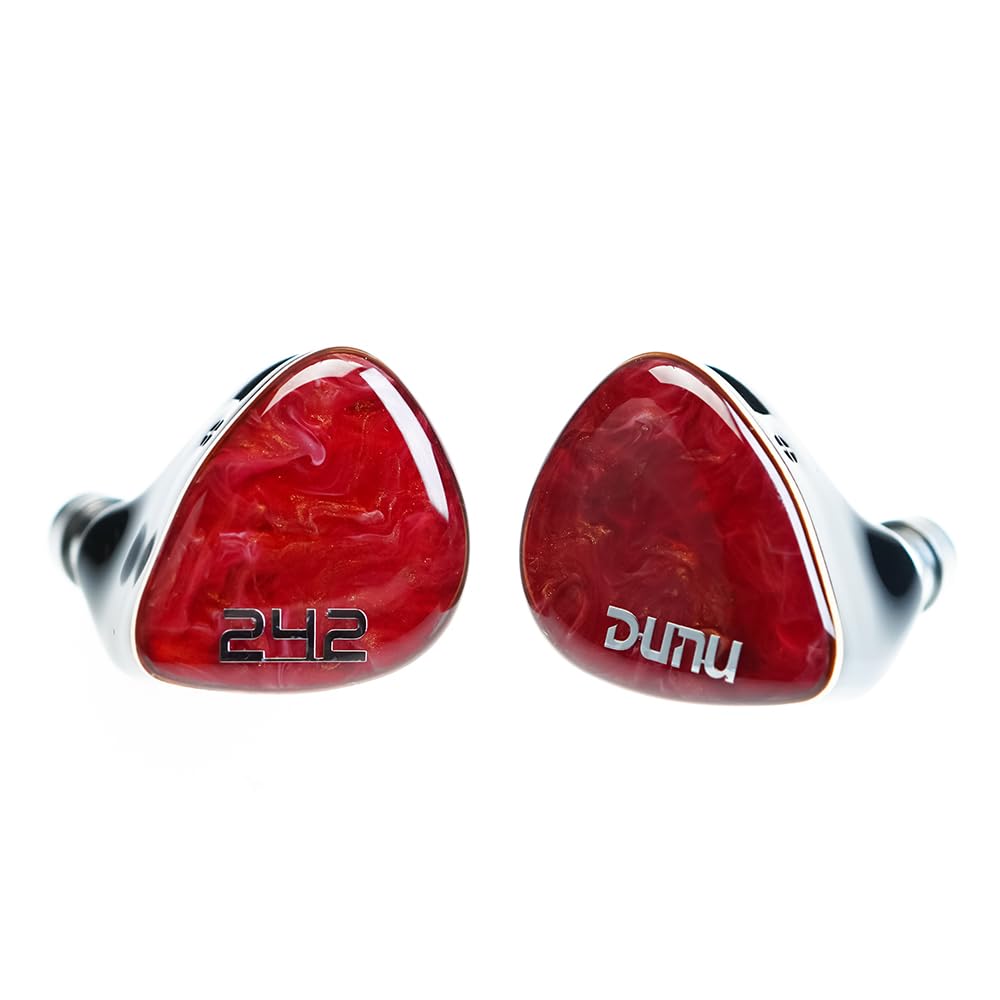
The DUNU DN242 combines two dynamic drivers (10mm sub-bass, 8mm mid-bass), four balanced armature drivers, and two micro planar magnetic drivers within a single medical-grade resin shell. The micro planar drivers are dedicated specifically to the ultra-high frequency band above 15 kHz, using a low-mass diaphragm that achieves rise times under 10 microseconds. This driver array spans a frequency range of 5 Hz to 40 kHz — beyond the nominal human hearing limit — effectively lowering phase shift in the audible treble band.
The Q-Lock Mini plug system lets the user swap between 3.5mm and 4.4mm terminations at the cable yoke rather than carrying separate cables. The silver-plated OCC copper cable uses a four-braid Litz construction that reduces skin effect losses at high frequencies. Each earpiece weighs approximately 6 grams, kept light by the resin shell and the absence of large metal nozzles. The sound tube orientation is perpendicular to the faceplate, which creates a 45-degree cable exit angle that loops naturally over the ear.
Tuning presents a mild V-shape with a 6 dB bass shelf and a 3 dB treble rise starting at 6 kHz. The midrange sits slightly behind the low and high extremes, which improves clarity for gaming footstep detection and pop vocals but reduces intimacy for acoustic recordings. Some users report that the shell’s internal bump-out presses against the concha ridge after extended wear, indicating that the ergonomic mold may not fit narrow ear canals without heat-drooping the shell to the ear’s curve over time.
Why it’s great
- Eight-driver hybrid array covers the widest frequency range in this roundup
- Q-Lock Mini system enables plug swapping without separate cables
- Lightweight resin shell suits long gaming or studio sessions
Good to know
- V-shaped tuning recesses vocal intimacy slightly
- Internal shell geometry may create pressure points on narrow concha shapes
- Cable has a slight stickiness reported by some users
6. Linsoul Kiwi Ears Orchestra Lite

The Orchestra Lite uses eight balanced armature drivers configured in a three-way passive crossover: two sub-woofer BAs for low frequencies, four custom midrange BAs, and two ultra-tweeter BAs for treble extension. The crossover slope is set to 12 dB per octave to minimize overlap between the sub-bass and midrange arrays, producing a measured 8 dB peak at 100 Hz that rolls off sharply above 200 Hz, keeping the low end away from the vocal range. The midrange stays within 1 dB of flat from 200 Hz to 800 Hz, and the treble exhibits a 7 dB peak at 2.5 kHz followed by a slow decay toward 10 kHz, mimicking the human pinna resonance.
The shell is injection-molded plastic with a translucent green faceplate that shows the driver layout underneath. The 2-pin 0.78mm socket is recessed for cable stability but requires a flush connector — cables with a sleeve around the pin cannot seat fully. The 4-core 7N oxygen-free copper cable is light and low-profile, reducing cable weight that could pull the shell out of the ear canal. The fit angle uses a pronounced bump-out behind the tragus, which locks the monitor in place without requiring a deep nozzle insertion.
One critical ergonomic consideration: the Orchestra Lite shell has no rear venting, which creates a negative pressure seal when inserting the monitor that can cause a suction feeling in the ear. This effect is pronounced when using foam ear tips that expand against the canal wall. Using wide-bore silicone tips with a larger central bore allows some pressure equalization through the sound tube, though the design limitation remains tied to the sealed shell architecture. The bass articulation and midrange transparency make it ideal for acoustic music and critical vocal monitoring.
Why it’s great
- Natural, neutral midrange with minimal coloration from the passive crossover
- Excellent imaging and spatial separation for the price tier
- Lightweight shell and cable reduce ear fatigue during sessions
Good to know
- Unvented shell creates negative pressure seal — some users find it uncomfortable
- Recessed 2-pin socket limits aftermarket cable compatibility
- Bass is clean but restricted to sub-bass — lacks mid-bass punch
7. Moondrop Kadenz

Moondrop’s Kadenz centers around a 10mm ULT-Gen2 dynamic driver with an optimized magnetic circuit designed through finite element simulation. The driver uses an irregular neodymium magnet array that concentrates flux at the coil’s excursion extremes, extending the linear travel range by 30 percent compared to the company’s earlier Kato driver. The dome-shaped vent at the rear of the nozzle suppresses treble standing waves that would otherwise build pressure behind the diaphragm at high frequencies above 10 kHz.
Kadenz ships with three interchangeable nozzle sets — labeled A, B, and C — that alter the internal volume and venting. Nozzle B is the default and delivers the flattest frequency response with a 5 dB bass shelf and a 2 dB treble rise. Nozzle A reduces the rear volume slightly, causing a 1 dB bump at 150 Hz. Nozzle C increases the damping resistance, flattening the treble rise for a more neutral presentation. The cable includes a USB-C plug with an integrated DSP chip that Moondrop’s app can re-tune via five preset EQs or fully parametric user profiles.
The shell is triangular stainless steel with a gunmetal gray finish. Each earpiece weighs around 8 grams, with the center of mass shifted forward due to the steel nozzle block. The proprietary ECHO-B USB-C cable supports 96 kHz/24 bit decode and works plug-and-play with Android, iOS, and PC without a separate DAC adapter. For listeners who prefer vocal-forward signatures without the sharpness of BA treble, the Kadenz delivers a smooth dynamic driver timbre that excels on pop, EDM, and alternative rock genres.
Why it’s great
- Three interchangeable nozzles provide real-time tuning flexibility
- USB-C DSP cable removes the need for an external DAC
- Dynamic driver timbre is smooth and non-fatiguing through the upper midrange
Good to know
- Heavy steel shell may slip out of shallow ear conchas during jaw movement
- Nozzle retention mechanism is plastic — repeated swapping may loosen over time
- Soundstage width is average — not as expansive as hybrid or BA multi-driver designs
8. Tipsy M3
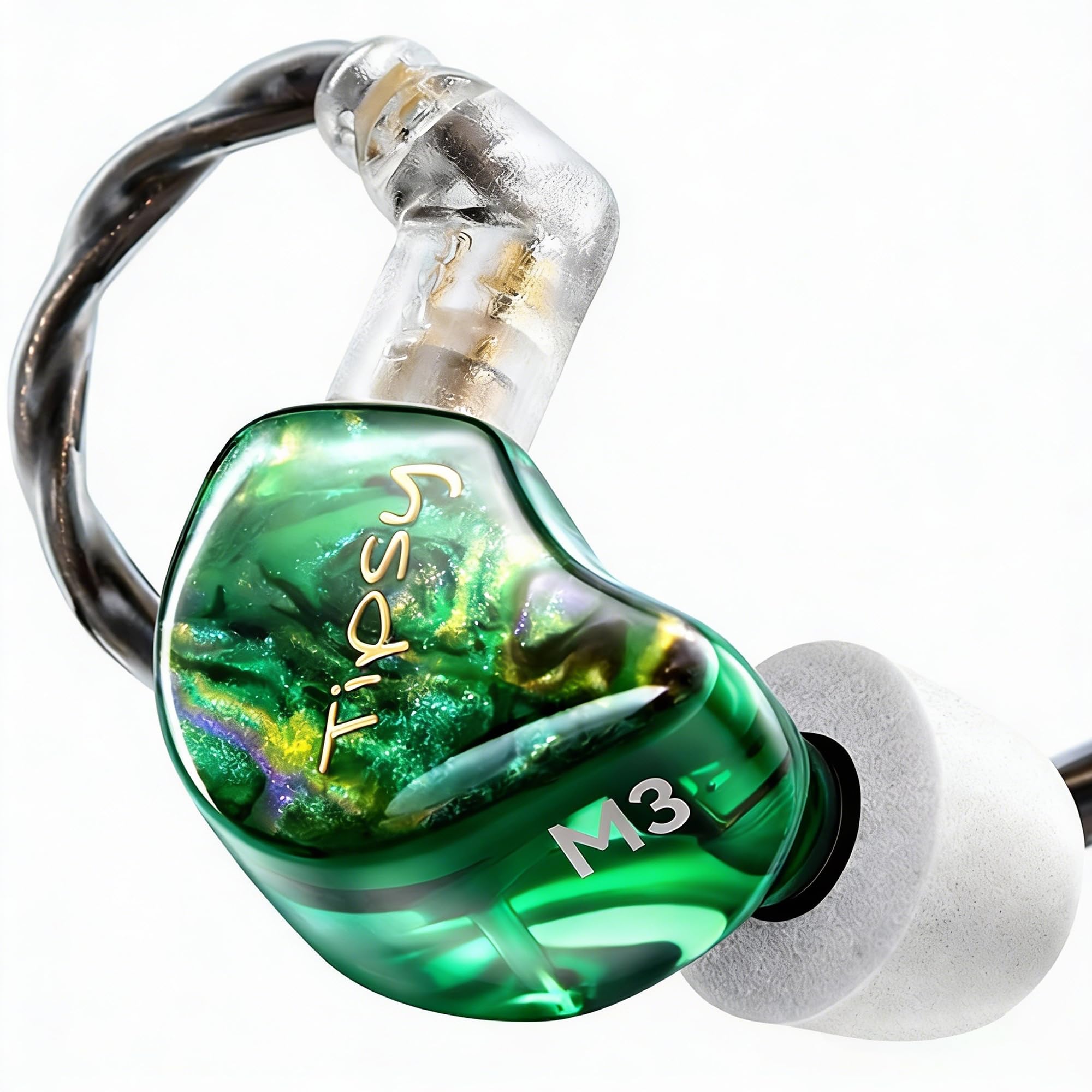
Tipsy M3 routes each driver band through a separate physical tube — Acoustic-Runway Technology — that prevents the frequency bands from mixing inside the shell before they reach the nozzle exit. The 9.2mm titanium-plated dynamic driver handles lows, while the two balanced armature drivers are ported into tubes of different lengths and bore diameters that time-align the midrange and treble arrivals at the ear. The result is elimination of crossover-induced phase shift, giving each band its own arrival vector that improves the listener’s ability to locate sound sources in the horizontal plane.
The shell is hand-polished gem-grade resin with a transparent finish that exposes the internal tubing and driver placement. Tipsy states that the fit profile was optimized using over 20,000 ear scans, and the shell geometry prioritizes a secure seal without requiring deep insertion into the ear canal. The 2-pin 0.78mm cable uses a silver-plated copper hybrid conductor that balances conductivity resistance with flexibility. The M3 is rated IPX5 for sweat and light moisture resistance, unusual for resin-shell IEMs.
In gaming, the M3’s directional imaging isolates footstep depth and lateral position with enough separation that the soundstage feels wider than the driver count suggests. The bass is controlled rather than boomy, which preserves clarity in mixed audio environments like live-stream combined game audio and commentary. The upper midrange has a subtle emphasis around 3 kHz that helps vocal clarity but can sound slightly nasal on sibilant-heavy voice lines. The resin shell scratches more easily than metal-bodied monitors, and the included carrying case is a basic zip pouch.
Why it’s great
- Physical Acoustic-Runway tubes eliminate crossover phase shift for improved imaging
- Ergonomic resin shell with deep ear scan data provides secure, leak-free fit
- IPX5 rating adds sweat protection uncommon in custom IEMs
Good to know
- Over-ear wire routing can create discomfort during very long gaming sessions
- Upper midrange emphasis may sound nasal on certain vocal recordings
- Resin shell surface scratches more easily than metal alternatives
9. Linsoul 7HZ Timeless

The 7HZ Timeless is anchored by a 14.2mm planar magnetic driver with a double-sided N52 neodymium magnet array that exerts uniform force across the entire diaphragm surface. This large magnet area allows the thin film to achieve high SPL with minimal electrical current, making the Timeless easier to drive than most planar IEMs — a smartphone dongle is sufficient for normal listening levels. The diaphragm is a multilayer polymer-etched conductor that reduces the moving mass to approximately 5 milligrams, yielding a transient rise time comparable to electrostatic headphones at a fraction of the system cost.
The shell is machined from aviation-grade aluminum with a hard anodized oxidation coating that resists scratching and fingerprint buildup. Each earpiece weighs 5 grams — the lightest in this roundup — which eliminates ear fatigue during extended wear. The MMCX cable features an inner core of single-crystal copper paired with silver-plated single-crystal copper, with an outer silver foil shield that keeps interference noise below the audible floor. The nozzle is short and wide, which provides a stable seal for users with larger ear canals but allows the shell to shift in smaller conchas during head movement.
The tuning is neutral with a 3 dB bass lift below 200 Hz, producing a planar bass signature that is tight and fast rather than boomy. The midrange is relatively flat with a slight smoothness in the 1 kHz to 2 kHz region that reduces vocal fatigue. The treble extends cleanly to 15 kHz before rolling off naturally. Some users find the short nozzle causes the shell to contact the inner ear cartilage, leading to hotspot discomfort after one hour — experimenting with ear tip depth can often move the pressure point away from the cartilage ridge. The Timeless is a no-frills planar entry point that rewards source quality without demanding premium amplification.
Why it’s great
- Large 14.2mm planar driver delivers fast transient response with low distortion
- Ultra-light 5g aluminum shell reduces ear fatigue during long sessions
- High sensitivity means no dedicated amplifier required for adequate volume
Good to know
- Short nozzle design can cause fit issues for users with smaller ear canals
- Stock cable quality is functional but not upgrade-ready for critical monitoring
- Bass is tight but lacks the deep sub-bass extension of larger dynamic drivers
FAQ
Can I use a custom IEM without a dedicated amplifier?
How long does a custom IEM shell typically last before needing a refit?
What driver configuration delivers the best imaging for competitive gaming?
Final Thoughts: The Verdict
For most users, the best custom iem overall is the Sennheiser IE 900 because its single dynamic driver eliminates crossover phase issues while delivering the widest lateral soundstage in its class. If you prioritize tuning flexibility with interchangeable sound signature filters for monitoring a wide variety of source material, grab the Shure SE846 Gen 2. And for high-SPL recording environments where distortion at peak transients must remain negligible, nothing beats the Technics EAH-TZ700 with its ferrofluid-damped driver system.

Mo Maruf
I created WellFizz to bridge the gap between vague wellness advice and actionable solutions. My mission is simple: to decode the research and give you practical tools you can actually use.
Beyond the data, I am a passionate traveler. I believe that stepping away from the screen to explore new environments is essential for mental clarity and physical vitality.