Our readers keep the lights on and my smoothie glass nicely filled. As an Amazon Associate, I earn from qualifying purchases.
Manually counting stacks of cash eats into your workday and leaves room for human error. A reliable currency counter handles the grunt work in seconds, catching counterfeit bills and tallying totals so you can focus on running your business rather than babysitting your cash drawer.
I’m Mohammad Maruf — the founder and writer behind WellFizz. I’ve spent countless hours analyzing the specifications, sensor arrays, and real-world performance data of dozens of currency counters to separate the workhorses from the paperweights.
Whether you run a small retail shop, a food truck, or a busy gas station, this guide will help you find the best currency counter for your specific cash-handling volume, counterfeit risks, and budget.
How To Choose The Best Currency Counter
A currency counter that matches your business’s daily cash flow will pay for itself in time saved and errors avoided. The wrong choice — too slow, too many jams, weak detection — becomes a frustration instead of a solution. Here are the four specs that separate a wise investment from a shelf ornament.
Counterfeit Detection: Beyond the UV Pen
A basic UV lamp catches only the simplest fakes. Serious currency counters stack multiple detection methods — Ultraviolet (UV), Magnetic (MG), Infrared (IR), and for premium units, Contact Image Sensors (CIS) that scan both sides of the bill like a human eye. Machines with 2CIS technology can detect sophisticated superdollars that fool single-sensor units. If you handle high-value notes or operate in a high-risk area, prioritize at least UV, MG, and IR detection.
Counting Speed & Feeding System
Speed is measured in notes per minute (NPM). Entry-level units hit 800–1,000 NPM, while mid-range and premium models reach 1,200–1,500 NPM. Raw speed matters less than feeding reliability: friction-style rollers made in the USA (common on RIBAO machines) handle worn, creased, or polymer bills better than budget rollers. A machine that jams every 50 bills wastes the time it’s supposed to save.
Hopper & Stacker Capacity
The hopper is where you load bills; the stacker is where they land. Standard hopper capacity is 200 notes. If you count large stacks (500+ bills per session), look for a machine with a stacker that matches the hopper — some budget units choke when the stacker fills. Mixed-denomination counting also adds complexity: machines with CIS sensors can tally total value without sorting, a huge time-saver for high-volume businesses.
Value Counting Modes
Not all currency counters calculate total dollar value. Basic models count only the number of bills. Mid-range and premium units offer a “Value” mode where you manually set the denomination (or let the machine auto-detect it in mixed mode). If you process multiple denominations daily, mixed-counting capability is non-negotiable. Batch and ADD modes let you pre-set target counts (e.g., 25 bills per strap) and accumulate totals across multiple stacks — features that speed end-of-day reconciliation.
Quick Comparison
On smaller screens, swipe sideways to see the full table.
| Model | Category | Best For | Key Spec | Amazon |
|---|---|---|---|---|
| MUNBYN IMC01 | Premium | High-volume businesses needing serial number tracking | 2CIS sensors, 11 detection methods | Amazon |
| RIBAO MC-50 | Premium | Multi-currency businesses with 20+ currencies | 4.3″ touchscreen, 1,500 notes/min | Amazon |
| RIBAO BC-40 | Mid-Range | Mixed-counting with US-based support | 3.5″ TFT touchscreen, CIS/UV/MG/IR | Amazon |
| Aneken N60 | Mid-Range | Mixed-denomination with printer ready | 3.5″ TFT display, 1,200 notes/min | Amazon |
| VEVOR Mixed Denomination | Mid-Range | International cash handling (USD, EUR, GBP) | CIS sensors, dual screens, 1,200 notes/min | Amazon |
| KOLIBRI KBC-3000 | Mid-Range | Single-USD businesses seeking precision | 1,200 notes/min, ValuCount mode | Amazon |
| Aneken AL-1000 | Budget | Entry-level counting with six detection modes | 1,000 notes/min, noise under 60dB | Amazon |
| LOLARAN AL1000 | Budget | First-time buyers wanting external display | 1,300 notes/min, 3.7″ LCD | Amazon |
| AccuBANKER D450 | Budget | Basic single-bill verification only | 5 detection methods, under 1 sec per bill | Amazon |
In‑Depth Reviews
1. MUNBYN IMC01

The MUNBYN IMC01 is the only machine in this lineup that uses dual Contact Image Sensors (2CIS) to scan both sides of every bill simultaneously. This dual-scan approach makes it three times more accurate at value counting than single-sensor units, even with worn, ripped, or damaged banknotes. The 11 counterfeit detection methods — UV, MG, IR, MT, and serial number recognition — provide bank-grade security against superdollars and other sophisticated fakes.
Beyond detection, the IMC01 records serial numbers and supports multi-currency value counting for USD, MXN, CAD, EUR, COP, and more. A built-in printer port lets you generate paper receipts with count totals and serial numbers. The 200-note hopper and stacker keep high-volume sessions running without constant emptying. Users consistently praise the jam-free feeding system and the responsive 24-hour technical support.
The IMC01 costs more upfront than most competitors, but its 2CIS technology and serial number tracking are features typically found on machines that cost twice as much. For any business that processes large volumes of mixed cash daily — gas stations, grocery stores, or police departments — this is the most capable and future-proof option available.
Why it’s great
- 2CIS sensors read both sides of each bill, dramatically reducing value-counting errors.
- Serial number recording provides an audit trail for high-security environments.
- Supports 120+ currencies and polymer bills without issue.
Good to know
- Premium price point means it’s overkill for very low-volume operations.
- Occasionally stops on heavily folded bills — straightening them before feeding solves this.
2. RIBAO MC-50

The RIBAO MC-50 leads the pack in raw speed, processing up to 1,500 notes per minute — faster than any other machine on this list. More importantly, it handles 20 different currencies simultaneously, including USD, EUR, GBP, CAD, MXN, JPY, and many Latin American note types. The 4.3-inch touchscreen interface provides clear denomination breakdowns and error codes, making it easy to train new staff.
Counterfeit detection on the MC-50 is serious: a specially designed Contact Image Sensor uses both 850nm and 940nm infrared rays to catch superdollars that single-wavelength detectors miss. The friction nudge rubber rollers are produced in the United States, giving this machine reliable feeding across brand-new bills, worn notes, and even slightly ripped banknotes. Users who upgraded from cheaper units describe the MC-50 as “flawless” when bills are kept flat and clean.
Two-year US-based after-sales support and free software updates for life protect your investment. The MC-50 is ideal for businesses that handle international cash daily — currency exchanges, import-export operations, and border-area retailers who need one machine to process multiple countries’ banknotes without manual sorting.
Why it’s great
- Fastest counting speed in this guide at 1,500 notes per minute.
- Supports 20 currencies simultaneously with auto-recognition.
- Dual-wavelength IR detection catches advanced superdollars.
Good to know
- Heavier than most at 15.6 pounds, so it’s not highly portable.
- Requires flat, clean bills for best feeding reliability — folded corners trigger stops.
3. RIBAO BC-40

The BC-40 brings professional-grade mixed-denomination counting with a 3.5-inch TFT touchscreen at a mid-range price point. Like the MC-50, it uses US-made friction rubber rollers for smooth feeding, but costs significantly less. The CIS, UV, MG, and IR sensors work together to detect counterfeits effectively, and the machine can count mixed denominations of USD, EUR, CAD, and MXN without pre-sorting.
One standout feature is the easy rear-access cleaning port — you can open the passage from the back to clean sensors and clear jams without disassembling the whole unit. A dust cover is included to protect the sensors between uses. Users consistently report that the BC-40 is accurate, reliable, and handles 500-bill stacks comfortably with the external display making shared viewing easy for customers or employees.
RIBAO’s US-based support team is known for responsive service, with one reviewer noting a replacement part was shipped the same day after two years of ownership. For small-to-mid-sized businesses that want mixed-denomination value counting with minimal maintenance headaches, the BC-40 is the smartest mid-range choice.
Why it’s great
- US-made friction rollers provide reliable feeding with street-quality bills.
- Rear-access cleaning port makes maintenance simple and fast.
- Responsive US-based support with strong warranty coverage.
Good to know
- Does not support serial number recording like the IMC01.
- Mixed-counting accuracy can drop with extremely worn or folded notes.
4. Aneken N60

The Aneken N60 is engineered for businesses that need mixed-denomination counting without breaking the bank. In MDC mode, the machine automatically recognizes each bill’s value and displays both quantity and total amount simultaneously on the 3.5-inch TFT screen. An external monitor connects for dual-view access — ideal for retail counters where customers want to see the count in real time.
Counterfeit detection covers UV, MG, IR, and dimensional checks, and a printer port lets you attach an external printer (sold separately) to generate printed receipts of your count totals. The 200-note hopper is standard but the machine’s feeding system is well-calibrated: Aneken’s own literature claims a 60 percent reduction in jams when bills are placed correctly. Users back this up, reporting rare jams and fast, smooth operation even with mixed stacks of new and old bills.
While the N60 doesn’t handle as many currencies as the RIBAO units, it supports USD, CAD, MXN, EUR, and GBP — enough for most US-based businesses with occasional Canadian or Mexican cash. Lifetime software updates and extended product support add long-term value. This is the best mid-range pick for a single-location retail store that processes multiple denominations but doesn’t need international currency breadth.
Why it’s great
- Mixed-denomination auto-value counting is accurate and fast at 1,200 notes/min.
- External monitor provides dual-view for customer-facing counters.
- Printer port allows paper receipts for record keeping.
Good to know
- Occasionally spits out a bill during mixed counting, forcing a full recount.
- Limited to five major currencies — not ideal for businesses handling many international notes.
5. VEVOR Mixed Denomination
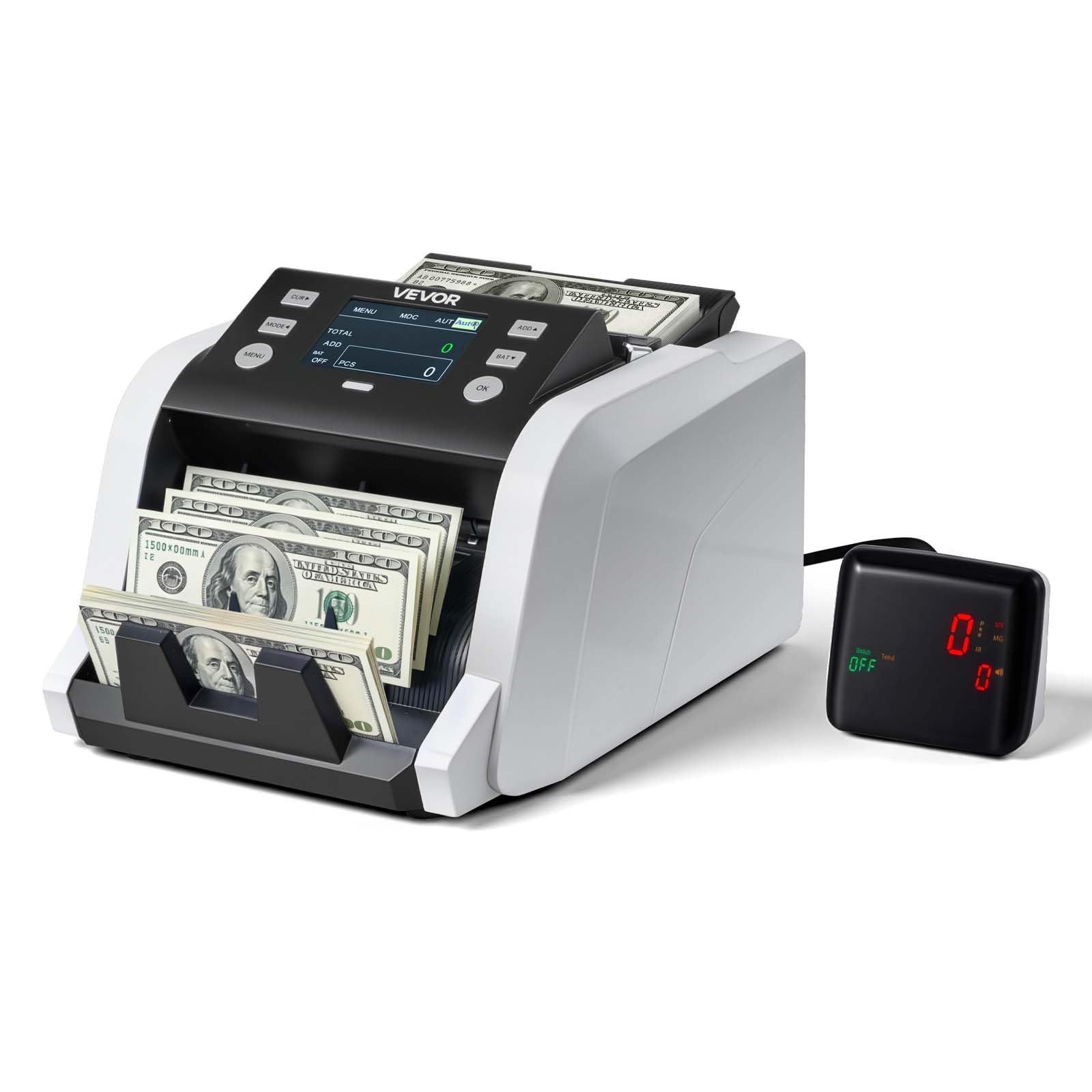
VEVOR’s mixed-denomination counter uses CIS sensors to scan both sides of each bill, enabling automatic denomination recognition for USD, CAD, MXN, EUR, and GBP without any pre-sorting. The 3.5-inch TFT display shows count and total value clearly, and an external monitor lets employees or customers read data from multiple angles. A high-durability transmission system is built to withstand daily use in busy retail environments.
Counterfeit detection covers UV, MG, IR, DD, DBL, HLF, and CHN — stopping immediately if a suspicious note is found. The hopper holds 200 notes and the stacker matches that capacity, reducing interruptions during peak hours. Users consistently rate this machine highly for its speed and value, with several noting it performs identically to units costing significantly more. A simple adjustment to the reject count setting (lowering it from 70 to 40) eliminates most crumpling issues.
One minor trade-off: to calculate the total dollar amount of multiple denominations, you must enter the bill values manually in Valuation mode. The machine does not auto-sum mixed denominations without this manual step. For businesses that process one denomination at a time or don’t mind a single manual entry per stack, the VEVOR offers reliable performance at a competitive mid-range price.
Why it’s great
- CIS sensors automatically recognize denominations without pre-sorting.
- Stacker matches hopper capacity at 200 notes, reducing busy-hour interruptions.
- Strong multi-currency support for USD, CAD, MXN, EUR, and GBP.
Good to know
- Valuation mode requires manual denomination entry — not fully automatic mixed value counting.
- Adjusting the reject count setting is recommended to prevent crumpling with older bills.
6. KOLIBRI KBC-3000
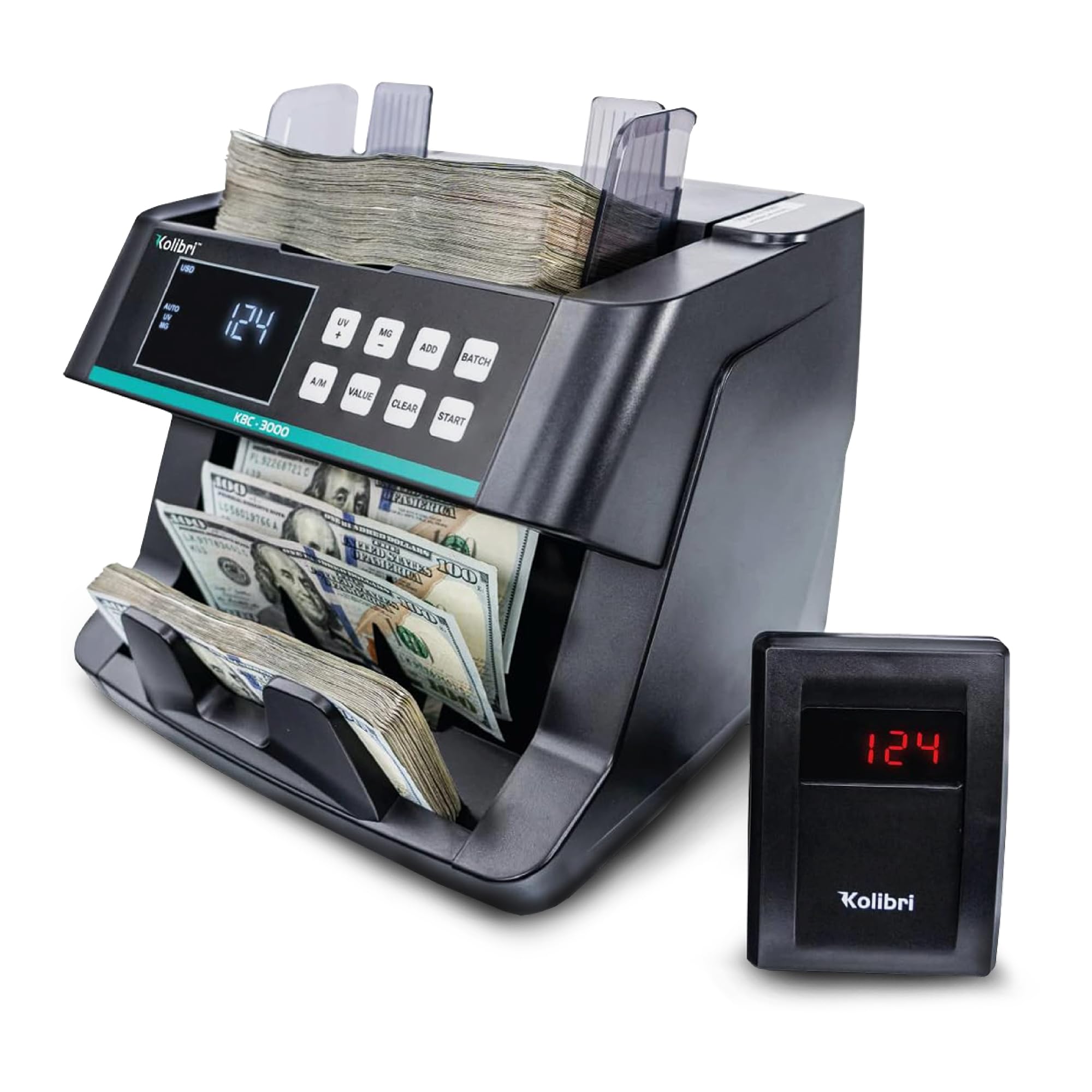
The KOLIBRI KBC-3000 focuses on single-denomination USD counting with precision. While it lacks mixed-denomination auto-sorting, its ValuCount mode lets you manually select a denomination and then quickly calculate the total monetary value of a stack. Seven operation modes — Count, Add, Batch, Add+Batch, Auto, Manual, and ValuCount — give you granular control over how you process cash, making it a fine tool for businesses that handle large volumes of a single bill type.
Ultraviolet and infrared sensors detect suspect bills and stop counting with a clear alert message if a counterfeit is found. The machine’s feed system is precise enough to avoid errors like chains, double bills, and half notes. Users report it’s been reliable for five or more years, with one reviewer calling it their third unit — they kept buying KOLIBRI because the performance was consistent. The interface includes a built-in printer for generating paper totals.
At roughly the same price point as the RIBAO BC-40, the KBC-3000 offers fewer features on paper but delivers exceptional reliability for its niche. It’s best for businesses that process mostly single-denomination cash — vending machine routes, laundromats, or parking lot attendants — and want a machine that will run accurately for years without fuss.
Why it’s great
- Proven long-term reliability — multiple users report five years of daily use.
- ValuCount mode quickly totals stacks of the same denomination.
- Built-in printer adds convenience for record keeping.
Good to know
- No mixed-denomination auto-counting — must sort bills yourself.
- Interface is slightly cluttered with multiple mode options; slower speed setting is recommended for best accuracy.
7. Aneken AL-1000

The Aneken AL-1000 delivers reliable counting at 1,000 notes per minute with six counterfeit detection methods (UV, MG, IR, DD, DBL, HLF, CHN) — all at a very accessible price point. The 3.7-inch LCD display and included external monitor make it easy to read counts from across the counter. It supports COUNT, ADD, BATCH, AUTO, and MANUAL modes, giving you flexibility for different cash processing workflows.
Value counting requires manual denomination selection (the machine does not auto-detect mixed bills), but in ADD mode you can accumulate totals across multiple stacks of the same denomination. The motor is surprisingly quiet for the price, operating at under 60 decibels — quieter than most office printers. Users consistently note it saves hours of manual counting time and has held up well over months of regular use.
The main trade-off at this price point is occasional jamming with old or worn bills. Several reviewers mention that keeping bills straight and flat before feeding minimizes this issue. For a startup, small food truck, or weekend market vendor who needs to count a few hundred dollars per day without spending a lot, the Aneken AL-1000 is a solid entry-level choice.
Why it’s great
- Quiet operation at under 60dB — comfortable in small retail environments.
- Six detection methods provide solid counterfeit protection at this price.
- External monitor included for shared viewing.
Good to know
- Occasionally jams with worn or creased bills — requires careful feeding.
- 110V only, not compatible with 220V outlets without a converter.
8. LOLARAN AL1000

The LOLARAN AL1000 packs fast counting — up to 1,300 notes per minute — into a chassis made from alloy steel, giving it a sturdy, durable feel that exceeds its price bracket. Advanced counterfeit detection covers UV, MG, MT, IR, DD, and HLF, and when a suspicious bill is detected the display turns red and an alarm sounds. The 3.7-inch LCD is bright and clear, and the external display helps customers follow the count.
Like the Aneken AL-1000, this machine requires manual denomination setting for value counting. However, the ADD mode lets you accumulate totals across multiple stacks of the same denomination, which is useful for end-of-day reconciliation. The hopper holds 200 notes and the machine handles mixed orientations (bills can be facing up or down) without issue.
The LOLARAN weighs 10.4 pounds — heavier than the Aneken AL-1000 due to the alloy steel construction, which actually helps stabilize it during fast counting. One user noted that overloading the hopper can cause a jam, but keeping stacks under 50 bills per feed yields smooth operation. For businesses that want a slightly faster count speed and a robust build without moving into mid-range pricing, the LOLARAN AL1000 is a strong budget alternative.
Why it’s great
- Fast 1,300 notes/min speed for a budget-priced unit.
- Alloy steel chassis provides stable, durable build quality.
- External display and bright LCD make reading easy from any angle.
Good to know
- No auto-denomination recognition — value counting must be set manually.
- Overloading the hopper with more than 50 bills at once can cause jams.
9. AccuBANKER D450

The AccuBANKER D450 is a compact, single-bill verification device rather than a high-speed counter. It uses five counterfeit detection methods — Ultraviolet, Magnetic Ink, Infrared, Watermark, and Size detection — to check one bill at a time in under a second. Bills are fed automatically, and the machine provides both audible and visual pass/fail notifications. Its lightweight design (1.1 pounds) makes it easy to move between counters or store in a drawer when not in use.
This is the right tool for businesses that see low volumes of cash but face a real counterfeit risk. A restaurant server, a flea market vendor, or a small clinic that accepts cash only occasionally doesn’t need a 1,200-notes-per-minute machine. The D450 fits on a small desk and verifies each bill individually before you deposit it. Users appreciate the fast scan time but note that positioning the bill correctly on the face mockup is important for accurate readings.
The D450’s main limitation is speed: you cannot stack 50 bills and walk away. Each note must be placed one at a time, and bills that are torn or improperly aligned can get stuck or ripped. The 3-year warranty from AccuBANKER adds peace of mind. If your daily cash volume is under 50 bills and you prioritize counterfeit detection over counting speed, the D450 is a useful, compact tool — but it is not a replacement for a proper counter for higher-volume operations.
Why it’s great
- Ultra-compact at 1.1 pounds — fits anywhere, even a small drawer.
- Five detection methods provide thorough single-bill verification.
- 3-year warranty is longer than most entry-level units.
Good to know
- One-bill-at-a-time feeding — too slow for stacks over 50 notes.
- Can rip damaged or torn bills if not perfectly aligned.
FAQ
What is the difference between UV, MG, and IR counterfeit detection?
Can a currency counter handle old, wrinkled, or torn bills?
Do I need a mixed-denomination machine or is single enough?
How often should I clean the sensors and rollers?
Final Thoughts: The Verdict
For most businesses, the best currency counter winner is the MUNBYN IMC01 because its 2CIS sensors and serial number recording provide bank-grade accuracy and traceability that no other machine in this lineup can match. If you handle international cash across 20 currencies, grab the RIBAO MC-50 for its speed and global currency support. And for a mid-range mixed-denomination workhorse with easy maintenance, nothing beats the RIBAO BC-40.

Mo Maruf
I created WellFizz to bridge the gap between vague wellness advice and actionable solutions. My mission is simple: to decode the research and give you practical tools you can actually use.
Beyond the data, I am a passionate traveler. I believe that stepping away from the screen to explore new environments is essential for mental clarity and physical vitality.