Our readers keep the lights on and my smoothie glass nicely filled. As an Amazon Associate, I earn from qualifying purchases.
Crossbow bolts hit harder and faster than vertical bows, which is precisely why using the wrong fixed blade broadhead can cost you a shot you trained all year to take. Blade deflection at high speeds, weak ferrule joints, and poor spin balance turn a perfect release into a frustrating miss or a marginal hit.
I’m Mohammad Maruf — the founder and writer behind WellFizz. I’ve spent hundreds of hours digging into the mechanical tolerances, ferrule materials, blade thicknesses, and customer fl ight reports that separate a reliable crossbow broadhead from one that’s simply marketed as “crossbow compatible.”
This guide breaks down the seven most tested fixed blade broadheads for crossbows, comparing cut diameter, blade thickness, ferrule construction, and actual field performance so you can confidently pick from the best crossbow fixed blade broadheads for your setup.
How To Choose The Best Crossbow Fixed Blade Broadheads
Crossbow energy demands a fixed blade broadhead that resists mechanical failure on impact, maintains its aerodynamic form in flight, and holds a razor edge through hide, muscle, and bone. You need to evaluate three interconnected specs: ferrule material, blade retention method, and cutting diameter.
Ferrule Construction: One-Piece vs. Replaceable-Blade
A one-piece metal injection molded (MIM) ferrule, like the designs from G5, eliminates any threaded joint or glued insert that could snap under the kinetic load of a 400+ fps bolt. Replaceable-blade ferrules are easier to refurbish, but each screw hole or locking slot introduces a potential stress riser. For high-speed crossbows, the MIM approach tends to deliver longer service life and more consistent accuracy.
Blade Thickness and Material
Blade thickness, measured in thousandths of an inch, directly controls penetration through heavy bone. A .025” blade cuts through soft tissue with less drag but risks rolling or chipping when it strikes a scapula or rib. A .035” stainless steel blade, like those used in Grim Reaper models, absorbs far more impact energy before deforming. Carbon steel holds a sharper edge but corrodes faster than stainless; stainless steel trades ultimate sharpness for durability and weather resistance.
Cutting Diameter vs. Flight Profile
Fixed blade broadheads with cutting diameters above 1.5 inches create larger wound channels and better blood trails, but they also generate more aerodynamic drag and require precise fletching alignment to steer properly. A 1.25-inch or smaller diameter, like the 1.25-inch Muzzy MX-3, flies closer to a field point and groups tighter at 40+ yards. Balance your hunting environment: heavy cover calls for a wide cut, open fields reward tighter accuracy.
Quick Comparison
On smaller screens, swipe sideways to see the full table.
| Model | Category | Best For | Key Spec | Amazon |
|---|---|---|---|---|
| G5 Montec CS | Premium Steel | Deep penetration through bone | One-piece carbon steel MIM | Amazon |
| G5 Montec | Premium Aluminum | Reusable accuracy | One-piece aluminum MIM | Amazon |
| NAP Thunderhead | Mid-Range | Replaceable blade versatility | Micro-grooved ferrule, .025” blades | Amazon |
| Excalibur Boltcutter | Premium | Long-range crossbow accuracy | Full stainless steel ferrule | Amazon |
| Grim Reaper Razorcut SS | Premium | Large wound channels | 2” cut, .035” stainless blades | Amazon |
| Swhacker #219 | Mid-Range | In-flight profile for speed | 1.75” cut, 100 grain | Amazon |
| Muzzy MX-3 | Budget | Budget-friendly reliability | 1.25” cut, .025” blades | Amazon |
In‑Depth Reviews
1. G5 Montec CS (Carbon Steel)
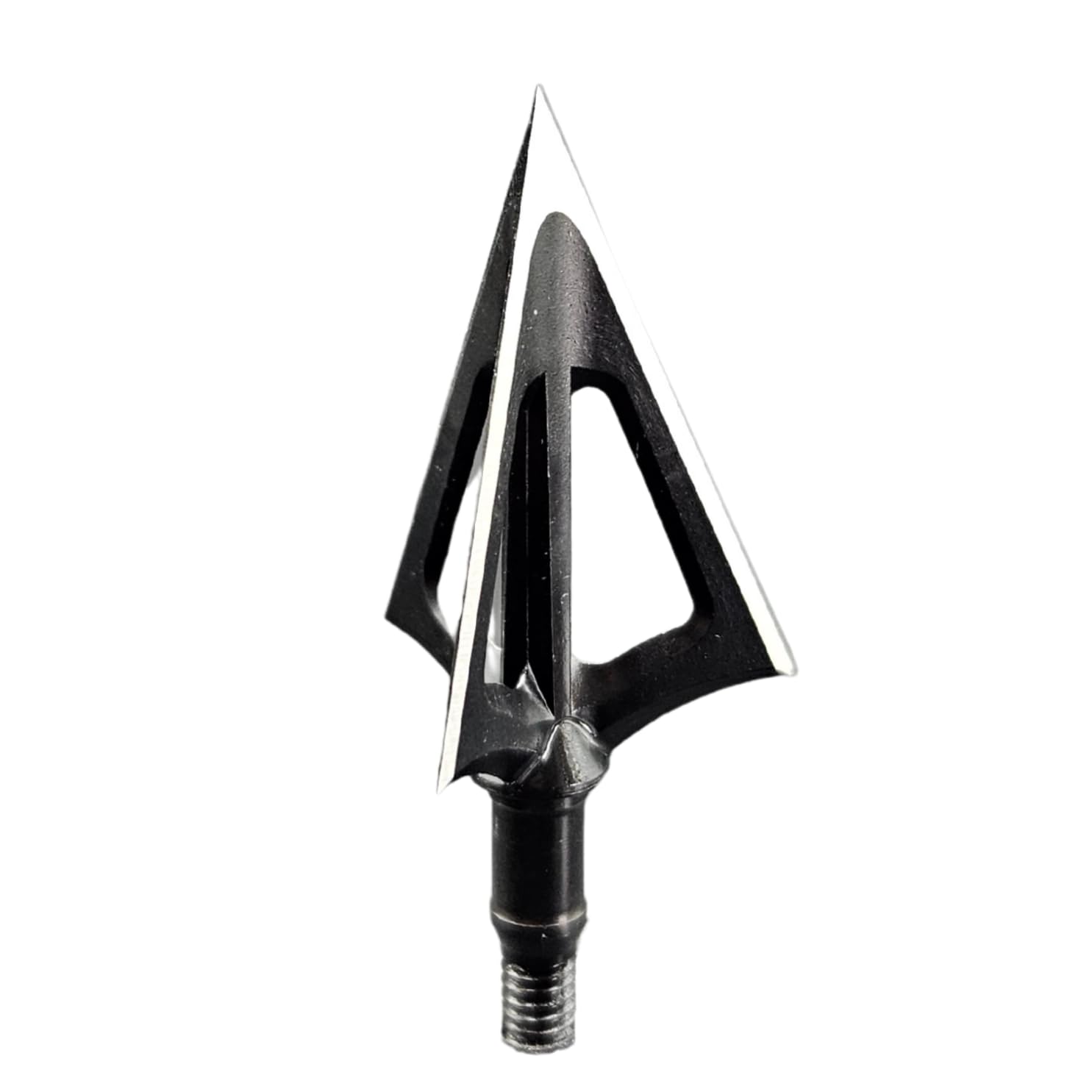
The G5 Montec CS uses a one-piece carbon steel metal injection molding (MIM) process, eliminating every threaded joint and glued insert that can fail under high-velocity crossbow impact. Carbon steel holds a diamond-cut edge longer than standard alloys, and the single-piece ferrule means there is no blade retention hardware to loosen or break. At 100 grains with a 1 1/16-inch cutting diameter, this head balances speed with enough mass to drive through heavy bone.
Multiple customer reports confirm that this broadhead survives impacts with ribs, scapulae, and even solid wood without deforming. One user shot through a 3-inch maple tree and reinstalled the same head on a new bolt. The spin-tested production ensures that every head arrives balanced; field reports show groups that match or improve on field-point accuracy at 40+ yards.
The trade-off is a smaller cutting diameter than mechanical broadheads or larger fixed blades. The 1 1/16-inch cut produces reliable blood trails but may not create the massive exit wounds seen with 2-inch designs. Carbon steel also requires more attention to rust prevention after wet hunts.
Why it’s great
- One-piece carbon steel construction eliminates all weak retention points.
- Spin-tested balance provides field-point-like accuracy at extended ranges.
- Diamond-cut edge stays sharp through multiple uses and bone impacts.
Good to know
- Smaller 1.06-inch cut may require precise shot placement for ideal blood trails.
- Carbon steel is prone to corrosion if not dried after wet hunting conditions.
2. G5 Montec (Aluminum)
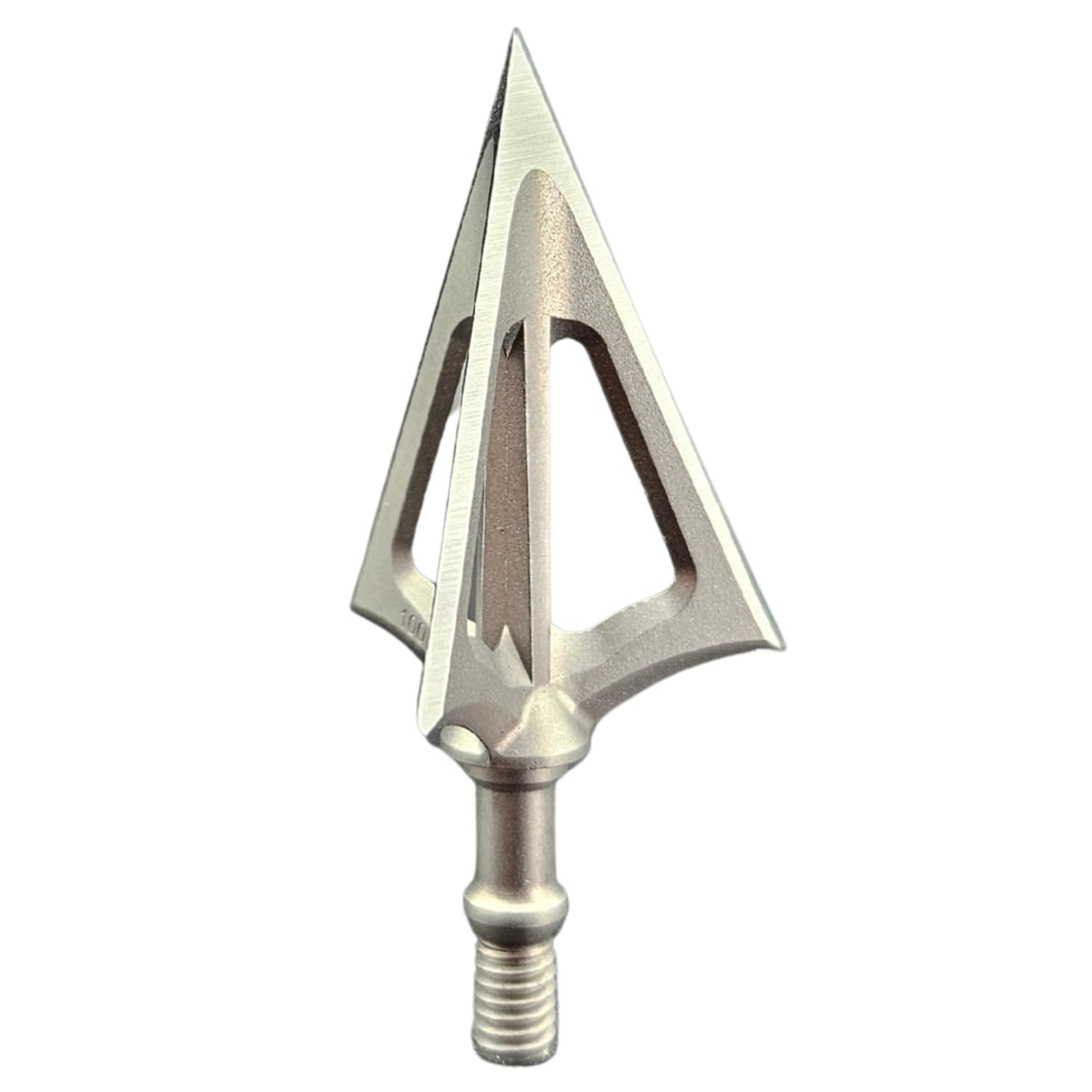
The original G5 Montec shares its one-piece MIM construction with the CS version but uses an aluminum alloy instead of carbon steel. This makes it lighter for its cutting diameter (1 to 1.125 inches) and completely rust-resistant, an important factor for hunters who spend long days in damp environments. The cut-on-contact tip initiates penetration immediately, and the spin-tested ferrule ensures that the head flies true without wobble.
Customer reviews consistently note that the Montec flies identically to field points out to 50 yards, with one user reporting a complete pass-through on a quartering-away shot at 35 yards that dropped the deer within 25 yards. Another user shot through a 3-inch thick maple tree without damaging the head, demonstrating the ferrule’s structural integrity under extreme forces.
Because the blades are not replaceable, the entire head must be resharpened when dull. Some users report that the edge can be restored easily with a diamond stone, but repeated sharpening eventually reduces the cutting diameter over many seasons.
Why it’s great
- Rust-proof aluminum ferrule is ideal for wet-weather hunting.
- One-piece MIM construction has zero mechanical failure points.
- Field-point flight accuracy at 40 to 50 yards reported by multiple users.
Good to know
- Non-replaceable blades require whole-head sharpening when dull.
- Aluminum is less hard than steel; may deform on heavy bone hits.
3. NAP Thunderhead

The NAP Thunderhead has been a fixed blade staple for over three decades, and its micro-grooved ferrule design is specifically engineered to reduce rotational drag and increase stability at high speeds. The 100-grain version uses a 1 3/16-inch cutting diameter with .025-inch thick replaceable blades. The Diamize sharpening process produces some of the sharpest edges available out of the box.
Customers who switched to the Thunderhead after mechanical failures with other brands reported complete pass-throughs on whitetail at 40 yards with minimal blade damage. The replaceable blade system makes field refurbishment fast — swap blades and keep hunting without re-tuning your bow. A 30-year user noted that the Thunderhead outperforms many modern mechanicals in penetration on angled shots.
The blade retention design uses pressure rather than lock rings or O-rings, which can loosen if the head is not fully seated. Some users also report that the blades can shift during hard impacts if the ferrule threads are not tight against the arrow insert.
Why it’s great
- Diamize sharpened blades are ready to hunt straight from the package.
- Micro-grooved ferrule improves flight stability at crossbow velocities.
- Replaceable blades allow quick field refurbishment without replacing the entire head.
Good to know
- .025-inch blades may roll or chip on heavy bone contact.
- Blade retention depends on ferrule-to-arrow tension; not ideal for all inserts.
4. Excalibur Boltcutter

The Excalibur Boltcutter was designed from the ground up for modern high-speed crossbows, and its 150-grain mass helps it maintain momentum through heavy brush and bone. The entire ferrule and blade assembly is machined from high-strength stainless steel, making this one of the most durable fixed blade heads on the market. The 1 1/16-inch cutting diameter keeps the flight profile compact, and Excalibur’s testing shows sub-4-inch groups at 40 yards with Firebolt arrows.
Long-time users of the Boltcutter report consistent performance across multiple seasons with the Matrix and Bulldog series crossbows. One customer using a Matrix 380 reported dropping deer where they stood with complete pass-throughs and tracking distances under 30 yards. The stainless steel construction resists corrosion even after prolonged exposure to moisture.
The downside is the weight: at 150 grains, this head significantly changes your arrow’s trajectory compared to 100-grain field points. You will need to re-sight your crossbow and potentially re-tune your arrow spine selection. The heavier mass also creates more drop at extended ranges, though terminal energy remains high.
Why it’s great
- Full stainless steel construction delivers maximum durability and corrosion resistance.
- 150-grain mass provides deep penetration through heavy bone.
- Sub-4-inch groups at 40 yards in factory bolt testing.
Good to know
- Heavier grain weight requires re-sighting and may need stiffer arrows.
- Cutting diameter of 1.06 inches is smaller than many competitors.
5. Grim Reaper Razorcut SS
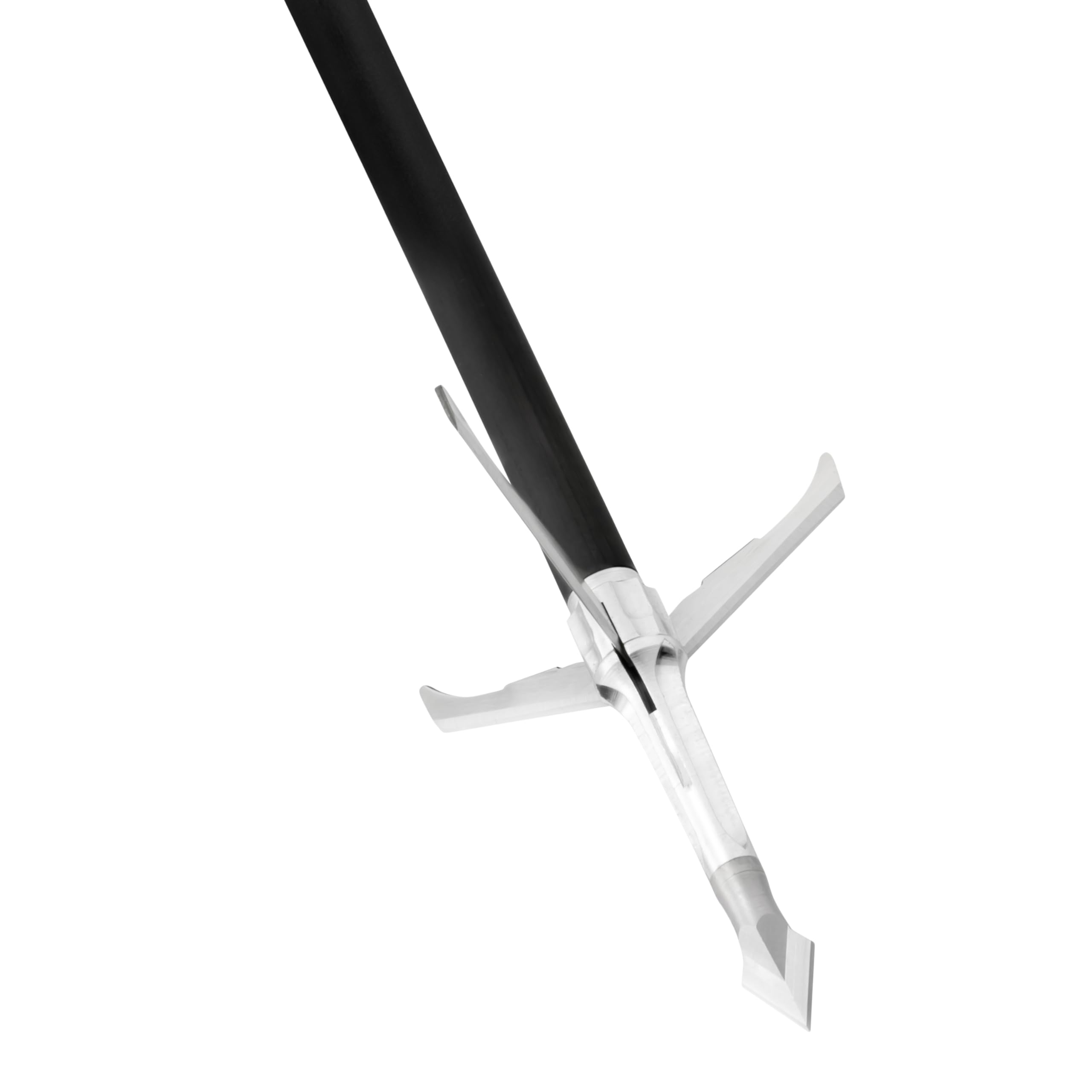
The Grim Reaper Razorcut SS stands apart by combining a massive 2-inch cutting diameter with .035-inch thick stainless steel blades. The blade thickness is nearly 40% greater than standard .025-inch heads, which allows the Razorcut to slice through heavy bone without rolling the edge. The included practice head lets you tune your crossbow before exposing the hunting blades to high-speed flight.
Users report that the Razorcut produces exit wounds large enough to create immediate blood trails, even on marginal hits. One customer noted that after a 20-yard pass-through on a doe, the exit hole measured roughly tennis-ball size. The blades close after pass-through via a spring mechanism, which some users find reduces arrow drag through brush on the back side of the shot.
The 2-inch cutting diameter creates significant aerodynamic drag. This head requires proper fletching alignment and a well-tuned crossbow to group consistently at ranges beyond 40 yards. The practice head helps, but some users still report a 2-inch point-of-impact shift at 50 yards compared to field points.
Why it’s great
- .035-inch thick stainless blades resist rolling on bone impacts.
- 2-inch cutting diameter creates massive exit wounds for easy blood trailing.
- Includes a practice head for point-of-impact tuning before the hunt.
Good to know
- Large cutting profile requires precise fletching alignment for accuracy.
- May cause point-of-impact shift of 2+ inches at longer ranges compared to field points.
6. Swhacker #219
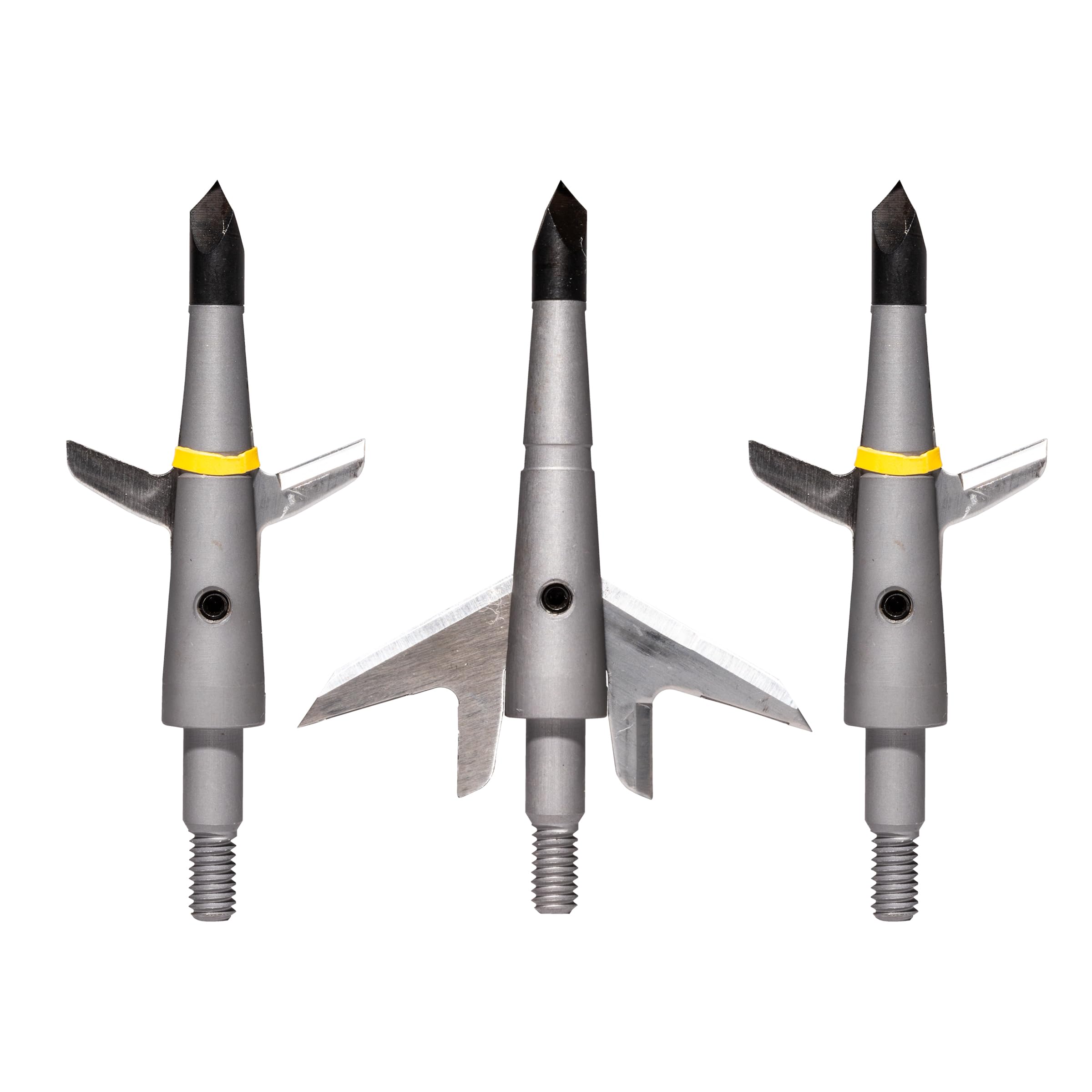
While the Swhacker #219 is a mechanical expandable broadhead, its Two-Slice deployment technology is distinct enough to merit consideration in a fixed-blade discussion. The wing blades deploy first while the primary blades remain closed mid-flight, slimming the in-flight profile. Upon impact, the primary blades open to create a 1.75-inch cutting diameter. For crossbows shooting above 400 fps, Swhacker recommends using two O-rings per head to prevent premature deployment.
Customer reviews consistently highlight the devastating wound channels and short tracking distances. One user reported three deer taken at 20 yards with no animal traveling more than 50 yards. The aircraft-grade aluminum ferrule and stainless steel blades handle the acceleration forces from high-speed crossbows without structural failure.
The moving parts inherent to mechanical broadheads introduce failure modes that fixed blades do not have. Pre-installed bands on some units have failed during flight, causing blade deployment mid-air and resulting in misses. Replacing these bands with fresh ones mitigates the risk, but it is an extra step not required with solid fixed-blade designs.
Why it’s great
- Two-Slice deployment provides a compact flight profile with a large wound channel on impact.
- 1.75-inch cutting diameter creates reliable blood trails.
- Aircraft-grade aluminum ferrule rated for crossbow velocities.
Good to know
- Mechanical design requires careful O-ring inspection to prevent mid-air deployment.
- Does not fly like a field point; practice tip also requires re-sighting.
7. Muzzy MX-3

The Muzzy MX-3 is a no-frills fixed blade broadhead that earns its place in this guide through decades of field-proven reliability. The aluminum ferrule houses three .025-inch thick blades with a 1.25-inch cutting diameter. The Trocar tip design crushes bone on contact rather than deflecting, which is critical when shooting a high-speed crossbow that can drive a bolt through a shoulder blade.
Budget-conscious hunters appreciate that the MX-3 flies close to field points, with one user reporting that a bow tune error (3-inch right drift) became obvious only after switching to these heads. Corrected, the broadheads grouped at the same point of impact as field points at 20 yards. Penetration tests at 65lbs and 310fps showed 12-14 inches through a tough foam target, compared to 6 inches for field points.
The replaceable blades are inexpensive and easy to swap, but the .025-inch thickness is more prone to bending on heavy bone contact than thicker .035-inch alternatives. The compact 1.25-inch cutting diameter results in smaller wound channels than wider fixed or mechanical heads. For large game like elk, this may mean slightly longer tracking on non-ideal shots.
Why it’s great
- Price point makes it the most budget-friendly option in this guide.
- Trocar tip drives through bone without deflection.
- Flies nearly identical to field points when bow is properly tuned.
Good to know
- .025-inch blades may bend on heavy bone contact.
- 1.25-inch cutting diameter produces smaller wound channels than wider heads.
FAQ
Is it safe to use fixed blade broadheads on a crossbow over 400 fps?
Does a larger cutting diameter guarantee a better blood trail?
How do I align the blades of a fixed blade broadhead with my arrow fletchings?
Final Thoughts: The Verdict
For most users, the best crossbow fixed blade broadheads winner is the G5 Montec CS because its one-piece carbon steel MIM ferrule delivers unmatched structural integrity with field-point flight accuracy. If you want a rust-proof option with identical one-piece construction, grab the G5 Montec (Aluminum). And for budget-conscious hunters who still demand reliability, the Muzzy MX-3 offers proven performance at the lowest cost of entry.

Mo Maruf
I created WellFizz to bridge the gap between vague wellness advice and actionable solutions. My mission is simple: to decode the research and give you practical tools you can actually use.
Beyond the data, I am a passionate traveler. I believe that stepping away from the screen to explore new environments is essential for mental clarity and physical vitality.