Our readers keep the lights on and my smoothie glass nicely filled. As an Amazon Associate, I earn from qualifying purchases.
Framing a wall, tiling a shower, or hanging a row of cabinets demands a line that refuses to drift. A cross line laser level replaces the bubble vial with a locked, rotating beam that projects crisp horizontal and vertical references across an entire room, cutting layout time by more than half and eliminating the guesswork that comes with a manual level and chalk line.
I’m Mohammad Maruf — the founder and writer behind WellFizz. I’ve spent hundreds of hours analyzing beam visibility under different lighting, self-leveling recovery speed, battery architecture, and mount stability across dozens of models to isolate the few that deliver genuine precision without frustrating cut corners.
This guide breaks down the top seven models currently on the market, comparing range, self-leveling behavior, power systems, and kit completeness so you can confidently choose the right best cross line laser level for your specific job, budget, and work conditions.
How To Choose The Best Cross Line Laser Level
A cross line laser level seems simple — push a button, see a line. But the differences in diode quality, leveling tolerance, available laser planes, and battery system determine whether that line is usable on a sunny afternoon or disappears the moment you step two feet away.
Laser Color and Diode Brightness
Green laser diodes (532 nm wavelength) appear roughly three to four times brighter to the human eye than red diodes (635 nm) at the same power output. That extra visibility matters in rooms with window light, on textured drywall, or when the line must cross a dark floor. Green units cost a bit more, but the usability gain is immediately obvious the first time you work near a bright window.
Self-Leveling Range and Recovery Speed
A self-leveling laser compensates for minor surface tilt using an internal pendulum mechanism. The “leveling range” (usually ±3° or ±4°) tells you how far off-level the surface can be before the laser refuses to lock. A wider range means fewer shims under the tripod. Recovery speed — how fast the beam stabilizes after a bump — is equally important. Models that re-level in two to three seconds keep workflow smooth; units that take ten seconds or flash an alarm for every accidental knock become a nuisance.
Number of Planes (2D, 3D, 4D)
A basic 2D cross line laser projects one horizontal and one vertical line. A 3D model adds a second vertical line at 90 degrees, covering three walls. A 4D model spins a horizontal beam 360 degrees and often includes two or four vertical lines, effectively covering all four walls and the ceiling simultaneously. For tiling a single wall, 2D is enough. For full-room layout, cabinet alignment, or drop-ceiling installation, 3D or 4D saves substantial time.
Power System and Runtime
Entry-level units often run on four AA batteries. Mid-range and premium models use integrated or swappable lithium-ion packs. Swappable batteries are a major advantage for all-day use — one pack charges while the other runs the laser. Pay attention to the charging port (USB-C is far more convenient than micro-USB) and whether the unit can operate while charging, which eliminates downtime entirely.
Quick Comparison
On smaller screens, swipe sideways to see the full table.
| Model | Category | Best For | Key Spec | Amazon |
|---|---|---|---|---|
| Huepar Y03CG | 3D Green | Digital angle display | 3 x 360°, ±1/9″ at 33 ft | Amazon |
| Huepar HM03CG | 3D Green | 5-year warranty coverage | 3 x 360°, 98 ft range | Amazon |
| Enriprt 16-Line | 4D Green | Full room 4 x 360° layout | 4 x 360°, 2 x 2400mAh batteries | Amazon |
| Alloyman 4×360° | 4D Green | Extended outdoor work with pulse | 4 x 360°, 12 hr runtime | Amazon |
| Prexiso PLC360SGA | 2D Green | Simple indoor DIY tasks | 360° horizontal, 100 ft range | Amazon |
| Skil LL932301 | 2D Red | Budget-friendly cross line accuracy | 50 ft red, integrated battery | Amazon |
| WEIDDW 4×360° | 4D Green | Long runtime with 2 x 3600mAh packs | 4 x 360°, 10 hr total runtime | Amazon |
In‑Depth Reviews
1. Huepar Y03CG
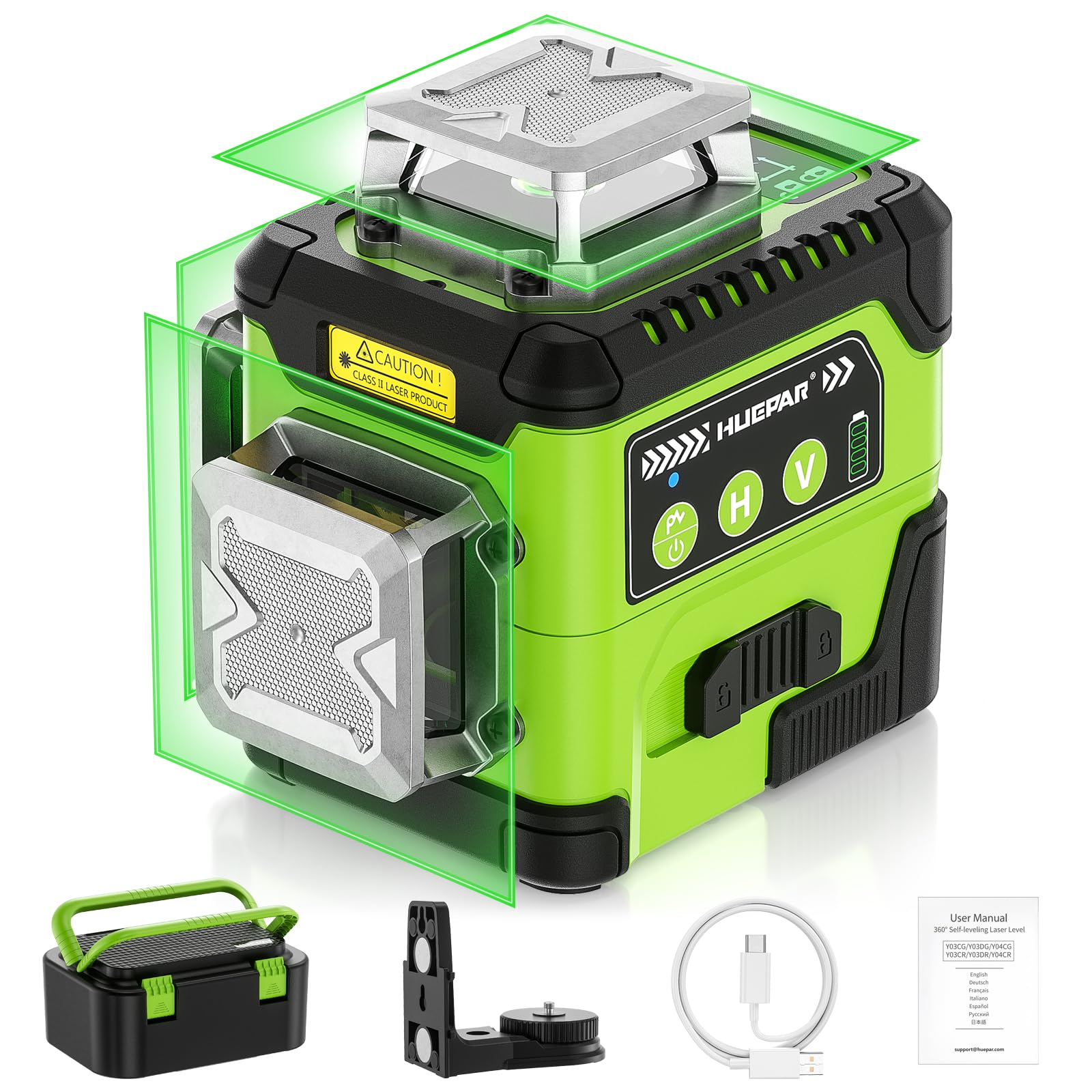
The Y03CG is Huepar’s most refined 3D unit, integrating a small LCD screen that displays X and Y axis angles in real time. That digital readout eliminates the need to raise a separate protractor or digital angle gauge when setting sloped ceilings, stair stringers, or angled soffits. The laser itself uses an upgraded green diode that remains clearly visible across sixty feet indoors, and the quick-leveling mechanism recovers from a bump in roughly two seconds — fast enough to keep pace with framing work.
The built-in 4000mAh lithium battery delivers about six hours of continuous operation, and the USB-C port allows the tool to work while charging, which effectively eliminates downtime on long days. Huepar backs this model with a five-year device warranty and lifetime technical support, which is rare at this tier. The kit includes a 360° magnetic pivoting base and a hard carry case with custom foam inserts, so the unit stays protected in a truck bed or tool bag.
One detail worth noting: the LCD screen is a genuine productivity upgrade for anyone who sets compound angles regularly, but it adds cost that a pure level-and-square user may never leverage. If your work rarely requires calibrated slopes, the screen delivers a feature you won’t use. For professionals framing stairs or installing commercial railings, however, the Y03CG earns its place as the most technically complete option in this group.
Why it’s great
- LCD angle display provides immediate X and Y axis readings
- Quick leveling recovers in 2-3 seconds after a knock
- Five-year warranty and lifetime support from Huepar
Good to know
- Built-in battery cannot be swapped for a fresh pack in the field
- LCD screen is overkill for basic level-and-square applications
2. Huepar HM03CG
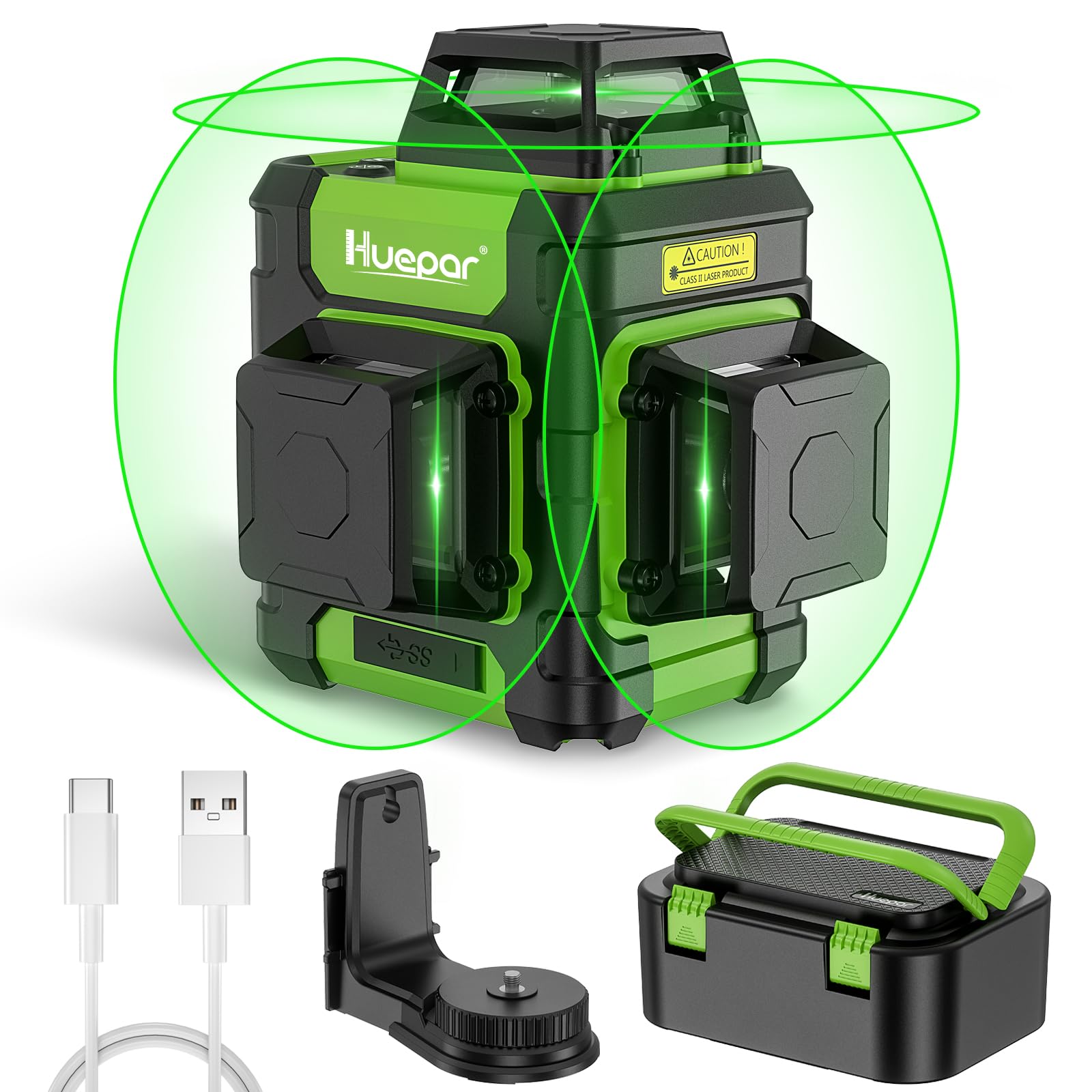
The HM03CG has become a benchmark in the mid-market cross line laser category because it nails the fundamentals without adding unnecessary complexity. It projects three 360-degree planes — one horizontal and two vertical — from a single rotating head, covering a full room from one setup. The green laser beam maintains solid visibility up to ninety-eight feet indoors, and the pulse mode pushes that range to about two hundred feet when paired with a Huepar receiver, making it viable for outdoor foundation layout or large commercial interiors.
Build quality is a genuine step above budget alternatives. The housing is ABS wrapped in TPR soft rubber, which cushions drops and reduces vibration during self-leveling. The self-leveling system locks within three degrees of level and flashes an alarm if the surface exceeds that limit. The Type-C charging port is a welcome convenience, and the eight-hour runtime covers a full workday without the need for a mid-shift recharge. Huepar includes a 360-degree magnetic bracket with both 1/4″-20 and 5/8″-11 thread inserts, so it adapts to nearly any tripod or mounting surface.
The biggest selling point, however, is the warranty package: five years on the device and two years on the battery, with year one offering a full replacement kit if anything goes wrong. That level of manufacturer confidence is nearly unheard of at the price and makes the HM03CG the easiest recommendation for anyone who needs a reliable 3D laser without paying professional-brand premiums.
Why it’s great
- Five-year device warranty with first-year full replacement
- Pulse mode extends range to 200 ft with receiver
- TPR rubber overmold adds drop protection and dampens vibration
Good to know
- Battery is built-in, not swappable in the field
- Laser windows are glass; reflections off shiny tile can create ghost lines
3. Enriprt 16-Line 4×360°
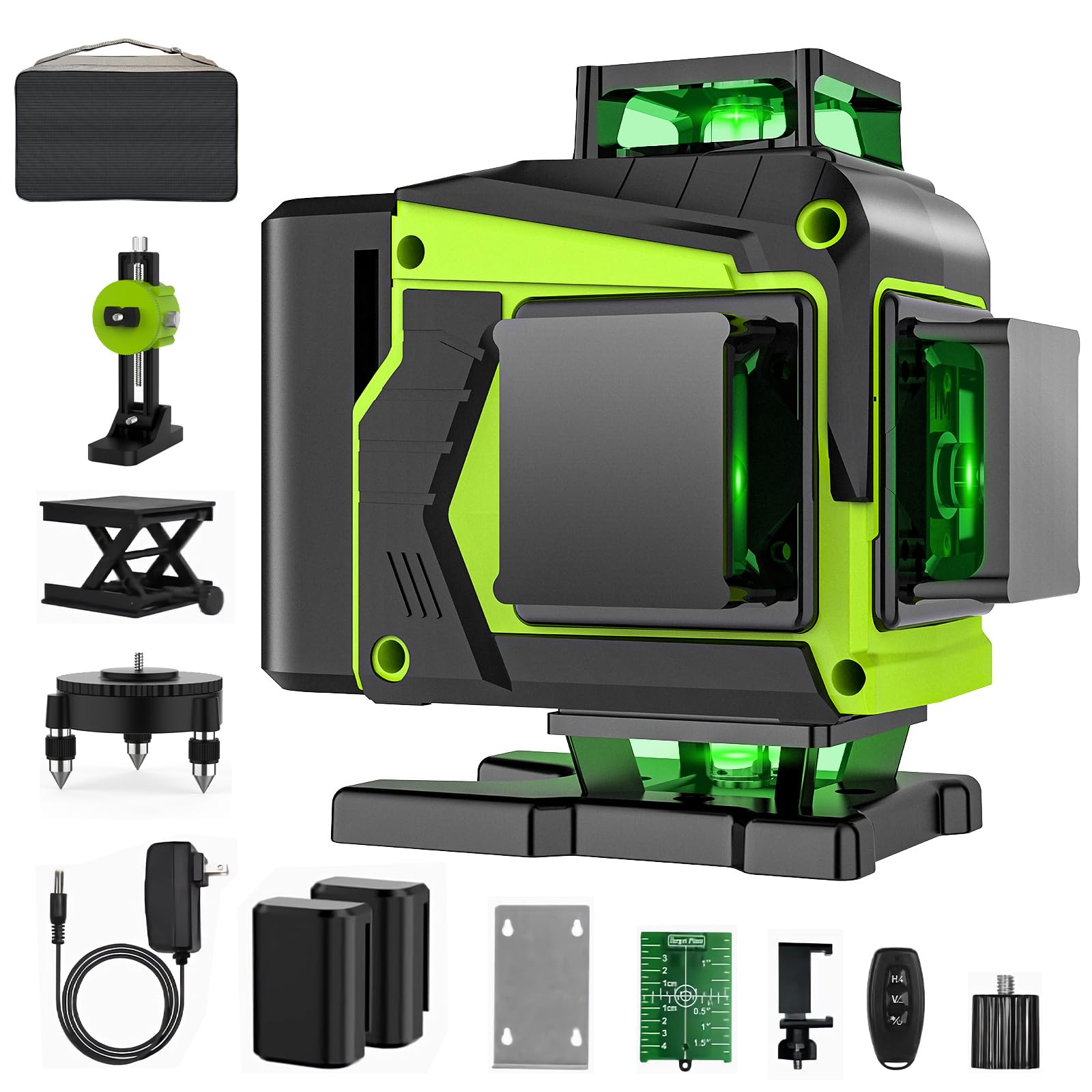
Enriprt’s 16-line 4D laser packs two swappable 2400mAh lithium batteries into a single kit, giving you roughly eight hours of continuous operation per battery and effectively unlimited runtime as long as you keep one pack charging. The 4×360-degree layout projects four full planes, covering every wall, floor, and ceiling surface from a single position. Accuracy is rated at ±1/10 inch at eight feet, which is more than adequate for residential framing, cabinet installation, and tile layout.
The unit includes a remote control, which is genuinely useful when the laser is mounted high on a wall bracket or in the center of a large room. You can switch between self-leveling and manual mode, activate individual lines, or cycle the pulse mode without climbing down from a ladder. The IP54 dust and water resistance rating means it can handle the particulate and moisture common on renovation sites without internal damage. The kit is unusually complete: magnetic bracket, mini tripod, lifting platform, wall panel, target plate, and a carrying case are all included.
The magnetic bracket itself is the weakest link — several user reports note that the magnet is not strong enough to hold the laser securely on vertical steel surfaces without additional bracing. If you plan to mount it on metal studs or steel beams, plan to supplement with a separate clamp or tripod. That one caveat aside, the Enriprt delivers a remarkable amount of capability for the price, especially for anyone who needs 4D coverage without paying premium-tier prices.
Why it’s great
- Two swappable 2400mAh batteries provide all-day runtime
- Remote control enables adjustments from a distance
- IP54 rated for dust and moisture on job sites
Good to know
- Magnetic bracket lacks holding strength for heavy use on steel
- Manual mode disables the beeping alarm but pendulum remains active
4. Alloyman 4×360°

Alloyman’s 4×360-degree green laser positions itself as a mid-range workhorse with a few smart design touches. The most notable is the pulse mode, which extends the working range to roughly 150 feet when used with a separate laser receiver — a genuine advantage for outdoor framing or large interior spaces that exceed the standard visual range. The kit ships with two 4.0V lithium batteries that together provide up to twelve hours of runtime, enough to cover demanding full-day tile or framing projects without a recharge break.
The self-leveling system operates within a tight three-degree tolerance and flashes a beeping alarm when the surface exceeds that limit. That tolerance is narrower than the four-degree standard on many competitors, which means the Alloyman is slightly more demanding about initial setup but rewards with arguably better precision once locked. The included remote and the 360-degree magnetic swivel stand make it easy to rotate and lock the laser without touching the unit itself. Users can adjust the brightness in two stages to conserve battery when working in dim indoor conditions.
The primary weakness is the tripod, which several users have described as flimsy and insufficient for professional job-site abuse. The laser body itself feels solid with a decent plastic build, but the included stand is best treated as a backup or spare. If you already own a quality tripod from a previous purchase, the Alloyman pairs well with it. If you are starting from scratch and need a rugged tripod for daily use, budget for an upgrade.
Why it’s great
- Pulse mode reaches 150 ft with an external receiver
- Two 4.0V batteries deliver up to 12 hours combined runtime
- Two-stage brightness adjustment saves battery indoors
Good to know
- Included tripod is too flimsy for regular professional use
- Narrow ±3° self-leveling range demands careful initial setup
5. Prexiso PLC360SGA

The Prexiso PLC360SGA is a straightforward 360-degree horizontal green laser that adds a secondary vertical beam for cross-line applications. It does not attempt to cover all four walls with multiple vertical planes — instead, it focuses on delivering a bright, self-leveling green line with a simple switch between self-leveling and manual mode. The green diode is rated three times brighter than an equivalent red laser, and several users report that the line remains visible indoors even in direct sunlight hitting the wall, which is impressive for a unit at this price point.
The kit is thoughtfully packaged for a weekend DIYer. It includes a 37.5-inch tripod, a set of green-enhancement glasses that snap over prescription eyewear, a nylon carry bag, and four Duracell AA batteries. The tripod is basic and extends to only about three feet, which limits its usefulness for tasks that require a higher line, such as wall-top plate layout or vaulted ceiling alignment. For standard floor-level tiling, baseboard installation, and picture hanging, however, the height is adequate.
The self-leveling mode works within a four-degree range and the laser blinks if the surface exceeds that limit. Switching to manual mode disables the pendulum lockout, allowing sloped alignment for staircases or angled chair rails. The plastic housing is light and seems durable enough for careful home use, but it lacks the rubber overmold or IP rating that would make it comfortable for job-site dust. For the homeowner who needs a capable, no-fuss green laser for occasional projects, the Prexiso is a clean pick with solid accuracy.
Why it’s great
- Green beam stays visible indoors even with direct sunlight
- Complete kit with tripod, glasses, bag, and batteries included
- Simple two-mode operation with clear lock/unlock switch
Good to know
- Tripod max height of 37.5 inches is too low for wall-top layout
- Plastic housing lacks IP rating for job-site dust resistance
6. Skil LL932301

Skil’s LL932301 is a red-beam cross line laser with a fifty-foot range, an integrated rechargeable lithium battery, and a micro-USB charging port. It ranks as the most affordable entry in this guide and the only red-beam unit in the selection. The red diode is inherently less visible than green under ambient light, but in basement rooms, closed interior spaces, or evening work, the line remains sharp and readable. The self-leveling function works reliably within its range and includes an intuitive indicator that flashes when the tool is not level.
The included clamp is a clever touch that sets it apart from similarly priced competitors. Instead of a traditional tripod mount, the clamp attaches to the top or bottom of the laser body, allowing you to secure it to shelf edges, door frames, or joists without needing a separate mounting bracket. The body itself is compact at 3.03 inches by 2.8 inches and weighs only 0.56 pounds, making it easy to carry in a tool apron pocket. The soft bag is basic but sufficient for storage.
The trade-offs come in the form of limited range and beam color. Fifty feet is adequate for small-to-medium rooms, but you will hit the limit quickly in a large open basement or during outdoor work. The micro-USB port (rather than USB-C) is a minor annoyance if your other devices have already transitioned to the newer standard. Skil backs the unit with a five-year warranty, which is excellent for the price and indicates confidence in the internal electronics. If your work is mostly interior, small-scale, and budget-constrained, the Skil delivers dependable cross-line accuracy without drama.
Why it’s great
- Five-year warranty at the lowest price point in this guide
- Clever clamp mount secures the laser to edges and frames
- Ultra-compact design fits in a tool apron pocket
Good to know
- Red beam is significantly less visible than green in daylight rooms
- Micro-USB charging port is outdated compared to modern USB-C
7. WEIDDW 4×360°

WEIDDW’s 4D green laser distinguishes itself with a paired set of 3600mAh lithium batteries — the largest individual capacity of any unit in this guide. Each battery runs for about three to four hours with all sixteen lines active, giving you a combined runtime of roughly eight to ten hours. That is enough to cover an extended framing day or a weekend of tiling without needing a wall outlet. The laser projects four full 360-degree planes from a self-leveling head that compensates for up to four degrees of tilt, with manual mode available for sloped work.
The kit is lean compared to the Enriprt or Alloyman bundles. You get the laser, two batteries, a charger, a tripod, and a remote control. The tripod and carrying case have drawn criticism for being lightweight and potentially fragile, but the laser unit itself is reported to have decent build quality for the price. The green beam is visible at moderate indoor distances, but users note that it struggles in bright daylight — a limitation shared by most lasers in this price tier without pulse-mode support.
WEIDDW includes a twelve-month warranty on the device, which is shorter than the five-year coverages offered by Skil and Huepar. That shorter warranty reflects the unit’s positioning as a budget-friendly high-capacity option rather than a long-term investment. For the user who needs maximum battery life above all else — say, a solo contractor working without convenient charging access — the WEIDDW’s dual 3600mAh packs are a genuine differentiator. If build quality and warranty length are higher priorities, a mid-range model with smaller but swappable batteries may serve better in the long run.
Why it’s great
- Dual 3600mAh batteries provide the highest total runtime in this guide
- Four-degree self-leveling range reduces setup time on uneven floors
- Includes tripod and remote for out-of-reach adjustments
Good to know
- Tripod and case quality feel cheap and may need upgrading
- Twelve-month warranty is short relative to competitors
FAQ
What does 4×360° coverage actually mean for layout work?
Why does my laser level flash and beep when I set it on the floor?
Can I use a green laser level outdoors in direct sunlight?
Final Thoughts: The Verdict
For most users, the best cross line laser level winner is the Huepar HM03CG because it delivers reliable 3D green laser coverage, an eight-hour rechargeable battery, sensible build quality with rubber overmold protection, and an industry-leading five-year warranty at a mid-range price that does not ask for compromises. If you need the extra feature of a digital angle display, grab the Huepar Y03CG. And for maximum runtime with swappable batteries on a tight budget, nothing beats the Enriprt 16-Line 4×360°.

Mo Maruf
I created WellFizz to bridge the gap between vague wellness advice and actionable solutions. My mission is simple: to decode the research and give you practical tools you can actually use.
Beyond the data, I am a passionate traveler. I believe that stepping away from the screen to explore new environments is essential for mental clarity and physical vitality.